Flirting With Technology

I’ve already done several posts reflecting on my learning from the SMART Factory League 2022 Summit, but I just spent a couple of hours during my flight home studying my notes. That study yielded another seven topics for reflection, further study, and a blog post being written. Something that we discuss this week while in Hamburg, Germany was the fact that we are always flirting with technology. There is always some new device, application, updated application, or increase capability for us to “flirt” with. I loved that way of putting it – “flirting.” Because flirting is not committing. Interestingly, the manufacturing industry and education have the same issue here: we flirt too much without making sure what we are flirting with meets our needs, is usable by our stakeholders, or even adds more burden than value. Therefore, we discussed that when flirting with technology there must be a great deal of experimentation.
This flirtation cannot be a speed date! I see this so many times, where someone in a school likes a particular technology, so that becomes the next thing. Probably the biggest areas I hear this in education are with learning management systems. I hear things like “I’m not sure who picked this, but it really isn’t that useful.” We talked a lot about the stakeholder gaps while discussing change management this week. Clearly there are stakeholder gaps in my example here. I get the fact that there needed to be some quick decisions made during the heat of the global pandemic, but we mustn’t forget the experimentation component to flirting with technology.

This experimentation must include using a model like the Vantage Point Model©. The experimentation must include stakeholder representation from the organization related to philosophy, culture, policy, strategy, tactics, logistics, and tasks. I teach this model in all leadership development work I do. I truly believe and have witnessed it to be true that if all seven stakeholder groups are represented, change has a great chance of success. Additionally, I have seen failure, particularly in the area of technology, when the stakeholders involved with tactics, logistics, or tasks are not included in the experimentation.
The list of seemingly necessary IT capabilities continues to grow, and IT spending continues to consume an increasing percentage of their budgets. No one person, committee, or department should be left to make, often by default, the choices that determine the impact of IT on your organization’s business strategy. Beware of chasing elusive benefits (eg. Information to anyone, anytime, anywhere). Choose goals for technology/digitization that match the strategy of your organization. You cannot do it all at once – do it in sprints. We need to consider how our technology can help give us a centralized global perspective, but also maintain individualization on a regional and local level. Involving all stakeholders is again important to the experimentation here.
Bottom-line: Flirting With Technology = Great Deal of Experimentation.
SMART Global Reflections

I love traveling internationally and connecting with people from all over the world. As I fly the last leg of my trip home this evening I am reflecting on how blessed I was to be in Hamburg, Germany 🇩🇪 for the SMART Factory League 2022 Summit. Industry and manufacturing leaders from around the world came together to discuss current issues and promising practices. It was so great to be with Anna Beklemisheva, from Greece 🇬🇷, who is the GIA event manager. The last time I saw Anna in person was in Berlin back in 2018, pre global pandemic. I love working with Anna and will always make myself available to chair and speak at events for her. Every time I am with Anna I learn so much.
It was great to see individuals in person that I had connected with back in 2018. One big difference that we all noted in the discussions from 2018 to 2022 were how people centric the discussions have become. It seems to be a global issue with no industry exempt from having a talent shortage. They were kidding me that in 2018 I kept wanting to talk education and talent with only limited interest. Now in 2022, every speaker and every panel discussion ended up discussing the workforce. And, I loved it when they all agreed that we must be thinking about talent development down into the younger ages/grades of education. This is a passion of mine. We need to be thinking exposure, exploration, and experience much earlier.
It is so critical to have these global interactions and learn from each other. One leader from Poland 🇵🇱 discussed that we are setting ourselves up for failure if we believe that schools and teachers can keep up with changes in technology and other industrial advances to be able to teach effectively. He believes industry needs to step up and provide teachers. I have been advocating for years now that we need to be thinking about do we best put people who have actually done the things they are teaching in front of our scholars. We already do this in many of our career and technical education programs and I believe this is a way to increase our teaching in a relevant context and putting great teachers in front of students every minute of the day. Keep in mind that if we are creative about this a person might only teach one hour a day and be in their industry career the other part of the day. Or it could be someone who has retired from business or industry. This would take some logistical work and partnering between industries and schools, but I believe it could be done.
I am coming home excited that the world is thinking about how we become more people centric. We need to do a better job of talent mapping and development for our young scholars as well as our current employees.
I Don’t Want We’ll See
This week’s Simple Truth #39: “Don’t Ever Make A Promise You Can’t Keep” in Simple Truths of Leadership: 52 Ways To Be A Servant Leader and Build Trust, Making Common Sense Common Practice, Ken Blanchard and Randy Conley reminded me of how upset, even at a very young age, my son would get when my reaction to some request to do something was, “We’ll see.” He would shoot back, “I don’t want we’ll see!” This resulted in me then saying, “No.” Which was probably going to be the answer anyway, but I was just delaying. Conley told us that, “A promise creates an expectation” (p. 103). This really goes beyond using the word “promise.” Just saying “yes” is really a commitment as well. I loved what Conley said: “Only say it if you have a surefire plan to make something happen” (p. 103). Ever been told that something will happen, only to find out it was not? I have had this happen to me in a couple of pretty significant ways in the last couple of years. Let me tell you, I seriously question that individuals integrity, and certainly do not have any trust left.
Back to my son. I’ve always tried to teach him and be an example for if you say you are going to do something, do it. As I write this post I am sitting in the airport waiting for the first leg of flights to Hamburg, Germany for the SMART Factory League 2022 Summit. Early in the year I was asked to chair the event, lead a panel discussion on talent acquisition, development, and retaining of talent, and creating a talent pipeline that meets employer/industry demand now and in the future. I love working globally, but traveling oversees is always a commitment. Once I created my “surefire plan” I then said “yes” to my friends at GIA Global Group. Then proceeded to secure my plane tickets and we went from “we’ll see” to “will do!” And, now I am doing. I can’t wait to get to Hamburg!
I think of my son saying, “I don’t want we’ll see!” often and what a great lesson this was for both of us. It taught me to go ahead and say “no” immediately, rather than prolonging. Additionally, it gave me a chance to model for my son that when the answer was “yes” we always followed through and did whatever we said we were going to do. Interestingly, one of the top traits of great leaders that comes out in leadership development gatherings I do is “follow through.” Whether we call it a promise, saying yes, or committing to something, we must follow through or trust is very quickly lost. So, next time you say “we’ll see” think about whether you really mean it.
Being Global

My dad taught me from an early age how important it was to think globally. He understood the inherent complexity of international affairs from multiple national perspectives. He understood the economic implications and advantages of trading goods all around the world. My dad taught me that globalization was about contribution. Think about all the different contexts which we must work globally. This is very nuanced work. It’s not just about worldly knowledge and connections; it’s about contribution.
I was reminded of this and have been reflecting on my dad’s teachings as I prepare to leave for Hamburg, Germany next week to chair and speak at the 2022 SMART Factory League Summit. I’m am so excited to have the opportunity to connect, learn with, and learn from top industry and education leadership from around the world. What really got me to thinking about all this was my study of Oktoberfest. I am so excited I will be in Germany for Oktoberfest. I learned that Oktoberfest ends each year on October 3rd, which is German Unity Day that commemorates the reunification of the Federal Republic of Germany (West Germany) with the German Democratic Republic (East Germany) in 1990. Having grown up during the Cold War, this was a big deal. For this to happen there had to be great global leaders that were bridge builders.
As I have the chance to connect with old and new friends from around the world I want to remember to be a bridge builder and a connector of knowledge, resources, best practices, and talent across cultural and political boundaries. In addition I want to be a contributor. I do not take the “global” part of my company name, Leadery Global, lightly. It is my hope and sincere wish to help others continually improve around the world. And, take what I learn from others to make things better at home.
Remember To Care First

I’ve got a good friend that always says, “if your the smartest person in the room, you need different people in the room.” I always reply that I want to be the dumbest person in the room.” I believe we are saying the same thing – we want to be surrounded by creative and innovative people who have expertise in the space we are working in. in Simple Truth #35: “People Don’t Care How Much You Know Until They Know How Much You Care” in Simple Truths of Leadership: 52 Ways To Be A Servant Leader and Build Trust, Making Common Sense Common Practice, Ken Blanchard and Randy Conley, Randy reminds us, “Demonstrating care and concern for others is the quickest and easiest way to build trust” (p. 93). And, don’t forget, it must be genuine care and concern.
I was reminded of this during an elementary teacher focus group I was conducting this week as part of a strategic planning process I am facilitating for a school corporation. The teachers were very clear about the fact that their principal, “I’m supported”; “Family first, Kelli [principal] really does practice this”; “We are checked in on, Kelli cares about us”; and, “Open door policy, Kelli is accessible.” It was clear these teachers respect their principal. These we’re all great reminders that caring must come first.
Be Like Potatoes Not French Fries
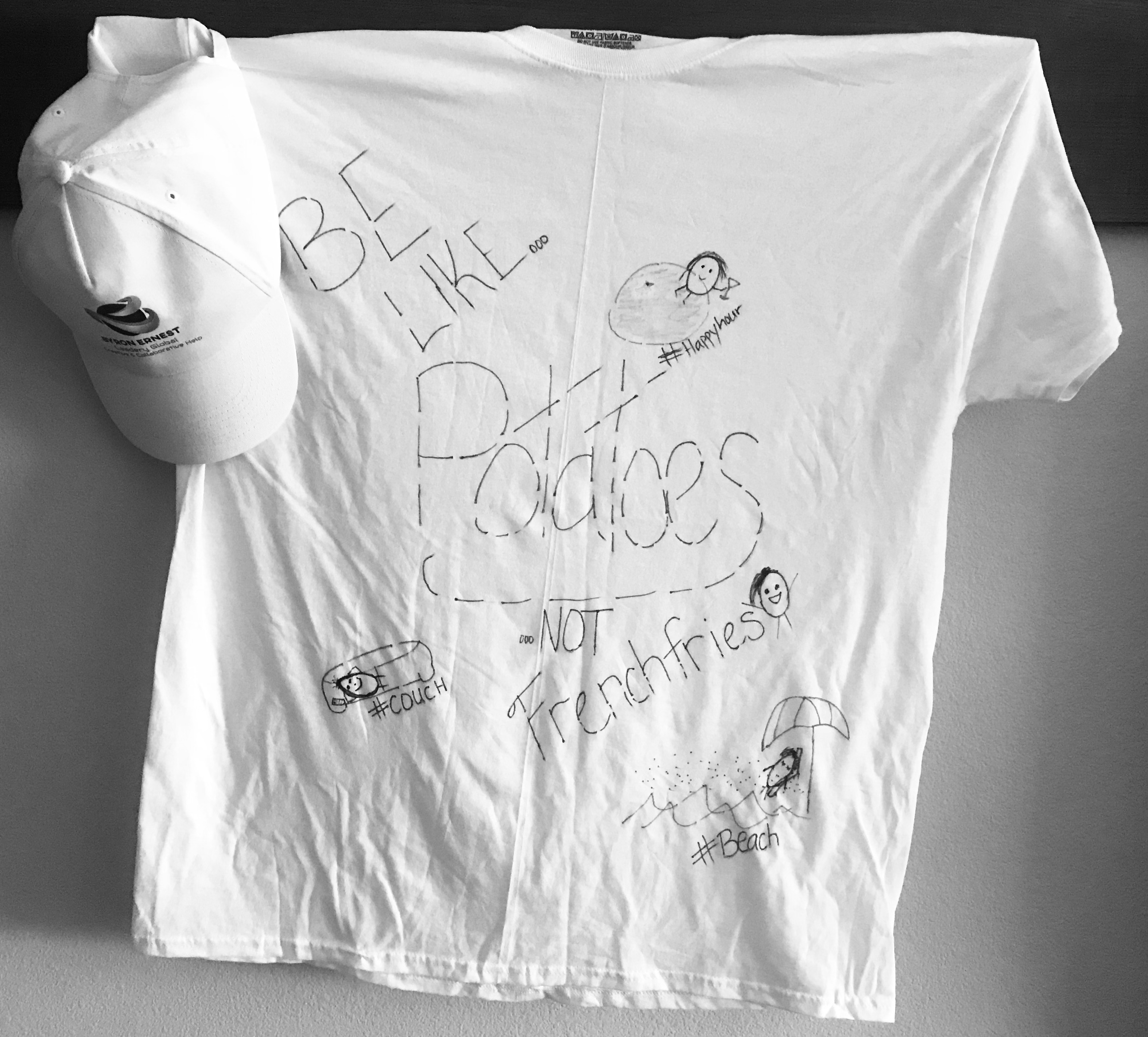
This week, a breakout group who was developing a self-care club t-shirt (see featured picture) as part of a project for a professional development I was facilitating came up with an incredible theme: “Be Like Potatoes, Not French Fries.” This was an interesting metaphor and not something I had heard before. The thought was to do everything possible to be a whole person and not processed/fried pieces. The theme was really pretty genius and I couldn’t stop thinking about it and what it meant to be a like a potato. When I studied the shirt I found it was okay to sometimes just relax and be a couch potato. Sometimes it is okay to take part in a happy hour or spend time on the beach (hard for me on a daily basis, but I was facilitating in Florida).
The point was that we don’t have to spend every moment processing and transforming every moment like becoming a French fry. To be the whole person and stay like the potato we need to make sure and schedule time for what another group called “Self Care A La Carte. Check out their list of a la carte self care items on their t-shirt:
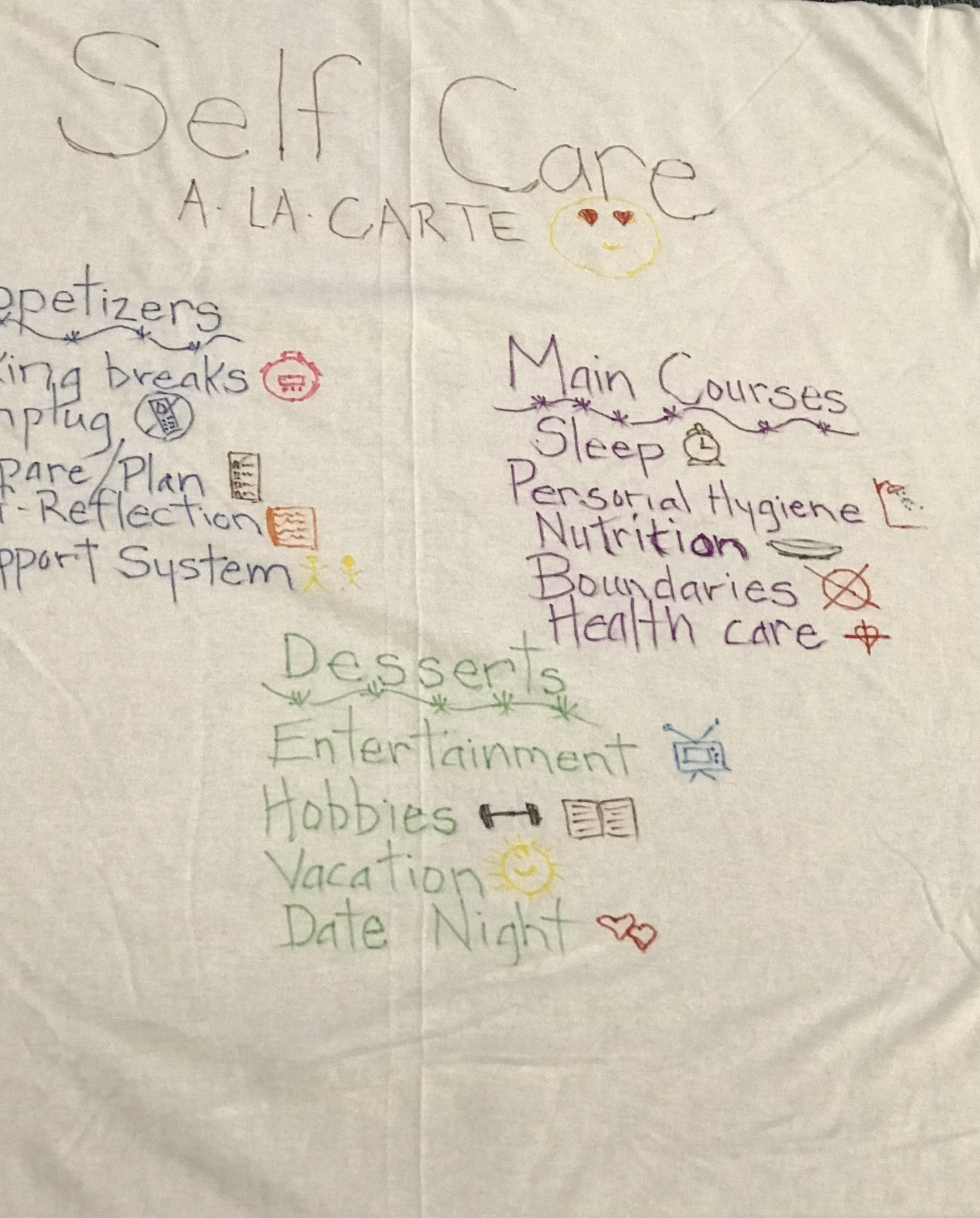
These were educators I was working with and one of the important things we discussed was the importance of focusing on self so we could effectively focus on others. As educators we provide support, how well we provide that support depends on how well we take care of ourselves. Here are some tips for having a good day:
- Get one important thing done
- Plan your perfect daily timetable
- Listen to a great music playlist (of course this should include some KISS songs)
- Go for a walk
- Leave your bad mood at home
How will you take care of yourself?
Are You Invisible?

Clayton M. Christensen said, “There is no single right answer or path forward, but there is one right way to frame the problem.” Ever since having the opportunity to meet Dr. Christensen at Harvard, I’ve been a fan of this quote because I have always advocated for teaching our scholars in ways that there is no single answer. If we want to make school work look like real work it can’t all be single right answers, because our real-life problems don’t have single right answers. I was reminded of this yesterday in a meeting when someone said, “All of these answers could be right.” Therefore, how we frame the problem is crucial.
I’ve come to believe there are very few absolute right or wrong answers when it comes to decision making. There are only the best choices given the circumstances. There are good and bad decisions based on our core values, beliefs, and morals. But, again, there are very few absolute right or wrong answers when it comes to decision making. Sometimes, this keeps people from making decisions – even ones that will affect our lives. This causes us to be invisible and miss out on creating our own story. Thus why we need to be teaching our young scholars how to be decision makers in a world of no single right answers.
How do we do this for our scholars and ourselves? Here is a pretty basic four step approach:
- Frame the problem or choice to make
- Consider all the possible choices/solutions. Consider a pro/con approach
- Do the research
- Make a decision
As adults we worry we’ll make a decision that will be judged by others as “the wrong one”. I believe this fear was developed in us because our curiosity for learning is thwarted because our main goal in school was to find the “right answers” to achieve an A on the exam. By not making decisions, stepping into our strengths, knowledge, or confidence, we, and our students, become invisible.
Give Them A Chance To Surprise You

Last night while watching Major Crimes I heard a great line from Rusty about Buzz: “The more I get to know him the more I get surprised by him.” This jumped out at me because this happens a lot and should remind us how important it is to get to know those around us. I once heard someone say, “Don’t assume a person you don’t know is just like you expect them to be! Give them a chance to surprise you!” This is so important with students. There is so much there we cannot see. We must realize that most groups, even people in “our own group,” are quite heterogeneous, and can be very different in background and beliefs.
This begs us to take care with our assumptions and always test them out. Let people explain and demonstrate who they are and what they think. I’ve often found that “enemies” are actually very similar to me in surprising ways and actually could be “friends.” At the same time “friends” turn out to not be very much like me at all. We must make an effort to get to know everyone better and give them the opportunity to surprise us.
How Do I Teach That?

I’m not sure when I had last been in an actual movie theatre before last night for Top Gun: Maverick. It had been several years, though. My son was home and the family decided we would go. Great experience. Great movie. 🎥 Great popcorn with all the butter. 🍿 It really was a great movie. It was incredibly well-made and had many great leadership and teaching lessons. There were a couple of great lines that Maverick (Tom Cruise) made in the movie that jumped out at me. The one we will explore here is:
“It’s not what I am, it’s who I am. How do I teach that?”
Pete ‘Maverick’ Mitchell to Ice
At first Maverick rejects and dismisses the idea of being a teacher. In the end his students prove him wrong. The best leaders I’ve experienced have been teachers – they have worked to help develop me or give me development experiences. The leaders who are the worst at teaching or the ones that worry that someone will exceed them are the ones that have great talent slipping through their fingers. This idea of how to teach “who you are” is one I have contemplated over and over in education. In this movie it came down to the timeline of the mission being compressed so much that it sets off a wave of despondency and doubt within the ranks. The possibility of mission success seems hopeless. Maverick proves it can be done, however, by doing it. He stretches himself almost to the breaking point to serve as an inspiration to his young recruits, who now see what’s possible.
Do you model and set an example for those you serve? These are both great strategies for teaching.
Just You Leadership

“No pretenses, no masks – just you.” ~ Randy Conley in Simple Truths of Leadership: 52 Ways To Be A Servant Leader and Build Trust, Making Common Sense Common Practice, Ken Blanchard and Randy Conley. This is the 31st week of the year and I am on Simple Truth #31: “People Admire Your Strengths, But They Respect Your Honesty Regarding Your Vulnerability.” When we allow ourselves to be seen as less than perfect, others get to really know us beyond title or position. When others see us modeling this, they are more inclined to do the same.
“I think when you’re vulnerable, people realize that you, too, are human. And, perhaps even more importantly, they love your ownership of your personal positive and negative characteristics.”
Colleen Barrett, President Emerita of Southwest Airlines
I was actually discussing this with a group of teachers last week. We were discussing how back in the day, teacher educators would tell you to never let the students know if you didn’t have/know the answer. I hope no one is still giving this terrible advice. From experience, let me assure you that showing some vulnerability with students is valuable. Some of the greatest labs we did in my agricultural science classes were ones that didn’t work. Student would say, “What happened?” I would then say, “I have no idea, but l’ll bet we can figure it out together.” We would proceed to “figuring it out” and a series of learning moments would follow. Let me tell you, Colleen Barrett, president emeritus of Southwest Airlines was right; the students loved that show of vulnerability and it made our relationship stronger. Vulnerability is very powerful when it is authentic. Are you willing to be “just you?”
 Byron's Babbles
1 comment