Being Global

My dad taught me from an early age how important it was to think globally. He understood the inherent complexity of international affairs from multiple national perspectives. He understood the economic implications and advantages of trading goods all around the world. My dad taught me that globalization was about contribution. Think about all the different contexts which we must work globally. This is very nuanced work. It’s not just about worldly knowledge and connections; it’s about contribution.
I was reminded of this and have been reflecting on my dad’s teachings as I prepare to leave for Hamburg, Germany next week to chair and speak at the 2022 SMART Factory League Summit. I’m am so excited to have the opportunity to connect, learn with, and learn from top industry and education leadership from around the world. What really got me to thinking about all this was my study of Oktoberfest. I am so excited I will be in Germany for Oktoberfest. I learned that Oktoberfest ends each year on October 3rd, which is German Unity Day that commemorates the reunification of the Federal Republic of Germany (West Germany) with the German Democratic Republic (East Germany) in 1990. Having grown up during the Cold War, this was a big deal. For this to happen there had to be great global leaders that were bridge builders.
As I have the chance to connect with old and new friends from around the world I want to remember to be a bridge builder and a connector of knowledge, resources, best practices, and talent across cultural and political boundaries. In addition I want to be a contributor. I do not take the “global” part of my company name, Leadery Global, lightly. It is my hope and sincere wish to help others continually improve around the world. And, take what I learn from others to make things better at home.
Remember To Care First

I’ve got a good friend that always says, “if your the smartest person in the room, you need different people in the room.” I always reply that I want to be the dumbest person in the room.” I believe we are saying the same thing – we want to be surrounded by creative and innovative people who have expertise in the space we are working in. in Simple Truth #35: “People Don’t Care How Much You Know Until They Know How Much You Care” in Simple Truths of Leadership: 52 Ways To Be A Servant Leader and Build Trust, Making Common Sense Common Practice, Ken Blanchard and Randy Conley, Randy reminds us, “Demonstrating care and concern for others is the quickest and easiest way to build trust” (p. 93). And, don’t forget, it must be genuine care and concern.
I was reminded of this during an elementary teacher focus group I was conducting this week as part of a strategic planning process I am facilitating for a school corporation. The teachers were very clear about the fact that their principal, “I’m supported”; “Family first, Kelli [principal] really does practice this”; “We are checked in on, Kelli cares about us”; and, “Open door policy, Kelli is accessible.” It was clear these teachers respect their principal. These we’re all great reminders that caring must come first.
Be Like Potatoes Not French Fries
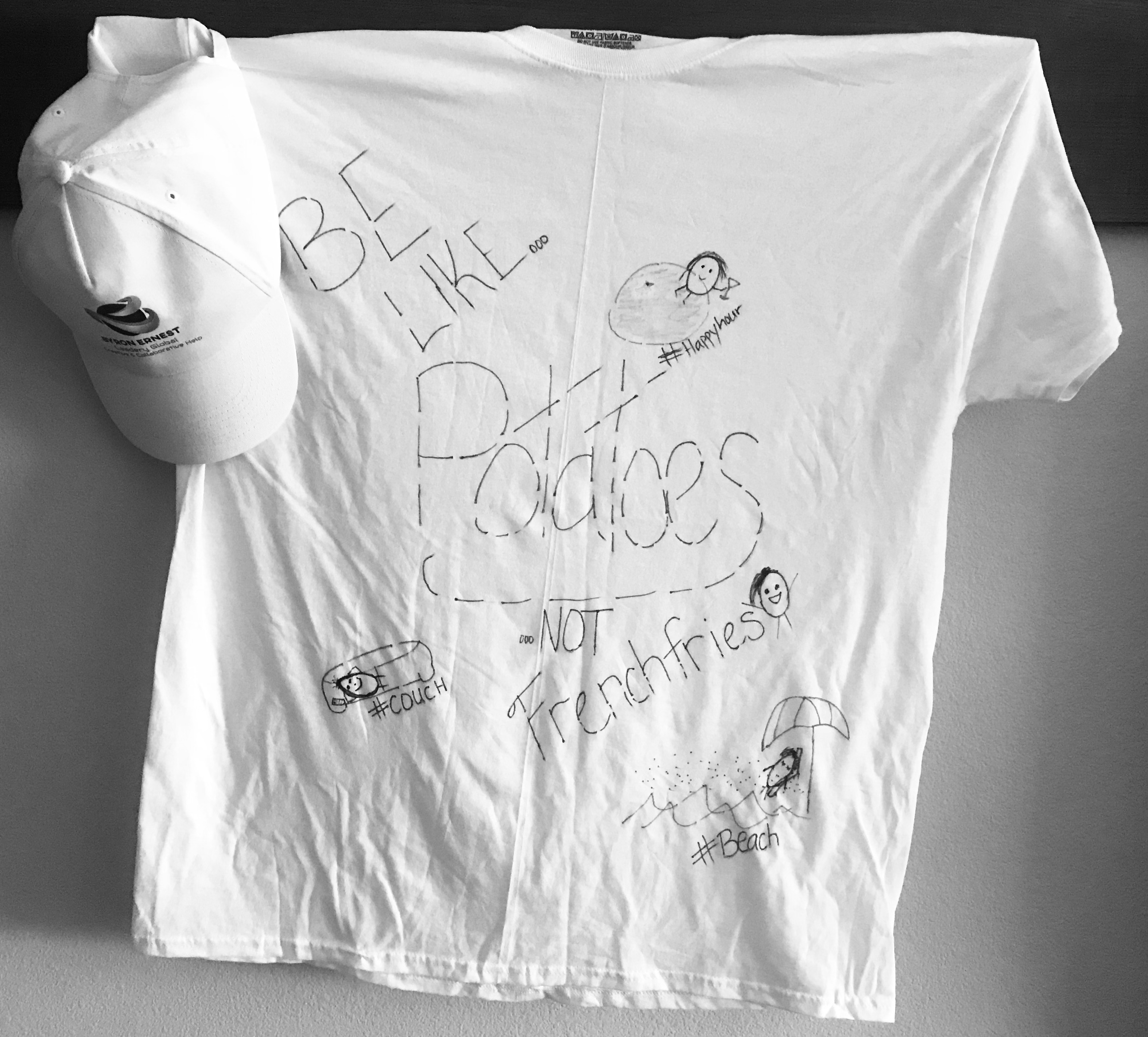
This week, a breakout group who was developing a self-care club t-shirt (see featured picture) as part of a project for a professional development I was facilitating came up with an incredible theme: “Be Like Potatoes, Not French Fries.” This was an interesting metaphor and not something I had heard before. The thought was to do everything possible to be a whole person and not processed/fried pieces. The theme was really pretty genius and I couldn’t stop thinking about it and what it meant to be a like a potato. When I studied the shirt I found it was okay to sometimes just relax and be a couch potato. Sometimes it is okay to take part in a happy hour or spend time on the beach (hard for me on a daily basis, but I was facilitating in Florida).
The point was that we don’t have to spend every moment processing and transforming every moment like becoming a French fry. To be the whole person and stay like the potato we need to make sure and schedule time for what another group called “Self Care A La Carte. Check out their list of a la carte self care items on their t-shirt:
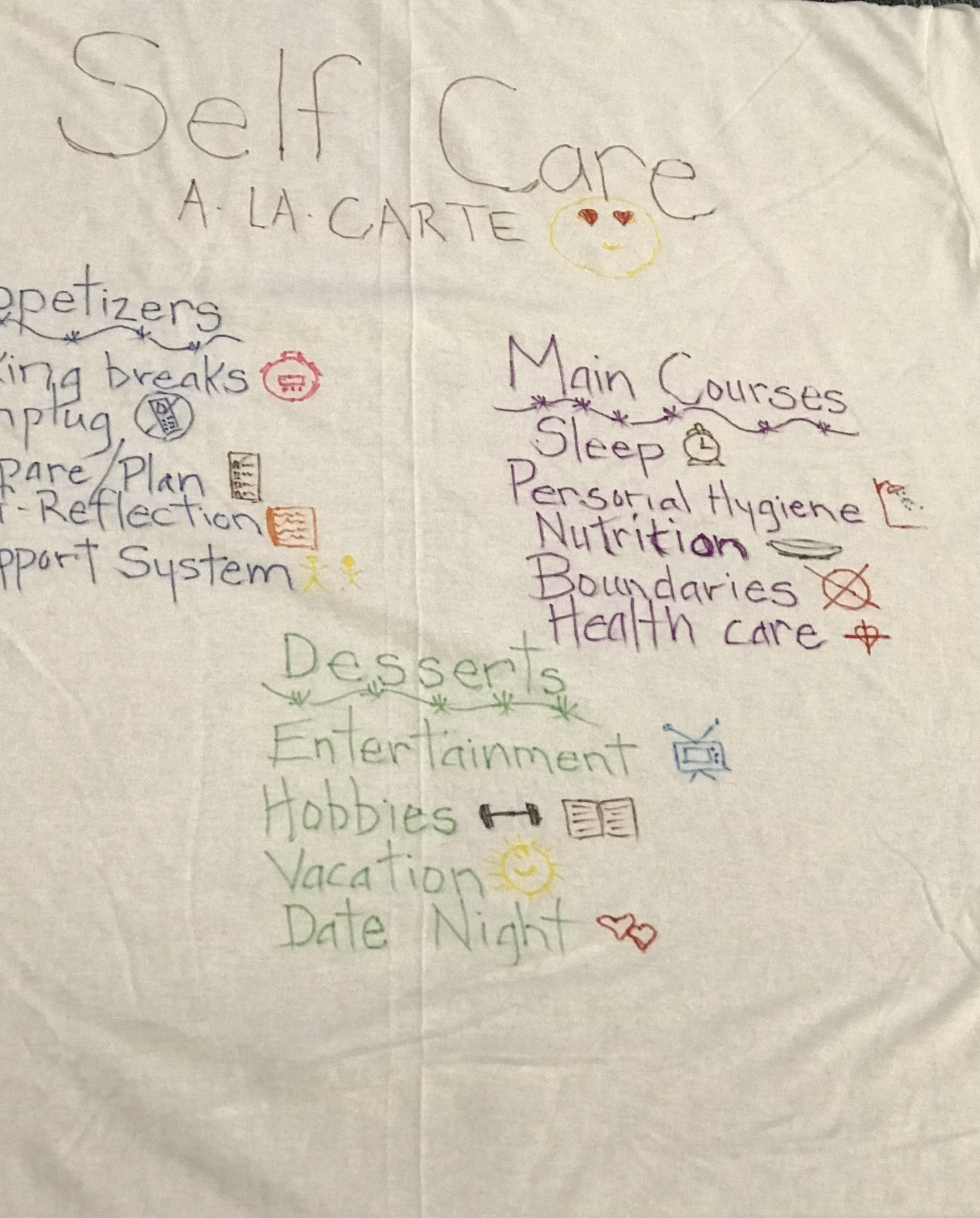
These were educators I was working with and one of the important things we discussed was the importance of focusing on self so we could effectively focus on others. As educators we provide support, how well we provide that support depends on how well we take care of ourselves. Here are some tips for having a good day:
- Get one important thing done
- Plan your perfect daily timetable
- Listen to a great music playlist (of course this should include some KISS songs)
- Go for a walk
- Leave your bad mood at home
How will you take care of yourself?
Are You Invisible?

Clayton M. Christensen said, “There is no single right answer or path forward, but there is one right way to frame the problem.” Ever since having the opportunity to meet Dr. Christensen at Harvard, I’ve been a fan of this quote because I have always advocated for teaching our scholars in ways that there is no single answer. If we want to make school work look like real work it can’t all be single right answers, because our real-life problems don’t have single right answers. I was reminded of this yesterday in a meeting when someone said, “All of these answers could be right.” Therefore, how we frame the problem is crucial.
I’ve come to believe there are very few absolute right or wrong answers when it comes to decision making. There are only the best choices given the circumstances. There are good and bad decisions based on our core values, beliefs, and morals. But, again, there are very few absolute right or wrong answers when it comes to decision making. Sometimes, this keeps people from making decisions – even ones that will affect our lives. This causes us to be invisible and miss out on creating our own story. Thus why we need to be teaching our young scholars how to be decision makers in a world of no single right answers.
How do we do this for our scholars and ourselves? Here is a pretty basic four step approach:
- Frame the problem or choice to make
- Consider all the possible choices/solutions. Consider a pro/con approach
- Do the research
- Make a decision
As adults we worry we’ll make a decision that will be judged by others as “the wrong one”. I believe this fear was developed in us because our curiosity for learning is thwarted because our main goal in school was to find the “right answers” to achieve an A on the exam. By not making decisions, stepping into our strengths, knowledge, or confidence, we, and our students, become invisible.
Give Them A Chance To Surprise You

Last night while watching Major Crimes I heard a great line from Rusty about Buzz: “The more I get to know him the more I get surprised by him.” This jumped out at me because this happens a lot and should remind us how important it is to get to know those around us. I once heard someone say, “Don’t assume a person you don’t know is just like you expect them to be! Give them a chance to surprise you!” This is so important with students. There is so much there we cannot see. We must realize that most groups, even people in “our own group,” are quite heterogeneous, and can be very different in background and beliefs.
This begs us to take care with our assumptions and always test them out. Let people explain and demonstrate who they are and what they think. I’ve often found that “enemies” are actually very similar to me in surprising ways and actually could be “friends.” At the same time “friends” turn out to not be very much like me at all. We must make an effort to get to know everyone better and give them the opportunity to surprise us.
How Do I Teach That?

I’m not sure when I had last been in an actual movie theatre before last night for Top Gun: Maverick. It had been several years, though. My son was home and the family decided we would go. Great experience. Great movie. 🎥 Great popcorn with all the butter. 🍿 It really was a great movie. It was incredibly well-made and had many great leadership and teaching lessons. There were a couple of great lines that Maverick (Tom Cruise) made in the movie that jumped out at me. The one we will explore here is:
“It’s not what I am, it’s who I am. How do I teach that?”
Pete ‘Maverick’ Mitchell to Ice
At first Maverick rejects and dismisses the idea of being a teacher. In the end his students prove him wrong. The best leaders I’ve experienced have been teachers – they have worked to help develop me or give me development experiences. The leaders who are the worst at teaching or the ones that worry that someone will exceed them are the ones that have great talent slipping through their fingers. This idea of how to teach “who you are” is one I have contemplated over and over in education. In this movie it came down to the timeline of the mission being compressed so much that it sets off a wave of despondency and doubt within the ranks. The possibility of mission success seems hopeless. Maverick proves it can be done, however, by doing it. He stretches himself almost to the breaking point to serve as an inspiration to his young recruits, who now see what’s possible.
Do you model and set an example for those you serve? These are both great strategies for teaching.
Just You Leadership

“No pretenses, no masks – just you.” ~ Randy Conley in Simple Truths of Leadership: 52 Ways To Be A Servant Leader and Build Trust, Making Common Sense Common Practice, Ken Blanchard and Randy Conley. This is the 31st week of the year and I am on Simple Truth #31: “People Admire Your Strengths, But They Respect Your Honesty Regarding Your Vulnerability.” When we allow ourselves to be seen as less than perfect, others get to really know us beyond title or position. When others see us modeling this, they are more inclined to do the same.
“I think when you’re vulnerable, people realize that you, too, are human. And, perhaps even more importantly, they love your ownership of your personal positive and negative characteristics.”
Colleen Barrett, President Emerita of Southwest Airlines
I was actually discussing this with a group of teachers last week. We were discussing how back in the day, teacher educators would tell you to never let the students know if you didn’t have/know the answer. I hope no one is still giving this terrible advice. From experience, let me assure you that showing some vulnerability with students is valuable. Some of the greatest labs we did in my agricultural science classes were ones that didn’t work. Student would say, “What happened?” I would then say, “I have no idea, but l’ll bet we can figure it out together.” We would proceed to “figuring it out” and a series of learning moments would follow. Let me tell you, Colleen Barrett, president emeritus of Southwest Airlines was right; the students loved that show of vulnerability and it made our relationship stronger. Vulnerability is very powerful when it is authentic. Are you willing to be “just you?”
Critical Improvisations

As I re-read Ron Chernow’s great autobiography Grant I keep picking up things to reflect on that I didn’t catch the first time through. I already did one such reflection in Respecting and Watching With Reverence. Yesterday while reading Chernow described the campaigns of the rebellion to take control of eastern Tennessee, specifically in Chattanooga. Much credit for success was given to “critical improvisations” and “extemporaneous routing of the enemy.” As a intent-based leadership advocate, I loved these terms. The soldiers saw opportunities that would lead to success and they took them even though they were not exactly part of the original plans. The great organizations develop every person to be ready for critical improvisation and extemporaneous routes. For example, one of the skills I developed early as a teacher was the ability to improvise during lessons according to student questions and discussions. This allowed me to make extemporaneous routes for true differentiation. Did you catch that play on words I just did? I believe I still do this while facilitating to this day. I believe this is one of the most important skills we need to be developing in education. And, educators need to feel comfortable and encouraged to make critical improvisations each and every day. The data is created with the teachers and students and that is where decisions should be made.
In any organization, our environment may change hundreds of times in a single day. This improvisation and extemporaneous routing becomes understanding the nuances of each of the new or changing environments and how those changes will impact on our ability to perform optimally and effectively. Practicing improvisational techniques allow us to quickly analyze changing environmental conditions and communicate quickly and effectively within them. In improv classes we are taught the “yes and” technique. Basically, we take what we are given and develop it further. It’s about accepting a nuanced environment and changes quickly and looking for opportunities immediately. We also have to create an environment where seeking solutions is accepted.
As leaders we need to model and reward positive and risk-taking and adaptation, the faster the organization can read the nuances and improvise. After the successful Chattanooga campaign Grant asked who had ordered the charge up the mountain against soldiers who appeared to be falling back. All officers said it had not been them. Those in the field read the opportunity and acted. Grant was proud of them. Some (well actually a lot of leaders I’ve encountered would have been upset), but not Grant. He needed every soldier to be a leader. If Grant were leading today, I don’t think he would need an email asking for permission and copied to 10 other people on every issue. Unfortunately, you all reading this know the leaders I’m talking about – I hope you’ve not experienced it, but I bet you have.
Make no mistake, however, for successful critical improvisations to happen EVERYONE in the organization must have the technical skill training and development. Otherwise it will be chaos. Grant was a stickler for drilling and training. Also, there need to be clear goals with plans that allow for agility. Then, and only then, we can allow everyone to use their talent and goal focus to seize opportunities of the moment and carry out critical improvisations and extemporaneous routes.
Subtracting Shows Competence
Last year I read the great book Subtract: The Untapped Science Of Less by Leidy Klotz and described the book as changing my life. Learning from the book also ends up in many of my blog posts, like Don’t Always Saticfice. Last evening I had the honor of facilitating a discussion between Leidy Klotz and National Teacher Ambassadors of the National FFA Organization. As part of their training, the teacher ambassadors received a copy of the book and Leidy was gracious enough to spend time with the group. Leidy spent some time discussing what led to the research and ultimately the book, which was fascinating, and then had a very open discussion with our teachers.
One of the points Leidy made last night, that I have heard him make before is that, “Subtracting shows competence.” We all need to reflect on this. Whether as a school principal, we show competence to remove the things teachers have to do that don’t really have anything to do with student learning, or myself as a policymaker continuing to advocate for reducing the number of standards having to be taught/tested. Or, just the competence it takes to reduce that email from four paragraphs, which by the way no one reads, to a couple of sentences. I’m sure you can think of thousands of other examples.

Leidy taught us not to focus on what we can’t get done and want/need to subtract, but focus on what we will be able to do better because of eliminating those mundane tasks that create marginal value at best. Those of us in education can really relate to this. It’s not easy. As Leidy pointed out, adding more is highly visible and easy to promote and subtracting either goes unnoticed or becomes controversial. I loved this advice from Leidy: “Give yourself a definition for what you are setting out to accomplish. This will help narrow down the necessary from the unnecessary.” Dr. Klotz’s job is to create and share knowledge and he did a great job of schooling us on subtracting.
Linked Lives

You all know I am a very reflective person. Holidays always seem to become days of reflection for me. On this Fourth if July holiday I am reflecting about my son growing up, our relationship changing from dad and lad to dad and man, and whether my dad knew how great a job he did for prepping me for life and how much I appreciated it. Circumstances have allowed me to get to be at my son’s house in Madisonville, Kentucky near where he is interning for Cal-Maine Foods, every weekend for the past five weekends in a row. Dream come true, because I love spending time with the boy, now man. I make a point of saying, man now, because he is just that. And what’s more the father-son links are now converting to an adult relationship and I am loving every minute of it. Everyone who knows me knows how close Heath and I are. I’m always in a funk for a couple of days after spending time with him.
Last weekend I had the chance to meet my son’s boss and have a great conversation. In the course of the conversation he gave me one of the greatest compliments a dad could hear. He said that he could tell how close Heath and I were and that I had not left raising him and giving him the experiences necessary to succeed in life to anyone else. He said, “All the responsibility you gave him and the modeling you did for him on the farm growing up has prepared him for this moment and his life’s work (I just teared up repeating that). I quickly deferred much of the credit to Hope, my wife and Heath’s mother, but then was very thankful that he recognized that. When Heath was born, I made a commitment that I was going to spend every moment I could with him – and I did. I had watched other people leave much of this responsibility to grandparents or hired people and I just wasn’t going to do that. I know some very wealthy and allegedly successful people who never really got to know their kids. Sad! I am so blessed to have taken Heath on so many FFA trips with me and all the time we spent working side-by-side here on the farm. Some said it was too early to have him in Washington D.C. at six months old or out helping me with horses and livestock from the time he could walk, but the research would now suggest I was on to something. My goal was to have had him in all 50 states by the time he graduated high school. We did not quite make that goal but have made it to 46 and Canada twice. This year is his senior year in college, so I have a year to get him to Utah, Idaho, New Mexico, and Alaska before he graduates from college.

Please do not take this post as a criticism of others’ parenting because it is not meant to be. It is meant to highlight the concept of “linked lives” introduced in Parent Nation: Unlocking Every Child’s Potential, Fulfilling Society’s Promise by Dr. Dana Suskind. All members of the National Association of State Boards of Education (NASBE) were given the opportunity to receive a copy of the book. So glad I got my copy! I am reading the book right now and have been inspired, as a policymaker and education leader, to want to shepherd and cheerlead the concepts introduced in the book. For example, I was recently told that some schools no longer allow their agriculture teachers to take their own children on trips. This would have seriously limited my time with Heath. At a time when teachers a seriously exploring alternative career options, shouldn’t we be finding (exploring) ways to help our teachers stay linked to their own children? In the book Dr. Suskind said, “The lives of children and parents are intertwined” (p. 139). As a policy-maker I recommit to doing all I can to create environments where parents can be all they can be. I hear parents say they appreciated the extra quality time that they had during the pandemic. Let’s learn from this and find creative/flexible ways to help.
Also, we need to think both quantity and quality. More time with our kids is great, period. So that is a start, but quality of that time really thinking about brain development is also critical. I think back to my own upbringing by two of the greatest parents of all times. I was linked to their lives. Dr. Suskind also said, “The experiences we have in childhood, as mediated by our parents, will be reflected in much of what happens years later” (p. 139). At my mom’s passing I blogged about our link in Leadership Lessons From My Mom and I am reflecting on my dad this morning and all he did to prepare me for all the moments I have been blessed with; including raising an incredible lad turned man. My dad passed away when I was 25. My hope on this holiday morning is that he knew the great job he had done at linking our lives.


leave a comment