Where Do We Put The First Brick?
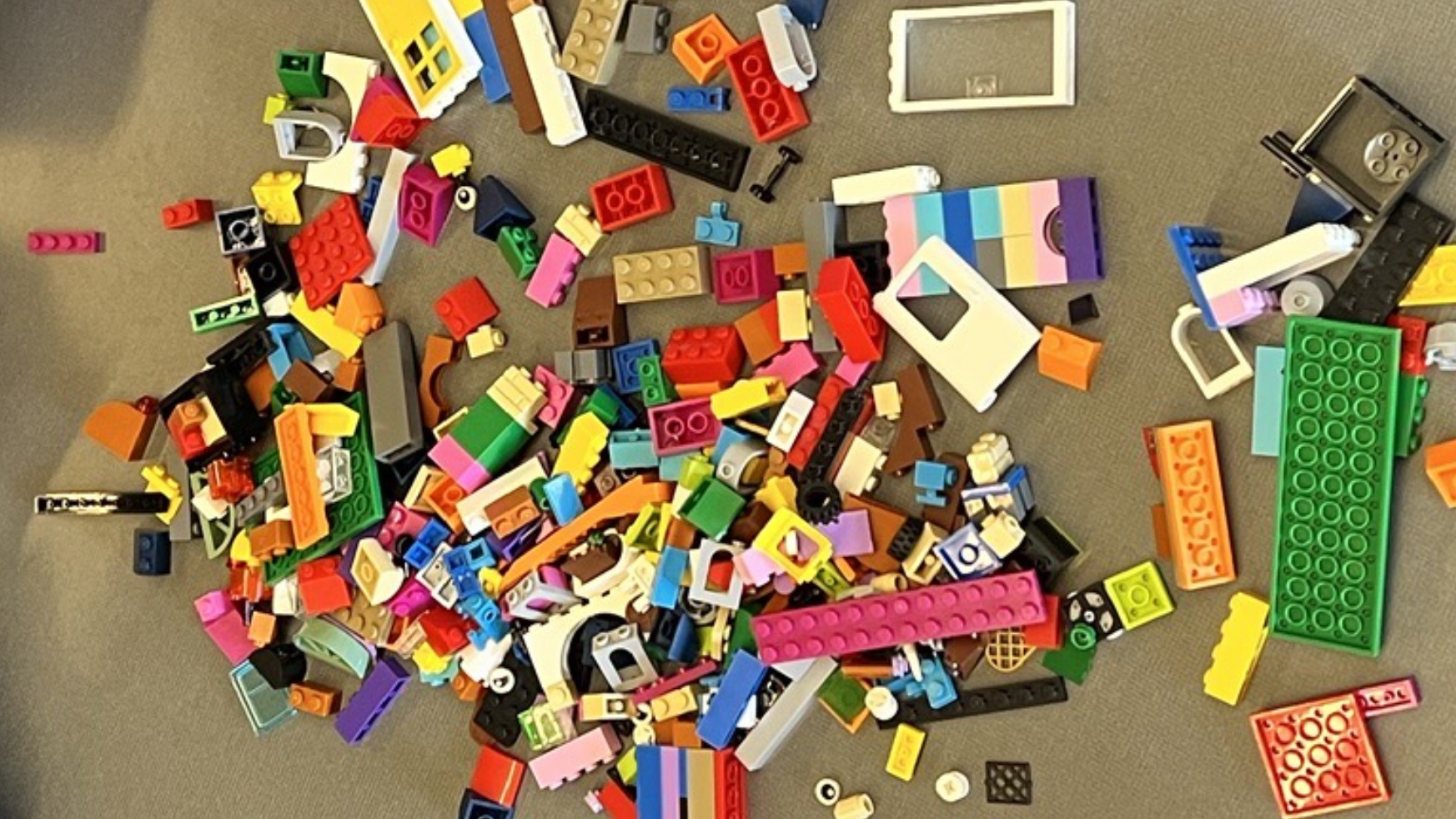
During our final session of the National Association of State Boards of Education (NASBE) 2022 Legislative Conference, Scott Palmer of the Education Counsel, told the story that his grandfather said he could build a bridge if someone told him where to place the first brick. Then, he asked the panel he was moderating to tell where they would place the first brick as we continue recovery from COVID and redesign education. For me, this is about stopping the throwing of bricks at each other. Let’s have the difficult conversations and get it figured out for our scholars.
We all need to be rethinking what the opportunity to learn means. My first metaphorical brick, however, is that we need to find every child. Now, in our 514th day of the Global Pandemic, we have many students that have become anonymous. We need to find every child and make sure we are giving them the opportunity to learn. Then we need to take an integrated systems approach to:
- integrate all outside experiences the scholars have.
- we need to rethink the time and place of learning.
- we need to consider the time and place of learning.
- we need to consider the different paradigms for opportunities to learn.
- we need to provide critical experiences for all our students.
- we need to take into account the ecology of a young person’s experiences;
- all the adults that students experience and interact with.
- the other students in their lives.
- the extracurricular and other activities outside the traditional school day.
I continue to say that school is no longer just a place. We need to shift the system to meet the needs of every kid, not have the kids shift to meet the needs of the system.
I’ll leave you with this thought: Whatever we want to be true for our students has to be true for their teachers, including experiencing safety, belonging, and purpose in the community of school.
What Is The Point Of A Theory?

Recently, I heard someone say, “What is the point of a theory if no one is going to test it.” It was a great point because that is the point of a theory. A theory is a special language that explains and helps us understand some phenomenon, for example, learning, motivation, or administration (Tosi, 2009). The major function of a theory is to describe and explain – in fact, theory is a general explanation, which often leads to basic principles. This has really got me to thinking that so many times we leave the important part of creating a theory when trying to solve some issue. It is why developing a theory of action is so important.
I love the idea of heuristic learning and strive to create environments in my work facilitating professional development for that kind of learning to occur. Heuristic learning is the ability to discover for oneself while doing something. Therefore, a theory is heuristic because it stimulates and guides the further development of knowledge. We all use theories to guide our actions. Some are implicit, and others are explicit; in fact, many of our personal implicit theories are formal ones that have been internalized Hoy & Adams 2016). I believe that if we want coherence and accountability we must start with a theory of action and then test it. We can start by asking, “What is the challenge you are trying to solve?”
REFERENCES
Tosi, H.L. (2009). Theories of organization. Thousand Oaks, CA: Sage.
Hoy W. K. & Adams C. M. (2016). Quantitative Research in Education – A Primer. Thousand Oaks, CA: Sage.
Challenging Assumptions With Lateral Thinking
In the great book The Martian, Andy Weir uses the term “lateral thinking” to describe what NASA was doing a lot of to keep astronaut Mark Watney alive and bring him home from Mars. It won’t surprise anyone who knows me that I love lateral thinking. Lateral thinking is a tool used worldwide, knowingly/unknowingly by many individuals for a creative output/product. Psychologist Dr. Edward de Bono originated the term lateral thinking and is a proponent of the teaching of thinking as a subject in schools. Imagine that – teaching students to think. Lateral thinking processes provide guidance for thinking out of the box, thinking and creating something that has never been thought of. Just what was needed for Mark Watney’s success return to home in the novel and the real life return home of Apollo 13.
” Intelligence is something we are born with. Thinking is a skill that must be learned.”
~ Dr. Edward de Bono
Lateral thinking looks at things from a sideways perspective in order to find answers that aren’t immediately apparent. In other words, being able to think creatively or “outside the box” in order to solve a problem. Lateral thinking is very situational. Lateral thinking leads to changes in attitude and approach; to looking in a different way at things which have always been looked at in the same way. Liberation from old ideas and the stimulation of new ones are twin aspects of lateral thinking.
With lateral thinking we challenge assumptions and generate alternatives – what many call “out of the box thinking.” I didn’t even know there was a box! This is why I am such a believer in using real world and relevant contexts when facilitating learning. Notice I didn’t say teaching. When students are in a productive struggle working out a real world problem or issue, they are learning to learn and think and be creative. Whether we serve adults or young scholars we need facilitate learning that hones their ability to develop original answers to difficult questions. Why is this so important? Because in our world today, traditional solutions are unlikely to get the desired result. We all remember that failure was not an option on Apollo 13. How was failure averted? The “voyage and return” lateral thinking.
Discretion
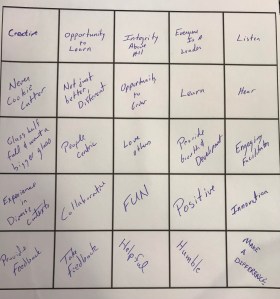
I did a Bingo card strengths/talents/values activity during a leadership development gathering this week with the great leaders I get to work with at Hamilton Heights School Corporation focused on building highly effective teams. The focus was on both being a great team member as well as being a great team leader. Filling out the Bingo card starts as an individual activity, but also has some time allowed for discussing getting to exactly the right words and helping each other find the right words. I always do this activity right along with the groups and my Bingo card is the featured photo of this post. This group was really into getting the right words to describe their strengths, talents, skills and values. This group’s discussion inspired me to think deeper about those traits as well.

It always seems that in the days after doing this activity I come across an intriguing word that I would maybe like to add. Today, while reading the incredible book The Body Scout by Lincoln Michel I read the line, “Do you know what the most important trait we look for in a great baseball scout? Discretion!” I have paraphrased a little here, but discretion is an interesting trait. Check out the definition:

I love the dual definition that discretion has. Discretion is something we should have as a great leader and team member. And, it is something we should give as a great leader. It is so important for us to use discretion when working with others. Great leaders are required to extensively exercise discretion to address the issues they face. Discretion must be used in the current context. Discretion is a behavior that involves using our core values. The sniff test I use is asking the question, “Is this my story to tell?” Guess what? Most of the time it is not. That helps me use discretion.
Additionally, as a leader whose mantra is “make it so” we must be ready to give discretion to those we serve. That also means we must have those we serve developed with the technical skills to effectively use that discretion. This really made me think about those times when I’ve been told, “Byron, use your discretion.” I don’t know about you, but that makes me feel really good! Think about how that makes others feel when you say it. As a teacher, it also gave my students incredible agency, gave them tremendous empowerment, and engaged them.
So, I encourage you to use discretion! It really is an important trait. But remember, great leaders do not use their discretionary freedom for personal rather than organizational benefit. With discretion comes the ‘do the right thing’ distinction and we must be aware of the importance of choice and vision. At the same time once a choice is made it’s critical that ‘things are done well’. In other words, the choice made is executed well, and others on the team are given discretion, thus engaging everyone in the delivery.
Serving Instead Of Putting On A Show

So, let’s see here; if we are constantly looking up to make sure our boss is seeing and approving of us or bragging about what we’ve done, we’re probably paying less attention to the people we’re now leading or worse yet, our customers. If your organization follows a traditional hierarchy, which most unfortunately still seem too, attention will naturally shift up — be directed up the hierarchy. Ever been a part of an organization where there always seem to be the favorites, you must make sure those high on the hierarchy are hearing every great thing you do, or having to make sure you’ve bragged on those high on the hierarchy? It’s not a good place to be.
In Simple Truth #3, Servant Leaders Turn The Traditional Pyramid Upside Down, in Simple Truths of Leadership: 52 Ways To Be A Servant Leader and Build Trust, Making Common Sense Common Practice we are told by Ken Blanchard and Randy Conley that great leaders turn the hierarchy over and make those closest to the customer the top of the organizational pyramid. For example, in a school, this would put the teachers at the top of the pyramid. In this model, the principal serves the teachers. Let me tell you from experience, this works. What this ultimately does is place the customer (in my example, the student) at the top of our organizations. This really shifts us to an intent-based leadership model where everyone is a leader. Then, everyone is serving.
Turning Talk Into Reality
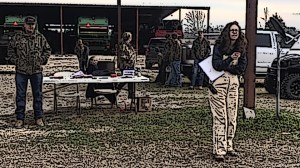
To go from talk to action is a journey. We better support ourselves and others when we understand what the journey to proficient implementation really entails. Yesterday my son and I were in Screven County, Georgia for an annual event with the Screven County FFA. Last June I had told the agriculture teacher and National FFA Ambassador, Nancy Sell, that I wanted to be a part of the event. We walked the talk and made it happen. Once I got clarity about the exact date, what else would be going on at that time, et cetera, et cetera, et cetera; I was able to say, “Yes, I’ll be there.” Then, there was no backing out. If YOU SAY IT, DO IT! As someone commented yesterday, “We turned the talk into reality.”
How many times do we hear people say, “I’ll be there.” Then, they won’t be, and you knew all along they would not be. Or, even worse, “I’ll take care of this and __________will happen.” Then when it doesn’t you get the, “I’m sorry, so and so said we can’t do that” “Or, I didn’t know…” This really is a case of faking it. Or worse yet, lying. Michael Fullan (2001) called this “false clarity.” False clarity occurs when change is interpreted in an oversimplified way; that is, the proposed change has more to it than people perceive or realize” (p. 77). The problem with false clarity is we know less than we think we do. We can relate this to walking the talk or turning talk into change/action. So many times leaders see talking as doing. The real work begins when the talking ends. Successful teams make decisions that impact behaviors and produce visible results.
Bottom-line here is that successful leaders move through talk to action!
Fullan, M. (2001). The meaning of educational change (3rd ed.). New York: Penguin Group.
The View From The Bottom Of The Tree
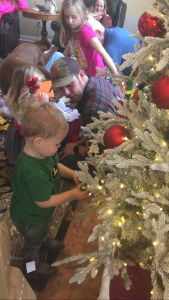
This is one of those blog posts that has taken me a little time to put together. I could have taken it in so many different directions and there were so many rabbit holes to go down. And, I’ve actually gone down a few of them here. But, the picture (featured in this post) of my niece’s son, Brooks, says it all and makes my point. My mother-in-law gave him a Christmas ornament for his birthday and he immediately got up, went to the Christmas tree and put it on. As I looked at the tree, most of the ornaments were around the bottom of the tree. Why? Because Brooks is two and doesn’t have a very high reach yet. I’ve watched trees being allegedly decorated by children only to have the ornaments moved by the parent, with phrases like “that would go better here,” “there’s too many on that limb,” “we need more at the top,” or “I’ll do that one so it doesn’t break.” What? Are we having a family Christmas memory generating activity or trying to win a decorating contest? And, oh by the way, none of those moves by the parent are informed by research. I googled it – nothing!
When we don’t let the ornaments be put where the child can reach and in her/his mind wants them to go, we are reinforcing the old binary model of one right answer and one wrong answer. Who is to say that the next great decorating craze might not be all the ornaments on the bottom two foot of the tree? Isn’t that the way great things happen? Some creative non-conformist said, “let’s try this instead?” If we want our young scholars to be creative we need to, well, let them be creative! I know, novel idea right? But, think about all the times this does not happen. And, come on, the sun will come up tomorrow if all the ornaments are on one limb. We give tests with questions that only have a right and wrong answer. I get that 4×1 and 2×2 always need to equal four (I think), but what about all the times in life that we have to choose the best out of three or four options?

Here’s another thing. We pesky adults trim the tree and cross the task off the holiday to-do list, but children view the Christmas tree as a modern day living art installation. If you watch children, they will walk by the tree and move an ornament of two. My son used to take ornaments off and then a day later put them back on. I love the iterative nature of this. I get that if you are entering a Christmas tree decorating contest that at some point it needs to be done. Also, I feel very sorry for you being so vain to enter in a Christmas tree decorating contest! But I’ve digressed! Toddlers and young children apparently have very flexible ideas as to what constitutes proper tree decor, and I can’t say I blame them. Think about the person who went wild one day and put cheese on a hamburger – voilà: the cheeseburger is born. Or, my favorite, from my hero, Thomas Edison, “I wonder if we could light the world with a little bulb run by electricity?”
Letting the kids decorate the Christmas tree is an incredible exercise and lesson to us adults in letting go of the fantasies about how the holiday decoration should look and allowing for how they CAN look. It is about living in the here and reality of now. We may not get the Christmas card-inspired tree, but honestly I love a good tree inspired by children. They are an honest reflection of our families. Don’t forget the Christmas tree in A Charlie Brown Christmas.
History’s Experiments

One of the great books I am reading right now is The Epigenetics Revolution by Nessa Carey. As an animal science guy, I have been fascinated with epigenetics for a long time. In fact, when I was teaching I had a grant project with Purdue University that included epigenetics. One of the lines in the book that really jumped out at me was, “History creates experiments.” This is so true. The book talked about research using birthweight, growth, and maturity patterns following a famine. Other fascinating research is also cited in the book. I just can’t get past this thought, however, of history creating experiments. That is really what history is.
This is why one of my favorite authors, Robert A. Caro told us that we should be reading biographies in order to learn from others. In many ways, what others have done before us were experiments. In fact my own country of the United States is often referred to as an experiment. It is so important to look at all aspects of our history in order to learn for the future.
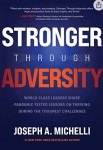
Another one of my favorite authors, good friend, and just great person, Dr. Joseph Michelli used how leaders led during the onset of the global pandemic as a way to learn about leading in a crisis. His outstanding book, Stronger Through Adversity: World-Class Leaders Share Pandemic-Tested Lessons On Thriving During The Toughest Challenges is in the running for my top non fiction book of the year. Really, all of his books are about history’s experiments in entrepreneurial leadership. You should check out his work – I love it! His work always reminds me how important it is for us to come together as a global community and be learning from each other.
I wonder how many experiments history has created that we have not taken the time or even thought to do the research on. It’s really about using that outer loop in double loop learning – evaluating the learning, creating and sharing the knowledge, and building capacity. Thanks Nessa, Robert, and Joseph for reminding us that “history creates experiments” and the data set to learn from.
Only The Wearer Knows
I love the work of Beverly Kaye and Sharon Jordan-Evans. In the sixth edition of Love ‘Em Or Lose ‘Em they taught us to “Ask so you don’t have to guess.” I quote them on this in my leadership development work all the time. I had a participant in one of my programs this week say, “Byron, that is one of the simplest, yet extremely profound things you have shared.” She went on, “Now, anytime I catch myself even beginning to guess, I just ask.” This and other things going on right now, particularly in the world of our teachers, makes me worried we just aren’t doing the simple things.
I had another teacher say, “Byron it was huge that you put your hand on my shoulder and said, “How are you really doing?” She continued, “It was huge to be asked that by someone who I knew really did care what the answer was and would try to help if he could.” Then she finished with, “Ive not been asked anything like that in over two years.” Wow! Once again, we need to make sure we are doing the simple things. But really these are not simple things they are huge things that don’t cost anything to do. But (another but here) we have to be willing to act on what we hear.
We need to be asking because as Robert A. Heinlein wrote in Stranger In A Strange Land, “Only the wearer knows where the shoe pinches.” We need to remember to ask because sometimes all we have is cognitive empathy – we only have the ability to understand another person’s perspective. If we’ve not been directly afflicted by the same source of pain or unhappiness we can’t truly truly understand the needs of the person experiencing it. Therefore, we need to ask what the person needs, not guess. Why? Because only the person involved in something can identify the source of some trouble or associated stress.
I know that sometimes it is hard for us to ask or for the affected person to tell us, but this brings up the linchpin to all of this – relationships. It’s amazing that in every discussion about great leaders and those that have had a profound influence on is that relationship building always comes up. If we have the relationship we can then ask like T.C. did to Rick in the latest episode of Magnum P.I. when he said, “Can I ask how you’re doing?” That shows a real desire to understand where the wearer’s shoe is pinching.
Being Thankful AND Proud

Showing our children we are proud of them is very important. Additionally, teaching them to be humble and modest about accomplishment is critical to their development as well. This is a really difficult dichotomy in philosophy. Character trait development gets tricky. I’m not here saying I know the perfect balance and right approach to appropriate praise and appropriate expressions of pride in a child’s efforts and accomplishments, but I’m here saying that we have an obligation to do it and learn to do it right.
Yesterday I had the opportunity to do some practicing. We started a new chapter in how to spend Thanksgiving. My son couldn’t make it home from college due to responsibilities there and so we made the trip down to Murray, Kentucky (he goes to Murray State University) on Wednesday. Then yesterday morning the other hour and a half to Jackson, Tennessee and spent the day with his girlfriend’s (we still call them girlfriends, right?) family. It was an incredible day and I could make that a tradition each year, but let’s not get in a rut yet. It may just be the excitement that in an hour my son and I will be on Kentucky Lake fishing. You all can have your shopping today – we’ll be fishing.
Anyway, one of the things Heath’s girlfriend’s family does before Thanksgiving lunch/dinner (2:00pm CT) was go around and tell one thing you are proud of your kids for. Genius! Mine: I love that Heath has been able to become a part of another family so easily and fit in. He brings his own cultural pieces to the puzzle but has been able to learn and understand his girlfriend’s family cultural puzzle and made his own pieces fit by understanding and respecting theirs. That’s how we raised him to be – global. We might just have got that accomplished. And, with Heath in the world it’s going to be a little bit better place. We’re proud of him!
So, don’t just be thankful, be proud. And, do the balancing act to show it!
 Byron's Babbles
leave a comment