Community Is The Culture
 This past week I had the opportunity with Mike Fleisch to do a design sprint (what others would call a workshop) on our school’s Focused Leader Academy. During our design sprint we built models together of what a community would look like where there is a serious commitment to developing leaders. I told the design sprint participants that I now described what we were doing as community building, not culture building. Culture emerges from the past values we develop together. I would rather us live in the context of the world we live in now and, more importantly, how do we want the world to be. With this worldview in mind, we wanted the group think about what a community of people in a school could create together.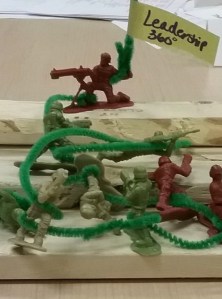
Daniel Goleman said “Executives who can effectively focus on others emerge as natural leaders regardless of organizational or social rank.” These leaders are the ones who find common ground, whose opinions carry the most weight, and with whom other people want to work.They emerge as natural leaders regardless of organizational or social rank. As leaders we need focus on others, which is the foundation of empathy and of an ability to build social relationships.
As a leader I believe it is important for me to be available to stakeholders so that I have the opportunity to meet others, engage in conversation, and share thoughts, ideas and concerns, and to build community and a sense of belonging. It has been my experience that those I serve have lots of wisdom, the ability to make connections, and to help come up with solutions. 
Peter Block said “We will never eliminate our need for great leaders and people on the stage; we just cannot afford to put all our experience and future in their hands.” To be a transformative leader we must create communities (a community can be our organization, school, or business too) that produce deeper relatedness across boundaries. Additionally we need to create new conversations that focus on the gifts and capacities of others.
“Leaders are held to three tasks: to shift the context within which people gather, name the debate through powerful questions, and listen rather than advocate, defend, or provide answers.” ~ Peter Block
I have now begun to talk in terms of community instead of culture. We need to begin to think of all the contexts we operate within are communities. Community then grows out of the possibilities of those in our communities. It is those citizens that build our communities. I have learned that the culture is the set of shared values that emerges from the history of experience and the story that is produced out of that. It is the past that gives us our identity and corrals our behavior in order to preserve that identity. Context is the way we see the world. Peter Block taught us to see the world, not remember the world. 
So, as we continue to improve the communities in which we live, work, and lead we need to continually ask the question “What can we create together?” This emerges from the social space we create when we are together.
Show Me A Leader
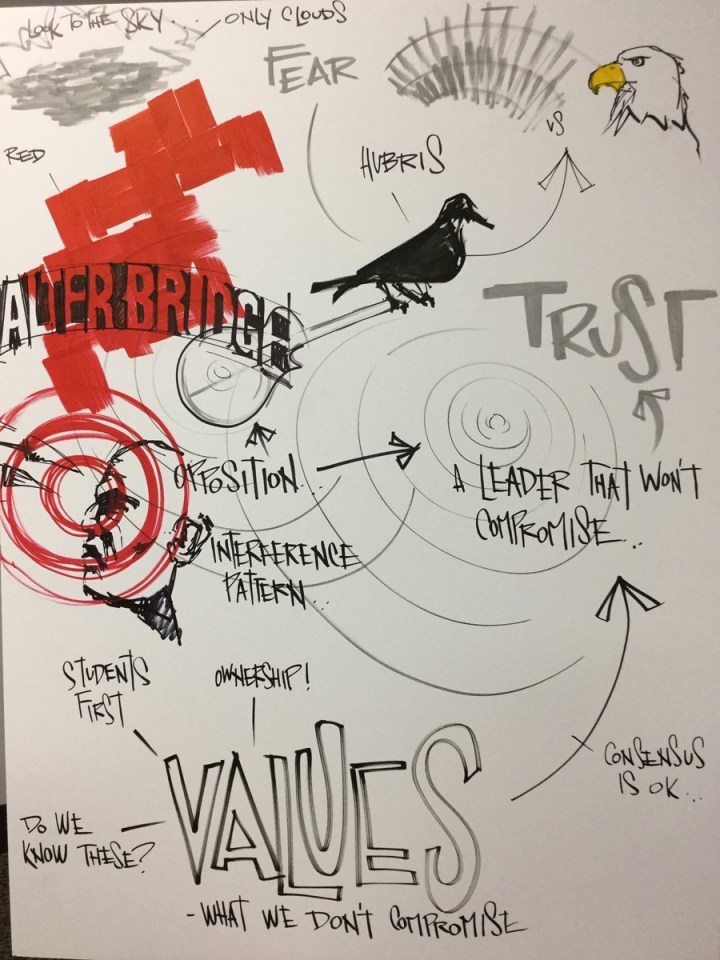 By now, most of you know that the great rock band, Alter Bridge, has changed my life in the last year. The release of “Show Me A Leader” has rocked my world and the way I think about leadership. Click here to watch the video I made of “Show Me A Leader.” Here are some verses/phrases from the song that have really resonated with me:
- “Well they’re selling another messiah here tonight; But we’re all way too numb and divided; To buy it” – we should never put our leaders in a position of needing to be a messiah, or the chosen one. Nor, should we ever consider ourselves, as leaders, above others and in messiah status. According to my faith, there is only one of those and there will not be another.
- “Show me a leader that won’t compromise” – we cannot as leaders compromise our values.
- “Disillusioned and tired of waiting; For the one; Whose intentions are pure unpersuaded; We can trust” – we need to earn trust and make sure our intentions are always pure and unpersuaded by self interest and are for the good of the whole.
- “‘Cause a promise is never enough” – pretty self explanatory; don’t promise what you cannot deliver, period.
- “It’s getting harder to fight out here on our own” – Sun Tzu taught us the skillful leader subdues the enemy without any fighting. This means we need a leader that will help us have the conversations of what we can do to create the future. The communal possibility rotates on the question “What can we create together?” This emerges from the social space we create when we are together.
- “Show me a leader that knows what is right” – To do “the right thing” means to make a choice among possibilities in favor of something the collective wisdom of humanity knows to be the way to act. Great leaders must call upon a broad band of intuitive knowledge and use it to give guidance and direction. If a person comes to a position of power as a leader in an organization or in society without knowing how to do the right thing, then the people under his or her influence are in for a bad time. At worst they will find themselves plunged into brutal conflict with outside forces, or at best they will spend a lot of time and energy struggling with internal disharmony and damage control.
- “Show me a leader so hope can survive” – Great leaders often earn their credentials before they become successful. Often, it’s during the times of darkness and hardship that the greatest leaders are born. Hope is the ingredient to which failure knows no answer. And great leaders instill this belief to help the others around them. Hopes and dreams can become real. But often to do so they need life consistently breathed into them. To keep them alive until they are transmuted into reality. Great leaders do this by consistently communicating their beliefs to their followers in the form of visions. They take every opportunity they can – through being a role model, meetings, presentations and writing to describe their visions as crystal clear as possible.
- “We need a hero this time” – There are leaders, there are great leaders, and then there are heroic leaders. The best of the best put others before themselves. They sprint into danger. They pay dearly for their courage, and they often go years, if ever, without the recognition they deserve.
 These bullets have become guides for me and benchmarks for some of my personal core values. Particularly this thought of not compromising. Click here to read my thoughts on compromise in “There Can Be No Compromise!”
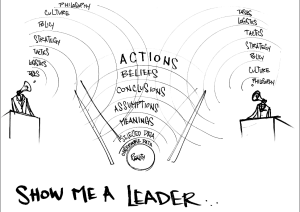
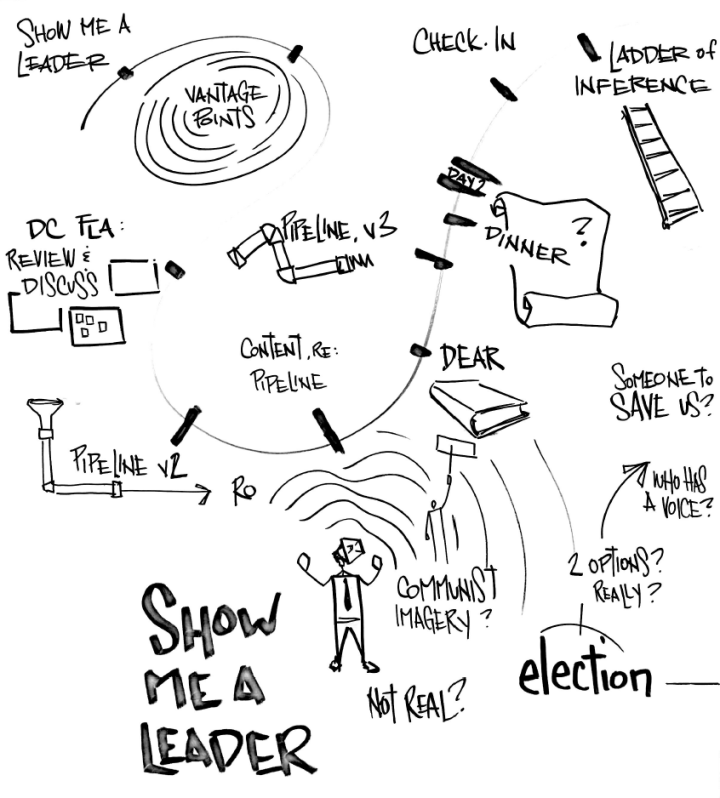
Furthermore, the music video for “Show Me A Leader” is amazing. Click here to watch the video. In fact, I have now used it three times to lead discussions on leadership. Throughout, and at the beginning of this post are graphics done by Mike Fleisch of the sessions we have facilitated on this great song and video.
There Can Be No Compromise!
 Great leaders know that leading change sometimes means they will have to fight for their vision and values. They can sometimes face strong resistance and criticism. At these moments they are fully aware that it is about being able to connect, and to convince others why this change is important. This means they invest energy and time in communication, in increasing mutual understanding, and in strengthening alignment. But they will not compromise their values and vision.
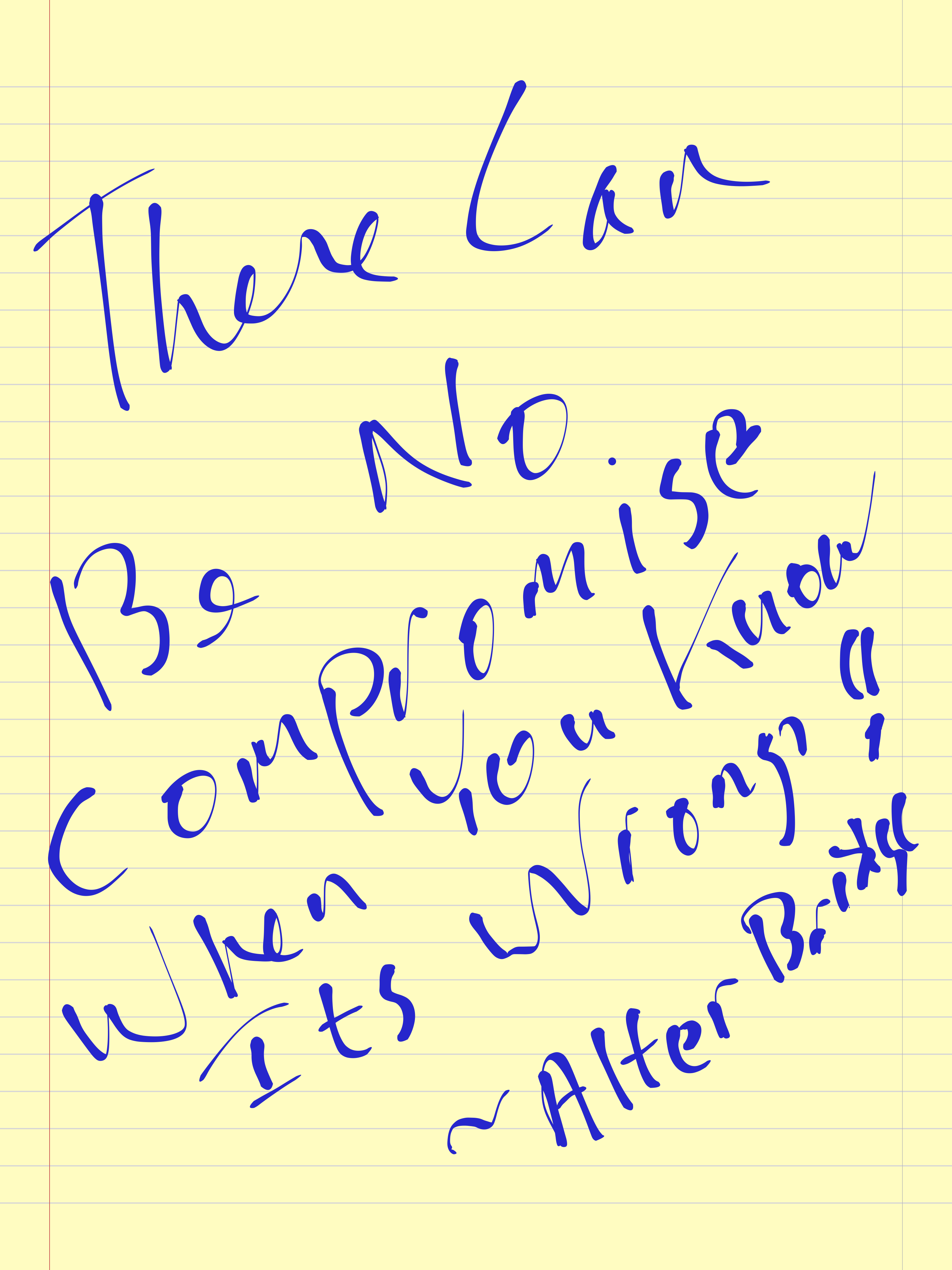 Two songs by Alter Bridge constantly cause me to think about compromise. In “Show Me A Leader” songwriters: Myles Kennedy, Brian Marshall, Mark Tremonti, Scott Phillips want a leader that won’t compromise. Additionally, in the song “Last of Our Kind” we hear the words: “There can be no compromise when you know it’s wrong ’cause in the end the sacrifice was worthless all along.” When compromising you give something up on both sides, you don’t create something together! A compromise is by definition leading to a suboptimal solution. Great leaders understand this, and are therefore reluctant to compromise.
I believe that compromise can easily blur our vision and core values, can create confusion, and therefore undermines the motivation of people. I realize, however, as leaders there are times when compromise is necessary. It is important to understand that no one knows everything. Great leaders listen to all sides, think about their own experience and then make decisions. Those decisions must based on a balance of knowledge and not compromise the leader’s core values. Sometimes the decisions don’t sound or look exactly like what the leader wanted. but they are the best for the organization as long as no core values have been compromised. So, when I hear, “Show me a leader that won’t compromise” I am reminded to never compromise my values.
Errors In Leadership Coordinates
 Lesson #21 entitled “It’s Only Two Degrees” in 52 Leadership Lessons: Timeless Stories For The Modern Leader by John Parker Stewart really drove home the fact that small errors can have big consequences. On the 28th of November 1979, Air New Zealand flight 901, crashed into Mt Erebus on Ross Island, Antarctica, instantly killing all 257 people on board. Antarctic overflights were a new and exciting breakthrough in airborne tourism. Interest in the Antarctic had been particularly strong in the scientific community since the late 1950s, but only a small number of privileged people had experienced the wonders of the icy south. At the heart of much of the eventual controversy surrounding the causes of the accident were changes made to the flight plan of TE901. The plan loaded into the aircraft’s flight management computer was not that on which the flight crew had been briefed 19 days earlier, but no one had told them. The flight plan was only two degrees different, but this two degrees made all the difference between crashing and not crashing. Because of the white snow covering all of the area, the 12,000 foot rise of the volcano was not noticed because of what is now called “sector whiteout.”
As leaders, we should foster environments adopting a strategy that is able to take on the challenge of avoiding negative error consequences and learning by fostering positive error consequences simultaneously or in alignment. Error prevention aims at avoiding negative error consequences by avoiding the error altogether, the error management approach focuses on error consequences directly. It aims at avoidance of negative error consequences and the promotion of positive error consequences by means of early error detection, quick and effective correction, error analysis, and long term learning from errors.
Edmondson (1996) posited that the open climate characterized by a willingness to report and discuss errors, allows learning from errors, and thereby can affect team performance positively. Edmondson (1996) further asserted that these teams had a better error climate, which allowed them to talk about errors, which in turn increased detection and correction. Generally, errors are discussed only when the consequences are high or even disastrous, I believe that errors with small consequences should also be taken as chances to learn. We must create an environment where our teams are encouraged to take responsibility for their errors. What kind of culture for dealing with errors are you developing in your organization?
Iterate, Don’t Change!
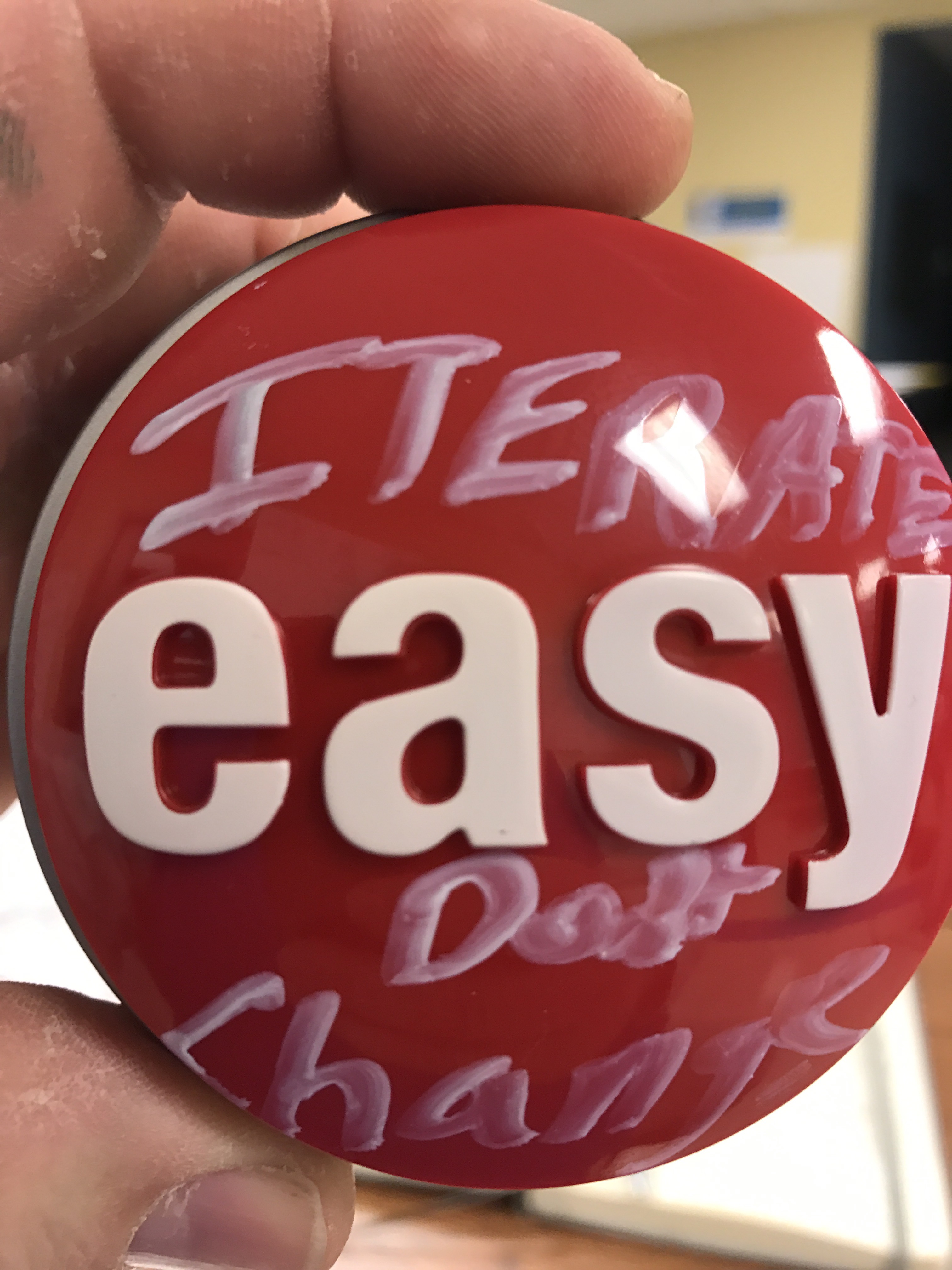 Mark Twain once said that the secret of getting ahead is getting started. But it’s often hard to get started. Why? Because we know we could fail, and many times that fear hinders us from even starting. We don’t have to get things right the first time, however. We can allow ourself multiple iterations to succeed. It could take many iterations to succeed, so the sooner we start the better. Don’t wait until everything is perfect before you start. Iteration works because it gives you the permission to fail. You don’t have to succeed right away, so you won’t be afraid to start.
Iteration is also different than change. To me, change means a reset and starting over. Iteration means you are changing and creating in real-time as we go. Iteration gives an organization agility. This agility is valuable and an agile organization will not only suffer less when hit by unpredictable external shocks, but will also be able to exploit unforeseen opportunities. True iteration should also include teams working together to channel their creative genius.
In education we are immersed in a world that is constantly trying to create and recreate. I am such a believer in the power of iteration. It adds layers of meaning to what it really means to be an educational leader. It is becoming clear to me that the power of iteration transcends the concrete and physical: The power of iteration is a driving force of creating a culture of excellence.
Iteration is really somewhat of a repetition with tweeks as we create and recreate. Computers are often used to automate repetitive tasks. Repeating identical or similar tasks without making errors is something that computers do well and people do poorly. Repeated execution of a set of statements is called iteration. iteration, useful in slightly different circumstances. After an iteration, we should always ask: how can we make improvements next time? Find the lessons and apply them to your next iteration.
I strive to create an environment where innovation is welcome, mistakes are appreciated, and all are accepted and actively included. The power of iteration allows us to make something out of nothing, it allows us to make greatness out of challenge, and it allows us to build something we never thought we could build.
It means that instead of trying to be perfect the first time you do something, you simply aim to get better over time. You want your second try to be better than your first one, your third try to be better than your second one, and so on. We need to iterate quickly. The faster you iterate, the better. If it takes too much time between iterations, your progress will be too slow. So, do your next iteration as soon as possible.
The power of iteration can help you and your organization achieve your goals. Keep learning. Keep improving through iteration. You will eventually succeed.
Leading From An OASIS
 OASIS Conversations: Leading with an Open Mindset to Maximize Potential by Ann Van Eron
My rating: 5 of 5 stars
This book takes you on a journey of deep listening, trust building, and truly meaningful dialogue. The reader can’t help but reflect and develop improvement goals while learning to build a clear intention, plan when possible, and build rapport using OASIS conversations:
O = Observation
A = Awareness (of assumptions, emotions, and background)
S = Shift (to being open)
I = Importance
S = Solution
Every leader would do well to learn and use this framework. As an educational leader, the lessons of this book are instantly transferable to the context of working with principals, teachers, students, and families.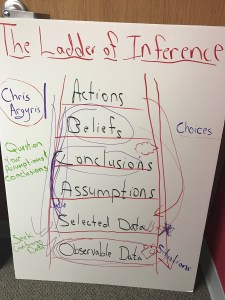
The learning from this book fits so well with some of my Harvard University learning on the Ladder of Inference. I have included a picture of the visual I have been using when discussing the ladder. You will note the similarities. Most importantly, from Chris Argyris’ model, are making sure we question our own assumptions and conclusions and seek contrary data in order to stay low on the ladder. Combine this with the model for OASIS Conversations and you have the makings of deep listening, meaningful conversations, and dialogue that can bring about incredible change.
Break The Boulder Up To Move It!
 I use the term, “Break the boulder up to move it” all the time when referring to big opportunities (what I also call challenges). We look at opportunities as one big boulder that just can’t be moved. Therefore I always remind everyone that if we can break it down into manageable sized rocks we can overcome the challenge or make the opportunity a success. As a farm kid I have moved my share of rocks and still do on our farm today. I know that if you do not get the rocks out of the way they can tear up farm machinery in seconds. Therefore it is always better to move rocks when they become obstacles than to go around them.
Continuing with the original metaphor, when we come across a rock blocking our path, there are two possible solutions to the problem. You can try to move the rock, which if small enough is the best solution. But, if the rock is massive (boulder sized), you can be clever and start breaking the rock into smaller, easier to move pieces. Our challenges as leaders are similar to this metaphor. It is smart to break these opportunities down into smaller pieces. This is done by using a varied set of view angles. The ideal process would be to break the challenge into six to twelve different questions or parts. These parts will help to tickle the imagination and trigger thoughts and ideas of those on your team for solving the larger issue. These smaller fragments are not meant to solve the whole issues that will in turn lead to a “boulder sized” solution.
“The best way out of a problem is through it.” ~ John Parker Stewart
My thoughts above were inspired while reading Lesson #20, “The Farmer and the Rock” in 52 Leadership Lessons: Timeless Stories For The Modern Leader by John Parker Stewart. This was the story of a farm family that for generations had been farming around a rock they thought was to big to move. Finally, one day the younger farmer got mad and hook the tractor and chain to the rock and it broke up and was easily moved. Do you as a leader plow around obstacles, or do you confront it and get it out of the way for good?
Your Life’s Journey Is Your Education
 The Education of Henry Adams by Henry Adams
My rating: 4 of 5 stars
This book really caused me to do a great deal of reflection about education and my own education in particular. As a believer in lifelong learning, Adams assured me that investing in learning at any point in life is a sound investment. His teachings also made me reflect on the fact that living life is an education in and of itself. We need to make sure we are using the context in which we live and all the experiences to learn at the highest level. How do we do this? I believe we can learn from Adams that it is ok that we are ignorant at every new turn in life and that we need to begin learning from everyone and every experience we have. If I were to sum up the book in one statement it would be, “Your life’s journey is your education.”
In this book, Henry Adams is not talking about himself as much as he is of the education and the context in which he lived provided an education. Adams serves as the narrator in this book. At the writing he is in his late sixties and refers to himself in the third person. This is an interesting way to read an autobiography that I am not sure I like, but I got used to it. Sometimes his referring to himself in third person made it made it hard to follow, but in the context of making living life our education this was probably the right way to do it. In his “Preface,” he introduces the metaphor of a manikin, which represents Henry Adams. The various garments draped across the manikin represent his education. It was this metaphor and how all events proved learning that I formed the opinion that Adams believed in lifelong learning. He continually refers to his ignorance, which told me he was of a growth mindset long before the development of the “growth mindset” theory.
Adams tells his readers that any young man seeking education should expect no more from his teacher than the mastery of his tools. Leaning on the scientific approach that he develops in the education, he suggests that the student is merely a mass of energy. The education he seeks is a way to economize that energy. The training by the instructor is a manner of clearing obstacles from the path of the student. My take on Adams’ position is that a person’s life in its entirety is our education.
Adams wrote, “Probably no child, born in the year, held better cards than he.” Adams also told us that the world he lived was rapidly changing – as it does for all of us. It is a world of contrasts. It was this contrast that Adams used throughout the book to discuss his education. In the book Adams states that as yet he knows nothing. Even after graduating from Harvard, he did not believe his education had begun. My sense is he believed in learning by doing and being the person in the arena. Here are some of my favorite quotes from the book:
– The Ego has … become a manikin on which the toilet of education is to be draped in order to show the fit or misfit of the clothes. The object of study is the garment, not the figure.
– Nothing in education is so astonishing as the amount of ignorance it accumulates in the form of inert facts.
– The object of education for that mind should be the teaching itself how to react with vigor and economy. No doubt the world at large will always lag so far behind the active mind as to make a soft cushion of inertia to drop upon, as it did for Henry Adams; but education should try to lessen the obstacles, diminish the friction, invigorate the energy, and should train minds to react, not at haphazard, but by choice, on the lines of force that attract their world.
And… my favorite of all the quotes: “Man does not concern himself with understanding how discoveries can be used. He will let the discovery show him how.” I really believe this reinforces my theory that Adams believed that our life’s journey is our education. How would you write the autobiography of your education? What do you need to be doing in your context to have it read how you would like it to? This book will cause you to reflect.
~ Dr. Byron L. Ernest
Blue Heron Leadership
 The Blue Heron is one of my favorite birds. Because of some ponds on our farm we see them flying over and walking in the water often. We also see them gleaning through our fields. They are beautiful and majestic birds. After reading Lesson #19 in in 52 Leadership Lessons: Timeless Stories For The Modern Leader by John Parker Stewart I realized just how beautiful and awesome the Blue Heron really is. In fact they follow a very participatory and holacratic organization structure like I believe in. Most generally we only see Blue Herons one at a time. This is because, as Stewart pointed out, they like to stay in small groups or by themselves until nesting. At nesting time Heronies are formed to cooperatively get the work of raising young accomplished.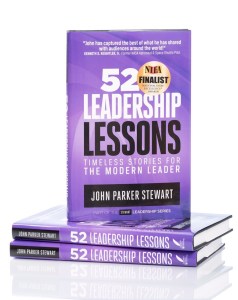
“When there is commitment and a willingness to do whatever is needed, success is far more likely. As the Blue Herons were true to each other in following through with their part, so can we as we follow their example and remain ‘true blue’.” ~ John Parker Stewart
Both male and female work together to get the nest built. After the eggs hatch both parents take care of feeding, teaching them to fly, and teaching them to catch fish. Notice there is no hierarchy here – this is about as flat a structure as you can get. There is only an eagerness to complete the task. The Blue Herons are not concerned about status or position. Furthermore, there is no complaints about fairness, equity, or doing undesirable tasks. This is the huge advantage of an intent-based environment where everyone is considered a leader. If we want our team members to work cooperatively together like Blue Herons then we must create an environment where they are able to move up the rungs of the Ladder of Leadership (created by David Marquet). The rungs are as follows (also check out the graphic pictured here):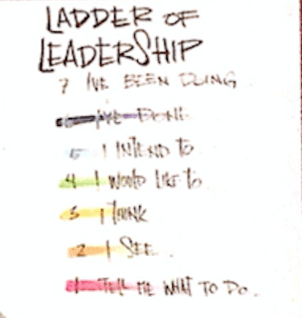
- Tell me what to do
- I see
- I think
- I would like to
- I intend to
- I’ve done
- I’ve been doing
Are you modeling an intent-based environment where everyone works cooperatively and is concerned with getting the work done, not in titles and hype?
“Go Ask Your Mother”
 I have a coworker who will occasionally comment after working with staff members that she just wants them to go ask their mothers. Usually I chuckle at this comment, but after reading Lesson #18 titled “The No-Brain Stage”by John Parker Stewart in 52 Leadership Lessons: Timeless Stories For The Modern Leader. I realize this is probably not funny. In this lesson, Stewart pointed out the basic needs of a two-year-old child. Here they are:
- They need to be cared for.
- They need security and protection
- They need to be listened to and included.
- They need their questions answered.
- They need love, reassurance, entertainment, attention, praise, and discipline.
- They even need age-appropriate responsibilities.
“If your people are acting like two-year-olds, ask yourself which of their ‘two-year-old’ needs you may have neglected.” ~ John Parker Stewart
So… if you have ever said, “I work with a bunch of two-year-olds.” You’re right. That list of what a two-year-old needs is spot on for any age group we serve as a leader, don’t you think? This lesson really caused me to think about whether I am doing my part to meet the needs of all those I serve. We all need to take time and listen deeply to our team members and make sure we are meeting their current needs. Remember, their needs do change over time.
My challenge to you and myself is to take some time and analyze the needs of those who report to me and see if those needs are being met.
 Byron's Babbles
leave a comment