Creating a Strategy for a Compelling Story
 The following is an excerpt from What Are Your Blind Spots?
Creating a Strategy for a Compelling Story
By Jim Haudan and Rich Berens
A few key concepts must be established when creating and delivering an effective story. Each and every time you create an effective story, you must:
• Identify your primary audience.
• Focus on the overall message.
• Outline the core drama.
• Make it personal.
• Practice delivering it.
Let’s explore how to execute each one together.
Identify Your Primary Audience
Before you start crafting your story, you should have clarity on who your primary audience is. What is this group’s mindset and knowledge base on the content? Do you want the people in the group to be excited, curious, fearful, apprehensive, or charged up? How much do they know about your story already? Do they have any preconceived notions? If you don’t have full awareness about your audience, you could craft a compelling story that misses the mark with those you are trying to reach.
Focus on the Overall Message
Just about every great story has an overarching message, moral, or key takeaway. Think of any of your favorite movies. There are many subplots, but they tend to be connected to one larger dominating theme. In Star Wars, the Rebels beat the Empire and destroyed that darn Death Star the enemy kept rebuilding. In E.T., Elliott and helpers made sure to get the poor fellow back home. Think of the story you want to tell your employees.
If being risk averse is a core concern within your organization, you might focus on how taking risks and embracing failure is essential for long-term success as the major guiding thought. If the key concern is speed and adapting to a rapidly changing competitive environment, the ability to collaborate, transcend silos, and work differently might be your guiding thought.
Outline the Core Drama
Any great story has a core drama that shapes its narrative. Whether it’s something that disrupts, creates a new challenge, or forces the key characters to think and act differently, drama is present. Be clear on that drama and make it a critical component of your narrative. This could be a nontraditional competitive threat, the inability to work together within the organization, or a dramatic shift in customer expectations. No matter the situation, you will want to build out that core drama element and channel most energy toward overcoming that issue.
Make It Personal
Every story gains credibility and authenticity when it feels real and personal. So if you think that changes in customer expectations are a real threat to how you can compete, share personal experiences that friends, family, or even you personally experienced when purchasing your product or service. This might create unexpected “aha” moments. We were working with the CEO of a leading building products company that had great products but was struggling with the customer experience it provided. At a leadership meeting, the CEO shared a detailed account of how he remodeled his kitchen and the very frustrating experience he had buying his cabinets and said that he was inclined never to do it again. It made the challenge more vivid and personal, and it moved the topic from an intellectual customer experience problem to a meaningful account of what it is like to interact with the company’s products and channels in real life.
Practice Delivering
It Interestingly, when we ask leaders how often they practice giving a keynote speech or a key presentation to their board, they respond by saying, “Always.” When we then ask how often they practice telling their strategy story to their people, their answer is, “Rarely.” Like most things in life, it takes practice to be great. In boxing, the conventional wisdom is that you have to practice for 30,000 minutes to be good for 3. Comedians run through an incredible amount of reps before they master the timing of their jokes. As leaders, we often share content in real time and don’t practice our delivery. The ability to practice how you tell your story, where to emphasize certain points, where to pause for reflection, and how to really engage with your audience simply takes time and practice.
Putting These Steps into Action
By combining these story creation essentials (primary audience, overarching message, core drama, making it personal, and practice), you will have a storyline that complements your vision headline.
 *******************************
About Jim Haudan
Jim Haudan is Co-Founder and Chairman of Root Inc. Root Inc., the organizational change expert on helping companies create leadership alignment, execute strategies and change successful, build employee engagement, and transform businesses. He is a sought-after business presenter who has spoken at TEDx BGSU, Tampa TEDx, and The Conference Board. His latest book, What Are Your Blind Spots?: Conquering the 5 Misconceptions that Hold Leaders Back is co-authored with Rich Berens is CEO and Chief Client Fanatic of Root Inc. The book equips readers with the tools needed for a personal leadership reset. You’ll discover how to increase engagement, productivity, and growth in your own organization.
About Rich Berens
Rich Berens is CEO and Chief Client Fanatic of Root Inc, and has helped align leaders at Global 2000 organizations to drive strategic and cultural change at scale. He is a noted speaker on the issues of, transformation, and how to create lasting change and has authored articles for numerous publications and blogs. Under Rich’s leadership, Root has been listed among the Great Place to Work® Institute’s top 25 places to work, been named to the Inc. 5000 fastest-growing companies list, and experienced 10 years of consecutive growth. His latest book, What Are Your Blind Spots?: Conquering the 5 Misconceptions that Hold Leaders Back is co-authored with Jim Haudan is Co-Founder and Chairman of Root Inc.
I’ve Been BitMoji’d, Literally!
 So, I was asked to provide a BitMoji for my work to use on a key card. Sounded fun, but honestly, I had no idea what a BitMoji was. I knew what an emoji was, and have even blogged about them. In fact I just checked and I have blogged about emojis seven times. Click here to find my blogs on emojis. You are probably asking yourself, how did he figure out what a BitMoji was? Well, I did what any baby boomer would do, asked a much younger and tech savvy person. I happened to be working in a school at the time asked, so I asked a teacher. She was kind enough to help me find the app, download it, and show we how it worked. I love this reverse-mentoring stuff. What fun!
Well, do you BitMoji? If not, then you are missing out! I found it to be quite fun and even an exercise in reflection. I like the fact that you take a selfie and then your selfie is right there as you are creating the avatar. I found this to be a metaphor for how we reflect on how we are doing as leaders and in our jobs. Sometimes we need that selfie to help us reflect. Here’s my selfie and BitMoji (how did I do?):


What is funny is that at our 3D Leadership gathering this past weekend, the group was kidding me about using the word “literally” a lot. They created a “literally” hashtag: #literally. How cool was it that there literally is a “lit·er·al·ly” BitMoji. This caused me to reflect about the words and language I use, because we all know language matters.
Building a positive culture in our organizations takes commitment, consistency, and teamwork…and adding a little Bitmoji may just add that extra fun you are looking for. Don’t forget, it can also bring some reflection time into your own personal development and growth. Next time you are looking to represent your organization or school’s culture, just remember, there’s a Bitmoji for that! How will you use Bitmojis to add to your organization’s positive culture?
The Messiness Of The Truths We Are Frustrated With
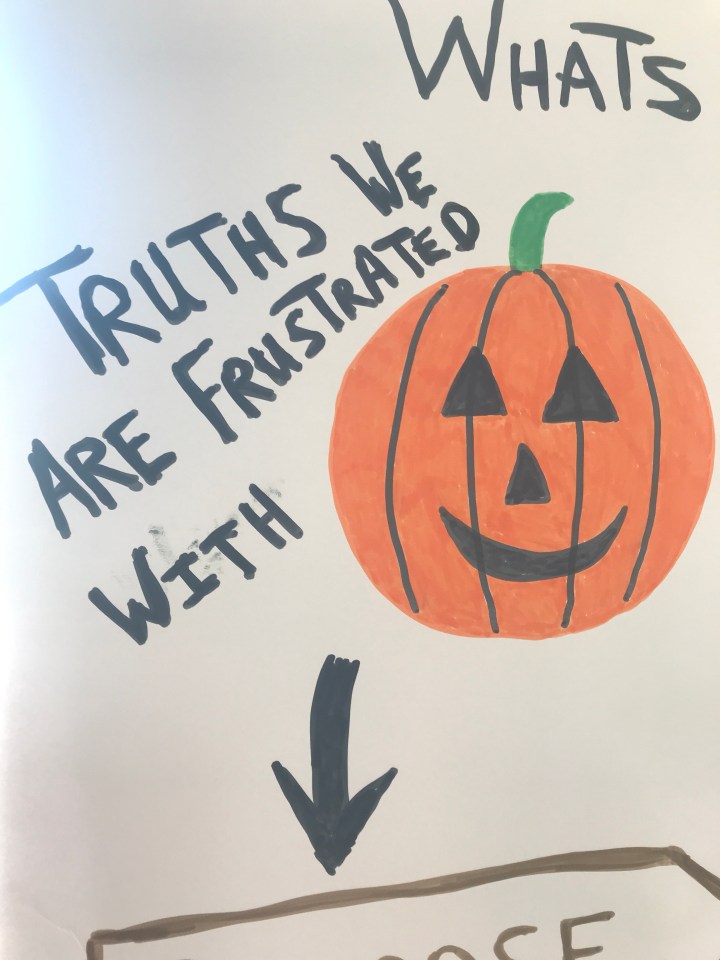 Reality is, if you are willing to be present in the messiness and take appropriate action based on the conditions in which you actually find yourself, you will be uncomfortable quite often and also probably experience feeling vulnerable. We dove into this messiness at our Indiana 3D Leadership gathering this past weekend. The through line of our gathering was, “What’s My Story?” The first activity was to carve a pumpkin. You heard me right, carve a pumpkin. But not just the usual face, but a jack o lantern that answered the phrase: “Truths We Are Frustrated With.”

 I’ve gotta tell you, I was blown away. They were all awesome. The stories were all awesome. The group was so into this project that they found a dark room, lit up their pumpkins, and formed a semi circle to tell their stories. I videoed a few of them and let me tell you they were all inspiring. I am sure I will have more blogs following this one on these stories.
One of the stories that jumped out at me was on the messiness of leadership and the truths that frustrate us. Check it out by clicking here:
 I learned a lot from this observation and visual. This pumpkin carving and story taught us that, as a leader, it’s up to us to put ourselves second, and operate in a way that allows others to feel at ease, to feel understood, and to work in the way that’s best for them–even if it’s not the way we might operate ourselves. Sometimes we need to let go of the meaning we are putting on the moment and just be there.
Your team wants to know what you stand for and believe in, and that your values align with theirs. Great leaders step up to challenges, and come face-to-face with their commitments.
Why You Should Read “What Are Your Blinds Spots?”
 What Are Your Blind Spots? Conquering the 5 Misconceptions That Hold Leaders Back by Jim Haudan
My rating: 5 of 5 stars
This book dives deeply into five areas that are written and talked about often in the realm of leadership, but does it in a way that is different from all the rest. The areas of purpose, story, engagement, trust, and truth are all leadership dispositions that most would think are very straightforward. Because they are dispositions, however, we become blind to our organizations and our own approach to these, we miss opportunities for improvement or even gross inadequacies. This book is not just all talk; practical applications are given along with activities to identify and inform our blind spots. We all have a leadership style and mantra, and this book gives the reader a chance to take an introspective look at whether that mantra is what we want those on our team to be sharing about us. As a leader, student of leadership development, and leadership development professional, I found the lessons in this book engaging, able to be used immediately, and transferable. I grew professionally from reading this book.
Leader Traits From The Palmetto State
 I was reading some research on leadership development this week and one of pieces that jumped out at me was the statement, “what leaders really want is a personalized experience and the opportunity to learn from…their fellow-leaders.” I was reminded of this last night during the September 3D Leadership gathering of our South Carolina members. One of the things discussed during our plus/delta time at the end was the fact they were able to discuss freely and transparently which made it possible for them to get to know each other and learn from each other. In fact one participant said, “I’m so glad you brought up the issue of communication and that we discussed that. Now we can work on making it better.” Effective leadership development involves time for reflection and learning from those around us.
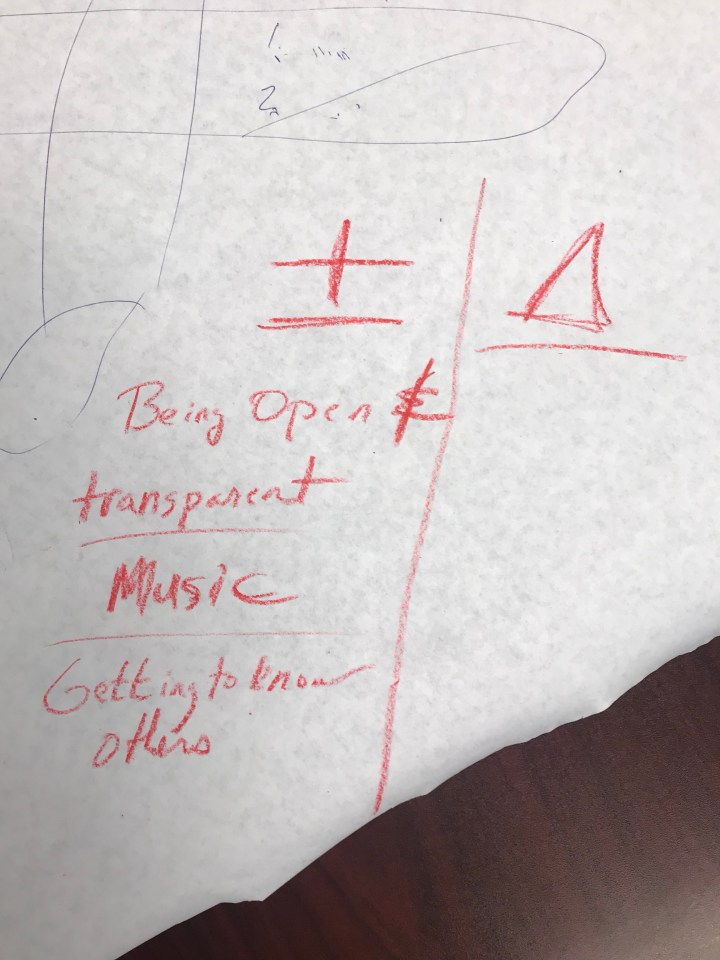
We did one such learning activity last night where the South Carolina group developed their own top list of good and bad leadership traits. It was a great discussion with being supportive coming out as their number one trait every good leader should have. Here are the rest of their results:
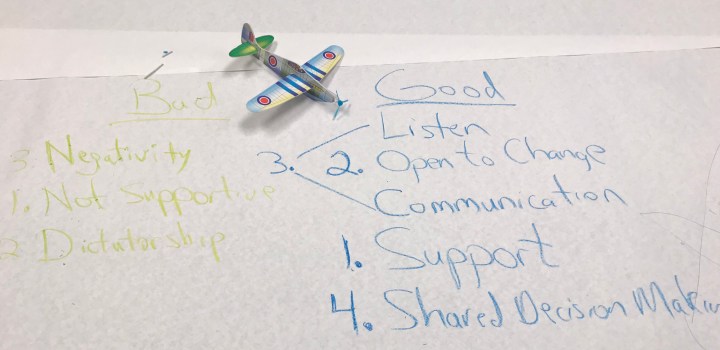
Here’s what we know: Success in today’s world depends on how leaders perform as a team. The unpredictable and rapidly changing landscape, whether it is in government, education, or business, means you need to have people with a variety of skillsets and mindsets who can quickly step in to show leadership in response to a variety of challenges. This is why organizations need to look at all employees as leaders, with “leadership potential,” and start developing leadership potential earlier in careers. That is why we do 3D Leadership – to help our leaders Discover, Develop, and Distribute leadership wherever and whenever it is needed.
Why Everyone Should Read Dopesick
 Dopesick: Dealers, Doctors, and the Drug Company that Addicted America by Beth Macy
My rating: 5 of 5 stars
As soon as I finished this book I tweeted, “Anyone who is a public policy maker, educator, or citizen (in other words everyone) needs to read Dopesick: Dealers, Doctors… by Beth Macy. This book tells the history of the #opioidcrisis back to the Civil War until today like none other!” I learned so much history that I did not know. By the time the Civil War ended, addiction had already touched middle-class housewives, immigrants, veterans and even physicians hoping to soothe their own aches and pains. This is when the opioid epidemic began. Between the 1870s and 1880s, America’s per capita consumption of opiates had tripled. On March 1, 1915 a law passed by Congress and signed by one of my favorite Presidents, Woodrow Wilson, would become the first law to criminalize drug use, the Harrison Narcotics Tax Act. I also learned that opioids such as morphine and codeine are naturally derived from opium poppy plants more commonly grown in Asia, Central America and South America. Heroin is an illegal drug synthesized from morphine.
Hydrocodone and oxycodone are semi-synthetic opioids, manufactured in labs with natural and synthetic ingredients.
I really like fact that Macy also spent a great deal of time discussing and educating her readers on the public policy component of the opioid crisis. Macy argues that a big obstacle to solving the crisis is that many local, state, and federal agencies and governments are more concerned about protecting turf and budgets than solving the problem and helping people. This book pushed and stretched me to understand this very complex issue.
North Carolina Leader Traits
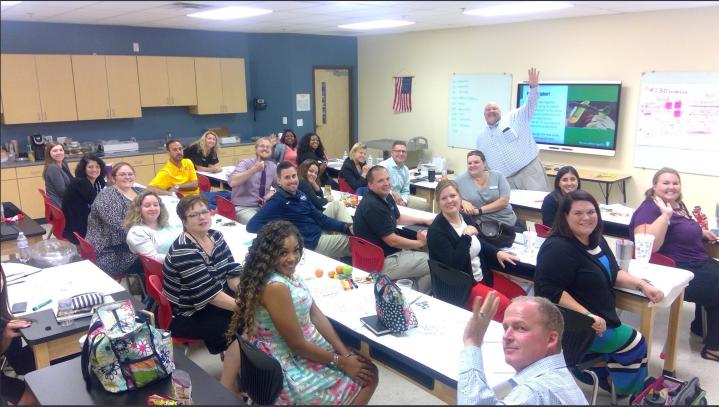
North Carolina 3D Leadership Cohort #1
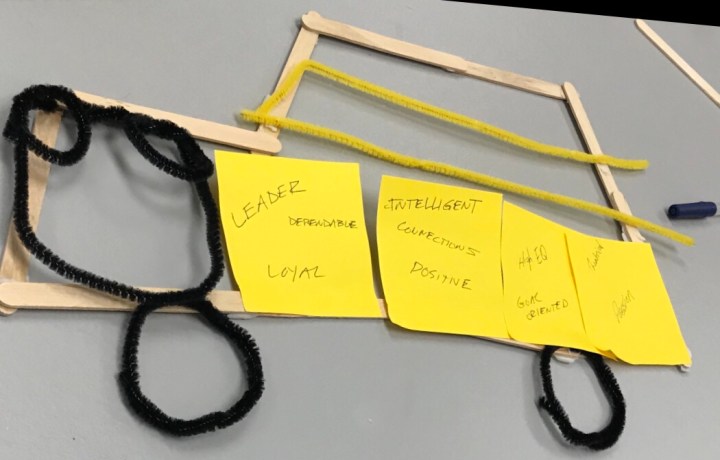
Last night at our North Carolina cohort of 3D Leadership developed their top five list of good leadership traits and bad leadership traits. To do this we used one of my go to facilitation props (no pun intended), the toy prop gliders. Here is what participants did:


The groups then got back together and listed their top five list. Then the whole cohort voted on the top five good leadership traits and top five bad leadership traits. Here are the results:
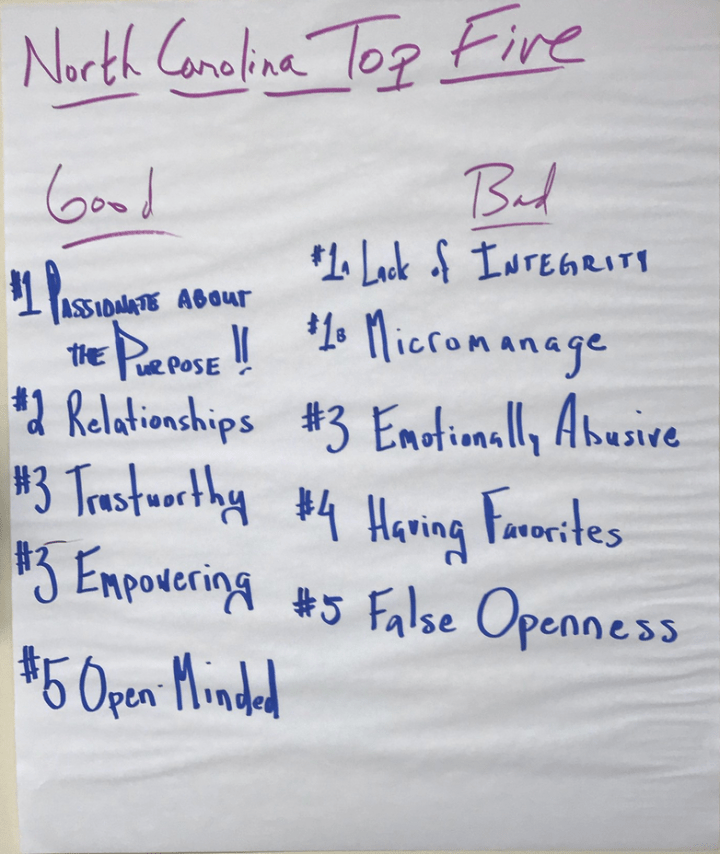
It is always interesting to me that as I do this in many different states and with individuals of different experiences, how different the lists can be. Successful organizations need leaders, someone (or as I believe everyone) who can inspire employees and lead them and the organization toward success. Leaders encourage others to work to their full potential, inspire creativity and aid motivation. During turbulent times, the need for good leaders intensifies. As I always say, “Leading is easy when things are going great, but really hard when it is chaos and earthquakes.” Someone who presents a clear vision for recovery, leads by example and instills confidence in those around them. A good leader has many traits, if you can recognize these within yourself and capitalize on them, then you can become a successful leader in your work environment and on your team.
By consciously making an effort to exhibit the traits highlighted by my North Carolina friends, people will be more likely to follow us. If we exhibit these traits on a regular basis, we will be able to grow our influence to its full potential as a leader. What’s on your top five list of good and bad leadership traits?
Horse Power – What is the Equivalent for Companies? HumanPower
 This guest post originally appeared on the Alex Vorobieff Blog
Horse Power – What is the Equivalent for Companies? HumanPower
By Alex Vorobieff
Today, there is a lot of talk about Artificial Intelligence, AI, and computers taking over more jobs but as I write this, human beings still provide the essential power to build thriving companies. What is this power we provide? The term “Human Resources” is inadequate. The term “Human Capital” is static. A company’s power comes from its people’s ability to coordinate their efforts. HumanPower is what propels companies. We quantify car engine horse power but what is the equivalent for companies? HumanPower.
What determines whether a company thrives or slowly dies? How well its people use their experience and expertise to coordinate their decisions and actions.
Recent scientific insight has shed light on how our species of humans, homo sapiens, evolved and thrived while other species died out even though we were not the fastest or strongest. We survived because of our unique competitive advantage; our ability to coordinate our efforts.
Coordinating efforts generates the HumanPower that propels the few companies past the many that struggle, but misaligned HumanPower can also tear companies apart. For example in an Olympic rowing competition, team members rowing at slightly different paces are working against each other and diminishing their HumanPower. Understanding how to harness HumanPower is critical for growing a business successfully.
Okay Vorobieff, how do we coordinate the efforts of our people? By answering key questions that provide guidance for people within the company to make big and small decisions such as:
Why does the company exist?
• What are we really selling? (What problem are we solving for our customer?)
• Who is our core customer?
• What is essential for the company to survive and thrive?
• What are the core values essential for keeping our unique culture?
• Who is responsible for what?
• When things don’t go according to plan, how do we get back on track?
• What is the number one priority for the company?
These questions do not answer themselves. If answered, the answers are easily forgotten, or often not communicated to new team members. Most companies do not have clear answers to these questions. Over time, differing and conflicting answers evolve generating conflicting decisions and efforts or worse DeadPayroll.
How can you measure HumanPower? There is no Dynamometer to hook people up to measure a company’s horsepower. It’s easier to measure the drag than the force. Start with measuring your DeadPayroll.
You can also measure HumanPower by using the most powerful tool humans’ possess, questions. Start asking the key questions listed above to your leadership team. Let them answer separately and see if your people are headed in the same direction or are pulling the company in different directions.
Coordinating decisions and actions was the competitive advantage our ancestors used to survive and thrive in a harsh environment where survival was not guaranteed, and the same coordination will determine whether your company thrives in a competitive environment where long-term survival is not guaranteed.
 ******************************
About Alex Vorobieff
Founder and CEO of The Vorobieff Company, Alex Vorobieff is a business turnaround specialist, working to implement Business Alignment Tools for their specific needs. Alex has served as clean-up CFO and president of companies in telecommunications, aviation, aerospace, and real estate development, leading successful turnarounds in as little as three months. He shares his how-tos and techniques through Confident ROi magazine and his latest book, Transform Your Company: Escape Frustration, Align Your Business, and Get Your Life Back.
Shaking Our American Demons
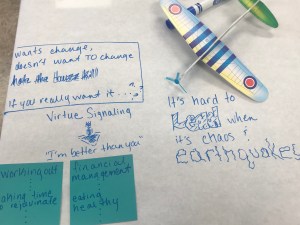
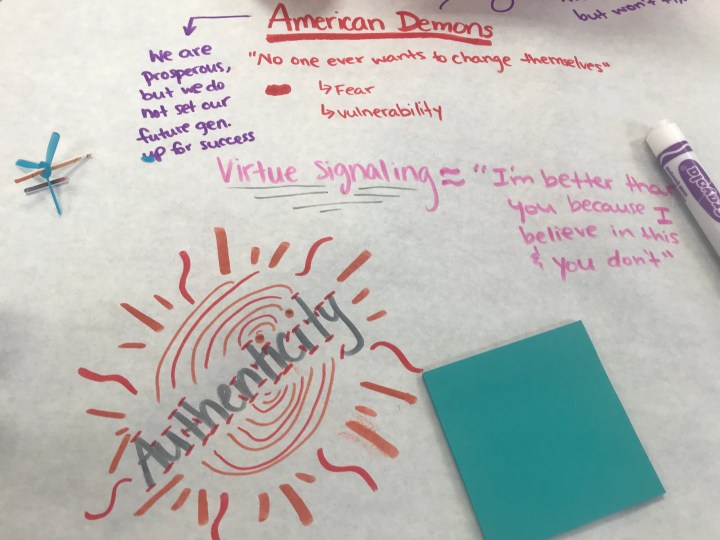 This past week I started a session of our Noble Education Initiative 3D Leadership Program by playing the song “Do You Really Want It?” by Nothing More. The participants were to listen and graphically reflect on what the song meant to them as leaders. Click here to read another post, “What Do You Really Want?”, I wrote about this song and see a music video of the song. One of the things we discussed during this pat Thursday’s session was a phrase in the song (Do You Really Want It?) that says, “We say ‘give me a sign that proves what I believe in’ So I can shake these American demons.”
 This was actually a phrase I discussed with Johnny Hawkins when on the tour bus hanging out with Nothing More a week ago. Our 3D Leadership participants discussed it in much the same way as Johnny did. They talked about how, as Americans, we are so prosperous, but we do not set our future generations up for success.
As I reflect on this great discussion I think about how we, United States Of America, are so different from other countries of the world. For one thing, we were an experiment. Plus, American independence, of course, involved more than humility. It was an act of defiance rooted in an arm-long list of grievances. While pondering all this I went back and studied the Declaration Of Independence. The Declaration was the genius of our founders. I believe it was Abraham Lincoln that posited that the founders did not need much of what is in the Declaration just to declare our independence from Great Britain.
 Our Founders, however, had the forethought, according to Lincoln, to add in these words to our Declaration Of Independence: “We hold these truths to be self-evident, that all men are created equal, that they are endowed by their Creator with certain unalienable Rights, that among these are Life, Liberty and the pursuit of Happiness. — That to secure these rights, Governments are instituted among Men, deriving their just powers from the consent of the governed, — That whenever any Form of Government becomes destructive of these ends, it is the Right of the People to alter or to abolish it, and to institute new Government, laying its foundation on such principles and organizing its powers in such form, as to them shall seem most likely to effect their Safety and Happiness.” As I continue to read these words I believe this is our battle cry to shake our “American Demons.”
I believe it was incredibly visionary that our Founders included these concepts, knowing it would not be until later, when we actually got our government and society created that we would actually be able to begin to govern accordingly, and by these core values and beliefs. I also believe we have gotten away from walking the walk of our values we declared our independence with. What if we checked all our decisions against the fact we should secure our rights of life, liberty, and the pursuit of happiness?
To me, the Declaration of Independence proclaims we are all created equal. This means that all human beings, regardless of religion, sex, or skin color, possess the same natural rights. The Founders had to know that different people are unequal in physical and mental capacities. I believe we can shake our “American Demons” by always remembering that however noticeable the differences between people may be, they are never so great as to deprive them of their rights.
Who We Are
 After my post yesterday, I really got to thinking about this question of being bigger than something other than ourselves. You can click here to check out All The World’s A Stage. It’s actually pretty simple, however, we are all part of something bigger than ourselves, namely the universe. We often forget this, however, and we stop looking beyond our own body, opinion, experience, well-being, and other self interests. I constantly need to be reminded that, though I am tiny and only temporarily on this earth, I can take action toward outcomes that go beyond my own life, needs, comforts, desires, gains and losses — often through shared work with others, influencing decisions, or helping, coaching, or mentoring others.
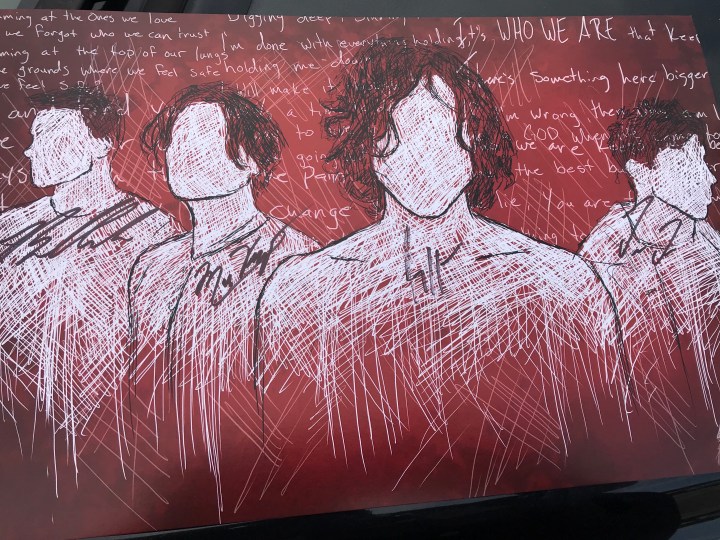
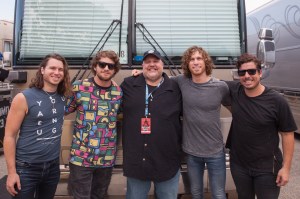 Because it was my conversation with Johnny Hawkins, Mark Vollelunga, Daniel Oliver, and Ben Anderson, the band members of Nothing More, that really got me thinking about all this, I am going to point to one of their songs for inspiration. Honestly, I not paid very close attention to the words of their song, Who We Are, until they autographed the poster pictured here in this post, and gave it to me. It has the words to the song in the background. There’s a pretty powerful message in this song that who we are should keep us believing. Click here to watch the video of Who We Are by Nothing More.
“It’s who we are that keeps me believing
There’s something here bigger than ourselves
If I’m wrong then why am I still feeling?
Who we are, keeps me believing
Keeps me believing”
~ Chorus From Who We Are by Nothing More
This is actually very profound. Who we are is much more important than what we do. We need to focus on being bigger on the inside, our character, than we are on the outside, our influence. Think about it, if our character waivers, our influence becomes discounted. We must line our lives up with our values or we will live a life that is out of balance and devoid of the creative energy we need to achieve our true potential.
“For what will it profit a man if he gains the whole world, and loses his own soul? ” ~ Jesus in Mark 8:36
We also need to think about the chorus phrase, “It’s who we are that keeps me believing.” Think about that; it doesn’t say, “who I am” it says, “who we are.” This is profound when we think about leading or being part of our businesses and organizations, our communities, our schools, our country, or the larger aggregate of the world 🌎. Who we are and what we believe in aggregate matters. We need to create organizations, communities, countries, and a world 🌍 where we all matter.
“What we know matters but who we are matters more.” ~ Brené Brown
As it says in Who We Are, I want the “you, that’s in me, [to be] in everything.” Let’s work to create a world where we can “stand together” because of Who We Are!
 Byron's Babbles
1 comment