Manatee Leadership Lessons

![image1[7322]](https://i0.wp.com/byronernest.blog/wp-content/uploads/2019/12/image17322.jpeg?w=236&h=236&crop=1&ssl=1 "image1[7322]")

Yesterday, I had the opportunity of a lifetime to learn leadership lessons from the West Indian Manatee. Our Central Florida/Tampa 3D Leadership Program participants decided that we would start our gathering at the Tampa Electric Company Manatee Viewing Center. The Big Bend Power Station in Apollo Beach delivers reliable electricity to the community. When the Tampa Bay water temperature reaches 68ºF or colder, the Manatees gather in large numbers in the power station’s discharge canal, where saltwater – taken from Tampa Bay to cool Unit 4 flows, clean and warm, back to the bay. The discharge canal is a state and federally designated Manatee sanctuary that provides critical protection from the cold for these unique, gentle animals. It has also been developed into an incredible education center dedicated to the Manatee, Sting Ray, birds, butterflies, and other wildlife and plant life indigenous to the area. I even got to smell the breath of a Manatee. For the farm kid from Indiana this was an incredible experience.


Prior to arriving for the experience I did a a little studying and learned how the Manatee handle thermoregulation by doing central-place grazing. In other words, they go out into the cold bay water to graze on plant life (they are herbivores) and then come back to the warm water near the power plant to get warmed up. I was also able to study the migratory maps of these amazing mammals.
The objective of participants was to come up with the leadership lessons learned from our Manatee experience. Here is what we came up:
- Must be caring
- Adaptive to change
- Lead by example
- Able to function alone
- Still move forward through the unknown
As you can see there are so many great leadership lessons to be learned from studying and observing these wonderful animals. I have done other blog posts with lessons from animals, such as Pelican Leadership Lessons, Living and Leading Like A Lobster, and Leading Like A Platypus. Using animals as metaphors for great leadership is a great way to learn and teach leadership. Do you have any examples? Share them by replying to my post.
Lessons Of Florida-Opoly
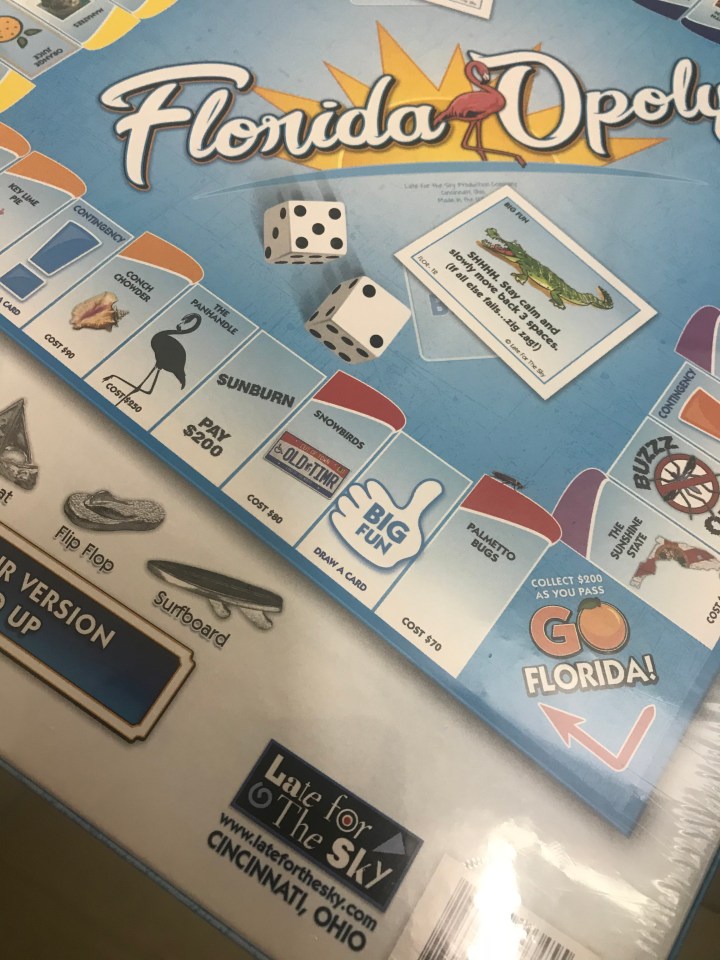 I was so honored to be presented with the newest wave of personalized Monopoly game, Florida-Opoly, last night by the Central Florida/Orlando cohort of 3D Leadership. For the guy that teaches leadership through the metaphors of toys, this was very appropriate and appreciated. When presented the game it was said they picked it as a gift of appreciation because I love to have fun, see the value of playing games, and have strived to learn all I can about Florida while spending time in the area. All true!
By personalizing the Monopoly game to local places, the creator, Late For The Sky, believes it brings more fun to the game through local authenticity. As a believer in local and state autonomy, this custom-opoly board game really struck a cord with me as I opened the box and began to explore all the parts, rules, and possibilities.
Here’s a brief rundown on what I found:
- Palm Trees
- Sunglasses
- Sea Turtles
- Sailboats
- Flip Flops
- Surfboards
- Key Lime Pie
- Alligators
- Orange Juice
- Disney World
- Snowbirds
- Manatees
- Dolphins
- Flamingos
- Hurricanes
- Sunscreen
- Atlantic Ocean
- Gulf of Mexico
- Conch Chowder
- Cuban Sandwiches
Now that’s a game. Players can buy their favorite Florida properties, like beach houses and resorts. But you have to watch out for hurricane warnings, alligators, and run ins with stingrays. Basically, it is a fun way to experience The Sunshine State. Also, it was a reminder of how different Florida is from my home state of Indiana. Now, I could make you a list of 20 cool things in Indiana, but the lesson here is the reminder of the different contexts in which we live.
This game is an important reminder of the complexity of the theory of autonomy. In 1982, President Ronald Reagan proposed returning significant responsibilities to the state and local governments. My other hero, Patrick Henry would have cheered. The challenge with this rhetoric, for as much as I believe in it and believe it should always be contemplated, is that it is not as simple as it sounds. The question that remains still today is what powers should be local and yet not compromise national concerns. I so wish I would have been around for the Federalism and Anti-Federalism discussions with the founders. It’s obvious I would have been an Anti-Federalist, but clearly a balance is where we landed (and needed to land). And, it continues to be a balancing act to this day.
As James Bryce posited in The American Commonwealth, “The wisest statesman is he who holds the balance between liberty and order” (Bryce, 1888, p. 749). Bryce spoke a lot about the balance of state’s rights and federalism in his critique of our democratic system of government. Bryce also warned of “Ill-considered legislation, facility and excess of law-making, and inconstancy and mutability in the laws, form the greatest blemish in the character and genius of our governments” (Bryce, 1888, p. 750). From a state’s rights standpoint, Bryce was concerned with states conducting rash experiments.
Alexis de Tocqueville did a much more sophisticated analysis of the underpinnings of a successful democracy. In Democracy In America (appearing in two volumes in 1835 and 1845), posited that there were two important tracks to our system, one of which were the broad freedoms assured by our national constitution. The other was a complimentary track of secondary liberties at the state and local levels. Tocqueville saw this as being product of human wisdom and choice, not historical necessity. Tocqueville saw the genius in a balance of both national and state/local control. Here we are at the end of 2019 still grappling the question of what the ideal balance is. Maybe that means our system works.
Only I could take the fun game of Florida-Opoly and turn in into such a deep political analysis. But, having spent Monday and Tuesday of this week up in Gary, Indiana to sort out best solutions for a school situation that I, as an Indiana State Board of Education member, have responsibility for, I can tell you the local, state, and federal contexts are at play. Full local autonomy failed our children, but some might argue that state and federal laws and requirements might have played a factor. Again, I believe it is a balancing act.
What I am for sure reminded of by Florida-Opoly is that we need to be aware of our local strengths, weaknesses, and needs. We then need to work within the autonomy we have to make our states and local communities great!
Leadership Dominoes

“Everything affects everything else in one way or another. Whether you are aware of that or not does not change the fact that this is what is happening. That’s why I say a business is a system. This systems perspective reminds us that this is what is going on. And when you see it this way, you can manage your business better. You appreciate, for example, that any action will reverberate throughout the entire company. This causes you to pay more attention to what you do, and learn the right lessons from your experience.” – John Woods
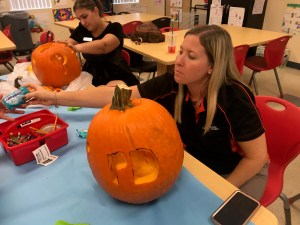
I use the metaphor of dominoes falling all the time and was reminded that everything affects everything last night at our Tampa, Florida area gathering of 3D Leadership. We did an activity carving pumpkins in the theme of “truths that frustrate me”. As a story was being told about how a Curriculum Resource Teacher (CRT) was covering classes that didn’t have a teacher, because of the teacher shortage, she stated that she loved covering the class and teaching. The problem, however, was that she was very frustrated she was not able to support the teachers that she was responsible for coaching. This really made me think about how this was really two rows of dominoes put in play. I did my best to graphically represent it (shown here in the post). The first row of dominoes was put in play when there was a teacher not available for a class. The second row of dominoes was put in play when the CRT covered the class, even though she loved doing that, and she couldn’t work with the teachers on her coaching load.
 Dominoes are actually a learning lesson when it comes to leadership. Up until the time I heard this story originating with a pumpkin carving I had thought of the domino effect in a very linear view. this caused me to think about all the other rows of dominoes that get put into play with just one decision, event, action, or mistake. Regardless of the catalyst that sets the dominoes in motion, it is some type of change. Leaders and organizations need to navigate these changes carefully and be sure the changes, or the people making the changes, aren’t like a bull in a china shop. Sorry for the use of another metaphor. We need to lead with a systemic focus. We need to take into consideration all the interconnected parts of our organizations that could set the domino effect into motion, impacting the success of the change, productivity, effectiveness and lives of those we serve.
Even though all the people and parts of your organization are not dominoes, we would be well served to treat them as such. Our organizations are interconnected systems. Changes in on area have a direct impact on changes in other areas. We need to remember that once dominoes start to topple over, it will take time to get them put back up.
Questions?
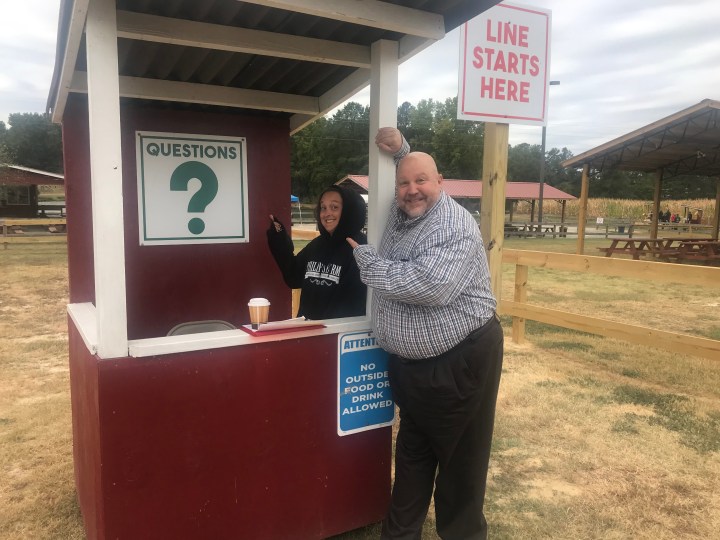 Yesterday at our North Carolina 3D Leadership gathering we went to Phillips Farm pumpkin patch in Carey, North Carolina to get pumpkins for an activity. The activity is not the focus of this post. The focus is on a booth set up at the farm for answering questions. The kiosk literally had a question mark sign on it with the word “questions” (see picture). Everyone in our group was immediately struck by the feeling of being put at ease knowing that we had a person and place specifically designed to answer any and all of our questions. What a simple sign and simple concept!
 The young lady at the kiosk was able to answer all our questions and get us set up to get everyone the chance to pick out their very own pumpkins. She even gave us a Dum Dums sucker, telling us that no question was too dumb to ask. But the part that continued to amaze us was how comfortable that sign made us feel when entering the area. There was no anxiety trying to figure out where to go or what to do.
 We then began to discuss how we should make kiosks in our schools during parent events or back to school events to make families comfortable asking questions. The question mark sign had empowered us to ask questions. It gave a very different feeling than if there would have been a sign that said “information” or just people standing around to answer questions. It was just comfortable – there is no other way to describe it.
This reminded me of the research that has been done in schools on surveys of climate and culture. Research tells us that if we were only able to ask one question on a survey the most important one would be, “How comfortable are you asking questions in your class?” If students are comfortable asking questions the schools is most likely on an upward trajectory. Therefore, we need to make our classrooms comfortable places for inquiry and empower our students to ask lots of questions.
In fact, as leaders, we need to make every environment we facilitate a safe place to ask questions. Think about the last meeting, professional development session, or gathering that you didn’t feel comfortable asking questions. Miserable, wasn’t it? Then, think about the times when no question was a dumb question and there was a free flow of inquiry. Makes us feel very empowered and comfortable, doesn’t it?
So, let’s start staffing “Questions?” kiosk both literally and figuratively, and creating empowerment through comfort in asking questions.
Is Your “Want To” Big Enough?
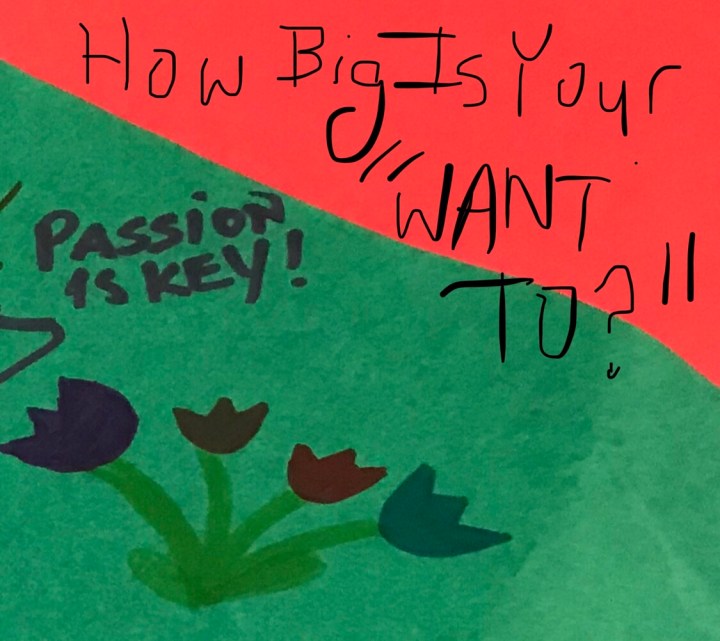 This morning I flipped through the television channel to see what was going on in the world and stopped on a channel with one of my favorite preachers, Joel Olsteen. When I tuned in he was asking the question, “How big is your ‘want to’?” I love this question. Many times our “want to” must get to a certain size for us to make a change or go after a desire.
This went right along with a discussion we had this past week in our 3D Leadership Program about the statement in Nothing More’s song Do You Really Want It?, “Everyone wants to change the world, but one thing is clear, no one wants to change themselves.” How big your “want to” is goes right along with this.
Your “want to” is how bad do you want to accomplish something. It is your “want to” that will be your driving force behind how far you go and how much success you will have with it. Many people like to talk big games, but “talk” and your “want to” are two different things. You have to really want something in life in order to accomplish it, especially if it is a big goal or aspiration. As with all big goals and aspirations there will usually be a lot of obstacles and roadblocks that will pop up along the way.
Other people call it your “purpose”. Some call it your “why”. Your “want to” is what it really is. How bad you want it, or answering the question Nothing More asks, “Do you really want it?” is what it really comes down to. Your “want to” will determine how far you will go to ensure success. The bigness of your “want to” must rise to match the power hidden in the thing you want.
Bottom-line: until your “want to” gets big enough, we will never make the changes, or do the necessary preparation, or other things needed to do the desired action. To achieve great things to change the world, you need a big “want to”. Your big “want to” should inspire and drive you to take the necessary action to achieve it.
Infectious Leadership


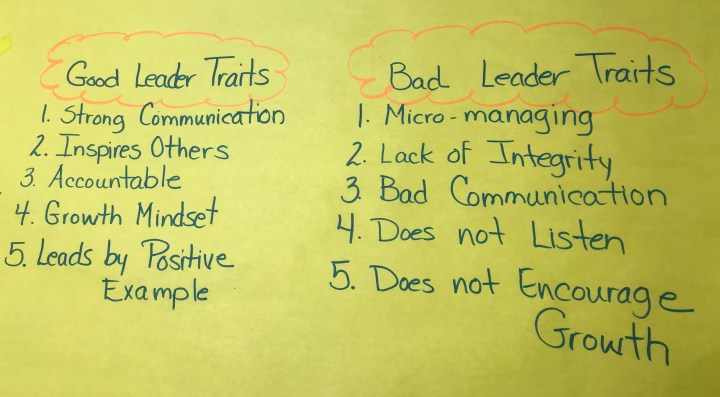
In the past week I have been with four groups of school and teacher leaders from three different states doing leadership development facilitation as part of our 3D Leadership Program. As part of this months focus we did a good leader/bad leader activity where each group developed a top 5 good leader trait and top 5 bad leader trait list. Two things that did not hit the lists were charisma and celebrity. It is clear that all want present and technically competent leaders who have a growth mindset and are contagious. This then trickles down to the team.
So what does having a growth mindset mean? To me it means having a transformative and innovative approach with the team. It means letting the team be curious and creative; finding ways to get better. Great leaders let go of certainty and open the door to other points of view. Great leaders also trust their team members and give them more latitude. These same leaders provide appreciation for all new ideas and achievements of employees. They are comfortable trying new things knowing that all will not work. It’s about being curious themselves.
To set the stage and paint the picture for modeling this growth mindset the leader needs to talk in ideals; ideal work, ideal team, ideal outcome. The question I always like to answer as an innovative and curious leader with a growth mindset is: “what does success look like?” One thing is clear from listening to all these leaders: we need to be present, communicate (including effective listening), and have a mindset for growth. Are you infectious?
Manufactured Culture
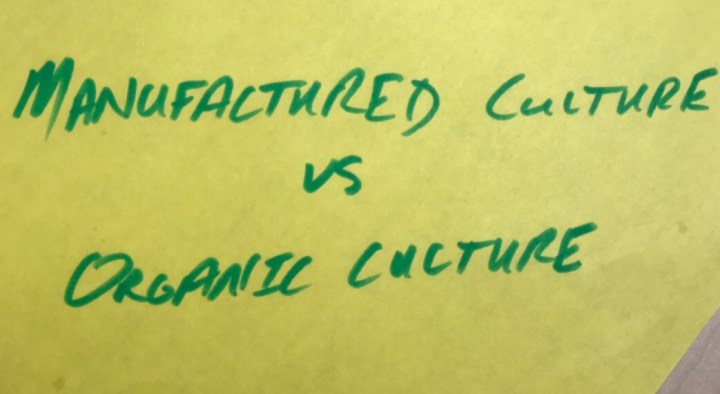 Tonight in our Central Florida gathering of 3D Leadership in Orlando, Florida we got into a discussion about “manufactured cultures” vs. “organic cultures”. Clearly, just like with food, organic wins out as best. We always talk about how great it is for things to happen organically, but I had really never thought a lot about how detrimental it was for leadership to try and manufacture culture.
Most team members truly try to be honest and try to make the environment a better place. Leadership, conversely, that is inexperienced or questionable results in bad decisions. These leaders then try to manufacture a culture that is contrary to that of the larger organizational community. This leadership lacks tactical and long term strategic vision. Ultimately, this results in a disconnect of culture/morale. Check out this list of top five good leader traits that would lead to an organic culture and top five bad leader traits developed by the participants tonight that would contribute to a manufactured culture:
In order to develop a community with an organic culture, leaders need to understand their own limitations and areas for growth and fix them. Additionally, great organizational communities identify the difference between finger pointing and leading. We must also listen to our long term team members, whose insight has been proven over and over.
Great organizational communities with organic cultures listen to their teams and fix issues right away. There is also always honesty about what is going on in the organization. Additionally, organizations sometimes become very cult like which results in a manufactured culture.
How about you? Are you leading in a way that lets your organizational culture develop organically, or are you manufacturing it?
We Hate The Buzz Kill
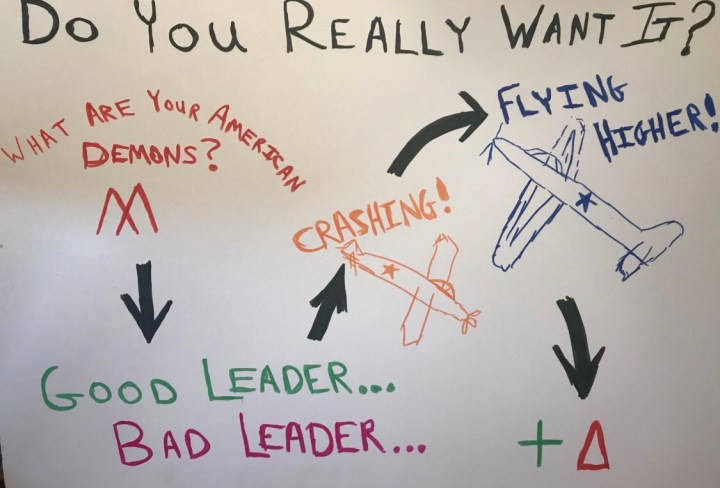
“Everybody wants to change the world…But one thing’s clear…No one ever wants to change themselves…That’s the way things are…All because we hate the buzzkill…Jaded when we need to feel…But we can change it all if you really want it.” ~ Nothing More in the song Do You Really Want It?
Today in our 3D Leadership, session with North and South Carolina participants, we discussed the concept of a buzz kill. This was prompted by a discussion and analysis of the lyrics to the great Nothing More song Do You Really Want It?
Beware of the buzz kill. That person who is in your organization, community, class, school, or government who takes a perfectly good idea, concept, or change and shucks it off as being worthless or not meeting their own values. They do it with their negativity and virtue signaling. The thing about buzz kills is they are usually smart, respected, and rationale people. they appear to be very noble in their actions, but are full of crap at the same time. Their points may make sense, but we do not want to hear them at the time. The goal of the buzz kill is to have you join their misery.
We also need to be aware that we can create the buzz kill for ourselves and those around us. Think about times when you’ve poo poo’d someone else’s, or your own dreams or steps to changing the world. Remember, if you are not experimenting with new ideas, you are probably stuck with old, out of date ones. Notions change all the time, after all. Stick with old ideas, and your thinking will end up obsolete.
We can change it all if we really want it. Ignore the buzz kill!
Preaching From The Office
 Last night we had a great 3D Leadership gatherings in Indianapolis. One of the cool things we did was have a good leader/bad leader discussion. With this we discussed good leadership traits and bad leadership traits. Then by writing good leader traits on the right wing of gliders and bad leader traits on the left wing and throwing them to each other, we developed a top 5 good leader traits and top 5 bad leader traits.
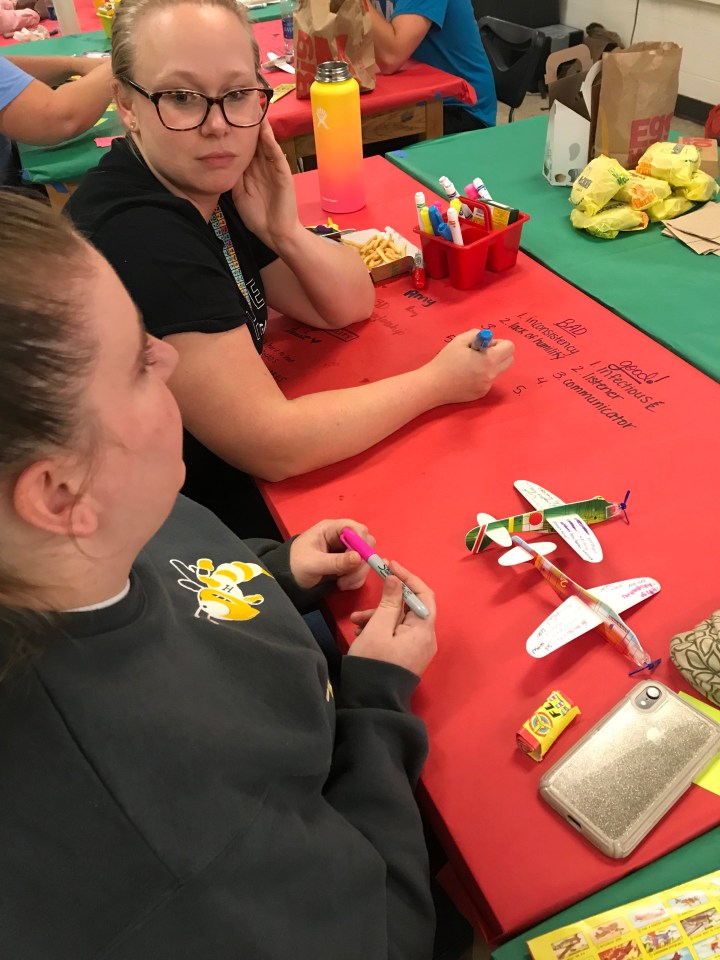 One of the top 5 bad leader traits was “Preaching From The Office”. Bottom-line: the pull to stay in the office can be great. It takes a love of the people and the work to throw oneself into the work, for leaders to leave their offices. The best leaders, according to the teacher leaders I was working with last night, get out of their offices. Here’s why:
- When we get out of our offices we give encouragement to those we serve.
- When we get out of our offices we discover the amazing people in our organizations. This enables us to get to know those we serve.
- When we get out of our offices we collaborate. This allows us to see the organization from all vantage points. Thus we would avoid making decisions in isolation.
- When we get out of our offices we see where the vision has leaked, excellence has slipped, and communication has faltered.
- When we get out of our offices we are able to tweak and make changes with knowledge, clarity, and credibility.
As you can see this bad leader trait has serious implications. The good news is, it is easily fixed. Get out of your office. You will gain insight and those you serve will love having you in the trenches.
It’s Not My Story To Tell

Hailey showing off her temporary Emoji tattoo
I am writing this post as I sit in the airport waiting to fly home after a few days in central Florida facilitating our last 3D Leadership sessions for the spring semester. I am going to miss doing these in June and July, not just because I love doing them and working with all the great leaders that I have the opportunity to serve, but also because of all the learning and reflecting I am able to do as well. We have had so many great discussion and I have a whole list of topics I want to reflect deeper on and study.
This post is about communication, but not the normal topics related to communication like the leader that talks in espoused cliche´infused declarations like “Students first,” or “Customers first,” “All hands on deck,” or “We need to move with urgency.” Over and over again, they present grand, overarching and fuzzy statements of who really knows what. Too often we assume that everyone shares the same definitions for terms that go on and on like vision, value, move with urgency (does that mean I’m supposed to run everywhere?), teamwork, focus, strategy, and on and on. While it is important for great leaders to get a handle on this communication issue, this is not the focus of tonight’s post.
Tonight, I remembered a statement by one of our North Carolina members, Hailey Odum, made in her first session while reflecting on what she wanted to be as a leader. Hailey said it bothered her when people talk about things they either shouldn’t be talking about, or really don’t know all the details about. She said she does not tell the story if: “It’s not my story to tell.” This really hit me because this is a pet peeve of mine as well.
You know the individuals Hailey and I are talking about here:
- need to know everything and probably don’t.
- want you to know they know something.
- usually don’t have all the details.
- flaunt that someone called them and let them know something before you, or even say, “I’ll bet they haven’t told you yet.”
- start with: “I’m not supposed to know this, but so and so told me.”
- you hear in a meeting an announcement and are told it is not public yet, but you heard a group talking about it the week before with all the details you just heard.
When I look at these items in bullet list form it almost reminds me of being in the third grade again. I am sure you could probably add another six bullet points to this list, but you get the point. Now this is not to say that I do not know things at times in advance of others or that others don’t confide in me at times, but I really do try to use Hailey’s sniff test of asking myself “Is it my story to tell?” If it is not then I shouldn’t. Notice I did not say I don’t because I am not perfect, but I have to say I am much better at applying the sniff test since Hailey pointed this out as a leadership trait that needed to be followed.
This then goes to thinking about how communication is handled. For example if you work in a team, it is probably not healthy for certain team members to find out things ahead of others. If we have to say things like “Oh, I thought you knew.” or “You didn’t hear this yet.” or the worst one “So and so probably didn’t tell you, but she let me know (you’ve just been told you are not worthy of knowing at the same time as everyone else).” Now in reality what we may have just experienced is simply terrible communication skills, but even so, this is a little bit like leadership by the game of telephone. And, because it is probably not the person who is telling you story to tell, things maybe are not represented correctly.
I really appreciate Hailey bringing this up as a topic of discussion because it has now been something that I consciously think about. So next time you know something, or think you know something, ask yourself, “Is that my story to tell?” Nine times out of ten I’ll bet you answer, “It’s not my story to tell.”
 Byron's Babbles
leave a comment