Boil It Down To Essence

In the first volume of Mark Twain’s autobiography he talked about “boiling down to it’s essence.” He was referring to people, events, and characters in stories. I have always been intrigued by essence and blogged about essence most recently in What Is Your Essence? Essence can be defined as “the intrinsic nature or indispensable quality of something, especially something abstract, that determines its character.” When thinking of people and organizations I think of essence as the soul, substance, and core values. This really is as Twain described it “boiling” down to. It’s the honest and critical view of us or our organizations.

Highly effective leaders are context generators. I often discuss that context matters. Our essence generates that context. Our essence is the personification of our values, principles, and character. From an essence standpoint those values, principles and character are always implicit in the leader’s actions. Notice I didn’t say present from “words.” Essence is how a person walks the talk, or doesn’t. As leaders, our essence is reflected in our organizations.
Having A Sharp Eye For Capacity

Mark Twain said, “Always do right. This will gratify some people and astonish the rest.” Unfortunately, Twain was taken advantage of more than once during his life. But he always tried to “do right.” I am reading Mark Twain’s autobiography right now and it is amazing. He dictated much of his autobiography and purposely wrote it as memories came to mind, not in chronology order. For some of my more linear friends this might drive you crazy. Those that know me, know I am loving this non-conventional approach. I love it because in his “twittering” (yes that is a word used by Twain a great deal and I now know where the name for Twitter came from) he talks about friends, how he met them, and his interactions.
One such friend was Henry Huttleston Rogers, the Standard-Oil magnate who became one of the most powerful tycoons of his day. Twain first met Rogers in New York in 1893 at a time when Twain’s unfortunate financial ventures had led him to the verge of bankruptcy. Rogers helped sort out Twain’s commercial enterprises and saved the author’s copyrights. In the autobiography, Twain expressed his gratitude saying, “His wisdom and steadfastness saved my copyrights from being swallowed up in the wreck…and his commercial wisdom has protected my pocketbook ever since.” These two became great and very close friends.
One of the things that Twain recognized in Rogers was “he [Rogers] has a sharp eye for capacity.” I love that Twain picked up on Roger’s ability to see the talent and ability in others and then develop those individuals. Twain discussed this being one of the key ingredients of Rogers’ success. This just shows how important it is for leaders to hone this skill, or find ways to sharpen the eye for capacity. I was working with a group of school principals yesterday and we were discussing this very subject.
We can distill the notion of capacity to the skills, knowledge and abilities of an individual. We must sharpen our ability to recognize capacity and then build that capacity in people. Consequently, our teams and organizations will become more resilient and stronger. The greatest leaders recognize and build on the strengths of others and what they have to say. They are a voice among many in conversations, and not just a voice that tells others what to do. As Twain said in his autobiography, “If everybody was satisfied with himself there would be no heroes.” Let’s not be satisfied. Let’s work hard to recognize and build capacity in those we serve.
Stop Playing Games

In a leadership gathering I facilitated this past weekend we did an activity where we recognized leaders who were influential in our lives. A comment that came up on a couple of the influencers was that they knew how to “play the game.” Interestingly, we also discussed how there shouldn’t be a game to have to play. It is a huge paradox that is still causing me a great deal of thought. My problem is, why does there have to be a game? I get it; lots of good things come from the healthy bi-play of ideas and personalities. Good leaders take good advice from the people around them and make better decisions as a result. There is a negative side, though, when we play each other and manipulate.
In the spirit of controlling the things I have control of, the surest way to avoid game playing is not to play games myself. As leaders, we must remember that if we create games and try to manipulate others, those watching will model the behavior they see in us. Thus a culture/community of having to play the game is born and cultivated. I’ve seen it first hand and it is toxic. Thus the paradox: the organization’s culture portrays the internal political game that lies with the organization more than its core values. Even though the organization game or office politics is a negative, I have learned and know many who would agree that choosing not to play the game can actually hurt more than playing the game. Yes, you guessed it, I’ve experienced that too.
Aristotle said, “man is by nature a political animal.” Unfortunately, the political game has a big influence on what happens to us, our projects, and our teams. So, we can’t just ignore the game, but I do hope we strive to eliminate it where we can. Research tells us that employees are less engaged when they perceive there being a game to be played. No surprise there! People are also more likely to quit in that environment, which means to be successful you need to know how to play the game. And round and round we go!
So let’s try where we can to eliminate the hidden agendas and need to play the game. Where we can’t eliminate the game, let’s make sure we play in a way that does not hurt others or ignore others’ rights. It comes down to being sincere.
We Should Not Need Trumpet Lessons

We were taught to catch ourselves doing things right in Simple Truths of Leadership: 52 Ways To Be A Servant Leader and Build Trust, Making Common Sense Common Practiceby Ken Blanchard and Randy Conley. In Simple Truth #17, “It’s Okay To Toot Your Own Horn,” we we given two really good points:
- “When people appreciate what you’re doing, don’t say, ‘Yes, but…’ Instead tell them you appreciate their noticing” (p. 49).
- “Along the same lines, when someone pays you a compliment, simply smile and say, ‘Thank you.’ Don’t disagree with them – that’s like telling the person they don’t have good judgement or aren’t very smart” (p. 49).
Those two points are great personal growth reminders and things I need to continually work on. These remind us to not be modest to a fault. If we underrate your own abilities, it’ll be hard for anyone else to recognize them. We need to give ourselves credit for our expertise.
When reflecting on the metaphor of tooting your own horn, however, I believe it is a leaders responsibility make sure those they serve do not need to take trumpet lessons. Instead we need to development a community where everyone is noticed for their contributions. We all know people who get ahead because they are gifted artists at the practice of getting the boss’ recognition—even if others have done most of the work. And we’ve seen the boss’s that don’t have the awareness to see through this. Then, in many organizations, those with their heads down doing the work are overlooked. It is a leaders responsibility to find these people. It is about awareness. Great teams shine the light on each other when they deserve it.
Being Eclectic

A couple weeks ago after doing my weekly social media posts about the books I am reading, one of my connections posted, “That’s an eclectic mix. Thanks for sharing.” This got me thinking about being eclectic. Inherent to the meaning of eclectic is the idea of a mixture. In the context of loving to learn from a mixture of intersectional (unrelated) genres, topics or authors I myself could be considered eclectic. I am such a believer in the power of intersectional learning. In fact I many times use things like how a toy is played with in my workshops to spur thinking about totally unrelated topics. For example, last week each participant received a toy and then had to find someone with the same toy and figure out how to use the way the toy was played with to solve an issue in their school. We had some incredible responses and discussion.
This also got me to thinking about the eclectic philosophers. These were a class of ancient philosophers who did not belong to, nor found any recognised school of thought, but drew ideas and doctrines from various schools. While I have some very definite core values/beliefs, I would have to say I do draw from and love studying various schools of thought. I am really not sure how I would continually grow and improve if I did not. I look at this as using diverse instruments and theories strengthened and harmonized when learned and used in a mutually reinforcing manor.
Remember, as human beings, we don’t just passively experience the social world around us. Instead, we actively construct that world ourselves through our actions and the ideas that guide them. Therefore, the more eclectic our sources to learn from, the more ideas available. We must also never forget that we may need to know what others know in order to solve our own problems. I like to approach everything as an exploring instead of an expert. Diversifying how and where we learn will not compromise our core values and beliefs.
Becoming Humble

Last year in Leading Like Charlotte’s Web I wrote, “Wilbur was humble. ‘Why did you do all this for me?’ Wilbur asked. ‘I don’t deserve it. I’ve never done anything for you.’ ‘You have been my friend,’ replied Charlotte. ‘That in itself is a tremendous thing.’ People respond well to humility because it shows that you place yourself at the same level as others, and not above them.” I am also reminded of Drybar’s seventh core value: “7. Nothing is sexier than honesty and humility! Arrogance and cockiness are gross. Actions speak louder than words. Be sexy.” I wrote about those core values in Core Values Are The Heart &Soul. Humility does not show weakness or confidence. It shows we recognize something pretty obvious – no one knows everything. The great leaders know what they don’t know and understand there are things they don’t know they don’t know. But, learning from and with others, asking questions, and asking for help are hallmarks of an effective and humble leader.
Giving others credit when things go well and taking full credit when things do not go so well were considered the hallmarks of a servant leader in Simple Truth #16, “People With Humility Don’t Think Less Of Themselves, They Just Think Of Themselves Less”, in Simple Truths of Leadership: 52 Ways To Be A Servant Leader and Build Trust, Making Common Sense Common Practiceby Ken Blanchard and Randy Conley. We are at a time when I hope more will become more humble. Especially when it comes to intellectual humility. We need to open our minds to learning. With intellectual humility we become wiser. It is really about realizing that we can learn from opposing views and have more constructive discussions, even when we disagree. Practicing intellectual humility allows us to be less judgmental of others.
Ask, Don’t Assume

I’m always amazed at how many leaders think they know what the people they serve want, need, or motivates them. In fact I discuss a lot that we need to ask not guess. Many times providing the wrong things is worse than nothing at all because it proves you have not taken the time to get to know those you serve, or their needs. Ken Blanchard reminded us of this when he said, “Motivate your people in an effective and personal way” (p. 43). Loving those we serve is all about personalizing for each person’s needs.
In Simple Truth #15, “Never Assume You Know What Motivates A Person”, in Simple Truths of Leadership: 52 Ways To Be A Servant Leader and Build Trust, Making Common Sense Common Practice by Ken Blanchard and Randy Conley we learned that “The reality is that people have personal reasons for what motivates them” (p. 43). If we are serious about building relationships, ask, don’t assume
Wanna Into Gonna

As I was flying home from facilitating a leadership professional development gathering yesterday I noticed what was written on the Southwest Airlines napkin. The Southwest business model has always been intriguing to me and I was struck by what was on the napkin, “In 1971, a triangle scribbled on a napkin transformed a dream into an airline and a wanna into a gonna.” I love the thought of a wanna becoming a gonna. This is also a reminder that it takes action to make dreams realities. We also, can’t do it all ourselves.
Whether it is making the plan visible and real on a napkin or just getting to work, the point is we have to start somewhere. There is a whole lot to what Herb Kelleher had to do to get Southwest Airlines off the ground (pun intended). I’ll let you do all the reading on that, but the point is we need to plan out turning our wanna into gonna. Also, remember, in this age of crediting everything to rugged individualism, no-one accomplishes things by themselves. We all need someone that provides us with the assist. It is very disingenuous to tell our kids that if they just work hard they will succeed. That is simply not true. It is an important part, for sure, but not the end-all-be-all. We all need those that provide us with privilege for accomplishing our dreams. Yes, Kelleher had tenacity and stuck with it, but he had people all around him, including his employees who he cared for deeply helping him get it done.
What dream triangle do you need to scribble on a napkin, and who can help you turn your wanna into a gonna?
Being Treated Well
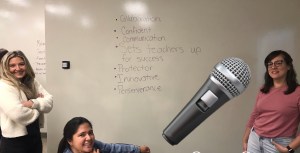
Today I was reminded of something I heard Steve Jobs say, “Leadership is about inspiring people to do things they never thought they could.” A participant in a leadership development gathering I facilitated actually said it better when she said, “Leadership is not about a title. It is about the actions you take for others and the example you set for others.” That was a drop the mic moment given that we had been discussing the leaders who had the most influence on us. We had also been reflecting how how well we had been doing influencing others.
As we develop our own leadership style we must understand that those we serve want to be given opportunities to lead themselves. I’m a huge fan and student of Richard Branson. In an interview with Inc. he said, “If the person who works at your company is 100% proud of the job they’re doing, if you give them the tools to do a good job, they’re proud of the brand, if they were looked after, if they’re treated well, then they’re gonna be smiling, they’re gonna be happy and therefore the customer will have a nice experience.” The key words there are treated well. To me that means loving those we serve. It also means being set up for success. In that same interview Branson discusses putting staff first so everything else can fall into place. I have often said in education we must put teachers first so students can be first. Let’s treat everyone well!
Insane Plans

One of my favorite books this year has been The Martian by Andy Weir. There were many great lines in the book that caused me to think. Here’s one I pulled to blog about today: “This was an insane plan and somehow it worked. I spent the last three months being the loneliest man alive.” In the book I got to thinking about all the crazy and insane plans that have worked over time. I can think think of some of my own and I’ll bet you have a list too.
I am reminded that in January of 1917, during World War I, The German Kaiser declared all-out unrestricted submarine warfare on any ship that came within the sights of German U-boats. Between March and December of 1917, British ships of all kinds were sunk, at a rate of 23 a week. Insane plan: camouflage ships — a tactic that proved to be very effective on land. The challenge, however, was how do you do that with a ship? Thomas Edison suggested camouflaging ships as islands. Gotta love Edison Answer: make the ships stand out. Dazzle camouflage was introduced.
During WWI hitting a ship with a torpedo was more art that science. Therefore if all kinds of geometric shapes, swirls, angles, and other art forms were painted on the ships it thoroughly confused the U-boat operators. Guess what? It worked! It also helped the allies quickly identify friendly ships. What was considered insane saved lives and ships.
Do you have an insane idea you need to try? Go ahead. It might just be the next great breakthrough!
 Byron's Babbles
leave a comment