Knowing Your Mission & Purpose
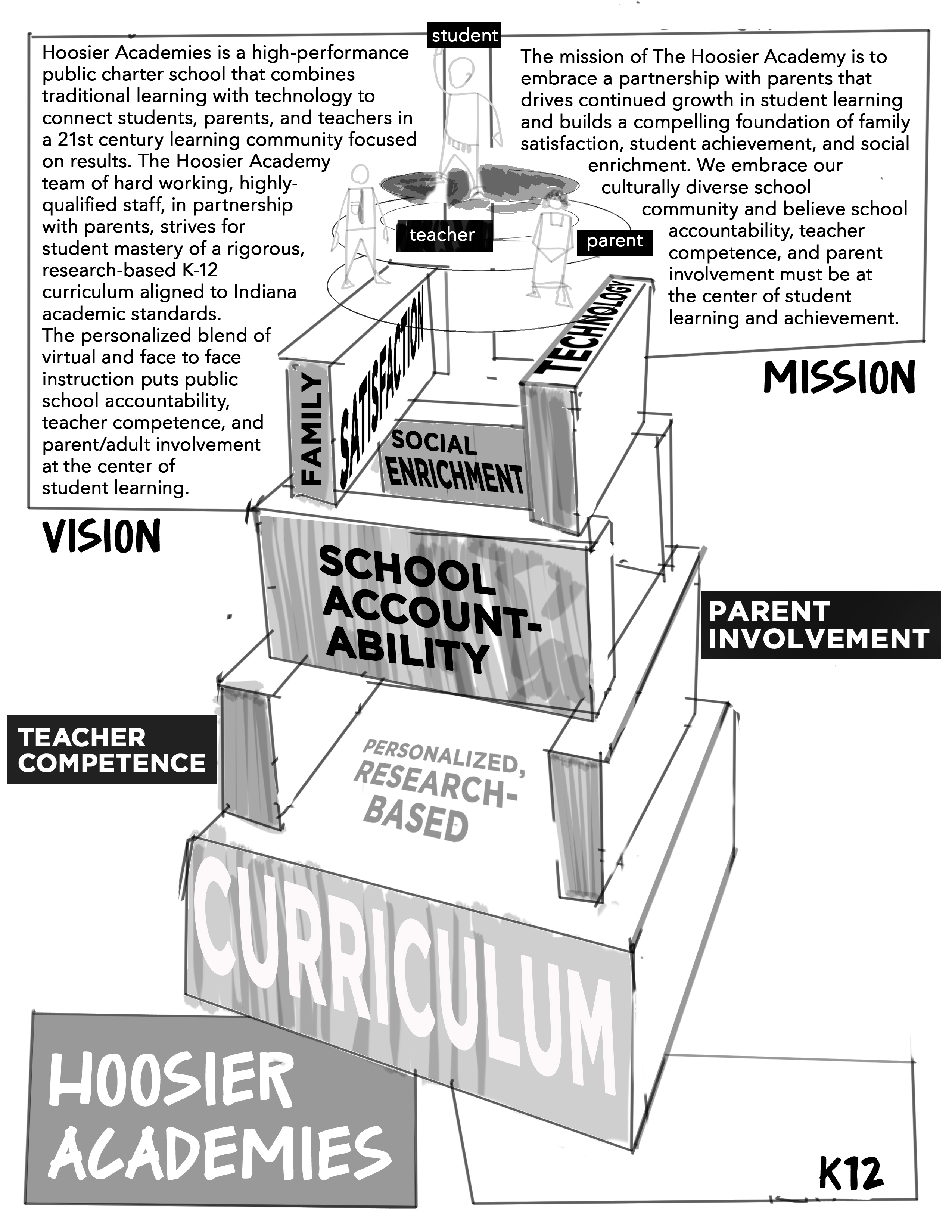
A Graphic Representation of Our Organization’s Study of our Mission & Vision. Thanks Mike Fleisch!
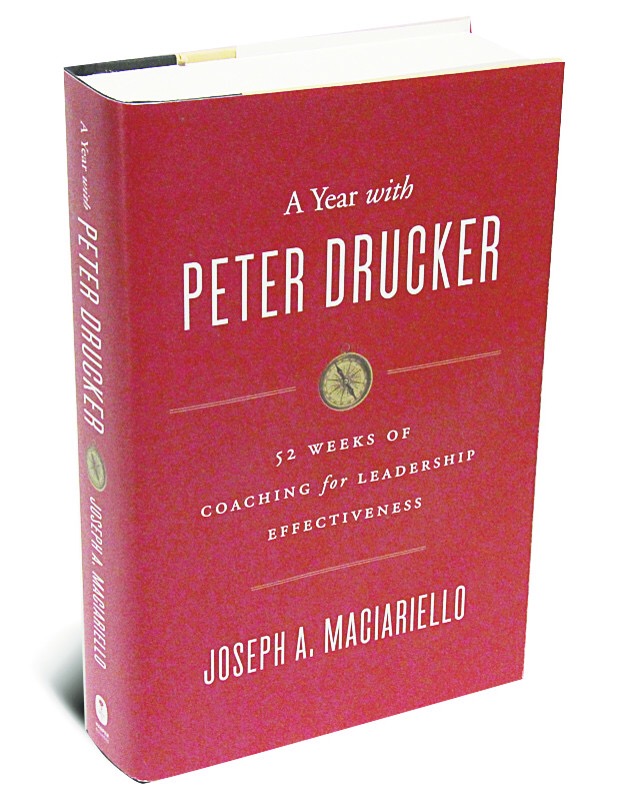
We are working on this very process right now in the schools I lead, Hoosier Academies. I have attached some visuals of our work in this area thus far. It is our desire that this process go so much further than just having words. We want our mission and vision to truly represent the shared purpose of all stakeholders in putting students first. By doing so, we can then budget on purpose, structure on purpose, staff on purpose, program on purpose, and strategic plan on purpose. We must know our mission because not everything is in life is worth doing. Without purpose it is hard to discern what is worth doing. In week 45’s lesson in A Year With Peter Drucker (Maciariello, 2014), five reasons for being purpose driven:
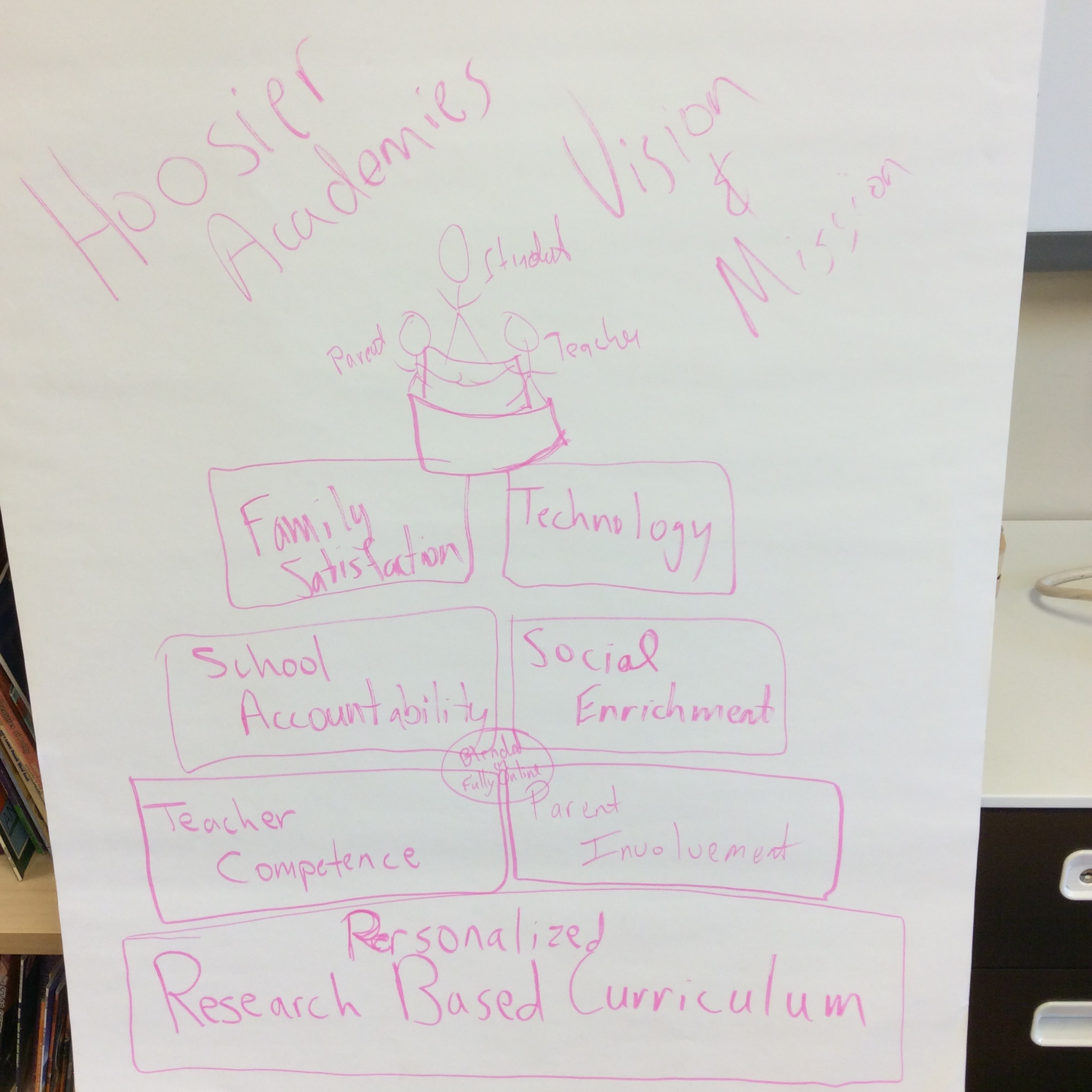
1st Draft of Our Graphic Study of Our Mission & Vision
- Purpose builds morale.
- Purpose reduces conflict in organizations.
- Purpose provides vision.
- Purpose allows concentrating.
- Purpose provides a system of evaluation.
Drucker (Maciariello, 2014) posited that a theory of business needed three parts to be successful. First, there needed to be defined assumptions about the environment of the organization. Second there must be a specific mission. Drucker put this so well, saying, “The assumptions about mission define what an organization considers to be meaningful results – they point to how it envisions itself making a difference in the economy and society at large.” (Maciariello, 2014, p.353) Finally, core competencies define where an organization must excel in order to maintain leadership.
 One of the main reasons we are going through this process right now was driven home by the fact that a mission must be tested against reality. Our schools had not taken a look and really studied it’s mission and vision since the start of the schools. No mission lasts forever. Also, we have to remember what Drucker (2014) taught, “Knowledge is a perishable commodity.” (p. 355) We must not procrastinate if our mission and vision are obsolete or no longer match our purpose. Additionally, we must rethink the assumptions and core competencies on which our mission and vision are based and update the premises on which our organizations are operating. I always have to remind myself and our team to stay focused on the things our organization must do extremely well in order to succeed in carrying out our mission. You will notice in the graphic representation of our mission and vision we chose to use a Jenga theme (I will be doing a post dedicated to the process we are using with our Graphic Facilitator, Mike Fleisch, later). We really think in the case of a school this is such a great way to look at our purpose, vision, and mission using because we have the student at the top, but if any other area fails it brings down the tower and does not allow us to carry out our core value you of putting students first. We must support those areas of required excellence by offering continuing professional development and education.
Reference
Maciariello, J. A. (2014). A year with Peter Drucker: 52 weeks of coaching for leadership effectiveness. New York, NY: HarperCollins Publishers.
Overcoming Obstacles
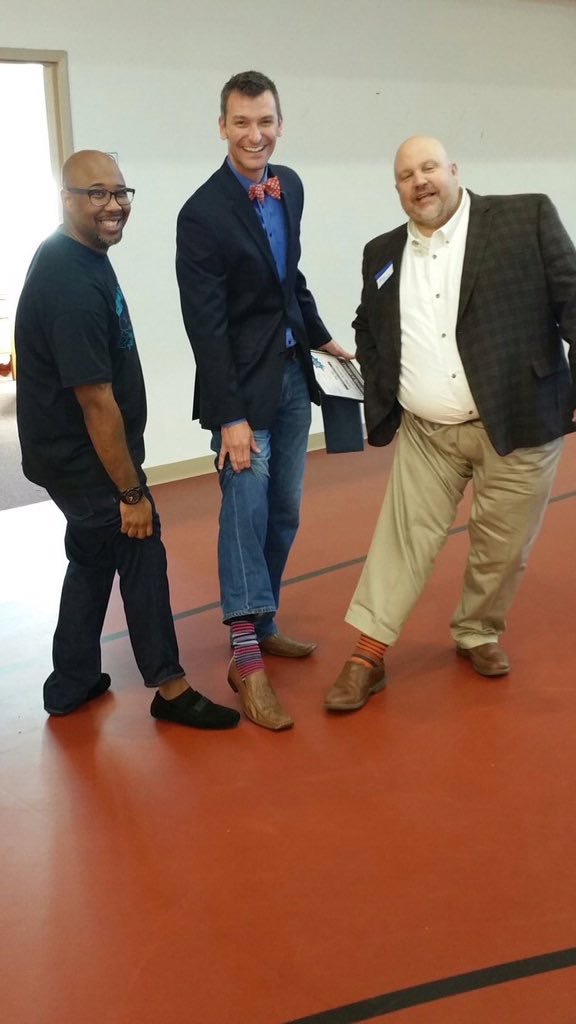
Showing off our stylish socks!
 I had the tremendous honor this past Saturday to be part of the Uplift Indy Youth Expo 2015. The theme of the Expo was Overcoming Obstacles. You can take a look at the program by clicking here. I am so thankful that Reverend Antwan Houser, CEO and founder of UPLIFT Indy, invited me to be a part of this incredible event. Teaching kids to overcome obstacles is part of the organizations mission and I am positive this event will help them become more successful in life.Tim Doty from WTTV CBS 4 Indy was the Emcee and did a tremendous job and it was great to get to meet him. He made a point that is so true: “Bringing about change for our youth is a marathon, not a sprint!” We even had a little fun showing off our fancy socks!
I knew I was in for a treat when the first two speakers were youth, MaKayla Ivory and Jalen McGraw. Here are the points the two of them made that really moved me:
- Don’t let others tell you who you are, what you believe, or what you want to do.
- Start and finish everything with God.
- Many obstacles our youth face exist because they are invisible.
- When working with Indianapolis youth, remember: the blessings are bigger than the burden.
Then, DeAndra Yates, mother of DeAndre Knox who was shot spoke. Knox was shot in the back of head at a party on the city’s northwest side February 1, 2014. Knox is alive today and took his first steps after the shooting on September 30. He still can’t talk, but is starting to respond to questions by nodding his head. Her points were very moving as well. Here are some notes I took during her inspiring message:
- God did not allow this to happen without a reason.
- Grieve, but recognize that the God is using this tragedy to open doors. Yates said she is making it her personal mission to reduce crime in the city and avoid another tragedy like her sons.
- Expect the unexpected. None of us know what the future will bring.
- This happened to me, yet I am still here.
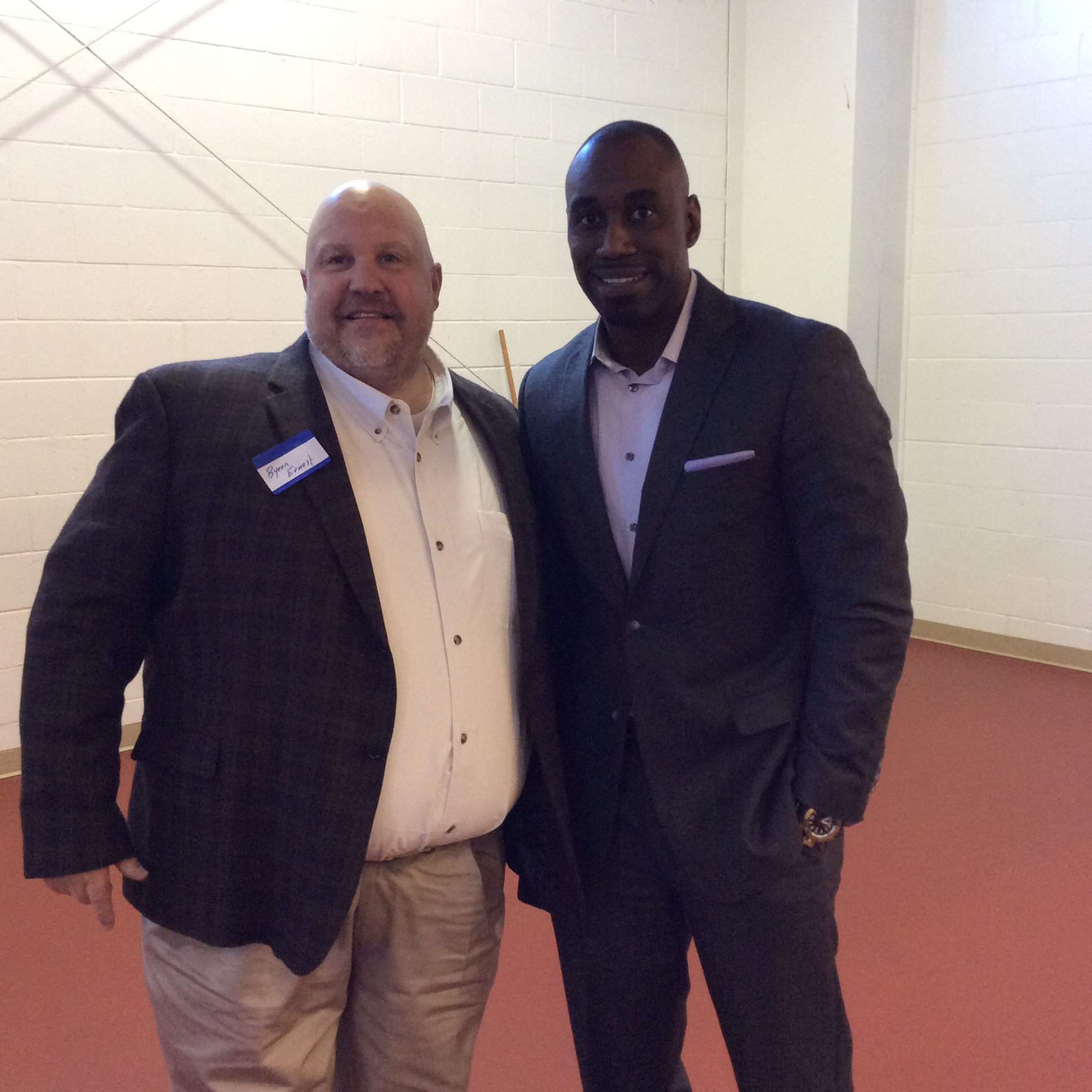
Corey Parchman & I
Other great speakers included State Trooper, Aaron Allen; Pastor Terry Webster, Jr; and, Sgt. Kendale Adams. Here are some points I tweeted from their remarks:
- Don’t let obstacles get you sidetracked.
- Any mentorship program based on forming meaningful relationships will be successful!
- You must define your own destiny.
Then it was time for my keynote. I titled it “Being Prepared for What You Don’t Know You Need to be Prepared For.” I started with the story of the Little Frog in the Well.
My good friends, imagine if you were to live at the bottom of a deep, dark well. What kind of world would you see?
There was a Little Frog who lived at the bottom of a deep, dark well. Now let us go down there and see what kind of world he had.
It was a very old well filled with shallow water at the bottom. The walls of the well were all covered with wet moss. When the Little Frog was thirsty, he drank a little bit of the well water, and when he was hungry, he ate some insects. When he was tired, he lay on a little rock at the bottom of the well and looked up at the sky above him. Sometimes he saw passing clouds. He was very happy and satisfied.
Now, the Little Frog had been living at the bottom of this old well since he was born. He had never been to the outside world. Whenever a bird or birds flew by and stopped at the edge of the well, the Little Frog always looked up and bragged, “Hello! why don’t you come down here and play with me. It’s so pleasant down here. Look, I have cool water to drink and countless insects to eat. Come down! At night I can watch the twinkling stars, and sometimes I can see the beautiful moon, too.”
Sometimes the birds would tell the Little Frog, “Hi, Little Frog! You see, the outside world is much bigger and nicer. It’s many times more beautiful than your little well at the bottom. ” But the Little Frog would not believe them. “Don’t lie to me, I don’t believe there is any place that could be better than here. ”
Gradually, all the birds began to dislike him They thought he was too stubborn and stopped talking to him.
The Little Frog could not understand why nobody would like to come down to his nice place.
One day, a yellow sparrow stopped by at the edge of the well. The Little Frog was so excited he greeted the sparrow and invited the sparrow eagerly. “Hello, Mr. Yellow Sparrow, how are you? Please come down to my most beautiful house.” The yellow sparrow did not say a word and flew away. The next day the yellow sparrow came again and the same thing happened again. It went on for six days. On the seventh day, the yellow sparrow finally said, “Little Frog, may I show you the outside world?” But the Little Frog refused the offer.
Finally the yellow sparrow became angry. He flew down to the bottom of the well, picked up the Little Frog on his back, and flew out of the well.
“Oh!” the Little Frog exclaimed. “How is it that the outside world is so big!” He had been in the bottom of his dark well for so long that the bright sunshine made his eyes blink shut, and he could hardly open his eyes to see.
When he finally opened his eyes, he saw so many things around him. “Hey! Be careful! Don’t hit this strange thing. What are all these green high and low things?” The yellow sparrow laughed happily: “Ha! ha! These are mountains and valleys. There are countless mountains in this world. The Himalayas, the Swiss Alps, the Rockies and… ”
The Little Frog could not believe there were so many big mountains in the world. When they flew over the high mountains, the next view made the Little Frog even more surprised.
“What is this long, silvery, shiny view?”
“It is a river,” the yellow sparrow replied.
“Then what is that huge, blue thing over there?”
“That is a sea,” the yellow sparrow replied.
“That river and sea, how much water do they have? How much bigger are they than my well? They must hold a billion times more water than my well.” The Little Frog began to realize how tiny his well was. “Let’s go down, O.K. ?” The yellow sparrow put the Little Frog down on the ground and flew away.
The Little Frog jumped into the grass and saw many beautiful flowers of different colors. He had never seen such beautiful flowers and had never smelled such nice scents. He kept on going and went into a forest. In it he looked up and saw many tall trees. He looked down and found many different kinds of fruits that had fallen to the ground. He picked up an apple and tasted it. “Wow, so sweet !” Then he listened to the beautiful singing of the birds. The cute squirrels were jumping, the monkeys were swinging from branch to branch, and the antelopes were scampering speedily.
In the pond, the lotus flowers were dancing in the air, and the lotus leaves were floating on the water like umbrellas. There were many fish in the water.
“The outside world is so big, so wonderful, and beautiful!” The Little Frog finally cried out happily and jumped into the pond. He climbed up on a huge lotus leaf and enjoyed his new life there. The yellow sparrow came back and asked, “Little Frog! How’s this outside world? Big? Beautiful?”
“Thank you very much. If you had not brought me out to see this world, I would never had known that there are such beautiful things that exist outside my well .” The Little Frog never tried to go back to his old well again.

I then talked about my past and how I had ended up in teaching. My teaching career did not begin with the same story that many teachers share. I did not have an epiphany when I said to myself, “I want to be a teacher.” My journey as an educator began during my sophomore year at Purdue University when Professor Dr. Hobart Jones pulled me into his office and asked if I had ever considered teaching. When I said, “no,” he explained that he saw a talent in me for educating and wanted me to double major in Animal Science and Agricultural Education. It is amazing how someone like Dr. Jones can make a huge impact on someone’s life. His inspiration and personal interest helped me to deal with the challenges of a double major, making my 31 year educational career possible. Without Dr. Jones’ personal interest in my abilities, I probably would have missed this opportunity. It is his example of true caring that I strive to emulate every day of my teaching career.
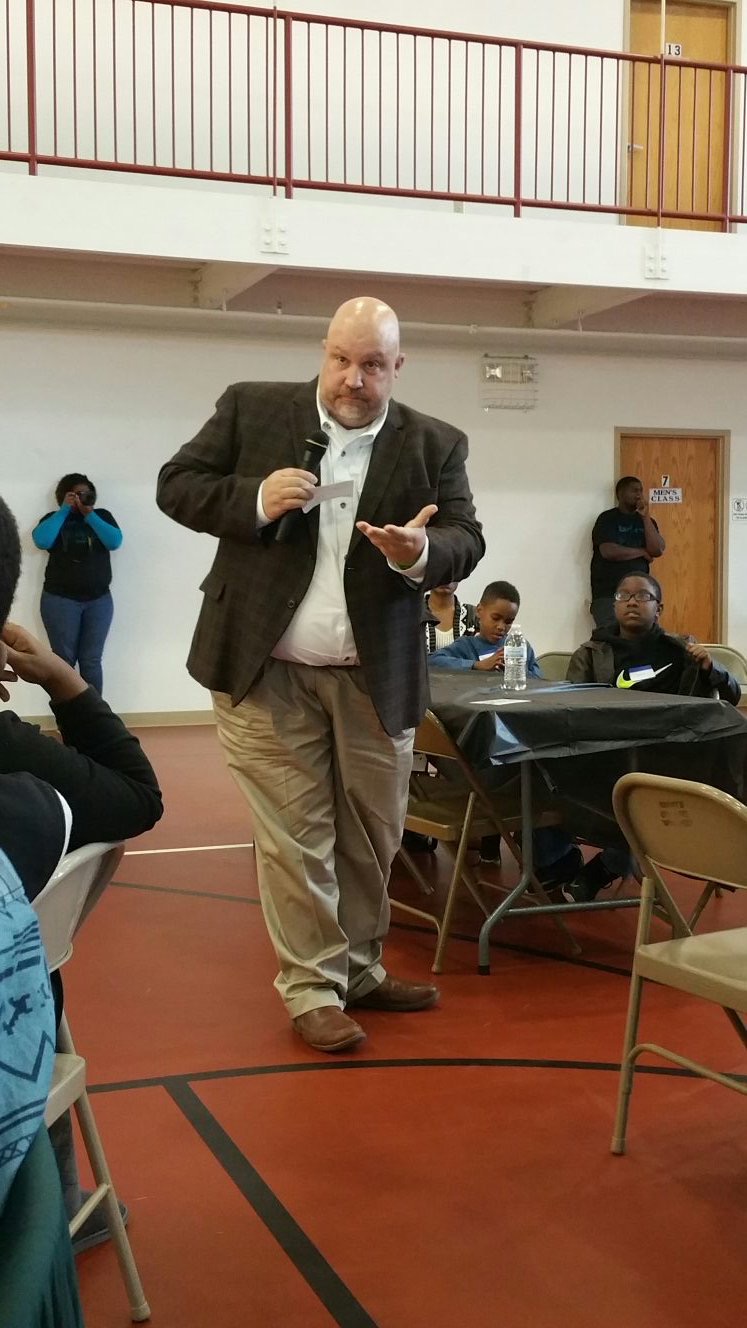
We Must Be Prepared For What We Don’t Know We Need To Be Prepared For!
“Age wrinkles the body. Quitting wrinkles the soul.” ~ General Douglas MacArthur
I then closed with two Bible verses from the book of James that give us comfort when coming up against obstacles in our life and prepare us for what we don’t know we need to prepare for:
“Perseverance must finish its work so that you may be mature and complete, not lacking anything.” ~ James 1:4
In other words many of the obstacles we come up against are placed there by God to help prepare us for our future missions and roads in life. We may not know what we need to be prepared for, but God does.
“Come near to God and He will come near to you.” ~ James 3:8

Panel Discussion
I would like to close out this post by repeating the question of this young lady for you to ponder and maybe leave a response to this post about. “How do we ever get to a time when we can recognize and appreciate all of the uniqueness that each of us possess?”
It Isn’t Always Right To Be Right
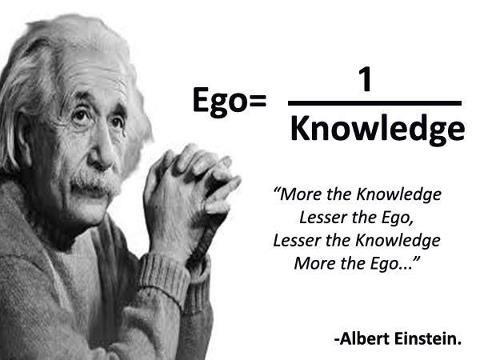
This week’s lesson in The Disciplined Leader (Manning, 2015) dealt with humility. Manning points out that disciplined leaders admit they do not have all the answers. They are able to let go of the ego and ask for and accept help. The lesson here is, according to Manning (2015), you are responsible for how you carry and lead yourself. It’s really pretty simple, talk less and listen more.
“Disciplined Leaders live and die based on the performance of their team. You will find that many of the best business leaders talk about their team and keep them in the spotlight, not talking about themselves. These leaders understand their role is to help their team be successful and give them credit every time credit is due. Through these actions, such leaders earn that crucial respect, build loyalty, and consistently get their desired results.” ~ John M. Manning
Manning (2015) gave us three great points to live by in the book:
- Look beyond you for answers.
- Adopt a teamwork mindset.
- Grow awareness of your verbal and body language.
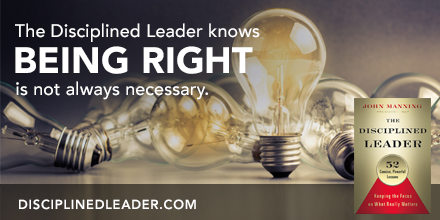
I am a believer we must share our mistakes as teachable moments. When, as leaders, we showcase our own personal growth, we legitimize the growth and learning of others; by admitting our own imperfections, they make it okay for others to be fallible, too. We also tend to connect with people who share their imperfections. Another way to practice humility is to truly engage with different points of view. Too often leaders are focused on swaying others and “winning” arguments. When people debate in this way, they become so focused on proving the validity of their own views that they miss. As Manning(2015) pointed out, “It isn’t always right to be right.” Ambiguity and uncertainty are par for the course in today’s knowledge society. When leaders humbly admit that they don’t have all the answers, they create space for others to step forward. Finally, we must role model being a “follower.” Inclusive leaders empower others to lead.
“Develop your leadership style like a branded product. You want others to trust that brand and always lean toward it.” ~ John M. Manning
Reference
Manning, J. (2015). The disciplined leader: 52 concise, powerful lessons. Oakland, CA: Barrett – Koehler Publishers, Inc.
Being Prepared For What You Don’t Know You Need To Be Prepared For
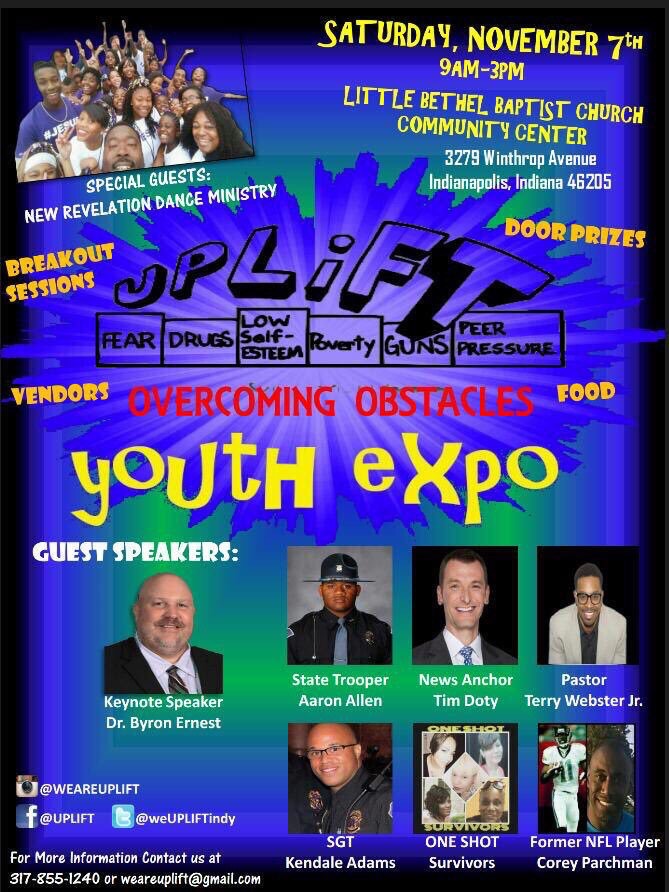
Later today I will be speaking at the Overcoming Obstacles Youth Expo. This expo is being put on by Uplift Indy. I love the title, “Overcoming Obstacles.” That’s really what it is all about. I will be closing out the day and will tie it all together by working with the youth on around the idea of “Being Prepared For What You Don’t Know You Need To Be Prepared For.” Isn’t that what obstacles are? Things we are not prepared for. But really, we have some tools already in our toolbox for being prepared and just need to think through how we get the rest. I can’t wait to spend time with these kids today!
I will post my comments and thoughts from the day when the expo ends today.
Living A Courageous Life Full of Contribution
 Peter and Doris Drucker gave tangible form to their values and concerns for America. When they arrived in America in 1937 they were faced with the severe economic challenges all Americans and the country itself was facing at the time. The Druckers did find and treasure the hospitality and warmness of Americans that they called “sweetness” (Maciariello, 2014). Peter Drucker believed, however, that it would take the social sector, particularly nonprofits, not government, to solve our social problems. He believed the social sector must create communities for citizens.
Drucker believed that only nonprofit organizations could provide the diversity of communities we need. These organizations include churches, professional associations, homeless care, health clubs and many others (Maciariello, 2014). Drucker argued the nonprofit social sector organizations were the only ones capable to satisfy the need for effective citizenship needed by an effective community. Drucker posited, “Only the social sector can create what we now need, communities for citizens” (Maciariello, 2014, p. 345). By doing this and becoming involved in the social sector we can give tangible form to our values and concerns.
“What bothers me in this country is that our society today has lost its sweetness. It’s sour, terribly sour, and I think that this isn’t anything government can do much about, or is likely to do very much about. In fact the way we are going, government is making the sourness worse. It’s only this kind of activity in the nonprofits, this kind of self-respect shown to people, this kind of initiative in solving our most difficult social problems that I think we can make this a society again.” ~ Peter Drucker
Drucker taught us we should strive to elect local public officials who understand the limits of government and the need for public, private, and nonprofit cooperation to further strengthen the work of our social sector and public sector institutions. I’ll close this post with the charge that we all need to become involved in civic organizations that are active in strengthening the social bonds that help create more healthy communities in the United States.
Reference
Maciariello, J. A. (2014). A year with Peter Drucker: 52 weeks of coaching for leadership effectiveness. New York, NY: HarperCollins Publishers.
Truth: The Key To A Candid Workplace Culture
“The longer I live and participate in the business world, the more I realize telling the truth is almost always the correct choice, painful or not. There are ways to communicate with tact; a harsh reality can be delivered in a constructive way.” ~ John M. Manning
 As I read this week’s entry in The Disciplined Leader (Manning, 2015) I was reminded of the dramatic scene in the great movie A Few Good Men. In the movie’s final court scene where the military lawyer, Kaffee, played by Tom Cruise is trying to draw the arrogant colonel, Jessup, played by Jack Nicholson into admitting that he ordered a Code Red (a sort of vigilante justice within a unit) that was officially not allowed by the military; Kaffee yells at him: “I want the truth!”, and then Jessup yells back “You can’t handle the truth!”, and then proceeds to make the admission and tell the truth, finally. This telling of the truth ultimately builds trust on the team. According to Gary Peterson of Forbes Magazine (Peterson, 2013) there are four key attributes to strong followership. Followership is defined, according to the University of Oregon, as the willingness to cooperate in working towards the accomplishment of the group mission, to demonstrate a high degree of teamwork, and to build cohesion among the group. (University of Oregon, 2013). Here are the four key attributes: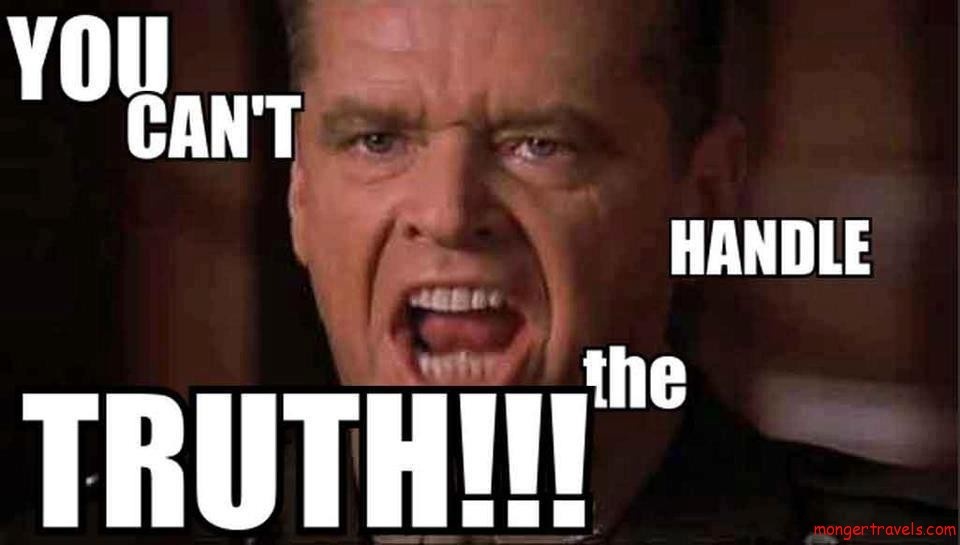
- Trust: Through everyday behavior, “followership” requires that the leader provides evidence that they can be trusted.
- Stability: Leaders with strong “followership” remain calm in the face of panic and give a sense of confidence to those around them.
- Compassion: Strong “followership” leaders have unrelenting passion for people and show empathy when those folks are enduring hard times.
- Hope: “Followership” requires that the leader has unwavering belief that their product/service will not only succeed, but will change lives.
Manning (2015) points out that the truth also sets the stage for a candid workplace culture. This allows it to be a productive and safe place for team members to be engaged and part of a learning organization culture. The truth never hurts us, it is what we do with the truth. I really like the way Manning (2015) describes the truth as giving us the ability to act fast. He posits that truthfulness is a change agent (Manning, 2015). This truthfulness will act as a catalyst for making decisions that mirror our core values, wisdom, self-discipline, and integrity. We must remember to make the truth a part of our core values.
References
“Followership.” Followership. The University of Oregon, 01 Jan. 2013. Web. 15 June 2013.
Manning, J. (2015). The disciplined leader: 52 concise, powerful lessons. Oakland, CA: Barrett – Koehler Publishers, Inc.
Peterson, Gary. “Leadership 310: The Four Principles of ‘Followership'” Forbes. Forbes Magazine, 23 Apr. 2013. Web. 14 June 2013.
Understanding Oneself to Manage Oneself
“Truly knowing yourself is a powerful lever for initiating personal growth and development.” “When you know yourself well, you are better able to maximize your leadership potential. You will realize what’s been working for you and what’s not. You will gain clarity on how to leverage your strengths and overcome your weaknesses.” ~ John M. Manning

It is amazing to me how two entries in two entirely different books could be so alike in the entries today. In A Year With Peter Drucker (Maciariell, 2014) discussed “A Catalyst to Help People Manage Themselves and Move to the Second Half of Their Lives.” I titled my blog post about that entry “Managing Oneself.” Click here to read that post. In that study I learned that once we understand our strengths, our values, how we work, and areas in which we are likely to make a contribution, we are ready to manage ourselves in the second half of our lives. In today’s entry in The Disciplined Leader: Keeping Focus on What Really Matters (Manning, 2015), John Manning taught us that part of initiating a change or developing professionally begins with an analysis of ourselves. This analysis can then provide the necessary building blocks for continued improvement.
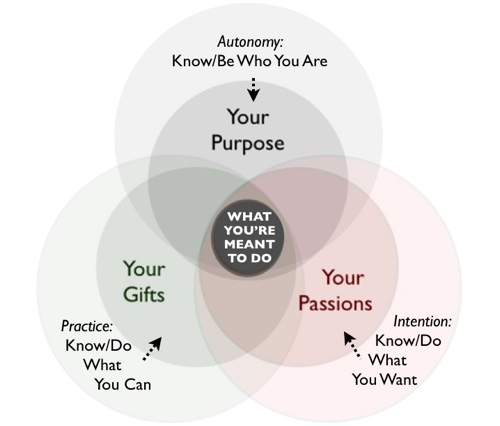
 I have learned that in order to understand ourselves and our willingness to lead others we should also take a detailed look at what really drives us. What drives us will influence what we value and enjoy, our attitudes and behaviors in the workplace and is likely to provide insight into our strengths and talents. In order to lead others, we need to be able to relate to and connect with other people, their motivations, needs and aspirations and their deepest values and core beliefs. Before others are willing to be lead by us, they will want to connect to something within us – something that is authentic, real and true. This is why when we talk about leadership, we often focus on ‘authentic leadership’ or being an ‘authentic leader’. In order to be an authentic leader, we need to be a person that others can relate to. We need to know ourselves, our beliefs and core values and how they manifest in our attitudes, behaviours and actions and in the impact that we have on others. For this I would go back to what Drucker (Maciariello, 2014) argued were the four things we needed to understand for managing oneself:
- What are we good at – that is, our strengths.
- Managing oneself requires that we understand our values.
- We should understand how we work best – alone or with others as a team.
- Are we good at taking on unstructured tasks, or do we do better when we understand the structure at the outset?
 I am going to try one of Manning’s (2015) Take Action! Tips and would encourage you to as well. Identify five changes in routines you could do tomorrow that are easy. I can think of five right of the bat that would make me a better leader. I’ll bet you can to!
References
Maciariello, J. A. (2014). A year with Peter Drucker: 52 weeks of coaching for leadership effectiveness. New York, NY: HarperCollins Publishers.
Manning, J. (2015). The disciplined leader: 52 concise, powerful lessons. Oakland, CA: Barrett – Koehler Publishers, Inc.
Managing Oneself
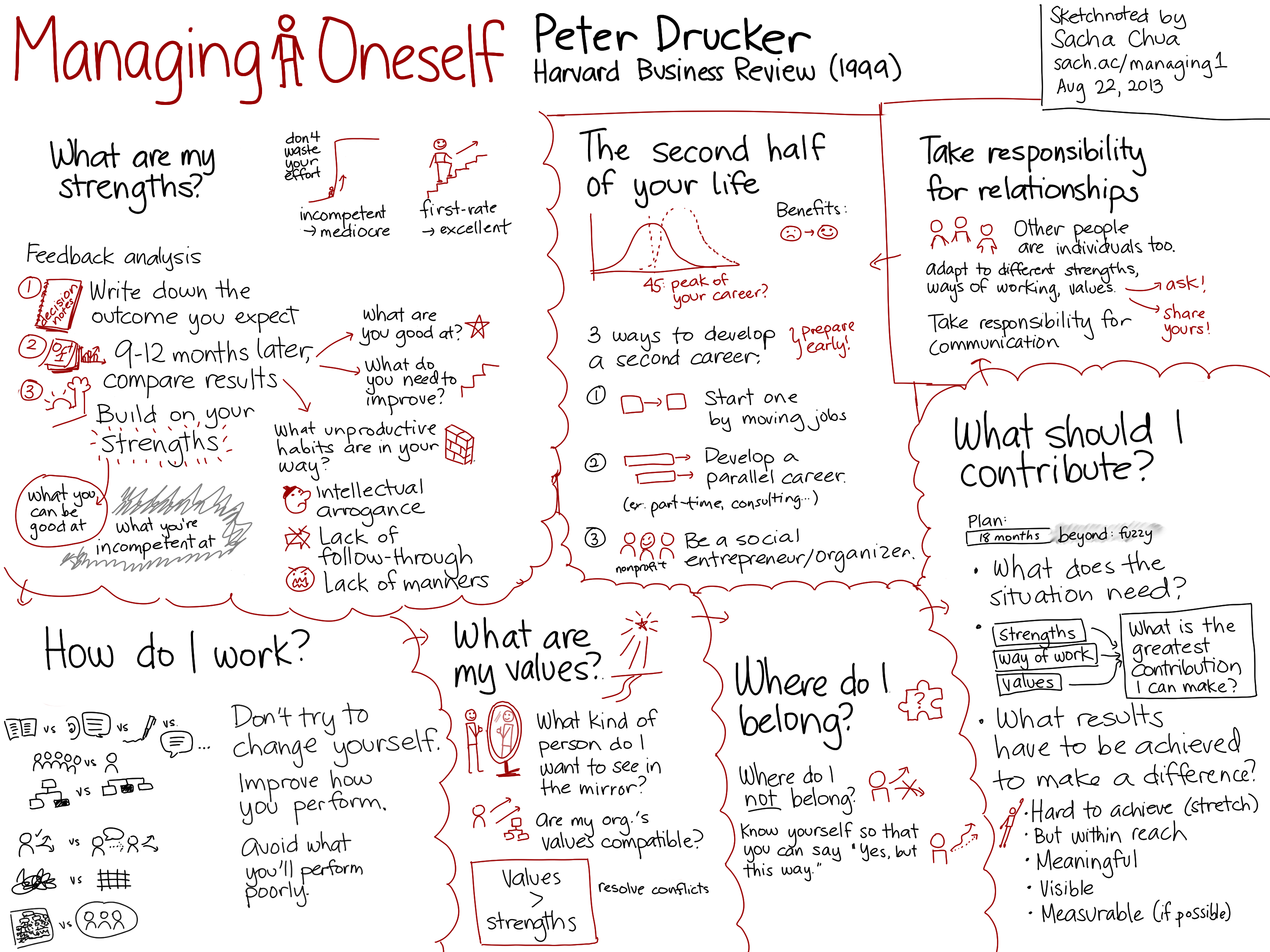 This week’s entry is the last dealing with moving from success to significance in the last half of our life. In this entry Maciariello (2014) explains Drucker’s body of knowledge on “managing oneself.” Managing oneself requires that we understand four things:
- What are we good at – that is, our strengths.
- Managing oneself requires that we understand our values.
- We should understand how we work best – alone or with others as a team.
- Are we good at taking on unstructured tasks, or do we do better when we understand the structure at the outset?
Once we understand our strengths, our values, how we work, and areas in which we are likely to make a contribution, we are ready to manage ourselves in the second half of our lives. In order to reach significance, Drucker believed you could not do more that two or three initiatives; with one probably being the best focus (Maciariello, 2014). 
“Siginificance need not be a 180-degree course change. Instead , do some retrofitting so that you can apply your gifts in ways that allow you to spend more time on things related to what is in your box {your strengths and values}. And to do it in such a way as to reclaim the thrill of that first deal.” ~ Bob Buford
Today, knowledge workers are likely to outlive organizations, and the knowledge worker has mobility. Mobility is widely accepted in the United States, but the idea of outliving organizations is still a tougher pill to swallow. Drucker believed that boredom leads to an underutilization of our talents (Maciariello, 2014). We run the risk of what he called being “mentally finished.” Therefore managing oneself requires us to prepare for the second half of our life.
Reference
Maciariello, J. A. (2014). A year with Peter Drucker: 52 weeks of coaching for leadership effectiveness. New York, NY: HarperCollins Publishers.
Significance Through Social Entrepreneurship
 It is hard to believe there are only 10 lessons left in A Year With Peter Drucker (Maciariello, 2014) after this week’s entry. This means a couple of things: I am about to finish a book that has inspired a great deal of thought and action in me; and, we are only 10 weeks away from closing out 2015. This week’s lesson reminded me of the entrepreneurial spirit that brought about the social civil society we now have in the United States. The Salvation Army, CARE, Alcoholics Anonymous, Red Cross, Girl Scouts, and Lions club were all organized as the result of a service oriented entrepreneur recognizing a social need. In 2011 there were approximately 1.6 million tax-exempt, 501(c)(3) organizations in our great country. This 1.6 million was made up of private charities, private foundations, and religious institutions (Maciariello, 2014). Clearly social innovations is one of the distinguishing characteristics of American society.
 Drucker (Maciariello, 2014) advised us that an opportunity set exists for successful leaders in the second half of life to create significance. If leaders, according to Drucker (Maciariello, 2014), have a develop a narrow focus they can find opportunities for utilizing their gifts in their communities, states, nation, and the world. To do this we need to analyze our own strengths, weaknesses, and core values. Drucker (2014) also spoke of how systematic innovation can be found when he said, “The unexpected – the unexpected success, the unexpected failure, the unexpected outside event; the incongruity – between reality as it actually is and reality as it is assumed to be or as it ‘ought to be’; innovation based on process need; changes in industry structure or market structure that catch everyone unawares. The second set of sources for innovative opportunity involve changes outside the enterprise or industry: demographics (population changes); changes in perception, mood, and meaning; new knowledge, both scientific and nonscientific (p. 333).” When reflecting on the lessons of Peter Drucker I was reminded of how Duke University was founded. Back in the 1920s, James P. Duke wanted to build a medical school and a hospital to provide medical resources, including doctors, to the Carolinas. Today, Duke University provides a place for extraordinary academic learning and research. This is accomplished through undergraduate and graduate schools, research centers and a variety of international programs. In Mr. Duke’s vision, leadership also involved harnessing the power of higher learning for the larger social good to meet the world’s great needs. Duke University is now widely recognized for its pioneering leadership in social entrepreneurship education, having provided essential and important legitimacy for the field by producing and facilitating academic research that has defined, informed, and advanced the field, and having delivered high quality courses to undergraduates and graduate and professional students eager to learn about the field. This is a pretty outstanding example of successful social entrepreneurship if you ask me.
We all need to take some time, especially as we reach halftime, to think about our “opportunity set” and what we need to learn to make a significant commitment, thus, ensuring a probability of success.
Reference
Maciariello, J. A. (2014). A year with Peter Drucker: 52 weeks of coaching for leadership effectiveness. New York, NY: HarperCollins Publishers.
Don’t Worry, Be Happy!
 This week’s entry in The Disciplined Leader (Manning, 2015) is a great one that we all have to diligently work on as leaders taking the responsibility of leading ourselves first in order to effectively lead others. The topic was that of managing our worries. This is one topic that we can all say we have experience with, right? If we are honest, this is something we all struggle with. Instead of mindlessly rushing through life, often stop during the day to ask yourself what really matters to become more aware of your inner world and the chatter in your mind (metacognition). Another very helpful way to calm anxiety and fear is to take the proverbial ‘fly on the wall’ perspective as an observer. When you experience these emotions, imagine stepping back as a third person observer and observing yourself and the situation at a distance. Distancing has proved to be one of the most effective ways to calm our fear. This mindfulness allows us to be very thoughtful in analyzing the situation to either develop a solution or realize no action or worry is necessary because it is out of our control.
“Worry is a toxic emotional condition that can feel like it’s choking us at times, even though most of what we worry about doesn’t ever happen.” ~ John Manning
 Manning (2015) offers three suggestions for leaving your worries behind:
- Understand that worrying is not a solution. I am reminded of one of my favorite TV shows growing up: MacGyver. I’ll let you click on the link I’ve provided to get the details if your not familiar with the show. My takeaway and lesson I learned from watching the show was that MacGyver never let fear take over; he looked for the solution instead of staring at the problem. Then he would take action with his trusty Swiss Army knife and go to work. What a great lesson – if you have never watched an episode get one and let the learning begin.
- Surface your worries. Categorize into what you can control and what you cannot control. I always go one step further and think about what do I need to control and when do I need to worry about controlling it. In other words is it something that is a priority right now.
- Reduce worries. This involves being proactive. Taking control where you can. I use the example here of having a very tight and sound school safety plan. I can’t control what may happen, but with an outstanding plan that every staff member understands, I can eliminate constant worry.
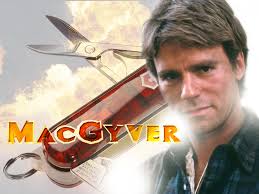 Finally, just be mindful of priorities and use your problem solving skills to diminish your worries so you can be like MacGyver and look for solutions instead of mindlessly staring at the fear.
Reference
Manning, J. (2015). The disciplined leader: 52 concise, powerful lessons. Oakland, CA: Barrett – Koehler Publishers, Inc.
 Byron's Babbles
leave a comment