ESSA Opportunity #10: New Community Support for School Successs Grants
 ESSA establishes a new grant program that will enable community partners to play an important role in personalized learning environments.
The program supports the following goals:
- Promise Neighborhoods – significantly improve the academic and developmental outcomes of children living in the most distressed communities of the United States by providing access to a community-based continuum of high-quality services. ESSA defines Promise Neighborhoods strategies as “pipeline services” and utilizes this term to refer to “a continuum of coordinated supports, services, and opportunities for children from birth through entry into and success in postsecondary education, and career attainment.” The goal of Promise Neighborhoods to to do the following:
-
1) high quality early childhood education programs
-
2) high quality school and out of school time programs and strategies
-
3) transitions from elementary school to middle school, from middle school to high school, and from high school into and through postsecondary education and into the workforce
-
4) family and community engagement and support
- 5) postsecondary and workforce readiness
- 6) community based support for students who are either living in the community or who have attended schools serviced by the pipeline
- 7) social, health, nutrition, and mental health services and supports
- 8) crime prevention and rehabilitation programs for youth.
-
- Full Service Community Schools – provide support for schools that improve the coordination and integration, accessibility, and effectiveness of services for children and families, particularly for children attending high-poverty schools.
ESSA Opportunity #9: Modernized 21st Century Community Learning Centers Grant
 The 21st Century Community Learning Centers grant program supports academic enrichment activities in after school or extended day settings. This part provides opportunities for communities to establish or expand activities in community learning centers that provide opportunities for academic enrichment, offer students a broad array of additional services, programs and activities, and offers families of students served by community learning centers opportunities for active and meaningful engagement in their child’s education, including opportunities for literacy and related educational development.
Funding is made available for continuation of certain current grants; there are reservations for national activities, and for Bureau of Indian Education schools. There is a local competitive subgrant program. The program is authorized at $1,000,000,000 for FY 2017 and $1,100,000,000 for each of FYs 2018-2020. States should give priority to applicants that will provide high quality credit bearing opportunities outside of the traditional classroom environment. Priority should also go to applicants that will serve students attending schools identified for comprehensive and targeted support and improvement.
ESSA Opportunity #8: Title IV, Student Support & Academic Enrichment Grant
 The Every Student Succeeds Act (ESSA) consolidates a number of existing federal grant programs into a new Title IV state block grant that may fund district activities to:
- provide all students with access to a well-rounded education.
- improve school conditions for student learning.
- improve the use of technology to improve academic achievement and digital literacy.
States could use this block grant to create an innovation fund for districts interested in scaling personalized learning strategies. ESSA would reconstitute Title IV, Part A into the Student Support and Academic Enrichment program, and would authorize the new program at $1.6 billion annually through 2020. That authorized amount comes in addition to the authorized $1.1 billion in Title IV, Part B, which funds the 21st Century Community Learning Centers Program. Part A would then require states to spend 20 percent of those funds on “well-rounded educational opportunities,” 20 percent of those funds on “safe and healthy students,” and a portion of the funding on the “effective use of technology.” Part B authorizes $1.1 billion for 21st Century Community Learning Centers that offer after-school academic enrichment programs. Part C includes federal funding for charter schools, which would increase from $253 million in 2015 to $300 million by 2020. Funding is similarly increased for magnet schools, which Part D of Title IV would increase from $92 million in 2015 to nearly $109 million by 2020.
In addition, Part E of Title IV would allow for education innovation. These innovations could include programs like: Promise Neighborhoods, full-service community schools, arts education, Ready to Learn television, and gifted and talented education programs. As you can see there are some tremendous opportunities for our students with ESSA.
ESSA Opportunity #7: Reservation for School Leaders
 This opportunity is one that is near and dear to me. I really believe in job embedded professional growth/development. Under ESSA, states may reserve up to 3% of their Title II, Part A funds to build a workforce of leaders with the skills to help schools transition to personalized learning environments. Priority funding should go to support leaders serving in schools identified for comprehensive support and improvement. As a school leader who has now taken on a high school and now a school system that fits this priority, I can attest to the need for this development of teacher leaders. ESSA also requires that professional development programs should be customized, embedded, and align to statewide professional competencies so leaders can advance along individualized career pathways.
I believe programs like what we have started at Hoosier Academies Network of Schools in our Focused Leader Academy really fit the bill. This is an employee development and engagement program. The idea is that great minds and great motives still matter. Teachers with school leadership aspirations have the opportunity to become part of a cohort which will take part in monthly leadership training and be part of supervised leadership projects of the school. Cohort size is at least 10-15% of teacher leaders per year. The Vision is: Leadership will be born out of those who are affected by it. The Mission is: Leadership will appear anywhere and anytime it is needed. Our Theory of Action is: If we empower our teachers through leadership skill development…Then we will have teacher leaders ready to contribute to the success of Hoosier Academies Network of Schools and be an important part of our talent pipeline. I believe states should endorse and help schools develop programs such as this in order to have approaches required by ESSA that build and strengthen professional learning systems aligned to teachers’ learning needs. This would allow schools to do what I call “hyper-personalizing professional growth.” Click here to see ESSA’s Definition of Professional Learning & Title ll Allowable Uses of Funds.
Also, Learning Forward and National Commission on Teaching and America’s Future have come up with an Agents for Learning competition related to state planning for Title II funds. These competitions are great ways to collaborate for best practices and to get a lot of ideas for how best to use the funding. Click here to get more information on the competition. I, for one, hope they get lots of applications. Teachers are in the best position to contribute recommendations for the best use of federal funding for professional learning, the successful implementation of ESSA, and the improvement of student learning.
Pulling Together
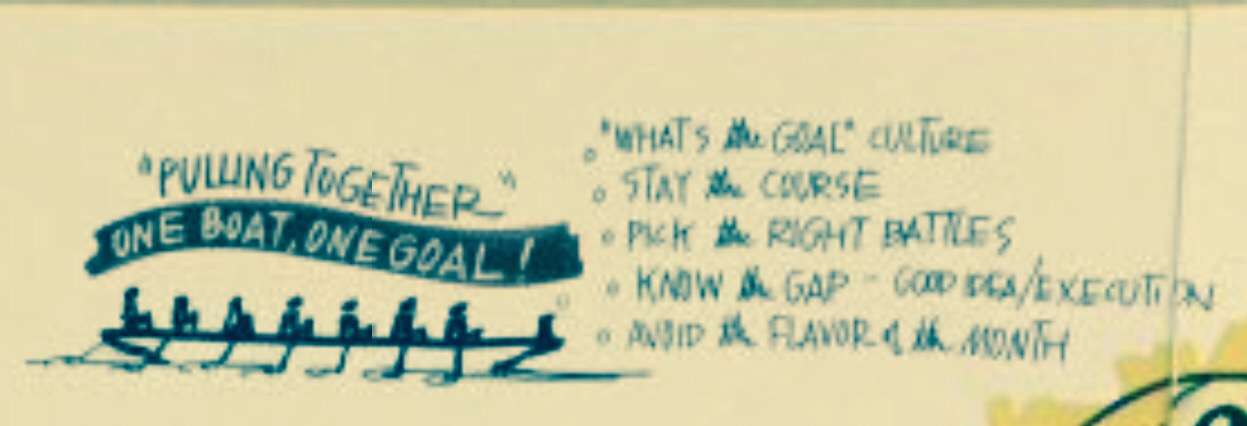 I’m so excited I just started reading 52 Leadership Lessons: Timeless Stories For The Modern Leader by John Parker Stewart. As you know, I love books that are broken into 52 lessons. These lessons allow me to reflect and the blog each week. This week’s lesson was entitled “Baboons and Impalas” and dealt with how our differences make us fit together better. Stewart taught us that the baboons are watchmen for the impala and the Impalas stir up insects for the baboons. This is a great relationship that benefits both. Now, let’s relate this to our context as leaders. Turning a group into a team is one of the biggest challenges leaders face. We find ourselves leading groups of very diverse individuals in complex projects and tasks. We don’t always get to hand pick our team, but rather we often inherit teams and all of their past baggage. Whatever the state of the group, we all need team skills. It seems easier and more comfortable to work with people of similar styles, thinking and background, but diversity brings a richness to a team. Leaders and team members should value, encourage and reward diversity.
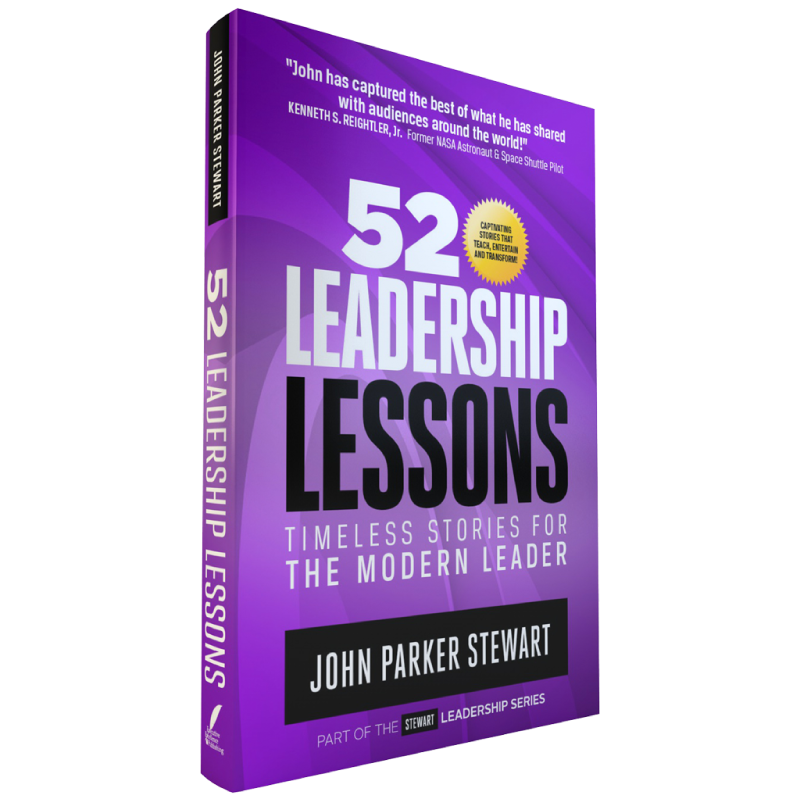
Ralph Waldo Emerson said, “No member of a crew is praised for the rugged individuality of his rowing.” Effective teams do not encourage heroes or superstars. They look for ways to maximize their resources and build on each other’s strengths and diversity. Therefore, we need to:
- Develop a what’s the goal culture.
- Stay the course.
- Pick the right battles.
- Know the gap – good ideas/execution.
- Avoid the flavor of the month.
Effective leaders embrace differences, respect disagreement, honor those who question processes and direction, and doesn’t surround himself or herself with “yes” people. As Stewart taught us, “When selecting others to be on a team with you, choose unlike yourself.” Create a balanced team by thinking of the baboon and the impala.
Everyone Is A Leader
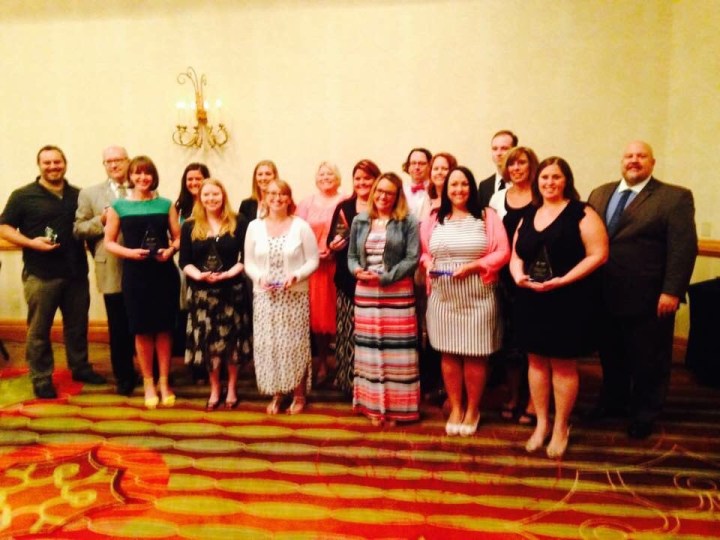
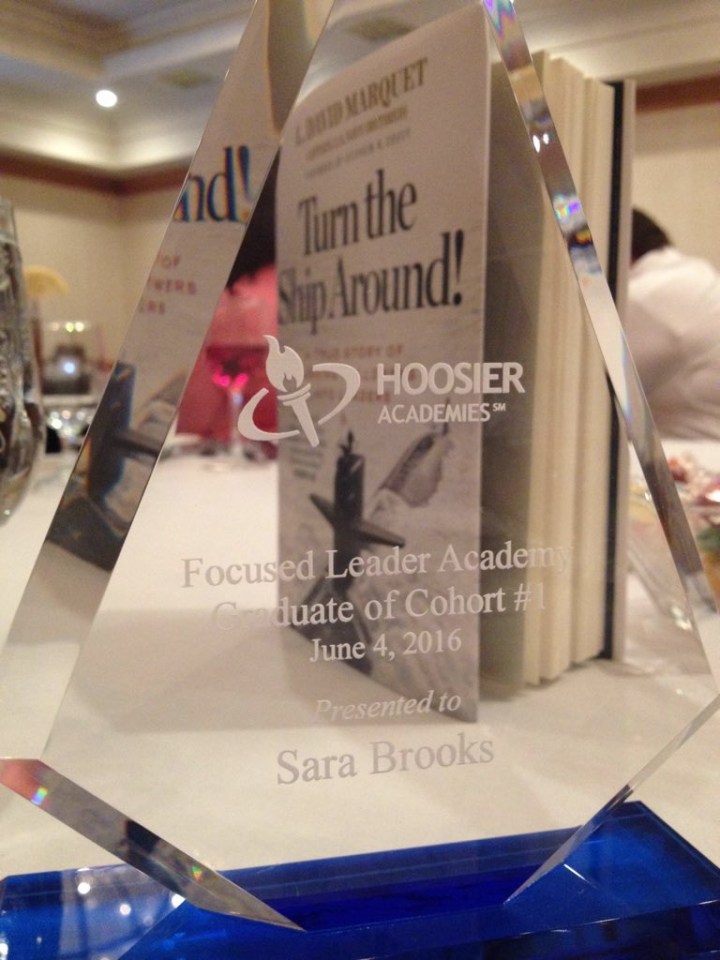
Focused Leader Academy Cohort #1
I am finally in for the evening and sitting down for some reflection time with my computer blogging. What a day! This morning we graduated our first cohort of teacher leaders from our Focused Leader Academy. Then we had our commencement exercises for our Hoosier Academies Network of Schools 2016 graduates. This post is about our celebration breakfast for our Focused Leader Academy. 
We had an incredible program recognizing our teacher leaders and an outstanding program by Andy Worshek of Turn the Ship Around! He is an expert on Intent-Based Leadership. Andy served in the navy for 24 years, and achieved the rank of Master Chief. Assigned to the nuclear powered submarine USS Santa Fe with Captain David Marquet and imagines a workplace where everyone engages and contributes their full intellectual capacity, a place where people are healthier and happier because they have more control over their work—a place where everyone is a leader.
 Great Leadership creates an organizational culture that spawns generations of additional leaders throughout the organization. Which is exactly what we are doing with our Focused Leader Academy. With this program we are embracing continual learning as the primary activity of the organization. Andy taught us today that most people don’t quit the job, they quit the people. This really hit home as a leader of leaders. Andy discussed that instead of thinking about leaders and followers we need to think about having leaders and leaders. In order to do this we must move authority to information instead of information to authority. In other words, in a highly functioning organization the authority to use information is kept at what I call street level so it can be used effectively. In a school that means with teachers. Make no mistake, however, when shifting this model, we have an obligation to make sure that those we are empowering have the technical knowledge and skill to handle this authority. Otherwise, Andy taught us this would lead to chaos. Furthermore, for intent based leadership to work there must be organizational clarity. This is clarity is one of the things I am very proud we spent a great deal of time working on this past year as a school and with our Focused Leader Academy.
“Don’t move information to authority, move authority to the information.”
― L. David Marquet, Turn the Ship Around!: A True Story of Turning Followers into Leaders
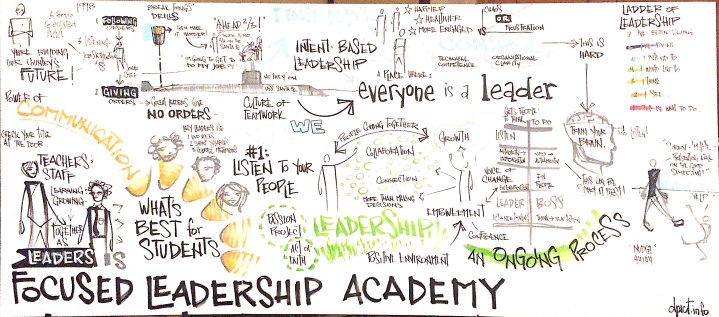
Another eye opener for me was the idea of needing to change the environment, not the person. People’s behaviors depend on the environment. If you manipulate the environment, you manipulate behaviors. Since the earliest times, humans have needed to be sensitive to their surroundings to survive, which means that we have an innate awareness of our environment and seek out environments with certain qualities. The culture and environment of an organization can facilitate or discourage interactions among people. Additionally, the environment of an organization can influence peoples’ behavior and motivation to act.
“When a flower does not bloom in your garden, you fix the environment in which it is growing. You do not fix the flower.” ~ Alexander den Heijer
 Too many organizations believe that “leadership” is a noun based on someone’s title. I believe, however, that leadership is a verb based on someone’s actions. By that definition, everyone is a leader. If we believe everyone is a leader then effective leadership helps to unify a culture, and a collaborative culture made up of leaders and leaders can solve just about anything. Now, that is an ideal environment where everyone is a leader. Organizations should realize that leaders permeate the organization. I believe the role of a leader is to find and develop other leaders – in essence, to multiply ourselves. We must intentionally look for people displaying leadership behaviors and create a process for developing the next generation of leaders. I believe that the Focused Leader Academy has done that for us.
Vital Leadership Learnings
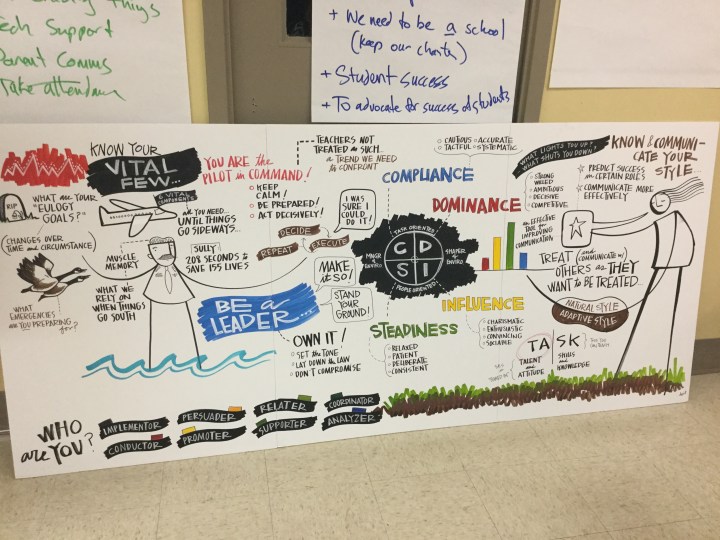
 A couple of weeks ago we had the honor of having Will Pemble from MAP Vital Factors Solutions work with our Focused Leader Academy on being disciplined leaders. This day was set up by John Manning, author of The Disciplined Leader (2015). As you know from previous posts, our Focused Leader Academy read the book, that is set up in 52 lessons, and blogged about each lesson. We then had a discussion about what we felt were the vital few leadership focuses we needed more work on for each section of the book and overall. Really, that pre-exercise was an incredible discussion and experience. It was very interesting to hear the individual vital few from the FLA participants and then hear the discussion of narrowing down to the group’s vital few. This allowed for a rich discussion about how individual vital leadership skills affect the vital few of an organization.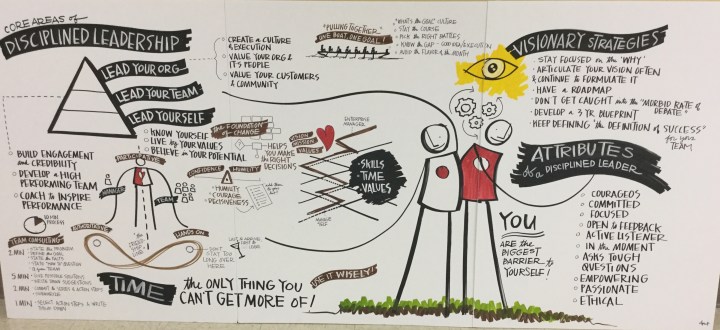

Here are our Focused Leader Academy Vital Few (I have included the lesson number from the book, in case you want to check it out and follow along):
Part 1:
Our top 2 were…. #4 Know Yourself and #13 See Mistakes as Opportunities. Then we were torn between #14 Listen More, Talk Less and #11 Drop Defensiveness.
Part 2:
Our top two were…. #30 Empower Employees and #37 Advocate for Your Team. Then we settled on #31 Give Effective Performance Feedback because we knew what we were getting ready to embark on with redesigning our entire performance evaluation system. We also had #26 Honor Your Commitments high on our list.
Part 3:
Our top three were….#39 Develop a “What’s the Goal?” Culture, #43 Put More Weight on “Why?” and #46 Avoid the Dangerous Gap Between Good Ideas and Execution. We also had a strong feeling for #51 Keep Ethics Strong.
So then we went back and voted to come up with our TOP THREE VITAL FEW…
Part 1: #13 See Mistakes as Opportunities
Part 2: #30 Empower Employees
Part 3: #39 Develop a “What’s the Goal?” Culture
 Will Pemble started out our workshop by have us develop a list of all the qualities of a disciplined leader. Here’s our list:
- Runs toward a challenge
- Decisive
- Listener
- Reflective
- Active participant
- Clear values that the leader sticks to
- Loves what he/she does
- Commitment
- Communicator
- Risk-taker
- Willing to be uncomfortable
- Willing to suffer (What’s your suffer score? How much are you willing to suffer for something?)
- Willing to fail… a lot
- Learner
- Accepting
- Courageous
- Focused
- Empowering
- Open to feedback
- Passionate
- Ethical
- In the moment
- Asks the tough questions
Pretty awesome list, huh? Of course, if we could all be great at all those, we would be the most incredible leaders ever. Well, I’ve got some work to do…I don’t know about you. I’m guessing we all have some work to do.
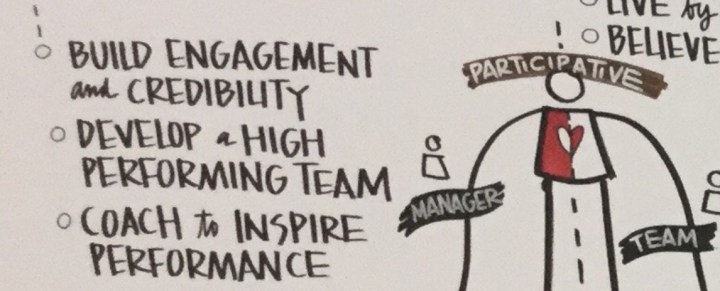
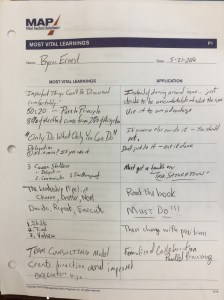 We had a cool sheet that we kept individually during the day that was titled: “Most Vital Learnings.” I really liked having this sheet that had spaces for 10 vital learnings (see photo). In keeping with the vital few mantra of The Disciplined Leader, I have selected my vital few most vital learnings. Here they are:
- “Important things can’t be discussed comfortably.” Instead of dancing around issues, we need to decide to be uncomfortable and hit the issue head on and solve it.
- “Pareto Principle”… 80:20 – 80% of the effect comes from 20% of the system. We need to use this to our advantage. We must focus on the vital few and ignore the trivial many.
- Decide, repeat, execute. Need we say more? This is definitely a vital few.
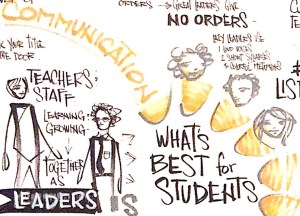
As you can see, our experience with the book, The Disciplined Leader, and Will’s great facilitation of our workshop was incredible. It was also incredible to be back together with Sita Magnusun doing our graphic facilitation for this program. I first met Sita at my first Harvard University class and have been both blown away by her work and continue to believe in graphic facilitation as a component of effective facilitation of learning. Two of her graphics are posted here.
ESSA Opportunity #6: Elimination of Highly Qualified Teacher
 Every Student Succeeds Act (ESSA) has revised a key element of No Child Left Behind (NCLB) related to teachers. NCLB referred to “highly qualified teachers” 67 separate times. When NCLB was written in 2001 it was an important piece of the legislation that every child should be instructed by a “highly qualified teacher.” The terminology was ambiguous and it put a strain on schools really being able to put effective teachers in every classroom. ESSA solves this problem by deleting any reference to “highly qualified” teachers. Instead, it refers to “effective” teachers.
The law replaces the “highly qualified teacher” requirements with a requirement that states ensure teachers meet the applicable state certification and licensure requirements. ESSA eliminates the NCLB language prohibiting emergency or provisional certification. In fact, ESSA does allow for provisional certification and the waiving of licensing criteria for states and schools receiving Title I funding.
This provides states with an opportunity to design a new strategy for educator quality that aligns to a vision for personalized learning. Specifically, states could align their certification and licensing requirements to reflect new teaching roles and competencies for instruction in personalized learning environments.
ESSA Opportunity #5: New Direct Student Services

My fifth entry of the top 10 opportunities that Every Student Succeeds Act (ESSA) deals with the new direct student services provision. States may reserve up to 3% of their Title I, Part A grant to provide grants to school districts for direct student services. States must prioritize districts serving the highest percentage of schools identified for comprehensive and targeted support and improvement.
Activities must include:
- Enrollment in courses not available at a student’s school
- Credit recovery and acceleration courses
- Activities that assist students in completing postsecondary credit
- Components of a personalized learning approach
- Transportation for students who wish to switch schools
ESSA Opportunity #4: Identification of School Improvement Strategies

States can establish their own framework for supporting identified schools that incorporates personalized learning strategies. ESSA has two two required categories for intervention.
Action/intervention is required in at least the following types of schools:
- Comprehensive Support and Improvement Schools: The lowest performing 5 percent of Title I schools and all high schools with graduation rates below 67 percent. Districts have the initial responsibility for improvement activity. If schools don’t improve within four years, states have to intervene.
- Targeted Support and Improvement: Schools where any group of students is consistently underperforming. Schools work with districts on improvement activity. If schools don’t improve, the district has to ensure more rigorous intervention.
The big key here is that the School Improvement Grant (SIG) is eliminated with ESSA. Now in its place is a new provision that allows STATES to set aside 7% of their Title I funds for school improvement activities.
 Byron's Babbles
leave a comment