The Bear Facts of Leadership
 Every winner has a coach, and every coach has a philosophy. Lets take a deeper look inside the philosophy of one of the best. It is appropriate on this weekend before the National College Football Championship game between Alabama and Clemson to reflect on the leadership of Coach Bear Bryant. He had a keen instinct for what needed to be said and done, and a willingness to confront his present reality in order to make progress as a team. Bryant led his Alabama team to six national championships and was elected to the College Football Hall of Fame in 1986. While Bryant drove many people away with his authoritarian coaching style, he had many players who stayed to become champions. Even with this authoritarian style, Bryant made it a point to take responsibility for what his team did on the field. Gene Stallings, who coached under Bryant said this of his leadership style: “His philosophy as far as players were concerned is that if the team was successful they did it, and if for some reason we lost, he took the blame for it.” Bear Bryant found that if he took responsibility for his team, they would respond by doing everything they could to make the team successful.
“I’m just a plow hand from Arkansas, but I have learned how to hold a team together. How to lift some men up, how to calm down others, until finally they’ve got one heartbeat together, a team. There’s just three things I’d ever say: If anything goes bad, – I did it. If anything goes semi-good, then we did it. If anything goes really good, then you did it. That’s all it takes to get people to win football games for you.” ~ Bear Bryant
Lesson #25 entitled “Big Bear, Little Ego” in 52 Leadership Lessons: Timeless Stories For The Modern Leader by John Parker Stewart tells the story of Bear Bryant when he was in the United States Navy and disobeyed an order to abandon ship to save shipmates – teammates. Bryant may have pushed them to extreme limits and beyond what they thought they were capable of, but he got the best out of them. The players understood that. And they knew that Bryant was committed to their success. That’s where the bond came from—they were all in it together. Some leaders claim they don’t care if they’re liked; they just want to be respected. Other leaders are well liked but not really respected. The unusual leader, the really good one, is respected and revered. It takes a unique balance in a person to inspire that kind of loyalty and admiration, but it can be done. Coach Bryant brought his teams together by focusing on a common goal. They worked together, survived together, and ultimately succeeded together. Remember, great leaders do not consider themselves more important than the team, but as a part of the team. Leaders merely have a different set of responsibilities.
“Ready! Down! Break! Hut! Hut! Hut!” Send a spiraling pass to your team!
5 Ways to Stop Thieves from Stealing Your Happiness
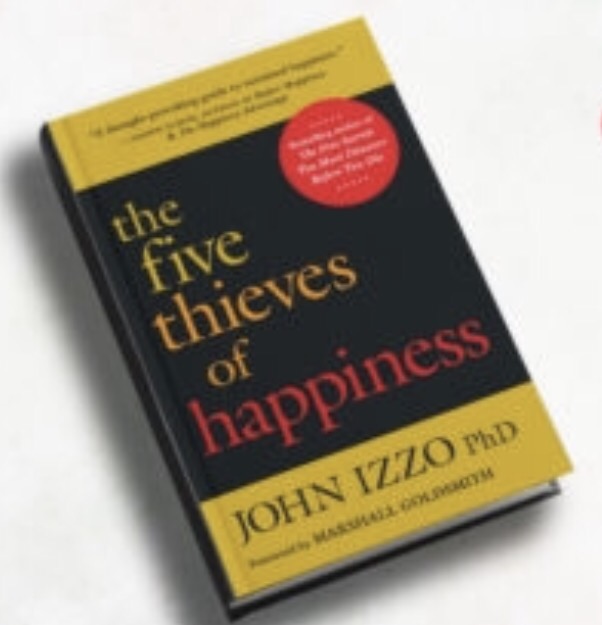 I am so excited to bring you this guest post from Dr. John Izzo. Learn in this post 5 Ways to Stop Thieves from Stealing Your Happiness.
Most self-help literature makes it seem like happiness is a very elusive thing, something we must work very hard to achieve. It is my contention that happiness is our natural state. The child’s natural smile and the calm of sleep are metaphors for the happiness which is already ours. We don’t need to seek it as much as we need to get out of its way.
It is my suggestion that there are five thieves that rob us of our happiness. A thief is someone who takes away something that is already yours. In the case of happiness, the thieves are thought patterns and internal filters through which we see the world in a distorted way. They cloud our view of what is true and natural.
The five thieves are control, conceit, coveting, consumption, and comfort.
Control
The first thief is control, the desire to control the outcomes of our life and for things to be different. Happiness is knowing what we can control and accepting what we cannot control. At the most basic level, happiness comes from understanding that we can control our actions and our responses to things external to us, but we cannot control the results of our actions. Focusing on our actions brings happiness; focusing on the result of our actions brings unhappiness. All suffering is resistance to whatever is at any moment.
How to stop the thief:
In each moment surrender to whatever is happening. Control and influence what you can while choosing to accept whatever is at that moment. Accept the hard truths about life.
Remember that it is the craving for things to be different, not the circumstance that robs you of happiness.
Conceit
Conceit is perhaps the single greatest barrier to true contentment and even societal well-being. Conceit if a focus on your small self, on trying to find happiness separate from all other people and things as opposed to in the experience of being one. Another word for this thief is ego. Happiness comes from serving and getting lost in something outside yourself.
How to stop the thief:
Whenever you find yourself obsessing about the story of your life, remind yourself that you are already a part of a larger story. The thief wants you sitting around, staring at your reflection, but there is no happiness to be found there. Building an equitable world that works for all is part of this, if not for moral reasons than for practical ones. Only when all prosper can we all be truly safe and happy.
Coveting
Coveting is the third thief and comes disguised as something harmless or even ambitious in some productive way. What could be wrong with wanting to have something you don’t yet possess? Is not desire for something the very source of moving forward in life? The opposite of coveting is to be in a place of gratitude. Coveting also keeps us from celebrating for others because life becomes a comparison.
How to stop the thief:
Whenever you find yourself asking the mirror on the wall of your subconscious how you compare with others, remember that it is the thief speaking to you. It is lying when it tells that you that life is a contest rather than a journey. Ask instead: Am I being my best self? Also, practice gratitude through daily journaling or simply taking a few minutes to identify three things that you are grateful in that day and one in your life. Each day choose another person and write down three things you want to celebrate for them.
Consumption
Consumption tells us that there is something outside ourselves that we need to achieve happiness, and it tries to hide from us the truth that we can choose it at any moment. Intuitively, of course, we all know that happiness cannot come from consumption of something because we all know people who appear to “have it all” but are consistently discontent, as well as people who have “next to nothing” and appear to be quite happy. This thief is like a thirsty person with a large bottle of good fresh water but a hole in their throat.
How to stop the thief:
Whenever you find yourself saying, I will be happy when…or I will be happy if…, stop these thoughts and come back into the inner house where happiness is found. Focus on the choice to be happy now. Challenge the consumer in yourself. Whenever you are tempted to buy something, ask yourself if it will bring any real happiness. The thing itself is not a problem; the belief that it will bring happiness is the issue.
Comfort
The final thief—comfort—is an insidious one. In fact, at first glance it may even appear as a source of happiness rather than a barrier to it. This thief is like a lethargic person on the sofa, TV remote in hand. It wants us to stay on the same channel, in the same comfortable position, stuck in a routine that is not life giving. It does not care about the consequences of this routine, even if the channel we are on is no longer of interest to us or serving our higher needs.
How to stop the thief:
Make a commitment to try one or two new things every week. Vary your routines, from taking a new route on your daily walk to a different dating experience with your partner on a Friday night. Try new areas of learning—it is good for both your mental and physical health. Notice the core comfort patterns of your life. What have you carried from your past that is no longer adaptive to your life today? Identify an important pattern, and take two months to work on noticing how it shows up, then choose to ride in another direction.
Take The Five Thieves of Happiness quiz to find out what thief is robbing your happiness.
Dr John Izzo is a corporate advisor, a frequent speaker and the bestselling author of seven books including the international bestsellers Awakening Corporate Soul, Values Shift, The Five Secrets You Must Discover Before You Die, and Stepping Up. His latest book is The Five Thieves of Happiness.
Over the last twenty years he has spoken to over one million people, taught at two major universities, advised over 500 organizations and is frequently featured in the media by the likes of Fast Company, PBS, CBC, the Wall Street Journal, CNN, and INC Magazine.
Twitter: @drjohnizzo
LinkedIn: Dr. John Izzo
I Promise
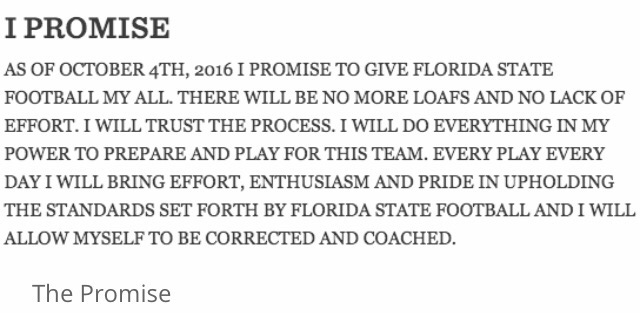 A signed copy of the promise pictured here sits in the locker of each Florida State player. After an awful start to Florida State’s season this past year, head coach Jimbo Fisher took an unprecedented step and presented his team with a promise and challenged them to sign it and live up to it.
As I read it I was struck by the simplistic way coach Fisher presented powerful points. It is really a well written combination of a mission and core values to follow. Here are the main points I take away:
- The commitment of “I promise to”
- No loafing
- Effort
- Trust the process
- Preparation
- Effort and enthusiasm in every play, every day
- Pride
- Allow myself to be corrected and coached
Just eight powerful points, but what a change in the season this battle cry brought about. The next game after the players signed the promise was a win against in-state rival Miami Hurricanes. Florida State won 20-19. “You cannot say that they did not play hard, that they did not play with fight, that they did not play with guts,” Jimbo Fisher said after the win. “We’re a work in progress but at least that heart and soul is there.” I am particularly struck by the point of “Allowing myself to be corrected and coached.” This is so important to all of us. We must continue to grow and develop each and every day.
On a day when everyone make New Year’a resolutions, I wander what would happen if we all just adjusted the promise to our own lives and then actually kept it; just like the Florida State Seminoles. Would you be willing to sign and hang in your locker?
Happy New Year!
Leading Like Santa
 It would be no picnic having to be Santa every day, especially wearing the same itchy red wool suit every day. Try it sometime. I have, as I make a pretty good Santa if I do say so myself. Yet Santa Claus pulls it off, year after year.
Santa has set some great examples of sound leadership for us to follow. Here are some Santa leadership traits that I have reflected on after encountering Santa Claus during a recent visit with him at Conner Prairie Interactive History Park. We’d all do well to emulate these skills in our everyday lives as leaders.
Here’s a list of dispositions I witnessed first hand while both watching him interact with the children and my own experience sitting on his lap. Yes, that’s right, I talked to the big guy myself – and asked for Legos (there is a picture in this post to prove it). There is just no warmer feeling than getting a hug from Santa while sitting on his lap.
- Santa takes time to connect and get to know every child, young and old.
- Santa cared about what my wants and needs were.
- Santa communicates well with everyone. By communicating well, I mean he practices deep listening. Those sitting on his lap do most of the talking and he asks questions instead of offering up solutions.
- Santa clearly loves what he does and let’s it show.
- Santa is believable. Over time, millions of people have put their faith in Santa — even Virginia. Good leaders do the right things consistently. Do your team members believe in you?
- Santa is sensitive to others. Santa is aware of customs and cultures around the world and makes sure that he addresses those cultures and customs. Do you do the same thing?
- Santa never forgets his impact. Santa has the ability to change peoples’ lives. I’ve never forgotten the wonder at coming home from church as a youngster and seeing presents from Santa under our tree. I’ve never forgotten those leaders in my life who took time from their schedules to coach and mentor me. Know that you have the ability to impact others – positively or negatively – it’s your choice.
- Santa asks for feedback. Santa could never get it right if he didn’t ask others for feedback.
- Santa doesn’t make promises he can’t keep. Have you noticed, he doesn’t comit to anything that is not for sure going to happen. He is even so honest that he tells us there will be surprises – and we are always excited about it. Unlike leaders who make ludicrous comments/commitments like “I’m 99% sure this or that will happen.” What does that even mean? How do these leaders calculate 99%? Why do leaders want to have to backtrack when the so called 1% chance happens? Bottom line: Santa does not do that.
- Santa is accessible to everyone. Think about it, Santa Claus spends weeks sitting in shopping centers and appearing in parades in the month leading up to Christmas. Wouldn’t this, in reality, be when Santa is at his busiest getting things done in the North Pole? Santa understands the value of spending time with those that he serves. Getting to know them and putting them first with his time helps Santa to understand people’s needs and serve them better.
- Santa is clearly a giver not a taker. Santa lives to serve others. Rumor has it that Santa does enjoy a tall glass of Jersey (just had to throw that in) milk and sugar cookie, but essentially we all know Santa as the person who gives and gives. We love Santa because somehow he knows exactly what we would like and very often provides it for us. Clearly, Santa does not exist for his own sake, but for the sake of the millions of children that will benefit from his giving. Boy, can we learn something from that. I
No matter how old you are, Santa Claus can put a sparkle in your eyes too. He has some amazing leadership traits that we should all pay attention to. What would you add to this list? Please leave me a comment and let me know what to have observed.
Leadership Ink
 Regardless of your position on this topic, “inking” is in. What I’m talking about is tattooing. The interest of young and old in getting a tattoo is increasing. Many of our heroes have ink and we maybe want one too. Amazingly, 25% of those getting tattoos regret it within the first month of getting the tattoo. Now, to be clear, I don’t really think I want a tattoo right now, but I do have a temporary tattoo that won’t seem to go away. Let me tell you the story.
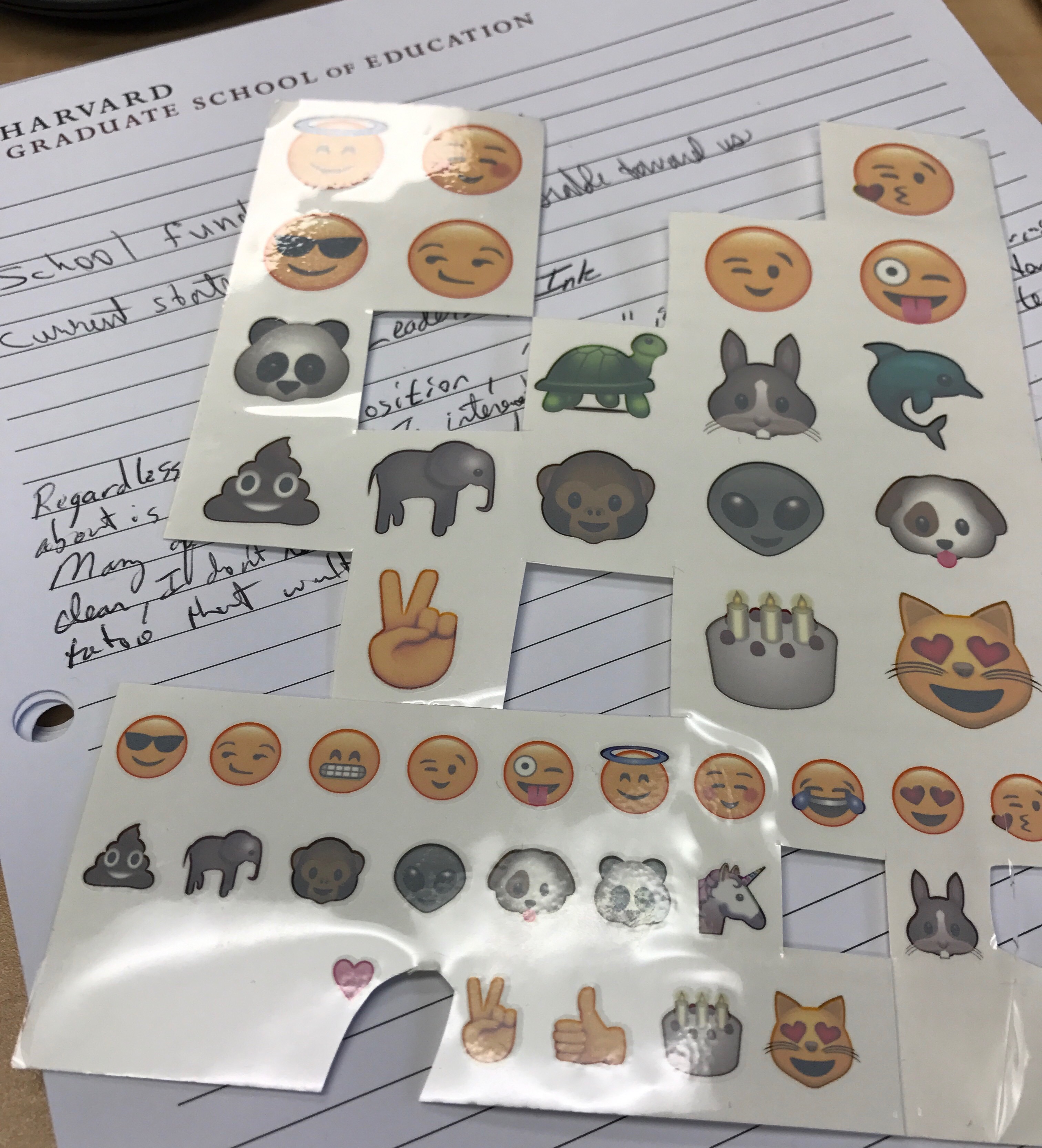
This past weekend we used Emojis as a “through line” for our Focused Leader Academy (FLA) December retreat. The first activity we did had participants pick an Emoji temporary tattoo and put it somewhere on their body. Check out the picture of the sheet of available tattoos. The catch was, you needed to explain why you picked the tattoo you did and the significance of where you placed the ink on your body. Needless to say, we had a lot of fun with this.
This was an exciting and inspiring activity. The explanations were very well thought out. Some were comical, while at the same time being very meaningful and heartfelt. I am hoping our Cohort #2 FLA members will reply to this post with their stories. Here’s mine:
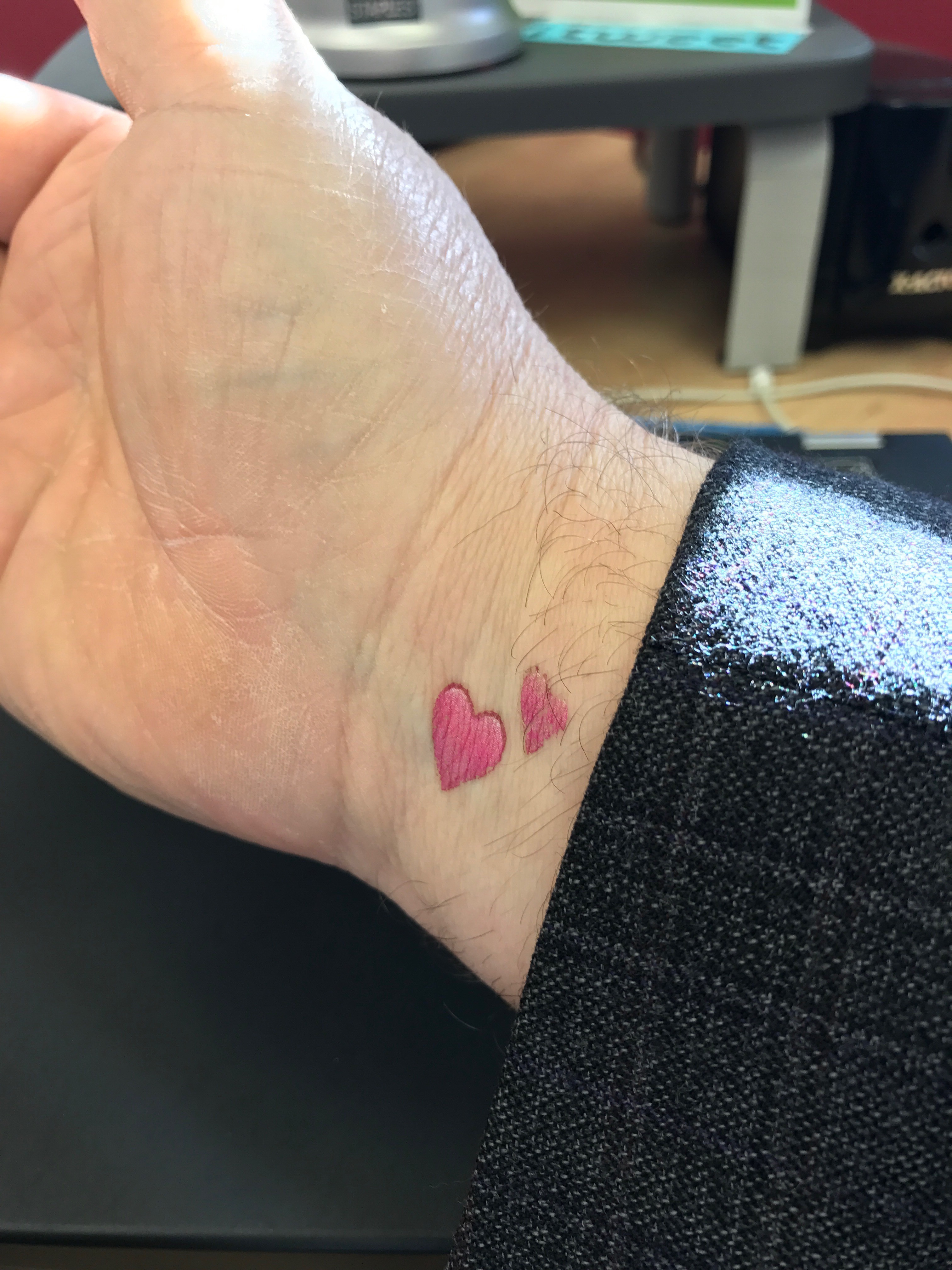
“I chose to put the two pink hearts Emoji on the inside of my right wrist. I explained this was because I love FLA and love facilitating the learning of our teacher leaders. In the words of Cohort # 1 graduate, Jill Landers, these weekend retreats are Byron’s “leadership heroine.” She’s right; I’m addicted. Furthermore, I placed the tattoo on the inside of my wrist because by personally working with our teacher leaders it helps me keep a pulse on what is going on with our teachers.” ~ Byron
Now, here we are almost a week later and my temporary tattoo looks just as good as on the day I applied it. At first I got a little concerned, but I have gotten used to it and actually really like it. I keep getting questions about it. Questions like the one at the state board of education meeting this week, “Byron, do you really have a tattoo of two pink hearts on your wrist?” These questions give me the chance to say “Why yes. Let me tell you why and about the journey our teacher leaders are taking through our Focused Leader Academy.”
So, if you were going to get some first time, or new, leadership ink; what would your tattoo be and why?
How Do You Emoji?
 This is the second of six great guest blog posts from the teacher leaders in our Focused Leader Academy. These guest posts are a result of a session yesterday on blogging as a leadership tool. We had been using the “through line” (a theme or idea that runs from the beginning to the end of one of our design sprints that has a connecting theme or plot) of Emojis, so it made sense to have the prompt of: Emojis: Benefit or Hindrance? Participants paired up and proceeded to write a blog post kowing I would be posting it as a guest post.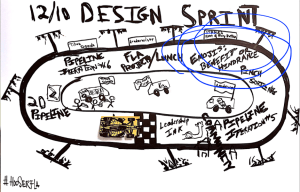

Graphic by Mike Fleisch
Enjoy Kristen and Lisa’s post:
Pick up your phone and take a look at the last emoji you used. What is it and what could it mean? My last emoji was 😬 in a tweet that reads “Don’t let perfection get in the way of a good blog 😬.”
An emoji can be beneficial or can be a hindrance. Here are our top 5 pluses and deltas of using an emoji:
- Supportive/Inspirational-Whether it be 😘 or a 👍 these simple gestures can provide support to a friend in need.
- Clarifying- An emoji can quickly add to and create the tone of the conversation.
- Telling-Did you know that Siri reads emoji’s as exactly what they are? Take for example when your teenage daughter says to Siri “Call Caleb.” And Siri responds with “Calling Caleb fire, beating heart, face blowing kiss.” 🔥, 💕, 😘. That real life situation was very telling for my husband when he overheard our teenage daughter calling her boyfriend.
- Misinterpreted-Could your emoji actually be a pinch to your reader? Have you ever gotten an unexplained winky face? 😜
- Unprofessional/inappropriate-There is a time and a place for an emoji and its probably not in the work place.
So choose your emojis wisely. ☺
Emojis: The Good, The Bad, & The Ugly
 I am super excited to post the first of six guest posts from participants of the current cohort of our Focused Leader Academy. The other five will come each day for the next five days. The authors of this first guest post are Carlie Coblentz and Brandon Johnson. Today, at our monthly Design Sprint (what others call professional development) we used Emojis to facilitate our learning. Part of our time was spent on how to create a great blog post. I really wanted to stress the use of blogging as a leadership tool. As is our custom in our design sprints, we split into pods and the question of “What can we create together?” was answered by the creation of six blog posts about the use of emojis. The prompt for this creation was: Emojis: Benefit or Hindrance. The pods of two then worked to create a guest blog post for me to post.
Of course we couldn’t just stop there. Participants also used our Emoji Maker kits to create Emoji stickers that represented their blog post. A picture of Carlie and Brandon’s sticker is at the beginning of this post. I am very proud of the posts that were written today and am excited to share them with you over the next six days. I have also included the graphic created by Mike Fleisch during our blogging session. Take a look at the graphic. Hopefully you will find some useful tips for your blog posts as well.
Here is Carlie’s and Brandon guest post:
The 👍, the 👎, and the 👺 of Emojis
Take a moment and think about the last time you used an emoji. These silly little characters have become very popular in the past couple of years. They can be used to quickly express many different types of emotions with friends and family. But, there are times that they can be a hindrance. Here’s a list of pros and cons of Emojis:
Pros
- Fun 🎉
- Engaging 👀
- Unique way of expression🦄
- Quick ⚡️
We could probably agree that Emojis can be a very fun and engaging way to communicate. You’re able to express your feelings with people without the usual long, drawn out stories.
Cons
- Takes away reading and writing skills 📝
- Limits communication🗣
- Misinterpretation 🤔
- Not appropriate in some situations 🤐
On the contrary, Emojis are very similar to what would be considered “text-talk.” They do not always communicate exactly what you’re trying to say, and sometimes, they could be misunderstood by the recipient, causing confusion and frustration.
What would you consider to be the 👍, the 👎, and the 👺 of Emojis?
What Can We Create Together?
 Whether you are the president of a company or the janitor, the moment you step from independence into interdependence in any capacity, you step into a leadership role. You are in a position of influencing other people. And the habit of effective interpersonal leadership is to develop a win-win mindset. Creating a community where win-win attitudes and behaviors is important work of leaders. So we need to focus on producing personal and organizational excellence by developing information and reward systems which reinforce the value of cooperation. We can develop this community by asking the question “What can we create together?” Remember, I now call the organizations, schools, or businesses we lead, the places we live, or even our families communities.
Unfortunately, most of us have been deeply scripted in the win-lose mentality since birth. Certainly there is a place for win-lose thinking in truly competitive and low-trust situations. But most of life is not a competition. We don’t have to live each day competing with our spouse, our children, our co-workers, our neighbors, and our friends. In Lesson #38, “Only One Winner,” in 52 Leadership Lessons: Timeless Stories For The Modern Leader, author John Parker Stewart points out we should “Replace internal competition with mutually beneficial and encouraging cooperation.” Most of life is an interdependent, not an independent, reality. Most results you want depend on cooperation between you and others. And the win-lose mentality is dysfunctional and detrimental to that cooperation and development of community. Community offers the promise of belonging and calls for us to acknowledge our interdependence.
The challenge for building a win-win community is this: While visions, plans, and committed top leadership are important, even essential, no clear vision, nor detailed plan, nor committed group leaders have the power to bring this image of the future into existence without the continued engagement and involvement of citizens. To do this I challenge you to as a leader help your community answer the question “What do we want to create together?”
There Can Be No Compromise!
 Great leaders know that leading change sometimes means they will have to fight for their vision and values. They can sometimes face strong resistance and criticism. At these moments they are fully aware that it is about being able to connect, and to convince others why this change is important. This means they invest energy and time in communication, in increasing mutual understanding, and in strengthening alignment. But they will not compromise their values and vision.
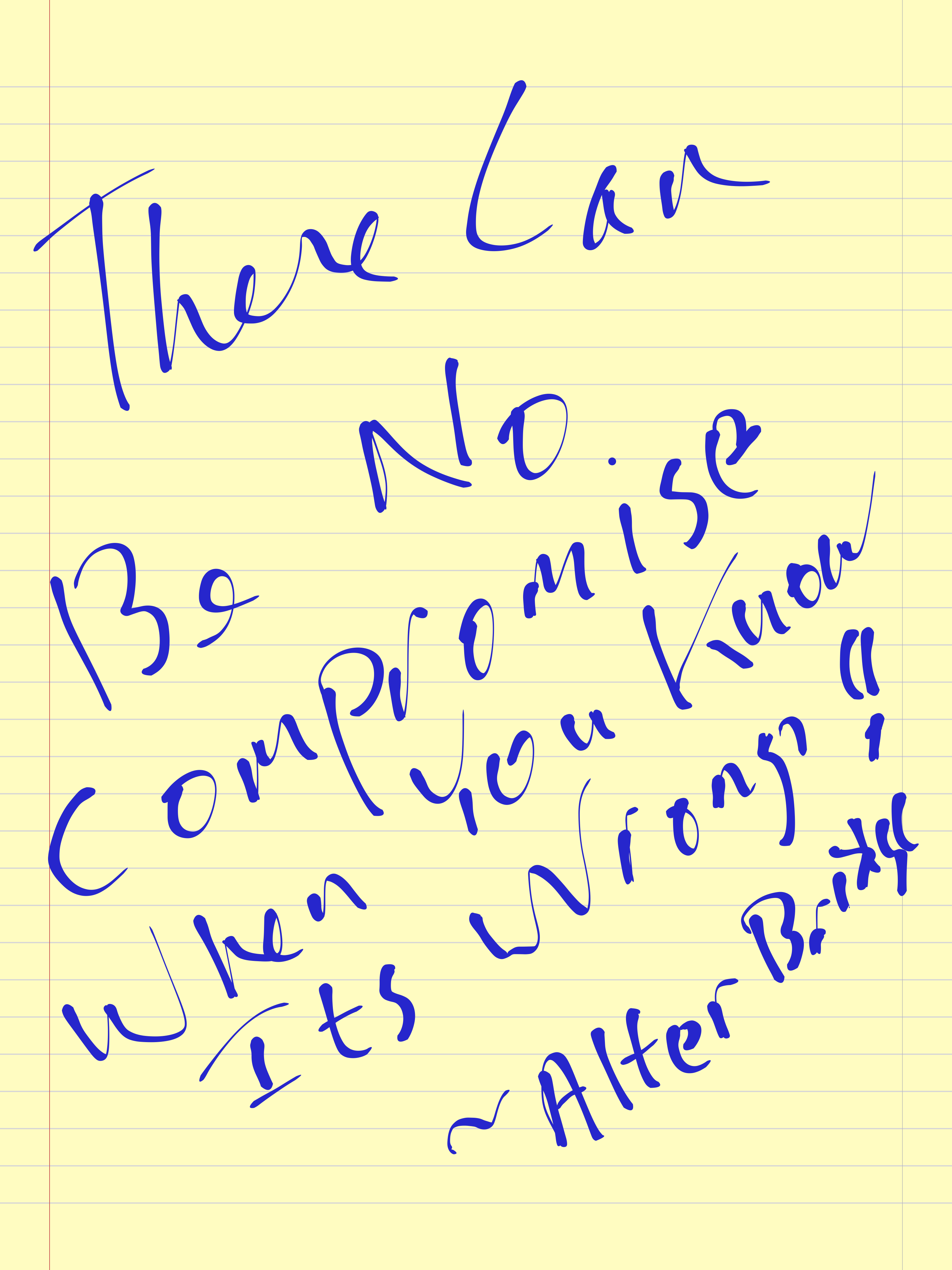 Two songs by Alter Bridge constantly cause me to think about compromise. In “Show Me A Leader” songwriters: Myles Kennedy, Brian Marshall, Mark Tremonti, Scott Phillips want a leader that won’t compromise. Additionally, in the song “Last of Our Kind” we hear the words: “There can be no compromise when you know it’s wrong ’cause in the end the sacrifice was worthless all along.” When compromising you give something up on both sides, you don’t create something together! A compromise is by definition leading to a suboptimal solution. Great leaders understand this, and are therefore reluctant to compromise.
I believe that compromise can easily blur our vision and core values, can create confusion, and therefore undermines the motivation of people. I realize, however, as leaders there are times when compromise is necessary. It is important to understand that no one knows everything. Great leaders listen to all sides, think about their own experience and then make decisions. Those decisions must based on a balance of knowledge and not compromise the leader’s core values. Sometimes the decisions don’t sound or look exactly like what the leader wanted. but they are the best for the organization as long as no core values have been compromised. So, when I hear, “Show me a leader that won’t compromise” I am reminded to never compromise my values.
Iterate, Don’t Change!
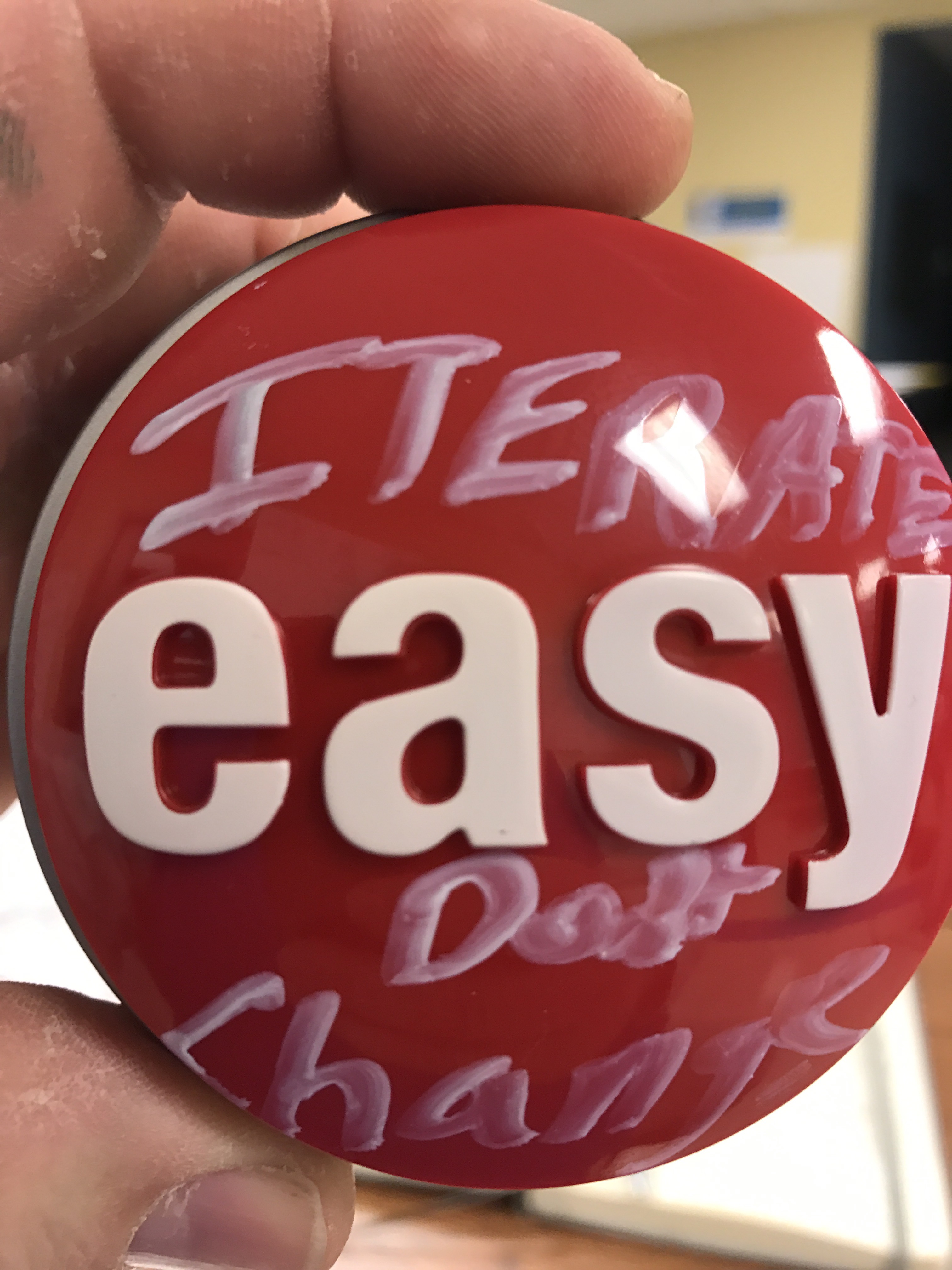 Mark Twain once said that the secret of getting ahead is getting started. But it’s often hard to get started. Why? Because we know we could fail, and many times that fear hinders us from even starting. We don’t have to get things right the first time, however. We can allow ourself multiple iterations to succeed. It could take many iterations to succeed, so the sooner we start the better. Don’t wait until everything is perfect before you start. Iteration works because it gives you the permission to fail. You don’t have to succeed right away, so you won’t be afraid to start.
Iteration is also different than change. To me, change means a reset and starting over. Iteration means you are changing and creating in real-time as we go. Iteration gives an organization agility. This agility is valuable and an agile organization will not only suffer less when hit by unpredictable external shocks, but will also be able to exploit unforeseen opportunities. True iteration should also include teams working together to channel their creative genius.
In education we are immersed in a world that is constantly trying to create and recreate. I am such a believer in the power of iteration. It adds layers of meaning to what it really means to be an educational leader. It is becoming clear to me that the power of iteration transcends the concrete and physical: The power of iteration is a driving force of creating a culture of excellence.
Iteration is really somewhat of a repetition with tweeks as we create and recreate. Computers are often used to automate repetitive tasks. Repeating identical or similar tasks without making errors is something that computers do well and people do poorly. Repeated execution of a set of statements is called iteration. iteration, useful in slightly different circumstances. After an iteration, we should always ask: how can we make improvements next time? Find the lessons and apply them to your next iteration.
I strive to create an environment where innovation is welcome, mistakes are appreciated, and all are accepted and actively included. The power of iteration allows us to make something out of nothing, it allows us to make greatness out of challenge, and it allows us to build something we never thought we could build.
It means that instead of trying to be perfect the first time you do something, you simply aim to get better over time. You want your second try to be better than your first one, your third try to be better than your second one, and so on. We need to iterate quickly. The faster you iterate, the better. If it takes too much time between iterations, your progress will be too slow. So, do your next iteration as soon as possible.
The power of iteration can help you and your organization achieve your goals. Keep learning. Keep improving through iteration. You will eventually succeed.
 Byron's Babbles
leave a comment