The Power of Ping-Ponging Ideas: Enhancing Community Collaboration

Today, during a discussion in the final day of a weeklong training of National FFA Teacher Ambassadors, one of the Ambassadors shared she loved the ping-ponging of ideas we did during the sessions. I was so proud to hear this because I really believe our work gets better in community. There is such power in heuristic learning and sharing. When I think of community and collaboration, I’m reminded of C. S. Lewis’s Inklings who provided J. R. R. Tolkien with encouragement and Lewis the right story.
In any vibrant community, innovation and progress often stem from dynamic conversations and the free exchange of ideas. One particularly effective method to foster this exchange is ping-ponging ideas — a process where thoughts, suggestions, and feedback bounce back and forth among members, much like a lively game of table tennis.
What Is Ping-Ponging Ideas?
Ping-ponging ideas involves collaborative brainstorming where participants actively listen, respond, and build upon each other’s contributions. Instead of linear discussions, this approach encourages a rhythm of giving and receiving, allowing ideas to evolve organically through continuous dialogue.
Why Is It Valuable for Communities?
- Encourages Creativity and Innovation: When ideas are bounced around, they often spark new perspectives and creative solutions that might not emerge in solitary thinking or one-sided discussions.
- Builds Collective Ownership: Engaging everyone in the idea-generation process fosters a sense of ownership and commitment to the community’s initiatives, leading to increased participation and support.
- Strengthens Relationships: Regular exchange of ideas creates connections among members, building trust and understanding that can translate into stronger collaboration.
- Facilitates Inclusive Decision-Making: Ping-ponging ensures diverse voices are heard, helping the community make more well-rounded and inclusive decisions.
- Accelerates Problem-Solving: As ideas bounce around, potential issues are identified early, and innovative solutions are quickly developed through collective input.
How Does Effective Ping-Ponging in Our Communities Make Our Work Better?
- Create Safe Spaces: Encourage open-mindedness where all members feel comfortable sharing their thoughts without judgment.
- Use Structured Formats: Organize brainstorming sessions with clear prompts or questions to guide the idea exchange.
- Leverage Technology: Utilize online platforms that facilitate real-time discussion and idea-sharing, especially for remote or hybrid communities.
- Promote Active Listening: Remind participants to attentively consider each contribution before responding, ensuring meaningful exchanges.
- Follow Up: Keep the momentum by revisiting ideas, giving feedback, and implementing viable suggestions.
Ping-ponging ideas is more than just a metaphor; it’s a powerful technique that nurtures collaboration, sparks innovation, and deepens community bonds. By embracing this dynamic exchange, communities can grow stronger, more creative, and better equipped to face challenges together.
Experiences Over Experience

Today during a discussion with National FFA Teacher Ambassadors about who we influence and how we influence others, a teacher commented that sometimes she worried she lacked influence because others viewed her as not having enough years experience. This teacher is going into her third year of teaching and went on to say she has had a lot of experiences that others with more years of experience have not had. Did you catch the distinction here? I loved this and it is something I have always told teachers I’ve coached or mentored: Experiences trump experience!
While the number of years someone has spent in a field can give a general sense of their exposure, it doesn’t necessarily reflect the depth, quality, or relevance of their experiences. Considering the actual experiences of others allows us to understand their challenges, problem-solving approaches, and lessons learned in specific situations. This deeper insight helps us evaluate their true expertise and adapt their knowledge to our own circumstances more effectively. Ultimately, focusing on meaningful experiences fosters more genuine learning and growth than simply counting years.
Let The Work, Work

This past weekend during the “DIY Lasting Leadership” workshop of the Hamilton Heights School Corporation Teacher Leader Academy 3.0 Finale Summit we used the butcher paper on the tables to record leadership thoughts as we built our individualized projects. I always appreciate Hamilton Heights Middle School Principal, Bret Bailey being a part of the Finale with us. As his table participants were working, they discussed how there were steps and “layers” to the project and at times we have to let the “paint dry” and “let the work, work.” I loved this statement and we proceeded to have a discussion about it.

When a leader says “Let the work, work,” they may be emphasizing the importance of trusting in the process and allowing tasks to be completed without unnecessary interference. Also, we sometimes start new initiatives, but don’t let them play out to know if they are successful or not. This was also a reminder to take charge of our own professional development as we navigate the challenges of transitioning from an individual contributor to a leader.

Additionally, sometimes we have to manage the conditions that drive team performance, but other times leadership means “letting the paint dry” and stepping back and allowing team members to do their jobs without micromanaging or getting overly involved. It implies having faith in the abilities of the team and letting them work independently to achieve their goals. “Letting the work, work” also reminds us, as leaders, we must coach colleagues and share feedback in ways that enable them to develop and deliver.
It All Comes Back To Relationships
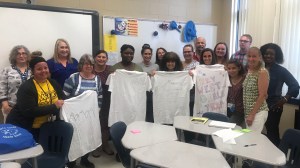
I’ve had the honor of spending the past two days in Florida facilitating professional development for teachers. It was so inspiring to work with teachers who were so positive and clear in their purpose for serving scholars. Interestingly, as we come back even better after the pandemic years one theme came out in every one of my sessions: relationships are the key to everything. No matter how tough things are, we have to remember that building the meaningful relationships with students is number one. We have known for a long time that the relationship with a teacher can be critically important to how well students learn. We also know these meaningful relationships are much deeper than social interactions. Great teachers engage with students around their curiosity, their interests, their habits of mind through understanding and approaching material to really be an effective teacher. Research also tells us that the teachers that form these relationships are happier and experience the true joy of teaching.
When I was teaching I actually had the personal mission statement of, “I strive to use rigor, relevance and relationships to be a steward of high student achievement.” I blogged about that in Drumming Up Relationships. We must learn our students and connect with them on a real level, showing respect for their culture and affirming their worthiness to receive the best education possible. Our relationships with students matter more than we might ever know. Our abilities to show empathy and compassion are crucial. We must also continually hone our skills at practicing perspective-taking: actively imagining how a student might perceive or be affected by a situation. This can help us reduce bias and deepen our relationships with students. With deeper relationships comes trust, and with trust comes more engagement in learning.
A Scholar’s Book Of Life

Yesterday, we used pumpkins in our leadership development workshop in Georgia. Participants carved out an image of their leadership mantra on one side and their leadership legacy on the other. I always love seeing these and hearing the explanations. They were all very meaningful and inspiring, but one really caused me to pause as an educator and leader. The participant had carved a book into the pumpkin (the featured picture of this post).
The teacher leader then went on to explain that the book represented each students’ book of life and she wanted her legacy to be entered in the book as having taught the student something and having positively influenced her or his life in some way. I thought this book was a pretty great metaphor.
In some professional development at another school this week we discussed how every teacher needs to own every scholar in the school regardless if she or he is in your class or not. The pumpkin carving reminded us that we are impacting students even when we don’t know it. Here’s the best part: to make it in a student’s book of life, teachers don’t have to be perfect.
Students remember teachers for all kinds of reasons. Students might be inspired by teachers who were kind, funny, brilliant, or passionate. The kids we serve remember the teachers who really cared about them. Our scholars remember teachers who were supportive or encouraging or saw something in them no one else did and then challenged them and made them think. Finally, our students also remember teachers who were maybe just a little quirky. Thank goodness!
Every staff member in the school represents the next entry or chapter of our scholar’s stories. Let’s fill up the pages of those books!
Seventh Graders Know!
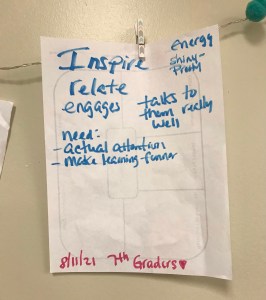
I spent this past week coaching teachers during their first days of school. It was so great to be in classrooms all day and then spend time leading reflection discussions after school. It has always been interesting to me how I can walk into a class and immediately know whether the teacher has the entire class engaged and the overall culture of the classroom. I think it is because I always focus on what the students are doing. I walked into a seventh grade class this past Wednesday and saw a teacher and group of students knocking it out of the park. It was one of those moments where I wanted to be back in seventh grade and a part of her class.
At an appropriate transition I asked the teacher and class if I could interrupt with a question. They all said yes and I asked if they all thought their teacher was doing a great job. It was a loud and resounding “YES!” I then asked a followup, “Why?” I also asked the teacher to write down what the seventh graders told us. By the way, a student pointed out I had asked two questions and not just the one I had gotten permission for – gotta live seventh graders! The list is the featured pictured of this post. What they said was:
- Our teacher inspired us.
- She can relate to us.
- She makes it exciting and engages us.
- She had a lot of energy (literally, this teacher was running from student to student).
- She helps them make everything shiny and pretty.
- She talks to us really well.
- She gives us actual attention.
- She makes learning funner (I know funner is not a word, but it should be and I told the student I would allow it).
This teacher was clearly “withit” and was building relationships with her students. Our students deserve those eight items that these seventh graders outlined. It really doesn’t matter what age group a person is facilitating, all these items apply. Our seventh graders know!
Leading Like A Hinge

I spent this week coaching teachers as the school year got started for many of the schools I work with. One of the teachers I coach told his students that he loved it when I was in the school because I was like the hinges on a door. “Without hinges the door is useless. You can have fancy doorknobs and windows, but the hinges make the door functional. Hinges attach a door to its frame, and are the pivot point for opening and closing the door.” I do hope I am helping teachers connect with their students and am serving as a hinge for the door to open for them to become highly effective facilitators of learning for their students.
Upon further reflection I was reminded of something retired Admiral James Stavridis, author of Sailing True North: Ten Admirals and the Voyage of Character, said: “Leadership is how we influence others. It is like a big door that swings. But that big door of leadership swings on the small hinge of character.” I hope that I bring a great degree of character to my leadership and that I inspire others to do the same.
I want to provide those I coach with the tools, guidance, support, and feedback they need to thrive in their teaching career. I want to be the hinge that opens the door to their success.
I Was Needed!

I love that a lot of what I do is helping teachers get better at their craft. Teaching is such a beautiful cross of science and art. Leonardo da Vinci would be having great fun if he were around helping us improve our teaching for learning today. He believed science and art were very tightly connected. This week I have had the honor and pleasure of facilitating professional development for teachers at Nashville Collegiate Prep and Knowledge Academies in Nashville, Tennessee. I have truly been inspired by this group of professionals. Every day I am excited to get the day of learning with them started.
“Change the audience, change the meaning.”
Leonardo da Vinci
On Wednesday I did a session entitled “Engagement Strategies: Teachers As Facilitators, Knowledge Navigators, and Co-Learners. At the beginning of this session I do an activity that begins with the prompt question, “What do you want students to say at the
end of the week about your facilitation?” The groups got five minutes to write everything that came to mind on Post-it® notes. This is part of a larger activity and participants get to share out after each part. I love walking around and looking as they are writing. There were literally hundreds of sticky notes being made, and I was inspired by all of them. But, one caught my eye and required my attention (the featured photo of this post).
On one of the Post-it® notes of Jamie Martineau, Kindergarten teacher at Nashville Collegiate Prep she had written four bullet points:
- I was part of something
- I was important or needed
- I am a part of this class
- We did it
I was blown away by the thought of every student feeling this way. After getting to know Jamie this week, I have no doubt that her students will feel that way. Going through school is where many of students begin learning to be part of something bigger than themselves. It’s during this time in our classes that we can help make our students feel valued as individuals. The developing personalities of our students need a strong and secure environment in order to flourish in academia. Let’s face it; our students learn more and behave better when they receive high levels of understanding, caring and genuineness.
We cannot underestimate the importance of cultivating a classroom culture in which students feel valued, respected, heard, and an important part of something. One way we can build this solid foundation for learning is to listen to our students. Fostering conversations about real world and relevant issues, topics, and problems ensures that our classrooms become places of academic inquiry and collaboration founded on a sense of fairness and mutual respect.
If a student considers their teacher to be caring and accepting, they’re more likely to adopt the academic and social values of their teacher. This, in turn, influences how students feel about their school work and how much (or how little) they value it. Here are some tips on how to make sure our students belong and are part of something:
- prioritising high-quality teacher-student relationships
- creating a supportive and caring learning environment
- showing interest in students
- trying to understand students’ point of view
- respectful and fair treatment
- fostering positive peer relationships and mutual respect among classmates to establish a sense of community
- positive classroom management
- Giving students a voice
We all want to belong. ALL of our students deserve to be an important and needed part of our school communities. We can do it!
Loving Teachers

As we close out Teacher Appreciation Week for 2021 I wanted to weigh in with my thanks and call for us all to love our teachers year round, not just a designated week. During a presentation I recorded for ASCD’s Annual Conference this week, I talked about how we needed to love our teachers if we wanted to stop losing great teachers and change the trajectory of teacher retention in a positive direction. I do not take the term “love” lightly and learned about this form of “love” from Beverly Kaye and Sharon Jordan-Evans, authors of Love ‘Em Or Lose ‘Em. To love our teachers we must be providing opportunities to grow and develop and be the best at carrying out their purpose of serving students every day. I am a former teacher and school leader who has shifted to creating and developing meaningful learning environments and transformative professional learning opportunities for educators and leaders, both in my day to day professional life, and as a citizen leader and policy maker. As a believer that everyone is a leader, we need to make sure we are doing everything possible to love our teachers, listen to their needs and desires, and honor them every day.
We have learned much about leading through a crisis during the past year. The pandemic has challenged us to be more agile in educating our children. Our teachers have met the challenge. Responding to new conditions and new data prompted us all to see school as no longer a single place. My hope is that we will double down on rethinking what success looks like in education. I also want to acknowledge the adjustments that teachers have always made every day to increase equity, access, rigor, and engagement for all students. As I write this I am reminded of the great teachers I have had over the years and continue to have. I am very fortunate to work with teachers every day and must say that I still learn from them each and every day. I was blessed to have teachers who had amnesia for the mistakes and my sometimes (okay, maybe more than sometimes) less than perfect actions. My teachers were pivotal figures in my life. They not only educated me, but set me up for a life of success.
Thank you teachers for inspiring our students to think outside the box, outside of the classroom, and into the future. We need to be guiding students toward their largest, best, life-long interests; not just the narrow obstacle course we now control. Therefore, I stand committed to showing you love by continuing to push for, advocate for, champion for, and be a cheerleader for creating space and flexibility for creativity, curiosity, and innovation you deserve.
Pathways To Quality Principals

Yesterday I had the opportunity to be part of a great National Association of State Boards of Education (NASBE) webinar where Susan M. Gates presented findings from research conducted by RAND Corporation. Click this recording link to view the recording of the webinar entitled Using State-Level Policy Levers to Promote Principal Quality. I was honored at the end of Susan’s presentation of the findings to, along with NASBE’s President and CEO Robert Hull, provide some thoughts, observations, and feedback.
First of all, this is such an important topic for state boards and all policymakers to contemplate. Leadership matters. The research suggested, as we might have all guessed, that there is no “one size fits all” policy that will miraculously place quality principals in all schools. Another point that came out in the research was that professional development alone is insufficient. Highly effective pre-service development must also be a part of the pathway to quality principals. As a former principal, I reflected as I was reviewing this report and was thinking about the complexity of being a principal. Ultimately, the principal is a leader of learning, but there are many parts to that. Highly effective teachers and facilitation of learning and leadership define how successful any school is. A school without a strong leader will likely fail the students it serves.
The RAND report gave us four key levers to use as policymakers. Those four levers are:
- Standards
- Licensure
- Program Approval
- Professional Development
Interestingly, four things came to mind as I was reviewing and listening to Susan’s report. Here are my thoughts, observations, and feedback:
- As state board members, we need to take the approval of teacher education and leadership development programs very seriously. In my own state, our department of education does a tremendous job of evaluating and providing us reports for revue prior to approval of programs. We still have an obligation to study these reports and make sure the programs meet the test of equity and excellence. We also need to make sure that any pathway to the principalship is not rewarding the person who can best meet meaningless requirements.
- As I listened, I wondered if there were ways to leverage the attention we are now rightly giving to teacher leadership. Teacher leaders are so important to building the capacity is schools and it seems to me we could better leverage identifying those teachers with the leadership dispositions and develop those skills. Notice I said dispositions, because many teachers are very interested in being teacher leaders but not, at least in the present-tense, being a principal. As a believer that everyone is a leader and that leadership should happen where the data is created, in this case the classroom, it makes sense we would be developing teacher leaders to make decisions that traditionally have been cascaded down to teachers. This real-time development would give teachers practical pre-service development that would be important to effective leading for learning whether a teacher or principal. I would argue that a well developed and highly effective teacher/teacher leader could be the best bet to become a high quality principal. You’ll want to check out Susan’s response to this point in the recording.
- Another point made was the fact that sometimes we need to look at subtraction as well as addition when formulating policy. We deal with this a lot in education where we continue to place mandates without taking anything away. We need to allow for more flexibility. Additionally, how can we more effectively use incentives or information sharing in the place of mandates?
- Finally, there was a suggestion in the report of finding opportunistic ways: “Be opportunistic: link principal initiatives to key state education priorities and build on related initiatives.” By doing this we might find new ways to streamline, provide flexibility, or identify those things that can be removed.
I really appreciate the research and this report. Again, it provides levers for us to consider using as policymakers as we contemplate how to better prepare and provide quality pathways for the development of our critically important principals.
 Byron's Babbles
leave a comment