Telling Your Leadership Story

Dr. McCormick (10th from left) With Our Focused Leader Academy Participants
 After breakfast and the sharing session on the learning from our meal at Ulen Country Club it was time to explain why in addition to the normal fresh flowers, crayons, markers, fresh fruit, and butcher paper there was a $100 bill taped to the tables. I explained it was now their, FLA participants, turn to plan a meal in order to tell a story. My instructions were to prepare a meal that had an appetizer, main course, and dessert that told the story of their journey as a teacher leader and of our school. I gave these instructions at 9:30 am and told them the meal would be at 12 noon. I also told them to plan as if they would have some type of government official present to tell the story to. A few questions ensued, but for the most part they got started.
It was amazing to watch the process unfold. Different leadership styles emerged. Some went straight to doing, others to planning. Others began developing the story. Then about 30 minutes in they all began to check on each other. The appetizer and main course groups realized they were developing along the same story lines of “selling the steak and not the sizzle” and “under fire.” Quickly, they all all came to the conclusion to use a Mexican food theme and serve fajitas.
 In normal form for me, I then added two last pieces to the design sprint. I told them they could get another $100 through a non competitive automatic grant (I called it the LWFS Grant – Leading With Food Stories Grant) if they wanted it. One group applied and received the grant, but in the end did not use it. This caused a great discussion about budgeting, having too much money, and being able to move the money where it was needed. My philosophy is to have as few buckets in a budget as possible. This way money can be used where it is needed the most to make strategy reality. Also, we talked about that with less buckets we eliminate the trap of people/departments spending money just because they have it. This was a great philosophical discussion and real world budget lesson for our teacher leaders and future school leaders.
The other new wrinkle I added was that there really would be a government official in attendance. I had arranged for our Indiana State Superintendent of Public Instruction, Dr. Jennifer McCormick, to be in attendance to have lunch with our teacher leaders and hear there journey told through food and a meal. My only regret was not having a camera ready or a video going when I told them, because it was truly an “Oh Shit!” moment. The look on their faces said, “Oh Shit, this is really happening. We have an hour and a half!” I laughed because their theme of “under fire” was coming true and very appropriate. We all know that leaders grow leaders. This why I have taken it as my personal charge to develop, grow, and improve our Focused Leader Academy. Remember my rules for learning: For accelerated leadership growth we must create an environment where our developing leaders experience fear, excitement, anxiety, and experimentation. This design sprint of preparing a meal to tell a story really did this. For rapid growth we must create real time, real work experiences of:
- Fear
- Excitement
- Worry
- Anticipation
- Terror
- Thrill
- Anxiety
- Experimentation
- Risk
- Possibility
Additionally, I watched in amazement as one group proceeded to clean and make sure the convening space was just right. They went and got table clothes, bulletin board materials, and everything else needed to make our commons area perfect for the event. I was so impressed because I really hadn’t thought anything about that.
When asked why I was so calm, I told them I had total faith in them and the only piece I had to worry about was whether Dr. McCormick would show up on time, call in sick, or forget. I was not expecting any of those, but you never know. As I expected, Dr. McCormick showed up about 10 minutes prior to the start time for lunch. My part was done!
 As for lunch…It was perfect! I am so proud of our FLA members. They planned the perfect lunch menu in buffet style. They had set up and decorated three tables for eating and visiting. The appetizer group went with Dr. McCormick first through the buffet line for appetizers and then had her sit with them and they explained the story they were telling with the appetizers. They then ate the appetizers and visited. Then it was the main course team’s turn to go through the buffet line with her for fajitas, tell their food story, and visit while eating at their table. Then, last but certainly not least, since they were serving Gigi’s Cupcakes and ice cream, the dessert team used the same format as the other teams. Again, and I know I am biased and sort of like the proud papa here, it was PERFECT!
For more details, a picture really is worth a thousand words. I am going to let the graphic recordings that Mike Fleisch did during the three courses of the meal fill in the details of the discussion. Here they are:


 After the meal and great discussion we gave Dr. McCormick the opportunity to say a few words or reflect. She spoke of how great it was to learn about our school and our development program for teacher leaders. She spoke of how education goes both ways – in other words, is all about learning from each other. Dr. McCormick also invited our FLA members to get involved on her advisory committees. Finally, she left the group with three very important and inspiring points:
- Be nice!
- Work hard!
- Be amazing!
Here is Mike Fleisch’s graphic recording of her comments:
 As you can see, this was quite the event. In my next blog post entitled Leadership Story Reflections, I will capture the group’s thoughts and emotions after the meal.
Leadership Breakfast Story
 This is the second post in a series of four that tells the journey of our Focused Leader Academy (FLA) learning to tell a story with food. Click here to read the first post entitled Feeding Leadership.
We started the day yesterday with my good friend and Graphic Recorder, Mike Fleisch, and I telling a story of our six year journey working with teachers together by cooking breakfast. We had so much fun planning for this and wanted to model storytelling, like we had learned from … the night before. This was so much fun and really caused a lot of reflection on the part of Mike and I.
Most importantly, we noted the fact that we practiced our normal “Jazz Improvisation” when putting this breakfast together. I would say, let’s have this and Mike would say yes and I can bring this to top it off and make it really cool. Honestly, that’s how it works with us. We have become such great friends and convening partners that we can visualize what each other is doing and improvise the next part of the music, so to speak. That was an important part of this story for us to tell. What sets Mike and I apart from others who bring groups together for professional development is what sets jazz apart from other music – this cool thing called improvisation.
Jazz is certainly an art of the moment, but it is also an art in and of a particular history, and history flows out of every note played. Mike and I practice adaptive leadership, what I’ll call Jazz, of the moment and become artful in differentiating for the moment. Our form of leadership jazz is also rooted in life, it takes all that life has to offer and makes a rich amalgam with the history and context of the teacher leaders we serve in our Focused Leader Academy.
Here was our breakfast:
- Starbucks Coffee – coffee from a socially responsible company was important to Mike and I because we both want to be a part of social change and making the world a better place.
- Titus® Donuts – These are the official donut of FLA. We felt it was important to go ahead and make the staple and constant product available. An important thing for leaders to do, even when introducing new and exciting things.
- Mixed fruit cups – When Mike and I first met and started facilitating together, we both came with different talents, beliefs, and skills. Just like when you put different fruits together with different tastes, textures, and colors it makes something really amazing. And, Mike did his usually of adding the artistic touches of shaved lime and real whipped cream on top. Improve at its best!
- Then came an awesome cheese dish with toast that Mike made with Wisconsin Cheddar cheese since he is from Milwaukee, Wisconsin.
- Eggs – We wanted to serve eggs because we wanted this to represent how great leaders differentiate and meet those they serve where they are. We represented this by preparing the eggs to order – over easy, over hard, sunny side up, scrambled, or the most complex order of the morning: one whole egg and three egg whites scrambled together.
- Goetta – First let me explain what Goetta is. Pronounced “get-uh”, the sausage-type patty is pretty synonymous with Cincinnati (where Mike lives), though its roots are steeped in the “Queen City’s” German heritage. Goetta employs steel-cut or pinhead oats to extend the amount of pork and beef scraps that are then blended with spices, formed into a log, sliced, and fried. We chose Goetta because each month I go spend a day with Mike and plan out our weekend retreats. He always has some new cultural thing for me to learn and we go to his favorite places. One time he took me to a great restaurant where I had Goetta for the first time. This is one of the discoveries that has remained closest to my heart. It proves how relationships and trying new things can change our lives and cause us to grow.
- Non-alcoholic Mimosa – Bottom-line it’s elegant and can be made with so many combinations. Think about it, you can really add in any of your favorite fruits – peaches, blueberries, kiwi – the possibilities are endless. Mike and I like trying new things, putting new models into play, and iterating. It was the perfect drink to top off our breakfast storytelling.

So, let me finish by talking about the very important leadership skill of storytelling again. Everybody talks about ‘storytelling’. It’s a leadership buzzword – I hate buzzwords. That’s why we are used ‘food stories’ as our through line this weekend. Storytelling is something we’re all meant to be doing (or think we do already) as leaders. But, do we actually know how to tell a story? How are stories structured? And what makes a story impactful? It is very important to learn storytelling skills that move those you lead to action, whoever they may be.
Here are three things Mike and I expected our teacher leaders to take away from our Leadership Breakfast Story:
1. Learn how to use stories to communicate complicated messages and data without jargon and without the dreaded ‘death by PowerPoint’. If you want me to become un-engaged, just pull up the PowerPoint. Note: technology is not allowed, except for Tweeting, at any of our FLA retreats.
2. Learn how to use stories to influence others, and persuade them in a human and authentic way.
3. Learn how stories make your messages more memorable and more likely to be passed on.
Just like I said in Leading With “Food Stories”, “Subconsciously, when you eat something, your brain is always comparing it to what you’ve had previously, the place you were eating it, and the people you were eating with. Think about it – our brain tries to find connections and similarity. Just like being able to tell stories is a very important leadership trait, the more powerful story behind the food, the more it evokes the memory, which in turn enhances the flavor. There is no doubt that flavor is inextricably linked with memory and emotion. They’re all processed by the same part of the brain,’ planning the food for a meal is an excellent way to learn and model storytelling.
What foods would you use to tell the story of your leadership journey?
Schools For All Citizens
 On this President’s Day, 2017, I am reminded that there are those who believe people are now judged by the content of their character rather than the color of their skin. I want to believe this too, but know that the question of race runs much deeper than this. Others would contest that racial identity still strongly influences many aspects of their lives in American society. The question that is still causing me pause is “How do we reconcile such opposing opinions?” Furthermore, I need to make sure that I constantly remember to consider that all students have tremendous potential and most, regardless of race, are school dependent, and underachievers. Additionally, I really believe that many of the staff I serve, again regardless of race, have huge potential and many times are underachievers. I have a strong belief that race does not cause achievement differences, but how we structure the education and the pedagogy we use for teaching.
The real problem is low quality instruction for classes of lower skilled, underachieving students. Differentiated teaching is very difficult and presents a challenge to mixed ability groupings. Equity for me means that we are making sure that every student has the same high quality instruction. It also means that I continue to learn and remove my own and the school’s as a system implicit biases to make sure we are not grouping students incorrectly and making sure we are meeting the student where he/she is. As a school leader I must remember the school as a workplace is the most important place for teacher training/learning/and induction.
When discussing equity in education I believe we must first address the difference between equality and equity. I believe the definitions set forth by the Center for Public Education (2016) do an adequate job of capturing what I believe and read: Equality in education is achieved when students are all treated the same and have access to similar resources. Equity is achieved when all students receive the resources they need so they graduate prepared for success after high school. It is very important to recognize that equality and equity are not the same thing. When dealing with issues of equity we need to use data driven decision making and transparency as keys to success. I also believe we need to shift school and district level foci to external benchmarks as points of comparison, instead of inter-group comparisons in the home community. One of the pieces of the Every Student Succeeds Act that I really value is the breaking out and analyzation of more sub-groups.
“One fundamental aim of our democracy is to provide an adequate education for every person. Our educational systems face a financial crisis. It is deplorable that in a Nation as rich as ours there are millions of children who do not have adequate schoolhouses or enough teachers for a good elementary or secondary education. If there are educational inadequacies in any State, the whole Nation suffers. The Federal Government has a responsibility for providing financial aid to meet this crisis.
In addition, we must make possible greater equality of opportunity to all our citizens for education. Only by so doing can we insure that our citizens will be capable of understanding and sharing the responsibilities of democracy.
The Government’s programs for health, education, and security are of such great importance to our democracy that we should now establish an executive department for their administration.” ~ President Harry S. Truman in his 1948 State of the Union message to Congress , Jan 7, 1948.
I do not believe we have gotten to where President Truman wanted us to be in terms of education. It is interesting to me we have researched, written and debated about for years the problems of race, poverty, and public education. These issues have been studied by academics and fueled by talk radio, television, and politicians which serves as a place for us as citizens to argue, debate, and complain about who is right or wrong and who needs to change. All of this has caused me think about the questions of race as related to education and see that what we now call problems are simply symptoms of something deeper.
What I believe we need to be asking is about a breakdown in our communities and education, not viewing as a problem. If we think of race as a problem then we will only be looking for symptoms. Instead we need to be thinking about what is possible and what can we create together. If we continue to look at education in the context of a set of problems to be solved, we may actually limit any chance of the future being different from the past. We need to be having the courageous conversations as a community to develop ways in which all school dependent children are provided the opportunities needed in a great education.
I believe that community health, educational achievement, local economic strength, and other measures of community well-being are dependent on the level of social capital that exists in a community. We need to create communities where citizens have the experience of being connected to those around them and knows that their safety and success are dependent on the success of all others. I believe as Peter Block does that “A shift in the thinking and actions of citizens is more vital than a shift in the thinking and action of institutions and formal leaders” (Block, 2009, p. 31). We need to continue to find ways to bring communities of people together to work for continuous improvement of our schools and the systems with which we evaluate those schools.
Reference
Block, Peter (2009-09-01). Community: The Structure of Belonging (p. 31). Berrett-Koehler Publishers. Kindle Edition.
Leaders Doodle

My Doodles From A Task Force Meeting
Drawing with pencil, pen, or brush on paper isn’t just for artists. For anyone who actively exercises the brain, doodling and drawing are ideal for making ideas tangible. In order to encourage doodling in meetings, retreats, and professional development events I put white butcher paper sheets on the tables, a box of crayons, and a small container of colored markers to use for doodling. Then there other details, like getting small flower vases and the flowers. These may seem like little things, but you have to understand that creating the perfect environment is crucial to convening great conversations.
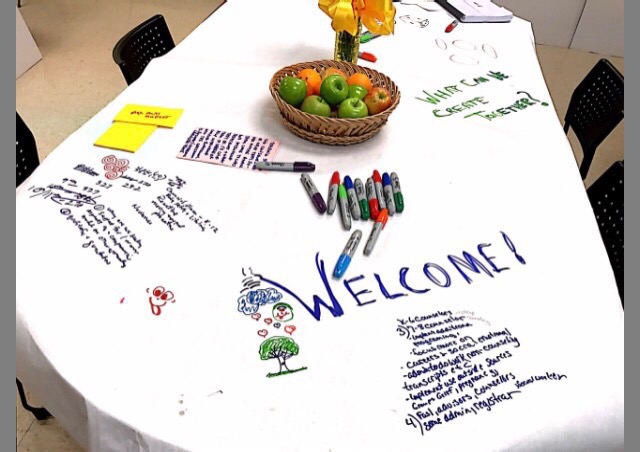 Recall a time when you had a great conversation where real learning or new insight occurred—what enabled that to happen? In this way, participants have the opportunity to participate in an environment where the emotional context and framework support innovative thinking. If you can design the physical space, the social space, and the information space together to enhance collaborative learning, then that whole system turns into a learning system.
As a side note, many of our presidents, like the rest of us, doodle. Dwight Eisenhower drew images of tables, pencils, and nuclear weapons. A Herbert Hoover doodle provided the pattern for a line of rompers. Ronald Reagan dispensed cheery cartoons to aides. John F. Kennedy reportedly doodled the word poverty at the last cabinet meeting before his assassanation.
Are you encouraging your team to doodle?
Listening as a Principle for Authentic Community Engagement
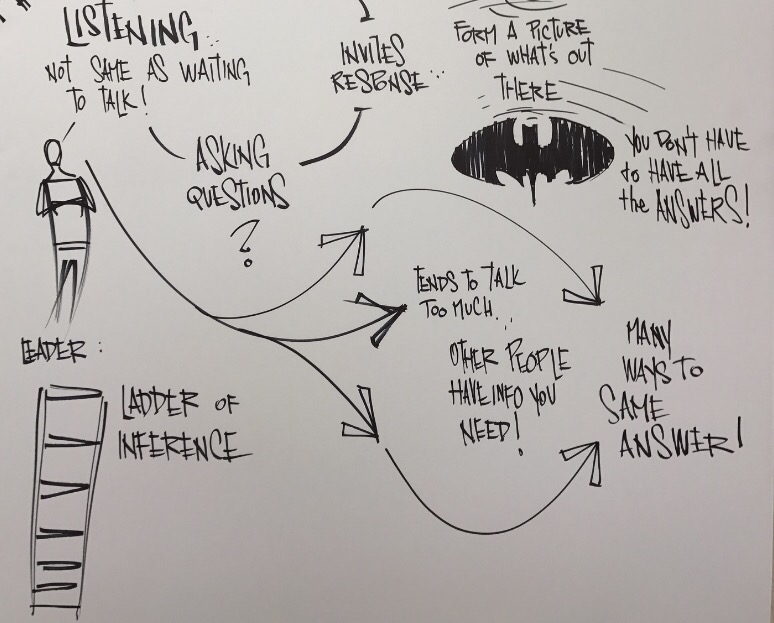 Lead with Listening Listening is a neglected skill, especially in change efforts. Often the leaders’ emphasis is on communicating a decision to stakeholders. When listening campaigns are con…
Source: Listening as a Principle for Authentic Community Engagement
Leading Conversations
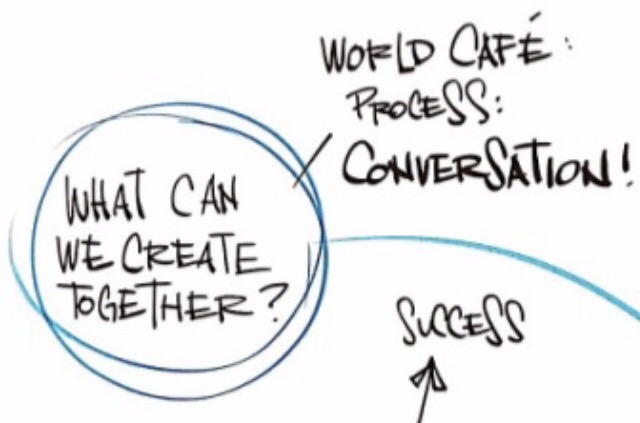 I continue to be amazed at how many people espouse to want to have great conversations and be a conversational leader, but really can’t help themselves from becoming a pontificator and problem solver. So many leaders leap right to answering the questions themselves. There are many reasons for this, but I believe for many it is just ego of hierarchy – he wants to be seen as the smartest or person who solved the problem. Authentic conversation that deepens a group’s thinking and evokes collaborative intelligence is less likely to occur in a climate of fear, mistrust, and hierarchical control.
I believe everyone is a leader. Everyone has the right, responsibility, and ability to be a leader. In fact, I believe everyone has the obligation to be a leader. We all need to lead from where we are. How we define leadership influences how people will participate. In my world with educators, teacher leaders yearn to be more fully who they are—purposeful, professional human beings. Leadership is an essential aspect of an educator’s professional life. This is why I spend a great deal of time working directly with our rising teacher leaders in our Focused Leader Academy.
We are building an organizational community for thinking more deeply together about key strategic questions. It has been my experience that results do come from the questions. The results lie in the personal relationships, the knowledge, and the mutual caring that gets strengthened in people’s conversations together about the questions, along with the discovery of their own answers.
What kind of conversations are you leading?
Leaders Are Readers
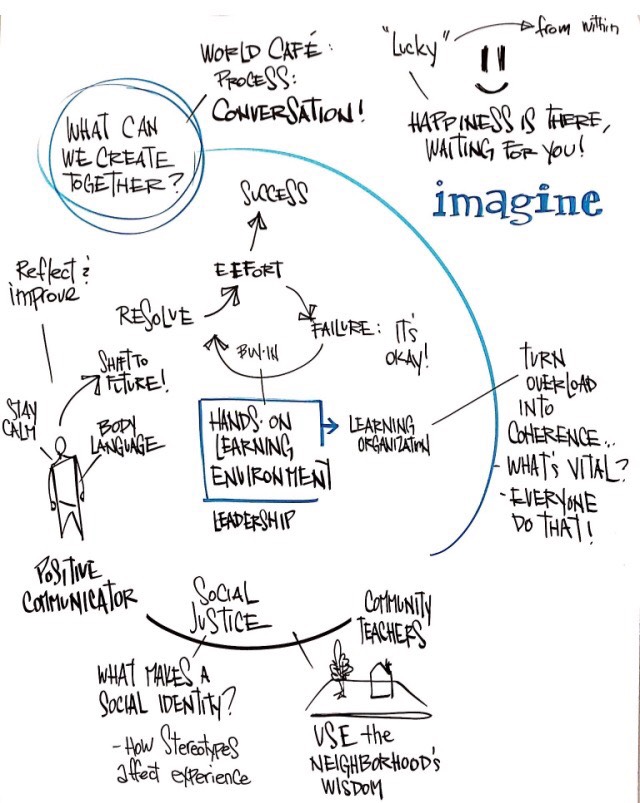
Mike Fleisch Graphic Of Our Leaders Are Readers Session
It goes without saying that “leaders are readers.” This past Saturday during our January Focused Leader Academy (FLA) we did a very cool activity. We all read a book in 45 minutes. I purchased copies of the last 16 books I have read and let our FLA participants pick a book to read and make their own. Here is the protocol we used:
How to Read a Book in 45 minutes
1. Read the introduction, carefully. A good intro will give you the book’s thesis,
clues on the methods and sources, and thumbnail synopses of each chapter.
Work quickly but take good notes. Allow fifteen minutes here.
2. Now turn directly to the conclusion and read that. The conclusion will reinforce
the thesis and have some more quotable material. In your notes write down 1-2
direct quotes suitable for using in a review. Ten minutes.
3. Turn to the table of contents and think about what each chapter likely contains.
Five minutes.
4. Skim 1-2 of what seem to be the key chapters. Look for something clever the
author has done with her or his evidence, memorable phrases, glaring
weaknesses–Fifteen minutes, max.
5. Meet some friends and tell them the interesting things you just learned,
speaking from the author’s point of view (driving it deeper it your memory).
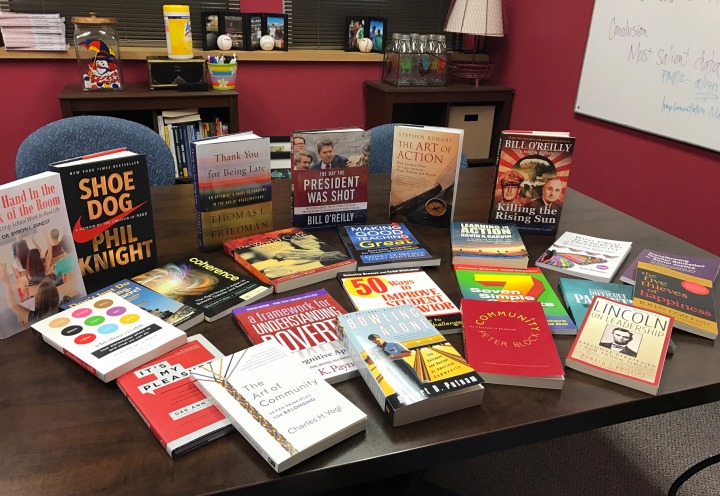
Great Books Our Teachers To Chose From
Here are the books that were available for selection:
Bowling Alone: The Collapse and Revival of American Community by Robert D. Huffer
Don’t Just Do Something, Stand There: Ten Principles for Leading Meetings by Sandra Janoff
The Five Thieves of Happiness by John B. Izzo, Ph.D.
Whistling Vivaldi: How Stereotypes Affect Us and What We Can Do by Claude M. Steele
The Art of Community: Seven Principles for Belonging by Charles Vogl
The World Cafe`: Shaping Our Futures Through Conversations That Matter by Juanito Brown and David Isaacs
Community: The Structure of Belonging by Peter Block
The Art of Action: How Leaders Close the Gaps between Plans, Actions and Results by Stephen Bungay
It’s My Pleasure: The Impact of Extraordinary Talent and a Compelling Culture by Dee Ann Turner
Thank You For Being Late: An Optimist’s Guide to Thriving in the Age of Accelerations by Thomas L. Friedman
Coherence: The Right Drivers in Action for Schools, Districts, and Systems by Michael Fullan
Learning in Action: A Guide to Putting the Learning Organization to Work by David A. Garvin
Killing The Rising Sun: How America Vanquished World War II Japan by Bill O’Reilly
Shoe Dog: A Memoir by the Creator of Nike by Phil Knight
The Day The President Was Shot: The Secret Service, the FBI, a Would-Be Killer, and the Attempted Assassination of Ronald Reagan by Bill O’Reilly
The Hand In The Back of the Room: Connecting School Work to Real Life by Byron L. Ernest
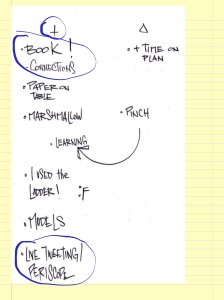
Needless to say, this activity was one of the favorites of participants. Even those who were skeptical really appreciated having the chance to be given a book and go through the protocol. You can see in the graphic of our +s and Δs discussion at the end of the day, that this session was one of the top rated. In fact you will notice in the video that one of those skeptics became a reader while doing this activity.
You will also see a plus on our +/Δ of “Live Tweeting/Periscope.” I live tweeted out the introduction to this activity as well as the report out from all participants using the hashtag #HoosierFLA. We had a large number of people watching live and were receiving several comments during the live tweet. Therefore, I am providing you the link to both videos.
Introduction to our “Leaders Are Readers” session:
https://www.periscope.tv/w/1YqKDAEqlMeGV?t=12s
“Go-Round” report-out from participants’ reading:
https://www.periscope.tv/w/1rmxPrAkbvVGN?t=2s
As you can see, leaders are readers. Are you tending to your own professional growth by reading? Are you supporting the professional growth of those you serve by encouraging reading?


Global Community: Don’t Just Stand There!
 It is said a global citizen is someone who identifies with being part of an emerging world community and whose actions contribute to building this community’s values and practices. We are going to have to learn to be effective change agents of a global future. We will need to create our own future, rather than trying to predict the outcome of all these global forces. Today the forces of global engagement are helping some people identify themselves as global citizens, meaning that they have a sense of belonging to a world community. This growing global identity in large part is made possible by the forces of modern information, communication, and transportation technologies.
“We know this much. The world is not going to be dominated by any one great power. For Americans that’s going to be a very difficult thing to accept. Most of us still see a world – the world of 1960 – in which America was the only great power, and the only functioning economy.” ~ Peter Drucker
Global citizens are also moved by a desire to make a positive contribution through their professional and personal lives. When it comes to being a member of the global community, will you be a leader, challenger, or spectator. Furthermore, we must bring global competency skills into our schools.
- Kids need skills to navigate globally!
- Kids Need To Navigate Shrinking World!
The skills and insights students can gain from interacting with people of different nations and cultures is critical as America engages more intensely with an increasingly global marketplace and interdependent world.
We must all serve as global community leaders and engage in the dialogue, to care about the issues and become a global citizen.
“To the world you may just be one person…but to one person you might just be the world.” ~ Mark Twain
Instant Relevance
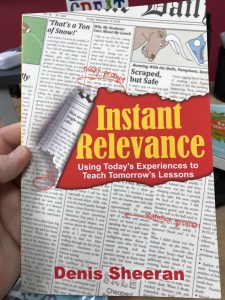 Instant Relevance: Using Today’s Experiences to Teach Tomorrow’s Lessons by Denis Sheeran
My rating: 5 of 5 stars
The first thing that struck me about this book was Denis’ use of Thinking Questions at the end of every chapter to guide the reader through the learning. As we know, questions open the door to the future and are more powerful than answers in that they demand engagement. I couldn’t help but be engaged as I read this book. As a believer in the fact that context and relevance matters, this book hits the mark.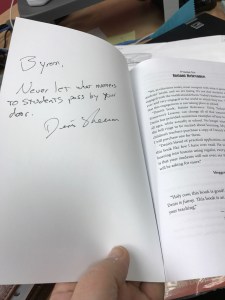
Denis shows you how he brings his life into the classroom. Whether we like it or not, our students want to get to know us – and why not? Or, why would we not want to form that relationship? As Denis said, “We have no choice but to make learning more relevant to our students, or they will learn without us.” If you want to make school work relevant and learn along with your students, you need to read this book.
~Dr. Byron L. Ernest
Emojis…Creative or Lazy?
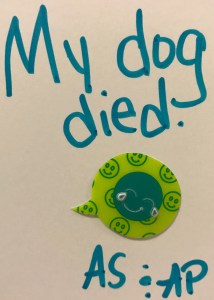 Here is the sixth and final guest post in this series on Emojis from our top teacher leaders. It has been exciting to bring you a new post every day this week from these talented individuals. The goal was for this cohort of our Focused Leader Academy to experience the thrill of putting content out there for anyone and everyone to read in the form of a blog post. They explained that it was a little scary and intimidating to put thoughts out there for others to critique. The biggest question our reluctant bloggers were asking was “Will I be clever?” While, yes, there is a certain amount of vulnerability, blogs can enable self growth, serve as a journal, and most importantly to me – serve as a library of personal thoughts, research, and lessons learned. I go to the archive of my posts often to get information from the past that I have documented in my blog. Blogs are an incredible leadership tool for your organization’s to know about you as the leader, but I believe blogs are most valuable as a personal tool.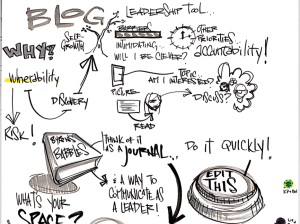
Check out this awesome post by Ann Semon and Aimee Campbell:
Emojis…Creative or Lazy?
“People who use emojis are too stupid to communicate with actual vocabulary.” This was a quote we saw on the internet, which sparked controversy. Are emojis stupid? Do people use them as a cop-out for thinking OR as an alternate way of communication? The way people communicate in 2016 come in various forms of email, text, tweets, etc. Does this mean we are dumbed down or actually more innovative and creative? It’s your choice.
Benefits:
Courtney Seiter says, “Scientists have discovered that when we look at smiley faces online, the same parts of the brain are activated as when we look at a real human face.” She goes on to say that emojis replace the tone of voice you would hear in typical conversation, thus creating an online version of empathy. When you communicate with emojis, are you using them as a tool to express emotions or as a symbol to replace real vocabulary? Right brained people tend to take a more artistic approach to communication, and like to be shown rather than told. Right brained people also prefer to draw rather than write which may lead us to believe, if you use emojis, you might have right brained tendencies.
Symbolism is often used in things like poetry and art. Emojis are essentially a picture that represent words…so could be considered an art form. For example, silent movies can be enjoyable because you get to interpret the story being told. Pictures books are another simpler form of using symbolism for story-telling purposes…could emojis be the same?
Hindrances:
Left brained people tend to be more detailed and use words rather than pictures. They often find it easier to read things that are straight forward rather than vague. With this being said, a left brained person may find it inappropriate to use these vague pictures to represent specific information, especially if it a message that should not be up for interpretation.
In an online environment, sometimes emojis can be misinterpreted. The simple mistake of a winking emoji in place of the regular smiling emoji may lead people to think you know something they don’t. This could lead to over-analyzing and misinterpreting a simple statement. Emotions are complex things and people can have a differing view on what an emoji could symbolize. General Motors actually introduced a publication in all emojis which caused confusion and intrigue. Some people may interpret this as a positive or a negative public relations move. It can also cause a gap of communication between generations. For example, in my personal life, an older family member used the “laugh so hard you cry” emoji with a post on Facebook about a death in the family. They assumed the tears were sad tears, thus causing major confusion and miscommunication.
In conclusion, do you find yourself relating more to the benefits or hindrances? If you associate more with benefits…you might just be a right brained person. If you tend to agree more with hindrances, you might be a left brained person. Maybe you’re in the middle, and find it depends on the situation. In the end, it’s all about the audience and getting across the message you’re trying to convey. However you choose to communicate, make sure it’s effective.
 Byron's Babbles
4 comments