Leader Traits From The Palmetto State
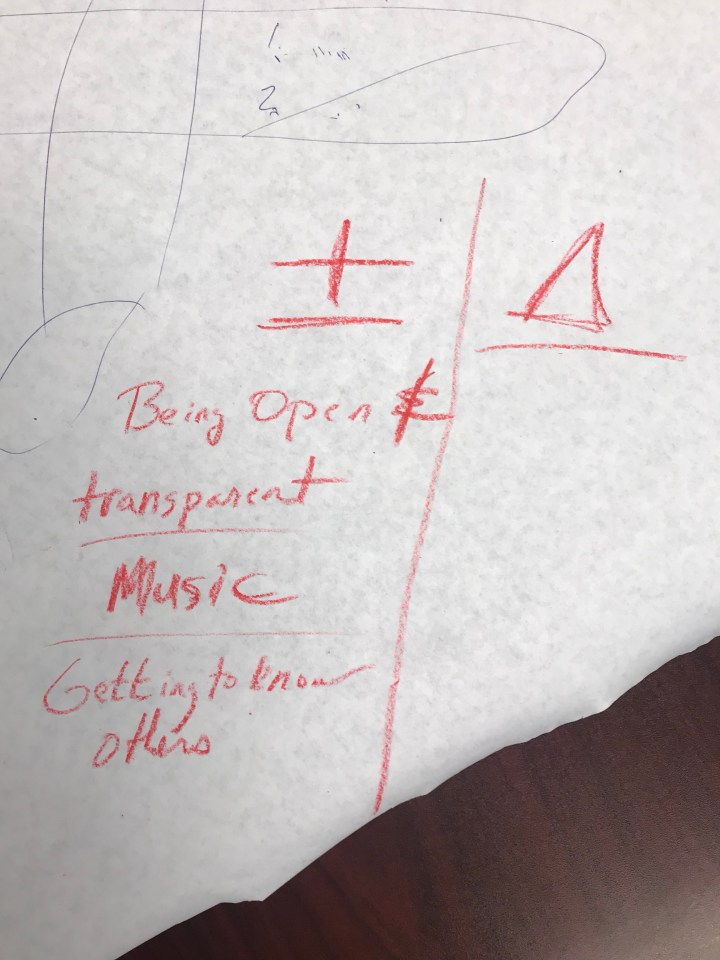
 I was reading some research on leadership development this week and one of pieces that jumped out at me was the statement, “what leaders really want is a personalized experience and the opportunity to learn from…their fellow-leaders.” I was reminded of this last night during the September 3D Leadership gathering of our South Carolina members. One of the things discussed during our plus/delta time at the end was the fact they were able to discuss freely and transparently which made it possible for them to get to know each other and learn from each other. In fact one participant said, “I’m so glad you brought up the issue of communication and that we discussed that. Now we can work on making it better.” Effective leadership development involves time for reflection and learning from those around us.
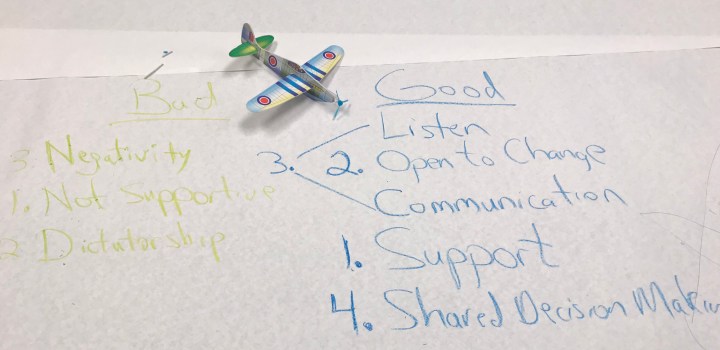
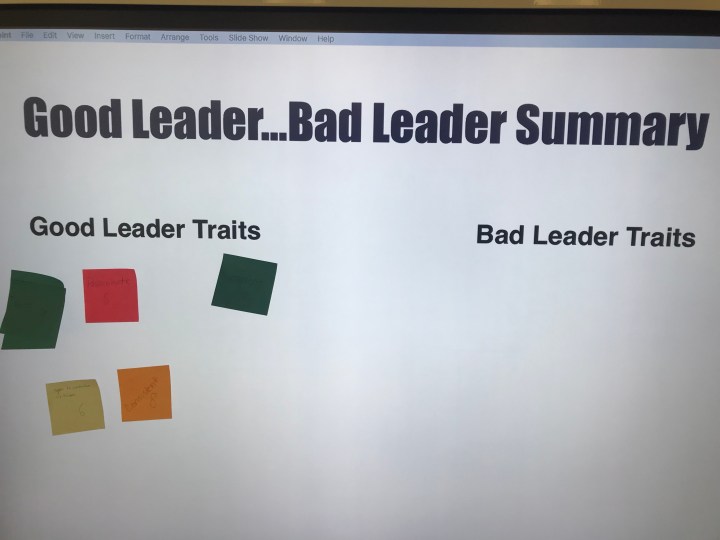
We did one such learning activity last night where the South Carolina group developed their own top list of good and bad leadership traits. It was a great discussion with being supportive coming out as their number one trait every good leader should have. Here are the rest of their results:
Here’s what we know: Success in today’s world depends on how leaders perform as a team. The unpredictable and rapidly changing landscape, whether it is in government, education, or business, means you need to have people with a variety of skillsets and mindsets who can quickly step in to show leadership in response to a variety of challenges. This is why organizations need to look at all employees as leaders, with “leadership potential,” and start developing leadership potential earlier in careers. That is why we do 3D Leadership – to help our leaders Discover, Develop, and Distribute leadership wherever and whenever it is needed.
Refreshingly Organic Leadership
 Humble Leadership: The Power of Relationships, Openness, and Trust by Edgar H Schein
My rating: 5 of 5 stars
This is a refreshing change to other leadership books and theories that have multiple steps that really only work in an ideal culture or environment, or when everything is going perfect. Humble Leadership is not about doing this and then that; it is about building authentic relationships and trust, and then letting the group growth and development happen organically. This book starts out by posing the question as to whether the leader makes the culture, or the culture makes the leader. The authors also posit that leadership exists at all levels and everywhere in the organization. This helps the reader view leadership as multidimensional as opposed to a two-dimensional, top-down hierarchy. Humble Leadership is about relationship building and trust. Humble Leadership teaches the reader how to be adaptive and practice adaptive leadership while letting the individual team members and organization grow in an organic way. There were great examples of how Humble Leadership works with the Air Force Thunderbirds and David Marquet’s turning around of the Navy submarine, USS Sante Fe. This book is a must read for all leaders who want a culture where every person is empowered to be a leader and is working to make the organization great.
The Implications of What We Call “Level 2” Relationships at Work
 The following is an excerpt from Humble Leadership
The Implications of What We Call “Level 2” Relationships at Work
By Ed and Peter Schein
Organizations today are doing all kinds of experiments in how work is defined and are showing great flexibility in how roles and authority are allocated. What we see in these experiments is that they encourage relationships that are more personal. Bosses, direct reports, team members, and resources from other teams are making it a point to get to know each other at a more personal level, fostering more openness and, in time, more trust and the psychological safety to speak up and be heard.
In a Level 2 relationship, I convey that “I see you.” This is not necessarily “I like you” or “I want to be your friend,” or “Let’s get our families together,” but I let you know through my words, demeanor, and body language that I am aware of your total presence, that in this relationship we are working together and are dependent on each other, are trying to trust each other, and should each try to see the other as more than a fellow employee, or associate, or team member, but as a whole person. By conveying that “I see you”, we are also conveying that we will not allow “professional distance” to separate us; we are forming a personal-working bond that will not tolerate obfuscation or deception. Seeing each other as whole persons is primarily a choice that we can make. We already know how to be personal in our social and private lives. Humble Leadership involves making that conscious choice in our work lives.

Six Principles of Humble Leadership
- Humble Leadership builds on Level 2 personal relationships that depend on and foster openness and trust.
- If Level 2 relationships do not already exist in the workgroup, the emergent humble leader’s first job is to develop trust and openness in the workgroup.
- In a Level 2 workgroup Humble Leadership emerges by enabling whoever has pertinent information or expertise to speak up and improve whatever the group is seeking to accomplish.
- The process of creating and maintaining Level 2 relationships requires a learning mindset, cooperative attitudes, and skills in interpersonal and group dynamics.
- An effective group dealing with complex tasks in a volatile environment will need to evolve such mindsets, attitudes, and skills in all of its members.
- Therefore, Humble Leadership is as much a group phenomenon as an individual behavior.
***********************************************
About Authors
Edgar H. Schein is Professor Emeritus from the M.I.T. Sloan School of Management. He’s a pioneer in organizational studies, organizational culture and leadership, process consulting, career development. Ed’s contributions to the practice of O.D. date back to the early 1960s and continue with the recent publication of Organizational Culture and Leadership 5th edition and now Humble Leadership, co-authored with Peter A. Schein, co-founder of OCLI.org who brings 30 years of hands-on experience in large and small companies leading growth initiatives in Silicon Valley.
A New Approach to Leadership
 The following is an excerpt from Humble Leadership
A New Approach to Leadership
By Ed and Peter Schein
This book introduces a new approach to leadership based more on personal relationships than transactional role relationships.
The good news: employee engagement, empowerment, organizational agility, ambidexterity, innovation . . . all of this can flourish in the rapidly changing world when the fundamental relationship between leaders and followers, helpers and clients, and providers and customers becomes more personalized and cooperative.
The bad news: continued deception, scandals, high turnover of disengaged talent, safety and quality problems in industry and health care, all the way to corruption and abuse of power at the highest levels of industry and politics, driven by financial expediency and the obsession with retaining power as primary success criteria . . . all of this will continue to happen as long as leader-follower relationships remain impersonal, transactional, and based on the roles and rules that have evolved in the current culture of management that still predominates in our hierarchical bureaucratic organizations.
The Leader-Follower Relationship
“Leadership” is wanting to do something new and better, and getting others to go along. This definition applies as much to senior executives developing new strategies, new purposes, and new values as it does to a group member down in the organization suggesting a new way of running a meeting or improving a process to drive better results. Both the word new and the word better remind us that leadership always refers to some task that can be improved and to some group whose values and culture will ultimately determine what is better.
What is new and what is better will always depend on context, the nature of the task, and the cultural values that are operating in the group or organization that is doing the work. What we later may label as “good or effective leadership” thus always begins with someone perceiving a new and better way to do something, an emergent leader. Our focus will be not on the individual and the desired characteristics of that emergent leader, but on the relationships that develop between that person and the potential followers who will have influenced what is finally considered to be new and better and who will implement the new way if they agree to try it. Those potential followers will always be some kind of workgroup or team, so our focus will also be on the relationships between them. They may be co-located or widely spread in a network, and their membership may change, but there will always be some kind of grouping involved, hence group dynamics and group processes will always be intimately involved with leadership.
*************************************
 About Authors
Edgar H. Schein is Professor Emeritus from the M.I.T. Sloan School of Management. He’s a pioneer in organizational studies, organizational culture and leadership, process consulting, career development. Ed’s contributions to the practice of O.D. date back to the early 1960s and continue with the recent publication of Organizational Culture and Leadership 5th edition and now Humble Leadership, co-authored with Peter A. Schein, co-founder of OCLI.org who brings 30 years of hands-on experience in large and small companies leading growth initiatives in Silicon Valley.
Good Leader Traits
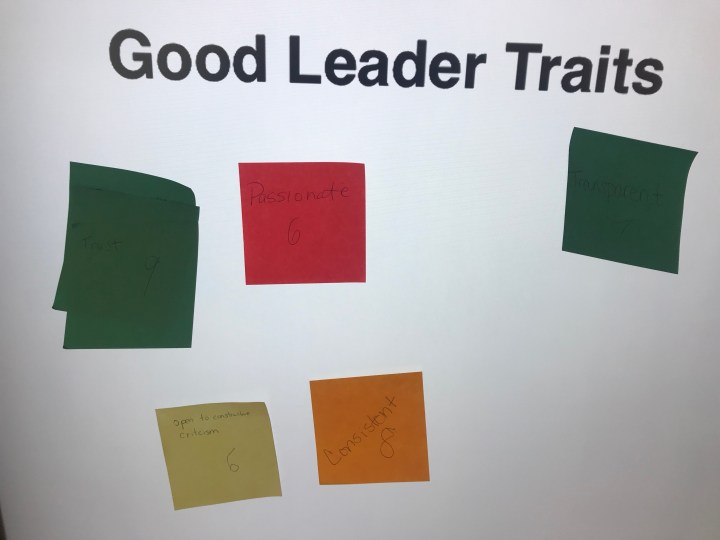 This past Friday in a session I did for our Noble Education Initiative Impact Indy Program we developed a top five list of great leadership traits. To get to that end, we developed a bad leadership trait list and then moved into the good list. Then we voted our way to the top five, great list. I would like to provide you with our top five in this post with some of the commentary about each one discussed during the session.
 Here they are:
- Trust – No big surprise here. Trust tops most lists characterizing great leaders. It’s at the root of every good relationship, including that of leader and employee. When your team trusts you, and they perceive that what you’re doing is honestly in their and the organization’s best interest, you are more likely to have an engaged team.
- Consistent – Consistency was a multifaceted item on this list. First, as a leader, you want to communicate a consistent focus on just a few critical issues (at most three to five) for each employee or team. And then you want to relentlessly follow up and focus only on those few issues. Less is more. Second, the great leader will have consistent moods, behavior, and decision-making so that her team knows where she is coming from. Finally, there must consistency in the message and actions delivered. The simple adage of “do what you say” goes a long way as most customers, families, students, or other stakeholders are accustomed to broken promises and poor service. With consistent delivery and consistent service, we can put all our focus on promoting a positive and consistent brand image with those we serve, including our customers.
- Transparent – Employees learn more about one another and can grow to work toward solving problems faster when their leaders are transparent. Transparency also allows relationships to mature faster, as openness can potentially avoid misunderstandings that can fuel unnecessary tension. If we are transparent, we can actually strengthen our role as a leader because those we serve begin to trust (see, there is our #1, trust, showing up again) us as person and thus will respect us more as a leader.
- Open To Constructive Criticism – If you are not being criticized, you are not leading and guiding the organization to grow, innovate and explore endless possibilities. We all have areas we need to improve in. Additionally, we must use criticism as an avenue to learning. Criticism can provide valuable insight for making course corrections. Don’t be offended by criticism, use it to your advantage.
- Passionate – Passion inspires others to join and identify with the organization’s vision. When we are passionate about something, it shows all over us. We can’t help but think about it, work at it, and be excited about it. Most importantly, passion is as contagious as a cold. Ever notice how your own enthusiasm escalates when you are around passionate people?
Pretty awesome list wouldn’t you say? What’s on your top five? Would you change any of these, or re-order the list? I would love to have you add your comments to this post.
What Do You Really Want?
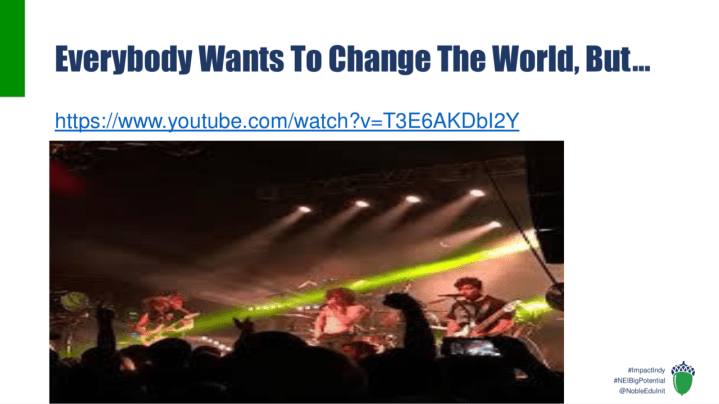
 Yesterday at our Impact Indy program to kick off our Noble Education Initiative supported schools in Indianapolis, Indiana I did a program titled: Leading Like a Rock Star: Chaos and Earthquakes. To kick off the program I played the video of the song “Do You Really Want It” by one of my favorite bands, Nothing More. Click here to watch the video:
Even if you are not a fan of the same genre′ of music as me, you’ll have to admit that the words make you think and reflect. The chorus really gets to me: “Everybody wants to change the world, but one things clear; nobody wants to change themselves.” So true! This is one of those Walk the Walk or Walk the Talk things. Do we really want to make the changes or develop ourselves in the ways necessary to make the revolutionary and transformational changes we need?
 Our discussion was very rich around this topic. I had the participants write down two things they had recently changed about themselves and two things they had resisted changing. It was a very open and candid discussion. Amazingly, in all cases when someone had gone ahead and made a change in themselves they were resisting, it led to great results.
“Kites rise highest against the wind, not with it.” ~ Winston Churchill
Fortunately and unfortunately, we are creatures of habit. Our brain creates neural pathways from repetitive thoughts and behaviors in an attempt to be efficient and make those things easier. And after some time, they become our default way of functioning. For things we want to change this is default is unfortunate, but we can you is to advantage by making the new changes the new habits or default. We live on “auto-pilot” in some cases. Even with an intention to change, we find ourselves repeating the same behaviors and experiencing the same thoughts. When these thoughts are based in doubt and fear, they are even harder to change. On some level, they are serving a protective function for us.
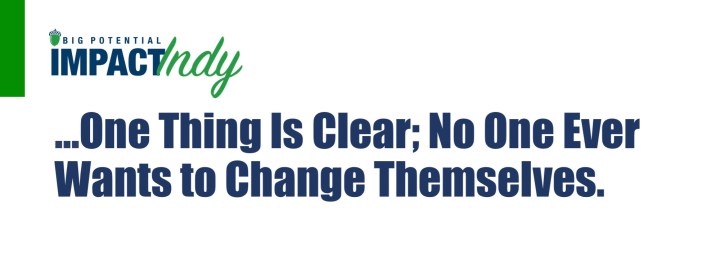 Some changes we resist because biologically we seek to stay status quo or be in a state of homeostasis. But, some changes we resist because of being hypocritical. I believe the chorus in Nothing More’s song, “Everybody wants to change the world, but one things clear; nobody wants to change themselves,” really describes this hypocrisy. It’s the old “do as I say, not as I do” syndrome. This hypocrisy doesn’t just undermine a leader’s authority, it can also directly threaten how the group functions. A leader’s perceived personal integrity, in other words, is a cue for how everyone who follows to interact.
If we want to make positive change, we must be willing to change ourselves and make our actions match our words. When the talk of the leader makes about what she values is consistent with her actions and the things she rewards, her followers will be more willing to engage and treat one another like neighbors. This alignment creates the feeling that when people put in effort on each other’s behalf, those efforts will be recognized and they’ll be supported when they need it. And it leads to trust that the organization or community has its members’ long-term interests at heart.
Unfortunately, this trust is lost by the hypocritical leadership we are discussing here. Hypocritical leadership is when a leader says one thing, but does another. It is when someone exhorts behaving one way, but then continues to behave in another. On the other hand, however, demonstrative leadership is when leaders not only talk the talk, but walk the walk as well. Are you ready to demonstrate changing yourself? Do you really want it?
“The Rock” In The Atlantic Ocean
 Yesterday while exploring the rocks along the Atlantic Coast of Maine I found a beautiful rock that once I took out of the ocean 🌊 wasn’t so beautiful any more. That experience prompted this VLOG Post:
What’s Your Elevated Story?
 One of the most common questions we get when meeting new people is, “So, what do you do?” Most of us have a standard answer about our profession, but there are some people who have jobs that you might not even know existed. More importantly, everyone’s job is important and in some way improves the lives of others. Think about every job that affects your household; there are a lot.

Perkins Cove
I was reminded of this yesterday when in Perkins Cove, Ogunquit, Maine. This is a lobstering port and a beautiful place with shops and restaurants. While exploring we came across a boat named the SS Crusher that had been dry docked (see picture). It was a cool looking boat and I wondered what was up with it. Then, I found that a children’s book, The Pride Of Perkins Cove, had been written about it by Brenda Yorke Goodale about the boat.
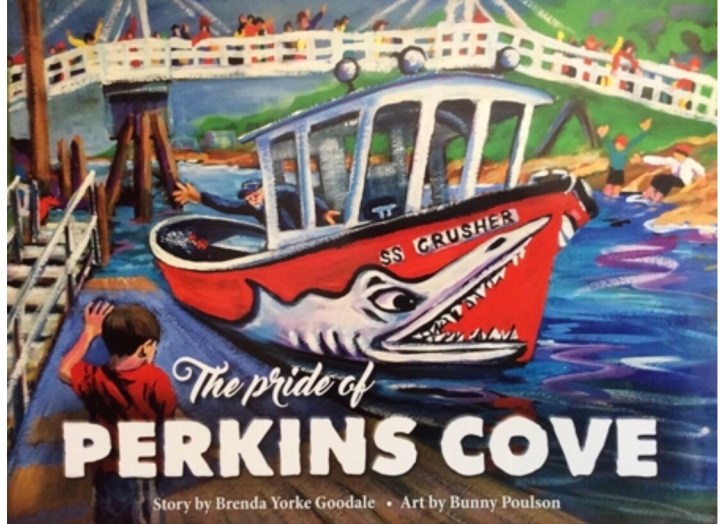
So, of course I had to dig deeper and found that the boat and it’s harbormaster have very important jobs. When it gets cold, and it gets cold in Maine; Perkins Cove freezes. Because the Cove is a working port, it has to stay open, so Harbormaster Fred Mayo spends hours every day breaking the ice. The town’s special boat, the SS Crusher, is built for the task of “crushing” through the ice. Before yesterday I did not even know what a lobstering port looked liked, let alone that freezing was a problem.
If we asked Fred Mayo what he does, he might give the same kind of answer we all would: “I’m a harbormaster.” But, wow, is it so much more. In fact, here, according to Wikipedia, is truly the world of a harbormaster: “A harbormaster is an official responsible for enforcing the regulations of a particular harbor or port, in order to ensure the safety of navigation, the security of the harbor and the correct operation of the port facilities.” Think about all the other colorful details that a harbormaster like Fred Mayo could add. I’ll bet there are some great stories of ice crushing in Perkins Cove. Here are a couple of pictures of Fred Mayo and the SS Crusher doing their job:


A few weeks ago I read a great book by Shawn Achor entitled Big Potential: How Transforming The Pursuit Of Success Raises Our Achievement, Happiness, and Well-Being. In the book, Achor points out that we usually just give a very quit and boring answer of what we do for our job. He argued, however, that we need to quit this and give what he calls the “elevated speech;” not to be mistaken with the elevator speech. The “elevated speech” should be us telling what we really do and why what we do is so important. The example I like to give here is the answer that we hear so many times from teachers: “Oh, I’m just a teacher.” I’ll admit I’m guilty of having done this. But, are you kidding me, “just a teacher?” I think not! Actually, I hope not!
 Let’s take a look at teaching as a very significant profession, or “job.” Here is my elevated version: “Teachers have been given a great gift – the power to change lives, each day I must be inspirational. I am a significant human being helping other human beings to realize their full potential and go on and make a positive difference in their world.” What do you think?
Achor posited that our beliefs create our world. He argued that if we elevate the story of what we do, we will get a new spring in our step and renewed inspiration for what we do each day. He’s right because Gallup (2017) told us that 60% of employees say the ability to do what they do best in a role is “very important” to them. Here’s the challenge, though, in 2016, only 33% of U.S. employees were
engaged – involved in, enthusiastic about and committed to their work and workplace (Gallup, 2017). This translates to only 4 in 10 U.S. employees strongly agreeing that in the last year, they have had opportunities to learn and grow (Gallup,2017). This is a huge engagement issue. Gallup (2017) results suggested that by moving that ratio to eight in 10 employees, organizations could realize 44% less absenteeism, 41% fewer safety incidents, 24% higher retention, and 16% higher productivity. I guess it is time to elevate those we serve.
Just like the story of the SS Crusher, we all have unique gifts, jobs to do, and make a significant difference in the world. Let’s get engaged and elevated! What’s your elevated story?
Reference
Gallup (2017). State of the American Workplace. Gallup, Inc. Washington D.C
Rewriting The Story To Create The Future!
 Story Driven: You don’t need to compete when you know who you are by Bernadette Jiwa
My rating: 5 of 5 stars
Rewriting The Story To Create The Future!
This book is outstanding and warrants the writing of a review. I did a great deal of highlighting while reading this book and tweeting. Bernadette does an outstanding job of guiding us through how to differentiate ourselves, our brands, and our organizations by telling the right story. In order to do this she teaches us in the reading how to know who we are, what we stand for, where we are headed, and what has made us personally, our brand, and our organization. Most importantly, she teaches us why this story is important to be told. She posits we need to forget about competition and focus on what makes us and our work unique and valuable. It was great to be reminded that we, and those we serve, are identified by what we do. Our story needs to be one of significance and not just success. Anyone who wants to be grounded, intentional, and deliberate in the creation of the future he or she wants the world to realize needs to read this book.
~Dr. Byron L. Ernest
A KISS of Stardom!
 This week I had the opportunity to do something that I had never done before. I became Gene Simmons as a part of a team in a Battle Of The Bands Lip Sync Contest. This was part of our Carolina Schools Big Potential Leadership Conference put on by Noble Education Initiative, Inc. What an experience. Although each of the group’s members is iconic, perhaps the most memorable of them all is front man Gene Simmons, who is famous for his demonic character that breathes fire, spits blood, and engages in all sorts of outrageous behavior on stage. Here’s the deal: when we hit the stage, after an hour and a half of getting in costume and having makeup put on, I became Gene Simmons. I even spit blood. And, I didn’t lip sync. I sang every word of “Rock And Roll All Night.” Then, I spit blood (we got the fake blood capsules at a party supply place and I put the all in my mouth – what a mess) and did “God Of Thunder.” The crowd was going wild – literally. I’ve got to tell you, I did not want it to end. It was addictive.
So, what did I learn?
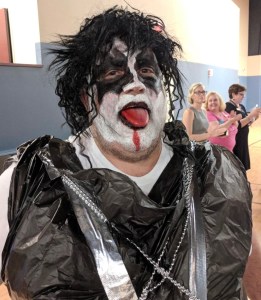 Shared Vision and Enthusiasm – Everyone, regardless of her or his age, knows KISS, the band. They are the band that would wear 6-inch heels, has blue/black hair, paints their faces, and one member, Gene Simmons, who would spit blood and blow fire. Amazingly, it’s hard to find anyone who doesn’t know that. Furthermore, when my colleagues and I started our rendition of “Rock and Roll All Night” it amazed me that everyone knew the words and sang along. It wasn’t just singing, though, it was singing with enthusiasm. We could tell, the song meant something to this group. Everyone was connecting in some way to it. As leaders, that is our job to make connections. Whether that means partnerships, or connecting everyone in the organization to a shared vision.
Engagement – I did a session yesterday morning on student engagement. While I was facilitating that session I was thinking about my rock band front man experience. My job both as a facilitator and front-man was to move, affect and engage an audience. This is also true in a classroom. We must move our students toward proficiency of skill, standards, and competencies, as well as affect change in their lives, while engaging them.
 The Band Is A Team – While I acted out the part of the demonic and crazed front man part of our our band, I realized it was the other three members of our band that made it all possible. Others in the band literally got my costume ready and did my makeup. They were supporting my antics on stage and supporting me acting crazy. The lesson here is that we can never be as good by ourselves as we can be as part of a team.
We All Need A Brand or To Be A Part of A Brand – The 2016 Gallup survey information tells us that we all want to be part of a successful brand or part of an organization that is doing good in the world. KISS holds all the records for record sales for any rock band ever – including Elvis and the Beatles. Their empire is worth over 1 billion dollars and there are over 3000 branded KISS products on the market today. KISS is a rock BRAND not a rock Band. What is your brand?
Have A No Limits Attitude and Approach To Life – There truly are no limits to what you can achieve. Success is a mind set. We all need to have a growth mindset. Either you think you can achieve it, or you don’t. Never let someone else tell you what you can and cannot achieve. Control those thoughts yourself.
 Upon reflection, I got chills thinking about a few things:
- Without KISS, I wouldn’t be who I am today.
- What would the world and I be like if there were no KISS?
- What band would have been my mentor to have a no-holds-barred attitude toward going after all my dreams?
- Who would have taught me it doesn’t matter what the critics are saying because you cannot please everyone; I learned, from KISS, to go after what I believe will create change in the world?
- Without Gene Simmons I don’t have the example of a humanitarian. Simmons received the MEND Humanitarian award, for his support of Mending Kids International, which provides surgical care to children in developing countries. During his acceptance speech he said, “I don’t have the right NOT to give back and neither do you. Some mother somewhere is crying her heart out because her child can’t have what we have in this country and we can change that.” Did you catch that? “I don’t have the right NOT to give back…” I heard you loud and clear, Gene!
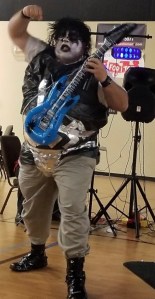
 As you can see, Gene Simmons and KISS has had quite an affect on me since the band began when I was 10 years old. I am so glad they have been a part of my life. I am also glad I had the opportunity this week to experience a very, very, very, very small part of what it feels like to be Gene Simmons on stage.
 Byron's Babbles
1 comment