Leaders Doodle

My Doodles From A Task Force Meeting
Drawing with pencil, pen, or brush on paper isn’t just for artists. For anyone who actively exercises the brain, doodling and drawing are ideal for making ideas tangible. In order to encourage doodling in meetings, retreats, and professional development events I put white butcher paper sheets on the tables, a box of crayons, and a small container of colored markers to use for doodling. Then there other details, like getting small flower vases and the flowers. These may seem like little things, but you have to understand that creating the perfect environment is crucial to convening great conversations.
 Recall a time when you had a great conversation where real learning or new insight occurred—what enabled that to happen? In this way, participants have the opportunity to participate in an environment where the emotional context and framework support innovative thinking. If you can design the physical space, the social space, and the information space together to enhance collaborative learning, then that whole system turns into a learning system.
As a side note, many of our presidents, like the rest of us, doodle. Dwight Eisenhower drew images of tables, pencils, and nuclear weapons. A Herbert Hoover doodle provided the pattern for a line of rompers. Ronald Reagan dispensed cheery cartoons to aides. John F. Kennedy reportedly doodled the word poverty at the last cabinet meeting before his assassanation.
Are you encouraging your team to doodle?
Blooming Leadership: Got Flowers?
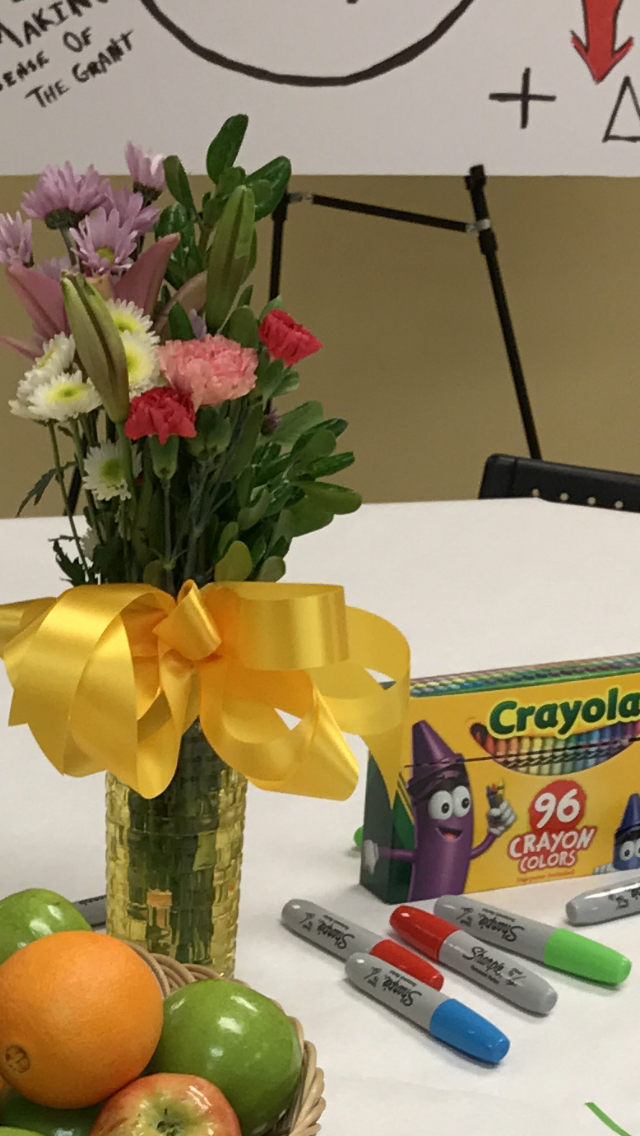 When planning big events, retreats, or task force meetings flowers should always be on the table. Flowers are every table conversation’s must-have accessory. Flowers have a place as the focal point in the middle of the table. According to a study conducted by Harvard Medical School, the right blooms may offer the perfect pick-me-up for attendees who don’t consider themselves morning people. So when you’re putting together your plans for the workshop, professional development, task force setting, be sure to include bright blooms front and center — it could have a big impact on the outcome of your meeting.
 Why Flowers?
Now when you think of putting flowers on tables you may think that it is a crazy idea and no one will really pay attention to the flowers in the meeting, but it has been proven that flowers can help the mood of the meeting and add a cheerful tone to any type of meeting. Just by adding flowers to your meeting tables can help you to make a long lasting impression on your clients and anyone else that might come to a conversation hosted by you.
For a team meeting, a floral arrangement put in the middle of the table can make the atmosphere more friendly and welcoming. Choose bright colors for the flowers and types of flowers that are cheerful, such as tulips. If the arrangement is to be placed in the middle of a meeting table, keep the height of the arrangement low enough that the participants can easily see each other around the table and conversation is not hindered by the flowers.
 Conversational leadership is an art, not a science. Use your own creativity when setting up the room. In addition to flowers, I like to put butcher paper on the tables and provide crayons and markers for doodling, taking notes, and graphic recording. Be sure to encourage people to write, draw, or doodle on the tablecloths in the midst of their conversations. Often these tablecloth drawings will contain remarkable notes, and they help visual learners link ideas.
 The flowers on the tables creates a special ambiance. They provide a focal point. Rigid positions seem to drop away as people listen together in order to discover creative connections. The flowers give everyone at the table something in common. At a task force meeting I hosted yesterday, I asked participants to comment during our +/^ session on the flowers. Everyone had actually thought about the flowers. Thoughts like, “I wonder when the Lilly’s will bloom,” to “I’m going to match my crayon color to the flowers,” to “Im glad the flowers are not blocking my view to the person on the other side.” Bottom line is they noticed and likened the flowers and they had served as a focal point. Flowers help us focus when you’re not talking and are listening together with others focused on the ideas in the middle of the table.
I believe flowers help us focus on opportunity and fuel energy. What do your tables look like?
Can You Let The Authentic You Out?
 Today, according to Adam Grant, a professor of management and psychology at the Wharton School of the University of Pennsylvania and the author of a new book, Originals: How Non-Conformists Move The World, we are in the Age of Authenticity, where “be yourself” is the defining advice in life, love, and career.
Authenticity
Authenticity means erasing the gap between what you firmly believe inside and what you reveal to the outside world. As Brene Brown, a research professor at the University of Houston, defines it, authenticity is “the choice to let our true selves be seen.”
We all have developed social filters or self-controls that prevent us from saying whatever may be on our mind at the time. If we expressed our true self and all the unfiltered thoughts that pop into our brain, we would probably be in a state of constant conflict and turmoil. Some things are just better left unsaid.
Self-Monitoring
How much you aim for authenticity depends on a personality trait called self-monitoring. If you’re a high self-monitor, you’re constantly scanning your environment for social cues and adjusting accordingly. You hate social awkwardness and desperately want to avoid offending anyone. But if you’re a low self-monitor, you’re guided more by your inner states, regardless of your circumstances.
Studies have shown that high self-monitors “advance faster and earn higher status, in part because they’re more concerned about their reputations. And while that would seem to reward self-promoting frauds, these high self-monitors spend more time finding out what others need and helping them.”
I would argue that this style reflects an insightful and empathic view of what’s happening to those we work with.
Rather than selling out, it’s a way to demonstrate how you can contribute to the good of the team and others along the way. This reflects positively on how you are viewed as a collaborator and a teammate. It does not mean that you live your work life in the selfless pursuit of the common good; it means that when what’s good for you, your team, and the organization are aligned, everyone wins.
If being authentic and a low self-monitor demands a greater level of self-disclosure about your feelings on a situation, then I can see the potential risk. I find that a candid appraisal of the impact of various decisions can be refreshing and stimulate good dialogue, but overly emotional responses get awkward and can stifle discussion.
Grant suggests that we focus on being sincere rather than just authentic.
I would also suggest we should make every effort to be sure that we are consistent and congruent in how we connect with others.
As I reflected upon this interesting perspective, it occurred to me that high self-monitors must have well-developed emotional intelligence and are probably highly empathic to those around them. Instead of focusing on how everything affects them and what they need, they first tend to focus upon the following questions regarding others:
- Why are they saying that?
- What are their needs for this effort or project?
- What would a good outcome look like for everyone involved in this discussion or project?
- How can they contribute in a manner that allows me to learn and grow?
Borrow and try to incorporate those styles as you grow and develop yours. Your ultimate transformation will always be the addition and subtraction of those behaviors and styles that work best. It does not diminish or sell out who you are, it’s just part of everyone’s life journey.
Ask yourself:
- Since you are not always the best judge of the impact you have on others, do you regularly ask for feedback in a manner that is efficient and effective for all involved?
- Do you regularly seek to understand before you worry about seeking to be understood?
- Do you exercise appropriate caution about how you present yourself to others on social media? Do you allow inappropriate social media tidbits to contradict the authentic self you are trying to project?
I look forward to your thoughts and comments.
****
Willy Steiner is the President of Executive Coaching Concepts, an executive coaching services firm dedicated to assisting senior executives in taking their individual and organizational performance “TO THE NEXT LEVEL”. He fine-tuned his skills in leading organizational change, building high performing teams and in devising innovative incentive systems with General Electric, RCA Corp. and Galileo International. Assisting executives in driving change by creating urgency, focus and alignment, with a keen eye for cultivating and sustaining necessary relationships, is an ongoing focus of his work. He is an expert in guiding organizations through complex international mergers and divestitures, blending distinct cultures and supporting growth in international markets.
For more about Willy, his new book, Discover the Joy of Leading: A practical guide to resolving your management challenges, and business, visit executivecoachingconcepts.com.
Listening as a Principle for Authentic Community Engagement
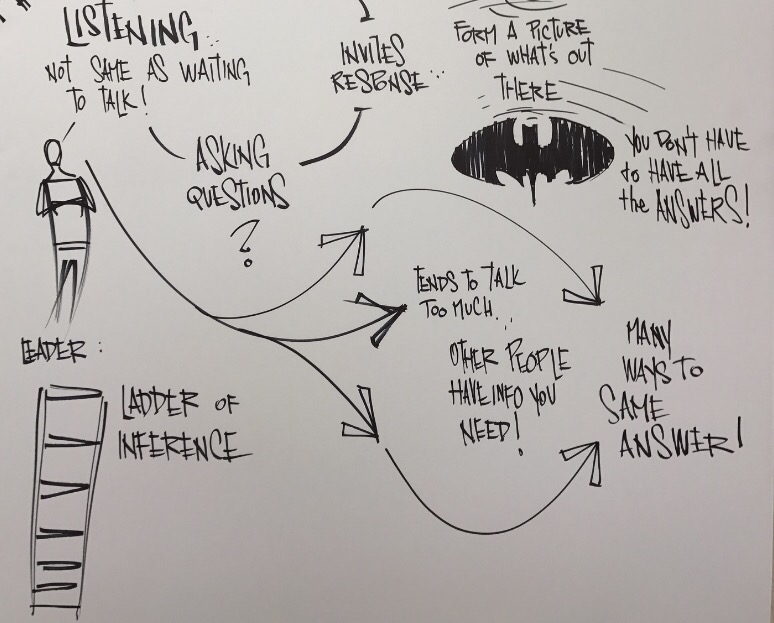 Lead with Listening Listening is a neglected skill, especially in change efforts. Often the leaders’ emphasis is on communicating a decision to stakeholders. When listening campaigns are con…
Source: Listening as a Principle for Authentic Community Engagement
Lady Gaga Walks The Walk
 I can’t wait for Lady Gaga’s half time show of the Super Bowl Fifty One tonight. Most of you know I am a huge Lady Gaga fan. This fandom started back in 2010 when I had the opportunity to see her in concert in Portland, Oregon. I was in Portland for a conference and sat down at a table for a dinner with six women who I did not know. They apologized that they would be leaving the dinner before it was over because they were going to see Lady Gaga. I probably said something super intelligent like, “Awesome, wish I was going so I didn’t have to sit through this dinner” (sounds like me doesn’t it?). Then one of the women said, “Hey we are going with a group of college sorority sister friends and one can’t go now at the last minute. Would you want to go?” Now, anyone reading this that knows me knows that I’m not turning down an adventure, no matter what it is. I was in! The rest is history, I have been a Lady Gaga fan ever since.
Now I know Lady Gaga causes controversy, her music might not be your cup of tea, but it is certain that you will be familiar with the girl from the Lower East Side of New York who in a few short years transformed herself from Stefani Joanne Angelina Germanotta into one of the world’s best-known musical performers. This post is about Lady Gaga – leader that walks the walk.
“When I wake up in the morning, I feel like any other insecure 24-year old girl. Then I say, “Bitch, your Lady Gaga, you get up and walk the walk today.” ~ Lady Gaga, Rolling Stone Interview June, 2010.
I love the fact that Lady Gaga walks the walk. There are many leadership lessons we can learn from her. When it comes to authentic leadership, Bill George identifies five dimensions and their respective characteristics that someone must develop in order to be an authentic leader (George, 2003). The five qualities authentic leaders demonstrate are:
- Understanding their purpose
- Practicing solid values
- Leading with heart
- Establishing connected relationships
- Demonstrating self-discipline
 Lady Gaga has been referred to as the queen of the outcasts because of her support of individuals who ride the boarder of social outcasts and underdogs. As everyone knows, Lady Gaga is far from what most people call “normal” and as a result suffered much bullying growing up. Propelled by her own experiences, Lady Gaga made it her purpose to help others rejoice in their individuality and not feel like outcast. In just this alone you can see the five qualities of authentic leaders being displayed.
Actually there have been many case studies done on Lady Gaga as a leader, including ones done by the Harvard Business School. Additionally, a case study done by Jamie Anderson and Jörg Reckhenrich of Antwerp Management School and Martin Kupp of ESMT European School of Management and Technology dives into the idea of leadership projection. The concept of leadership projection is an integrative approach of communication, behavior and aspiration that provide a leader with wide recognition across an industry or sphere of public life – in the case of Lady Gaga, social change. An important element of leadership projection is the ability of an individual to project herself into a future role that is much more influential than the current state – again, this describes Lady Gaga perfectly. Leadership projection is very much about followership; after all, a true leader only exists if he or she can excite loyalty in others. It involves a communication approach that typically integrates three universal story lines to excite and gain buy-in from followers:
- Who am I – how life experience has shaped my individuality and character
- Who are we – demonstrates and guides the values and behaviours of a group
- Where are we going – explains what is new, and creates a sense of excitement about direction.
Because of Lady Gaga’s display of the five dimensions of authentic leadership (George, 2003), walking the walk of the three principles of leadership projection, and the number of lives she has changed because of her efforts, it is safe to say that Lady Gaga displays the characteristics of what I consider to be a true leader. I cannot wait to watch her half-time show of the Super Bowl later this evening.
Reference
George, B. (2003). Authentic leadership: Rediscovering the secrets to creating lasting value. Jossey-Bass.
Leading Conversations
 I continue to be amazed at how many people espouse to want to have great conversations and be a conversational leader, but really can’t help themselves from becoming a pontificator and problem solver. So many leaders leap right to answering the questions themselves. There are many reasons for this, but I believe for many it is just ego of hierarchy – he wants to be seen as the smartest or person who solved the problem. Authentic conversation that deepens a group’s thinking and evokes collaborative intelligence is less likely to occur in a climate of fear, mistrust, and hierarchical control.
I believe everyone is a leader. Everyone has the right, responsibility, and ability to be a leader. In fact, I believe everyone has the obligation to be a leader. We all need to lead from where we are. How we define leadership influences how people will participate. In my world with educators, teacher leaders yearn to be more fully who they are—purposeful, professional human beings. Leadership is an essential aspect of an educator’s professional life. This is why I spend a great deal of time working directly with our rising teacher leaders in our Focused Leader Academy.
We are building an organizational community for thinking more deeply together about key strategic questions. It has been my experience that results do come from the questions. The results lie in the personal relationships, the knowledge, and the mutual caring that gets strengthened in people’s conversations together about the questions, along with the discovery of their own answers.
What kind of conversations are you leading?
This Time It’s Different
 Expensive Sentences: Debunking the Common Myths That Derail Decisions and Sabotage Success by Jack Quarles
My rating: 5 of 5 stars
Have you ever said, “This time it is different”, or been given cookie-cutter advice? Jack Quarles teaches us in this book that these sentences, and many others like them, can be very expensive. In the book Quarles teaches us how to become aware of these sentences. We are taught through the reading that our language reflects our beliefs. Quarles teaches readers through great case studies and examples that we need to be looking forward and that reality is always our friend. If you want to learn how to avoid the traps of expensive sentences then you need to read this book.
Would we be Better Off with Fewer Options?
 This is an original post by Jack Quarles and it does not appear anywhere else.
We can buy almost anything these days, but it wasn’t always that way. Here’s a brief history of buying:
History of Buying
Back in the cave, no one bought anything. No socks, no taco kits, no iPads. You couldn’t buy anything if you wanted to.
Fast forward to the American Revolution, 1776. There was currency and a marketplace. But still, many people might go weeks or longer without buying anything, as it was commonplace to make your own houses, clothes, and food.
Some people bought socks, and some made their own. Still no taco kits.
Over the following 200 years, of course, things changed quite a bit.
In 1976, everyone buys socks, all kinds of socks. In fact, no one doesn’t buy socks. It’s a consumer society, and you have to buy to get by. This is relatively new for humans.
It’s now been 40 years since the ‘70s. We buy socks, we buy iPads, and we buy taco kits, which lead to taco night.
Taco Night, Circa 1977
Here’s what happened on Taco Night in the 1970s: older kids chopped lettuce and tomatoes, and the younger kids shredded cheese. That was either cruelty or poor design, because the aluminum box shredder was a torture device. One slice too many, and your knuckles never forgot.
Some of you remember that pain, which also almost certainly means you are over 40. Those wounds today are as rare as polio, because of the mass-produced miracle called shredded cheese.
Pre-shredded cheese was not available at the 1970s supermarkets. Maybe grated parmesan in a shaker bottle, but that was it. You couldn’t send someone to the market and say “pick up some shredded cheese” because they didn’t have it.
Taco Night, Present Day
You still can’t place a simple order to “pick up some shredded cheese,” but for a different reason. You have to provide much more specific guidance. There are now – at my local market – over 50 varieties of pre-shredded cheese. Here are a few of the options:
- Finely shredded or regular shredding
- Low-moisture or regular moisture
- Whole fat, Low-fat, 1%, Non-fat
- New York Cheddar or mild cheddar or sharp cheddar or extra sharp cheddar
- Triple cheddar, Four-cheese Mexican blend, Gourmet sharp blend
- Store brand or multiple national brands
Any one of these permutations could make taco night delicious and far less dangerous than the razor-box grater and a cheddar block. Here’s the point: a simple activity from my childhood has now been replaced with fifty different buying options.
An Explosion of Options
The cheese is a low-tech example, on purpose. How much more have our buying options exploded in entertainment, shopping, travelling, advertising, and so on…?
Is this progress? As someone who still can’t look at a cheese grater without tensing up, I certainly think so. But it also presents some challenges. We are swimming in a sea of consumer choice, awash in options, and it takes effort to stay afloat. Too many buying options can paralyze us and distract us.
The New Skill
We need ways to manage our decisions without surrendering to them. It serves us to recognize that buying is a life skill of increasing importance. Our ancestors didn’t need that skill. They just had to be able to kill bears, knit socks, and grate cheese.
To get better at buying, we can first acknowledge the skill. The next step might seem counter-intuitive: reducing our options in order to make better decisions.
 Jack Quarles is a speaker, trainer, consultant, and author of Amazon #1 bestsellers How Smart Companies Save Money and Same Side Selling, as well as the upcoming Expensive Sentences. He has saved companies tens of millions of dollars over two decades in the field of expense management. Jack has co-founded several companies, serves on two non-profit boards, and received degrees from Yale and Northwestern’s Kellogg School of Business. Connect with Jack on LinkedIn or Twitter (@JackQuarlesJQ).
The Paradox of Staying In Your Lane
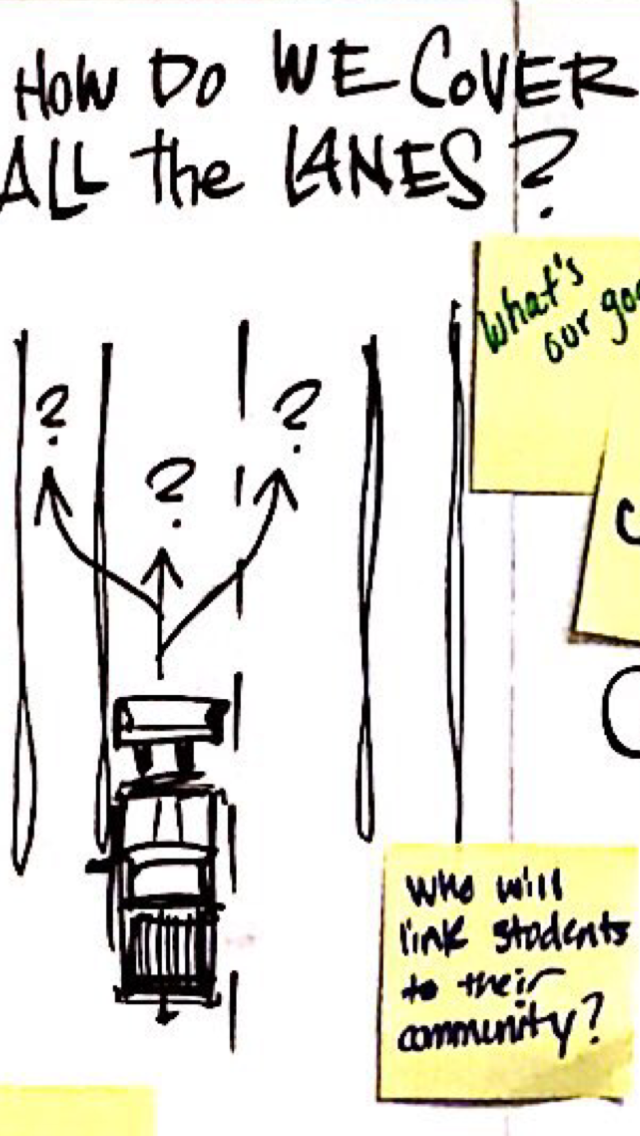 Mike Fleisch Graphic Recording of Our Discussion
Have you ever been challenged or, as a leader, challenged someone else to stay in their own lane? Whether your mind conjured up a football analogy or lanes on an interstate, you got the message: Quit trying to lead everyone else’s area, and focus on yours. This really is a paradox, though.
Think about it, because perhaps you heard or have given a different message in a different meeting when the leader, or you, told the team, “Everyone must help get this done. We all must own this.” So, as leaders, what is the right message or best practice? I would argue, we must do both.
This past weekend at one of our task force meetings we got into a lengthy discussion about this paradox. While we know that it is the most efficient thing to have everyone in their own lane, we know that somtimes this just doesn’t work. Here are reasons it doesn’t always make sense to stay in our own lanes:
- Individuals have not been trained properly to do the work of his lane.
- Individuals do not have the resources to do the scope of the work of her lane.
- Individuals do not have team to do the work of her lane.
- Individuals become overly concerned with everyone else’s position, you may jeopardize playing well in your own lane.
- Individualized become overly dependent on others to the point that they do your work for you. Then, you are not serving the whole well.
I believe we must own our own areas, including your realm of responsibility. If you are a leader, you have been given responsibility for a team, and no one should outpace you in passion or concern for the area you lead and steward. If we want to lead the whole, we first lead and be a steward of our lane exceedingly well. Then we will have the respect and be invited into other lanes.
But, let’s not forget the paradox, a great team pulls together in the same direction and shoulders these initiatives together. Therefore, the answer here is to spend most of our time in our own lane, but when needed we can visit other lanes. For this to work, though, we need to make sure our team members are trained properly, have the skills necessary, and understand the nuances of working in other lanes.
Do you and your team understand how to navigate the paradox of staying in your lane?
Widening The Circle
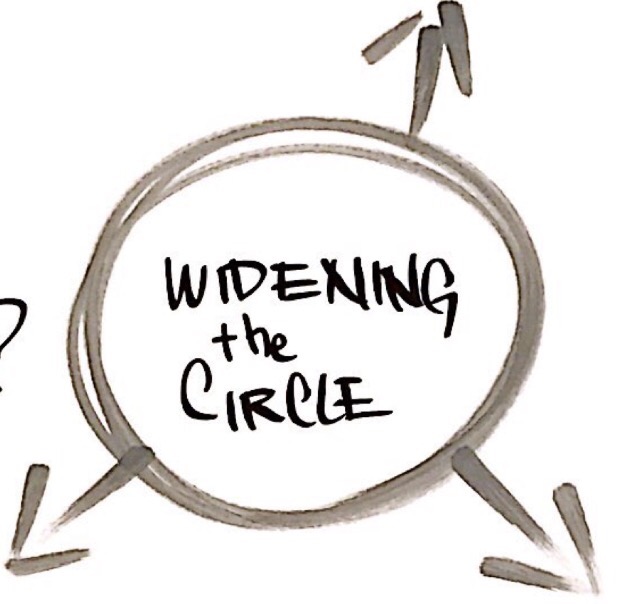 I believe widening our circle of stakeholder/community involvement is crucial to informing our most important decisions. We must identify all the participants who need to be a part of our circle for creation. By using a diverse mix of people, we can create a “maximum mix” of ideas.
Diversity of thought yields richer insights and discoveries. Collective insight evolves from:
- Honoring unique contributions.
- Connecting ideas.
- Noticing deeper patterns and questions.
If we widen our circle and invite a diverse group to collaborate, the knowledge and wisdom we need will already be present and accessible. Intelligence emerges as the system connects itself in creative ways. Encourage everyone to share their ideas and perspectives freely, and acknowledge that some people’s special contribution may be their presence as attentive listeners.
Another advantage of widening the circle is the ability to surface differences of opinion and understanding; this is part of their ability to generate new insights. I believe differences can foster either energy and excitement. A critical task of leadership is to protect space for the expression of people’s differences. When differences in opinion are truly valued, they become the object of genuine curiosity.
Is your circle wide enough?


leave a comment