Why Does Community Matter?
 This past week I had the honor to be involved in a webinar put on by my friend Becky Robinson at Weaving Influence. The webinar featured a hero of mine, Peter Block. I consider him to be the father of Community. In fact, he literally wrote the book on it – Community: The Structure of Belonging, 2nd Edition. The webinar was held to launch the 2nd Edition of the book that was released last week. Peter Block was introduced to me by my good friend Mike Fleisch. Mike has literally shown me all the great community work that Peter Block has done in Cincinnati. I have read Peter’s books and was excited to be on the webinar with him. Peter is truly helping to change the world.
“The best way to connect is with groups of three people with their knees 9 inches apart.” ~ Peter Block
Let me tell you, there was a great deal of content in a one hour webinar. Peter is very philosophical, but is also able to bring his philosophies and core values to a practical level as well. I want to provide you a bulleted list of some of the more salient points that I believe Peter made during the interview. I will provide you with the link to the webinar and you can make your own list later in this post. Here is my list:
- We’ve reached a limit as to what professionals can do.
- Schools cannot raise our children.
- PowerPoint pretends our conversations are predictable.
- How can you have learning, if all you have is content?
- We need to ask the question, “why did you show up?”
- All cultures value depth of relationship!
- We are afraid of the stranger.
- Working of deficiencies just makes the deficiencies stronger.
- Using community strategies creates real and concrete outcomes.
- You can’t innovate through legislation.
Wow, I just realized I created a top ten list from the webinar. I am not going to go back and number them because there is no real order to this list, but all important points that Peter covered in the webinar. I need to go back and blog about each one (we’ll see if I get that accomplished or not). So, I promised you the opportunity to make your own list. I want to provide you with the link to the YouTube video of the entire webinar, including the chance I had to visit with and ask a question of Peter Block. My next post after this one to my blog will specifically deal with my question and the conversation that followed. But for now, click here to watch the whole webinar (again my thanks to Becky Robinson and Weaving Influence for making this possible):
https://www.youtube.com/watch?v=cUPAFSbcEHY&feature=youtu.be
As you can see, this was a very powerful webinar. I would love for you to reply to this post with your top ten (or however many) takeaways you have from the webinar. By replying you will be creating the strong aggregate Peter talked about. Notice I am trying to practice the teachings of Peter by not offering my own thoughts on each of the bulleted points, but asking you to give your thoughts. I really do want to hear from you. Peter Block really is the father of using Community to change the world.
Good Leader Traits
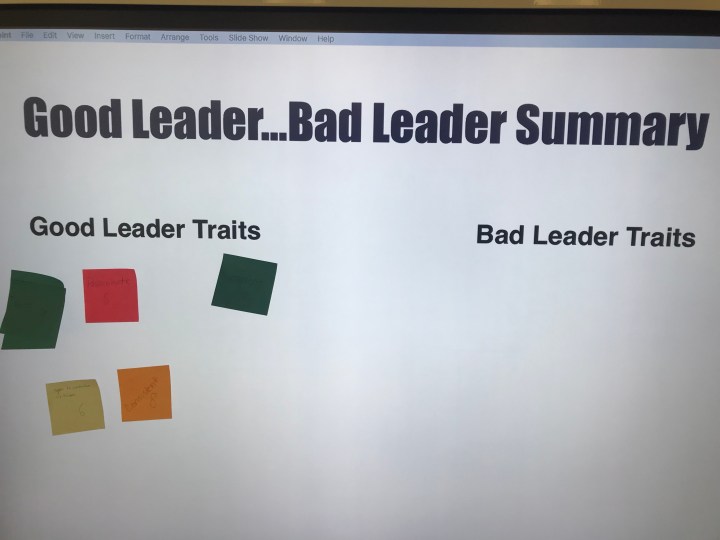
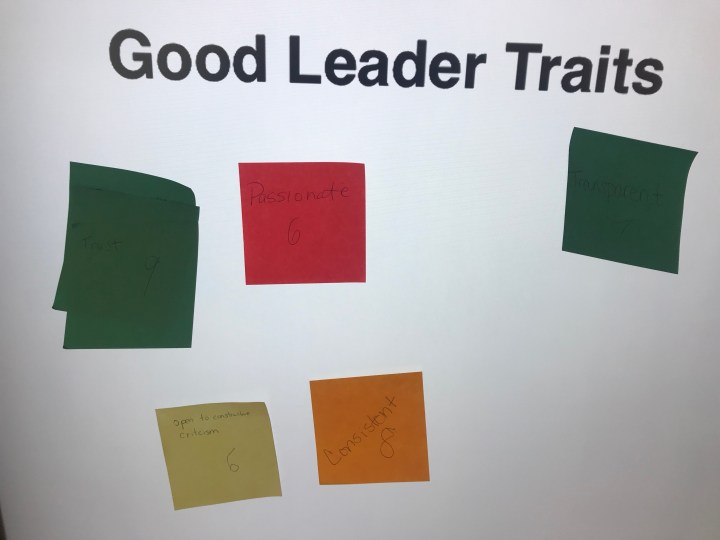 This past Friday in a session I did for our Noble Education Initiative Impact Indy Program we developed a top five list of great leadership traits. To get to that end, we developed a bad leadership trait list and then moved into the good list. Then we voted our way to the top five, great list. I would like to provide you with our top five in this post with some of the commentary about each one discussed during the session.
 Here they are:
- Trust – No big surprise here. Trust tops most lists characterizing great leaders. It’s at the root of every good relationship, including that of leader and employee. When your team trusts you, and they perceive that what you’re doing is honestly in their and the organization’s best interest, you are more likely to have an engaged team.
- Consistent – Consistency was a multifaceted item on this list. First, as a leader, you want to communicate a consistent focus on just a few critical issues (at most three to five) for each employee or team. And then you want to relentlessly follow up and focus only on those few issues. Less is more. Second, the great leader will have consistent moods, behavior, and decision-making so that her team knows where she is coming from. Finally, there must consistency in the message and actions delivered. The simple adage of “do what you say” goes a long way as most customers, families, students, or other stakeholders are accustomed to broken promises and poor service. With consistent delivery and consistent service, we can put all our focus on promoting a positive and consistent brand image with those we serve, including our customers.
- Transparent – Employees learn more about one another and can grow to work toward solving problems faster when their leaders are transparent. Transparency also allows relationships to mature faster, as openness can potentially avoid misunderstandings that can fuel unnecessary tension. If we are transparent, we can actually strengthen our role as a leader because those we serve begin to trust (see, there is our #1, trust, showing up again) us as person and thus will respect us more as a leader.
- Open To Constructive Criticism – If you are not being criticized, you are not leading and guiding the organization to grow, innovate and explore endless possibilities. We all have areas we need to improve in. Additionally, we must use criticism as an avenue to learning. Criticism can provide valuable insight for making course corrections. Don’t be offended by criticism, use it to your advantage.
- Passionate – Passion inspires others to join and identify with the organization’s vision. When we are passionate about something, it shows all over us. We can’t help but think about it, work at it, and be excited about it. Most importantly, passion is as contagious as a cold. Ever notice how your own enthusiasm escalates when you are around passionate people?
Pretty awesome list wouldn’t you say? What’s on your top five? Would you change any of these, or re-order the list? I would love to have you add your comments to this post.
What Do You Really Want?
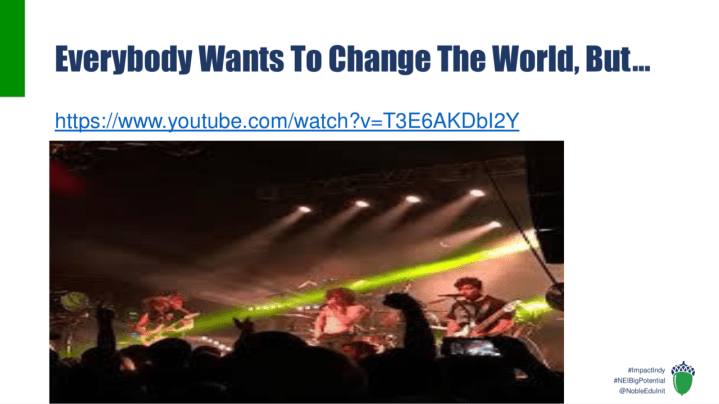
 Yesterday at our Impact Indy program to kick off our Noble Education Initiative supported schools in Indianapolis, Indiana I did a program titled: Leading Like a Rock Star: Chaos and Earthquakes. To kick off the program I played the video of the song “Do You Really Want It” by one of my favorite bands, Nothing More. Click here to watch the video:
Even if you are not a fan of the same genre′ of music as me, you’ll have to admit that the words make you think and reflect. The chorus really gets to me: “Everybody wants to change the world, but one things clear; nobody wants to change themselves.” So true! This is one of those Walk the Walk or Walk the Talk things. Do we really want to make the changes or develop ourselves in the ways necessary to make the revolutionary and transformational changes we need?
 Our discussion was very rich around this topic. I had the participants write down two things they had recently changed about themselves and two things they had resisted changing. It was a very open and candid discussion. Amazingly, in all cases when someone had gone ahead and made a change in themselves they were resisting, it led to great results.
“Kites rise highest against the wind, not with it.” ~ Winston Churchill
Fortunately and unfortunately, we are creatures of habit. Our brain creates neural pathways from repetitive thoughts and behaviors in an attempt to be efficient and make those things easier. And after some time, they become our default way of functioning. For things we want to change this is default is unfortunate, but we can you is to advantage by making the new changes the new habits or default. We live on “auto-pilot” in some cases. Even with an intention to change, we find ourselves repeating the same behaviors and experiencing the same thoughts. When these thoughts are based in doubt and fear, they are even harder to change. On some level, they are serving a protective function for us.
 Some changes we resist because biologically we seek to stay status quo or be in a state of homeostasis. But, some changes we resist because of being hypocritical. I believe the chorus in Nothing More’s song, “Everybody wants to change the world, but one things clear; nobody wants to change themselves,” really describes this hypocrisy. It’s the old “do as I say, not as I do” syndrome. This hypocrisy doesn’t just undermine a leader’s authority, it can also directly threaten how the group functions. A leader’s perceived personal integrity, in other words, is a cue for how everyone who follows to interact.
If we want to make positive change, we must be willing to change ourselves and make our actions match our words. When the talk of the leader makes about what she values is consistent with her actions and the things she rewards, her followers will be more willing to engage and treat one another like neighbors. This alignment creates the feeling that when people put in effort on each other’s behalf, those efforts will be recognized and they’ll be supported when they need it. And it leads to trust that the organization or community has its members’ long-term interests at heart.
Unfortunately, this trust is lost by the hypocritical leadership we are discussing here. Hypocritical leadership is when a leader says one thing, but does another. It is when someone exhorts behaving one way, but then continues to behave in another. On the other hand, however, demonstrative leadership is when leaders not only talk the talk, but walk the walk as well. Are you ready to demonstrate changing yourself? Do you really want it?
“The Rock” In The Atlantic Ocean
 Yesterday while exploring the rocks along the Atlantic Coast of Maine I found a beautiful rock that once I took out of the ocean 🌊 wasn’t so beautiful any more. That experience prompted this VLOG Post:
Independence Day Leadership Lessons From Maine & Joshua Lawrence Chamberlain
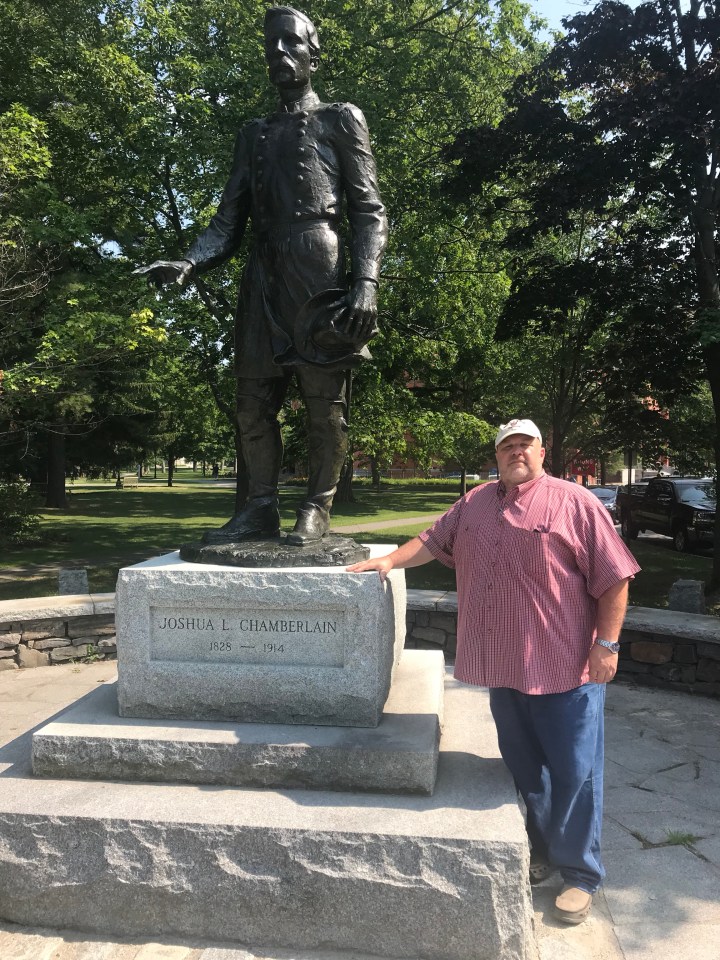 On this 2018 Fourth Of July morning I am reminded of the great leadership that has been necessary for the United States to become the great country it is. My family and I are vacationing in Maine right now so, of course, I had to do some studying of influential leaders from Maine. Boy did I come across a great one: Joshua Lawrence Chamberlain. Now I know that Independence Day is observed to honor our Declaration of Independence from the tyranny of Great Britain and those who provided the leadership during this important time of our country’s founding, but since I am in Maine I am going to honor and remember Chamberlain too.
Raised from a modest life in the small town of Brewer Maine, Joshua Chamberlain chose the professions of ministry and academia filling in the post of Professor of Rhetoric at Bowdoin College during the tumultuous 1850s. As the Civil War broke out, Chamberlain felt the impulse to serve based on his belief in preserving the union and his moral conviction against the institution of slavery. In early 1862, Chamberlain expressed his desire to serve to the Governor of Maine, who offered him the rank of Colonel in the Maine volunteers. He turned that rank down because he did not believe he had the experience necessary for the rank. This is lesson one learned from him – be modest and know what skill level you have and what you still have to learn. Believing he needed to gain experience and knowledge of the military profession, Chamberlain’s uncommon act of humility set a tone for the remainder of his service.
But the cause for which we fought was higher; our thought wider… That thought was our power. ~ Joshua Lawrence Chamberlain
Joshua Lawrence Chamberlain went on to have a very successful military career and ended that career as a Brigadier General, but two Civil War stories are worth telling in this blog post. Here they are:
Battle of Gettysburg, July 2, 1863, Little Round Top
Colonel Joshua L. Chamberlain, who he now commanded, ordered the 20th Maine Regiment to execute a daring counterattack against the 15th Alabama Regiment of the Confederate Army on July 2nd 1863 during the Battle of Gettysburg. At the extreme left flank of the Union Army, the 20th Maine fought off repeated assaults for the past several hours against the determined Confederate Soldiers. Even though the 20th regiment was outnumbered and low on ammunition, Chamberlain’s bold decision and courageous leadership led his men of Maine down the slopes of Little Round Top at Gettysburg, Pennsylvania and stopped the Confederate assault against the Union Army’s left flank. He showed tremendous insight and leadership in making this bold move. Colonel Chamberlain was inspirational to his men and as a leader, a true influencer.
Confederate surrender at Appomattox Courthouse, April, 1865
Joshua Lawrence Chamberlain taught us what it meant to be a man of character and compassion when he was personally asked by General Ulysses S. Grant to preside at the Confederate surrender at Appomattox Courthouse over the surrender detail. It was not the fact that he presided that is noteworthy here, it is the awesome act and example of leadership he performed. As the 20,000 Confederate Soldiers paraded by to turn over their arms and battle flags, Chamberlain gave the Union Army detail the command of “carry arms” to salute Confederate’s service and gallantry in battle. Many, then and now, credit this leadership gesture as the beginning for the country’s healing process toward reconciliation.
This act took courage and would bring him accolades and plagued him politically for the rest of his life. The southerners deeply respected him for this show of compassion and respect. Conversely, however, many northerners, including those in his home state of Maine, did not see it that way. They wanted to continue the humiliation of the Confederacy. Chamberlain did what was right and faced the consequences.
Congressional Medal of Honor
Joshua Lawrence Chamberlain was awarded the Medal Of Honor for his service At Gettysburg. He saw combat at Fredericksburg, Cold Harbor, Petersburg, Five Forks, and the Appomattox Campaign.
Chamberlain Leadership Lessons
Chamberlain always positioned himself in the middle of his brigade’s formation. He led shoulder to shoulder with his men. This built trust and gave him the ability to truly know what was going on. Chamberlain reassured his soldiers through his cool and calm presence during the heat of combat. He garnered the trust of his men through his actions in combat. The other thing that really impressed me as I studied this hero was his commitment to studying his new military profession, and his commitment to developing his subordinates. We need to pay attention to these lesson learned and apply them to our daily lives as leaders.
 Learn More About Joshua Lawrence Chamberlain
There are so many more leadership lessons to learn about this great man that went on to be President of Bowdoin College in Brunswick, Maine and four term (one year terms at that time in Maine). Let me suggest two ways that I did to learn more:
- Visit Bowdoin College in Brunswick, Maine and visit the Joshua Lawrence Chamberlain Museum. It is awesome! I learned a great deal from the tour and curators there. The museum is the restored home (the only home he and his wife, Fanny, ever owned). There is family history, Civil War history, history of his time as Bowdoin College President, and history of his Governorship. It is awesome!
- Read the great book by Alice Rains Trulock, In The Hands Of Providence: Joshua L. Chamberlain & The Civil War. This book is awesome and I gave it five stars. Is a very well written well told story of this great leader. This book inspired me to dig deeper and explore more to understand how this man became the great leader he did, at a crucial time in our nation’s history.
I am thankful on this Independence Day, 2018 for Joshua Lawrence Chamberlain. What leaders are you thankful for on this day of celebration of our great country, The United States Of America?
What’s Your Elevated Story?
 One of the most common questions we get when meeting new people is, “So, what do you do?” Most of us have a standard answer about our profession, but there are some people who have jobs that you might not even know existed. More importantly, everyone’s job is important and in some way improves the lives of others. Think about every job that affects your household; there are a lot.

Perkins Cove
I was reminded of this yesterday when in Perkins Cove, Ogunquit, Maine. This is a lobstering port and a beautiful place with shops and restaurants. While exploring we came across a boat named the SS Crusher that had been dry docked (see picture). It was a cool looking boat and I wondered what was up with it. Then, I found that a children’s book, The Pride Of Perkins Cove, had been written about it by Brenda Yorke Goodale about the boat.
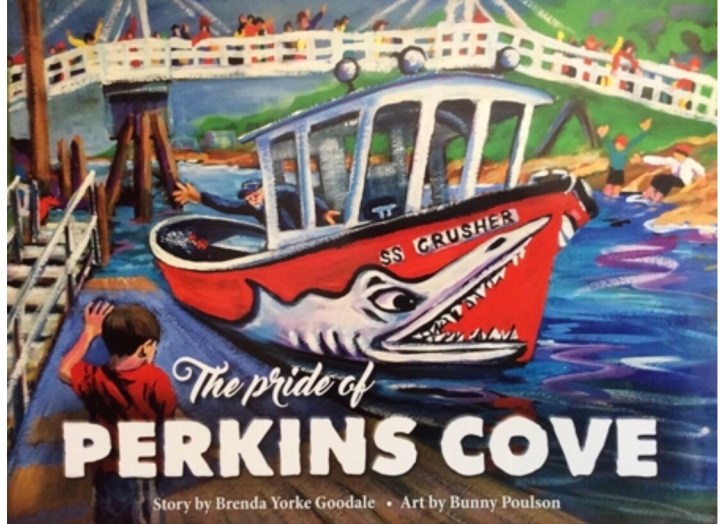
So, of course I had to dig deeper and found that the boat and it’s harbormaster have very important jobs. When it gets cold, and it gets cold in Maine; Perkins Cove freezes. Because the Cove is a working port, it has to stay open, so Harbormaster Fred Mayo spends hours every day breaking the ice. The town’s special boat, the SS Crusher, is built for the task of “crushing” through the ice. Before yesterday I did not even know what a lobstering port looked liked, let alone that freezing was a problem.
If we asked Fred Mayo what he does, he might give the same kind of answer we all would: “I’m a harbormaster.” But, wow, is it so much more. In fact, here, according to Wikipedia, is truly the world of a harbormaster: “A harbormaster is an official responsible for enforcing the regulations of a particular harbor or port, in order to ensure the safety of navigation, the security of the harbor and the correct operation of the port facilities.” Think about all the other colorful details that a harbormaster like Fred Mayo could add. I’ll bet there are some great stories of ice crushing in Perkins Cove. Here are a couple of pictures of Fred Mayo and the SS Crusher doing their job:


A few weeks ago I read a great book by Shawn Achor entitled Big Potential: How Transforming The Pursuit Of Success Raises Our Achievement, Happiness, and Well-Being. In the book, Achor points out that we usually just give a very quit and boring answer of what we do for our job. He argued, however, that we need to quit this and give what he calls the “elevated speech;” not to be mistaken with the elevator speech. The “elevated speech” should be us telling what we really do and why what we do is so important. The example I like to give here is the answer that we hear so many times from teachers: “Oh, I’m just a teacher.” I’ll admit I’m guilty of having done this. But, are you kidding me, “just a teacher?” I think not! Actually, I hope not!
 Let’s take a look at teaching as a very significant profession, or “job.” Here is my elevated version: “Teachers have been given a great gift – the power to change lives, each day I must be inspirational. I am a significant human being helping other human beings to realize their full potential and go on and make a positive difference in their world.” What do you think?
Achor posited that our beliefs create our world. He argued that if we elevate the story of what we do, we will get a new spring in our step and renewed inspiration for what we do each day. He’s right because Gallup (2017) told us that 60% of employees say the ability to do what they do best in a role is “very important” to them. Here’s the challenge, though, in 2016, only 33% of U.S. employees were
engaged – involved in, enthusiastic about and committed to their work and workplace (Gallup, 2017). This translates to only 4 in 10 U.S. employees strongly agreeing that in the last year, they have had opportunities to learn and grow (Gallup,2017). This is a huge engagement issue. Gallup (2017) results suggested that by moving that ratio to eight in 10 employees, organizations could realize 44% less absenteeism, 41% fewer safety incidents, 24% higher retention, and 16% higher productivity. I guess it is time to elevate those we serve.
Just like the story of the SS Crusher, we all have unique gifts, jobs to do, and make a significant difference in the world. Let’s get engaged and elevated! What’s your elevated story?
Reference
Gallup (2017). State of the American Workplace. Gallup, Inc. Washington D.C
Rewriting The Story To Create The Future!
 Story Driven: You don’t need to compete when you know who you are by Bernadette Jiwa
My rating: 5 of 5 stars
Rewriting The Story To Create The Future!
This book is outstanding and warrants the writing of a review. I did a great deal of highlighting while reading this book and tweeting. Bernadette does an outstanding job of guiding us through how to differentiate ourselves, our brands, and our organizations by telling the right story. In order to do this she teaches us in the reading how to know who we are, what we stand for, where we are headed, and what has made us personally, our brand, and our organization. Most importantly, she teaches us why this story is important to be told. She posits we need to forget about competition and focus on what makes us and our work unique and valuable. It was great to be reminded that we, and those we serve, are identified by what we do. Our story needs to be one of significance and not just success. Anyone who wants to be grounded, intentional, and deliberate in the creation of the future he or she wants the world to realize needs to read this book.
~Dr. Byron L. Ernest
The BEST Time to Look for a Job
 This guest post originally appeared on Dr. Dawn on Careers
The BEST Time to Look for a Job
By Dr. Dawn Graham
Of course, the best time to be looking for a job is always.
I don’t mean a full-on job search, but rather keeping yourself “job-change ready” just in case you need (or want) to make a shift. This way, you’re not starting at zero when you begin to look.
You don’t need to put in a lot of effort to keep yourself “job-change ready.” Here are a few tips:
• Listen. Opportunities are all around you – in your current company, at your friends’ companies, and even in the company five floors down from yours. When you tune into what’s happening at the happy hour gathering, talk to people in the elevator, or chat up your colleagues over lunch, you learn a ton about changes that will impact jobs. Stay curious and ask questions – you’ll be surprised at what you discover.
• Update. You likely have annual rituals – deep cleaning the freezer, doing your taxes, donating clothes to charity, etc. Make evaluating and updating your resume (and LinkedIn!) one of them. Review your achievements over the past year and use them to strengthen your brand. Consider what skills gaps you’d like to close in the coming year and seek out projects to gain that experience. People who are constantly on the move and involved get noticed when new opportunities arise.
• Strategize. Those people you know who always seem to land on their feet aren’t lucky. They have a plan for when things change. If you haven’t spent time thinking about companies that you’re interested in, roles you’d enjoy or projects you’d like to work on, now is the time. While no one can predict the future, continuously generating ideas, taking actions towards them, and keeping informed will ensure that you always have options available. Then, unexpected twists become opportunities versus setbacks.
 Job security only exists within you, not outside of you with an organization. Companies merge, policies shift, CEOs get replaced, departments downsize, and product growth bottoms out. Any of which can leave even the best performers on the unemployment line. This isn’t meant to instill a constant state of anxiety about work, but rather a reminder that employment in the US can be volatile, and your best defense is to always be job-change ready.
*******************************
Dr. Dawn Graham, PhD is one of the nation’s leading career coaches. She is the Career Director for the MBA Program for Executives at The Wharton School, where she counsels business leaders on making strategic career choices. A licensed psychologist and former corporate recruiter, she hosts SiriusXM Radio’s popular weekly call-in show Career Talk and is a regular contributor to Forbes.
Her latest book, Switchers: How Smart Professionals Change Careers – and Seize Successis written specifically for people thinking about changing career paths. Packed with psychological insights, practical exercises, and inspiring success stories, Switchers helps these individuals leap over obstacles and into a whole new field.
Ready, Set, Switch – Shape Up Your Social Media
 This guest post originally appeared on Forbes
Ready, Set, Switch – Shape Up Your Social Media
By Dr. Dawn Graham
If you’re a job seeker who isn’t on social media, you might as well not exist.
That’s a harsh statement, but in today’s technology-based world, there’s a basic expectation that you’re at least mildly engaged online, especially in the business world. Clients, employers, network contacts and even social acquaintances want to connect with you virtually.
So if you’ve been resisting social media, now is the time to get in the game, especially if you’re in a job search. You don’t need to go so far as to consult your teenager about the latest Apps, but there are a few foundational things that will help significantly.
First, the “why:”
• Working your network. Contacts and referrals continue to be the best source for finding new employment opportunities, and it’s pretty difficult to network if you’re not on LinkedIn when over 500,000,000 other people are. While you may be well-connected in your local geography, networking crosses global boundaries now, and the internet enables you to easily access that world. Don’t limit your reach.
• Information sharing. Over 90% of companies reported using social media in their recruiting and hiring in efforts. While LinkedIn was by far the top online site, Facebook and Twitter are gaining speed. Some recruiters use the tools to research candidates, while others use them as vehicles for posting openings and sharing updates. If you’re not following, you’re missing out. Additionally, the Society for Human Resource Management found that 35% of employers were less likely to interview candidates they could not find online.
• Getting recruited. Passive hiring is on the rise according to 2018 hiring trends, and it’s hard to be “found” if you’re not active online. To be competitive, you need to go beyond the basic profile. Your online presence needs to be intentional, showcasing your brand and demonstrating qualities that are attractive to your target audience. The Undercover Recruiter recently reported that passive candidates are 120% more likely to want to make a positive impact on their new organization. With pressure to find stellar talent, recruiters are recognizing this and prefer to find YOU. They can’t do that if your profile doesn’t exist or reflects who you were five years ago.
Now the “how:”
• Reconnaissance. Google yourself. Find out what comes up when you search for your name online. Is it a professional, updated LinkedIn profile at the top of the results list, or a DUI mug shot of someone who shares your name? Also, check your social media sites for questionable content and clean up photos or old posts that are not reflective of your professional brand. Even if your pages are “private,” chances are one of your contacts is connected to your new employer in some way. The world is getting smaller and that provocative photo at your friend’s wedding in Vegas may have been hilarious at the time, but not at all impressive to a potential employer. In fact, 55% of employers admitted to reconsidering a candidate after what they found online.
• Rebranding. Dust off your LinkedIn and ensure it reflects your current skills, interests, and accomplishments. Is it time for a new photo? Have you been remiss in connecting with new people you’ve met in the last few months (don’t forget the power of 2nd level contacts!). Is your profile linked to an old company you used to work for or do you include dates that make it easy to calculate your age when you’d rather not publicize it? You don’t need to, nor should you, include everything about yourself online. However, a few well-placed accomplishments and a descriptive summary will take you far. Bonus: A study by Jobvite showed that 65% of employers who noticed volunteer or charity work on prospective candidates profiles viewed them more favorably.
• Repurpose. Create a strategy to get active online to expand your brand professionally. Create a personal webpage, blog, or company page. If you’ve shied away from these strategies in the past, you might be surprised at how easy (and inexpensive) these things are today. If you’re not ready for that, follow influencers online whose work reflects your value and interests, and then repost their content with your network, sharing your insights. Also, check your daily notifications for anniversaries, birthdays or announcements about your network, which are easy ways to stay in touch. Create Google Alerts that do the heavy lifting for you by bringing relevant information directly to your inbox.
 If you still long for a life before texting and Twitter, you’re definitely not alone. However, these are the rules of engagement in today’s job search, so find a balance that works for you and get in the game. A job search is tough enough – why not tip the odds in your favor?
Happy Hunting!
*******************************
Dr. Dawn Graham, PhD is one of the nation’s leading career coaches. She is the Career Director for the MBA Program for Executives at The Wharton School, where she counsels business leaders on making strategic career choices. A licensed psychologist and former corporate recruiter, she hosts SiriusXM Radio’s popular weekly call-in show Career Talk and is a regular contributor to Forbes.
Her latest book, Switchers: How Smart Professionals Change Careers – and Seize Successis written specifically for people thinking about changing career paths. Packed with psychological insights, practical exercises, and inspiring success stories, Switchers helps these individuals leap over obstacles and into a whole new field.
A KISS of Stardom!
 This week I had the opportunity to do something that I had never done before. I became Gene Simmons as a part of a team in a Battle Of The Bands Lip Sync Contest. This was part of our Carolina Schools Big Potential Leadership Conference put on by Noble Education Initiative, Inc. What an experience. Although each of the group’s members is iconic, perhaps the most memorable of them all is front man Gene Simmons, who is famous for his demonic character that breathes fire, spits blood, and engages in all sorts of outrageous behavior on stage. Here’s the deal: when we hit the stage, after an hour and a half of getting in costume and having makeup put on, I became Gene Simmons. I even spit blood. And, I didn’t lip sync. I sang every word of “Rock And Roll All Night.” Then, I spit blood (we got the fake blood capsules at a party supply place and I put the all in my mouth – what a mess) and did “God Of Thunder.” The crowd was going wild – literally. I’ve got to tell you, I did not want it to end. It was addictive.
So, what did I learn?
 Shared Vision and Enthusiasm – Everyone, regardless of her or his age, knows KISS, the band. They are the band that would wear 6-inch heels, has blue/black hair, paints their faces, and one member, Gene Simmons, who would spit blood and blow fire. Amazingly, it’s hard to find anyone who doesn’t know that. Furthermore, when my colleagues and I started our rendition of “Rock and Roll All Night” it amazed me that everyone knew the words and sang along. It wasn’t just singing, though, it was singing with enthusiasm. We could tell, the song meant something to this group. Everyone was connecting in some way to it. As leaders, that is our job to make connections. Whether that means partnerships, or connecting everyone in the organization to a shared vision.
Engagement – I did a session yesterday morning on student engagement. While I was facilitating that session I was thinking about my rock band front man experience. My job both as a facilitator and front-man was to move, affect and engage an audience. This is also true in a classroom. We must move our students toward proficiency of skill, standards, and competencies, as well as affect change in their lives, while engaging them.
 The Band Is A Team – While I acted out the part of the demonic and crazed front man part of our our band, I realized it was the other three members of our band that made it all possible. Others in the band literally got my costume ready and did my makeup. They were supporting my antics on stage and supporting me acting crazy. The lesson here is that we can never be as good by ourselves as we can be as part of a team.
We All Need A Brand or To Be A Part of A Brand – The 2016 Gallup survey information tells us that we all want to be part of a successful brand or part of an organization that is doing good in the world. KISS holds all the records for record sales for any rock band ever – including Elvis and the Beatles. Their empire is worth over 1 billion dollars and there are over 3000 branded KISS products on the market today. KISS is a rock BRAND not a rock Band. What is your brand?
Have A No Limits Attitude and Approach To Life – There truly are no limits to what you can achieve. Success is a mind set. We all need to have a growth mindset. Either you think you can achieve it, or you don’t. Never let someone else tell you what you can and cannot achieve. Control those thoughts yourself.
 Upon reflection, I got chills thinking about a few things:
- Without KISS, I wouldn’t be who I am today.
- What would the world and I be like if there were no KISS?
- What band would have been my mentor to have a no-holds-barred attitude toward going after all my dreams?
- Who would have taught me it doesn’t matter what the critics are saying because you cannot please everyone; I learned, from KISS, to go after what I believe will create change in the world?
- Without Gene Simmons I don’t have the example of a humanitarian. Simmons received the MEND Humanitarian award, for his support of Mending Kids International, which provides surgical care to children in developing countries. During his acceptance speech he said, “I don’t have the right NOT to give back and neither do you. Some mother somewhere is crying her heart out because her child can’t have what we have in this country and we can change that.” Did you catch that? “I don’t have the right NOT to give back…” I heard you loud and clear, Gene!

 As you can see, Gene Simmons and KISS has had quite an affect on me since the band began when I was 10 years old. I am so glad they have been a part of my life. I am also glad I had the opportunity this week to experience a very, very, very, very small part of what it feels like to be Gene Simmons on stage.
 Byron's Babbles
1 comment