Justice Is Inherently Relational
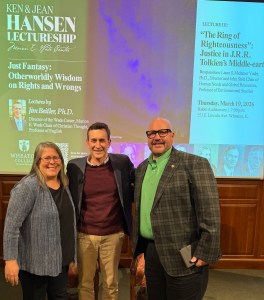
In her outstanding response to Dr. Beitler’s lecture, “The Ring of Righteousness”: Justice in J. R. R. Tolkien’s Middle-earth, Dr. Meitzner Yoder made the comment that “Justice is inherently relational.” As a person who believes relationships are the key to everything, this suggested that justice isn’t just about abstract rules or principles; instead, it emphasizes the importance of relationships between people. Essentially, justice arises through interactions—how individuals treat one another, fairness in relationships, and mutual respect.
For us as leaders, this means that fostering just environments goes beyond simply applying policies. We should pay attention to the nature of their relationships with team members and stakeholders, ensuring transparency, fairness, and empathy. By doing so, we create a context where justice is experienced and practiced through genuine connections, trust, and shared responsibility. This relational view encourages us to build inclusive, respectful cultures where everyone feels valued and treated fairly.
Imagining The Complex Unique Individual

In a great discussion following Dr. Jim Beitler’s Hansen Lecture, “The Horns of Elfland: On Fairyland Justice” we talked about justice and how the novels from Tolkien and Lewis help us develop an understanding and appreciation of others, particularly through our imagination. We even discussed justice in leadership being about how we imagine the person in front of us. Do we imagine them as just a collection of data or a complex unique individual. This really caused me to reflect about how we imagine those we serve, those we are just meeting and making friends with for the first time, and anyone we come in contact with.
It was suggested to read Elaine Scarry’s “The Difficulty of Imagining Other People.” This essay offers valuable insights for leaders aiming to cultivate a more human-centered approach. Here are some key lessons that we can draw from Scarry’s work:
- Recognize the Challenge of Empathy: Scarry emphasized how difficult it is to truly imagine and understand the experiences of others. Leaders can learn to acknowledge this challenge and intentionally develop empathy by actively listening and seeking diverse perspectives, rather than assuming we fully understand others’ realities.
- Value of Fragility and Vulnerability: The essay highlights the delicate nature of human identity and perception. Leaders who appreciate this fragility are more likely to foster environments of trust, compassion, and psychological safety, encouraging team members to be authentic and vulnerable.
- Importance of Imagination in Leadership: Effective leadership involves imagining the lives and struggles of others beyond immediate interactions. By cultivating our capacity to imagine different realities, leaders can make more compassionate decisions that genuinely serve the needs of their teams and communities.
- Counteracting Objectification: Scarry discussed how difficulty in imagining others can lead to objectification or dehumanization. We need to be conscious of this tendency and work actively to see team members as whole persons with aspirations, fears, and complexities—not just roles or functions.
- Fostering Being More Human-Centered:
Understanding the hurdles in imagining others encourages leaders to create practices that validate diverse experiences, promoting belonging within organizations.
Studying Scarry’s work encourages us to deepen our capacity for empathy, vulnerability, and imaginative understanding—fundamental elements of being truly human-centered. This approach not only enhances ethical leadership but also builds stronger, more resilient, and engaged teams.
Flocking Together: How Community and Camaraderie Boost Creative Success

Those that follow me know that I love Pelicans. They are amazing birds and there are so many leadership lessons we can learn from them. I have blogged previously about them in Pelican Leadership Lessons and Leading From The Optimal Height. I am in Georgia doing some work right now and yesterday was watching these incredible creatures while spending some time on Tybee Island.
Lately, I have been doing a lot of studying the literary discussion group from the 1930s and 1940s at Oxford University that included C. S. Lewis and J. R. R. Tolkien – the Inklings. As the tide came in yesterday morning there were groups of Pelicans putting on a show of their collaboration and holding each other accountable. Both the Inklings and Pelicans served, in my mind, as analogies to each other, and leadership.
The Inklings were known to be a close-knit, supportive community where members shared and critiqued each other’s works regularly, fostering mutual growth. The accountability that came from this included honest feedback, but the strong relationships and camaraderie enabled encouragement, cheerleading, and a collective pursuit of artistic and intellectual excellence—much like a flock of pelicans working together while fishing or migrating.
Pelicans are social birds that travel and hunt in groups, relying on cooperation for survival. They often communicate and coordinate their actions, holding each other accountable to stay organized and effective. Pelicans collaboratively move fish into groups for successful hunting of food. Pelicans, just like the Inklings did, thrive on their relationships to collaborate and work together toward a common goal —literary creation or efficient foraging.
The synergy of the relationships encouraged the support of one another in the Inklings. This support provided accountability; not in the form of punitive pressure, often associated with accountability, but by ensuring progress through collaboration. The Inklings shared purpose can be compared to that of the Pelicans. While the Pelicans shared purpose is survival, we know from research that many of the great literary works from Inkling authors would not have happened without their social group of accountability.
So, let’s be cognizant of the power of cooperative, communicative, and mutually supportive relationships that enhance our efforts through camaraderie and shared accountability.
The Allure Of Power

I just finished The Fellowship of the Ring by J. R. R. Tolkien. This is the book we are focusing on studying as Marion E. Wade Continuing Scholars at Wheaton College this year. It has been fascinating to read this book using a scholarly lens. It has also been interesting, as a person who loves to use fiction works as a learning tool, to study this book knowing that Tolkien did not like, nor use allegory. That said, there are still so many lessons to be pulled from this book. I still have several notes and reflections that may make their way into blog posts.

Today, I want to focus on a leadership lesson in a statement by Boromir at the end of The Fellowship of the Ring: “The fearless, the ruthless, these alone will achieve victory. What could not a warrior do in this hour, a great leader? What could not Aragorn do? Or if he refuses, why not Boromir? The Ring would give me power of Command. How I would drive the hosts of Mordor, and all men would flock to my banner!” I’m specifically pondering the idea of a leader putting all his faith in the power of a ring. The ring can serve as a metaphor for other sources of power or perceived power.
Boromir’s statement highlights a common temptation for leaders: the allure of power as a means to achieve victory. His belief that the Ring could bestow unmatched command reflects both his desire to protect his people and the dangerous misconception that power alone can ensure success.
The leadership lesson here is about the importance of integrity, humility, and understanding the true source of effective leadership. Relying solely on power, even if it promises immediate results, can lead to corruption and failure in the long run. Aragorn exemplifies the opposite approach: leading through wisdom, humility, and trust in a higher purpose rather than wielding power for its own sake. Aragorn, is a member of the Fellowship of the Ring. He resists the corrupting influence of power, showing great moral strength.
Boromir’s temptation serves as a reminder to us that true leadership isn’t just about exerting control or brute force but about inspiring trust, making wise decisions, and understanding the moral dimensions of power.
Leading By Starting

“‘It’s the job that’s never started as takes longest to finish,’ as my old gaffer used to say.” The leadership lesson in this phrase from J.R.R. Tolkien’s The Fellowship of the Ring is that procrastination or hesitation often causes tasks to become more daunting and time-consuming than they need to be.

Effective leaders understand the importance of taking initiative and starting work promptly. By beginning sooner rather than later, we can manage challenges more effectively, maintain momentum, and reduce the risk of projects becoming overwhelming. This quote emphasizes that decisive action and early engagement are key to successful leadership and accomplishing goals efficiently.
Leading On The Path Toward A Clear Goal

As I was reading The Fellowship Of The Ring by J. R. R. Tolkien yesterday I was struck by this description of Gandalf by Tolkien: “To Gandalf the far-off memories of a journey long before were now of little help, but even in the gloom and despite all windings of the road he knew whither he wished to go, and he did not falter, as long as there was a path that led towards his goal.” Tolkien created a great leadership example in Gandalf. He modeled that hope is preserved through small consistent actions.

From Tolkien’s statement about Gandalf, we can learn the importance of perseverance and clarity of purpose. Despite facing darkness and complex obstacles (“gloom” and “windings of the road”), Gandalf remains steadfast because he knows his destination and the path to achieve it. This highlights that having a clear goal and unwavering resolve can help us navigate through life’s uncertainties and challenges without faltering. It reminds us to stay focused on our objectives, trust in our direction, and persist even when the journey becomes difficult.
You Cannot Trust Us To Let You Face Trouble Alone

I loved this from Frodo’s friends as he was preparing for a difficult and dangerous journey in J. R. R. Tolkien’s The Fellowship of the Ring: “‘You can trust us to stick to you through thick and thin – to the bitter end. And you can trust us to keep any secret of yours – closer than you keep it yourself. But you cannot trust us to let you face trouble alone, and go off without a word. We are your friends, Frodo. Anyway: there it is.” This declaration of friendship from Frodo’s fellow Hobbits underscores that real friendship involves loyalty, trust, confidentiality, and a willingness to face hardships together—lessons that are valuable in our everyday relationships.

Frodo’s friends were highlighting key qualities of true friendship. It reminds us that genuine friends are loyal and dependable—they stand by you “through thick and thin,” offering unwavering support and trust. They also respect our privacy, being trusted to keep secrets confidential. Importantly, true friends don’t abandon us in difficult times; instead, they face challenges together with us, ensuring we’re never alone in trouble. Are you being a true friend?
Advice Is A Dangerous Gift

As I continue reading J. R. R. Tolkien’s The Fellowship of the Ring I keep reminding myself that Tolkien did not use nor like allegory. However, I still can’t help myself from being intrigued by scenes in the book and wanting to connect them to some lesson. One such scene was the conversation between Frodo and Gildor. Here is what they said: “‘And it is also said,’ answered Frodo: ‘Go not to the Elves for counsel, for they will say both no and yes.’ ‘Is it indeed?’ laughed Gildor. ‘Elves seldom give unguarded advice, for advice is a dangerous gift, even from the wise to the wise, and all courses may run ill. But what would you? You have not told me all concerning yourself; and how then shall I choose better than you? But if you demand advice, I will for friendship’s sake give it. I think you should now go at once, without delay;…” (p. 84). Frodo’s and Gildor’s words highlight the cautious nature of the Elves when giving advice, emphasizing how even the wise can be guarded.

The elves are wise and experienced, but also careful about sharing their knowledge and advice, knowing that words can have unintended consequences or that their insights might be misunderstood or misused. The quote recognizes importance of discretion: Sometimes, it’s better to be cautious about what we share, especially when the information could be sensitive or misunderstood.
There is wisdom in silence. Silence or restraint can be powerful, allowing us to observe and understand before speaking. We need to Recognizing that different people may interpret advice differently, and that sometimes holding back is a sign of wisdom.
Ring Of Power

I am reading J. R. R. Tolkien’s The Fellowship of the Ring right now as part of my Continuing Scholar work at the Marion E. Wade Center. In the story Gandalf told Frodo, “A Ring of Power looks after itself, Frodo. It may slip off treacherously, but its keeper never abandons it. At most he plays with the idea of handing it on to someone else’s care – and that only at an early stage, when it first begins to grip.” Even though J.R.R. Tolkien did not like the use of allegory or intentionally use allegory, the “Ring of Power” can serve as a powerful metaphor with valuable lessons. For example, it can illustrate the dangers of absolute power and corruption, the importance of humility and restraint, or the idea that what seems to offer power and control can ultimately lead to destruction.

Using the “Ring of Power” as a lesson encourages us to reflect on how the pursuit of power influences behavior and decisions, emphasizing caution, self-awareness, and the need for integrity in leadership and personal choices. Just like the ring and the power the ring possessed were almost impossible to give up, so are the many powers we often possess impossible to give up and become all consuming and fuel a desire for more.
The “Ring of Power” can also symbolize the seductive nature of material possessions and the way they can influence our values and priorities. Just like the ring grants immense power, material things can seem to offer security, status, or happiness. However, they can also become sources of obsession, greed, or distraction from what truly matters. The lesson is to recognize how attachment to material possessions can lead us astray, encourage moderation, and remind us to value inner qualities like integrity, humility, and meaningful relationships over fleeting material wealth. Ultimately, the ring serves as a reminder that true strength and fulfillment come from within, not from external possessions.
The Power of Ping-Ponging Ideas: Enhancing Community Collaboration

Today, during a discussion in the final day of a weeklong training of National FFA Teacher Ambassadors, one of the Ambassadors shared she loved the ping-ponging of ideas we did during the sessions. I was so proud to hear this because I really believe our work gets better in community. There is such power in heuristic learning and sharing. When I think of community and collaboration, I’m reminded of C. S. Lewis’s Inklings who provided J. R. R. Tolkien with encouragement and Lewis the right story.
In any vibrant community, innovation and progress often stem from dynamic conversations and the free exchange of ideas. One particularly effective method to foster this exchange is ping-ponging ideas — a process where thoughts, suggestions, and feedback bounce back and forth among members, much like a lively game of table tennis.
What Is Ping-Ponging Ideas?
Ping-ponging ideas involves collaborative brainstorming where participants actively listen, respond, and build upon each other’s contributions. Instead of linear discussions, this approach encourages a rhythm of giving and receiving, allowing ideas to evolve organically through continuous dialogue.
Why Is It Valuable for Communities?
- Encourages Creativity and Innovation: When ideas are bounced around, they often spark new perspectives and creative solutions that might not emerge in solitary thinking or one-sided discussions.
- Builds Collective Ownership: Engaging everyone in the idea-generation process fosters a sense of ownership and commitment to the community’s initiatives, leading to increased participation and support.
- Strengthens Relationships: Regular exchange of ideas creates connections among members, building trust and understanding that can translate into stronger collaboration.
- Facilitates Inclusive Decision-Making: Ping-ponging ensures diverse voices are heard, helping the community make more well-rounded and inclusive decisions.
- Accelerates Problem-Solving: As ideas bounce around, potential issues are identified early, and innovative solutions are quickly developed through collective input.
How Does Effective Ping-Ponging in Our Communities Make Our Work Better?
- Create Safe Spaces: Encourage open-mindedness where all members feel comfortable sharing their thoughts without judgment.
- Use Structured Formats: Organize brainstorming sessions with clear prompts or questions to guide the idea exchange.
- Leverage Technology: Utilize online platforms that facilitate real-time discussion and idea-sharing, especially for remote or hybrid communities.
- Promote Active Listening: Remind participants to attentively consider each contribution before responding, ensuring meaningful exchanges.
- Follow Up: Keep the momentum by revisiting ideas, giving feedback, and implementing viable suggestions.
Ping-ponging ideas is more than just a metaphor; it’s a powerful technique that nurtures collaboration, sparks innovation, and deepens community bonds. By embracing this dynamic exchange, communities can grow stronger, more creative, and better equipped to face challenges together.
 Byron's Babbles
leave a comment