The Leader’s Toolbox
 Indiana weather has been absolutely beautiful this weekend. The temperature has been in the 60s and it has been sunny. Perfect weather to get out and get a start on some spring farm jobs that need to be done; even if it is still February. My son, Heath, and I did some high tensile fence repair and maintenance today. As we worked I thought about a blog post I did a few years ago entitled “Mending Fences.” You can read it here, but it dealt with how the maintenance done to keep a high tensile fence in proper repair is like being a leader.
 Today as we were working, Heath made the comment that there were tools specifically made for the fence repair pieces we were using. Specifically, he was talking about the fence pliers/crimps used to splice a broken wire together using sleeves specially formed and gritted to hold the two wires together. As we talked I thought about the imagery of the tools is the toolbox to the tools we have available as leaders.This same metaphor of the leadership toolbox is being used in a book I am reading right now.
I am reading a great book by Robert Gates. The book is A Passion for Leadership: Lessons on Change and Reform from Fifty Years of Public Service. The book just came out in January 2016 and it is amazing. Just as great as one of Gates’s other books, Duty. I would recommend reading both of them. Gates served as secretary of defense under both President George W. Bush and President Barack Obama. He was also an officer in the United States Air Force and worked for the CIA before being appointed director of the agency. A member of the National Security Council staff in four administrations, he served eight presidents of both political parties. He was president of Texas A&M University from 2002 to 2006, is currently chancellor of the College of William & Mary, was named president of the Boy Scouts of America in 2013, and has served on several corporate boards of directors.
 In A Passion for Leadership, Gates discusses how to be a successful leader of change and reform we must empower those we lead. One tool for empowerment is the task force. Task forces provide a way to get people out of their ordinary bureaucratic routine and get them in an environment where they are sharing ideas with people from different parts of an organization and people often in those kinds of settings can come up with great ideas and new approaches. Sometimes I get criticized for being to collaborative and wanting to involve as many stakeholders as possible in coming up with the best solutions possible, but Gates seems to share this same believe with me. At the end of the day there are many decisions where the leader must make the final call, but why not have as many options and ideas on the table as possible. At the end of the day those we lead need to know we will make decisions and we’re not afraid to make tough decisions. But, to make those decisions we need to be knowledgeable as possible in order to make intelligent decisions. The only way to have that knowledge is to do personal study as well as listen to those around us. Finally, we as the leader, drive the change, reform, or turnaround agendas of our organizations. Great leaders decide what are the issues that she is going to expend time and political capital on.
It has also been exciting to read about Gates’s view on the tool of creating a vision. As you 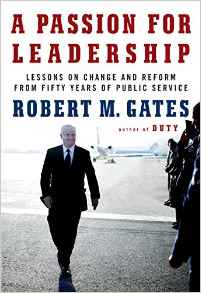 know we have been going through this very process with the school I lead presently. According to Gates, the vision doesn’t spring suddenly or fully developed from the leader’s brain. The person should listen, according to Gates, to a broad range of internal and external stakeholders, especially people who want to be part of a winning team. Leaders should integrate that information with instincts, experience and judgment to increase the likelihood that the vision will be grounded in reality, achievable and inspiring.
Again, it has been exciting to read about all the leadership tools Robert Gates has used during his successful career to change and reform the organizations he has lead, including our nation.
What leadership tools do you need to develop in your leadership toolbox?
Walk The Walk
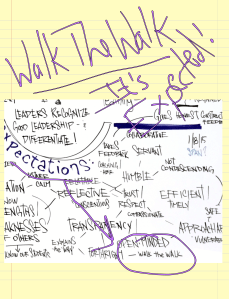 Last evening I was having a conversation with one of our teacher leaders and we were talking about leaders who do not follow through, who are always “checking on it,” “thinking about it,” or are always “working on it.” I also explained I had been in a meeting this past week where a person said, “I’m a visionary – I want nothing to do with execution or implementation!” Are you serious, I thought! The person went on to say, “I hate execution and implementation!” Are you kidding me! That’s the fun part. The world has way to many of these, so called “big thinkers” who have no clue how nor the grit to implement. The world does not need anymore of these people! I say we need more of people who are willing to be the “Deer in the Headlights” and I blogged about it here. The world needs more of my hero, Thomas Edison. He was visionary and innovative, but was also a creator, inventor, and implementation expert. In other words we need more people who can “walk the walk.” In fact we talked about this last fall in one of our Focused Leader Academy sessions.
The teacher leader I was having this discussion with is a great idea generator who also knows how to put a plan in action. We discussed how I really have come to the conclusion that the picture I most adore in my office that has penguins and says “Walk the Talk” is probably incorrect and should say “Walk the Walk.” Think about this: do I really need to talk if I am walking my and the organization I serve core values? Honestly, we, myself included, probably do too much talking and just need to do more walking. People will witness our actions and values and not need to be told about them. In other words, our behavior and day-to-day actions have to match the aspirations we have for those we lead, our colleagues, and organization.
“Innovation is rewarded, execution is worshipped.”
Let me be clear here, however, this does not mean I believe we don’t need thought leaders. We do. But… we need thought leaders that can turn those thoughts into reality. Many times a leader is ineffectual because she knows how to bark out ideas and orders, but is not able to explain, in language that is unique to her field and compelling to her colleagues or customers. This comes down to being able to explain the “why” what the team needs to do matters and how she expects the team to win. It has been said that great leaders think differently and invariably talk differently, as well. I am arguing here that great leaders also need to act differently. And… by act I mean it in the truest sense of the verb – do something about the talk. That is really what those we lead want is someone who gets things done.
In closing, remember this, authentic leaders must share the struggles and risks that we demand of our people. Furthermore, a leader’s actions must consistently reinforce the most important core values we hold up for our companies, organizations or movements. Don’t forget, innovation is rewarded and execution is worshipped. Go implement!
1973 – KISS Leadership

Gene Simmons of KISS during pregame of Super Bowl XXXIII
Yesterday I wrote Part I of a two part post entitled 1973 – Dolphin Leadership. Click here to read that post. Today, with only a few hours until Super Bowl 50, I continue to reflect on 1973 with Part II – 1973 – KISS Leadership. Leave it to me to be different. While everyone else is writing blog posts about the leadership of Peyton Manning and Cam Newton, I’m writing posts about the Miami Dolphins and KISS. Make no mistake, there is a KISS connection to past Super Bowls. The pregame show for Super Bowl XXXIII between the Denver Broncos (see the connection to Super Bowl 50?) and the Atlanta Falcons on January 31, 1999 at Pro Player Stadium in Miami, Florida included a  performance by KISS, along with their trademark elaborate make up, costumes, and theatrical pyrotechnics. By the way, Denver won that game.
Today’s post is about why I am so thankful that 1973 brought Gene Simmons, Paul Stanley, and KISS into our stadiums, arenas, homes, and lives. KISS has sold over 100 million albums worldwide. I would argue, and trust me I have, KISS is one of, if not THE biggest, greatest, and most successful bands ever. Why else would the announcer say “You wanted the best, you got the best! The hottest band in the land… KISS!” This was audacious! This was one of the first lessons I learned from Gene, Paul, and KISS – lead with audacity, but back it up! Led by the marketing genius that is Gene Simmons, they continue to reach new audiences while engaging lifelong fans. Think about the lifelong fan piece – there are literally, thousands of people just like me who would defend KISS as the greatest rock and roll band ever. Gene Simmons may be best known as the fire-breathing, bass playing demon in one of the most influential rock bands in history, but he can also teach us a thing or two about leadership. If you have not followed the journey as closely as I have, I would recommend you reading, Me, Inc.: Build an Army of One, Unleash Your Inner Rock God, Win in Life and Business. We can also learn a great deal from what Paul Stanley has learned during his journey as well. I learned a great deal from reading his book, Face the Music: A Life Exposed. In fact, I am going to put these two books on my to read shelf to reread. There are many other books written by the members of KISS that I would recommend. I’ll let you Google and make those choices.


So, let’s discuss KISS Leadership:
- Gene Simmons and Paul Stanley are truly “Rock Stars” and great examples of leaders. They are key members of my personal Mount Rushmore from the era of my youth, which also includes, Don Shula, Ronald Reagan, and Patrick Henry. To give an example of the KISS leadership example, I go back to an interview in April, 2014 during a great town hall interview on XM RADIO 39 HairNation following their induction in the Rock and Roll Hall of Fame where Gene said that he and Paul were always needing to try new “trepidatious” ways to perform! That’s what great leaders do! I promptly tweeted this (I’ve included an image of the tweet in this post).
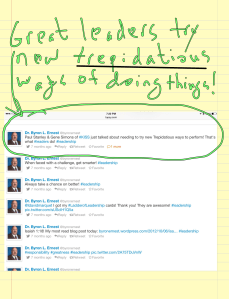 If you look up trepidatious you find the words: anxiety, anxious fear, and apprehension. So, that means they were being unorthodox, bold, and brave. Do you see the connection? Honestly, if you have not been to a KISS concert it will be hard for you to understand. Just suffice it to say, they are cutting edge. Heck, they redefine the edge…heck, there is no edge!
- In my blog post Language Matters, I wrote, “I still remember being inspired by the battle cry that the greatest rock and roll band ever, in my opinion, KISS, uses: “You wanted the best, you got the best. KISS!” Think about that – I wanted to go to the greatest rock show, and I always got it. Language Matters! But then we also know, we must then Walk the Talk!” Gene Simmons has taught us that the words we choose really do matter. Leaders must make the investment in time and energy and pay the price for choosing the right words based on the context and stakeholders. When we, as leaders, make this investment, the payoff is of “rock star” proportions. Choosing the right words will help us set up everyone we lead for a level of effectiveness that will bolster a culture of excellence and steady it against the winds of change.
- Gene Simmons teaches us that, “You have to understand that nothing appeals to everybody.” In other words you cannot be everything to everybody, but you must be the best you can be. Your content cannot be everything to everyone. KISS has always maintained a steady fan base by giving their fans what they wanted, and knew that they would never be able to please everyone. You are inevitably going to have critics; the important thing is to not let them derail your strategy. KISS has truly modeled for us how to be the greatest that you can be. There are none better at building a brand and trying bold and new ways to satisfy their customers.
- Paul Stanley taught us in his earlier mentioned book, Face the Music: A Life Exposed that, “No victories are won by individuals. The key to success is always teamwork.” Stanley learned that people coping with success need to surround themselves with people who have their best interests at heart. “Anyone who is pursuing success knows how lonely it can be and that having a support team or people who are blazing the path with you is very reassuring and gives you a shoulder to cry on and a team to celebrate with…” Paul Stanley also warns us to also beware of our own ego – I believe hubris could also come into play here as well.
- Gene Simmons taught us that we need to worry about imagery over content. In other words you don’t need to be the best or most qualified. Gene would tell us qualifications are highly overrated. There are thousands of people who had vision and leadership skills, who worked hard but didn’t have the exact skills to make their dreams reality.
 Think about it, Steve Jobs wasn’t a developer or a programmer, but as a leader he knew how to articulate a vision clearly with imagery. Leaders adapt the content to the audience, emphasize the vision’s intrinsic value, select words and symbols that are uplifting, and use language that is inclusive. If a leader is able to do these things, he or she will increase the chances that the vision will be embraced and the goal achieved. The real test is then implementation. As Gene Simmons says in his aforementioned book, Me, Inc.: Build an Army of One, Unleash Your Inner Rock God, Win in Life and Business, “There are many really stupid ideas that wind up being brilliant, if you can implement them.” Gene has shown us how to articulate the vision and then implement. Thus why thousands of us still consider ourselves part of the KISS Army.
- Continuing with the thought of implementation we must, as leaders, keep swinging the bat. We must not have a fear of failure, but a desire to try enough to fail and learn. In Me, Inc. Gene also teaches us, “Don’t let the fear of failure keep you from trying in the first place. Most baseball swings sound like this: ‘Swoosh.’ But, if you swing enough, you will hit some of the balls.” Enough said!
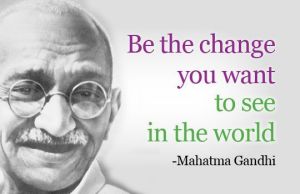
- Edge starts with self. Finally, I am reminded of an interview that KISS had with Jay Leno. Leno asked Gene Simmons where KISS got their edge. Without hesitation, Gene answered, “Edge starts with self.” Wow, that was several years ago, but is a perfect anthem for how we as leaders need to be. Let’s say that again: “Edge starts with self!” That gives me goose bumps! We have to be the leader our organizations and teams need us to be. Ghandi said, “You must be the change you wish to see in the world.” I say, “We need to become the leaders we need in the world!” Wow, I kind of like that – sure hope
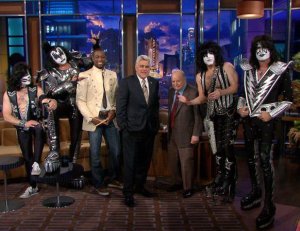 someone quotes me!
1973 – Dolphin Leadership
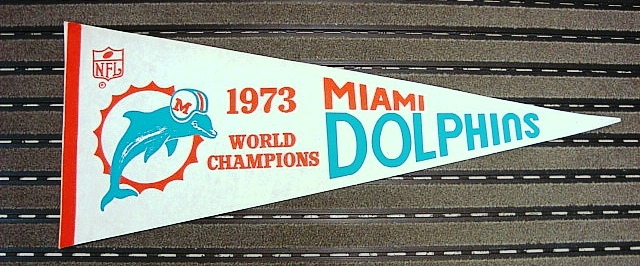
As I sit here on February 6, 2016 just hours away from Super Bowl 50, I am reflecting back on what I consider to be a year of great significance, when champions and rock stars where born: 1973. I was 10 years old and loved all the things that all 10 year old boys loved: football and rock and roll music. Yep, even as a rural raised, farm kid I would come in and spin the vinyl (for the younger ones in the crowd that’s short for records). Even at that age I was hungry and looking for those who could lead teams and groups to champion status. Well, I certainly found the icons that year.
 So, what made that year, 1973, special? Two things that would change my life forever. The Miami Dolphins won the Super Bowl and the band KISS was formed by Gene Simmons and Paul Stanley. Quite a combination of examples for the the young Ernest boy, don’t you think. Let’s take a closer look at my reflection of these two champions of rock start proportion. I am going to do this in two posts. Today’s post about the Miami Dolphins, Bob Griese, and Don Shula and tomorrow’s post about Gene Simmons, Paul Stanley, and KISS.
First, let’s look at the Miami Dolphins. You have to remember that there were no Indianapolis Colts at that time to follow or be a fan of. Therefore I became a fan of the team who had one of my future Purdue Boilermakers (he led Purdue to its first Rose Bowl Game in 1967) Bob Griese, at quarterback and renowned leader and coach, Don Shula at the helm. The undefeated campaign also had notable players Earl Morrall, and Larry Csonka as part of the team. The 1972 Dolphins went 14–0 in the regular season and won all three post-season games, including Super Bowl VII against the Washington Redskins, to finish 17–0. Wow, what a season for the kid that had the Dolphin towels, bed sheets and bed spread, sweatshirts, sweatpants, posters on the wall, and probably Dolphin underwear. You get the idea; I was all in for the Miami Dolphins. Little did I know it, however, but I was getting a great leadership lesson.
Don’t forget, the Dolphins also remain the only NFL team to complete an entire season undefeated and untied from the opening game through the Super Bowl. Pretty amazing and kind of like winning a triple crown. Also, let’s not forget that during the 1972 season, Bob Griese’s ankle was broken in Week 5 as he was sacked by San Diego Chargers defensive tackle Ron East and defensive end Deacon Jones. He was replaced by veteran Earl Morrall for the rest of the regular season. Griese returned to the field as a substitute during the AFC Championship game versus the Pittsburgh Steelers and then started for Miami in Super Bowl VII. So, there’s a leadership lesson from Griese, teaching us to fight back after adversity.
 On Leadership, Bob Griese was known for his decision making ability and servant leader mentality. He was known as the “Thinking Man’s Quarterback,” was drafted by the American Football League’s (AFL) Miami Dolphins in 1967. Also, don’t forget Griese led the Dolphins to three consecutive Super Bowls, winning two of them. There are those that say no one in NFL history had such talent around him to compensate for an average throwing arm. As for those teammates around him; the 1972 Dolphins defensive unit, called the “No-Name Defense” because Miami’s impressive offense received much more publicity. The Miami Dolphin defense was the league’s best that year. It was led by linebacker Nick Buoniconti, end Bill Stanfill, tackle Manny Fernandez, and safeties Dick Anderson and Jake Scott don’t know about that, but isn’t that what great leader do; surround themselves with great team member to achieve great purpose? That’s great leadership, baby! He is a leader and was a class act on and off the field.The man is a winner and a success at everything he does, just like all Purdue alums should be. He was an ideal sports icon for a young Indiana youth to be looking up to.
 Now, let’s talk about Don Shula’s leadership. It was great to have a championship role-model coach growing up. Later I read the books by Shula The Winning Edge and Everyone’s a Coach. Even though these books were published in 1973 and 1995 respectively, I would suggest everyone read them. In fact I just put the back on my reading stack for a re-read. Shula has given us an incredible acronym to live, coach, and lead by: COACH.
COACH
Conviction-Driven: Never compromise your beliefs
Overlearning: Practice until it’s perfect
Audible-Ready: Know when to change
Consistency: Respond predictably to performance
Honesty-Based: Walk your talk


Don Shula made a career of turning individuals into a team. He understood acquiring the perfect player is not the only way to win. Finding players with value, now that’s the formula. He developed the skills of players and gave them roles to contribute to the long-term success of the team. One of my most valued possessions in my office is my Don Shula 17-0 signed helmet. It reminds me every day what I need to strive for as a leader and COACH (someday I would love to get Bob Griese to sign it, too). Honestly, what more could we want or expect out of ourselves as leaders? So as we lead our own championship teams to run toward a greater purpose, let us remember these great leaders that 1973 brought to stardom.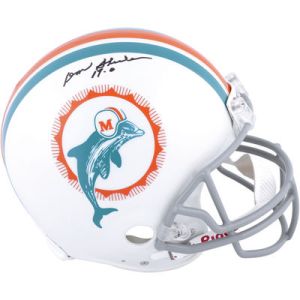
Tomorrow, my blog post will be entitled, 1973 – KISS Leadership. Find out about the other great leadership example born out of 1973.
Compelling Purpose
 It was such an honor to support the launch of the 10-year anniversary edition of The Serving Leader. I love having the opportunity to collaborate with Becky Robinson and all the great individuals at Weaving Influence. Being part of their launch teams has enabled me to grow personally as a leader and hopefully provide valuable information about potential books for other leaders to read, both through my blog posts and Tweets.
I am particularly glad I had the opportunity to read The Serving Leader, not only because it is a great book, but also because it really hit home with some things I am experiencing first hand right now as a school leader. I love the way the book has provided us with ways to navigate so many of the real-life challenges and opportunities that face leaders every day. By reading and reflecting on the book, I was able to put myself in those situations or go back and think about past experiences and think through the proper way to respond. The key word here is “respond,” instead of reacting. The book gives lessons on Five Powerful Actions:
- Run to Great Purpose
- Upend the Pyramid
- Raise the Bar
- Blaze the Trail
- Build on Strength
 For this post, I want to focus on “running to a great purpose” and “building on strengths.” I believe Kenneth Jennings and John Stahl-Wert (2016) got it right when they said, “Failing to provide workers with a link between their daily tasks and a great and compelling purpose is tantamount to managerial malpractice (p. 137).” It is possible for everyone in an organization and even the stakeholders supporting the organization to run toward a greater purpose. As a school leader of turnaround schools that have been in need of cultural, operational, and academic changes I have learned that the team needs a compelling purpose. For us, this has become being a “Real School” and “Students First.” Think about it…doesn’t every student deserve a “real school” and to be put at the top of the priority list.
This book really reinforced the idea that part of being a serving leader is to create and cultivate an exciting fully engaged workforce. We all know that workforce engagement, or the idea that we all believe that what we are doing makes a difference for the organization we work for and the people we serve. To that end it is very important that every individual understands his/her role in carrying out the purpose of the organization. We must, as is pointed out in the book, recognize that those we lead are looking to us to help them understand why the role he/she is playing is crucial to carrying out the great purpose.
I’m really proud of how we have been running toward a great purpose as a school. Through our Focused Leader Academy, becoming a learning organization, and making decisions in a collaborative fashion we are building on the strengths of our staff, which is becoming very engaged. Our teachers do understand the difference they are making in the world. Every day I see more of our teachers stepping up into teacher leadership roles. I would like to share a couple of comments written by a teachers applying to be part of our School Improvement Team. I believe that our vision is being translated into every daily work assignment (Jennings & Stahl-Wert, 2016). Here are the comments:
“As a school, our primary focus is upholding the expectation that all students will achieve academically. As educators, we strive to close the achievement gap between our low-performing students and their more average achieving peers. My commitment to school-wide change and my understanding of how to apply the collective knowledge of my colleagues in order to improve teaching and learning in my course has prompted me to apply for this excellent opportunity”
“…I have seen the school grow by leaps and bounds into something quite brilliant. I want to see the program continue to grow and evolve with the needs of our students, families, and staff. A school like ours is desperately needed by so many across the state. It would truly be a huge disservice if we simply dug our heals in and continued to just “do what we’ve always done.” We must keep our machine well-oiled, maintained, and on the cutting edge and the only way to accomplish that is to make improvements along the way.”
As you can see we are making progress toward a culture of excellence where our staff is becoming engaged in true contribution. By encouraging risk and encouraging failing forward our staff is excited to take on new and challenging leadership assignments with the goal of carrying out our compelling purpose.
Reference
Jennings, K. R. & Stahl-Wert, J. (2016). The serving leader: five powerful actions to transform your team, business, and community. Oakland, CA: Berrett-Koehler Publishers, Inc.
Language Matters!
 Have you ever had someone call you out for something you said? Have you ever regretted saying something in the way you said it? Have you ever wondered why your team did not understand what you said? Have you ever been offended by something someone said? I think you probably get the idea of where I am going in this post – Language Matters. Say what you mean. Mean what you say. Lesson #20 in John M. Manning’s book The Disciplined Leader (2015) deals with choosing the right words. Another way of looking at this is to “think before you speak.”
The truth is, leaders rise and fall by the language they use. Sometimes whole visions live and die on the bases of the words the leader chooses for articulating that vision. Using the right message can build champions in your corner. The right words make your ideas and vision memorable and powerful. Additionally, relationships are formed or torn apart by the words chosen. Using the right language and making the implicit explicit gives our stakeholders an insider type language that can bring an entire community of stakeholders together around a change, an idea, or a vision. It’s a battle cry of sorts.
Those I work with will tell you I take a great deal of time constructing how things will be communicated. Sometimes, I have been known to take several days to come up with just the right word or phrase. I want to find just the right way to capture the imagination, reality of context, or lift the spirit of the organization and all stakeholders. I am not suggesting that the time I spend on this is necessarily good – sometimes I am slow to get a message out. We could argue whether this is right or wrong, but I chose to strive to go out with the right thing, not the quickest thing.
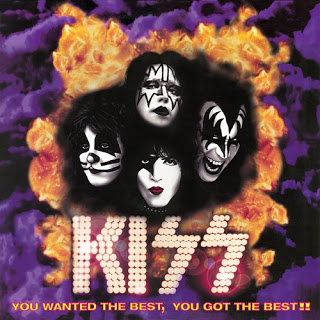 I still remember being inspired by the battle cry that the greatest rock and roll band ever, in my opinion, KISS, uses: “You wanted the best, you got the best. KISS!” Think about that – I wanted to go to the greatest rock show, and I always got it. Language Matters! But then we also know, we must then Walk the Talk!
Choosing the right words will help us set up everyone we lead for a level of effectiveness that will bolster a culture of excellence and steady it against the winds of change. I remember Gene Simmons talking about how the rallying cry of “You wanted the best, you got the best!” brought the entire Kiss Army together and began the huge following that still exists. Again, language matters!
If your not buying into what I am saying, think about this: KISS was started in 1973 with me as an immediate fan at age 10. Now, in the year I will turn 53, I am recalling the rallying cry of a group I still look to as a leadership example and an individual, Gene Simmons, who is on my personal Mount Rushmore as a leader. The bottom line is that the words you choose really do matter. Leaders must make the investment in time and energy and pay the price for choosing the right words based on the context and stakeholders. When we, as leaders, make this investment, the payoff is of “rock star” proportions.
“Chance Favors The Prepared Mind”
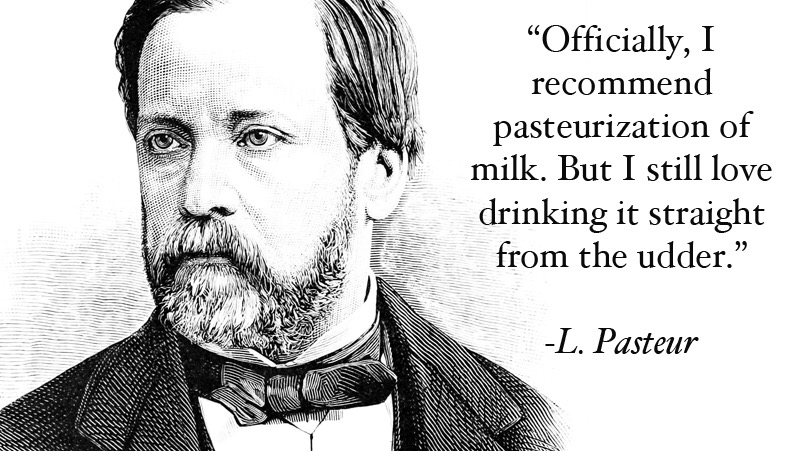 “Chance favors the prepared mind” was the statement Louis Pasteur, the 19 century scientist, used to describe his remarkable ability to invent and innovate across a complex set of problems.
 Peter Drucker believed we needed to notice the little things that other people miss (Maciariello, 2014). If we study Louis Pasteur’s research accomplishments – from his studies of crystallization and fermentation that aided industries ranging from dairying to silk-making to his work with germs and microorganisms that opened up whole new fields of scientific inquiry; we find that he was truly ready for chance to “happen” to him. Some people believe Pasteur was just lucky. Pasteur’s greatest gift may have been his ability to notice the little things that other people missed. Some of those little things proved to be the source of his lucky breaks (Maciariello, 2014).
As leaders and innovators we must immerse ourselves in our work at a level such that we can identify a breakthrough event when we spot it. In order to find significance in life, we need to prepare and dream. This preparation will enable us to spot unexpected opportunities. In 1888, the famous Pasteur Institute was named after him, and upon his death in 1895, he was hailed as a national hero. His last words were, ”One must work; one must work. I have done what I could.” In the last and 52nd entry in “A Year With Peter Drucker,” Maciariello (2014) poses a great question for us as a guide: “What would it take for me to take advantage of this opportunity right now?”
Reference
Maciariello, J. A. (2014). A year with Peter Drucker: 52 weeks of coaching for leadership effectiveness. New York, NY: HarperCollins Publishers.
Leaving Fingerprints on Others
 In the next to last lesson in A Year With Peter Drucker (Maciariello, 2014) we learn what a great mentor Peter Drucker was to Rick Warren and Bob Buford. Rick Warren said that when you visit Saddleback Church you see “his [Peter Drucker’s] fingerprints all over it (p. 389).” Warren also reflected on what he called “essential Druckers.”
- Leaders don’t ask, “What do I want?” but “What needs to be done and where does it need to be done?”
- “The mission comes first.”
“Here lies a man who knew how to put into service more able men than he was himself.” ~ Andrew Carnegie wanted to put this on his gravestone
Then Drucker mentored us to ask, “What is in my life that needs to be  done, and where do I need to be doing it?” Drucker believed it was important for us to also know what to stop doing (Maciariello, 2014). If we are to become all we can be, it is simply impossible to keep adding activities to our work and to our lives without dropping other activities. During a mentoring session with Rick Warren, Drucker once asked, “Don’t tell me what your doing, Rick. Tell me what you stopped doing (p. 391).” Drucker was clearly a great mentor. We need to learn from his modeling of how to leave our fingerprints on others.
Reference
Maciariello, J. A. (2014). A year with Peter Drucker: 52 weeks of coaching for leadership effectiveness. New York, NY: HarperCollins Publishers.
Bah Humbug! Leadership
 Last year I wrote a post about the classic Christmas movies Rudolph the Red Nosed Reindeer and Elf (click here to read the post). That post started an annual tradition, right? Well I guess so, because I’m doing it again this year. I missed church this morning because of a cow having a calf and when I came in I got caught up watching Disney’s A Christmas Carol – An animated retelling of Charles Dickens’ classic novel about a Victorian-era miser taken on a journey of self-redemption, courtesy of several mysterious Christmas apparitions. As I watched I was struck by the many leadership lessons.
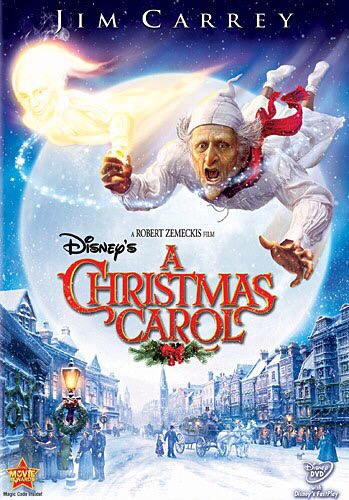 I was first struck by the fact that Scrooge would be considered successful by today’s standards – money, drive, and disciplined. But, remember there is a difference between success and significance. I have reflected on wanting to be more significant than successful a lot now that I have entered the second half of life. I am reminded of what the scripture says in Luke 12:48: “For unto whomsoever much is given, of him shall much be required; and to whom men have committed much, of him they will ask the more.” (King James Version) I like The Message version even better: “Great gifts mean great responsibilities; greater gifts, greater responsibilities!” Fortunately, Scrooge learned that he must use his success for significance in his second half. My favorite lines from Dickens sum up Scrooge’s transformation from success to significance quite well:
“A merry Christmas, Bob,” said Scrooge, with an earnestness that could not be mistaken, as he clapped him on the back. “A merrier Christmas, Bob, my good fellow, than I have given you for many a year. I’ll raise your salary, and endeavour to assist your struggling family, and we will discuss your affairs this very afternoon, over a Christmas bowl of smoking bishop, Bob. Make up the fires, and buy another coal-scuttle before you dot another i, Bob Cratchit!”
Scrooge was better than his word. He did it all, and infinitely more; and to Tiny Tim, who did not die, he was a second father. He became as good a friend, as good a master, and as good a man, as the good old city knew, or any other good old city, town, or borough, in the good old world. Some people laughed to see the alteration in him, but he let them laugh, and little heeded them; for he was wise enough to know that nothing ever happened on this globe, for good, at which some people did not have their fill of laughter in the outset; and knowing that such as these would be blind anyway, he thought it quite as well that they should wrinkle up their eyes in grins, as have the malady in less attractive forms. His own heart laughed: and that was quite enough for him. ~ Charles Dickens, A Christmas Carol
Furthermore, Scrooge taught us to be passionate about what we do. Whether Scrooge was busy piling up his riches or becoming a new man after the ghosts visited him, he went after everything to the full extent of his being. As a miser, however, he let the love of his own life supersede his ability to have an impact on others. Remember, what we do for others is the best measure of how we have used our time, treasures, and talent.
 In the end Scrooge comes through for us and teaches us a very important leadership lesson. He teaches us to learn from history and experience. Additionally he teaches us, as leaders, to put into practice what we have learned. It took four ghosts to break Scrooge of his idolization of money, and they showed him his own historical journey through life, the experiences of many others, and what could be his future journey of significance. Once Scrooge learned the necessary personal growth lessons, he changed his entire life, literally overnight. What a transformational leader. He gave to the poor; he reconnected with the only family he had, his nephew, Bob Cratchett. He grew especially close to Tiny Tim, who was shown dying by the Ghosts of Christmas Present and Christmas Future. As we know, Tiny Tim lives.
Charles Dickens’ best-loved story is one of personal transformation. Changing leadership behaviors and achieving significance in life requires experience, not just consideration of intellectual concepts. Each of Scrooge’s experiences brings him closer to the major transformation which ultimately determined his future. Nonetheless, all of these experiences were important to his transformation. Scrooge had the opportunity to relive the past, truly experience the present, and anticipate the future.
During this holiday season take some time to reflect on the past, enjoy today’s blessings, and anticipate and plan for living a life of significance.
“God bless us! Every one!” ~ Tiny Tim
Project Fascination
 Well, my friend Sally Hogshead has done it again. What has she done? Found a way to take FASCINATING off the chart. I am amazed and in awe of her! “Who is Sally Hogshead?”, you ask. Sally Hogshead is a Hall of Fame speaker and the New York Times best- selling author of How the World Sees You: Discover Your Highest Value Through the Science of Fascination. For the first half of her career, Sally was one of the most award-winning copywriters in the world, creating campaigns for brands such as Nike, Godiva, and MINI Cooper. She learned that when a brand knows how to fascinate customers, it becomes more profitable, admired, and loved. Since then, Sally has measured the communication traits of more than 700,000 people. Oh, and about the other question your likely to ask. A “hogshead” is a wooden barrel that holds 62 gallons. In Sally’s case, the barrel holds 62 gallons of fascination.

Sally Hogshead
Good morning!
First of all I want you to know how incredible it has been to be on our climb up Mount Everest in 2015. While we are not at the summit yet, we are certainly making progress to the higher elevations of a culture of excellence at Hoosier Academies. I am both honored and comforted to be securely safety harnessed to all of you as we make the climb together. I wish you all a happy holiday season and an incredible start to 2016.
During our November Focused Leader Academy session, we did a session called Good Leader/Bad Leader. I have attached Mike’s graphic of the session to this email. Also, please check out this blog post to get a description of how I used what I learned from our teacher leaders and the activity:https://byronernest.wordpress.com/2015/12/07/good-leaderbad-leader/
Here is Dana’s first blog post:
https://danamsmithblog.wordpress.com/2015/12/04/how-the-world-sees-you/
From reading the blog post you now know the book I chose for Dana’s professional growth. After she took the Fascination Rapid Report, she told me she wished our entire staff could take it. Well, you know me – I said make it so! Well, actually my friend Sally Hogshead made it so! A day later, Dana and I received emails giving us each $1,000 worth of Fascination Rapid Reporting to give away however we chose. So, we would like to share our gift with you all as our holiday gift to you. You can read the description of how to use our gift below and learn more about my friend Sally.In order to have enough codes, if your last name ends in A-M use Dana’s code and if your last name ends in N-Z use my code. I guarantee you will be fascinated.
Use this code to discover what Dana & I love about you:1. Go to HowToFascinate.com/YOU
2. Enter the code + your information
3. Click START NOW!
Who is Sally Hogshead? (And is that her real last name?) Sally Hogshead is a Hall of Fame speaker and the New York Times best- selling author of How the World Sees You: Discover Your Highest Value Through the Science of Fascination. For the first half of her career, Sally was one of the most award-winning copywriters in the world, creating campaigns for brands such as Nike, Godiva, and MINI Cooper. She learned that when a brand knows how to fascinate customers, it becomes more profitable, admired, and loved. Since then, Sally has measured the communication traits of more than 700,000 people. Oh, and about your other question. A “hogshead” is a wooden barrel that holds 62 gallons. In Sally’s case, the barrel holds 62 gallons of fascination.
In closing, I want you to know how fascinating I believe you all are, and look forward to climbing even higher in 2016!
Positively Fascinated,
Byron
Immediately after sending this, I started getting email responses. Here are are the responses to date and I will keep this updated for a few days:
- I love this stuff!!
- Honestly, this is the best staff gift and holiday email ever.
- Thank you so much for this!!! It was pretty right on for me!
- This is very cool!
- Thank you for including me! J
- This was very meaningful. Thank you! I can’t wait to discuss with my colleagues.
- I don’t know how you find all the great stuff you expose us to, but I’m glad you found us and that you share who and what you know with us.
- Thank you to you both. I loved this and got chills when I received my report. It’s so MEEEE and I can’t wait to dive a little deeper to figure out how to use my “Passion” to fascinate.
- Only you would send this as our holiday wishes email. You fascinate me.
I’m not gonna lie…I liked that last one…a lot! Like I said, I will keep the list updated. As you can see, Sally’s gift has fascinated. This gift also gives us a concrete example of what paying it forward is all about. I’d love to hear what you are doing to start the fascinating conversations of personal professional growth in your organization. As Sally says, “To become more successful, you do not have to change who you are–you have to become more of who you are.” How are you helping both yourself and those you lead become more of who they are?
 Byron's Babbles
leave a comment