Power In Our Hands
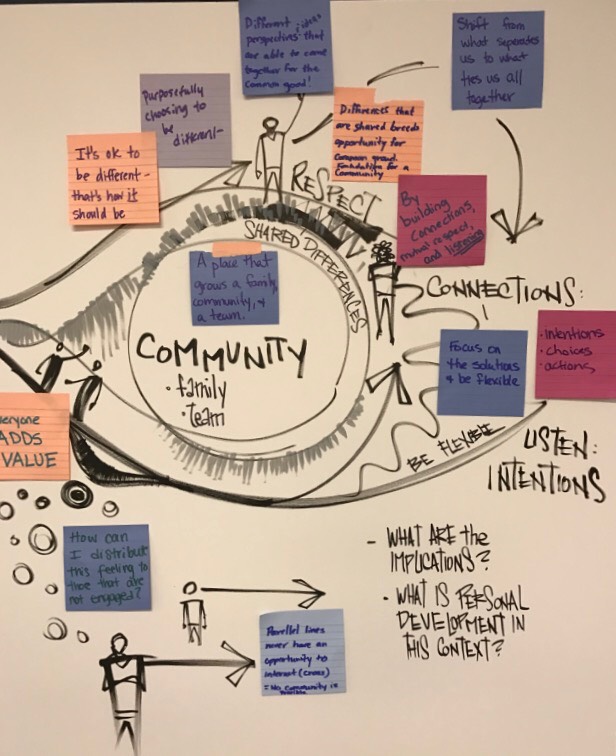 Attention on leaders makes for good copy, and gives us someone to blame when things don’t go right. But, is this shift from our own accountability as a community contributing to this blame game? Peter Block suggested in his book Community: The Structure of Belonging that “People best create that which they own, and cocreation is the bedrock of
  accountability.” Therefore, leaders must become convenors as opposed to service providers. Leadership is convening and held to three tasks:
- Shift the context within which people gather.
- Name the debate through the powerful questions.
- Listen rather than advocate, defend, or provide answers.
As leaders, I have come to realize, we must make the space available and bring the community together for the conversations and developing the future as opposed to answering all the questions and giving all the solutions. Questions open the door to the future and are more powerful than answers in that they demand engagement. The future is created through the exchange of promises between citizens, the people with whom we have to live out the intentions of the change. These exchanges and conversations create a space for learning and for producing knowledge that intersects with the needs and demands of a social movement.
“Our love of problems runs deeper than just the joy of complaint, being right, or escape from responsibility. The core belief from which we operate is that an alternative or better future can be accomplished by more problem solving. We believe that defining, analyzing, and studying problems is the way to make a better world. It is the dominant mindset of western culture.” ~ Peter Block
A shift in thinking and actions of citizens is more vital than a shift in the thinking and action of institutions and formal leaders. Most sustainable improvement in community (you can also insert your organization name here because it is a community) occur when citizens discover their own power to act (intent-based leadership). According to Peter Block “[I]t is when citizens stop waiting for professionals or elected leadership to do something, and decide they can reclaim what they have delegated to others, that things really happen.” This empowerment (intent-based leadership) is present is most stories os lasting community and organizational improvement and change.
“Communities are built from the assets and gifts of their citizens, not from the citizens’ needs or deficiencies.” ~ John McKnight and Jody Kretzmann
It is all about us, as leaders, co-creating a community of possibility with all citizens. Possibility, here, is a declaration of what we create in the world each time we show up. It is a condition, or value, that we want to occur in the world, such as peace, inclusion, relatedness, reconciliation, or insert your own community needs here_______. A possibility is brought into being in the act of declaring. What possibilities is your community declaring and co-creating?
5 Ways to Stop Thieves from Stealing Your Happiness
 I am so excited to bring you this guest post from Dr. John Izzo. Learn in this post 5 Ways to Stop Thieves from Stealing Your Happiness.
Most self-help literature makes it seem like happiness is a very elusive thing, something we must work very hard to achieve. It is my contention that happiness is our natural state. The child’s natural smile and the calm of sleep are metaphors for the happiness which is already ours. We don’t need to seek it as much as we need to get out of its way.
It is my suggestion that there are five thieves that rob us of our happiness. A thief is someone who takes away something that is already yours. In the case of happiness, the thieves are thought patterns and internal filters through which we see the world in a distorted way. They cloud our view of what is true and natural.
The five thieves are control, conceit, coveting, consumption, and comfort.
Control
The first thief is control, the desire to control the outcomes of our life and for things to be different. Happiness is knowing what we can control and accepting what we cannot control. At the most basic level, happiness comes from understanding that we can control our actions and our responses to things external to us, but we cannot control the results of our actions. Focusing on our actions brings happiness; focusing on the result of our actions brings unhappiness. All suffering is resistance to whatever is at any moment.
How to stop the thief:
In each moment surrender to whatever is happening. Control and influence what you can while choosing to accept whatever is at that moment. Accept the hard truths about life.
Remember that it is the craving for things to be different, not the circumstance that robs you of happiness.
Conceit
Conceit is perhaps the single greatest barrier to true contentment and even societal well-being. Conceit if a focus on your small self, on trying to find happiness separate from all other people and things as opposed to in the experience of being one. Another word for this thief is ego. Happiness comes from serving and getting lost in something outside yourself.
How to stop the thief:
Whenever you find yourself obsessing about the story of your life, remind yourself that you are already a part of a larger story. The thief wants you sitting around, staring at your reflection, but there is no happiness to be found there. Building an equitable world that works for all is part of this, if not for moral reasons than for practical ones. Only when all prosper can we all be truly safe and happy.
Coveting
Coveting is the third thief and comes disguised as something harmless or even ambitious in some productive way. What could be wrong with wanting to have something you don’t yet possess? Is not desire for something the very source of moving forward in life? The opposite of coveting is to be in a place of gratitude. Coveting also keeps us from celebrating for others because life becomes a comparison.
How to stop the thief:
Whenever you find yourself asking the mirror on the wall of your subconscious how you compare with others, remember that it is the thief speaking to you. It is lying when it tells that you that life is a contest rather than a journey. Ask instead: Am I being my best self? Also, practice gratitude through daily journaling or simply taking a few minutes to identify three things that you are grateful in that day and one in your life. Each day choose another person and write down three things you want to celebrate for them.
Consumption
Consumption tells us that there is something outside ourselves that we need to achieve happiness, and it tries to hide from us the truth that we can choose it at any moment. Intuitively, of course, we all know that happiness cannot come from consumption of something because we all know people who appear to “have it all” but are consistently discontent, as well as people who have “next to nothing” and appear to be quite happy. This thief is like a thirsty person with a large bottle of good fresh water but a hole in their throat.
How to stop the thief:
Whenever you find yourself saying, I will be happy when…or I will be happy if…, stop these thoughts and come back into the inner house where happiness is found. Focus on the choice to be happy now. Challenge the consumer in yourself. Whenever you are tempted to buy something, ask yourself if it will bring any real happiness. The thing itself is not a problem; the belief that it will bring happiness is the issue.
Comfort
The final thief—comfort—is an insidious one. In fact, at first glance it may even appear as a source of happiness rather than a barrier to it. This thief is like a lethargic person on the sofa, TV remote in hand. It wants us to stay on the same channel, in the same comfortable position, stuck in a routine that is not life giving. It does not care about the consequences of this routine, even if the channel we are on is no longer of interest to us or serving our higher needs.
How to stop the thief:
Make a commitment to try one or two new things every week. Vary your routines, from taking a new route on your daily walk to a different dating experience with your partner on a Friday night. Try new areas of learning—it is good for both your mental and physical health. Notice the core comfort patterns of your life. What have you carried from your past that is no longer adaptive to your life today? Identify an important pattern, and take two months to work on noticing how it shows up, then choose to ride in another direction.
Take The Five Thieves of Happiness quiz to find out what thief is robbing your happiness.
Dr John Izzo is a corporate advisor, a frequent speaker and the bestselling author of seven books including the international bestsellers Awakening Corporate Soul, Values Shift, The Five Secrets You Must Discover Before You Die, and Stepping Up. His latest book is The Five Thieves of Happiness.
Over the last twenty years he has spoken to over one million people, taught at two major universities, advised over 500 organizations and is frequently featured in the media by the likes of Fast Company, PBS, CBC, the Wall Street Journal, CNN, and INC Magazine.
Twitter: @drjohnizzo
LinkedIn: Dr. John Izzo
I Promise
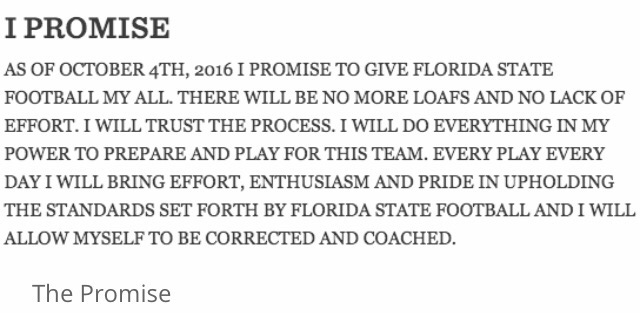 A signed copy of the promise pictured here sits in the locker of each Florida State player. After an awful start to Florida State’s season this past year, head coach Jimbo Fisher took an unprecedented step and presented his team with a promise and challenged them to sign it and live up to it.
As I read it I was struck by the simplistic way coach Fisher presented powerful points. It is really a well written combination of a mission and core values to follow. Here are the main points I take away:
- The commitment of “I promise to”
- No loafing
- Effort
- Trust the process
- Preparation
- Effort and enthusiasm in every play, every day
- Pride
- Allow myself to be corrected and coached
Just eight powerful points, but what a change in the season this battle cry brought about. The next game after the players signed the promise was a win against in-state rival Miami Hurricanes. Florida State won 20-19. “You cannot say that they did not play hard, that they did not play with fight, that they did not play with guts,” Jimbo Fisher said after the win. “We’re a work in progress but at least that heart and soul is there.” I am particularly struck by the point of “Allowing myself to be corrected and coached.” This is so important to all of us. We must continue to grow and develop each and every day.
On a day when everyone make New Year’a resolutions, I wander what would happen if we all just adjusted the promise to our own lives and then actually kept it; just like the Florida State Seminoles. Would you be willing to sign and hang in your locker?
Happy New Year!
Leading Like Santa
 It would be no picnic having to be Santa every day, especially wearing the same itchy red wool suit every day. Try it sometime. I have, as I make a pretty good Santa if I do say so myself. Yet Santa Claus pulls it off, year after year.
Santa has set some great examples of sound leadership for us to follow. Here are some Santa leadership traits that I have reflected on after encountering Santa Claus during a recent visit with him at Conner Prairie Interactive History Park. We’d all do well to emulate these skills in our everyday lives as leaders.
Here’s a list of dispositions I witnessed first hand while both watching him interact with the children and my own experience sitting on his lap. Yes, that’s right, I talked to the big guy myself – and asked for Legos (there is a picture in this post to prove it). There is just no warmer feeling than getting a hug from Santa while sitting on his lap.
- Santa takes time to connect and get to know every child, young and old.
- Santa cared about what my wants and needs were.
- Santa communicates well with everyone. By communicating well, I mean he practices deep listening. Those sitting on his lap do most of the talking and he asks questions instead of offering up solutions.
- Santa clearly loves what he does and let’s it show.
- Santa is believable. Over time, millions of people have put their faith in Santa — even Virginia. Good leaders do the right things consistently. Do your team members believe in you?
- Santa is sensitive to others. Santa is aware of customs and cultures around the world and makes sure that he addresses those cultures and customs. Do you do the same thing?
- Santa never forgets his impact. Santa has the ability to change peoples’ lives. I’ve never forgotten the wonder at coming home from church as a youngster and seeing presents from Santa under our tree. I’ve never forgotten those leaders in my life who took time from their schedules to coach and mentor me. Know that you have the ability to impact others – positively or negatively – it’s your choice.
- Santa asks for feedback. Santa could never get it right if he didn’t ask others for feedback.
- Santa doesn’t make promises he can’t keep. Have you noticed, he doesn’t comit to anything that is not for sure going to happen. He is even so honest that he tells us there will be surprises – and we are always excited about it. Unlike leaders who make ludicrous comments/commitments like “I’m 99% sure this or that will happen.” What does that even mean? How do these leaders calculate 99%? Why do leaders want to have to backtrack when the so called 1% chance happens? Bottom line: Santa does not do that.
- Santa is accessible to everyone. Think about it, Santa Claus spends weeks sitting in shopping centers and appearing in parades in the month leading up to Christmas. Wouldn’t this, in reality, be when Santa is at his busiest getting things done in the North Pole? Santa understands the value of spending time with those that he serves. Getting to know them and putting them first with his time helps Santa to understand people’s needs and serve them better.
- Santa is clearly a giver not a taker. Santa lives to serve others. Rumor has it that Santa does enjoy a tall glass of Jersey (just had to throw that in) milk and sugar cookie, but essentially we all know Santa as the person who gives and gives. We love Santa because somehow he knows exactly what we would like and very often provides it for us. Clearly, Santa does not exist for his own sake, but for the sake of the millions of children that will benefit from his giving. Boy, can we learn something from that. I
No matter how old you are, Santa Claus can put a sparkle in your eyes too. He has some amazing leadership traits that we should all pay attention to. What would you add to this list? Please leave me a comment and let me know what to have observed.
Show Me A Leader
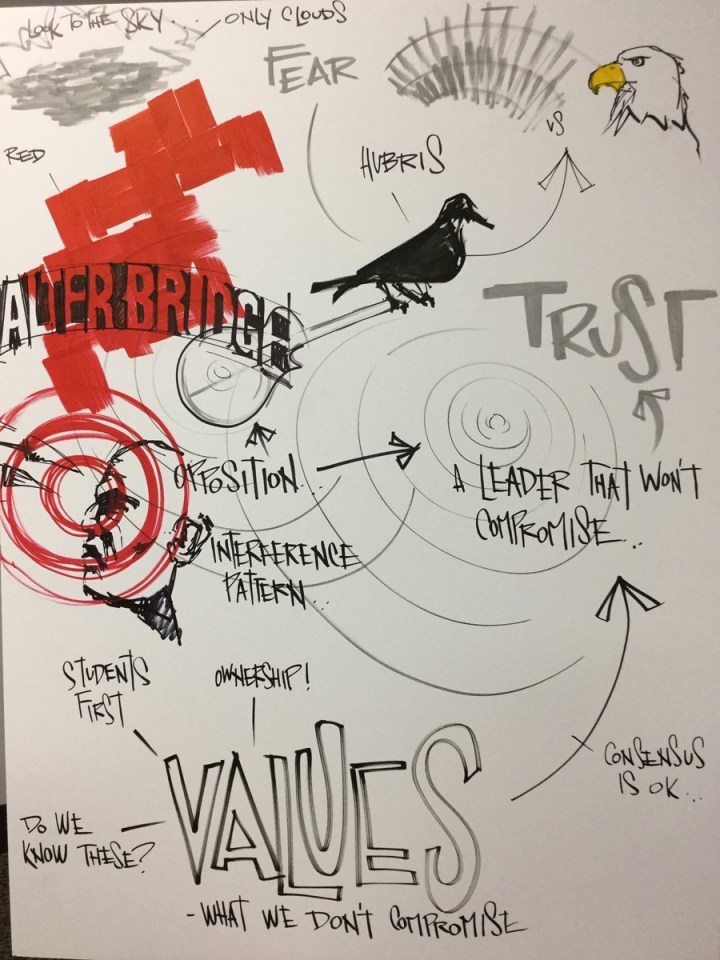 By now, most of you know that the great rock band, Alter Bridge, has changed my life in the last year. The release of “Show Me A Leader” has rocked my world and the way I think about leadership. Click here to watch the video I made of “Show Me A Leader.” Here are some verses/phrases from the song that have really resonated with me:
- “Well they’re selling another messiah here tonight; But we’re all way too numb and divided; To buy it” – we should never put our leaders in a position of needing to be a messiah, or the chosen one. Nor, should we ever consider ourselves, as leaders, above others and in messiah status. According to my faith, there is only one of those and there will not be another.
- “Show me a leader that won’t compromise” – we cannot as leaders compromise our values.
- “Disillusioned and tired of waiting; For the one; Whose intentions are pure unpersuaded; We can trust” – we need to earn trust and make sure our intentions are always pure and unpersuaded by self interest and are for the good of the whole.
- “‘Cause a promise is never enough” – pretty self explanatory; don’t promise what you cannot deliver, period.
- “It’s getting harder to fight out here on our own” – Sun Tzu taught us the skillful leader subdues the enemy without any fighting. This means we need a leader that will help us have the conversations of what we can do to create the future. The communal possibility rotates on the question “What can we create together?” This emerges from the social space we create when we are together.
- “Show me a leader that knows what is right” – To do “the right thing” means to make a choice among possibilities in favor of something the collective wisdom of humanity knows to be the way to act. Great leaders must call upon a broad band of intuitive knowledge and use it to give guidance and direction. If a person comes to a position of power as a leader in an organization or in society without knowing how to do the right thing, then the people under his or her influence are in for a bad time. At worst they will find themselves plunged into brutal conflict with outside forces, or at best they will spend a lot of time and energy struggling with internal disharmony and damage control.
- “Show me a leader so hope can survive” – Great leaders often earn their credentials before they become successful. Often, it’s during the times of darkness and hardship that the greatest leaders are born. Hope is the ingredient to which failure knows no answer. And great leaders instill this belief to help the others around them. Hopes and dreams can become real. But often to do so they need life consistently breathed into them. To keep them alive until they are transmuted into reality. Great leaders do this by consistently communicating their beliefs to their followers in the form of visions. They take every opportunity they can – through being a role model, meetings, presentations and writing to describe their visions as crystal clear as possible.
- “We need a hero this time” – There are leaders, there are great leaders, and then there are heroic leaders. The best of the best put others before themselves. They sprint into danger. They pay dearly for their courage, and they often go years, if ever, without the recognition they deserve.
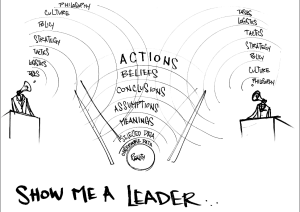 These bullets have become guides for me and benchmarks for some of my personal core values. Particularly this thought of not compromising. Click here to read my thoughts on compromise in “There Can Be No Compromise!”
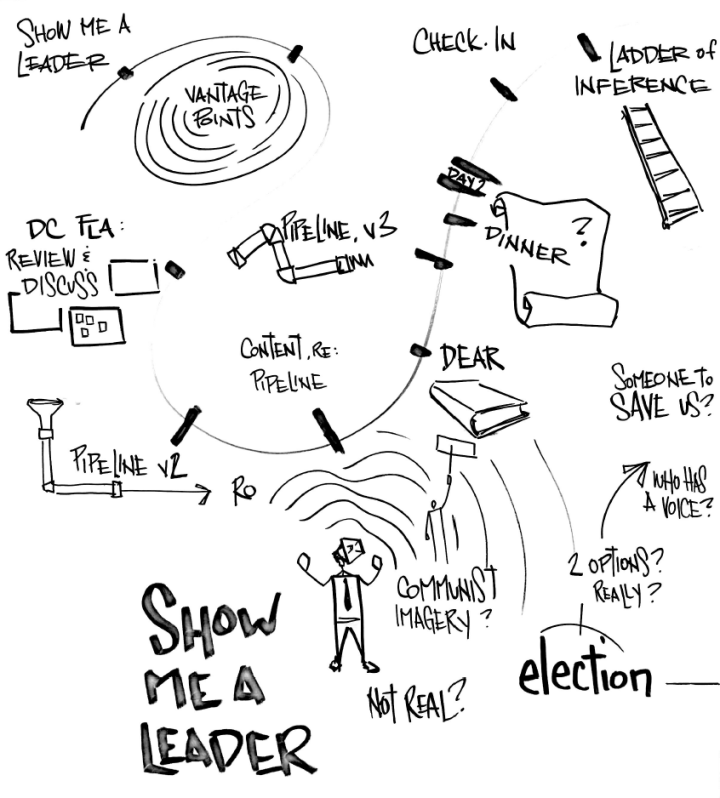
Furthermore, the music video for “Show Me A Leader” is amazing. Click here to watch the video. In fact, I have now used it three times to lead discussions on leadership. Throughout, and at the beginning of this post are graphics done by Mike Fleisch of the sessions we have facilitated on this great song and video.
There Can Be No Compromise!
 Great leaders know that leading change sometimes means they will have to fight for their vision and values. They can sometimes face strong resistance and criticism. At these moments they are fully aware that it is about being able to connect, and to convince others why this change is important. This means they invest energy and time in communication, in increasing mutual understanding, and in strengthening alignment. But they will not compromise their values and vision.
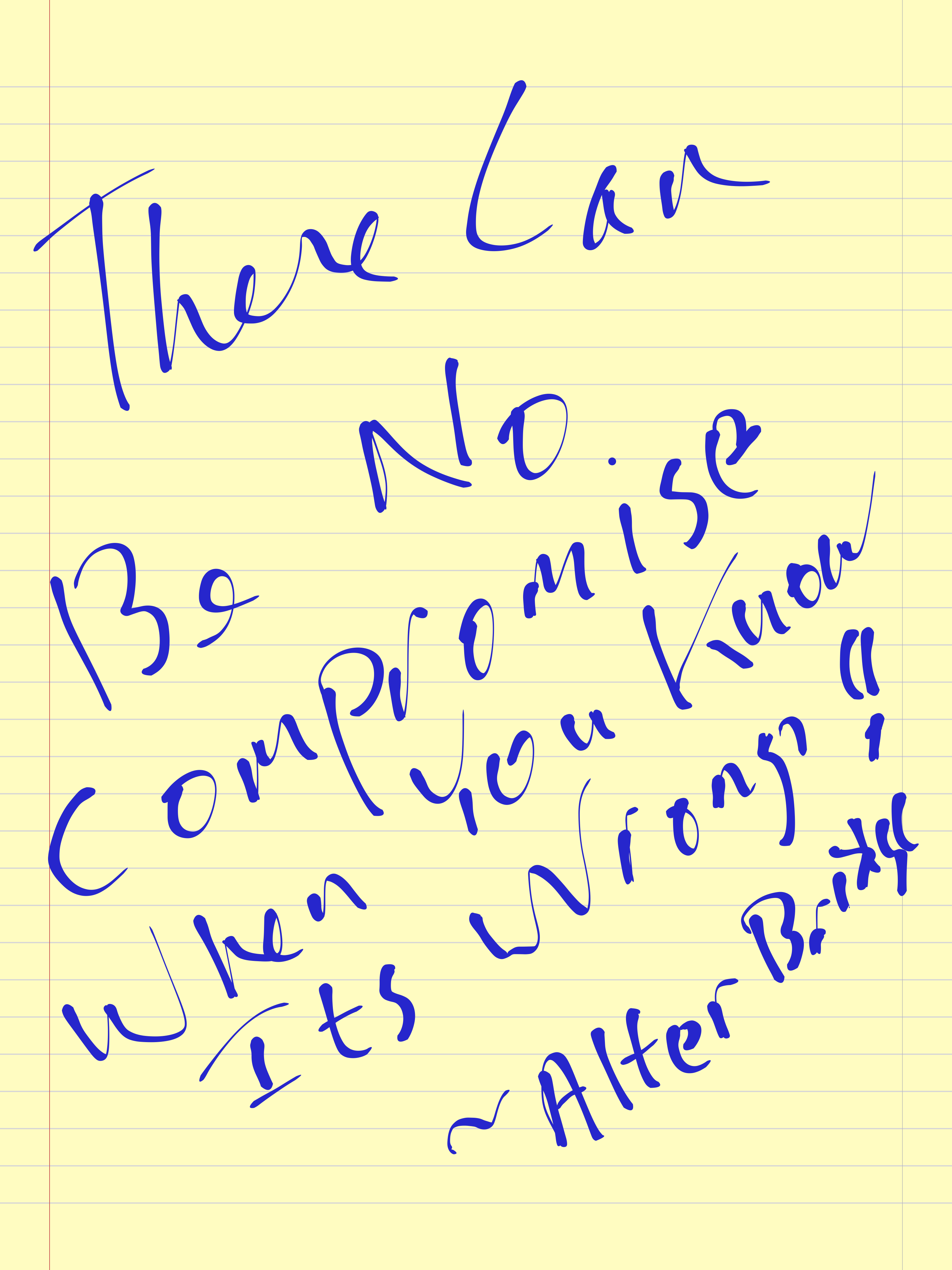 Two songs by Alter Bridge constantly cause me to think about compromise. In “Show Me A Leader” songwriters: Myles Kennedy, Brian Marshall, Mark Tremonti, Scott Phillips want a leader that won’t compromise. Additionally, in the song “Last of Our Kind” we hear the words: “There can be no compromise when you know it’s wrong ’cause in the end the sacrifice was worthless all along.” When compromising you give something up on both sides, you don’t create something together! A compromise is by definition leading to a suboptimal solution. Great leaders understand this, and are therefore reluctant to compromise.
I believe that compromise can easily blur our vision and core values, can create confusion, and therefore undermines the motivation of people. I realize, however, as leaders there are times when compromise is necessary. It is important to understand that no one knows everything. Great leaders listen to all sides, think about their own experience and then make decisions. Those decisions must based on a balance of knowledge and not compromise the leader’s core values. Sometimes the decisions don’t sound or look exactly like what the leader wanted. but they are the best for the organization as long as no core values have been compromised. So, when I hear, “Show me a leader that won’t compromise” I am reminded to never compromise my values.
The American Commonwealth
 The American Commonwealth, part 1 by James Bryce
My rating: 5 of 5 stars
This book is for anyone who wants to better understand the experiment in democracy that has become our great United States. Every aspect of our local, state, and federal government is covered in great detail from the Declaration of Independence to the turn of the 20th Century (I read the 1914 edition). It was interesting to learn Bryce’s views on Lincoln, the Civil War, and how our Constitution served as the navigational guide. I particularly valued the Part V Chapters on Public Opinion, Colleges & Universities, and voter suffrage.
This is a very academic read that causes reflection and further study. It took me almost a year to read (keep in mind I was reading other books at the same time), but it is well worth the investment. Every leader who wants to serve their community, state, and nation positively and significantly should read this book.
“Go Ask Your Mother”
 I have a coworker who will occasionally comment after working with staff members that she just wants them to go ask their mothers. Usually I chuckle at this comment, but after reading Lesson #18 titled “The No-Brain Stage”by John Parker Stewart in 52 Leadership Lessons: Timeless Stories For The Modern Leader. I realize this is probably not funny. In this lesson, Stewart pointed out the basic needs of a two-year-old child. Here they are:
- They need to be cared for.
- They need security and protection
- They need to be listened to and included.
- They need their questions answered.
- They need love, reassurance, entertainment, attention, praise, and discipline.
- They even need age-appropriate responsibilities.
“If your people are acting like two-year-olds, ask yourself which of their ‘two-year-old’ needs you may have neglected.” ~ John Parker Stewart
So… if you have ever said, “I work with a bunch of two-year-olds.” You’re right. That list of what a two-year-old needs is spot on for any age group we serve as a leader, don’t you think? This lesson really caused me to think about whether I am doing my part to meet the needs of all those I serve. We all need to take time and listen deeply to our team members and make sure we are meeting their current needs. Remember, their needs do change over time.
My challenge to you and myself is to take some time and analyze the needs of those who report to me and see if those needs are being met.
Conflict Creates Energy!
 Conflict Without Casualties by Nate Regier
My rating: 5 of 5 stars
Conflict is always difficult, but it leads to growth and change, which is good. No one likes pain, but pain wakes you up and tells you when to react. This book is a guide for leaders on how to navigate conflict so it is not an energy drain but an energy source. Some level of organizational conflict is actually desirable — it’s not always dysfunctional. When conflict exists, it generally indicates commitment to organizational goals, because the players are trying to come up with the best solution. Dr. Regier gives us three critical steps to follow for creating positive energy with conflict:
- Be open and transparent about how you are feeling and what you want.
- Show a non-judgmental curiosity to explore options and look for creative solutions.
- Gain clarity about your boundaries and principles. This is a must read for leaders that want true open dialogue and dissent to find the best solutions for our global challenges.
This is a must read for leaders that want true open dialogue and dissent to find the best solutions for our global challenges.
Be A Leader!
 If you aspire to be a great leader, the first requirement is that you look and listen, so that you can find out the true needs that a situation demands to be fulfilled. It seems to me there is a general myth that leaders are born rather than made, that somehow nature produces a peculiar species of human being who is bigger, more powerful, smarter, braver, and more charismatic than the rest. During this presidential election year I have been reflecting more and more on this. I have caught myself saying, “Is the right person even out there to lead our country for continued greatness?” A democracy, more perhaps than any other form of government, needs great men and women to lead and inspire the people. Now, there are lot’s of different theories out there as to why we might lack great leaders, such as:
- Our system of government does not always lend itself to the best people being elected to office.
- We seem to linger in a perpetual leadership vacuum.
- Are we open to having dialogue with leaders who are going to bring the spark of creativity to the situation?
- Are we open to having dialogue about new and tranformative ways of doing things?
- Ego causing leadership failure.
Americans, however, myself included, maintain that when the hour comes, it brings the right person. For example, it brought Abraham Lincoln. When he was nominated by the famous convention of 1860 his name had been little heard of beyond his own state. But he rose at once to the level of the situation, and that not merely by virtue of strong clear sense, but by his patriotic steadfastness and noble simplicity of character. If this was luck, it was just the kind of luck which makes a nation hopeful of its future, and inclined to overlook the faults of the methods by which it finds its leaders.
I believe we can all be great leaders, with all the rewards this carries, while still serving the needs of the whole group. We must, however, take an introspective look at ourselves and the areas for improvement we need to make. Having looked and listened, you will know the situation you are in and the need that is crying out to be fulfilled. This deep listening coupled with the criterion values and not compromising those values shapes a model of successful leadership.
We also need to have someone else…share with us the way they experience us…because it’s hard to see our own blind spots or limiting assumptions. We need to get feedback from trusted folks we either know or do not know. Here is my challenge to you: Connect to your top professional priority. Ask yourself: What is the one thing I could get better at that would help me most with my most important professional priority? Create a personal improvement goal around this professional priority. Does the goal implicate you? Your goal implicates you if it is clear that you must get better at something. Your goal should focus on something you can control. It should focuson something specific about yourself that you want to improve. Let’s all own being a better leader.
 Byron's Babbles
leave a comment