Can You Let The Authentic You Out?
 Today, according to Adam Grant, a professor of management and psychology at the Wharton School of the University of Pennsylvania and the author of a new book, Originals: How Non-Conformists Move The World, we are in the Age of Authenticity, where “be yourself” is the defining advice in life, love, and career.
Authenticity
Authenticity means erasing the gap between what you firmly believe inside and what you reveal to the outside world. As Brene Brown, a research professor at the University of Houston, defines it, authenticity is “the choice to let our true selves be seen.”
We all have developed social filters or self-controls that prevent us from saying whatever may be on our mind at the time. If we expressed our true self and all the unfiltered thoughts that pop into our brain, we would probably be in a state of constant conflict and turmoil. Some things are just better left unsaid.
Self-Monitoring
How much you aim for authenticity depends on a personality trait called self-monitoring. If you’re a high self-monitor, you’re constantly scanning your environment for social cues and adjusting accordingly. You hate social awkwardness and desperately want to avoid offending anyone. But if you’re a low self-monitor, you’re guided more by your inner states, regardless of your circumstances.
Studies have shown that high self-monitors “advance faster and earn higher status, in part because they’re more concerned about their reputations. And while that would seem to reward self-promoting frauds, these high self-monitors spend more time finding out what others need and helping them.”
I would argue that this style reflects an insightful and empathic view of what’s happening to those we work with.
Rather than selling out, it’s a way to demonstrate how you can contribute to the good of the team and others along the way. This reflects positively on how you are viewed as a collaborator and a teammate. It does not mean that you live your work life in the selfless pursuit of the common good; it means that when what’s good for you, your team, and the organization are aligned, everyone wins.
If being authentic and a low self-monitor demands a greater level of self-disclosure about your feelings on a situation, then I can see the potential risk. I find that a candid appraisal of the impact of various decisions can be refreshing and stimulate good dialogue, but overly emotional responses get awkward and can stifle discussion.
Grant suggests that we focus on being sincere rather than just authentic.
I would also suggest we should make every effort to be sure that we are consistent and congruent in how we connect with others.
As I reflected upon this interesting perspective, it occurred to me that high self-monitors must have well-developed emotional intelligence and are probably highly empathic to those around them. Instead of focusing on how everything affects them and what they need, they first tend to focus upon the following questions regarding others:
- Why are they saying that?
- What are their needs for this effort or project?
- What would a good outcome look like for everyone involved in this discussion or project?
- How can they contribute in a manner that allows me to learn and grow?
Borrow and try to incorporate those styles as you grow and develop yours. Your ultimate transformation will always be the addition and subtraction of those behaviors and styles that work best. It does not diminish or sell out who you are, it’s just part of everyone’s life journey.
Ask yourself:
- Since you are not always the best judge of the impact you have on others, do you regularly ask for feedback in a manner that is efficient and effective for all involved?
- Do you regularly seek to understand before you worry about seeking to be understood?
- Do you exercise appropriate caution about how you present yourself to others on social media? Do you allow inappropriate social media tidbits to contradict the authentic self you are trying to project?
I look forward to your thoughts and comments.
****
Willy Steiner is the President of Executive Coaching Concepts, an executive coaching services firm dedicated to assisting senior executives in taking their individual and organizational performance “TO THE NEXT LEVEL”. He fine-tuned his skills in leading organizational change, building high performing teams and in devising innovative incentive systems with General Electric, RCA Corp. and Galileo International. Assisting executives in driving change by creating urgency, focus and alignment, with a keen eye for cultivating and sustaining necessary relationships, is an ongoing focus of his work. He is an expert in guiding organizations through complex international mergers and divestitures, blending distinct cultures and supporting growth in international markets.
For more about Willy, his new book, Discover the Joy of Leading: A practical guide to resolving your management challenges, and business, visit executivecoachingconcepts.com.
Lady Gaga Walks The Walk
 I can’t wait for Lady Gaga’s half time show of the Super Bowl Fifty One tonight. Most of you know I am a huge Lady Gaga fan. This fandom started back in 2010 when I had the opportunity to see her in concert in Portland, Oregon. I was in Portland for a conference and sat down at a table for a dinner with six women who I did not know. They apologized that they would be leaving the dinner before it was over because they were going to see Lady Gaga. I probably said something super intelligent like, “Awesome, wish I was going so I didn’t have to sit through this dinner” (sounds like me doesn’t it?). Then one of the women said, “Hey we are going with a group of college sorority sister friends and one can’t go now at the last minute. Would you want to go?” Now, anyone reading this that knows me knows that I’m not turning down an adventure, no matter what it is. I was in! The rest is history, I have been a Lady Gaga fan ever since.
Now I know Lady Gaga causes controversy, her music might not be your cup of tea, but it is certain that you will be familiar with the girl from the Lower East Side of New York who in a few short years transformed herself from Stefani Joanne Angelina Germanotta into one of the world’s best-known musical performers. This post is about Lady Gaga – leader that walks the walk.
“When I wake up in the morning, I feel like any other insecure 24-year old girl. Then I say, “Bitch, your Lady Gaga, you get up and walk the walk today.” ~ Lady Gaga, Rolling Stone Interview June, 2010.
I love the fact that Lady Gaga walks the walk. There are many leadership lessons we can learn from her. When it comes to authentic leadership, Bill George identifies five dimensions and their respective characteristics that someone must develop in order to be an authentic leader (George, 2003). The five qualities authentic leaders demonstrate are:
- Understanding their purpose
- Practicing solid values
- Leading with heart
- Establishing connected relationships
- Demonstrating self-discipline
 Lady Gaga has been referred to as the queen of the outcasts because of her support of individuals who ride the boarder of social outcasts and underdogs. As everyone knows, Lady Gaga is far from what most people call “normal” and as a result suffered much bullying growing up. Propelled by her own experiences, Lady Gaga made it her purpose to help others rejoice in their individuality and not feel like outcast. In just this alone you can see the five qualities of authentic leaders being displayed.
Actually there have been many case studies done on Lady Gaga as a leader, including ones done by the Harvard Business School. Additionally, a case study done by Jamie Anderson and Jörg Reckhenrich of Antwerp Management School and Martin Kupp of ESMT European School of Management and Technology dives into the idea of leadership projection. The concept of leadership projection is an integrative approach of communication, behavior and aspiration that provide a leader with wide recognition across an industry or sphere of public life – in the case of Lady Gaga, social change. An important element of leadership projection is the ability of an individual to project herself into a future role that is much more influential than the current state – again, this describes Lady Gaga perfectly. Leadership projection is very much about followership; after all, a true leader only exists if he or she can excite loyalty in others. It involves a communication approach that typically integrates three universal story lines to excite and gain buy-in from followers:
- Who am I – how life experience has shaped my individuality and character
- Who are we – demonstrates and guides the values and behaviours of a group
- Where are we going – explains what is new, and creates a sense of excitement about direction.
Because of Lady Gaga’s display of the five dimensions of authentic leadership (George, 2003), walking the walk of the three principles of leadership projection, and the number of lives she has changed because of her efforts, it is safe to say that Lady Gaga displays the characteristics of what I consider to be a true leader. I cannot wait to watch her half-time show of the Super Bowl later this evening.
Reference
George, B. (2003). Authentic leadership: Rediscovering the secrets to creating lasting value. Jossey-Bass.
The Five Thieves Of Happiness
 The Five Thieves of Happiness by John B. Izzo
My rating: 5 of 5 stars
In this book readers will learn that “Life is not a contest.” Dr. Izzo teaches us that it is our craving for things to be different, not the circumstances that rob us of happiness. Because it is evolutionary that we have become collaborative; the real story of human progress is compassionate cooperation. We learn in this book that community change must begin in the heart of each of us. We also learn that we must become comfortable with being challenged by others’ beliefs. Craving for things to be different, not the circumstances robs us of happiness. If we will but contribute to the good of the whole, happiness will find us. Happiness awaits from reading this book!
Dr. Byron L. Ernest
Leaders Are Readers
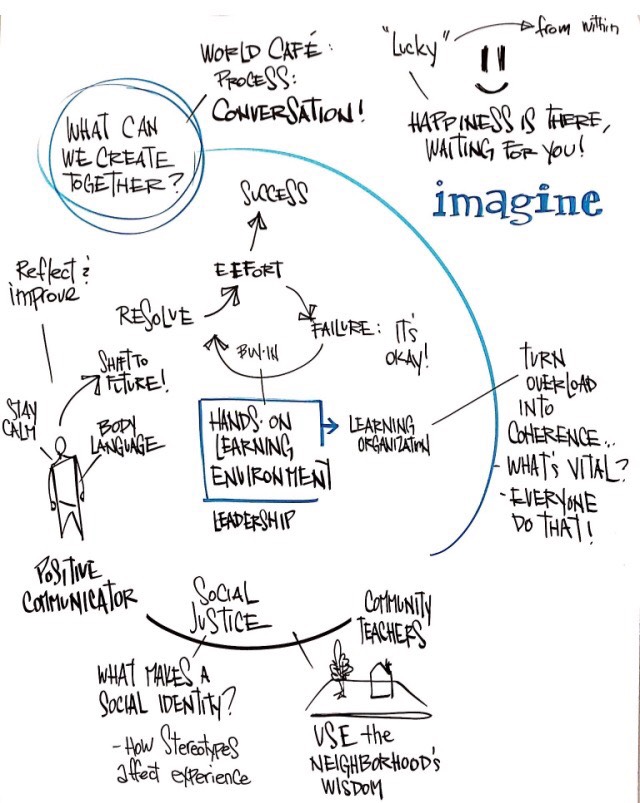
Mike Fleisch Graphic Of Our Leaders Are Readers Session
It goes without saying that “leaders are readers.” This past Saturday during our January Focused Leader Academy (FLA) we did a very cool activity. We all read a book in 45 minutes. I purchased copies of the last 16 books I have read and let our FLA participants pick a book to read and make their own. Here is the protocol we used:
How to Read a Book in 45 minutes
1. Read the introduction, carefully. A good intro will give you the book’s thesis,
clues on the methods and sources, and thumbnail synopses of each chapter.
Work quickly but take good notes. Allow fifteen minutes here.
2. Now turn directly to the conclusion and read that. The conclusion will reinforce
the thesis and have some more quotable material. In your notes write down 1-2
direct quotes suitable for using in a review. Ten minutes.
3. Turn to the table of contents and think about what each chapter likely contains.
Five minutes.
4. Skim 1-2 of what seem to be the key chapters. Look for something clever the
author has done with her or his evidence, memorable phrases, glaring
weaknesses–Fifteen minutes, max.
5. Meet some friends and tell them the interesting things you just learned,
speaking from the author’s point of view (driving it deeper it your memory).

Great Books Our Teachers To Chose From
Here are the books that were available for selection:
Bowling Alone: The Collapse and Revival of American Community by Robert D. Huffer
Don’t Just Do Something, Stand There: Ten Principles for Leading Meetings by Sandra Janoff
The Five Thieves of Happiness by John B. Izzo, Ph.D.
Whistling Vivaldi: How Stereotypes Affect Us and What We Can Do by Claude M. Steele
The Art of Community: Seven Principles for Belonging by Charles Vogl
The World Cafe`: Shaping Our Futures Through Conversations That Matter by Juanito Brown and David Isaacs
Community: The Structure of Belonging by Peter Block
The Art of Action: How Leaders Close the Gaps between Plans, Actions and Results by Stephen Bungay
It’s My Pleasure: The Impact of Extraordinary Talent and a Compelling Culture by Dee Ann Turner
Thank You For Being Late: An Optimist’s Guide to Thriving in the Age of Accelerations by Thomas L. Friedman
Coherence: The Right Drivers in Action for Schools, Districts, and Systems by Michael Fullan
Learning in Action: A Guide to Putting the Learning Organization to Work by David A. Garvin
Killing The Rising Sun: How America Vanquished World War II Japan by Bill O’Reilly
Shoe Dog: A Memoir by the Creator of Nike by Phil Knight
The Day The President Was Shot: The Secret Service, the FBI, a Would-Be Killer, and the Attempted Assassination of Ronald Reagan by Bill O’Reilly
The Hand In The Back of the Room: Connecting School Work to Real Life by Byron L. Ernest
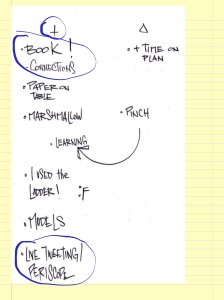
Needless to say, this activity was one of the favorites of participants. Even those who were skeptical really appreciated having the chance to be given a book and go through the protocol. You can see in the graphic of our +s and Δs discussion at the end of the day, that this session was one of the top rated. In fact you will notice in the video that one of those skeptics became a reader while doing this activity.
You will also see a plus on our +/Δ of “Live Tweeting/Periscope.” I live tweeted out the introduction to this activity as well as the report out from all participants using the hashtag #HoosierFLA. We had a large number of people watching live and were receiving several comments during the live tweet. Therefore, I am providing you the link to both videos.
Introduction to our “Leaders Are Readers” session:
https://www.periscope.tv/w/1YqKDAEqlMeGV?t=12s
“Go-Round” report-out from participants’ reading:
https://www.periscope.tv/w/1rmxPrAkbvVGN?t=2s
As you can see, leaders are readers. Are you tending to your own professional growth by reading? Are you supporting the professional growth of those you serve by encouraging reading?


Building S’more Leadership
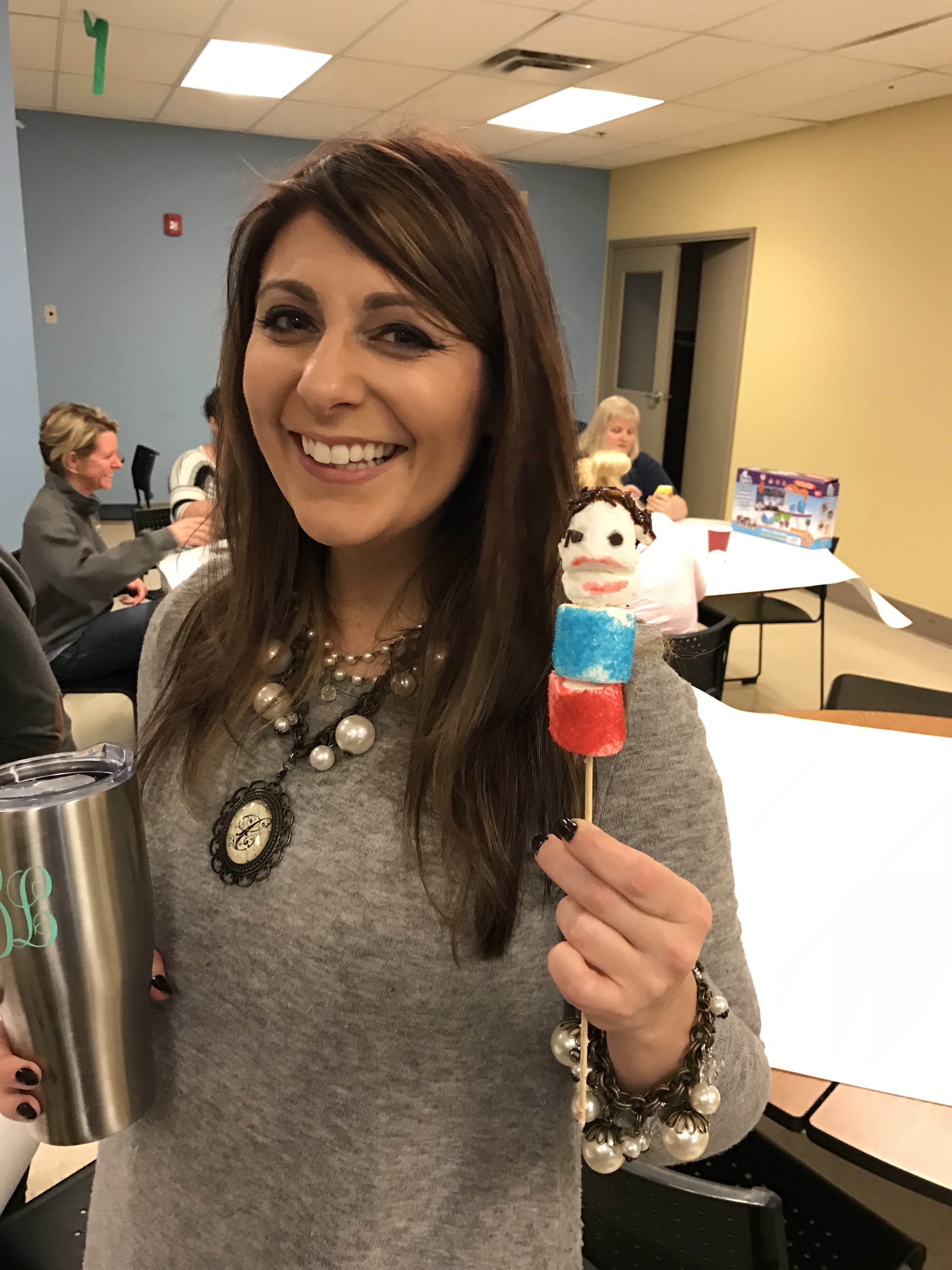 Yesterday our Focused Leader Academy (FLA), aspiring teacher leaders, came into our commons area to find tables coevered in butcher paper with crayons (we’ll cover that in another post) and marshmallow manufacturing machines. Also on the tables were marshmallows, liquid chocolate, liquid caramel, strawberry sauce, chocolate sprinkles, chocolate chips, and sugar sprinkles. The title of our agenda for the day was “Building S’more Leadership.” The through line for the day was, of course, marshmallows.

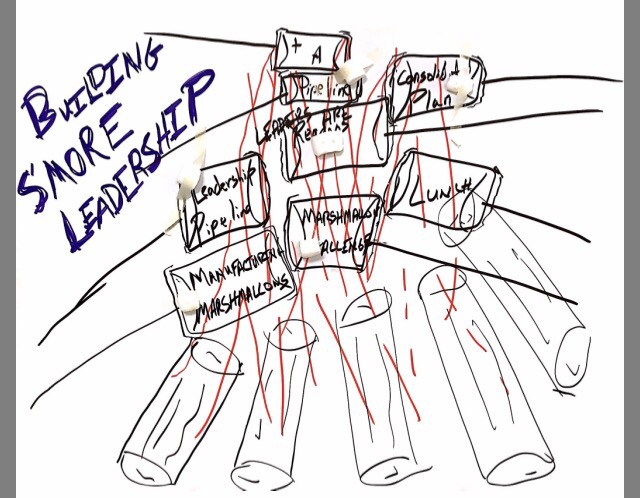
Here Is What The Agenda For Our Day Looked Like
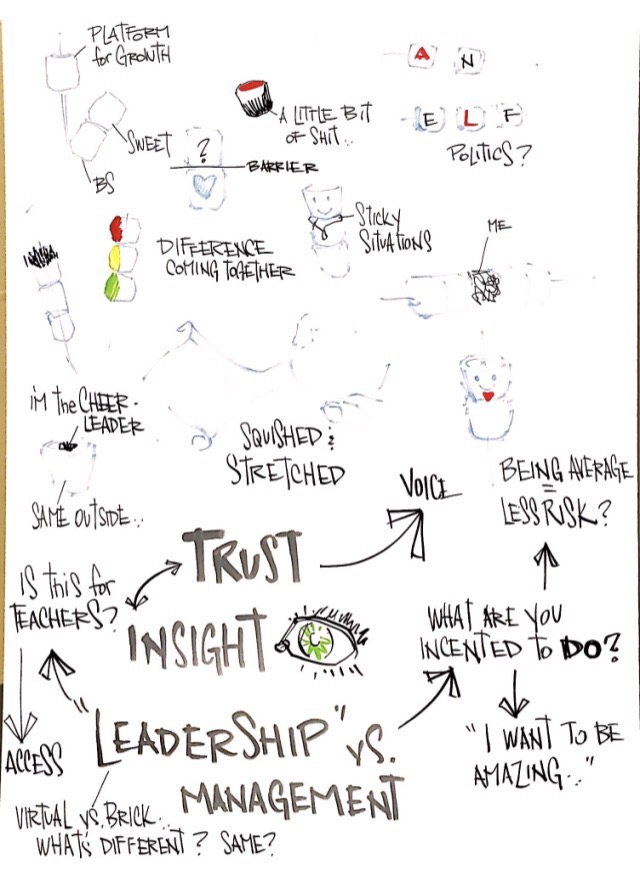
Mike Fleisch Graphic Of Our Discussion
In normal fashion, we circled our chairs and shared out upon completion of the creations. I was struck by the trust and openness we have developed in this community. Here are a couple of their stories that we live tweeted during the sharing:
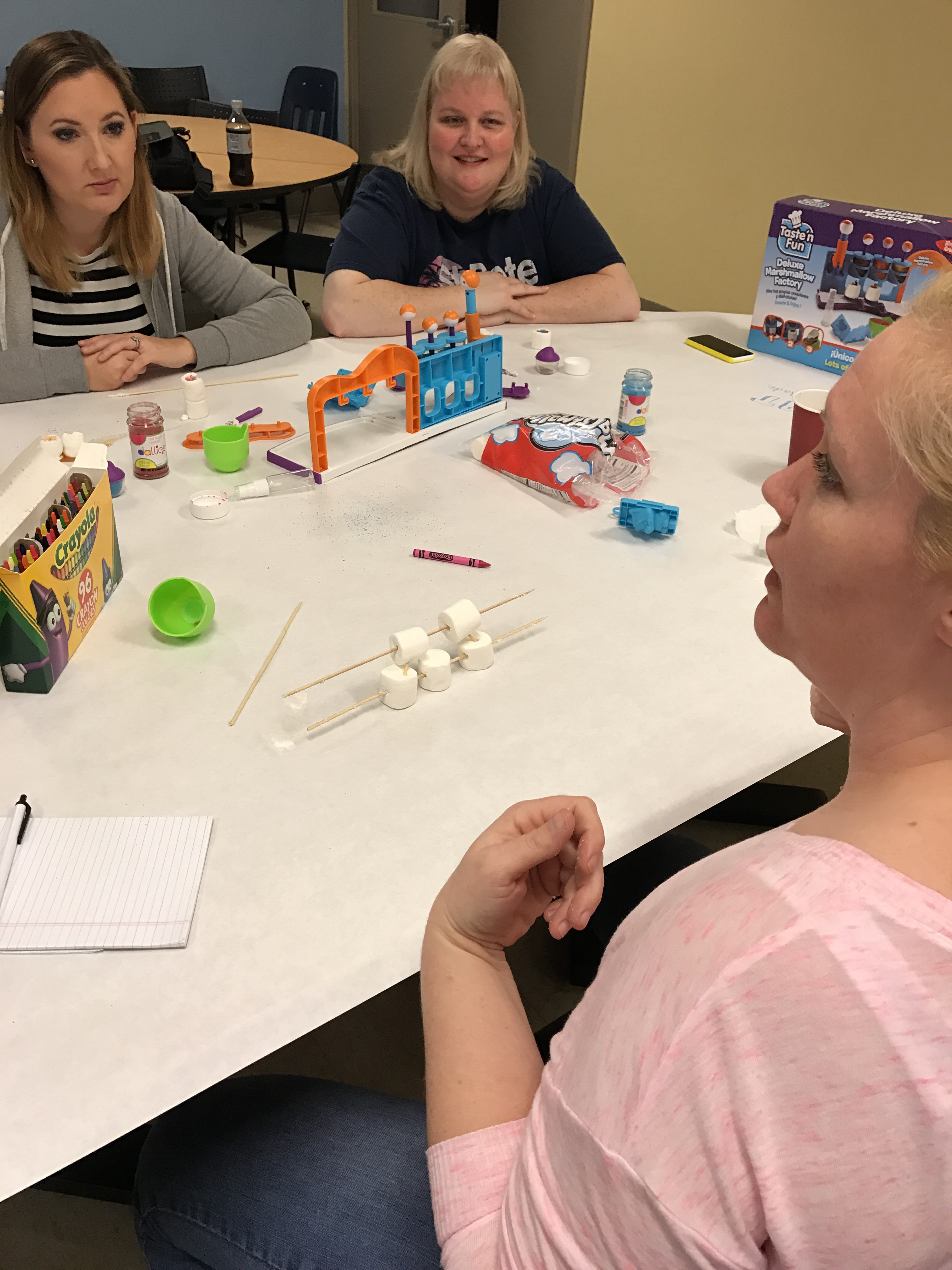
Leading A Community of Experimentation
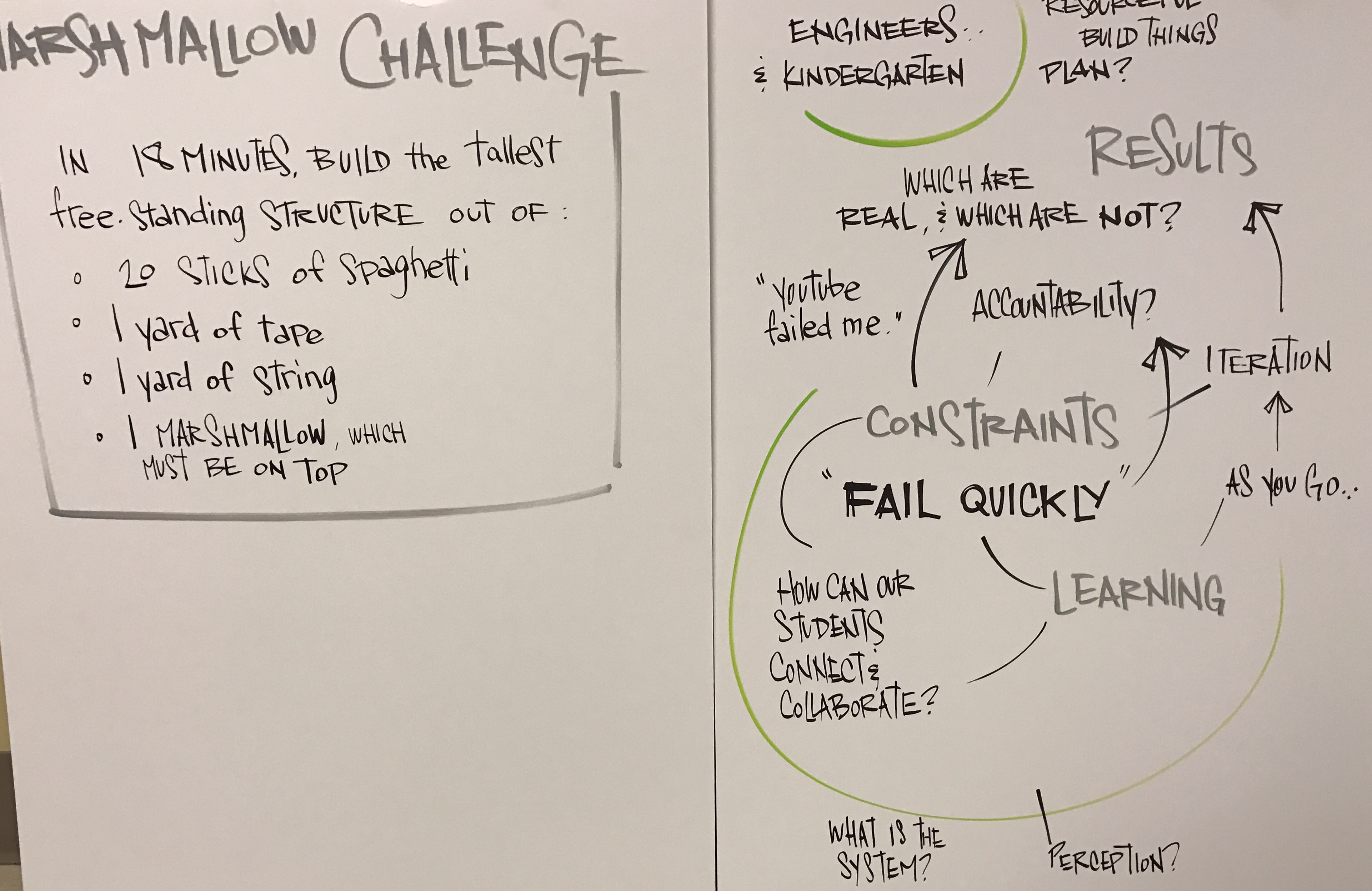
Mike Fleisch Graphic of Our Marshmallow Challenge Discussion
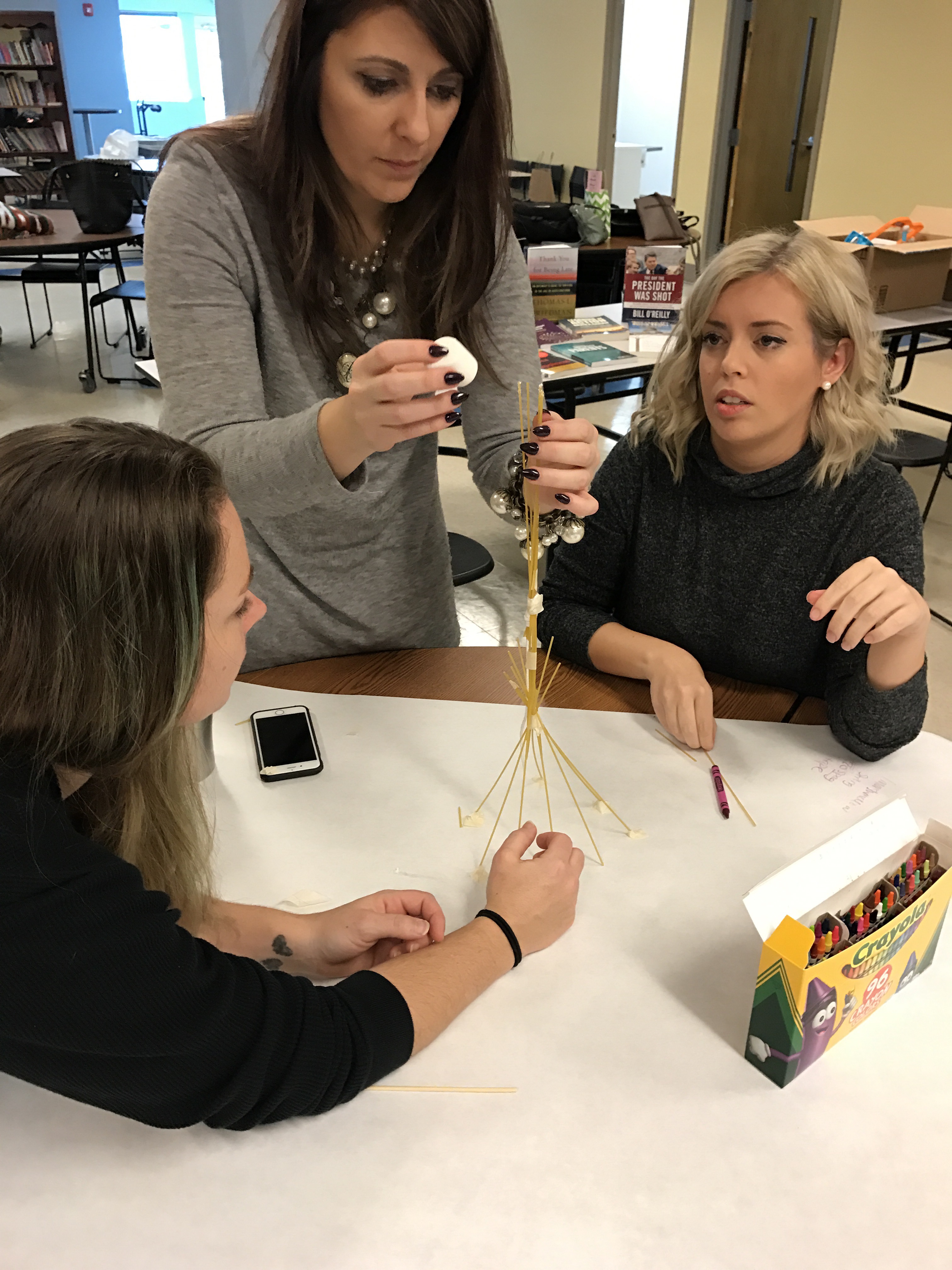 So, here is a generalization of what happened: They spent the first few minutes with someone establishing the leadership role, dominance, or trying really hard to be super collaborative. In a few teams’ cases one emergee as a leader. The next few minutes were devoted to planning. Construction began, usually with less than eight minutes left on the clock. Then, with about a minute to go, someone placed the marshmallow on top of the beautiful tower, and….it collapsed – failure.
 Kindergarteners and engineers do the best on this activity (see graph above). We decided that the kindergarteners win because kids don’t vacillate; they simply try something, and if it doesn’t work, they try again, and again, and again. Think about it… young children love to iterate. They are very curious.
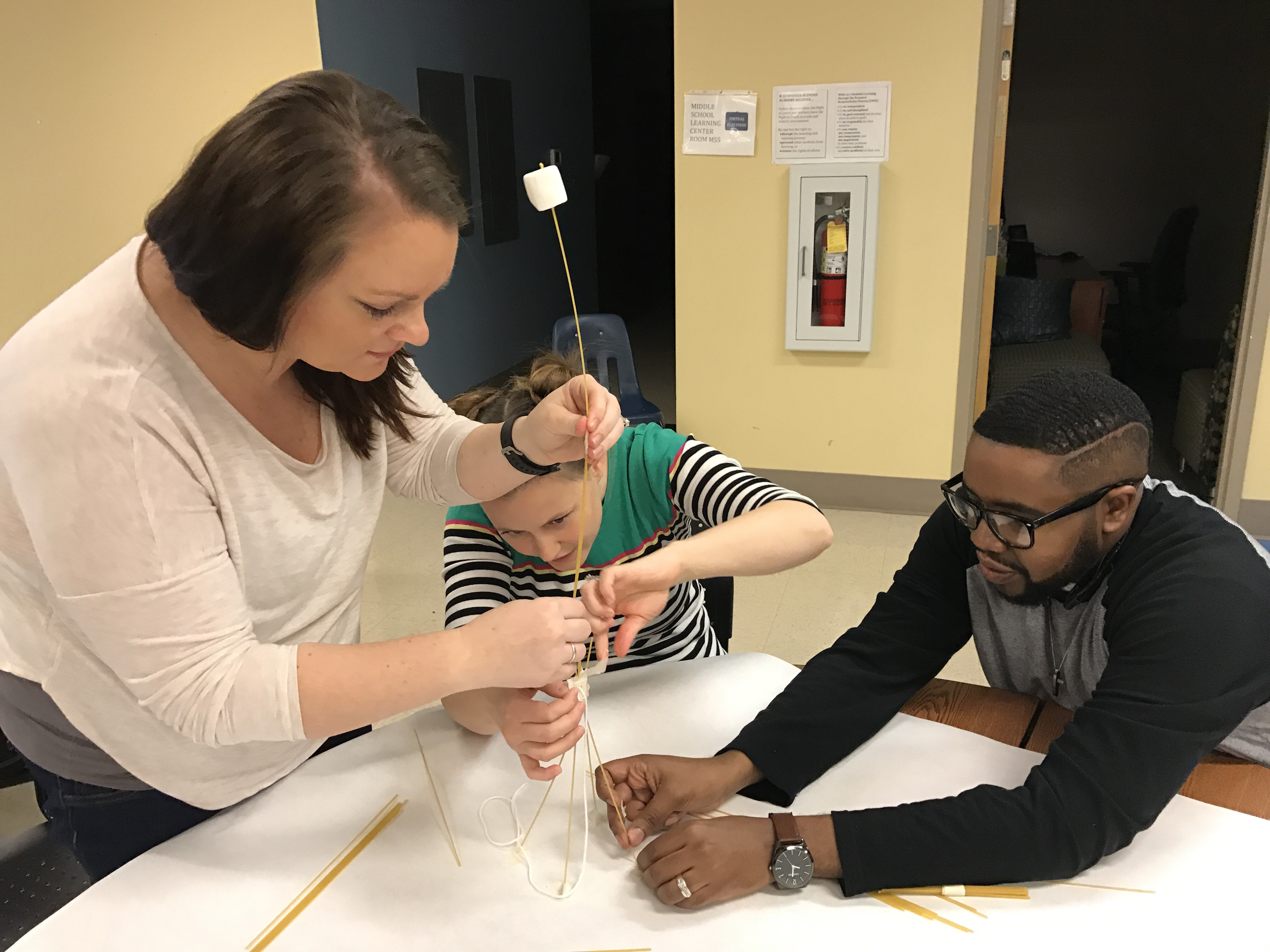 We concluded, in our post-challenge discussion (see picture for our Mike Fleisch graphic of the discussion), that engineers are good a this because they plan, build things, and are resourceful every day. In other words, engineers are quicker to understand how the spaghetti, tape, string, and marshmallow become a system together.
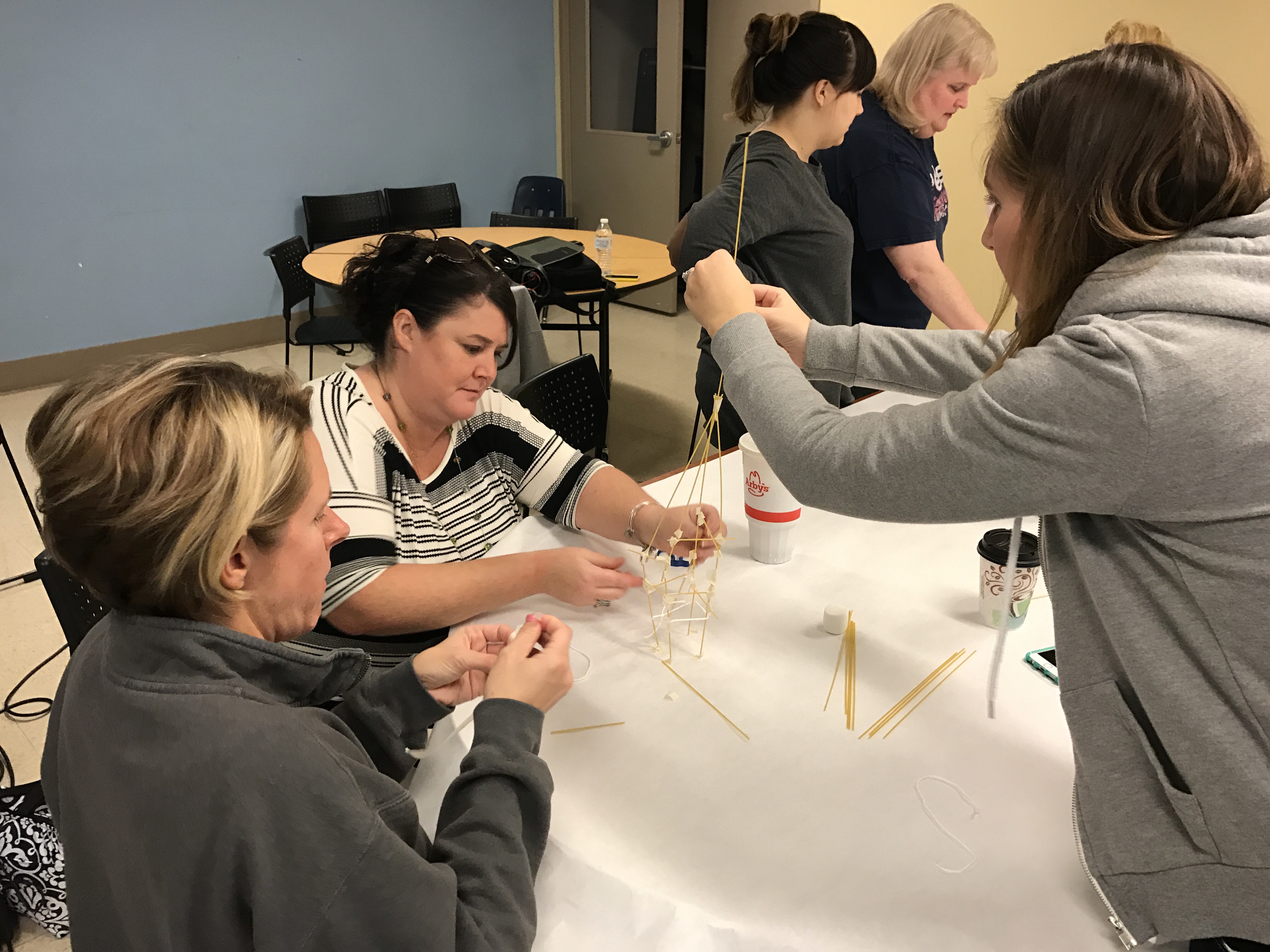 The big takeaway from our teams yesterday, however, was the idea of “failing quickly.” We are all familiar with the phrase “fail fast”, but what does that really mean? And how do you put it into practice? Failing fast isn’t about the big issues, it’s about the little ones. It’s an approach development and creation that embraces lots of little experiments and iterations with the mindset that some will work and grow and others will fail and die. And, that’s okay.
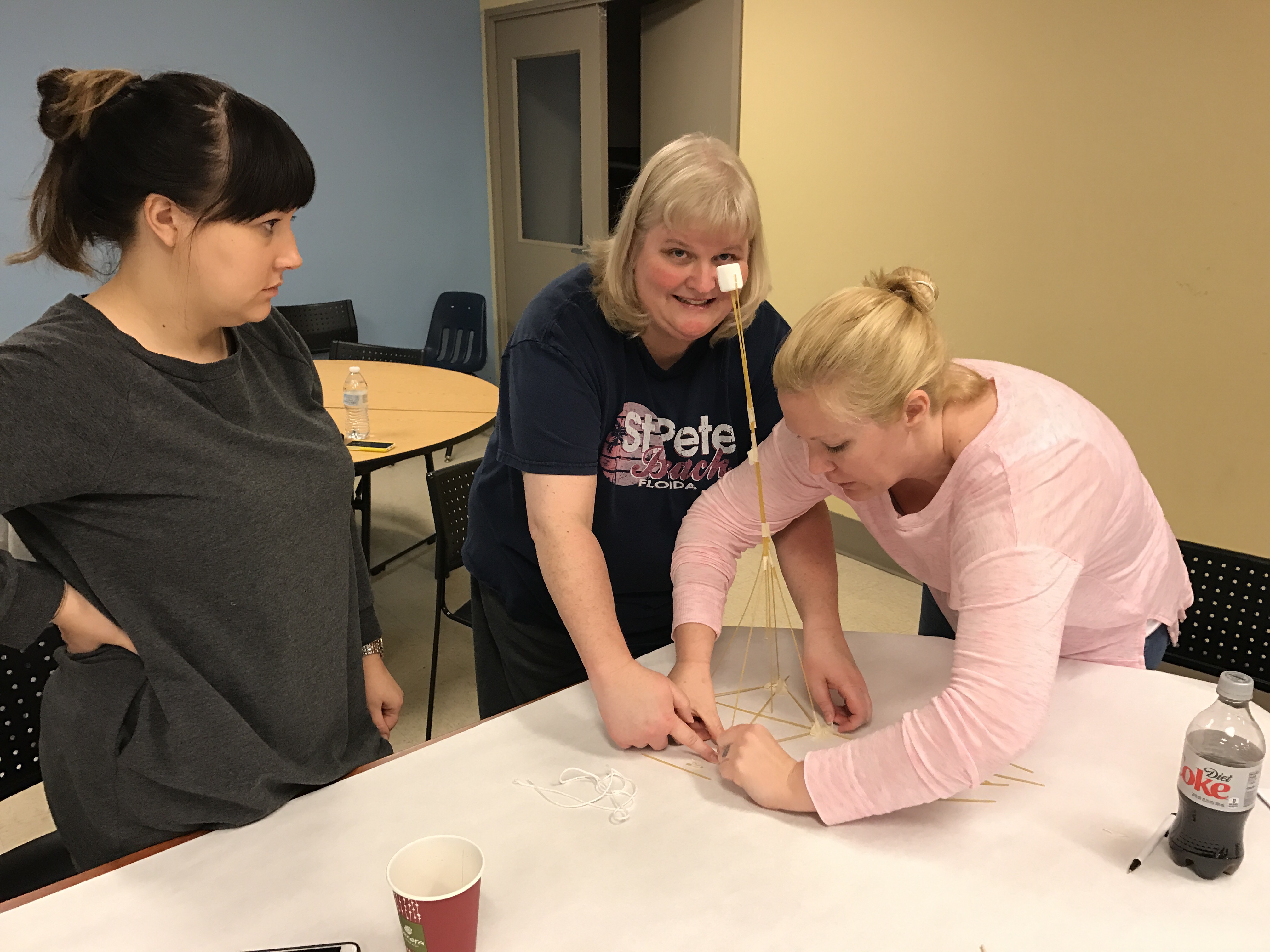 Develop a community of experimentation, be willing to try stuff, do it quickly. But if it’s not working, be willing to fail fast and pivot.
Global Community: Don’t Just Stand There!
 It is said a global citizen is someone who identifies with being part of an emerging world community and whose actions contribute to building this community’s values and practices. We are going to have to learn to be effective change agents of a global future. We will need to create our own future, rather than trying to predict the outcome of all these global forces. Today the forces of global engagement are helping some people identify themselves as global citizens, meaning that they have a sense of belonging to a world community. This growing global identity in large part is made possible by the forces of modern information, communication, and transportation technologies.
“We know this much. The world is not going to be dominated by any one great power. For Americans that’s going to be a very difficult thing to accept. Most of us still see a world – the world of 1960 – in which America was the only great power, and the only functioning economy.” ~ Peter Drucker
Global citizens are also moved by a desire to make a positive contribution through their professional and personal lives. When it comes to being a member of the global community, will you be a leader, challenger, or spectator. Furthermore, we must bring global competency skills into our schools.
- Kids need skills to navigate globally!
- Kids Need To Navigate Shrinking World!
The skills and insights students can gain from interacting with people of different nations and cultures is critical as America engages more intensely with an increasingly global marketplace and interdependent world.
We must all serve as global community leaders and engage in the dialogue, to care about the issues and become a global citizen.
“To the world you may just be one person…but to one person you might just be the world.” ~ Mark Twain
Fail Like A Champion
 Failure and adversity in our lives can help us, not hurt us. It’s extremely important to never lose sight of this truth. The song “My Champion” by Alterbridge delivers an extremely inspiring message to those who might feel as if they aren’t good enough. Click here to check out my video of the song I made while in Nashville, Tennessee with the band. Here is my favorite line from the song that always keeps me going:
“You’ve lost so many times it hurts
But failures made are lessons learned
Cause in the end what you are will be much more
Than you were.” ~ Alterbridge – My Champion
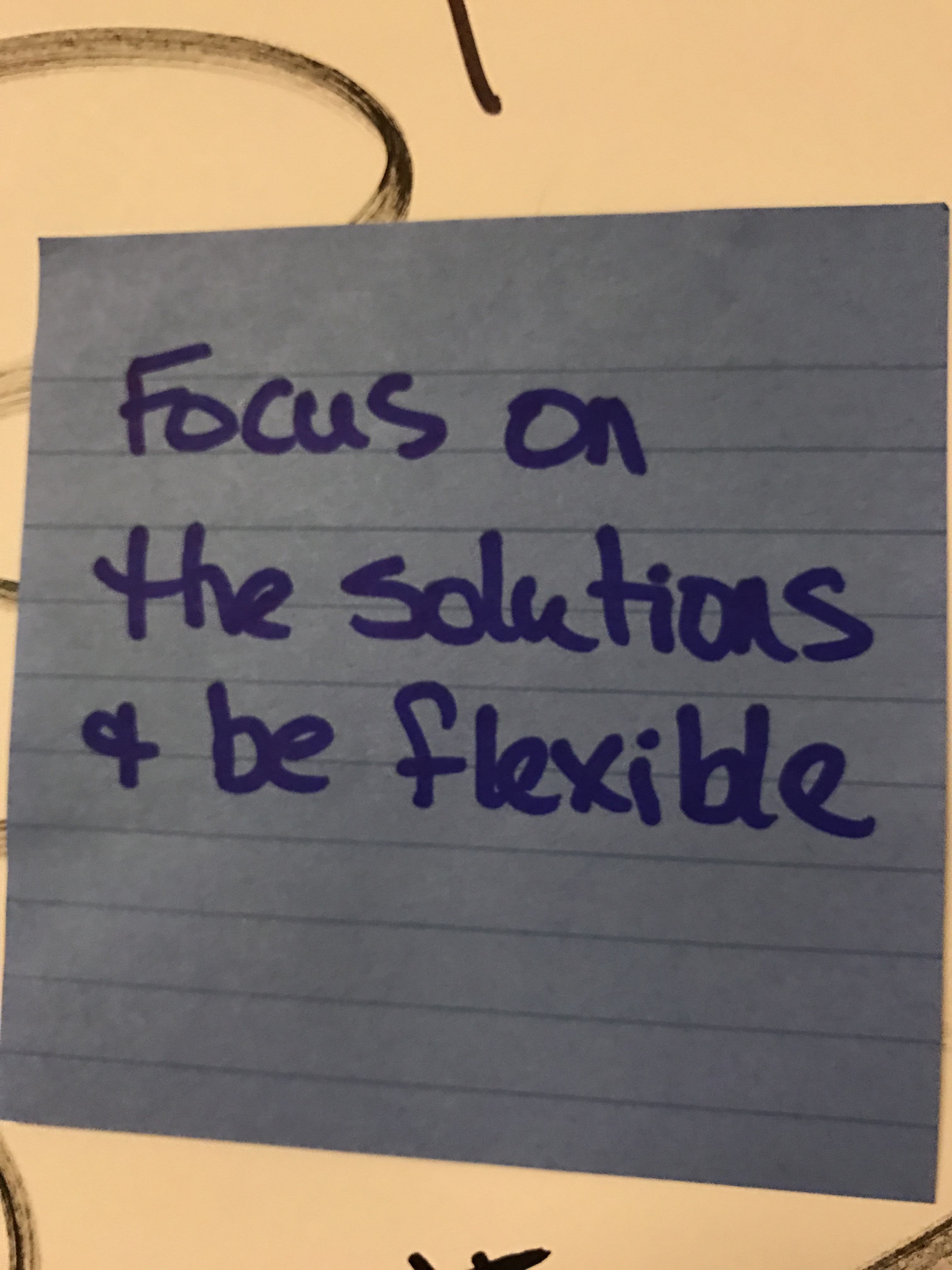
 To turn failure into a gift and grow through the tough times instead of just casually going through them, you must begin to start focusing on ways to actually resolve the situation. I think back to my childhood days of watching the original MacGyver show, and now in the new MacGyver – the character always looks for the solution, not at the problem. Many people let their minds wander toward the negative, which then prompts them to focus on more problems instead of searching for ways to resolve the situation and grow from it.
 Leaders and organizations that are able to get through tremendous setbacks and actually grow because of them are the ones who focus on solutions, not more problems. We can look to my hero, Thomas Edison, for a quick example. His persistence in continually searching for solutions after facing one failure after another is a prime example of the utter importance of focusing on ways to advance.
Looking for the solution is so crucial. Just staring at the problem is futile. Here are a few questions that can help keep us focused on developing solutions and not being focused on the problem/challelenge:
- How can we solve this task?
- How can we address this problem?
- What would be the first step to solve this problem?
- What kind of preparations will be necessary for this task?
Discovery Has No Example
 I am super excited to bring you my first Byron’s
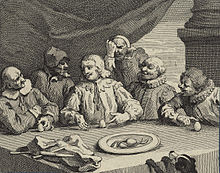
 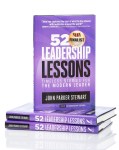 Babbles vlog post. I have been wanting to do this and Lesson #26 in 52 Leadership Lessons: Timeless Stories For The Modern Leader by John Parker Stewart entitled “Blinded By An Egg” gave me the inspiration. This is a story about Christopher Columbus and I hope you are as inspired as I was. Here is the link to my vlog post: Byron’s Babbles: Discovery Has No Example
“Discovery has no example, no easy path to follow. Are you willing to see and follow unknown paths?” ~ John Parker Stewart
The Bear Facts of Leadership
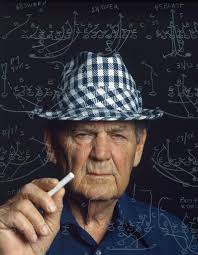 Every winner has a coach, and every coach has a philosophy. Lets take a deeper look inside the philosophy of one of the best. It is appropriate on this weekend before the National College Football Championship game between Alabama and Clemson to reflect on the leadership of Coach Bear Bryant. He had a keen instinct for what needed to be said and done, and a willingness to confront his present reality in order to make progress as a team. Bryant led his Alabama team to six national championships and was elected to the College Football Hall of Fame in 1986. While Bryant drove many people away with his authoritarian coaching style, he had many players who stayed to become champions. Even with this authoritarian style, Bryant made it a point to take responsibility for what his team did on the field. Gene Stallings, who coached under Bryant said this of his leadership style: “His philosophy as far as players were concerned is that if the team was successful they did it, and if for some reason we lost, he took the blame for it.” Bear Bryant found that if he took responsibility for his team, they would respond by doing everything they could to make the team successful.
“I’m just a plow hand from Arkansas, but I have learned how to hold a team together. How to lift some men up, how to calm down others, until finally they’ve got one heartbeat together, a team. There’s just three things I’d ever say: If anything goes bad, – I did it. If anything goes semi-good, then we did it. If anything goes really good, then you did it. That’s all it takes to get people to win football games for you.” ~ Bear Bryant
Lesson #25 entitled “Big Bear, Little Ego” in 52 Leadership Lessons: Timeless Stories For The Modern Leader by John Parker Stewart tells the story of Bear Bryant when he was in the United States Navy and disobeyed an order to abandon ship to save shipmates – teammates. Bryant may have pushed them to extreme limits and beyond what they thought they were capable of, but he got the best out of them. The players understood that. And they knew that Bryant was committed to their success. That’s where the bond came from—they were all in it together. Some leaders claim they don’t care if they’re liked; they just want to be respected. Other leaders are well liked but not really respected. The unusual leader, the really good one, is respected and revered. It takes a unique balance in a person to inspire that kind of loyalty and admiration, but it can be done. Coach Bryant brought his teams together by focusing on a common goal. They worked together, survived together, and ultimately succeeded together. Remember, great leaders do not consider themselves more important than the team, but as a part of the team. Leaders merely have a different set of responsibilities.
“Ready! Down! Break! Hut! Hut! Hut!” Send a spiraling pass to your team!
 Byron's Babbles
leave a comment