Applying A Little Heat
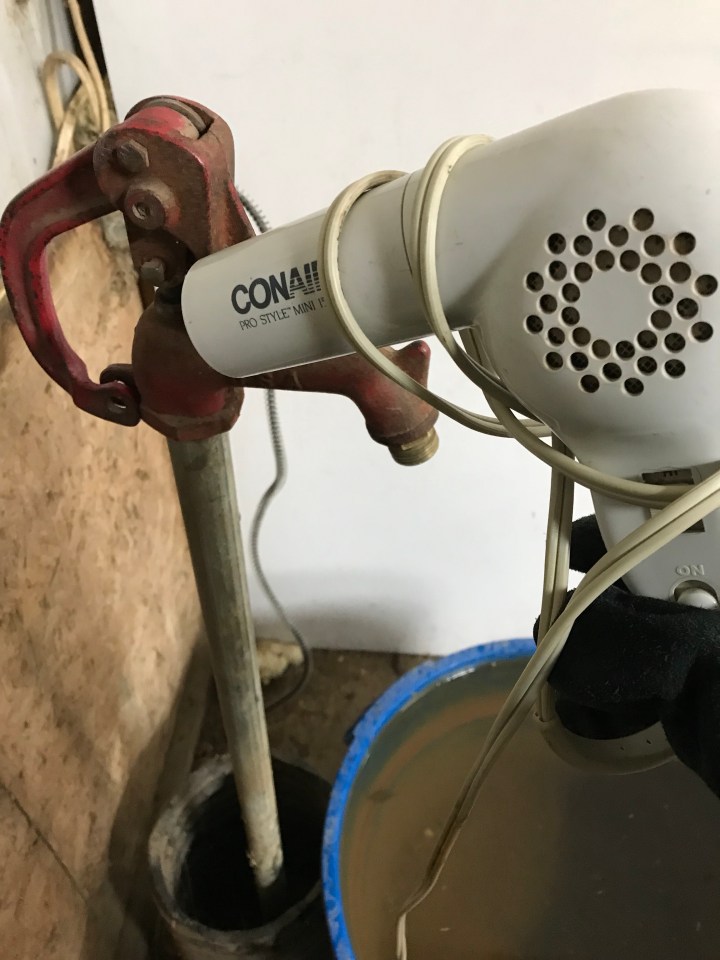 This morning, I walked to the barn to do the morning feeding and the thermometer 🌡 read 4 degrees Fahrenheit. I don’t mind the cold, but I always have to be cognizant that many things don’t work right, or at least need a little help to work right in this kind of weather. One of those things are frost free water hydrants.
For those who don’t know what that is, it is a water hydrant (pictured here) that is buried below the frost line and is designed so the on/off valve is at the bottom below the freezing point. Then when the water is turned off the water in the pipe drains down and out, and amazingly, no frozen water line. These are a great farm invention. They do, however, get a little moisture built up around the mechanism at the top for turning the water on and off.
Actually they are designed to withstand pulling the handle and turning them on, but I am always nervous in this kind of weather doing that. As we all know, things just have a way of going wrong in sub-freezing temperatures. Our way of mitigating this is to take a small hair dryer and running it for about 30-60 seconds on the valve. This small amount of heat makes it work perfectly – like it was 80 degrees out.
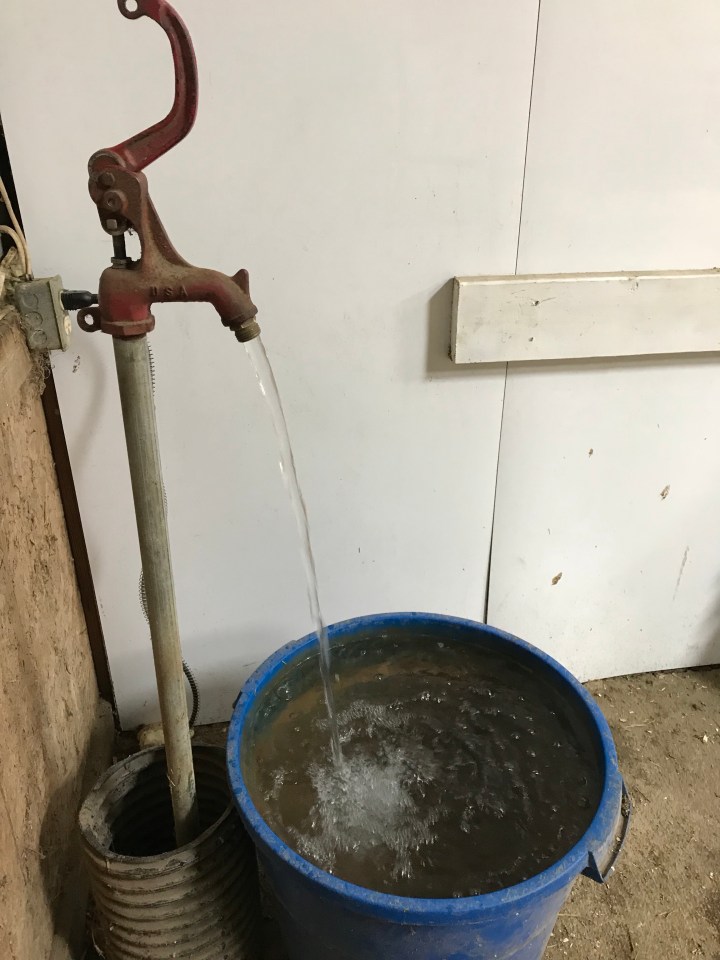 This morning, as I was doing this, I was reminded how a little heat being applied is good for all of us. I have always said that the best way to learn and grow is to be doing/trying something that causes a little fear. In fact I have blogged about it several times in: Leadership Lessons Of Mt. St. Helens, Telling Your Leadership Story, and Finding Your Leadership Voice just to mention a few.
As leaders we need to make sure we are enabling our team members to experience growth through real time projects and responsibilities that will, at times, cause a little “heat” and “pressure” to grow. The most effective leaders create unique experiences for themselves and others by taking calculated risks that put them and team members into situations that challenge their thinking, expand their perspective, make them feel vulnerable, and enable them to mature throughout the process.
Now, I am not saying throw yourself or your colleagues to the wolves. I am saying to act as the “hair dryer” I have used as the metaphor for this post and apply a little heat for growth to occur. This will allow us and those we serve to take key learnings from each of these experiences and apply them to similar circumstances we may be faced with. One of the ways I have learned to do this effectively is with task forces. Task forces gives teams of individuals a chance to form a community and create something for the organization.
The heat has been applied in my own personal life from being involved in turning schools around. Turnaround work can be one of the most thrilling and challenging adventures you can experience. Let me tell you, the “hair dryer” is pretty powerful and on high at all times. Turning around a struggling or failing situation teaches us to maximize the full potential of opportunities present in any situation and stretch the individual capabilities of ourself and other people. We learn that there is always a way out and forward when there is an effective use of tools, resources, people, and money.
So, instead of letting a little heat, pressure, or fear intimidate us; let’s welcome and embrace it. Remember, sometimes a little heat from the “hair dryer” can be good for us all.
Learning To Appreciate All Who Contribute To The Success
“Quite often it takes more than just ourselves to achieve the success we claim to have made. Our success is a result of many people’s contributions: those of our parents and other family members, fellow workers, peers, teachers, and advisers.” ~ Martin Kalungu Banda
We’ve all seen it in a TV show. The character goes to her boss or parents with a bright idea, the idea is ridiculed, and then (sometimes in the same breath), the idea is repeated right back, word for word. And, get this, it then becomes a great idea and he is glad he thought of it, too!
Unfortunately, these people do exist. In every company, in every organization, in every community, in every political party. Some might not have as bad a case of it as others, but at some point, we will run into one of these people, or an entire organization of these vane people.
Furthermore, I have even experienced not being able to reach compromise or consensus because certain individuals ideas weren’t being used or he had not come up with the idea. This level of ego and vanity is amazing to me.
“It Is Amazing What You Can Accomplish If You Do Not Care Who Gets the Credit.” ~ President Harry S. Truman
When faced with these type of situations I always remind myself and the group I am working with of the great thought of our 33rd President, Harry S. Truman, “It Is Amazing What You Can Accomplish If You Do Not Care Who Gets the Credit.” My choice has always been to favor the accomplishment of the idea, rather than worrying about getting credit for it. Really, very few accomplishments can be credited to any single person anyway.
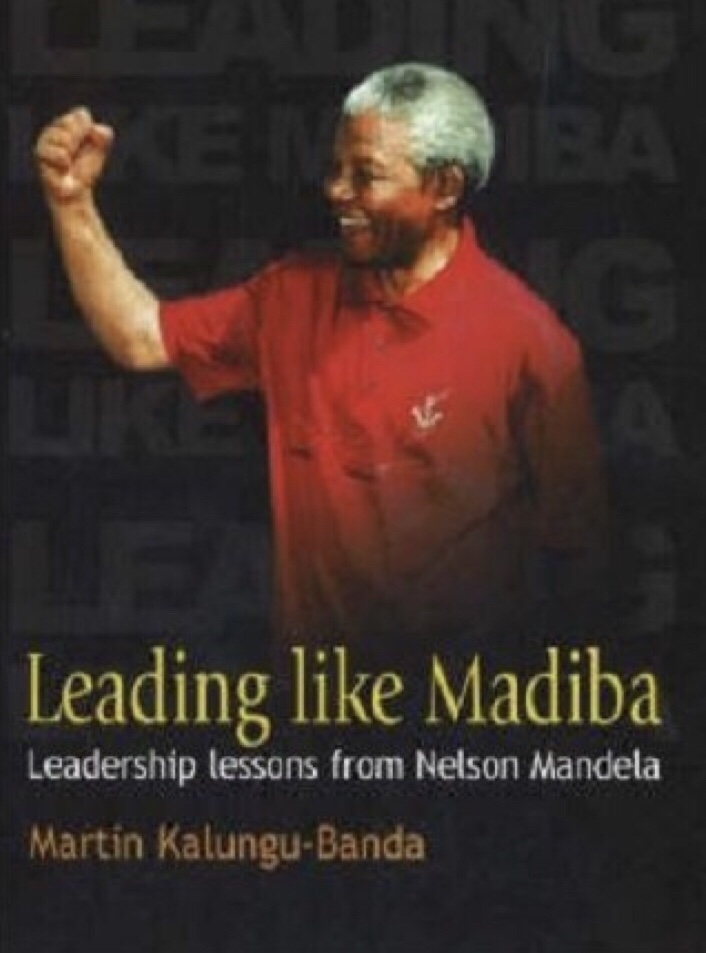 This very topic was the subject of the chapter I was reading this morning in the awesome book I am currently reading, Leading Like Madiba: Leadership Lessons From Nelson Mandela by Martin Kalungu Banda. In this chapter, Kalungu Banda teaches us that sharing the credit is a mark of great leadership. An interview of Nelson Mandela is the subject here where he shows that success is often the result of concerted effort by many people. In the interview Mandela says, “…the reality of our struggle is that no individual among us can claim to have played a greater role than the rest.” To me, this says it all – it took (or will take) everyone, not just one!
“Being praised for what we have done is such a sweet feeling. Then we know that our efforts are being recognised and appreciated by others. We all need that kind of feedback from those around us. But I suspect we are sometimes too eager to receive praise for ourselves. Then we end up forgetting those we worked with to achieve the very things we are being praised for. Selfishly we make ourselves the centre of a reality that is much larger and greater than us alone. We exaggerate our contribution out of all proportion. Without meaning to, we start radiating negative energies that repel others from wanting to cooperate with us.” ~ Martin Kalungu Banda
We have all seen people who have become so caught up in what they think they have accomplished that they forget there are/were a lot of of others working on that same issue with them.
“The paradox is that the more we acknowledge and celebrate the capacities and contributions of those around us, the more we deepen the strength and prowess of our own character. We become poised to do greater things because others feel confident enough to win with us.” ~ Martin Kalungu Banda
The fact is, great leaders recognize and honor the contributions of others. In fact, the greatest of leaders deflect credit from themselves to others. We need to learn from Mandela and create the space for others to be acknowledged. Here are a couple of questions to consider:
- Even if it is your idea, would you rather be right, or get the idea implemented?
- How much do you value your vanity, your pride?
What Inspires You?
 Yesterday I had a person ask me, “Byron, how do I deal with the person who does not want to learn or go through any professional growth experiences?” She went on to explain this was an experienced leader who believes she has seen it all. I explained that was a tough one. I have experienced these type of individuals. The type who say, “When you’ve been around as long as I have you’ve seen it all and know how to deal with…” Really, seen it all? I think not! Amazing!
In all honesty, I’m not sure there is a lot you can do with a person with that disposition. I say disposition because while I do believe leaders can be developed and don’t have to be born automatically a leader, I do believe that there are certain dispositions you must possess to be a great leader. One of those is a propensity to be a lifelong learner. I actually just blogged about lifelong learning this week in Lifelong Learning: The Farm Way.
So what was my advice? To have the tough conversation about the fact that all leaders need to continue to learn and find inspiration. I am a huge believer that those we serve as leaders need to see us learning and taking part in self development. Even better if they can experience this alongside us. If that doesn’t happen, I’m not sure how that person can be effective and I’m not sure how long they could continue in an organization that believes in growing its team members and being a learning organization.
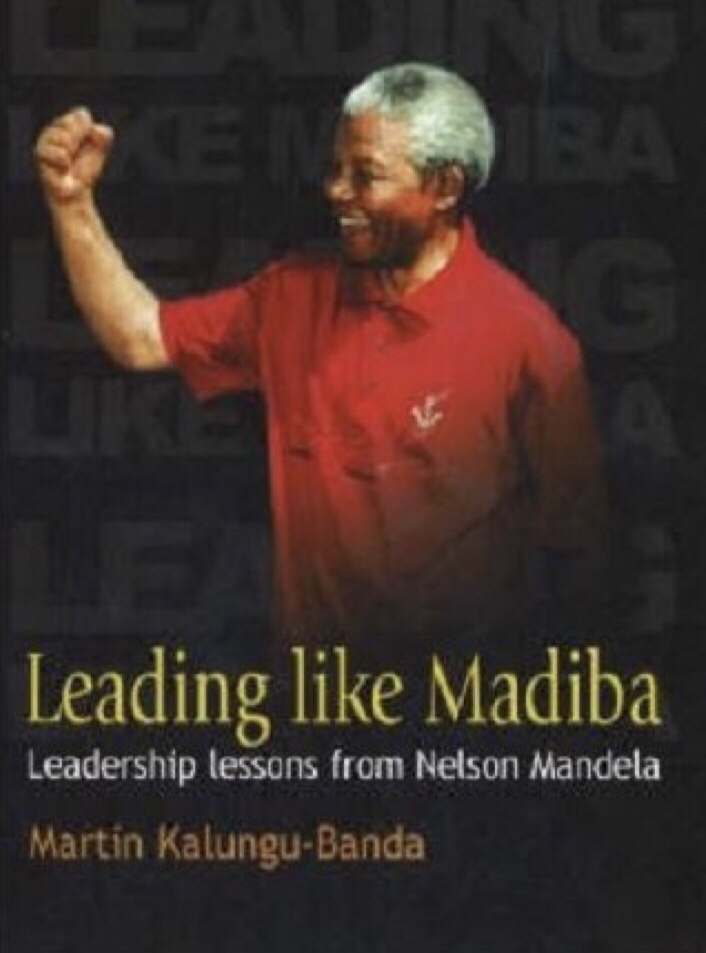 During my own personal growth time this morning I had this thinking affirmed in the great book I am currently reading, Leading Like Madiba: Leadership Lessons From Nelson Mandela by Martin Kalungu Banda. I was inspired to study Nelson Mandela by Richard Branson. Madiba is one of Branson’s leadership heroes. Just as Richard Branson is one of mine. Talk about a guy (Branson) who continues to learn, grow, try new things, and start new thing. Pretty sure he has never said, “I’ve seen it all and know it all.”
In Kalungu Banda’s book he tells the story of Mandela going into the locker room before a soccer match and asking his favorite professional soccer player, Mark Fish, to switch jerseys with him. Mandela was wearing a jersey with Fish’s number on it. Fish agreed and Mandela went on to explain how much he was inspired by him and learned from him. Fish was very touched and inspired by this and said that any time he wore or even looked at the jersey he had gotten from Mandela it inspired him to get better. What the story about Mark Fish in this great book shows is that great leaders also need to be inspired. Mark might think that it was Mandela who inspired him and not the other way round, but it is clear from the story that Mandela had long been inspired by Fish.
Martin Kalungu Banda gives some great, what he calls in the book, Food For Thought on this story:
“We often do not imagine great leaders to be in the process of learning. Indeed, most leaders do not look as if they want to learn or have the time for it. They are either giving advice or opening a workshop for other people. We are surprised when we hear that a leader spent a day at a conference as a participant.”
As I said earlier, we need to be seen by those we serve, learning. Even better to be learning right next to them.
“Imagine what becomes of leaders who do not find anything to inspire them. My guess is that they soon dry up. They cease to inspire others because they have no replenishment themselves. We can only give what we have. So, to be leaders who inspire our organisations and communities, I am convinced we need clear sources of inspiration ourselves. Inspirational leaders continue to be moved by the surprises and wonders of life –people and nature, and the interaction between the two. Such leaders position themselves so that they continue to experience the awesome character of the world that surrounds them and the profundity of human life.”
What inspires you? You cannot inspire other people unless you get inspired and continue learning yourself.
“They [leaders] are always learning. Learning is about lending oneself, through practice, to the ‘how’ question: How can I hear other people better? How can I do this better? How can I understand this situation better? This style could explain why in spite of his age Madiba beams with the joy and vitality of a 21-year-old. It could be his ability to be inspired by other people. The readiness to be inspired by a footballer.”
When we feel so knowledgeable that all we want to do is impart what we know on others, it is a sign that we have stopped learning. There is no such thing as standing still in learning, however. You are either learning or you are regressing. I don’t know about you, but I do not want to regress!
Lifelong Learning: The Farm Way
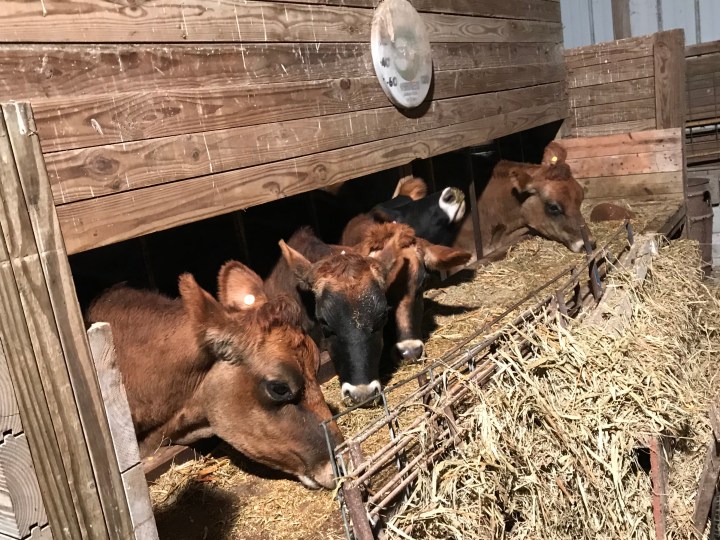 Many times leaders wonder what they can do to become well-rounded and competitive while increasing both their success and significance. An often overlooked yet simple way to improve is to increase our knowledge by being a lifelong learner. Structured education and professional growth opportunities are very important, but much success is derived from highly motivated individuals that have dedicated their lives to the concept of lifelong learning. Many times this learning is unstructured and just involves us paying attention and recognizing opportunities to learn. We all need look for these opportunities and prioritize the creation of time in our busy lives each day to educate ourselves on new concepts and ideas.
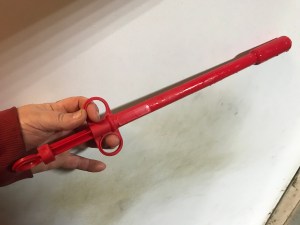 Last week I had an opportunity to learn just by observing the technique of someone else. We had two of our show heifers dehorned and we always get pain medicine (comparable to Tylenol® or Ibuprofen) in the form of boluses (big pills) to give for seven days. These are given orally with a bolus gun (pictured here). Growing up as a farm kid I have done this hundreds of times. It always seems, however, I end up fighting with the animal before I get the pill given. This time, though, I watched as the veterinary technician gave the first round while still at the vet’s office. She had an interesting technique and I took note of the way she held the calf’s mouth open. The calf did not fight and the pill went right down. The next day I used her technique and voila′ it worked perfectly. Let me tell you, I gave the seventh and last bolus tonight and all went perfectly with no fights every night. I am very excited to have learned a new technique.
This experience reminded me just how important it is to take advantage of every opportunity to learn. I try to learn something in everything I do. In fact there is a direct correlation between individuals who strive for growth in their personal lives and those who thrive in their professional lives. I really believe that the learning I do in my farm life does help me grow as a leader in my professional life. In an ever-changing world, it is more important than ever to stay current, competitive, and up to date – both in our personal and professional lives. We must rid ourselves of assumptions and convictions so that we can be open and receptive to new information and learning. The uncomfortable part is that at times the things we are observing or learning may contradict what we believe to be true. If we truly open our minds to lifelong learning we will come across information that challenges your worldview. We need to strive to jump out of our comfort zone, use this time to stop, reflect and shed light on these ideas in a way that can develop and expand our knowledge and vision. Just like my learning a new way to give calf boluses by watching someone who does it many times per day.
Now, I realize that my story from the vet’s office is a simple one, but the concept is important. We need to always be on the lookout for ways to improve and learn. Again, these do not need to be structured, and I would argue many times the best learning comes from paying attention and observing. Think about it, I could have just said, “That’s not the way I do that.” All that would have got me is the same old inefficient way of giving boluses and continuing to wrestle with calves every time I do it. Amazing what an open mind can bring us.
Hopefully this reflection will give us all a renewed commitment to learn new ways to expand and to sharpen our personal and professional skills. Reading great books, consuming excellent electronic media, and participating in engaging continuing education programs, from varied sources, will keep us informed, in touch with, and energized by new ideas – but only if we commit to our own learning. And, pay attention to lessons happening around us. Will you commit with me to being a dedicated lifelong learner?
Leading Like A Glue Stick
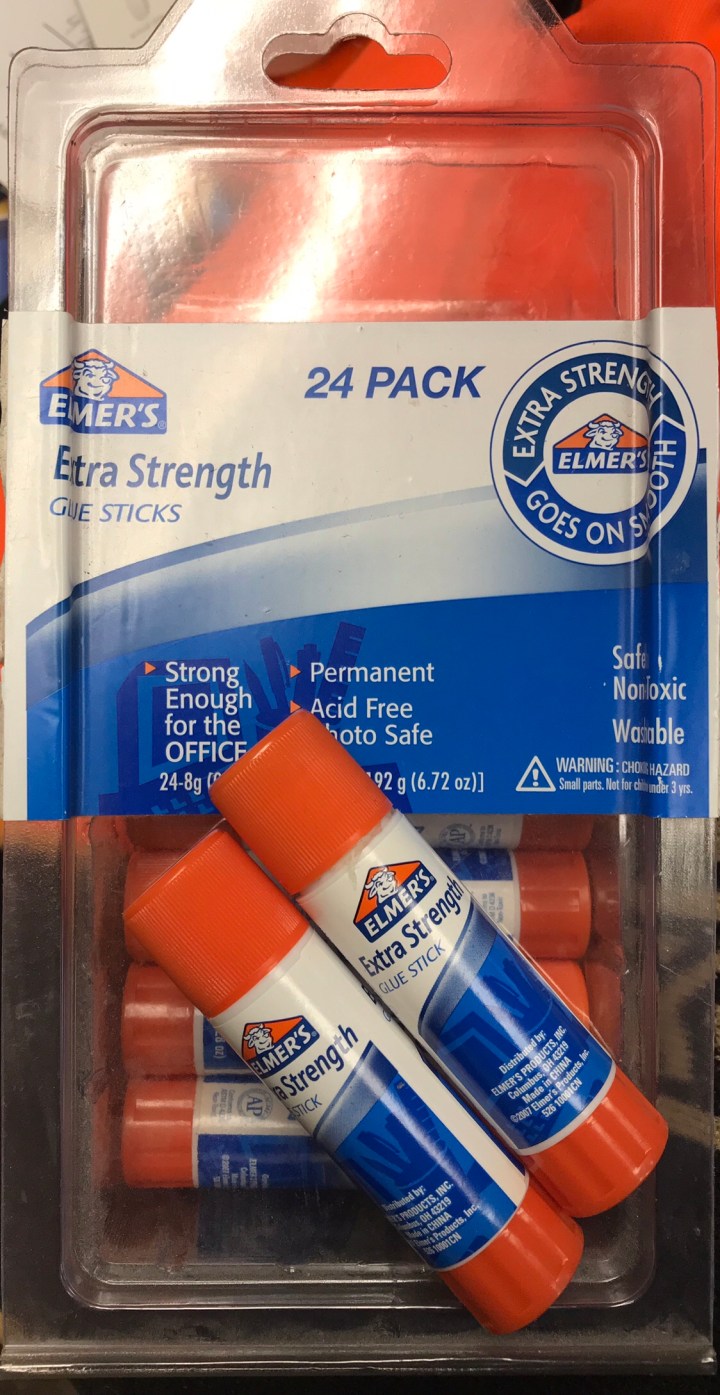 As an educator and leader I understand the value of a good glue stick. Glue sticks are very convenient for class and leadership retreat activities, but don’t last as long. The time they save in the classroom and the ability to create quickly is worth it. I can’t even imagine having to go back to bottles of messy glue that takes forever (it seems) to hold things in place. All of that being said, however, I would like this morning to look at the glue stick as a leadership metaphor.
This past week I had the opportunity to be a part of a convening of business/industry leaders, local/state government officials, school leaders, and community stakeholders in Goshen, Indiana – Elkhart County Indiana. The group was convened by Horizon Education Alliance (HEA). Dr. Jason Harrison, Director Of Facilitation for HEA, did an outstanding job of facilitating our convening. It is awesome how HEA has become the glue stick for Elkhart County to come together to improve all aspects of the community. Specifically, how to make sure our young scholars are prepared for any post secondary endeavor they choose. The idea is for all stakeholders to understand the needs and obstacles of each other. Then remove the obstacles and create great things for everyone in the community. Now that’s leading like a glue stick!

Here is an article in The Elkhart Truth I was interviewed for at the conclusion: http://www.elkharttruth.com/news/listening-and-collaborating-at-local-state-level/article_ab40b62f-4841-5fd8-8d39-fa086a79e9d5.html
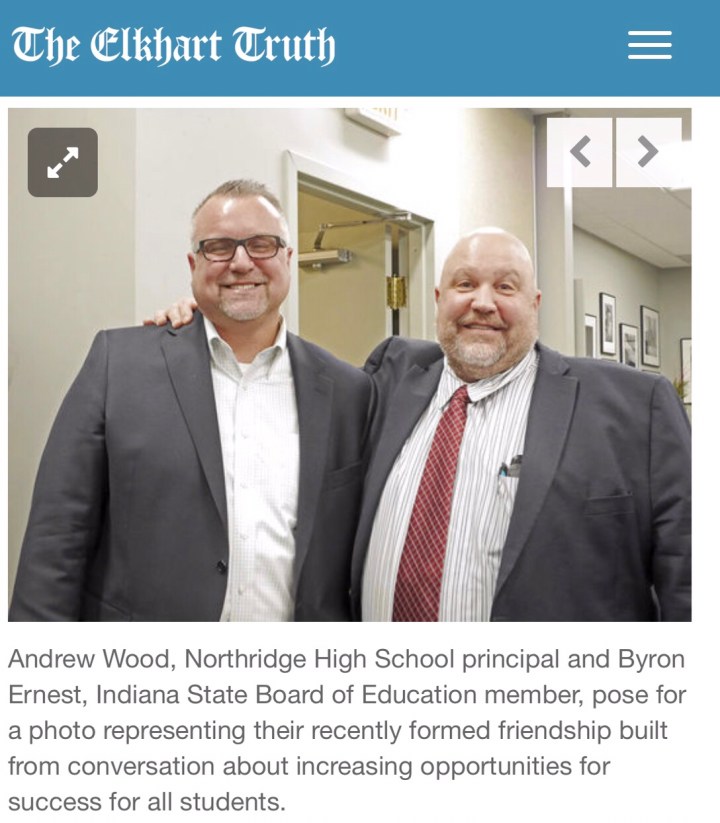 Additionally, I had a former team member text me this morning and I texted back to keep being the glue of the organization. She texted back and said that sometimes we need to be Super Glue. True. Then I got to thinking, what does it take to be the glue stick of an organization? I have heard it said that the indicators of a great team are its level of grit and the strength of its glue.
To me the glue of an organization measures how a team sticks together and how its members meld into an effective team, especially in tough times. Abraham Lincoln is famous for a quote he used when describing the division during the Civil War in the United States 🇺🇸: “A house divided against itself cannot stand.” He actually borrowed that phrase from the New Testament of the Bible. Probably why it is such a powerful quote no matter what divisions are being struggled with. The “house” can apply to our state or federal governments, our organizations, our teams, our local communities, or our families.
Relationships matter. Really, we need to know each other, trust each other, and hold a healthy respect for each other to achieve excellent results. Mutual respect and understanding of each other’s beliefs and values is key. These relationships are the glue that holds us together. Leaders need to create the space for team members to work together and encourage them to take the time to really see and learn from each other. This also means giving all team members the ability to lead from where they are. Everyone is a leader, and if treated as such, this can be Super Glue.
Furthermore, these relationships serve as glue sticks because teammates who build each other up, show appreciation for one another, and connect with each other are key parts of any great team. When we all work to be the leadership glue sticks of an organization it becomes a community working toward a common vision. This allows big and bold things to happen.
Are you a glue stick in your organization? How can you better distribute and develop all the glue sticks in your organization?
Graphic Recording: Good Quirky Or Too Off The Wall?
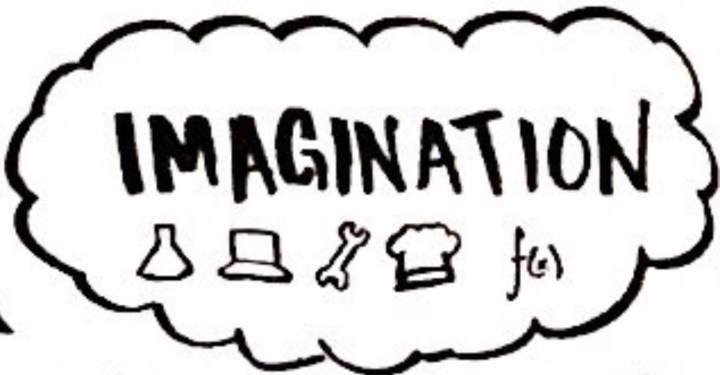 Recently I have been both criticized and lauded for using graphic/visual representations in my meetings. So, in reflecting on the negative reactions, I have thought deeply about the value. My first reaction was that “Wow, these people are very antiquated in their thinking and have had no experience with this great way of facilitating and thinking.” In all fairness, however, I wanted to dig a little deeper. In convenings I have facilitated the results have been positive and far-reaching. Engagement is improved and graphics give the group a way to quickly review thoughts and work that has been completed. In other words, a birds eye view into the work. What we have experienced makes sense given that 65% of the population are visual learners and there is evidence that we retain information as much as six times more effectively when it’s presented through a mixture of speech and visuals rather than speech alone.
There is so much work being done right now using graphics and visualizations to help convening groups understand the work they are doing. It is one of the key practices recommended in a book I am reading right now, Creating Great Choices: A Leader’s Guide to Integrative Thinking by Jennifer Riel and Roger Martin. This great book blends storytelling, theory, and hands-on advice to help any leader or manager facing a tough choice. In the book the authors recommend drawing pictures of the choices and visualizing the possible solutions. I have found this to be such a powerful way to work through creating the best choices. Every person’s thoughts and ideas become very real when they are put on the board.
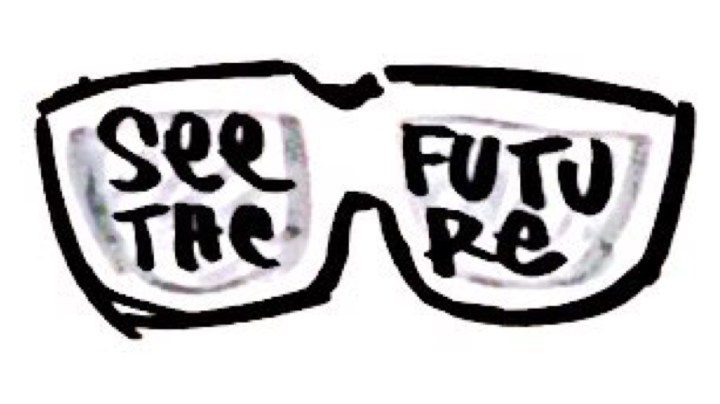 There is such power in seeing your own words be put up on the board. This was powerful as a classroom teacher and also powerful when facilitating the convening of meetings. Top facilitators make sure all participants’ words are recorded instead of their own. They write what was said, regardless of theperception of value by anyone collaborating at the time. When working with groups long term, I really like to get them to begin to do their own graphic recording. This is very powerful when the group takes ownership and owns this. Once written, follow-up questions can be used to get the participant to clean up the words and flesh out other thoughts.
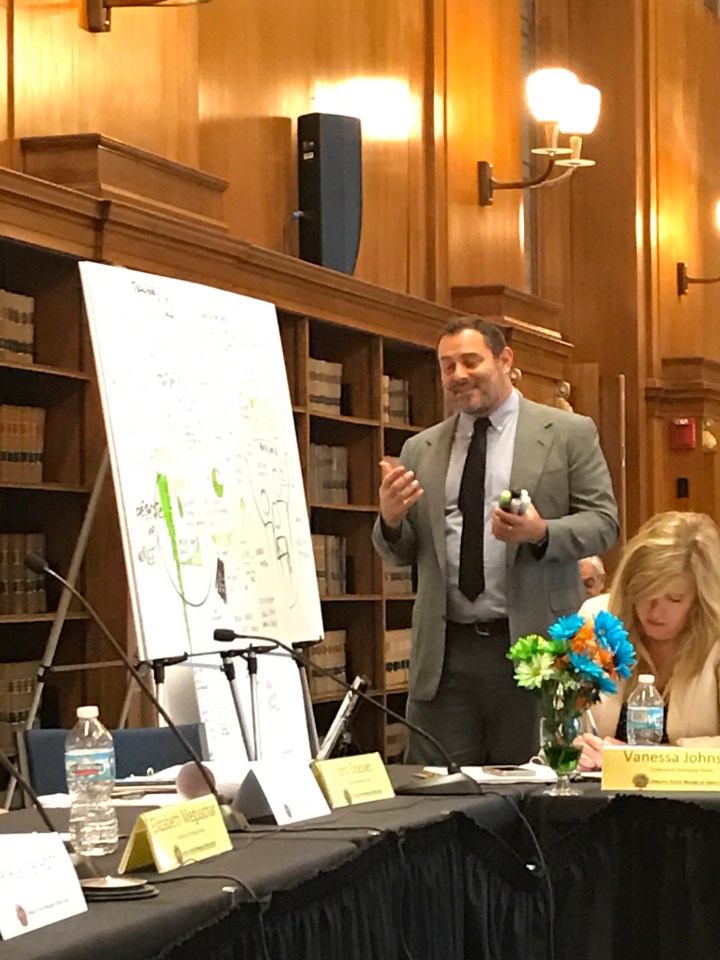 Furthermore, the use of graphics make an outstanding way to do a review at the end of a meeting or any time further clarification is necessary. I have made it a custom in any convening I facilitate to do a review at the end. This has proven to be a very powerful way to end meetings and make sure everyone is on the same page. This review can be very quick or very detailed depending on the work that is being done. It is also great to have the visuals available when reporting out from small group or breakout group work. It allows fellow collaborators to actually see the work that is being done and literally watch it develop. Really, this all works on the principle known as the picture superiority effect. Basically, using effective visuals will improve learning. The principle states that people generally have a better memory for pictures than for corresponding words.
Finally, the use of the graphic story boards from previous meetings serve as an awesome gallery walk prior to the next meeting. In fact it was awesome in a project I recently chaired to watch individuals get to the meeting early to review all the graphics from prior meetings. I have to give credit where credit is do and say that I learned the best practice of the gallery work review to my experience with the Harvard Learning Innovation Lab (LILA). Graphic recordings can help learners comprehend abstract concepts using visual language to depict meaning. In other words, the idea is to concretize abstract information with a corresponding visual when possible.
I also believe graphic recordings enrich the meeting space. Displaying the graphic recordings in the meeting space itself is one of the most effective ways to ensure the visuals are part of the ongoing discussion. People will naturally refer back to what was said — the graphic recordings serve as a tangible record in full view of everyone. Again, as I stated earlier by displaying the graphic recordings, you’re showing participants that their words and thoughts are valued and you’re encouraging people to review and discuss the content. This creates a safe environment to share ideas and conflicting opinions.
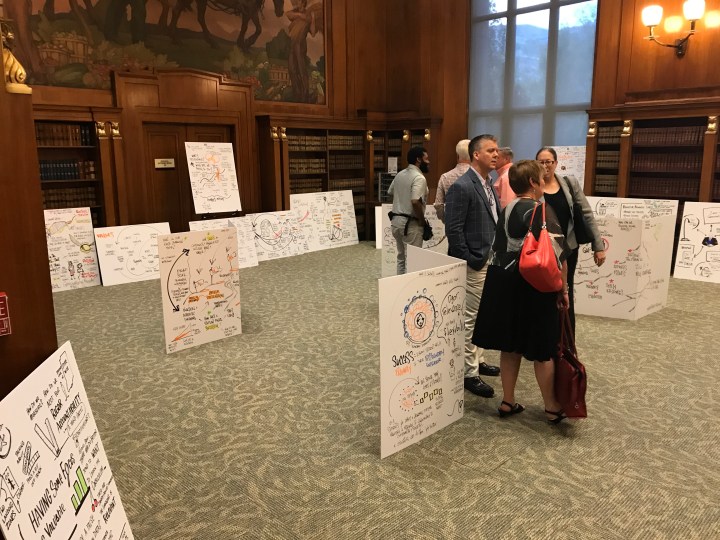
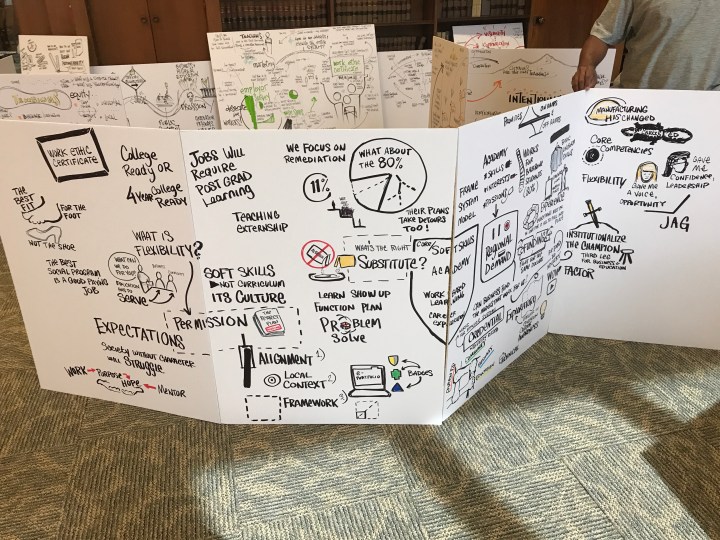 Bottom-line: Why do companies like Google, the Gap, Lego and Johnson & Johnson use graphic facilitation? Because they know how valuable their meetings are, and they know how graphic recording helps them get the most from their investment of time, money and talent to get their best people in one room. Therefore, I believe making a graphic recording makes the discussion visual. This enables those convened to have snapshot of the ground that has been covered so far. Almost immediately, you can see which points need to be built out and which have yet to be explored. We can “read” images much faster that written word, so the feedback loop is much quicker.
While some may think is quirky, I am a major believer in the use of graphic facilitation. I believe that when the meeting, leadership training, retreat, or any other type of convening really matters, graphic recording and facilitation will make that meeting more effective and productive.
Pictures in this post are of graphic recordings done by Mike Fleisch. I have learned a great deal from Mike and value the experience of having him facilitate many convenings with me.
Leading With Intellectual Honesty
 I am reading a great book right now that is super hard to put down every time I get a chance to sit down and do some reading. The book is by one of my favorite Presidents, Harry S. Truman. Where The Buck Stops: The Personal and Private Writings Of Harry S. Truman. This great book was published by President Truman’s daughter, Mary Margaret Truman Daniel. Although the book is entirely written by President Truman, with the exception of the introduction, he did not want it published till after he and the former First Lady, Bess Truman, had both passed away. The reason was that he is very critical of some of the presidents before and after him and did not want his thoughts released while he was alive. In the book, our 33rd U.S. President gave his “cut to the chase” theories and opinions on leadership and what it takes to be a great leader. He even gave his picks for best and worst presidents and, in detail, defended his reasoning.
 It would seem that my post today is to promote the book, but really that is not the case. Although, I would recommend reading the book. I was intrigued by a comment President Truman made in the book when arguing that the appearance, height, or stature of President has nothing to do with greatness. President Truman said:
“A president has got to have qualifications to do the job that he’s supposed to do. He has got to be honest. Particularly, he’s got to be intellectually honest, and if he isn’t, it doesn’t make any difference what kind of appearance he makes. In the long run, his good looks or good public presence doesn’t amount to anything because he’ll do a bad job, and he’ll be found out. Or even worse, as I’ve been pointing out in this book, some presidents go into the presidency and don’t do any kind of job at all.” ~ Harry S. Truman in Where The Buck Stops (Kindle Location 1369 of 6958)
I bolded the term that intrigued me: “intellectually honest” or intellectual honesty. What is intellectual honesty? It means always seeking the truth regardless of whether or not it agrees with your own personal beliefs. President Truman was reminding us that the great leaders approach problems and decision-making as rationally as possible. In other words we make arguments we believe are true as opposed to arguments we are supposed to by popular opinion or public pressure. We should not be afraid to show vulnerability or admit when we are wrong or don’t not know something. Probably a President, more than anyone else, can appreciate that facts and information may likely change, requiring a shift in execution.
 The best leaders I have observed have the curiosity to learn and improve — and an innate desire to create, innovate, iterate, and discover better and more efficient ways of doing things. When great leaders see change as an opportunity for growth they are able to pivot and execute effectively. We must work really hard to not cover up what we don’t know, or let personal beliefs interfere with our pursuit of the truth. As President Truman pointed out, this is not easy. We must continually work at it.
Leading Through The Lens Of Opportunity
 This past week I had a leader I am working with on a project say to me, “I am having trouble looking at this project through three different lenses.” My immediate response was don’t look through three lenses; just the one you were made a part of this project for. There are others on this committee that can work through the other lenses. It really got me thinking about whether we, as leaders, should look at things through multiple lenses or only one.
The most effective leaders I know approach problems through the single lens of opportunity. I had an incredible mentor and friend early in my career that always called problems “opportunities.” That has stuck with me ever since. The best leaders are the best problem solvers. They have the patience to step back and see the problem at-hand through broadened observation; circular vision. These great leaders see around, beneath, and beyond the issue/problem (opportunity) itself. They see well-beyond the obvious and see opportunities.
I also believe it becomes crucial to become a convener and let the wisdom of the crowd/community take over. This creates an environment where everyone’s concerns, points of view, ideas, and solutions are freely expressed. This community structure welcomes efficient cross-functional collaboration and problem solving. This also eliminates silos and allows individuals lead through the lens of their expertise.
Great leaders seek out and convene lifters and high-potential leaders within the organization or community to reap the benefits of open-mindedness that leads to more innovation and initiative. We should invite people together and name the possibility about which we are convening. I also believe we must specify what is required of each and what lens they should look through should they choose to be a part of the opportunity.
Reflections Of A Leader
 In my most recent post, The Leadership Symphony, I mentioned that I had just finished the great book 52 Leadership Lessons: Timeless Stories For The Modern Leader by John Parker Stewart. This book was truly 52 lessons that made me think about my own leadership and how to practice continuous improvement and honing of those skills. This is a book that prompted reflection and thought on my own leadership style and that style’s impact on those I lead.
Additionally, many of the lesson prompted ideas for blog posts. Here is a link that will take you to a run of all of them: https://byronernest.blog/?s=john+parker+stewart. All the lessons were easily adaptable to the real life leadership situations I was and am experiencing. As a guy who believes everyone is a leader, I love the Lead Now!™ model that is used to guide this book. As leaders we have a responsibility to create purpose and deliver excellence. Furthermore, if we intend to have those we serve leading from where they are we must continually develop others, as well as ourselves. Finally we must lead change.

 The four quadrants were developed using data from 360° leadership feedback, so it is no wonder that the lesson caused a great deal of reflection and self inflection. The stories in this book and the thoughts provoked enable the leader not to observe leadership, but to hone and develop leadership skills. These lessons increased my awareness of how I am perceived, and how I can make adjustments. As leaders we have scores of experiences from which to draw learned knowledge. I believe it is important to develop a habit of stopping the action occasionally to reflect and write about what happened, what worked, what didn’t, and what am I learning – thus my blog. I believe we have, literally, thousands of learning experiences. Without some type of guided reflection we lose thousands of learning opportunities. What are you doing to guide your reflection and continuous leadership improvement?
The Leadership Symphony
 Well, I have come to the end of another book. Actually this is the completion of my 84th book this year. My goal is 87. It has actually taken me a year to complete this book as it is divided in 52 distinct lessons. I have tweeted about many of them. I will do a post about the book as a whole and include the posts, but for now want to post thoughts on the 52nd lesson. In lesson #52 entitled “What Makes A Symphony” in 52 Leadership Lessons: Timeless Stories For The Modern Leader by John Parker Stewart he tells us how the conductor brings individual musicians together to form the playing of the symphony.
“A symphony consists of polished performances from many sections that become a unified whole. If not played together it is merely a cacophony of disconnected sounds.” ~ John Parker Stewart
This chapter really resonated with me as a believe in shared, intent-based, leadership. Everyone is a leader and has a part. But, there still must be a leader who is conveying the shared vision and making sure the musicians, in the case of a symphony, have the necessary professional development to do their part.
 This point was driven home this morning in the last general session of the annual conference of the National Association of State Boards of Education (NASBE). The keynote was delivered by Dr. Pedro Noguera. He is the Distinguished Professor of Education at the Graduate School of Education and Information Studies at UCLA. His research focuses on the way in which schools are influenced by social and economic conditions, as well as by demographic trends in local, regional, and global contexts. In his keynote, Dr. Noguera gave five strategies for successful school leadership:
- Shared leadership
- Concerted effort to obtain buy-in around the strategy
- A coherent strategy focused on student needs
- Differentiated professional development
- Follow through, examining the evidence, sticking with it
“Only a clearly communicated perspective, directed by a wise and capable leader, results in a magnificent performance. ~ John Parker Stewart
The big takeaways for me and relations to this 52nd lesson were the idea of shared  leadership, coherent strategy, and differentiation. As I said earlier, every person in an organization is a leader. As in a symphony, every person has an important part no matter their job or instrument. Additionally, in a symphony everyone needs to be playing from the same musical score, or strategic plan. And, finally, since everyone one plays different instruments or has different jobs or is playing/working at a different level of proficiency, the development must be differentiated.
The bottom line is that shared leadership an drive change. If, as a leader, we are the conductor, we must bring everyone together sharing the leadership of a coherent strategy. We know, for example, in schools we must invest in teacher leadership by developing leadership pipelines. This involves cultivating structures, processes, and mindsets for shared leadership. We must also prioritize and enhance instructional leadership skills. What are the priorities of your industry or organization?
 Byron's Babbles
leave a comment