Out of Kilter
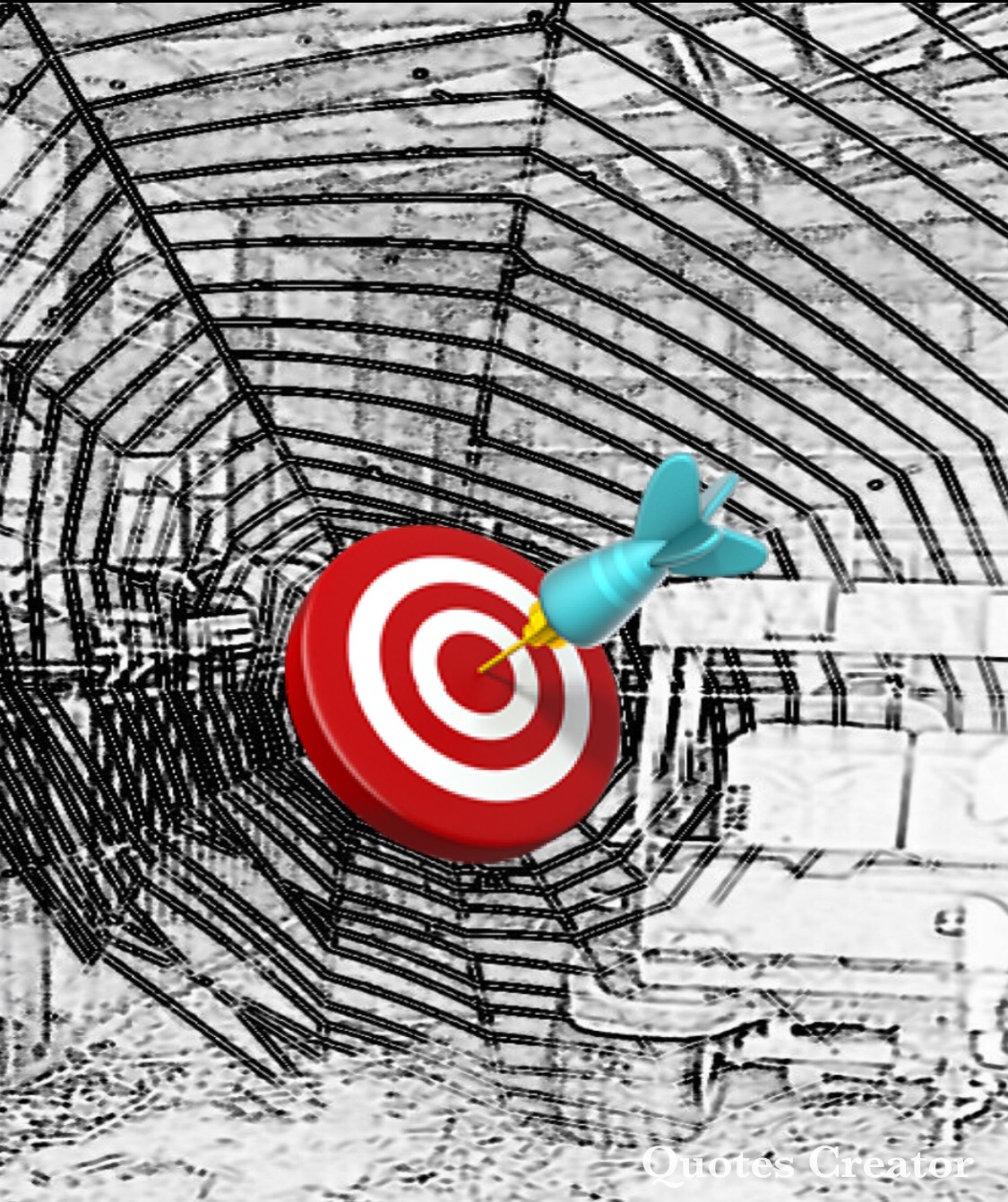
We had a gathering of our Carolina’s 3D Leadership Program today and, as is always the case, I was inspired and learned a lot from the group. Last week I blogged about the activity where I showed the group the picture of a spider web that I had taken in the barn that morning to the group to prompt a discussion. You can read about Leaders Weaving The Web here. Today I switched up the prompt just a little. Here it is: On Day 247 of the Global Pandemic, relate the journey you are on to the picture. The picture was the photo featured in this post minus the target and dart. After having some time to discuss in small breakout groups, they came back with some very insightful points for discussion. This post includes all of their points except one: the picture looks as though we are looking through a filter. I will address that point in a separate post.
Looks Like a Target
It was commented that the web looks like a target. I loved a comment that was made that even though the world has been thrown “out of kilter” (this, from one of our participants, is so much better than saying unprecedented times), we still have much to accomplish for our students. We must still be meeting our educational targets for our students and developing them as a whole person. In other words we need to be very careful about what things we have paused that turn into permanent pauses. Some pauses need to be made permanent, but we really need to match what decisions we make to the targets that need to be achieved for our students.
Looks Like Broken Glass
One group of participants said the web looked like broken glass. This was a reminder that we must keep going. This reminded us that there has been a great deal of positive innovation brought by the pandemic. Also, we discussed that the pandemic cannot be used as an excuse to lower expectations. Our kids deserve effective instruction and like was said earlier we must continue to lead them to their learning targets.
Looks Fragile
The group pointed out that everyone is very fragile right now, but there is strength in the web. We need to make sure we are serving like the silk of the spider web connecting all the small, important pieces together for our students, families, and those we serve. We need to continue connecting ideas, which in-turn creates the beautiful masterpiece. Even though the web looks fragile, we need to remember that much of the strength of the spider web comes from its elasticity.
It turns out that a key property of the silk in the spider web that helps make it so robust is something previously considered a weakness: the way it can stretch and soften at first when pulled, and then stiffen again as the force of the pulling increases. Now that is a great metaphor for during this time of being out of kilter. We are being pulled and we need to soften and allow for being stretched, which will then allow us to stiffen and become strong for those we serve. Markus Buehler, an associate professor of civil and environmental engineering (CEE) at MIT, has done extensive research on spider webs says this about the web: “It’s a very flaw-tolerant system.” We need to also assume this “flaw-tolerant” position when dealing with students or those be serve.
Hopefully this being out of kilter is preparing us for a new phase of greatness in education, business, and our lives. With each day of the pandemic my hope is that we are assuming an attitude of preparation. I know I am very different today that I was 247 days ago. I’d like to think that most of those differences land in the positive column. Let’s keep moving forward – onward and upward!
Don’t Overlook The Brilliance Of Our Students
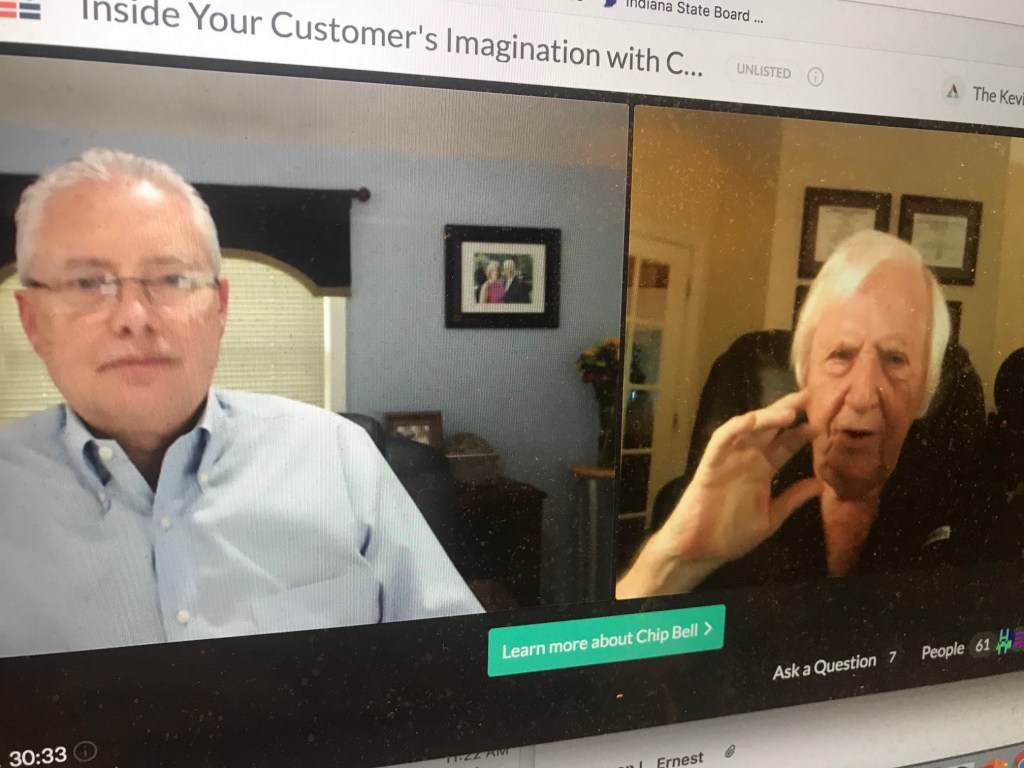
I’m still getting caught up on my reflection of the lessons from Kevin Eikenberry’s Virtual LeaderCon last week. This post is about Chip Bell’s response to my question about where education and the students we serve fall into the realm of the work he has put together in his latest book, Inside Your Customer’s Imagination: 5 Secrets For Creating Breakthrough Products, Services, and Solutions. The first thing he said was, “We must treat students like customers, not consumers.” There is brilliance in our students that so many times gets overlooked.

I asked Chip to go into a little more detail about treating students like customers and not consumers. To this he stated that we have board meetings and where are the students (I’m excited that many states have put students on their state boards of education – I’m still working on Indiana)? But, local school boards should think about student members in some capacity, too. He also asked us to think about where the student was when we were having planning meetings. Chip explained that everything we do should “have our customer’s fingerprints all over it.” He used the example of when we coach little league baseball we tell the kids to “be the ball.” We need to be telling our students to “be the customer.” And, then letting them be the customer. Chip believes our students should be partners along with our students’ families. He promotes student-staff partnership initiatives.
Chip Bell reminds us that customers can give us our best next idea. We should be asking the question, “What is something no-one else has ever thought of?” This discussion reminded me that the words “customer” and “consumers” are often interchangeably used and are easily confused with one another. While students are consumers and the ultimate user of the product, we need to treat them like customers – the person buying the product. We need to think of our students as a final customer– these are the customers who buy the product for their own need or desire. This kind of thinking will help us to better individualize education for every student.
We must innovate. Listening to our students will help us to do this. We can’t keep offering the same thing over and over and over again. We owe it to our students to be authentic. As Chip told us during Virtual LeaderCon, “Authenticity wins every time.”
Angry Fishing
 I just tweeted that having your son in Murray, Kentucky at Murray State University had its advantages; one of which is getting to spend the day on Kentucky Lake fishing for Crappie. Heath picked such a beautiful place in the world for college. We had a great day that started at 5:30am. It’s always great to spend the day doing anything together with the boy. We have been blessed to make so many memories doing a variety of things together. I’ve always said that raising this kid has been the single most important and rewarding thing I am doing.
 Today, we had the opportunity to use some of the latest computer vision technology for fishing. Thus the title for this post: Angry Fishing. It was truly like a video game, at times, that I would call Angry Fishing (referring to Angry Birds). As always, I was fascinated with the technology and learning how to use it. I was also amazed at how being able to use the technology, in much the same way a video game does, enabled me to improve my fishing skills.
 We were fishing for Crappie today and they require a very patient technique, but you must be quick to set the hook at the right time. With the video technology we could literally watch the fish going for the bait. I’m not going to lie, I missed several today because I got caught up watching fish going for Heath’s hook and him catching them. We were able to, in real-time, just like when playing Angry Birds, know what adjustments to make in our techniques. And the great part about Angry Fishing (real life fishing like we were doing) is you get to do it over and over, just like you can when playing Angry Birds. It was fascinating!
This was a reminder of how we need to always employ ways to give students, or anyone we are teaching for that matter, immediate and usable feedback. Today, I was even able to begin to self diagnose areas for improvement and make those changes immediately. Another reason we need to always be teaching using real-world and relevant contexts. We all, no matter what our age learn best when we are using adaptation. We need to be applying across disciplines, thus why I am right now applying this day of fishing to doing a better job of teaching and professional development. This also gives us the opportunity to apply the learning to real-world predictable and unpredictable situations. I talk about these same things when using Angry Birds as a throughline for discussing high impact teaching strategies.
It is also my hope, and I believe they are, that these technologies can be a catalyst for transformation of fishing and fishery policy. Under a sustainable approach, where we satisfy the needs of the present without compromising the resources of future generations, technological innovations like my son and I used today offer an opportunity to improve the fishery and seafood industries; as well as protect the environment. Electronic monitoring systems and computer vision technologies combined with artificial intelligence machine learning is being used to improve the cod fishery and preventing overfishing of halibut in the Pacific.
I continue to be amazed and hungry to keep learning the technological innovations that can help us all learn more effectively and continue to make the world a better place. The possibilities are as vast as the great bodies of water we love to fish on. Join me in continuing to explore and learn!
Where Is The “Twin”?
 Today I had the opportunity to moderate a great global webinar entitled “Creation of a Digital Twin.” The webinar was put on by GIA SMART Factory League. I am always honored to have the opportunity to work with this organization and it was incredible to be in the [virtual] room with industry representatives from over 36 different countries. And…now that we have learned we can hold these events effectively virtually and learn together apart, we can get together more often and not have the huge travel expense. Talk about holding the whole world in your hands!
 I value the opportunity to spend time learning from those in business/industry and manufacturing. It saddens me that many leaders in education talk a big game about wanting to hear from business stakeholders, but most of what happens is lip service. We need more walking the talk. Those in education must stop thinking we know more than those that hire the students we educate. It must be a partnership. There must be a true dialogue of listening to understand.
 That’s why I love events like the one today where we can learn together and learn each other’s industry specific languages. Today we were learning about the “digital twin.” The creation of a digital twin enables us to simulate and assess decisions:
- Before actual assets are built and deployed
- Before maintenance
- Before a design change
- Before complex tasks
 A number of industries are creating digital twins, digital replicas of products, and many other things including body parts. Today we saw a digital twin of the heart done by Philips Innovation Services. The heart digital twin performs patient specific adaptation. It was amazing. Imagine the testing of procedures and products for heart repair. Also, think of the possibilities for training and education. Endless!
 The digital twin mirrors what it is twinning in bits keeping the bit replica synchronized with the real one. I learned today that just certain parts of an asset can be selected to twin. Thus making it easier to focus in on specific functions or parts. It was pointed out that this could be of incredible use in education and training. In this sense digital twins are a new tool for education: rather than studying on the real thing you can study on its digital representation. Even though in a polling question I asked during my introductory statement today, there were only 7% of participants using digital twin technology for training/development and education, and 27% just starting too, technologies like virtual reality provide new tools for education.
Imagine if we had a digital twin of ourselves. We would still have all the flaws, but some some smart technician might find ways to help us improve. Far fetched? I think not!
Messy Creativity
 On Monday I was doing a professional development gathering for Cardinal Charter Academy in Cary, North Carolina entitled “Flat Stanley Goes Virtual: Let’s Be Engaging, Not Flat.” Of course, I used a through line: Flat Stanley’s and Flat Sarah’s. We were discussing achieving high student engagement. Participants made their very own Flat Stanley or Flat Sarah that represented their journey during the, then 156 day, journey they had spent during the COVID-19 Global Pandemic.
The participants were super creative and it is always interesting to hear the share out stories. One really caught my attention (see picture in this post) when the participant pointed out she had put a paint splatter on Flat Stanley’s right knee to represent the messiness of our lives right now during the COVID-19 Global Pandemic – the mixing of colors without a set plan or vision of a final piece of art. While it is true, there seems to be a lot of messiness and paint slinging, it got me to thinking that we should try to treat our current situation more like an artist.
In education we have always relied on our function being to provide clear standards and the facilitation and tools needed for student success. This function has been, and continues for the most part, done in a very rigid and standardized way. While reform attempts have been made there is still much work to be done to disrupt the status quo.
All of our lives have become messy during the now 158 days of the pandemic. Additionally, the pandemic has exacerbated the messiness of leading learning in education right now. To address an issue standing between a problematic status quo and student success, we must travel into an uncomfortable unknown territory with no signposts pointing toward the destination. Right now, in these times, we are on a quest not knowing our destination before arriving. We must recognize and accept the scariness and messiness of the unknown.
 We need to find ways to let loose and let the paint splatter, like on the knee of our participants Flat Stanley, into beautiful art. This makes me think of the paint splatter rooms that are popping up in many cities. Basically, you go, suit up in protective clothing, and sling paint (🎨 6+ colors) at each other and a canvas. What fun! Upon completion of your 30-45 minute “splattering” you have a beautiful piece of art. I really want to go do this! Leadership is so messy, and this splatter room concept makes such a great metaphor.
These splatter rooms have been used for therapy and team building because of the feeling of freedom achieved by just slinging the paint and the random mixing of colors. A messy process where the splatter artist doesn’t exactly know how the canvas will look in the end, but has created a beautiful product. There is so much we can’t predict, much less understand and control, especially right now. We need to keep leaping into an exploration of the possibilities with unscripted questions and activities – the splattering of paint.
We need to embrace the messiness and discover previously unimagined possibilities. Leadership is not about finding one’s courage. Rather, leadership is accepting the messiness and fear that goes with the new and unknown, and then finding the courage to surface its possibilities and beauty.
Bringing The Smithsonian to You!
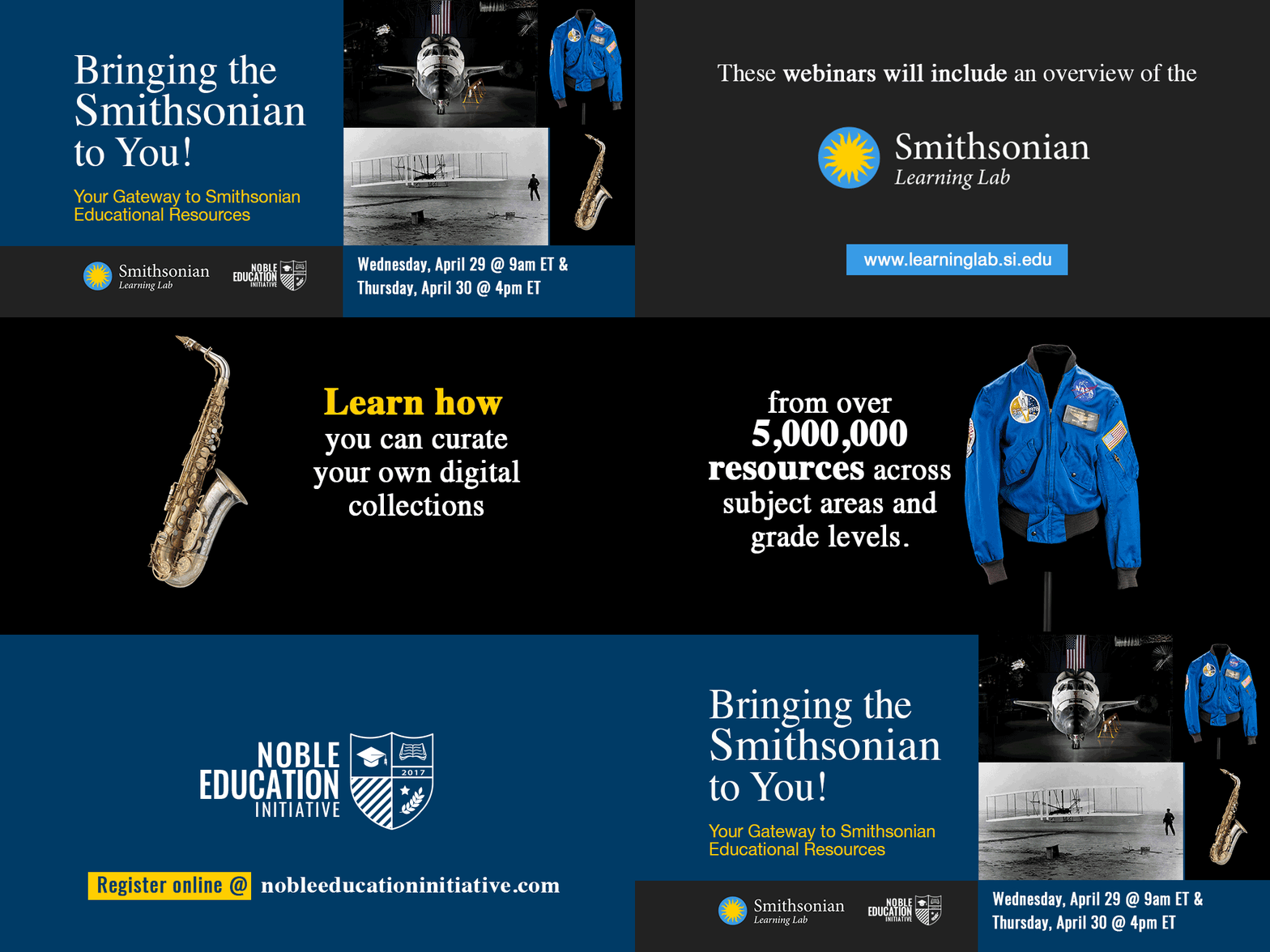
During the COVID-19 Pandemic and the many webinars we have been doing to support teachers as they facilitate learning virtually, I keep commenting that the Smithsonian Institution is a tremendous resource. Or, should I say, plethoras of resources and services. Then I got to thinking that if I was going to keep saying that educators needed to check out the Smithsonian, we needed to do a little “show and experience” for them. As a former Smithsonian Teacher Ambassador, I really value all the resources available for educators. So, I decided to reach out to Ashley Naranjo, Manager of Educator Engagement at the Smithsonian Learning Lab, and ask if she would be interested in doing a webinar together. She was quick and enthusiastic to respond in the affirmative. Needless to say, I was excited.
Ashley and I had a great planning session where she had great ideas for engaging webinar participants in actually navigating and using resources. In fact, she and I will be modeling an activity at the beginning – I can’t wait! As I mentioned earlier in the post, I was a Smithsonian Teacher Ambassador back in 2010 and 2011. During that ambassadorship I was talking to groups of educators and organizations about the over 1,600 Smithsonian resources available. I told Ashley this asked how many there were now; she laughed and said, “Over 5,000,000.” Boy did I feel outdated.
Bottom-line: educators won’t want to miss this free webinar. This interactive and engaging webinar will include an overview of the Smithsonian Learning Lab and how teachers can curate their own digital collections of resources across subject areas and grade levels. The great part is that educators will learn, by doing, how to use Smithsonian Education museum resources in their own teaching and learning contexts. Please join us for this journey of bringing the Smithsonian to you!
Influencer, Inspiring, & Impactful
 At yesterday’s Indiana 3D Leadership gathering I was inspired to do some deeper studying, which is usually the case, because of discussion that took place. I usually say the discussion inspired me, but for this post I’m contemplating what to call it. More on why I say that, later in the post. Last night we did an activity that I call Rushmorean Leadership which was then followed up by an activity called extending the influence. The activity calls for teacher leaders to bring pictures to identify four great leaders to put on their own personal Mount Rushmore. Then they bring six additional pictures to extend the influence.
As with everything this Indiana group does, I was blown away. What struck me last night, however, was that one participant talked about the persons on their board as influencers. Then the next referred to the leaders as inspiring and yet another referred to the her chosen leaders as impactful. For some reason I just had to ask the question of the group: What’s the difference, if any, in these descriptors? A great discussion ensued, which then led to me studying deeper this morning.
We all know that leadership is not about a title or a designation. We also know, and I’m glad we discussed this in depth last night that ambition is not a favorable characteristic of great leaders. For ambition will take over purpose. Influencers, we decided, spread passion for work, causes, innovation, or change. Those that inspire evoke a sense of energy. Finally, impact involves getting results. Impact is ultimately the measuring stick of the influence or inspiration.
Influencers cause us to think about things differently. They help us to shape our purpose, passion, and core values. Interestingly several participants had parents on their boards and referred to how they had influenced their lives.
In contrast, those that inspire help us gain motivation. This inspiration may be in the form of receptivity, positivity, or motivation. There is research that links inspiration to motivation. This inspiration causes us to actively engage in environments that lead toward self growth and fulfillment of needs.
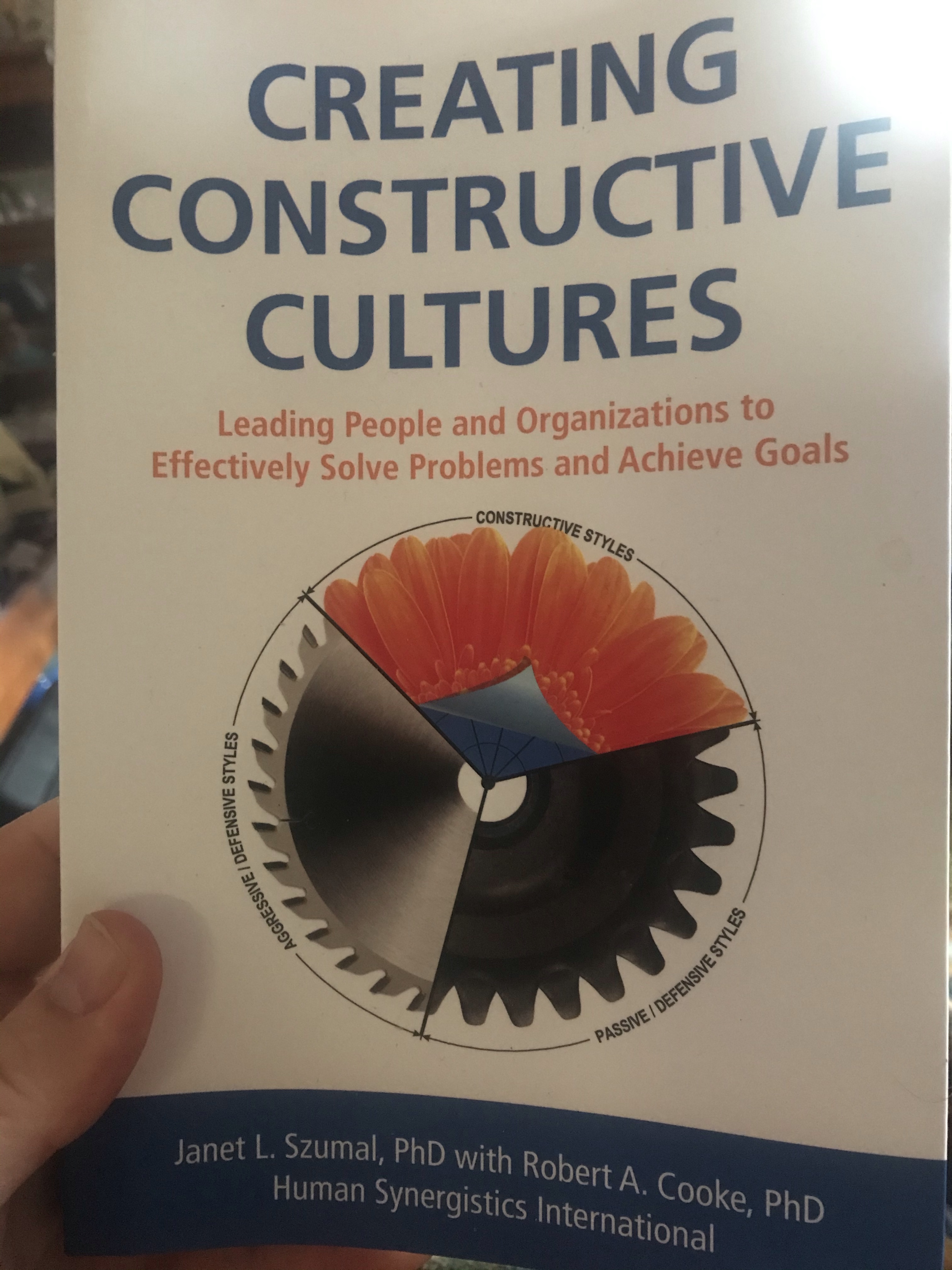 The more I studied and reflected on all this I formed the opinion that most, if not all, of the leaders chosen by the group were influencers who were creating an impact. These individuals were all helping to create constructive cultures, whether in organizations, nations, or globally. In their five star book, Creating Constructive Cultures: Leading People and Organizations to Effectively Solve Problems and Achieve Goals, Janet Szumal and Robert Cooke of Human Synergistics International ask the question: “As a leader, how can you both directly and indirectly influence your organization to ensure that members can independently and interactively solve problems and achieve the organization’s goals more readily and effectively?” I love the question because it has both directly and indirectly. Of the ten leaders each participant brought pictures of, some influenced directly, eg. parents. Others influenced indirectly, eg. Michelle Obama.
One thing is for sure; in all cases the individuals chosen embodied the necessary styles to create constructive cultures. All strove to create the cultural norms necessary for creating constructive cultural styles. See the constructive styles below: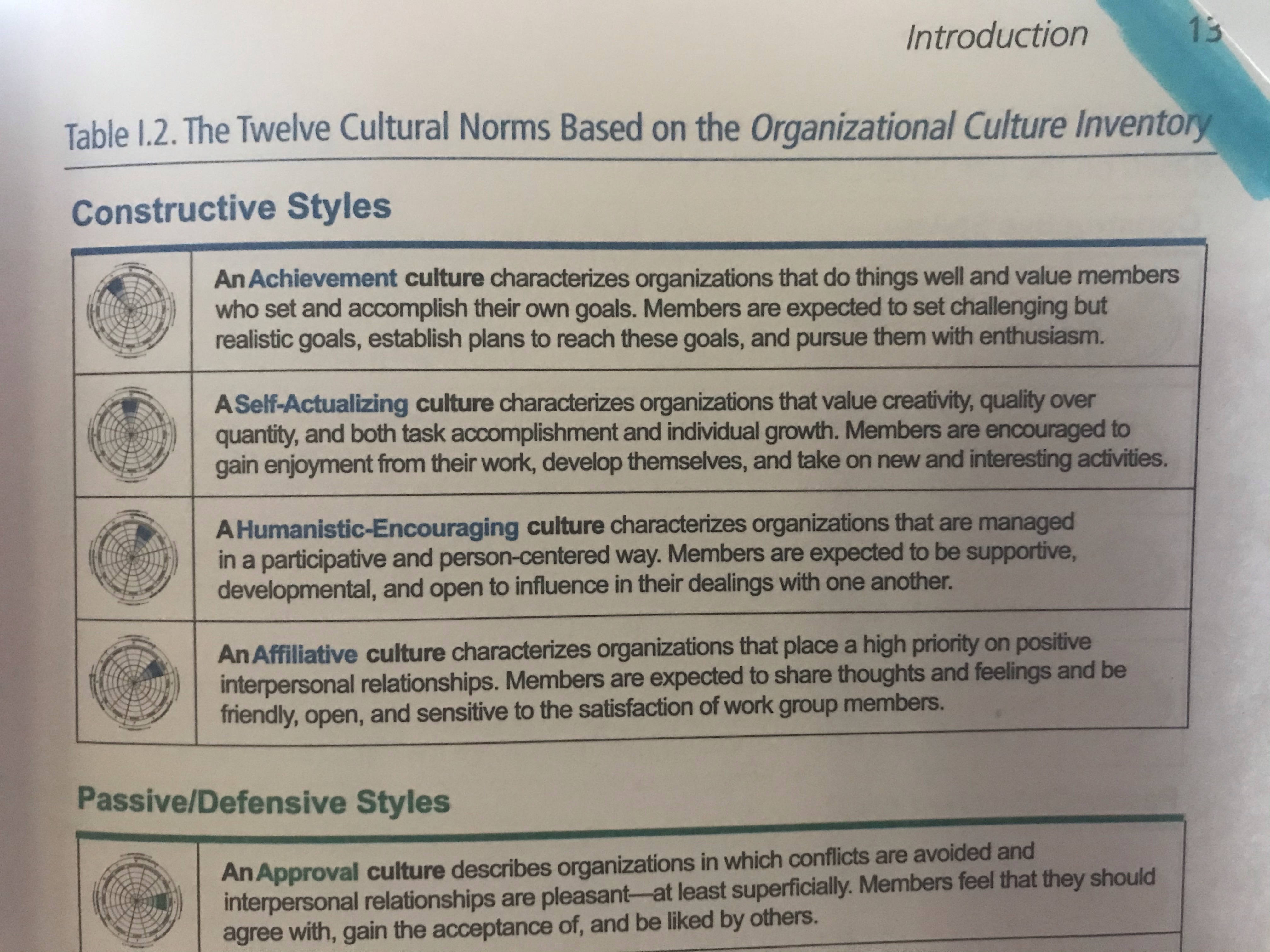
So, I’ve come to the conclusion that influencing, being inspiring, and being impactful are not mutually exclusive. They go hand in hand when being a model of personal growth for us and creating constructive cultures.
A Twist Of The Kaleidoscope
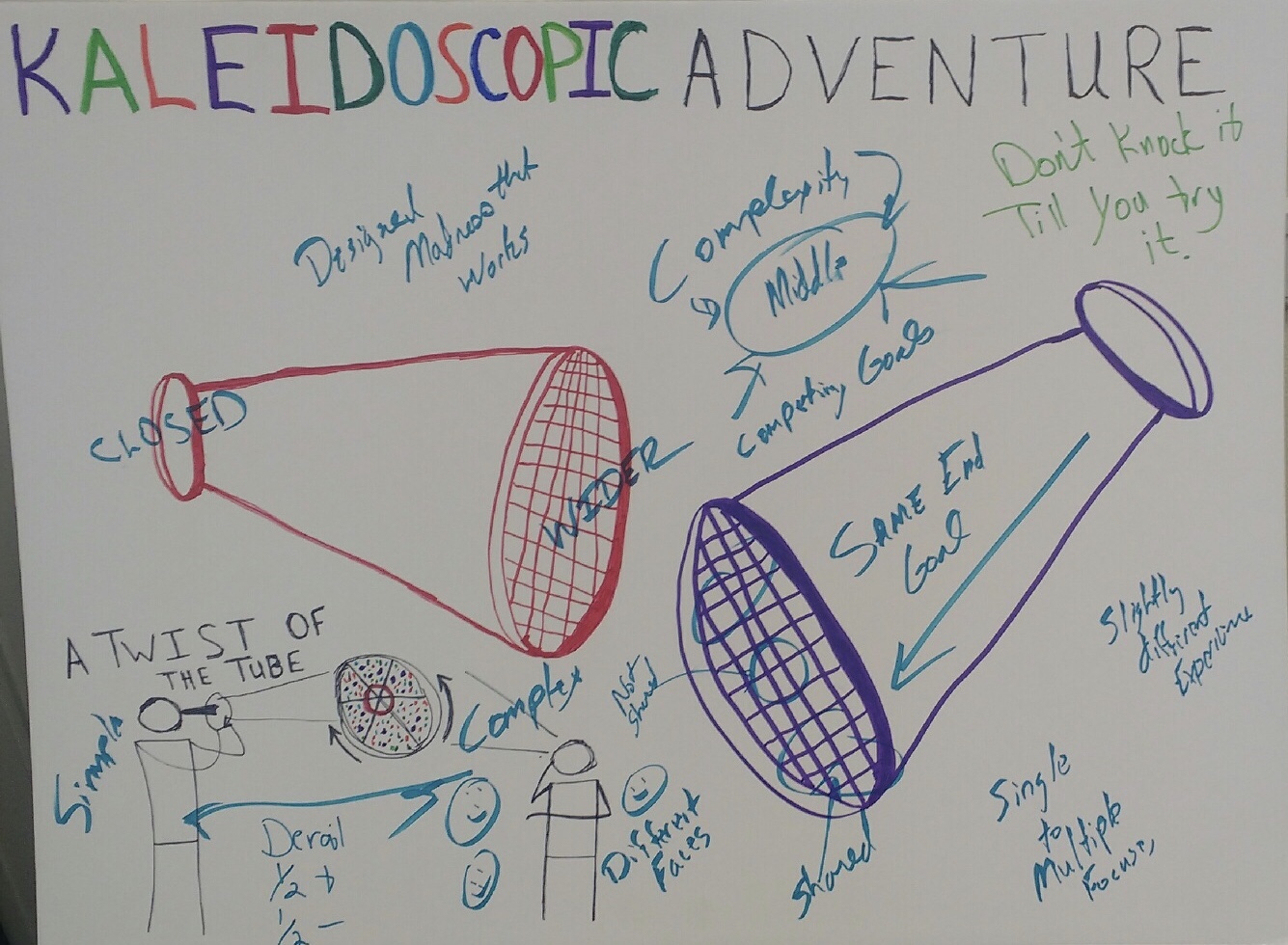 A couple of weeks ago I spoke to a group of college interns using kaleidoscopes as the through line. I gave all the participants a small kaleidoscope and had them get into groups, look through their toys, and relate the view to their journeys as interns and becoming leaders. As the graphic I drew during the presentation shows, I titled our time together Kaleidoscopic Adventure. I encourage you to take a moment and check out the points made by the groups reflected on the graphic.
 The interns quickly got the point that looking through a kaleidoscope is all about perspective. Perspective is the strongest power of the mind. Give the scope a twist one way and you see a set of images, and turn it the other way and you see another set of images. The different views represent our lives. We just need to find the angle we want to look through.
 Our lives are complex, random, and structured; all at the same time. Much like looking through a kaleidoscope, we look from the simple to the complex. Sometimes we need to remember to look back through the kaleidoscope the opposite way, taking the complex back to a simple focus. This reflection brings us back to a simple neutral.
View through the kaleidoscope given to the interns
One thing is for sure, we need to enjoy the beauty of the journey. Just like the kaleidoscope, we all have different views and experiences. We also need to remember that the world we live in is ever changing and quickly changing just like the view as we twist the kaleidoscope. A kaleidoscope is such a great metaphor because it symbolizes ever-changing and endless possibilities. The kaleidoscope also reminds us of our endless possibilities powered only by the limits of our own creativity and innovative prowess.
Serendipity Mattered
 This week while continuing to read Great Society: A New History by one of my favorite authors, Amity Shlaes, I found the shortest sentence in the book: “Serendipity mattered” (p. 188). Serendipity has always been an intriguing word to me that I have had trouble understanding because I here it being used in different ways. But when used in the context of Shlaes book, in a two word sentence it made perfect sense. The sentence “Serendipity mattered” really drove home the point she was trying to make and really made the lightbulbs come on for me.
 In other words, there needs to be serendipity for innovation to occur. So what is serendipity? As I said earlier, I have trouble understanding it fully, but I know that when conditions are right for it, great things happen. Serendipity is said to happen by simple chance. An opportunity that comes about by a chance occurrence. Therefore, we must create the opportunities for these occurrences. This was the point that Shlaes was making in the book. The Fairchild Semiconductor company realized they needed innovation. They also realized that looseness of hierarchy drove innovation. Thus, “Serendipity mattered.” It is also why we need to beware of the current tides toward any of the Great Society’s socialistic tendencies. This will stifle the serendipity that is so needed.
 I touched on serendipity in my blog post Alternative Truths back in 2017, but only to say that we need to be intentional to create space for serendipity to occur. Therefore, I needed to study a little more. Research led me to find that our use of the word serendipity comes from The Three Princes of Serendip. The musician and poet, Amir Khusrau wrote this Persian tale in 1302. The tale is about King Jafer and his three sons. He wants them to have the best education in the kingdom. The King believed that great book learning needed to be combined with a real world context. Wow, I preach that all the time! In fact, I wrote a book, The Hand In The Back Of The Room, about it!
Anyway, the king gave each of the boys a horse and told them to go discover. The boys relished and took advantage of this experience. They learned from being on a journey of taking in real world experiences. Then in 1754, Horace Walpole coined the word serendipity in a letter. He described serendipity, by referring to the tale of the three princes, as making discoveries, by accident and sagacity, of things which they were not in quest of. He was excited about this word because there was no word to describe the discovery of something you are not looking for. It was really accidental sagacity.
Then comes the question, how do we create space for serendipity to happen. It probably won’t work to get everyone a horse, but I’m certainly up for it. Think about all the great inventions and innovations that have happened by accident. We need to remember in all this that creation precedes innovation. We need to provide ourselves and others varied routines and time for serendipitous moments to occur. It is why the story of the king sending the princes on a horseback adventure is so important. They’re heads were clear and they were just observing. Think about it; it’s why just taking a walk to clear your brain can bring creative thoughts and solutions. I do this a lot when facilitating teacher leader gatherings. I will tell them to split into groups and take a walk and discuss… They always come back refreshed and with great thoughts and ideas.
Leaders, including political leaders, need to recognize the important role serendipity plays in creativity, innovation, and even relationship building. Interestingly, in my research I found having lunch together as a strategy for encouraging serendipity. I blogged about having lunch together in Let’s Have Lunch Together, but not from the angle of serendipity.
We need to start looking for more serendipity to happen and create space for it. We might not be looking for something specific, but we need to be tuned into a channel of infinite possibilities. Think about it; this blog post was inspired by a two word sentence. It must have been serendipity!
Deep Innovation
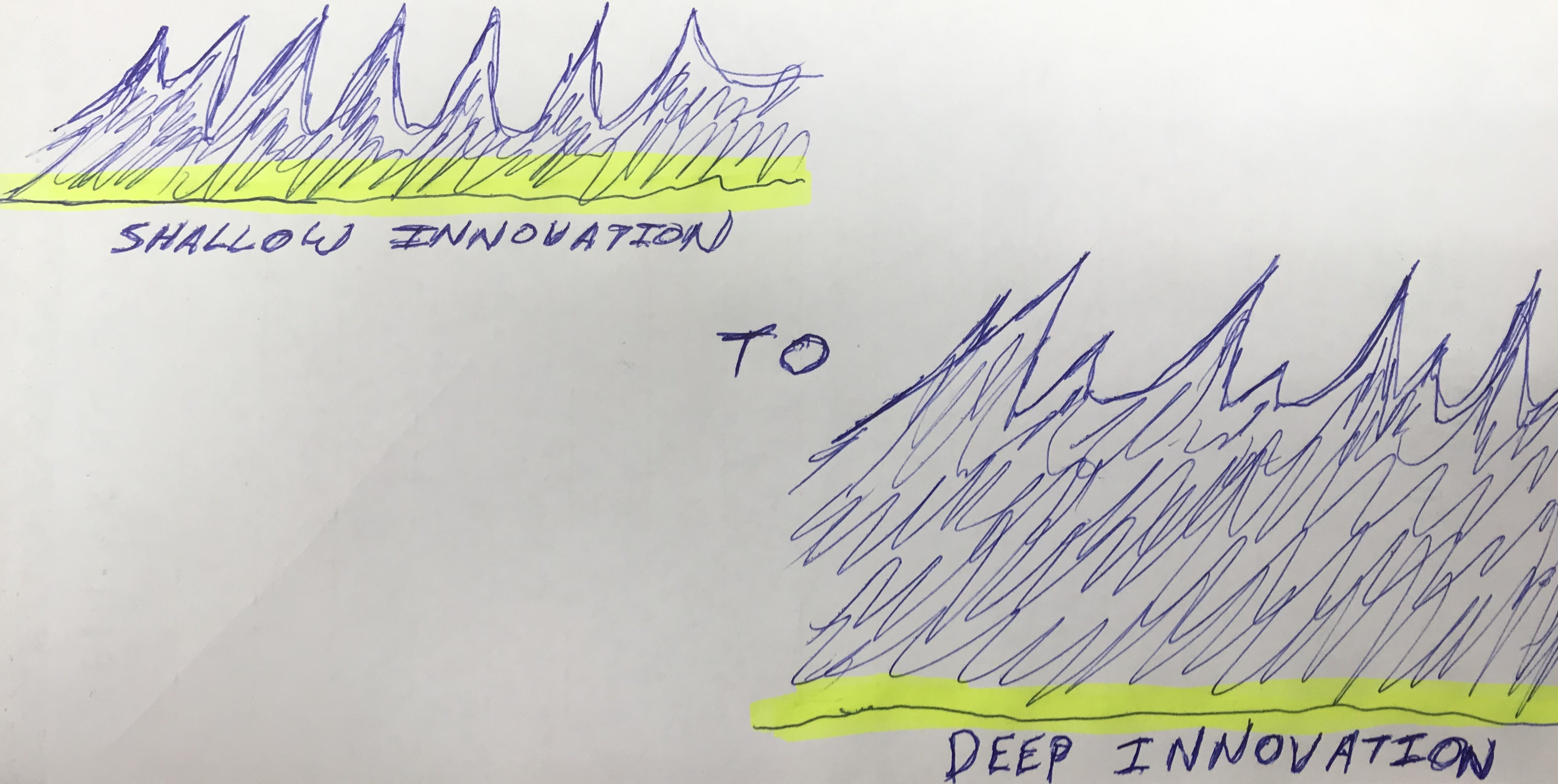 As a self proclaimed energetic change agent, I had a great chance to check my values and views toward innovation while reading the awesome book, Innovation For The Fatigued: How To Build A Culture Of Deep Creativity by Alf Rehn. Rehn argued that we have become “shallow innovators” and need to start practicing “deep innovation.” One problem is we start using the same old rhetoric that makes us think we are “maverick innovators,” being “transformative,” or practicing “disruptive thinking.” We think these buzzwordy titles mean we are innovating, but really we are merely tinkering around the edges and making superficial changes. See why I gave this book ⭐️⭐️⭐️⭐️⭐️?
“Innovation has become a tired buzzword.” ~ Alf Rehn
 According to Rehn, we need to focus on big solutions. In order to have deep innovation we need to start from scratch, or go in an entirely different direction. Real innovation, Rehn posited, looks beyond what we do and know now. One of my big takeaways was that we need to stop directing so much time and talent on incremental change. Many times we take the easy way out and make ourselves feel better, saying we are taking baby steps.
“Innovation history teaches us that human beings are terrible at identifying innovative ideas.” ~ Alf Rehn (p. 54)
Another part of the book that really jumped out at me was the section entitled “The Curse of Expertise” (p. 54). I have always worried about getting caught up listening to so called “experts.” In fact, I have blogged about my dislike of experts many times in Thanks For Not Being An Expert, Decision Making vs Problem Solving – and Why the Difference Matters, and Dig In & Stop Guessing. Rehn explained that many great ideas have been killed before they had a chance to prove themselves by these so called “experts.” Rehn said, “As curious as it sounds, the better we are at something and the more expertise we’ve amassed, the worse we often get” (p. 55). It is not that experts are bad, but we just should not rely on their word as the final word. Experts often forget that their expertise represents a very small part of the world’s total wealth of knowledge. We have a tendency to overestimate what experts know and want to use their opinions carte blanche. I see this happen a lot in policy decisions.
Finally, Rehn advised us to cultivate a culture of innovation. We need a certain amount of trust and an environment where we are able to voice our ideas or opinions without fear of censure or dismissal. This is what Amy Edmondson coined as “Psychological Safety.” If we lack an innovative culture we will only practice “shallow innovation” instead of “deep innovation.” This will then eat away at our organization’s purpose, according to Rehn. The loss of purpose will ruin an organization and affect employees at every pay grade of an organization.
So, let’s create a culture of innovation so we can practice “deep innovation” and change the world!
 Byron's Babbles
1 comment