Learning 4.0
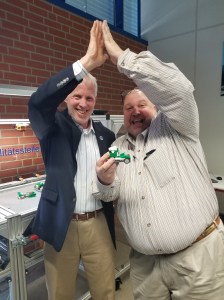 Yesterday I had an incredible experience at the Benteler Education and Training Center in Paderborn Germany. We had the opportunity to learn Smart Manufacturing first hand by working in the Benteler Industry 4.0 Learning Factory. This factory was built by the students and used to teach Industry 4.0 smart manufacturing practices and techniques. This learning factory also affords students the opportunity to use equipment and use 4.0 practices. There are three choices of products to build in the learning factory: speed boat, semi tractor; or sports car. The cool part was that all of the parts for the products except for the the grill ornament (made by 3D printer) were Lego™. I had the honor of working with Representative Bob Behning on this project.
The line starts with the selection of which product and what color the product will be built. For this part of the factory SMART glasses are used in order to give the student the opportunity to use and navigate this 4.0 technology. I am really glad I had the opportunity to do this. We had been hearing about SMART glasses and having the opportunity to actually use them on the production line was awesome. Then after the selection of the color and product the line gave us a tray of parts to get started.
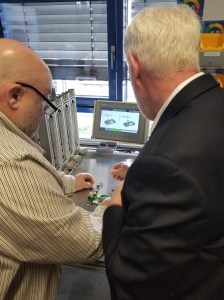 After assembling the frame of our truck it was then moved down the assembly line and the RFID chip (I could relate to this because it is like the RFID tags we use for data and identification of our dairy cows) read what product we were building and gave us the next set of instructions digitally. As we waved our hand over the screen the proper bin for the next part would light up and then the screen told us where to put the parts. Even though we were doing some human labor on this it was evident to see all the skilled labor that was needed to program the line to give us the right parts on time during the assembly. Finally, we installed the Benteler emblem made in the 3D Printer to the grill of the truck.
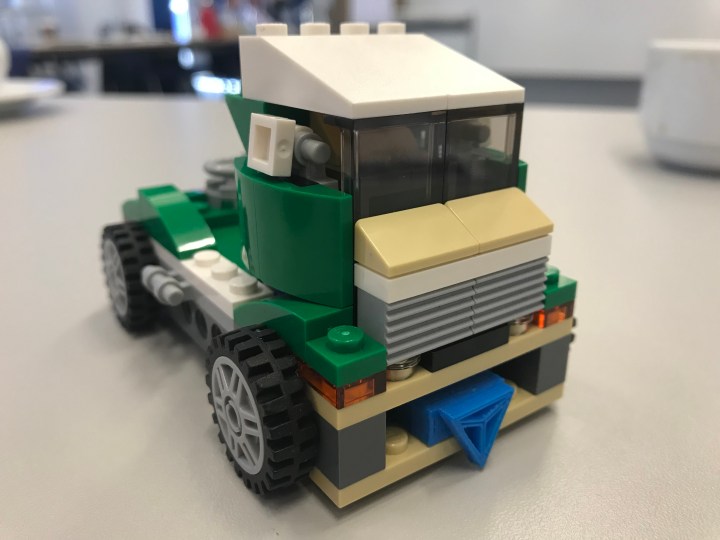
One of the coolest things was at the end of the assembly line when our completed truck went into the sensors to tell us if we had made it correctly. We either got a green light or a red light. The green light meant we had it perfect, the red meant we had a flaw. Sadly, we got a read light. We went back and studied, but could not find the issue. We found there was an error and we were not given the instruction or part to put some covers on the clearance lights on the front of the truck. But, how cool is that to have sensors that could tell us if the product was perfect. Here is a picture of our final product:
 I am so glad I had this experience. It also really drove home the fact that, as the research tells us, as adults we like to learn like our young students. We want the education to be relevant and we want to be engaged in the process. Let me tell you, Representative Behning and I were very engaged. We were excited as the truck came together and went down the line. Then we were screaming when the truck did not pass inspection. We were ultimately proud of our product. Bottom-line – This Industry 4.0 Learning Factory made school work into real work. We were using real life digital tools to make a real product in real time. How much more engaging can you get?
 The factories of the future will be very different from the workplaces of today – in 2016 alone nearly 200,000 robots were deployed in automotive factories and a further 85,000 were installed in factories making electrical and electronic goods, so automation will liberate people from the drudgery of production lines. Now with Artificial Intelligence (AI), the robots will be able to interact with the human. These “cobots” will take robotics to a new level. This past week we have also learned that at work or at home, the Internet of Things (IoT) will completely change the way in which most of us carry out our basic daily tasks, eliminating the drudgery of shopping, banking and even cooking.
I am so glad I have had the opportunity to learn about Industry 4.0 this past week. One thing is for sure: this will completely change the dynamics of manufacturing and will mean that we will be able to make products that are tailored exactly to our wishes in every way we could want. The very same technology is already being used to produce motor vehicles and even to “print” buildings, so the possibilities are almost endless! We need to make a commitment to making sure we have our students ready for this workforce. That means we must start and continue to have the conversations between all sectors about how to do what is best for our students. This involves bringing business/industry, k-12 education, higher education, education advocate organizations, business/industry organizations, state officials, families, and students together to partner how to make this happen. I appreciate all the work that organizations like Horizon Education Alliance are already doing to make the conversations happen – thus why we are learning in Germany and Switzerland. It is the right thing to do for our scholars!
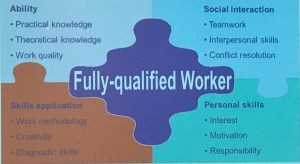
Fully Qualified Worker
 The past two days in Paderborn Germany have been awesome. Our Horizon Education Alliance education study group had the opportunity to spend a great deal of time at the Benteler Education and Training Center. We have spent a lot of time learning about the German Dual System of Apprenticeship and vocational training. Students in Germany can chose a company/employer apprentice or college training. See pictures here to get an idea of the German system:
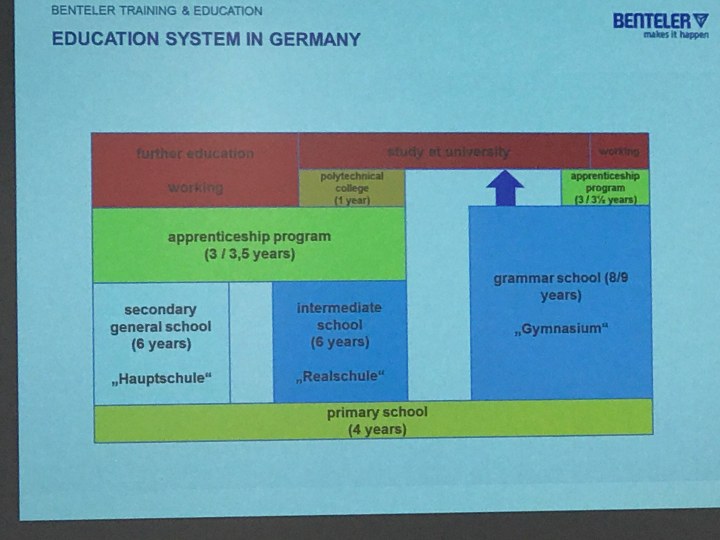
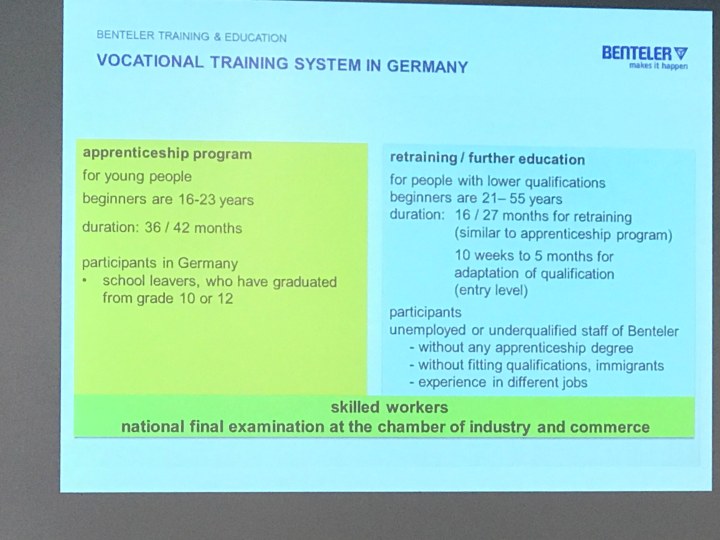
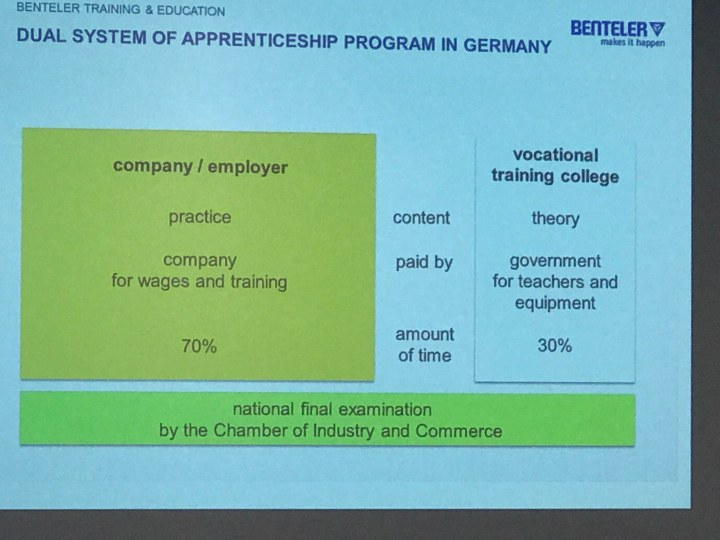 The German system is intriguing and I am amazed how much the companies take responsibility for being part of the training. Students have the opportunity to do two week internships to help them sort out what they want to do. Then, if the apprenticeship option is chosen they can then apply to companies. This can either happen after year 10 in school or can be chosen to do after year 12 in conjunction with the university.
 We had the chance to spend time with Benteler’s student touring and getting a first hand look at how the final examination/certification process works for the apprenticeship program. This examination is taken in two parts. One part is taken after 1 1/2 years in the apprenticeship and the other part is taken after 3 1/2 (the end) of the apprenticeship. The examination contains a theoretical part and a practicum part where the apprentice is doing an actual project in his/her chosen field of study.
I am amazed at the community that Benteler has formed to educate the students. The students are very engaged and interested in the process. In fact, I had the opportunity to have a student teach me how to use a robot welder. The same welder that would be used and in the same way he was taught in the apprenticeship program. This was a great experience for me to put myself in the shoes of the student. Here is a video clip of part of my robotics certification training:
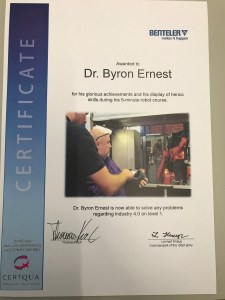 This was such an awesome experience and it is so incredible that Benteler has made the investment here in Paderborn Germany to educate its workers and these students. Due to Industry 4.0, the BENTELER training program has become very important to having a highly trained workforce and is constantly changing, integrating content and thus adapting it to the needs of the market. I was proud to be award an Industry 4.0 certification while I was there and again was really glad I took the opportunity to interact with the students and experience education from their point of view. Have you ever taken time to visit a school and experience life from the viewpoint of the student? You should!
Leading Work 4.0
 Today, our Indiana delegation in Germany spent the morning in Paderborn at the Benteler Vocational Training Center and then the afternoon touring the Benteler Automotive Plant. Because Benteler is 30,000 employees strong at 144 locations in 39 countries, they believe a company is the sum of all its employees. In other words, Benteler has 30,000 “guaranteers of success.” As a side note, 5,000 of those employees are in Indiana.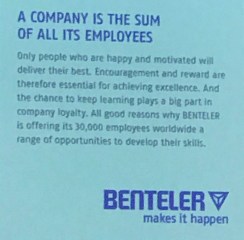
While visiting with Benteler officials and students, we learned more about five new and emerging areas in manufacturing and industry:
- Smart glasses
- Digital maintenance
- Predictive maintenance
- Smart production
- Work 4.0
These are all areas that both the manufacturing sector and education sector need to be area of and talking about together. This all further drove home the point about why we, in Indiana (and I am sure all over the U.S and Europe) to continue to replicate the great work that Horizon Education Alliance is doing to facilitate bringing together all the stakeholders to develop solutions for educating our young people to be ready for the workforce of tomorrow.
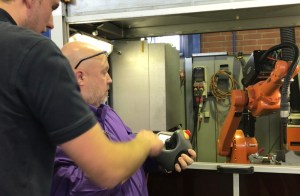 Smart Glasses
Smart glasses can collect information from internal or external sensors. It may control or retrieve data from other instruments or computers.
Digital Maintenance
Digital solutions applied to maintenance can considerably improve asset reliability and reduce operating expenditure by predicting equipment failures, streamlining supply chain, reducing unplanned and planned maintenance and increasing production efficiency. Equipment can be set up with a digital inspection plan, run-to-failure, condition based maintenance, preventive maintenance or predictive maintenance strategy.
Predictive Maintenance
In a predictive system, employees and systems can anticipate and act before issues or challenges arise, rather than simply reacting to them after they occur. This feature can include identifying anomalies, restocking and replenishing inventory, identifying and predictably addressing quality issues, and monitoring safety and maintenance concerns. The ability of the smart factory to predict future outcomes based on historical and real-time data can improve up-time, yield, and quality, and prevent safety issues. Artificial intelligence can also be used to predict when something will fail or need to be replaced.
Smart Production
Smart Production or Manufacturing and the Smart Factory enables all information about the manufacturing process to be available when and where it is needed across entire manufacturing supply chains and product life-cycles. This Smart manufacturing, or Industry 4.0 as it is also referred to, is the process that employs computer controls, modeling, big data and other automation to improve manufacturing efficiencies.
Work 4.0
Work 4.0 was the most intriguing topic of the day as it is really about the interaction of humans and machines (eg. robots). The use of pulleys in early antiquity or the Babylonians’ use of pumps to irrigate fields can be regarded as early examples of human-machine interaction. Now we have reached a whole new level of connectedness and interaction. Industry 4.0 has brought humans and machines to an almost human-like connection with emotions and feelings. The digital interconnection of all workers, tools and work-pieces in the production process and across company boundaries is generating an “Internet of Things (IoT).” This means we are going to need to be educating and training on new things. We will also need to educate on the benefits. We will need to answer the question for those we are educating: “How will this make my life easier?” It won’t just work to outline the financial benefits or improvements to the bottom line.
I’ve heard it said on this trip that technology is not the issue, it is the enabler. We will need to be teaching our students how to use the data and the technology. All of this is going to allow us to move from reactive to predictive and preventative (artificial intelligence). Human-machine interaction is taking on a new dimension due to developments in the field of artificial intelligence (AI). Because of AI there are now robots capable of interacting with humans. These are call “cobots.” No longer does the robot replace the human, but actually works along-side the human.
Are you ready to lead and educate in a Work 4.0 environment? 4.0 is here and we need to be having the conversations about how to have our workforce ready. You ready to have the conversation?
From Best Practice To Next Practice
 Today was the final day of the 2nd Annual Global Smart Manufacturing Summit in Berlin, Germany. I really valued the time to get to know business and industry leaders from around the world. I was reminded of what my good friend Kevin Eikenberry and I used to talk about a lot – when we look at the differences between different industries (eg. manufacturing vs. education), we see about 90-95% of our issues being the same and about 5-10% different. What I mean here is that many of the challenges and roads to improvement are the same. Think about it, we all have responsibility in finance, HR, facilities, and customers. If we break that down further, we all have one of the same groups within the customer category – employees. Now, I get it; our employees are our competitive advantage, but employees are still a customer to be taken care of at the highest level.
Organizational Commitment
The first session this morning was about initiatives and organizational commitment. As a believer in learning organizations, I was really enamored by the discussion of organizational commitment. This thinking really fits with a lot of the Gallup® research I have been studying around employee engagement. When we discuss organizational commitment, we are talking about the bond employees experience with their organization. Broadly speaking, we know employees who are committed to their organization generally feel a connection with their organization, feel that they fit in, and believe they understand the goals of their organization.
 Next Practice
One of the session titles this morning was “From Best Practice To Next Practice.” I really appreciated this session because we talk a lot in education about “best practices,” but really it is about making the right choice and implementing the next practice. Good or bad, I tend to be the one looking for the next practices. Really, that is what this entire discussion was about for the global leaders here: what are the next practices.
Convergence
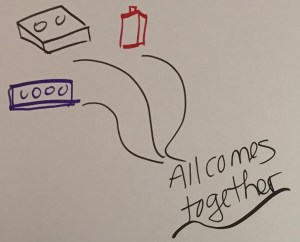
Then, it comes down to convergence. How do we take several sources of independent data and bring them together to develop strong conclusions? In education we call this using “multiple data points.” I don’t think we do the best job of bringing all the data points together. For example, this week I was reading and article about teacher pay and how it was decreasing. I question if we have been properly converging HR, financial planning, and student data in a way that would inform what we have been paying our teachers in Indiana. I’ll let you grapple with my comment here, but you get the point.
Problems
One of the comments that I loved most today was, “We shouldn’t be talking about the problems of today, but the problems of tomorrow.” This is so true! This means in education we need to be looking several years out as to what business and industry needs. We also need to think about what our execution model will be for making sure our students have the skills necessary to meet the needs of the workforce. A few phrases/questions coming from the global manufacturing leaders that jumped out at me were:
- What data is coming from where?
- How do you use your data?
- Appropriate levels of (you fill in the blank here)
- Move from reactive to predictive and preventative
Outcomes
All of this discussion has made me an hinkeven bigger believer in us (both Indiana and the United States) needing to move to a strictly outcomes based school accountability system. We could then, truly in partnership with business/industry and higher education, determine what transferable skills students need and have coming out of high school. Then we can match those transferable skills to outcomes that the students needs to accomplish. Here are some examples and outcomes:
- industry certifications
- 4 year degrees
- Associate degrees
- Trade school
- Joining the military
- Meaningful employment
At a time when our state has 75,000 jobs per year going unfilled because there are not skilled workers to take those jobs, we need to be thinking about the outcomes for our students. Thus the skills gap of only 42% having any kind of post-secondary preparedness versus the 75% needed.
If we are going to have our students ready for the workforce we will need to:
- Teach students in a real world and relevant context
- Enable, encourage, and stimulate students to be curious
- Teach students how to fail and that it is o.k. to fail
- Engage students in career exploration activities at a young age
- Determine the transferable skills needed to have students ready for today’s jobs
- Teach students to be disruptors
- Provide pre-apprenticeship, apprenticeship, and work based learning internships
Business and Industry engagement in education programs not only prepares students with the skills they need for careers, but it also contributes to the development of clearly developed career pathways that lead students to careers after graduation.
What Does Industry 4.0 Mean?
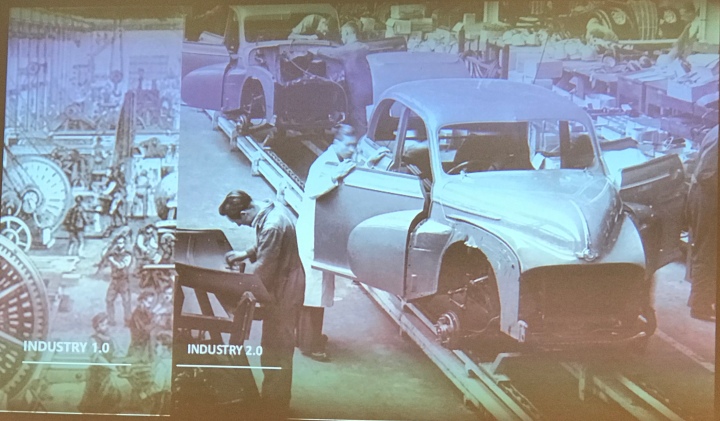 Today, I had the honor of being in attendance at the 2nd Annual Global Smart Manufacturing Summit in Berlin, Germany. One of the topics we grappled with was of what does Industry 4.0 mean? Ron Zahavi, Chief Strategist for IoT Standards and Consortia, Microsoft Corporation did a great job of walking us through some history.
Industry 1.0
This is the first industrial revolution:
- Technology such as wheels and engines replaced artisans
- Child labor laws had to be introduced to prevent abuse
Industry 2.0
- Assembly lines allowed workers to be turned into consumers
Industry 3.0
- Lean Processes improved the quality of products
- Advent of computer use
- Robots reduced mistakes and improved productivity and safety, but began replacing people
Industry 4.0
- Big data and analytics
- Autonomous robots
- Simulation
- Horizontal and vertical system integration
- The industrial Internet of Things (IoT)
- Cybersecurity
- Additive Manufacturing/Advanced Manufacturing
- Augmented Reality
Interestingly, in all these cases technology and mechanization are involved, but in the revolutions of Industry 1.0, 2.0, and 3.0, I wonder if we forgot how important people are. We must remember as we navigate Industry 4.0 that people are more important that the devices and technology.
In my world of educating young scholars and creating education policy, we have a responsibility to make sure as we move to Industry 4.0 to put people at the forefront. We do not want to make the same human mistakes with 4.0 that we made with the first three revolutions.
I really believe more than ever that we must make sure that we create space for industry to do as much of the training of our students as possible. Industry is in a good position to do this. What we have to do, though, is identify the transferable skills students need and institutionalize those skills in the framework of the internship learning being done in partnership with industry. This is crucial because of the mobility of our students.
We must be educating our students on the new things being done with Industry 4.0, but must also be educating them on the benefits. In other words, answering the question: How does this make life easier? Not just always pointing to financial improvement and the bottom line. We must begin to develop a workforce made up of the right quantity and right quality of workers. The skills we are preparing students with must match the needs of the workplace.
Industry 4.0 will require new skill sets, and manufacturers will need to attract the right talent. This may involve partnering with k-12 schools to train students. Existing training programs may need to be expanded to include new technologies that are introduced to the marketplace. Manufacturers also need to recruit for Industry 4.0, which may differ from how they have done it in the past. Both business and industry and education will need to stop all focus being on qualifications determined by degrees and certificates, companies should recruit for capabilities to succeed. These capabilities will include specialized skills.
For us to compete during Industry 4.0, it will require us to conduct constant iteration and be flexible. It’s not about buying software or purchasing a curriculum and then watching it all play out. To compete in Industry 4.0, the education sector and manufacturers must be flexible and agile in the face of change, and, most importantly, partner together.
 Byron's Babbles
2 comments