Our Collective Identity
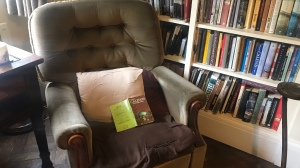
Mythology has come up a lot in the book I am reading while sitting where C. S. Lewis sat in the Common Room at The Kilns. The book is Out of the Silent Planet. I had not read Lewis’ acclaimed three volume Space Trilogy and was handed the books shortly after I arrived here for my Scholar in Residence Program. Wow, this is some incredibly thought provoking writing. One such quote from the book is, speaking of the character of Ransom, “It even occurred to him that the distinction between history and mythology might be itself meaningless outside the earth” (p. 169). The distinction between history and mythology lies in their nature and purpose. History is the study of past events based on evidence and facts, aiming to provide an accurate account of what happened. It often relies on primary sources such as eyewitness accounts, documents, and archaeological findings. The primary goal of history is to understand and interpret the past.

A place where the distinction of history and mythology gets blurred is the ideas of legends and heroes: American mythologies also include legends and heroes such as George Washington, Abraham Lincoln, and Martin Luther King Jr. These figures are celebrated for their contributions to American history and are often seen as symbols of national identity and values. I believe, however, these historical humans should be studied as human beings and not heroes or legendary myths.
On the other hand, mythology refers to a collection of stories, beliefs, and traditions that are often passed down orally or through written texts. Mythology may include elements of history but also incorporates supernatural, symbolic, and legendary elements. It serves various purposes such as explaining natural phenomena, teaching moral lessons, or outlining cultural values and beliefs.
The concept of the American Dream is a powerful myth in American culture. It represents the idea that individuals can achieve success, prosperity, and upward mobility through hard work, perseverance, and determination.
While history strives for accuracy and relies on verifiable evidence, mythology is more focused on conveying deeper truths and exploring the human experience through storytelling. Mythological narratives can be influenced by cultural, religious, and societal factors, making them subject to interpretation and evolution over time.
Mythologies and history are a part of all cultures around the world and play a significant role in shaping our values, rituals, and understanding of the world. They provide insights into a culture’s history, worldview, and collective identity.
Do Not Live In Your History

Yesterday I heard someone say, “Don’t live in your history.” Meaning we should not dwell too much on our past experiences, mistakes, or even achievements. There comes a point point where these personal historical archives can negatively impact our present and future. It’s important to acknowledge and learn from our past, but not let it define or limit us. Instead, we need to focus on being present in the moment and creating a better future for ourselves. We can let our past histories have the spotlight they deserve, but then we must move on.
Endings don’t always make perfect sense. Nor does there ever seem to be perfect timing. Life, unfortunately, is not governed by poetic justice. To stop living in the past we need to focus on what is in store for us today. One thing that keeps me from living in my history is being hyper-focused on continuous learning and professional growth. I truly do want to learn something new every day. This is the most effective way to stay present and not looking in the rear view mirror. What do you want to learn today?
Imagining Narnia

Have you ever had an experience where your imagination helped you understand or appreciate something in a way that reason could could not? Megs and George Devonshire did in, Once Upon A Wardrobe, by Patti Callahan Henry. George wanted Megs to get C.S. Lewis to answer the question, “Where did Narnia come from?” George’s question refers to Lewis’ fantasy novel, The Lion, The Witch, and The Wardrobe. In one of Megs’ visits to The Kilns it was stated that, “Reason is how we get to the truth, but imagination is how we find meaning.” This phrase in the book suggests that reason is a useful tool for discovering the truth, but imagination is essential for finding deeper meaning and significance in our experiences. George reminded us in this great historical fiction work of Patti’s that Albert Einstein said, “Imagination is more important than knowledge. For knowledge is limited to all we now know and understand, while imagination embraces the entire world, and all there ever will be to know and understand.” Imagination can truly take us beyond what we know, or think we know, and help us see the wider world.

Mere facts and information may not be enough to fully understand and appreciate the world around us; we need to use our creative and imaginative faculties to uncover the more profound truths and connections that often lie beneath the surface. I love how Once Upon A Wardrobe and all of Patti Callahan Henry’s great historical fiction works models this so perfectly for us. She takes historical facts which always seem to have gaps or facts that are not known and she uses her extensive research to guide her imagination to making sense out of all of it. We always need to remember that our imagination can help us find meaning.
History’s Experiments

One of the great books I am reading right now is The Epigenetics Revolution by Nessa Carey. As an animal science guy, I have been fascinated with epigenetics for a long time. In fact, when I was teaching I had a grant project with Purdue University that included epigenetics. One of the lines in the book that really jumped out at me was, “History creates experiments.” This is so true. The book talked about research using birthweight, growth, and maturity patterns following a famine. Other fascinating research is also cited in the book. I just can’t get past this thought, however, of history creating experiments. That is really what history is.
This is why one of my favorite authors, Robert A. Caro told us that we should be reading biographies in order to learn from others. In many ways, what others have done before us were experiments. In fact my own country of the United States is often referred to as an experiment. It is so important to look at all aspects of our history in order to learn for the future.
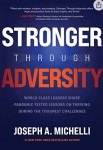
Another one of my favorite authors, good friend, and just great person, Dr. Joseph Michelli used how leaders led during the onset of the global pandemic as a way to learn about leading in a crisis. His outstanding book, Stronger Through Adversity: World-Class Leaders Share Pandemic-Tested Lessons On Thriving During The Toughest Challenges is in the running for my top non fiction book of the year. Really, all of his books are about history’s experiments in entrepreneurial leadership. You should check out his work – I love it! His work always reminds me how important it is for us to come together as a global community and be learning from each other.
I wonder how many experiments history has created that we have not taken the time or even thought to do the research on. It’s really about using that outer loop in double loop learning – evaluating the learning, creating and sharing the knowledge, and building capacity. Thanks Nessa, Robert, and Joseph for reminding us that “history creates experiments” and the data set to learn from.
Digging Up The Past To Get Past This
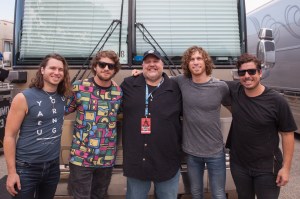
Last night I facilitated an incredible gathering of up and coming educational leaders from Georgia, North and South Carolina, and Tennessee. The title is the evening was “Do You Really Want It?” I got the inspiration for this session from my friends in the band Nothing More. A couple of years ago I had the chance to spend some time in their tour bus with them visiting and talking about inspiration behind a couple of songs. They have an incredible song “Do You Really Want It?” that I use to prompt deep thought and reflection for discussion concerning change, diversity, and overcoming our American demons (a term introduced in the song). Last night’s discussion did not disappoint.
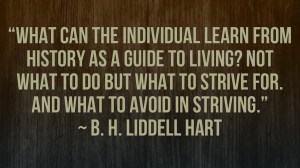
Every time I facilitate this discussion one stanza always comes up. “You gotta dig up the past to get past this.” I have been contemplating this a lot lately with all that is going on in the world. We must study the past and that sometimes involves digging up the past. But, we must get better at doing that in a productive way that allows us to actually learn from that past. I’ve been reading a lot on this and am reading Why Don’t We Learn From History by military historian B. H. Liddell Hart right now.
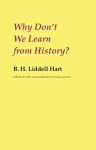
In the book we are told that when we’re able to learn from history, we can literally change the world. Otto von Bismarck “famously claimed that only fools learn from their own experiences. Truly visionary leaders – according to Bismarck – draw inspiration and insight from the experiences of others.” That is why we must study all leaders, even those in the background and behind the scenes, to learn from the good and the bad.
“History is the record of man’s steps and slips. It provides us with the opportunity to profit by the stumbles and tumbles of our forerunners.”
B. H. Liddell Hart
Every person needs to be studying history in order to broaden our understanding of the world. “Sure, an 80-year-old may have decades of life lessons to guide her actions, but a student of history will have hundreds or thousands of years’ worth of data to draw upon.” Hart taught us that, “Historians must pursue the truth even when it is uncomfortable.” I loved that Hart discussed that the context that the events of the past took place, the context of any documents created, and any biases must be taken into account when studying history.
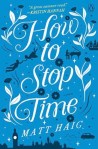
We have an obligation to study history and it is critical that we provide history and civics lessons that students can apply as they become citizen leaders. In another great book I’m reading right now by Matt Haig, How To Stop Time: A Novel, Tom Hazard answered the question of how he would bring history alive for students by saying, “There was no easier question in the world. ‘History isn’t something you need to bring to life. History already is alive. We are history. History isn’t politicians or kings and queens. History is everyone. It is everything. It’s that coffee. You could explain much of the whole history of capitalism and empire and slavery just by talking about coffee. The amount of blood and misery that has taken place for us to sit here and sip coffee out of paper cups is incredible.’” This is so true and thus we must make history and civics relevant for our students. We must be infusing real world issues and problems into the instruction, so our students can apply and adapt learning.
Because our youth are our future citizen leaders, we have an obligation to make the fountain of wisdom unattainable through mere personal experience that studying history provides. Let’s all do our part to study and teach history so we have the hundreds or thousands of years’ worth of data to draw upon.
Explore And Heighten On President’s Day
Interestingly, the holiday we celebrate today is officially Washington’s Birthday, not President’s Day. In 1971 when Congress passed the Uniform Monday Holiday Law, Washington’s Birthday (February 22) was moved to the third Monday in February. This put the holiday in between Abraham Lincoln’s birthday (February 12) and Washington’s. It also gave us another three day weekend – the intent of the Uniform Monday Holiday Bill. There was a push to change the name from Washington’s Birthday to President’s Day, but that did not pass – we just all call it President’s Day.
As I take a moment to reflect on this day, I remind myself of advice I give to others: study humans, not heroes. I believe this is important in teaching history and civics as well. While we have the advantage of hindsight when studying the past, always remember those who lived it, did not. One of my favorite authors, David McCullough, put it this way, “Nor was there ever anything like the past. Nobody lived in the past, if you stop to think about it. Jefferson, Adams, Washington—they didn’t walk around saying, ‘Isn’t this fascinating, living in the past?’ They lived in the present just as we do. The difference was it was their present, not ours. And just as we don’t know how things are going to turn out for us, they didn’t either. It’s very easy to stand on the mountaintop as an historian or biographer and find fault with people for why they did this or didn’t do that, because we’re not involved in it, we’re not inside it, we’re not confronting what we don’t know—as everyone who preceded us always was” (McCullough, February 15, 2005, in Phoenix, Arizona, at a Hillsdale College National Leadership Seminar on the topic, “American History and America’s Future.”). We need to remember that history was not created in a vacuum and could have gone a bunch of different ways.
As we reflect on our Founders and past Presidents we need to remember they were human beings, just like us, with flaws, sins, and both terrible and good qualities. We’ve had leaders do some terrible things and we need to study those things and call them out to make sure and not repeat them. We also need to learn, grow, and continue to improve and get better. In the world of improvisation there are the five syllables “explore and heighten.” This is where we usher in our imagination, where ideas are born, where our power finds its source, and where we discover what’s waiting for us. I believe this to be the genius of our American community. We know everything can and should be improved upon. So, on this day of reflection, let’s renew our resolve recognizing our errors of the past and continued improvement for making the world a better place for ALL.
“What Might Have Beens” Are Risky

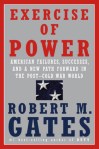
A comment made by Robert Gates in his great book Exercise of Power: American Failures, and a New Path Forward in the Post-Cold War World really made me think. He said, “Addressing ‘what might have beens’ in history is risky.” I wrote it in my notes so I could think about it and blog about it. I believe we need to study history in a way that doesn’t force us into being judgmental outside of the context the history was made in.
Everyone needs to study history. The past is filled with warning signs. We must be able to reflect on the events that built up to them, learn from mistakes made and resist and question if we see similar patterns emerging. By studying history we can identify when society is going down perilous and contribute toward getting back on the right track. This should not include continuing to place blame on individuals who are, in many cases, not even alive any more. We need to think of how to learn from the past not think in terms of “what might have been.”
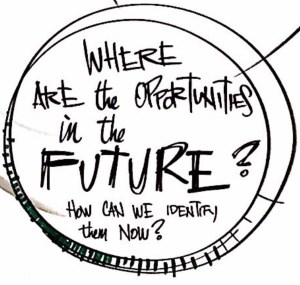
Additionally, history cannot be studied by learning isolated events without understanding the events, personalities, and events that molded the personalities involved leading up to historical events. One point I believe Gates was making was that there had been no perfect leader, and never will be. Therefore, we need to study the positives and negatives, uplifting and inspiring, and chaotic and immoral. There are lessons, both good and bad, to be learned from the way our ancestors have interacted with other people who have different ways of living. Understanding how our leaders, communities, and past societies have acted, reacted, and integrated is key to humanity improving in the future.
 Byron's Babbles
leave a comment