Leader Vs Boss
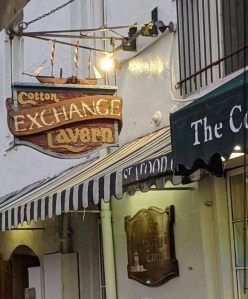
I love meeting inspiring young leaders who share inspiring lessons with me. Last night I met Novella at The Cotton Exchange Tavern in Savannah, Georgia. Novella was our server and I was first intrigued by her name. I never had a student named Novella during my time as a teacher or administrator. In doing a little research I found that in the past six decades (1959 to 2018), the name “Novella” was only recorded 1,170 times in the Social Security Administration database. The name Novella is of Latin origin meaning meaning new or young. Also, persons with this name typically have a stronger sense of analyzing life. I would agree because Novella told us she had only been at The Cotton Gin for a week. Her boyfriend is a traveling nurse and works in 13 week shifts. They decided to take advantage of his career right now while they have no children or responsibilities and experience as many new places as possible. Brilliant! Now that is analyzing life perfectly.
Now, for the leadership lesson. I asked Novella if The Cotton Gin was a great place to work. She said, “Yes.” Novella explained she had worked in a corporate chain restaurant before, and really enjoyed now getting to work in a restaurant individually owned. “Before, there was no personalization; bosses just yelled and barked orders to get things done,” she said. Then Novella said, “Here, the leaders make sure you understand why and how to do everything.” Did you catch that distinction between “boss” and “leader”? For example, she told us that as part of her onboarding she tastes the different menu items and that she is given items to take home for meals so she knows all the products first hand. She told us, “I love this restaurant and need to understand and be able to describe what I serve.” Novella had recommended the Cajun Tortellini to me and had described it perfectly.
Clearly the leadership at The Cotton Gin Tavern motivated Novella to go places that she would nor otherwise go. In any business climate, good leadership is perhaps the most important competitive advantage a company can have. We need leaders who will be around when we need them, and who would give us substantive advice, not platitudes. Thanks Novella for reminding us the distinction between “boss” and “leader”.
Smiles For All Your Miles
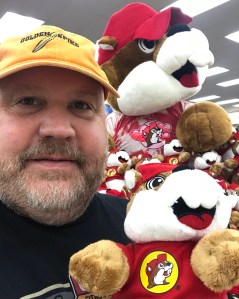
As a friend, student, and fan of Dr. Joseph Michelli and all his books, I understand the importance of the customer experience. I was reminded of this when I stopped at Buc-ee’s yesterday. For those not familiar, it is a humongous gas station/convenience store/outlet mall (with Buc-ee’s brands) all rolled into one. It is an experience! Founded in 1982, the mission is pretty simple: to provide a clean and friendly in-store experience. In fact, if you haven’t been, you need to go, just to experience the award winning bathrooms. Yes, you read that right – award winning. In 2012, Cintas, a corporate supplier to the service industry, named the New Braunfels, Texas Buc-ee’s location the winner of a nationwide restroom contest. You can read about it here.

In Exactly What We Aim For I quoted Michelli stating, “…I believe that even greater customer value comes from moving from services to experiences (rather than from products to services).” Buc-ee’s understands that the experience is everything. The co-founders Arch (“Beaver”) Aplin and Don Wasek set out to make these extravaganzas the very best in the world. They had a pretty simple strategy statement: “To have the cleanest restrooms.” Think about it, isn’t that all we really want when traveling? When exiting for a pit stop, I have heard my family more than once say, “Pick the place that looks like it will have the cleanest restrooms.” With the Buc-ee’s experience, we know it will be them.

They have even made the billboards along the interstate part of the experience. When 212 miles away you are seeing a billboard telling you that you can stop at Buc-ee’s in, well, 212 miles. Then, when you leave and get back on the interstate, the first billboard you see says, “Until We Meet Again – 165 miles” (see photo). Again, part of the experience. The other thing is, you won’t have to deal with 18 wheelers – not allowed. Every fuel pump, of which there are over 100, has both diesel and regular. The Buc-ee’s I was at even featured ethanol-free fuel and DEF. And, if you need it, they’ve got it! They have (and most of it, their own brand) souvenirs, food, snacks, clothing, hunting gear, college wear (although they were missing the Purdue stuff!), and my favorite – a jerky wall.
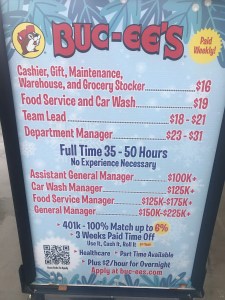
When you go on Buc-ee’s website and look under employment, they say, “We believe our store should be clean. We believe our staff should be friendly. We believe our prices should be low. If you believe what we believe, come join the Buc-ee’s team!” Then they ask, “Do you believe what we believe?” If that is not customer experience driven, I am not sure what is. As a person whose life-work is supporting education, I wish every young person could have the experience of learning from this business. Check out the photo of the careers available and salaries. Students would certainly be learning leadership and the customer experience. Maybe the Buc-ee’s folks and I should talk! Next time you are on the interstate and see the Buc-ee’s billboards, start planning your incredible travel-stop experience.
Don’t Freeze Me Out

Last night on FBI International we were introduced to Special Agent Zoey McKenna (Kelley Missal). McKenna was appointed to the Fly Team without the team leader, Scott Forrester’s (Luke Kleintank) knowledge or input. Forrester was upset and seems to be facing a transfer himself, but still recognized specific skills and included Zoey in solving the latest case. In the end Zoey told Forrester, “I was pretty sure you’d freeze me out.” Forrester replied, “Not my style.” As a person who does leadership development, I loved that reply. Have you ever been the victim of a freeze out? Or, have you ever been the one doing the freezing out? Agent Forrester could have frozen Zoey out of the team, but to what end? She had knowledge and skills that were crucial to solving the case. Practicing great leadership, Forrester put the greater good of the team above his own personal feelings.
This really got me to thinking about how cruel the practice of freezing someone out is. Being left out, excluded, or not communicated with is a terrible feeling. There is the speculation running through our heads as to what might be going on on the other person’s end. I’ve actually heard leaders advocate for freezing people out saying that “they’ll take the hint,” but in reality because the leader didn’t communicate their motives, the victim wouldn’t necessarily know what’s happening at all. I am so glad this reflection was prompted last night because I have been the freezer before. When considering all this I am reminded that no one deserves to go through that and how wrong I was. It really is about being a decent human. Let’s all make sure we are never practicing the freeze out.
Playing To Strengths
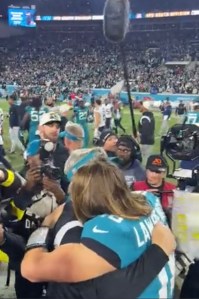
I have always been a fan of being a strengths finder. The best leaders find ways to play to the strengths of those they serve. My son and I watched the Jacksonville Jaguars win the NFL’s AFC South last evening. Their coach, Doug Pederson, is a strengths finding leader and someone I have studied and admired. First and foremost, he is genuine person who players have zero issues building relationships with – the most important leadership trait. Pederson can also relate and connect with professional athletes because of being one. Additionally, he has a credibility factor because of the success he has had as both a player and coach. Players call him “genuine.” Being genuine and authentic is about as good as it gets!
What has always impressed me is how Pederson builds a game plan around strengths and talent, not the other way around. For example he had Carson Wentz playing at an MVP level in just his second season with the Philadelphia Eagles. Then when Wentz was injured, in came Nick Foles, and the rest is history. Pederson made the necessary changes to play to Foles’ strengths and the Eagles won the Super Bowl. He found what Nick Foles did best and changed everything to compliment that. He has now done the same at the Jacksonville Jaguars for Trevor Lawrence. Changing everything to compliment what your quarterback does best and the talent around him – genius. Great leaders don’t try to fit everyone into their own prescribed way doing things; they make adjustments to compliment the strengths of the talented people they serve. Playing to the strengths of those you serve – great leadership!
More Found Than Lost

I loved the line, “Perhaps I was feeling more found than lost” in in Book 3 of Threads West An American Saga: Uncompahgre: Where Water Turns Rock Red by Reid Lance Rosenthal. The context was really the fact that the character, who was part of an 1855 wagon train westward, was feeling more found than lost because of being in such beautiful country, with newfound friends, and so much opportunity. And, feeling lost is many times a step toward feeling found. Also, all these characters left their familiar homes, friends, and families and were now with strangers in a very strange land. I heard it said once that sometimes we are never more found than when we are the most lost.

The members of the wagon train had become a very tight knit network offering vital connections between people who came to rely on one another. This network offered real, substantial support around a common vision. Unlike most our social networks of today. Another lesson we can learn from these emigrants is every one was aware of why they were doing what they were doing, I believe we learn from this how important it is for us to have a shared purpose and a network offering support.
Flattening The Bumps

Today, I had a person thank me for “flattening out the bumps for them along the way.” I appreciated the “thank you” and began to reflect on the bumps. Had I really done that much? She thought so. Then I got to thinking; it wasn’t about the bumps, it was about someone being there to flatten them out. Everyone needs someone to flatten out the bumps. Are you that person for someone?
Going The Distance

“It seems I’ve come a great distance but yet have still not arrived.” Rebecca said this as they were looking down the valley at Cherry Creek (what would become Denver, Colorado) in Book 3 of Threads West An American Saga: Uncompahgre: Where Water Turns Rock Red by Reid Lance Rosenthal. Considering she had started in England; taken a ship to New York; a train to St. Louis; and the a wagon train to Cherry Creek, she really had traveled a great distance, but there was still so much to explore, do, and experience. Sound familiar?
“We shall not cease from exploration And the end of all our exploring Will be to arrive where we started And know the place for the first time.” ~ from Little Gidding by T.S. Eliot
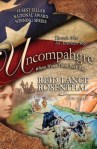
The quote above from T.S. Eliot says a lot. I believe all the characters in the great Threads West novel series that headed west knew themselves and where they came from better, the further they explored. Only after extensive exploration and experiences, in other words, living, do we fully understand the beauty or all that we gained from where we grew up and the people that have been part of our lives. We cannot see who we are and where we are until we go through the process. The process of searching for something outside of ourselves reveals the truth within ourselves. All the characters in this book, like us, are searching for something, and in the process all are finding themselves. What we should all aspire to do is to continually question, to seek, to “not cease from exploration,” and ultimately, the result of our quest will be to see our original experiences and encounters in new and enlightened ways, to see now what we could not see then (whether due to lack of maturity, contemplation or experience) and to have a full understanding of our experience’s meaning.
Eventually

“What happens when eventually comes too late?” ~ Nathan “Nate” Ford (Timothy Hutton) on Leverage. Those lines jumped out at me and really made me think. This should probably be one of this milestone/benchmark questions we should be constantly asking ourselves. I know we are at that time of year where everyone talks about New Year’s resolutions. Not me. But let’s contemplate the old adage that it is ‘never too late.’ While I believe that, I also believe we can wait too long. Sometimes I believe we, myself included, use ‘eventually’ and ‘it’s never too late’ as a crutch, or excuse, to not start something. This really is an avoidance to starting something we might really want or need to do. Think about these things: starting a business, going back to college, getting a doctor’s checkup, calling an old friend, or insert your own here, ____________. Now, look back at that list. Can eventually come too late? Can it really be too late? It sure can! By the time we finally do these things or get started we might just find ourselves in a difficult position and have to fight an uphill battle to get the things done or even stay alive.
“Sadly,
sometimes it’s too late.
And that’s the thing about time,
we cannot get it back.” ~ Kiana Azizian
Notice I made the title of this post ‘Eventually.’ I did not want ‘Eventually Is Too Late’ or ‘Eventually Is Never Too Late.’ Both could be right, but I want us on this New Year’s Eve to keep ‘eventually’ at the forefront of our thinking for 2023. While our calendar timeline is linear, our life’s timeline is not. We do not have complete control over when we are going to achieve something or when something will surprise us. Our lives are extremely unpredictable. Something might happen earlier than we think, it might happen later than you think, or it might not happen at all. So, as you think about that next eventually, remember life can be really long and really short and ask yourself, “What happens when eventually comes too late?”
Less Team & More Living Organism

Yesterday I was doing some work that I wanted a little noise in the background for so I turned on an old episode of </Scorpion>. The show was about four geniuses teamed up with a government handler and a mother of a young genius son, who solved issues globally. At the end of the episode, of which a theme of teamwork had emerged, it was said, “Maybe we should think less of ourselves as a team and more as an organism [that is living and adapting].” Many times teams operate under the old industrial model like machines. And…machines break down and are unable to adapt. By contrast, living organisms are masters at adaptation. Many times when we think of adaptation, we thing of Charles Darwin. One of the observations of Darwin that Ernst Mayr (1982, 2001) made was that, “Individuals in a population are not identical, they vary in many characteristics.” Adaptation comes from the Latin word adaptus, which means to become fitted, to join, and to adjust.
Here’s why teams need to think, act, and be led more like living organisms than machines:
- Organisms can adapt to their environment.
- Organisms respond to changes in their environment and continue to be relevant in a changing environment.
- Organisms function by keeping homeostasis, or equilibrium, between its many independent actors.
- Organisms grow and develop.
Now, go back and replace ‘organism’ with ‘great team’ and you’ll get the point of the post. Wait. I’ll do it for you:
- Great teams can adapt to their environment.
- Great teams respond to changes in their environment and continue to be relevant in a changing environment.
- Great teams function by keeping homeostasis, or equilibrium, between its many independent actors.
- Great teams grow and develop, both as individual team members and a whole team.
Get it? As great teams adapt and their members grow and develop, bonds of trust are formed and relationships are built. I’m grateful for the living organism metaphor for a team provided by </Scorpion>.
Learning Vs Being Right
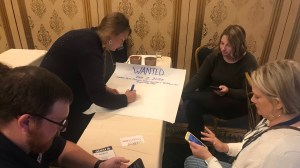
We live, work, and play in such complex institutional and cultural environments today. Therefore, we must be adaptive individual learners, as well as, learning organizations. Mary Catherine Bateson taught us that openness to learning and changing is more important than what one knows at any given point. Openness to learning and willingness to adjust are important qualities. Learning is more important and being right. Learning is a perspective as much as it is a practice. We need to be nurture and encourage an attitude of learning. We must seek out ideas, information, and approaches so we can learn from others, including those whose views diverge from ours.
There are really three pieces to great leadership:
- Curiosity
- Growth Mindset
- Openness
If we go back to the teaching of Bateson, we find openness as an essential trait. If we have an appreciation of diverse perspectives and a willingness to try new things, we can better navigate daily challenges and discover novel solutions. Openness allows ideas to merge and develop by valuing diversity of thinking. Unfortunately, school taught us (and is still doing this) that we need to always be right. But, that binary way of thinking keeps us from considering that there might be a right answer, especially when we are on uncharted ground.
 Byron's Babbles
leave a comment