Leaders Experiencing The Minute Details

Our “accumulated experience” and “inherited knowledge” are extremely important to us as leaders as they help shape our decision-making process, problem-solving skills, and overall leadership style. Experience allows us to learn from past successes and failures, giving us valuable insights that can guide us in making better decisions in the future. It also helps us earn the trust and respect of our team members, as they see us as someone who has been through various challenges and knows how to navigate them effectively. Overall, accumulated experience can make us a more effective and confident leader.

We were reminded by Mohammed bin Rashid Al Maktoum, just how important our accumulated experience and inherited knowledge are in My Story. He told us that, “Some say a leader must have a bird’s-eye view, looking at things from above so that he or she can assess them and make the relevant decisions. I say a leader must be on the ground living among the people, enduring their conditions, experiencing their lives and knowing the minute details of their suffering in order to change their situation for the better” (p. 67). I call this being the “deer in the headlights.” This is why I am also such a big advocate of, where possible, having people who have actually done what is being taught be the teachers of those transferable skills.
“Inherited knowledge” refers to the knowledge and expertise that is passed from one generation to the next within an organization or team. This knowledge can come in the form of best practices, lessons learned, and insights gained from past experiences.
Inherited knowledge is important to organizations and leadership because it allows us to build on the successes of the past and avoid repeating the mistakes that have been made before. By tapping into the collective wisdom of those who have come before, organizations can make more informed decisions, solve problems more effectively, and drive innovation.
Additionally, inherited knowledge can help to foster a sense of continuity and tradition within an organization, creating a sense of stability and cohesion among team members. It also enables leaders to mentor and develop the next generation of leaders, ensuring a smooth succession of leadership and the continued growth and success of the organization.
Adding New Skills To Our Repertoire

Having just returned from my maiden voyage to Dubai, United Arab Emirates, I have been doing quite a bit of studying on this new place I immediately fell in love with. Right now I am reading the great book by Mohammed bin Rashid Al Maktoum, My Story. In Chapter 17, Diving For A Living, he shared, “My father asked me to add a new skill to my repertoire, something that would expose me to an aspect of life I wasn’t used to seeing” (p. 65). I loved this because I have always tried to encourage and enable this with my son, Heath.
Continually adding new skills to our repertoire is important for personal and professional growth. By learning new skills, we can stay relevant in a rapidly changing world, adapt to new challenges, and improve our problem-solving abilities. Additionally, acquiring new skills can open up new opportunities for advancement in our careers and help us stay competitive in the job market. It’s important to never stop learning and to always be open to acquiring new knowledge and expertise. Adding new skills to our repertoire enables us to be ready for new opportunities that come our way.
The Infinite Loop of Our Influence

I got to watch some television last night and I like to study the characters and the personalities the writers give those characters. I love the show Bones. The protagonist of the series is Dr. Temperance Brennan (Emily Deschanel), also known as “Bones,” is a highly intelligent and socially awkward forensic anthropologist who works at the Jeffersonian Institute in Washington, D.C. She is known for her dedication to her work, keen attention to detail, and ability to solve complex cases through the analysis of human remains. Despite her rational and scientific approach to life, she also struggles with interpersonal relationships and often comes across as blunt or insensitive. Overall, Temperance Brennan is a fascinating and multi-dimensional character who is at the top of her field in forensic anthropology.
In the episode I was watching she made a comment to another character, Angela Montenegro (Michaela Conlin) to console her after worrying that she would never find true love again. Bones said, “Of course you will. Infinity goes in both directions. There are no unique moments. Nothing happens just once.” This was one of those highly intellectual and philosophical comments that most of us have trouble understanding. Those that know me know I love to think and ponder on comments like these. First, I had to decide if I believed what she said to be true. Bones was suggesting that time is infinite and cyclical, with events and moments repeating themselves in an endless loop. It implies that there is no such thing as a truly unique moment or experience, as everything is interconnected and part of a larger pattern. It also highlights the idea that nothing is ever truly isolated or one-off, as everything is part of the greater whole of existence.
Whether time is finite, infinite, or cyclical are philosophical questions that are still debated. I do believe there is interconnected, though. What we do affects the lives of others. Without certain people having been a part of my life, both personal and professional, my life would be very different. We need to stay cognizant of the fact that everything is part of a greater whole of existence. What we do today will affect not only those in our inner circle and those we serve, but others on a global level. C. S. Lewis taught us, “It is a law of the natural universe that no being can exist on its own resources. Everyone, everything, is hopelessly indebted to everyone and everything else” (Lewis, God In The Dock, p. 85). As my mom taught me, “Byron, your actions have consequences and will impact others, not just yourself.” Boy was she wise! Whose existence will you impact today? Make it a positive impact.
Being A World Changer

As you know, I am currently reading six books conceived and curated by Blake Crouch called Forward. I’ve already blogged about his first two questions that drove the series in The Unforeseen Twists & Turns and Rolling The Dice of Uncertainty. Now while reading a fourth awesome book in the series by Veronica Roth, Ark, I am contemplating the third and most difficult driving question, “How does it feel to change the world” (Crouch, 2019)? When I first started thinking about this question my mind went to individuals who had made big changes in the world that we could easily point to. You know…the ones monuments have been built to honor. It’s important to remember, however, that changing the world doesn’t always mean making grand or global changes. Even small actions can have a ripple effect and create positive change. Those ripples can and will eventually turn into change that might one day have a global impact.
When we find purpose in what we do it allows us to pursue significance over success in our chosen fields going beyond personal benefit in preparation for our world-changing. We may know if we are changing the world by reflecting on the impact our actions have on others, the solutions or innovations brought to problems, and positive influence we have on those around us.
Too many people believe that they have no power and can’t make a difference in this world. Not true! We can all make a difference in our own way. By refusing the status quo, thinking and dreaming big we can help create the environment for changing the world. We must all lead from where we are. All of us have unique talents, skills, and expertise that we need to share. Our willingness to share plays a crucial role in changing the world for the better by spreading ideas, fostering collaboration, and building a supportive community. It allows us to collectively tackle challenges, inspire others, and create a ripple effect of positive change.
Sharing can put us in a better position to change the world for the better in several ways. Firstly, when we share our ideas, knowledge, and resources with others, it can inspire and empower them to take action and make positive changes themselves. By sharing our insights and experiences, we can help others learn from our successes and failures, and encourage them to pursue their own ideas and initiatives.
Secondly, sharing allows for collaboration and collective problem-solving. When we work together and share our different perspectives and expertise, we can come up with more innovative and effective solutions to complex problems. By pooling our resources and working towards a common goal, we can achieve greater impact and change.
Furthermore, sharing fosters a sense of community and interconnectedness. When we share our time, kindness, and support with others, we create stronger bonds and build a network of like-minded individuals who are motivated to create positive change. This sense of community can provide the necessary support and encouragement to sustain our efforts and amplify our impact.
So, how does it feel to change the world? It feels like using our purpose to lead from where we are by using our purpose to make ripples by challenging the status quo, thinking and dreaming big, and sharing ourself with the world.
Framing The Causes

The term “causality” has always given me pause. First, I believe the term is overused in research. Causality assumes that the value of an interdependent variable is the reason for the value of a dependent variable. Social science and education research is very interested in making causal claims. This causal inference remains especially difficult to prove. My problem with claims of causality are the multiple potential explanations that always exist. This does not mean I don’t think causality is important to science. The best research uses methods for getting to causality. When statistically significant causality is proven it is very valuable. As I stated earlier, however, I just believe we are, at times, too quick to claim causality.
It is also interesting to me that causality is a topic debated in theology. In fact, in The Christian In The World, C.S. Lewis credits Sir Arthur Eddington with saying, “Each event comes from another event.” From the reading I believe Lewis struggled with this as an absolute philosophy and I always have too. Everything in life is too complex for that. Causality at face value means that every event or occurrence is caused by a preceding event or set of events. In other words, there a chain of cause and effect in the world, where one event leads to another, and so on. I believe we need to recognize the interconnectedness and continuity of events in our lives and in the world around us. While there may be provable causalities in some cases, we must remember there may be multiple contributing factors.
The Unforeseen Twists & Turns

I love collaboration and I believe some of the best examples of how to do this well lie with creative performing artists and writers. We are in a time where musicians collaborate on songs and perform together. These turn out to be incredible collective products. In my own world of having a professional service firm, I am always looking for potential collaborations or cross-branding opportunities. I am reading a collaboration of books conceived and curated by Blake Crouch. Blake brought together five other authors, Veronica Roth, N.K. Jemison, Amor Towles, Paul Tremblay, and Andy Weir, to write, along with himself, six books. In a note from the curator to the Forward collection, Blake Crouch tells us the three driving questions he posed to this collaboration of authors to write about. Here are the three questions (Crouch, 2019):
1. “How does anyone know at the moment of discovery where their work will ultimately lead?”
2. “Should we let that uncertainty stop forward momentum, or do we roll the dice and let the chips fall where they may?”
3. “How does it feel to change the world?”
Having just finished Towles’ You Have Arrived At Your Destination and Weir’s Randomize, I can already tell you this collaboration was a success. Those three questions Couch posed to the authors have continued to cause me to reflect however. Therefore, the reason for today’s post and probably a couple of other future posts. Pondering the question “How does anyone know at the moment of discovery where their work will ultimately lead?” helps us contemplate and begin to understand the uncertainty and fluidity of artistic creation, promotes openness and self-reflection, and encourages us to embrace the unknown in our innovative and creative journeys. We are reminded that, no matter how well we plan or strategize, there are always unforeseen twists and turns along the way.
Asking this question encourages us, as leaders, to embrace uncertainty and remain flexible in our approach – one of the big advantages of collaboration. It challenges us to let go of rigid expectations and instead focus on exploring new possibilities and adapting to changing circumstances. By acknowledging that the ultimate outcome of our work may be unknown, leaders can foster a culture of innovation, experimentation, and learning.
Moreover, asking this question promotes self-reflection and encourages leaders to question our assumptions and biases. It challenges us to critically evaluate our own work and consider alternative perspectives and approaches. This can lead to greater creativity, as well as a deeper understanding of ourself and the world.
The Artwork of Stories & Relationships
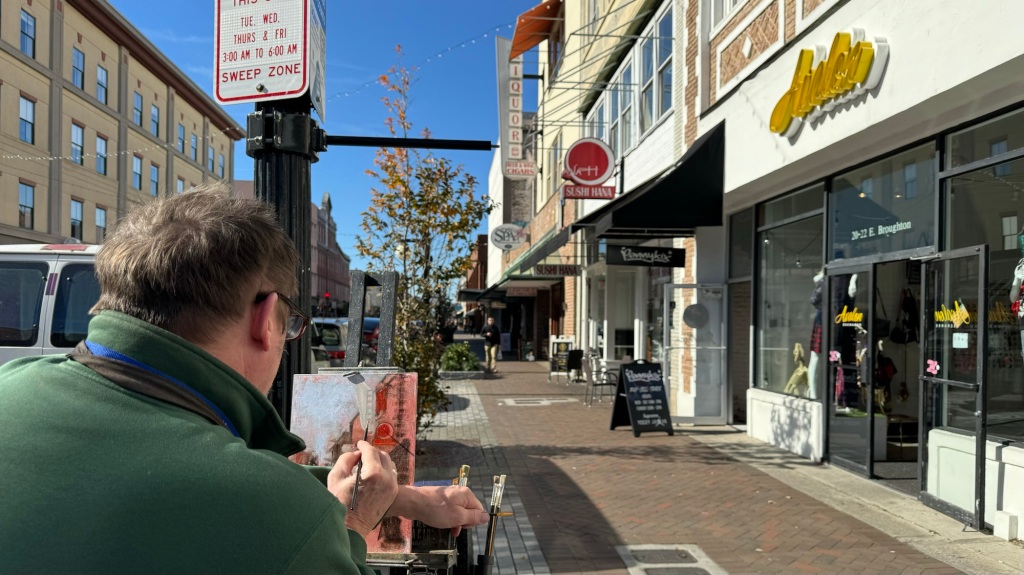
I love the opportunities that chance encounters bring for making new and valuable connections. Last week as we were going into Sushi Hana in Savannah, Georgia for lunch, I noticed an artist painting a streetscape in front of the restaurant. Those of you who know me well, know I can’t resist watching an artist practice their craft. He was just getting started, but I could tell this painting was going to be special (like I really know anything about it). The artist and I exchanged hellos and I told him I liked his work. My family and I went into Sushi Hana’s and ordered and I told them I had to go back out and meet the artist. I met Jeffrey Baumgartner, who coincidentally is from Chicago with Indiana connections. Small world! We immediately connected and he informed me it would take about three hours to complete. I told him I wanted to buy the painting. Then my wife came out and told me I needed to come in and eat. Imagine that!

After lunch I was back out to check the progress of “my” painting. It was coming along nicely and Jeffrey and I talked some more and made a plan for me to call him and 3:00 and see where he was on completing the painting. So, at exactly 3:00 as I stood along the Savannah River, I called my new artist friend back to see how my painting looked. He was just painting his signature on it as I called. Jeffrey told me it looked awesome. So I left my family to explore and climbed those old uneven steps up from River Street with some newfound energy and enthusiasm. Over to Broughton Street to see this exquisite piece of artwork (see photo). It was wonderful and I wanted it.

We agreed on a price then proceeded to talk, laugh, and share stories. Two students from the Savannah College of Art and Design (SCAD) came by who had watched and talked to Jeffrey earlier. He proceeded to give them an art, business, and leadership experience like no college professor could give. This artist was living it. He had driven his van (that he says is a “VanGo,” pun intended) to Savannah, set up in a campground, and was painting a new streetscape every day for a living. If that isn’t a real world and relevant context for teaching I don’t know what is. Not only was he schooling these young and aspiring artists, he was forming relationships. As a believer and teacher of building relationships as the most important leadership trait, I was watching and learning. Jeffrey was a master at it.
As I was complimenting him on his relationship-building prowess he told me that he came from the theater. “It’s all about the story, Byron,” he told me. So true; it is all about the story. I had gotten my painting, made new friends in Jeffrey and the students, and expanding my knowledge in leadership and creating an ideal customer experience. Jeffrey’s ability to connect had made the experience of buying this painting memorable and with a tremendous story.
Being able to build relationships is an important trait to have developed for a painter selling paintings, or any leader for that manner, because it helps in establishing trust and rapport with potential buyers. By building relationships, we can understand the preferences and tastes of our customers, tailor their artworks accordingly, and creating a personalized experience for the buyers. This lesson can also be transferred to all of us as leaders. We are creating experiences for those we serve.
Additionally, building relationships allowed Jeffrey to form a network of loyal clients who most likely will provide repeat business and recommend the artist to others. In Jeffrey’s case, he has a loyal following. This can help in expanding the reach and recognition of the painter’s work.
Moreover, through building relationships, we can also receive feedback and constructive criticism, which can be valuable for growth and improvement. By understanding the needs and desires of our clients and clients and those we serve, can better fulfill their expectations and create artworks that resonate with them.
Overall, being able to build relationships enables a painter to connect with their audience on a deeper level, promote their work effectively, and establish a strong presence in the art market.
Leading With Collective Aspirations

I had the honor of watching the sunrise and having breakfast at the top of Dubai’s iconic Burj Khalifa yesterday morning. It was absolutely breathtaking. Plus getting to learn about the dream and building of the Burj Khalifa was amazing. The Burj Khalifa is such a great story because it represents human innovation, engineering marvel, and the ability to push boundaries. It is the tallest building in the world, standing at a height of 828 meters (2,716 feet) with 163 floors. The construction of the Burj Khalifa was massive undertaking that required cutting-edge technology, advanced engineering techniques, and a highly skilled workforce.
I loved the words and meaning in the “I am Burj Khalifa” poem. This is projected on one of the walls as visitors enter. These words really describe great leadership. See what you think:
“I am the power that lifts the world’s head proudly skywards, surpassing limits and expectations.
Rising gracefully from the desert and honouring the city with a new glow. I am an extraordinary union of engineering and art, with every detail carefully considered and beautifully crafted.
I am the life force of collective aspirations and the aesthetic union of many cultures. I stimulate dreams, stir emotions and awaken creativity.
I am the magnet that attracts the wide-eyed tourist, eagerly catching their postcard moment, the centre for the world’s finest shopping, dining and entertainment and home for the world’s elite.
I am the heart of the city and its people; the marker that defines Emaar’s ambition and Dubai’s shining dream. More than just a moment in time, I define moments for future generations.
I am Burj Khalifa.”

The building’s design was inspired by traditional Islamic architecture, with a distinctive spiral shape that resembles a desert flower. The construction process involved overcoming numerous challenges, such as extreme temperatures, strong winds, and the need for a strong foundation to support the immense height.

The Burj Khalifa has become an iconic symbol of Dubai and showcases the city’s ambition and progress. It has attracted millions of visitors from around the world who come to admire its beauty and experience its breathtaking views from the observation deck. The building also houses luxury residences, hotels, offices, and entertainment facilities, making it a versatile and dynamic structure.
Overall, the Burj Khalifa represents human ingenuity, architectural excellence, and the ability to achieve the seemingly impossible. Its story inspires people to dream big and strive for greatness.
Leading By Symposium

While doing research for a book I’m writing I came across The Symposium by Plato. The research I am doing was related to “love” in the sense that I am a big proponent of leaders loving those they serve. And, since I believe everyone is a leader; we should all love everyone. I’m trying to articulate how to do that as a leader in the work I am doing. Anyway, The Symposium is Plato dialoging the speeches taking place at an ancient Athenian feast. Oh, to go back to 380B.C. and take part in that symposium. It was the whole idea of the symposium that prompted my post this morning. The symposium allowed nuanced and super-exploratory environments for deep intellectual discussion. Really, this is the format I strive to create with each of my leadership development gatherings.
What if all our discussions were like those of Socrates and Plato?
Leaders (all of us) can learn from having symposiums like Plato and Socrates in several ways. Firstly, symposiums provide a platform for open and intellectual discussions, allowing leaders to explore different perspectives and gain new insights. This can lead to more informed decision-making and the development of innovative solutions to complex problems.
Additionally, I love creating a safe place for the exchange of ideas among gathering participants. Leaders can benefit from engaging in dialogue with others who have diverse backgrounds and expertise, as this can challenge our own assumptions and broaden our understanding of various issues.
Furthermore, symposiums in their truest form, foster a collaborative and inclusive environment, where everyone’s opinions are respected and valued. This encourages teamwork and encourages leaders to listen to different viewpoints, promoting effective communication and fostering a sense of unity among participants.
Can’t you just imagine Phaedrus, Pausanias, Aristophanes, and Socrates, who all gave speeches at that Athenian feast, sharing their philosophies on love? Imagine that opportunity for leaders to network and build relationships with other influential individuals in their field. This can lead to valuable connections and collaborations that can enhance their leadership abilities and create opportunities for growth and development. It gives me goosebumps!
What is striking to me is how relevant all the dialogues still are today in one way or another. Are you hosting symposiums like Plato and Socrates that can help leaders expand their knowledge, improve their decision-making skills, foster collaboration, and build meaningful relationships within their communities?
A Honey Of A Deal For Being Interested In Learning

I remember being told that being interested makes us interesting. I believe this applies to being curious as well. Yesterday, I spent time at the Savannah Bee Company learning about honeybees, beekeeping, education, stewardship, and love. It was a reminder of just how curious and interested I get about a great number of subjects. Some have even called me eclectic. Guilty! Being interested in something can make us more interesting When we have a genuine passion for a subject or topic, it shows in our conversations and interactions with others. It can make us more engaging and knowledgeable, and can also spark curiosity and interest in those around you.

Yesterday, working with honeybees, I was reminded why I am such a believer in using real world and relevant contexts for learning. The Bee Cause Project introduces children to the science of bees and giving them a hands-on connection between these magnificent pollinators and their own lives. Founder and CEO, Ted Dennard is committed to the mission of building the buzz for integrating bees into education. By incorporating honeybee-related activities into STEAM (science, technology, engineering, agriculture/arts, and math) education, students not only learn important scientific principles but also develop skills in critical thinking, problem-solving, and data analysis. Additionally, they gain an appreciation for the natural world and a sense of responsibility towards sustainable practices.
It was exciting to take a deeper dive into learning about the, ecology, life cycle of bees, their and environmental behavior, and science. I was able to observe the bee’s hive and students in schools who are a part of The Bee Cause Project can also observe their own beehive and the bee’s role in pollination. And, by the way, produce a pretty sweet (honey) product in the process of learning. A relevant context at its best.
And, I can’t leave out the importance of Agriculture: honeybees are essential for pollinating crops, making them crucial to agriculture. By learning about beekeeping, students gain insight into agricultural practices and the importance of sustainable food production.
Being interested in STEAM subjects, for example, can lead to fascinating discussions and opportunities to share ideas and knowledge with others. So, integrating honeybee-related activities into the curriculum, is a great way educators can help students develop an interest in STEAM subjects while also promoting environmental awareness and sustainable practices. So, yes, being interested can definitely make you more interesting.
 Byron's Babbles
leave a comment