Leading From An OASIS
 OASIS Conversations: Leading with an Open Mindset to Maximize Potential by Ann Van Eron
My rating: 5 of 5 stars
This book takes you on a journey of deep listening, trust building, and truly meaningful dialogue. The reader can’t help but reflect and develop improvement goals while learning to build a clear intention, plan when possible, and build rapport using OASIS conversations:
O = Observation
A = Awareness (of assumptions, emotions, and background)
S = Shift (to being open)
I = Importance
S = Solution
Every leader would do well to learn and use this framework. As an educational leader, the lessons of this book are instantly transferable to the context of working with principals, teachers, students, and families.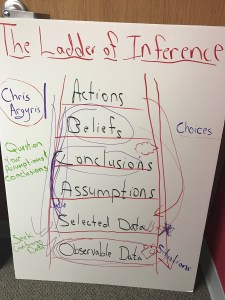
The learning from this book fits so well with some of my Harvard University learning on the Ladder of Inference. I have included a picture of the visual I have been using when discussing the ladder. You will note the similarities. Most importantly, from Chris Argyris’ model, are making sure we question our own assumptions and conclusions and seek contrary data in order to stay low on the ladder. Combine this with the model for OASIS Conversations and you have the makings of deep listening, meaningful conversations, and dialogue that can bring about incredible change.
Break The Boulder Up To Move It!
 I use the term, “Break the boulder up to move it” all the time when referring to big opportunities (what I also call challenges). We look at opportunities as one big boulder that just can’t be moved. Therefore I always remind everyone that if we can break it down into manageable sized rocks we can overcome the challenge or make the opportunity a success. As a farm kid I have moved my share of rocks and still do on our farm today. I know that if you do not get the rocks out of the way they can tear up farm machinery in seconds. Therefore it is always better to move rocks when they become obstacles than to go around them.
Continuing with the original metaphor, when we come across a rock blocking our path, there are two possible solutions to the problem. You can try to move the rock, which if small enough is the best solution. But, if the rock is massive (boulder sized), you can be clever and start breaking the rock into smaller, easier to move pieces. Our challenges as leaders are similar to this metaphor. It is smart to break these opportunities down into smaller pieces. This is done by using a varied set of view angles. The ideal process would be to break the challenge into six to twelve different questions or parts. These parts will help to tickle the imagination and trigger thoughts and ideas of those on your team for solving the larger issue. These smaller fragments are not meant to solve the whole issues that will in turn lead to a “boulder sized” solution.
“The best way out of a problem is through it.” ~ John Parker Stewart
My thoughts above were inspired while reading Lesson #20, “The Farmer and the Rock” in  52 Leadership Lessons: Timeless Stories For The Modern Leader by John Parker Stewart. This was the story of a farm family that for generations had been farming around a rock they thought was to big to move. Finally, one day the younger farmer got mad and hook the tractor and chain to the rock and it broke up and was easily moved. Do you as a leader plow around obstacles, or do you confront it and get it out of the way for good?
Your Life’s Journey Is Your Education
 The Education of Henry Adams by Henry Adams
My rating: 4 of 5 stars
This book really caused me to do a great deal of reflection about education and my own education in particular. As a believer in lifelong learning, Adams assured me that investing in learning at any point in life is a sound investment. His teachings also made me reflect on the fact that living life is an education in and of itself. We need to make sure we are using the context in which we live and all the experiences to learn at the highest level. How do we do this? I believe we can learn from Adams that it is ok that we are ignorant at every new turn in life and that we need to begin learning from everyone and every experience we have. If I were to sum up the book in one statement it would be, “Your life’s journey is your education.”
In this book, Henry Adams is not talking about himself as much as he is of the education and the context in which he lived provided an education. Adams serves as the narrator in this book. At the writing he is in his late sixties and refers to himself in the third person. This is an interesting way to read an autobiography that I am not sure I like, but I got used to it. Sometimes his referring to himself in third person made it made it hard to follow, but in the context of making living life our education this was probably the right way to do it. In his “Preface,” he introduces the metaphor of a manikin, which represents Henry Adams. The various garments draped across the manikin represent his education. It was this metaphor and how all events proved learning that I formed the opinion that Adams believed in lifelong learning. He continually refers to his ignorance, which told me he was of a growth mindset long before the development of the “growth mindset” theory.
Adams tells his readers that any young man seeking education should expect no more from his teacher than the mastery of his tools. Leaning on the scientific approach that he develops in the education, he suggests that the student is merely a mass of energy. The education he seeks is a way to economize that energy. The training by the instructor is a manner of clearing obstacles from the path of the student. My take on Adams’ position is that a person’s life in its entirety is our education.
Adams wrote, “Probably no child, born in the year, held better cards than he.” Adams also told us that the world he lived was rapidly changing – as it does for all of us. It is a world of contrasts. It was this contrast that Adams used throughout the book to discuss his education. In the book Adams states that as yet he knows nothing. Even after graduating from Harvard, he did not believe his education had begun. My sense is he believed in learning by doing and being the person in the arena. Here are some of my favorite quotes from the book:
– The Ego has … become a manikin on which the toilet of education is to be draped in order to show the fit or misfit of the clothes. The object of study is the garment, not the figure.
– Nothing in education is so astonishing as the amount of ignorance it accumulates in the form of inert facts.
– The object of education for that mind should be the teaching itself how to react with vigor and economy. No doubt the world at large will always lag so far behind the active mind as to make a soft cushion of inertia to drop upon, as it did for Henry Adams; but education should try to lessen the obstacles, diminish the friction, invigorate the energy, and should train minds to react, not at haphazard, but by choice, on the lines of force that attract their world.
And… my favorite of all the quotes: “Man does not concern himself with understanding how discoveries can be used. He will let the discovery show him how.” I really believe this reinforces my theory that Adams believed that our life’s journey is our education. How would you write the autobiography of your education? What do you need to be doing in your context to have it read how you would like it to? This book will cause you to reflect.
~ Dr. Byron L. Ernest
The American Commonwealth
 The American Commonwealth, part 1 by James Bryce
My rating: 5 of 5 stars
This book is for anyone who wants to better understand the experiment in democracy that has become our great United States. Every aspect of our local, state, and federal government is covered in great detail from the Declaration of Independence to the turn of the 20th Century (I read the 1914 edition). It was interesting to learn Bryce’s views on Lincoln, the Civil War, and how our Constitution served as the navigational guide. I particularly valued the Part V Chapters on Public Opinion, Colleges & Universities, and voter suffrage.
This is a very academic read that causes reflection and further study. It took me almost a year to read (keep in mind I was reading other books at the same time), but it is well worth the investment. Every leader who wants to serve their community, state, and nation positively and significantly should read this book.
Blue Heron Leadership
 The Blue Heron is one of my favorite birds. Because of some ponds on our farm we see them flying over and walking in the water often. We also see them gleaning through our fields. They are beautiful and majestic birds. After reading Lesson #19 in in 52 Leadership Lessons: Timeless Stories For The Modern Leader by John Parker Stewart I realized just how beautiful and awesome the Blue Heron really is. In fact they follow a very participatory and holacratic organization structure like I believe in. Most generally we only see Blue Herons one at a time. This is because, as Stewart pointed out, they like to stay in small groups or by themselves until nesting. At nesting time Heronies are formed to cooperatively get the work of raising young accomplished.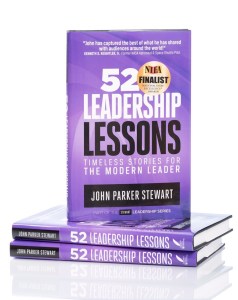
“When there is commitment and a willingness to do whatever is needed, success is far more likely. As the Blue Herons were true to each other in following through with their part, so can we as we follow their example and remain ‘true blue’.” ~ John Parker Stewart
Both male and female work together to get the nest built. After the eggs hatch both parents take care of feeding, teaching them to fly, and teaching them to catch fish. Notice there is no hierarchy here – this is about as flat a structure as you can get. There is only an eagerness to complete the task. The Blue Herons are not concerned about status or position. Furthermore, there is no complaints about fairness, equity, or doing undesirable tasks. This is the huge advantage of an intent-based environment where everyone is considered a leader. If we want our team members to work cooperatively together like Blue Herons then we must create an environment where they are able to move up the rungs of the Ladder of Leadership (created by David Marquet). The rungs are as follows (also check out the graphic pictured here):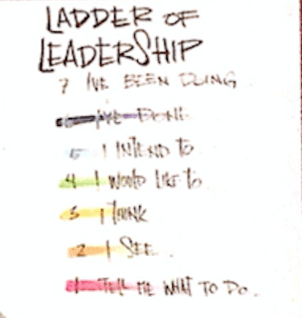
- Tell me what to do
- I see
- I think
- I would like to
- I intend to
- I’ve done
- I’ve been doing
Are you modeling an intent-based environment where everyone works cooperatively and is concerned with getting the work done, not in titles and hype?
“Go Ask Your Mother”
 I have a coworker who will occasionally comment after working with staff members that she just wants them to go ask their mothers. Usually I chuckle at this comment, but after reading Lesson #18 titled “The No-Brain Stage”by John Parker Stewart in 52 Leadership Lessons: Timeless Stories For The Modern Leader. I realize this is probably not funny. In this lesson, Stewart pointed out the basic needs of a two-year-old child. Here they are:
- They need to be cared for.
- They need security and protection
- They need to be listened to and included.
- They need their questions answered.
- They need love, reassurance, entertainment, attention, praise, and discipline.
- They even need age-appropriate responsibilities.
“If your people are acting like two-year-olds, ask yourself which of their ‘two-year-old’ needs you may have neglected.” ~ John Parker Stewart
So… if you have ever said, “I work with a bunch of two-year-olds.” You’re right. That list of what a two-year-old needs is spot on for any age group we serve as a leader, don’t you think? This lesson really caused me to think about whether I am doing my part to meet the needs of all those I serve. We all need to take time and listen deeply to our team members and make sure we are meeting their current needs. Remember, their needs do change over time.
My challenge to you and myself is to take some time and analyze the needs of those who report to me and see if those needs are being met.
Conflict Creates Energy!
 Conflict Without Casualties by Nate Regier
My rating: 5 of 5 stars
Conflict is always difficult, but it leads to growth and change, which is good. No one likes pain, but pain wakes you up and tells you when to react. This book is a guide for leaders on how to navigate conflict so it is not an energy drain but an energy source. Some level of organizational conflict is actually desirable — it’s not always dysfunctional. When conflict exists, it generally indicates commitment to organizational goals, because the players are trying to come up with the best solution. Dr. Regier gives us three critical steps to follow for creating positive energy with conflict:
- Be open and transparent about how you are feeling and what you want.
- Show a non-judgmental curiosity to explore options and look for creative solutions.
- Gain clarity about your boundaries and principles. This is a must read for leaders that want true open dialogue and dissent to find the best solutions for our global challenges.
This is a must read for leaders that want true open dialogue and dissent to find the best solutions for our global challenges.
Finding Your Leadership Voice
 This post is an excerpt from Paul Larsen’s new book, Find Your Voice as a Leader.
What Does It Mean To Be Courageous?
As you exert your influence to rally your team to your outcomes aligned with your values, finding your voice as a leader necessitates developing the courage to take steps forward, no matter how small the steps. Courage takes many forms. To stand up for what you believe. To speak up when no one else will. To test new behaviors. To change directions. To alter your opinion. To be visible. To stand alone in a crowd. To get comfortable with being uncomfortable. And the courage to believe in yourself. Though we most often associate courage with the battlefield, according to the Ivey Business Journal, courage is essential in the boardroom as well.
Although some may have a greater aptitude for it than others, courage isn’t something you’re born with. Anyone can learn to be more courageous. Some say courage is like a muscle—the more you use it the stronger it becomes.
Getting Comfortable With Being Uncomfortable
I think most people would like to believe they live a life that stands for something. That they have a job that makes a difference. That if push comes to shove, they would stand up for what they feel is right. In reality, those words and phrases are always easier to say but not always the easiest actions to take.
Not everyone is willing to be courageous if they fear any repercussions. It means taking a risk, no matter how small, being in an uncomfortable place. Did you know that when you feel uncomfortable, there might be an opportunity for growth? But with human nature being what it is, the minute we feel uncomfortable, we immediately seek an escape path back to our safety zone, our “zone of comfortableness.” So the next time you find yourself in an uncomfortable situation, stay in it, and become aware of why you feel uncomfortable. There might be something for you to learn. To try on a new skill or a new behavior. To challenge yourself. To seek a new path. To explore a new opportunity. To develop a new capability. To find your voice.
Not being afraid of discomfort is one of the key ways to learn to be more courageous, according to Forbes magazine. Not being afraid to “rock the boat” makes it much easier to stand up for what you believe. As a courageous leader, you need to have more than just a good vision and a good plan. You need to be brave enough to stand up for your team and your beliefs even when they may go against the accepted norm. You may need to challenge your traditionally held beliefs and those of others to empower yourself and your team to recognize new opportunities.
Think About This
When was the last time you remained quiet when you knew you should have spoken up? When was the last time you had an idea but didn’t say anything only to hear that same idea come from someone else later on? How many times have you wanted to speak up but didn’t? Why? What excuse did you use? Have you been feeling stuck in a rut but continue to do the same things? How does this make you feel: frustrated? disappointed? inadequate?
Now Think About This
When was the last time you stood up for what you believed in? When did you voice an opinion that was contrary to what the majority of other people were saying? When have you taken a risk and did something new: a new skill, a new activity, a new behavior? How did this make you feel: scared? excited? uncomfortable? satisfied? Probably a combination of all those and a few more feelings mixed in there. What was the outcome? Do you want to follow or lead? Do you want to remain quiet when you should speak up? That’s what courage is about: taking small, baby steps into the unknown, making yourself known, giving your opinion, asserting your feelings for what you believe is right, having an impact—having a voice.
******
Paul N. Larsen, MA, CPPC, is a Certified Professional Performance Coach and an experienced leadership consultant and speaker. He has over 30 years’ business experience with executive and senior-level responsibilities within small and large companies, including being the Chief Human Resources Officer for a $3 billion organization. Paul partners with industry-wide leaders and teams from Fortune 100, start-up, and high-tech environments to find their unique leadership “VOICE” and create compelling and purposeful outcomes for their organizations. He has a proven track record with organizations such as SAP, Electronic Arts Twitter, and Walmart. Read more about Paul and his latest book, Finding Your VOICE as a Leader at www.paulnlarsen.com.
Be A Leader!
 If you aspire to be a great leader, the first requirement is that you look and listen, so that you can find out the true needs that a situation demands to be fulfilled. It seems to me there is a general myth that leaders are born rather than made, that somehow nature produces a peculiar species of human being who is bigger, more powerful, smarter, braver, and more charismatic than the rest. During this presidential election year I have been reflecting more and more on this. I have caught myself saying, “Is the right person even out there to lead our country for continued greatness?” A democracy, more perhaps than any other form of government, needs great men and women to lead and inspire the people. Now, there are lot’s of different theories out there as to why we might lack great leaders, such as:
- Our system of government does not always lend itself to the best people being elected to office.
- We seem to linger in a perpetual leadership vacuum.
- Are we open to having dialogue with leaders who are going to bring the spark of creativity to the situation?
- Are we open to having dialogue about new and tranformative ways of doing things?
- Ego causing leadership failure.
Americans, however, myself included, maintain that when the hour comes, it brings the right person. For example, it brought Abraham Lincoln. When he was nominated by the famous convention of 1860 his name had been little heard of beyond his own state. But he rose at once to the level of the situation, and that not merely by virtue of strong clear sense, but by his patriotic steadfastness and noble simplicity of character. If this was luck, it was just the kind of luck which makes a nation hopeful of its future, and inclined to overlook the faults of the methods by which it finds its leaders.
I believe we can all be great leaders, with all the rewards this carries, while still serving the needs of the whole group. We must, however, take an introspective look at ourselves and the areas for improvement we need to make. Having looked and listened, you will know the situation you are in and the need that is crying out to be fulfilled. This deep listening coupled with the criterion values and not compromising those values shapes a model of successful leadership.
We also need to have someone else…share with us the way they experience us…because it’s hard to see our own blind spots or limiting assumptions. We need to get feedback from trusted folks we either know or do not know. Here is my challenge to you: Connect to your top professional priority. Ask yourself: What is the one thing I could get better at that would help me most with my most important professional priority? Create a personal improvement goal around this professional priority. Does the goal implicate you? Your goal implicates you if it is clear that you must get better at something. Your goal should focus on something you can control. It should focuson something specific about yourself that you want to improve. Let’s all own being a better leader.
Are You A Begonia?
 I am reading a great, award winning, and Pulitzer Prize winning book right now. The book is The Education of Henry Adams by Henry Adams. This book has such great insight into our life, what Henry Adams calls our education. His theory was we spend our entire life being educated. One of the metaphors he used in the book was of people who were like Begonias. These are beautiful plants known for their brilliant flowers and fancy foliage. The begonia has both of these lovely features. You probably get the idea; he was describing people who are all show and no substance.
When raising Begonias you must place them where they can be in the light. Do you know people like this, that need to constantly be in in the limelight? Begonias like a lot of light so place them on windowsills that face east or west so that your plants get several hours of sunlight each day. I believe this is one of the reasons Henry Adams chose this powerful metaphor.
In doing a little studying on Begonias I also found that they became a staple of many bedding schemes, and in some cases, were quite over-used. Begonias became as disliked as euonymus is as a municipal shrub. Begonias became the lazy choice for parks and gardens up and down the country, often with the same old, tired varieties; either a mushy begonia semperflorens or the superb, but over-bright ‘Non-stop’ series! Sound like any people you know that are all talk and no action?
In my research, one botanist described using Begonias as having a desire for instant color and makeover effects … one-stop gardening – disposable, dramatic and needing no knowledge beyond which way up to stick the plant in the ground. Pretty good metaphor for all we do not want to be as a leader, don’t you think? Therefore we need to strive, as leaders, to not just be seen as bright flowers and foliage in delicate vases or as great explosions of leaf and flower, all brought indoors as theatre and decoration. But when they start to fade, they all go on to the compost heap.
 Byron's Babbles
leave a comment