Teacher Evaluation Norming: “What Can We Create Together?”
 When creating the ideal school community for meaningful teacher evaluation we must clearly define the expectations for effective teaching at our schools. We must also effectively communicate the criteria that will be used to evaluate teacher performance. Personally, I believe the most important aspect of teacher evaluation is to ensure professional growth for our teachers in order to move them toward being highly effective. Our school has become a part of the Indiana Teacher Appraisal and Support System (INTASS) and I love how Dr. Sandi Cole, Director of Center on Education and Lifelong Learning puts it: “Teacher evaluation must be something done for teachers, not to them.” This statement has become a core value of our work of overhauling our entire teacher evaluation process. The INTASS process rests on four basic elements of a quality evaluation plan: a) Clear, frequent, and transparent communication among a wide base of stakeholders; b) Professional practice measures that are mutually agreed upon by stakeholders; c) Multiple measures of student learning outcomes, and d) Fully aligned post-evaluation processes, including job-embedded professional growth and support for all educators.
Another crucial part of this process is the norming of evaluators. We have chosen to have a monthly retreat of our evaluation team to ensure that evaluators have an accurate and aligned perception of classroom practice and student growth. This norming process also guarantees assigned evaluation ratings that are accurate reflections of teacher effectiveness. During norming, evaluators align or “calibrate” their scoring so that every member of the team applies the rubric consistently across teachers, and of the team of evaluators scores consistently with one another (inter-rater reliability). Having similar scoring and uniform expectations of teacher effectiveness is critical if you want to make meaningful comparisons among teachers.
I have also found the norming to be a good time for our administrative staff to engage in professional development for the purpose supporting effective leading of learning. A healthy team culture—and ultimately the school’s performance—rely on the team’s ability to encourage individual improvement in constructive ways. Through our norming process, administrative team members are learning and practicing the skills and dispositions necessary to mentor, coach, and evaluate colleagues. Our norming process has enabled the team to practice a model of shared leadership. By having regular norming retreats, team members are able to refine their collaboration skills and dispositions to ensure the team’s ability to act according to its shared purpose of enabling and empowering all of our teachers to be highly effective.
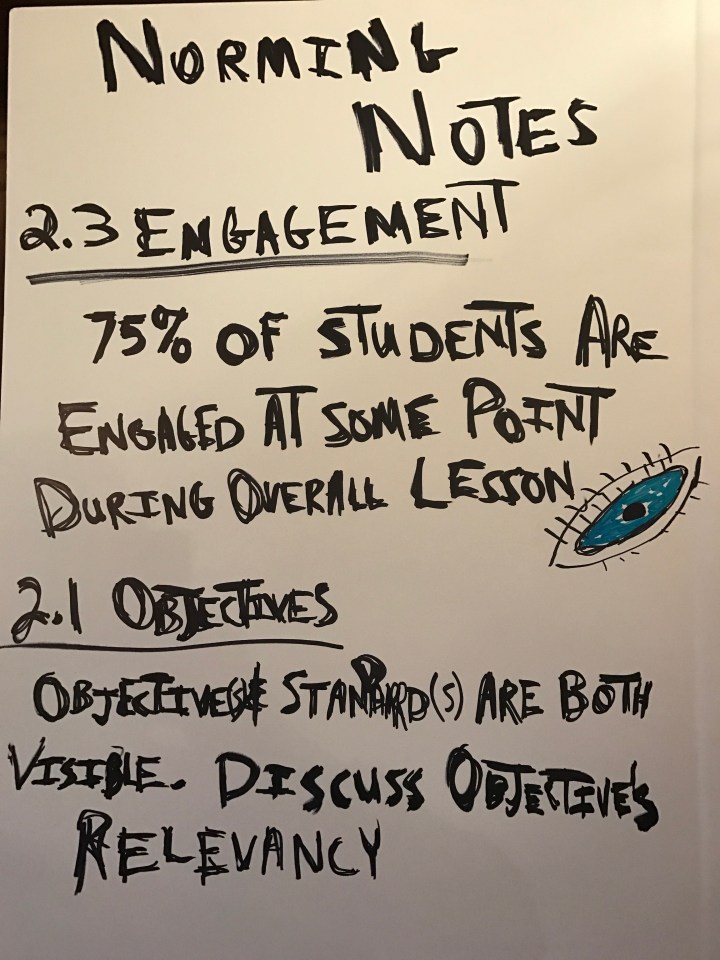
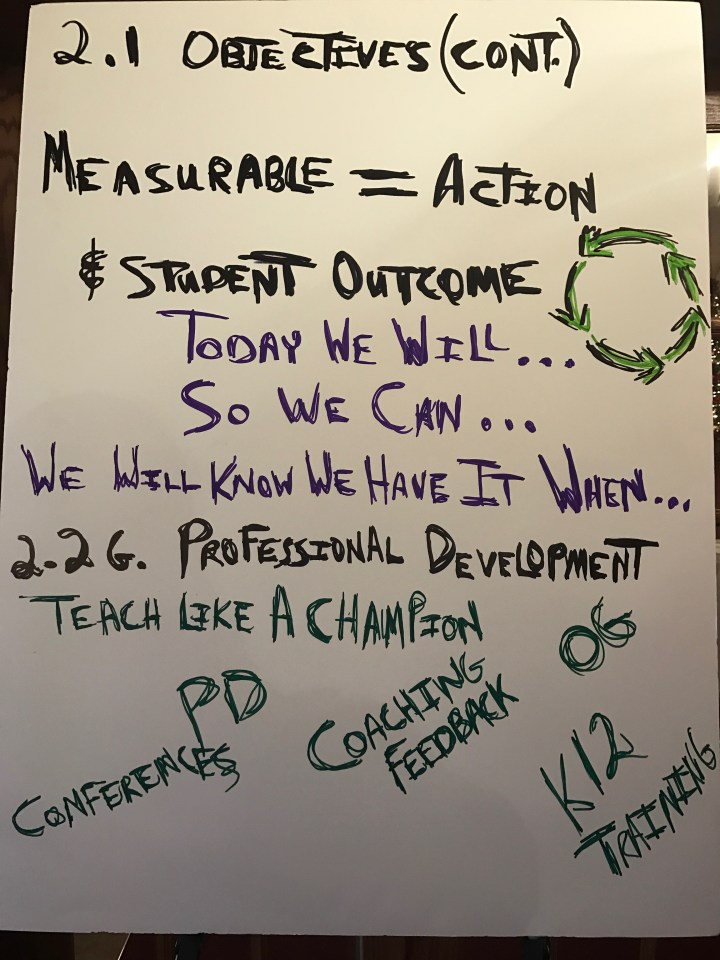
At this past week’s norming retreat I was struck by the amount of learning and professional growth that also went on with the administrative team of evaluators. There were discussions of how to more effectively use technology, sharing of best practices witnessed such as for checking for mastery, and new ways of engaging students; just to name a few. We even discussed the use of Emojis for engaging students. I couldn’t help but draw my own Emoji (shared in the picture above) as I graphically facilitated the norming retreat. We also were able to identify areas where we need to provide professional development learning opportunities for our teachers. I believe my role as a leader is not necessarily to always be a better role model or to drive change; my role is to create structures and experiences that bring our community of staff members together to identify and solve their own issues and drive improvement. Holding these norming retreats has enabled this structure of experiences for our administrative staff.
This norming process has become an important piece of being able for our school community to answer the question of “What can we create together?” I believe we are creating a community of continual improvement and one where our teachers are valued as professionals and given the feedback and resources to be the very best. I am attaching images of our notes from our latest norming retreat so you can see what went on:


Community Is The Culture
 This past week I had the opportunity with Mike Fleisch to do a design sprint (what others would call a workshop) on our school’s Focused Leader Academy. During our design sprint we built models together of what a community would look like where there is a serious commitment to developing leaders. I told the design sprint participants that I now described what we were doing as community building, not culture building. Culture emerges from the past values we develop together. I would rather us live in the context of the world we live in now and, more importantly, how do we want the world to be. With this worldview in mind, we wanted the group think about what a community of people in a school could create together.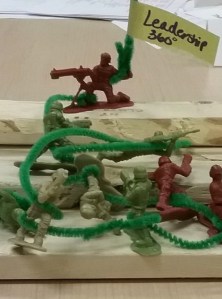
Daniel Goleman said “Executives who can effectively focus on others emerge as natural leaders regardless of organizational or social rank.” These leaders are the ones who find common ground, whose opinions carry the most weight, and with whom other people want to work.They emerge as natural leaders regardless of organizational or social rank. As leaders we need focus on others, which is the foundation of empathy and of an ability to build social relationships.
As a leader I believe it is important for me to be available to stakeholders so that I have the opportunity to meet others, engage in conversation, and share thoughts, ideas and concerns, and to build community and a sense of belonging. It has been my experience that those I serve have lots of wisdom, the ability to make connections, and to help come up with solutions. 
Peter Block said “We will never eliminate our need for great leaders and people on the stage; we just cannot afford to put all our experience and future in their hands.” To be a transformative leader we must create communities (a community can be our organization, school, or business too) that produce deeper relatedness across boundaries. Additionally we need to create new conversations that focus on the gifts and capacities of others.
“Leaders are held to three tasks: to shift the context within which people gather, name the debate through powerful questions, and listen rather than advocate, defend, or provide answers.” ~ Peter Block
I have now begun to talk in terms of community instead of culture. We need to begin to think of all the contexts we operate within are communities. Community then grows out of the possibilities of those in our communities. It is those citizens that build our communities. I have learned that the culture is the set of shared values that emerges from the history of experience and the story that is produced out of that. It is the past that gives us our identity and corrals our behavior in order to preserve that identity. Context is the way we see the world. Peter Block taught us to see the world, not remember the world. 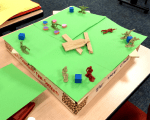
So, as we continue to improve the communities in which we live, work, and lead we need to continually ask the question “What can we create together?” This emerges from the social space we create when we are together.
I Count You Twice!
 Today is Thanksgiving – a joyous and festive kickoff to the holiday season. Many of us have a lot to be thankful for, including family and friends, and I’m especially thankful that I’m able to serve as a leader making significant strides in education. I also very thankful for all those I work with, serve, or have associations with. I am particularly thankful for all teachers who put in on the line every day for our sons and daughters. Please know that when I count my blessings I count you twice!
During this holiday season, take time to reflect on what you are thankful for. While we have many improvements to make in our educational community, and always will, we have many things to be thankful for.
Education options are more flexible than ever. Not too many years ago, proximity and zip code was a crucial part of education. If you didn’t live near a school, you were unlikely to have any access to it. The ability to have choices had made all the difference for huge numbers of our children and adults.
Today, we are more connected to k-12 and postsecondary education than ever before. There are evening classes, online options for both secondary and traditional college programs, and certificate programs for people who want to learn a specific set of skills or continue their professional growth.
As I reflect this morning on my education, both past and present, I am thankful that I was taught to think critically, solve problems creatively, analyze and be open to the world around us, and most importantly how to learn. I believe it is important for us to remember that it is during our education we learn our sense of community. Within a school setting, a child quickly learns the importance of teamwork and cooperation. A school requires a joint effort to be safe and clean. That’s when our children learn first-hand that everyone can make a difference and everyone’s efforts are important.
I am also thankful schools don’t just teach our children academic curriculum. Schools are also helping our children develop into respectful global citizens. It is at school that our children are presented with life lessons they may not have learned at home.providing our children with lessons in acceptance. Our children are learning that not everyone speaks the same language, wears the same types of clothes, or eats the same types of foods at lunches. And that’s all okay. Our children are learning to take time to truly understand others and embrace who they are.
While our education system certainly has room for improvement across multiple factors, I believe we need to be thankful for all the great things happening in education.
Errors In Leadership Coordinates
 Lesson #21 entitled “It’s Only Two Degrees” in 52 Leadership Lessons: Timeless Stories For The Modern Leader by John Parker Stewart really drove home the fact that small errors can have big consequences. On the 28th of November 1979, Air New Zealand flight 901, crashed into Mt Erebus on Ross Island, Antarctica, instantly killing all 257 people on board. Antarctic overflights were a new and exciting breakthrough in airborne tourism. Interest in the Antarctic had been particularly strong in the scientific community since the late 1950s, but only a small number of privileged people had experienced the wonders of the icy south. At the heart of much of the eventual controversy surrounding the causes of the accident were changes made to the flight plan of TE901. The plan loaded into the aircraft’s flight management computer was not that on which the flight crew had been briefed 19 days earlier, but no one had told them. The flight plan was only two degrees different, but this two degrees made all the difference between crashing and not crashing. Because of the white snow covering all of the area, the 12,000 foot rise of the volcano was not noticed because of what is now called “sector whiteout.”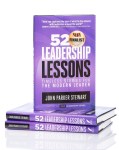
As leaders, we should foster environments adopting a strategy that is able to take on the challenge of avoiding negative error consequences and learning by fostering positive error consequences simultaneously or in alignment. Error prevention aims at avoiding negative error consequences by avoiding the error altogether, the error management approach focuses on error consequences directly. It aims at avoidance of negative error consequences and the promotion of positive error consequences by means of early error detection, quick and effective correction, error analysis, and long term learning from errors.
Edmondson (1996) posited that the open climate characterized by a willingness to report and discuss errors, allows learning from errors, and thereby can affect team performance positively. Edmondson (1996) further asserted that these teams had a better error climate, which allowed them to talk about errors, which in turn increased detection and correction. Generally, errors are discussed only when the consequences are high or even disastrous, I believe that errors with small consequences should also be taken as chances to learn. We must create an environment where our teams are encouraged to take responsibility for their errors. What kind of culture for dealing with errors are you developing in your organization?
Your Life’s Journey Is Your Education
 The Education of Henry Adams by Henry Adams
My rating: 4 of 5 stars
This book really caused me to do a great deal of reflection about education and my own education in particular. As a believer in lifelong learning, Adams assured me that investing in learning at any point in life is a sound investment. His teachings also made me reflect on the fact that living life is an education in and of itself. We need to make sure we are using the context in which we live and all the experiences to learn at the highest level. How do we do this? I believe we can learn from Adams that it is ok that we are ignorant at every new turn in life and that we need to begin learning from everyone and every experience we have. If I were to sum up the book in one statement it would be, “Your life’s journey is your education.”
In this book, Henry Adams is not talking about himself as much as he is of the education and the context in which he lived provided an education. Adams serves as the narrator in this book. At the writing he is in his late sixties and refers to himself in the third person. This is an interesting way to read an autobiography that I am not sure I like, but I got used to it. Sometimes his referring to himself in third person made it made it hard to follow, but in the context of making living life our education this was probably the right way to do it. In his “Preface,” he introduces the metaphor of a manikin, which represents Henry Adams. The various garments draped across the manikin represent his education. It was this metaphor and how all events proved learning that I formed the opinion that Adams believed in lifelong learning. He continually refers to his ignorance, which told me he was of a growth mindset long before the development of the “growth mindset” theory.
Adams tells his readers that any young man seeking education should expect no more from his teacher than the mastery of his tools. Leaning on the scientific approach that he develops in the education, he suggests that the student is merely a mass of energy. The education he seeks is a way to economize that energy. The training by the instructor is a manner of clearing obstacles from the path of the student. My take on Adams’ position is that a person’s life in its entirety is our education.
Adams wrote, “Probably no child, born in the year, held better cards than he.” Adams also told us that the world he lived was rapidly changing – as it does for all of us. It is a world of contrasts. It was this contrast that Adams used throughout the book to discuss his education. In the book Adams states that as yet he knows nothing. Even after graduating from Harvard, he did not believe his education had begun. My sense is he believed in learning by doing and being the person in the arena. Here are some of my favorite quotes from the book:
– The Ego has … become a manikin on which the toilet of education is to be draped in order to show the fit or misfit of the clothes. The object of study is the garment, not the figure.
– Nothing in education is so astonishing as the amount of ignorance it accumulates in the form of inert facts.
– The object of education for that mind should be the teaching itself how to react with vigor and economy. No doubt the world at large will always lag so far behind the active mind as to make a soft cushion of inertia to drop upon, as it did for Henry Adams; but education should try to lessen the obstacles, diminish the friction, invigorate the energy, and should train minds to react, not at haphazard, but by choice, on the lines of force that attract their world.
And… my favorite of all the quotes: “Man does not concern himself with understanding how discoveries can be used. He will let the discovery show him how.” I really believe this reinforces my theory that Adams believed that our life’s journey is our education. How would you write the autobiography of your education? What do you need to be doing in your context to have it read how you would like it to? This book will cause you to reflect.
~ Dr. Byron L. Ernest
The American Commonwealth
 The American Commonwealth, part 1 by James Bryce
My rating: 5 of 5 stars
This book is for anyone who wants to better understand the experiment in democracy that has become our great United States. Every aspect of our local, state, and federal government is covered in great detail from the Declaration of Independence to the turn of the 20th Century (I read the 1914 edition). It was interesting to learn Bryce’s views on Lincoln, the Civil War, and how our Constitution served as the navigational guide. I particularly valued the Part V Chapters on Public Opinion, Colleges & Universities, and voter suffrage.
This is a very academic read that causes reflection and further study. It took me almost a year to read (keep in mind I was reading other books at the same time), but it is well worth the investment. Every leader who wants to serve their community, state, and nation positively and significantly should read this book.
I Get To Read!
 I realize that, ideally, a fondness for books starts at home, but reading can become a habit through opportunities to read self-chosen books at school. Consumed by the urgency to raise students’ reading scores, some policy makers and school officials have forgotten that children learn to read by reading. I support “balanced literacy” instruction, which includes independent reading. All students should be given access to books they want to read throughout their schooling, and I dream of the day all pre-readers would have an adult who would read aloud to them everyday. Through independent reading children gain a wealth of background knowledge about many different things, come to understand story and non-fiction structures, absorb the essentials of English grammar, and continuously expand their vocabularies. Many also remember visually how to spell words.
Interestingly, it is the adult/child relationship to reading that prompted this post. This past week my son needed to pick a book to read for his sophomore English class. Yep, you heard me right, he got to choose. First of all, I was excited by that! In my view students should get to choose what they read. If you want to hear my story of how I got turned on to being the rabid reader I am today click here to read “Reading Big Red.” Short of the long story – I hated reading until I got to pick my first book (not till middle school mind you). Now I read 70-80 books a year. So, I’m sure you can see why I was excited for Heath to get to pick a book he wanted to read – just typing here I just can’t see why people don’t get this concept – picking your own book makes it about the reader (student centered). Research has shown that letting children choose their own books could in fact make them better readers. When you think back to your own classroom experience, being assigned one book to read as a class was often a dreadful experience. Teachers would assign students to read a some classic and, instead of being enamored with this classic tale, students were often less than thrilled. That was me and has also been my son Heath’s experience, too.
 Back to the story – Heath came home all excited (think about this; he’s coming home from school excited!) about the book he had picked: Tough As They Come by Travis Mills. Heath proceeded to tell me all about the book and Travis Mills. Travis is a retired United States Army Staff Sergeant and what he calls a recalibrated warrior. He is now a motivational speaker, actor, author and an advocate for veterans and amputees. In his book, Tough as They Come, Travis shares his journey of serving our country. Despite losing portions of both arms and legs from an IED while on active duty in Afghanistan, Travis continues to overcome life’s challenges, breaking physical barriers and defying odds. Travis lives by his motto: “Never give up. Never quit.”
Think about what just happened here:
- My son chose a book
- My son wanted to read a book (Not to sound like Donald Trump, but this is HUGE!)
- My son had researched about a book and the author
- My son was going to get a role model and mentor, Travis Mills, through the power of reading
I thought this was the coolest day ever. I read to Heath when he was younger every night and then rubbed his back till he went to sleep (He would not want me to tell that, but these were some of the greatest moments as a dad), but now he was explaining a book he wanted to read to me. And… as if it could not get any better… Heath proceeded to say, “Let’s both download this book and read it together Dad. I think you’ll really like it.” I ask you you, “How does it get any better than that?” My sophomore in high school son wants to read a book with his dad! Well it does get better – Heath has agreed to write a guest blog post about the book for me! Watch for it soon.
Here’s the deal: giving students a choice has been linked with scholastic achievement. Some researchers believe that when students (especially boys) are free to choose what they want to read, they will read for pleasure. Reading for pleasure has been linked with scholastic achievement in school. Furthermore, students will read for pleasure and enjoy reading. When children can freely choose what they want to read, they will be reading for pleasure, not because there is an assignment due. A choice allows children to be enthusiastic about what they are reading, and in turn they will be engaged.
I realize there are books and other literary pieces we need to have our children reading, but I believe we need to give students control of their own reading. Allow them to make their own choices and they will explore more genres. Expose your students to books they love and you will see that they will not only read for pleasure, but enjoy what they are reading. I have always said we need to change the mindset from, “I have to read.” to “I get to read!” We can do this and student choice is one piece of it.
Think about this as a conversation starter and relationship builder with your children and students: “So, what are you reading right now?”
Generative Complexity
 Yesterday I blogged about Dynamic Complexity after reading in the book by Adam Kahane and is titled Solving Tough Problems: An Open Way of Talking, Listening, and Creating New Realities. Another type of complexity worth organizing our thoughts about is Generative Complexity. Kahane (2004) said, “Generative complexity requires that we talk not only about options that worked in the past, but also about ones that are emerging now” (p. 75). To me this is all about not getting caught up in thinking about how things have always been done, but about how no one has ever thought about doing them.
“We cannot develop creative solutions to complex human problems
unless we can see, hear, open up to, and include the humanity
of all the stakeholders and of ourselves. Creativity requires all
of our selves: our thoughts, feelings, personalities, histories,
desires, and spirits. It is not sufficient to listen rationally to inert
facts and ideas; we also have to listen to people in a way that
encourages them to realize their own potential and the potential
in their situation. This kind of listening is not sympathy, participating
in someone else’s feeling from alongside them. It is empathy,
participating from within them. This is the kind of listening
that enables us not only to consider alternative existing ideas but
to generate new ones.” ~ Adam Kahane
We need to remember that there are many interdependent parts of a complex system. Additionally, a complex systems world view highlights that interactions between parts of the system and the behavior of the system as a whole are critical. As leaders, we must learn to do a better job of seeking out, fostering, and sustaining generative relationships that yield new learning relevant for innovation.
When discussing leadership we tend to focus on leaders’ individual characteristics rather than on the dynamics of interactions between leaders, group members, and the context in complex organizational systems over time; and we certainly do not do enough toward our own professional growth as leaders, or those on our teams, to create conditions that allow their organizations to evolve (2006). We must also find ways to improve our own and organizations’ ability to learn continuously and implement learning in action as projects proceed.
References
Kahane, A. (2004). Solving tough problems: An open way of talking, listening, and creating new realities. San Francisco: Berrett-Koehler.
Surie, G. & Hazy, J.K. (2006). “Generative leadership: Nurturing innovation in complex systems.” E:CO Issue Vol. 8 No. 4 2006 pp. 13-26.
Dynamic Complexity
 I am reading a great book for one of my Harvard courses right now. The book is by Adam Kahane and is titled Solving Tough Problems: An Open Way of Talking, Listening, and Creating New Realities. The thing I am most blown away by is the reality Kahane (2004) pointed out, that “Talk by itself, even brilliant speeches by famous people, does not create new realities. Most of the time it reproduces old ones” (Kahane, 2004, p. 69). Kahane (2004) taught us that our toughest of problems can only be solved if we talk candidly and openly. As we know, this takes a lot of courage. It should also be noted that there must also be deep listening. This really hit home for me as a leader in the education arena. We have complex problems in our educational systems and we must all, as leaders, immerse ourselves in and be open to this full complexity.
“[D]ynamic complexity, situations where cause and effect are subtle and where the effects over time of interventions are not obvious. Conventional forecasting, planning and analysis methods are not equipped to deal with dynamic complexity.” ~ Peter Senge
For me, the idea of dynamic complexity really hit home. Kahane (2004) said that, “Dynamic complexity requires us to talk not just with experts close to us, but also with people on the periphery” (p. 75). This means we must “widen the circle” and “deepen the bench,” which is very uncomfortable for us (Kahane, 2004). In reality, dynamic complexity heightens the subtlety between cause and effect. This heightened subtlety not only provides the key to explaining why some over-hyped tools don’t deliver, but is consistent with how growing knowledge in a field inherently advances and generates complexity. I believe this really describes our reality in education. This is why it is so important to involve all stakeholders in our solving of complex opportunities. Then we must employ open and deep listening, as this is the basis for all creativity. We must be open to truly listening to new ideas.
“To create new realities, we have to listen reflectively. It is not
enough to be able to hear clearly the chorus of other voices; we
must also hear the contribution of our own voice. It is not enough
to be able to see others in the picture of what is going on; we must
also see what we ourselves are doing. It is not enough to be
observers of the problem situation; we must also recognize ourselves
as actors who influence the outcome.” ~ Adam Kahane
The long and the short of all this is that the world is changing at a rapid rate. This is true in all organizations and industries, but particularly in education. We had better understand this, as well as the caveat that we cannot expect more of the same when we plan for tomorrow!
Reference
Kahane, A. (2004). Solving tough problems: An open way of talking, listening, and creating new realities. San Francisco: Berrett-Koehler.
How Can We Reinvent Ourselves?
 I had the honor and pleasure of being given an Advance Copy of Indivisible: Coming Home To Deep Connection by Christine Marie Mason. I love being part of book launches for Weaving Influence. This book was absolutely awesome. In fact, my first tweet was that the book “rocked my world.” If you want to check out my tweets about the book go to @ByronErnest or use the hashtag #Indivisible. There were so many things that resonated with me as an educator and leader. Most notable were sections that discussed, “Where does our core worth come from?” or “If you want to see separation in action, go to a public school cafeteria.”
 At the end of the book Christine spends time discussing resilience. This quote has stuck with me: “A long arc of a lifetime of achievement requires resilience and tenacity.” She goes on to explain her epiphany of, “I used to think that the traumatic things that happened to us in life were a curse, but I was wrong. Now I see these experiences as preparing me to serve.” Christine also taught me in the book that “A bad experience can be a point of departure from which we bring service to others.” Here’s the deal: This book is authentic! Christine wrote this book from her own perspective as what I call “the deer in the headlights.” This book will cause you to do a lot of reflection on your own life and how you lead.
Here is an excerpt selected by Christine to offer you in this post:
“The Western worldview teaches that we are independent, individual beings. In this system, our worth comes primarily from what we produce. We are always being graded by others, and our worth and security are wrapped up in how well we conform to what they expect.
This is the perspective within which I, like many other Americans, was raised. But as I grew up, moving from childhood experiences to experiences that I chose for myself, I realized that these teachings felt fundamentally untrue. My direct experience was one of increasing interdependence and interconnection. Each person was infinitely more complex than I had ever imagined.
I decided to question how I had lost touch with myself and others, and how to live better in relationship with one other person—and beyond that, to how we, as a culture, had lost touch with our interdependence in the first place. I would undertake an experiment to answer these questions, and my methods would be a combination of research and lived experience. The broader questions were: can we “hack” our own evolution, and the evolution of the collective? In other words, can we get in there and speed it up? What if everything we had taken in unconsciously was up for discussion, and we didn’t accept any of it whole hog? If we give ourselves permission to question, alone and with others, we might design any manner of new ways to live.
If we go through our lives unconsciously, the neurons and atoms that make us up will continue to play out their repeating code. But if we become conscious, we can (to a certain extent) rewire ourselves, as well as the culture we live in. Every bit of information we have about how we work – historical, sociological or scientific – can help us with this rewiring.
I’ve found that approaching this inquiry with a heart of compassion toward the institutions under inquiry, rather than a mindset of attack and critique, helps a lot. All systems are exquisite adaptations. They are contextual and place bound; they arose naturally to meet the very real needs of the time in which they were created. But as time and circumstance changed, they overstayed their welcome, and ossified.
When there’s a problem with the dominant culture, and we have the enthusiasm for reconnection and redesign, and we also join that enthusiasm with loving rather than destructive intent, we are using the force of our intention to create systemic change. In doing so, we can honor and celebrate what we’ve learned so far, and give it an honorable retirement. Of course, this requires that the whole society be willing to look together and release what isn’t working—rather than hold on tight, as if they can’t handle the coming change.
This process of questioning and reinventing may be difficult, but the result is more than worth the effort. In my experience, those who are seeking more connection and continuous reinvention are happier. They are open. They know that it is the separation that is the lie; the union is the true thing. These are people who are at ease with each other, even in conflict. They are egalitarian and able to equally commune with all. They are the ones for whom there is always a couch to sleep on, a table to sit at, a band to jam with.
I wanted to know this in my bones, not only conceptually. I wanted to investigate how will we move fully into our own lives, evolve and grow, rethink our assumptions, float above our judgments, and redesign things that aren’t working. What could I learn about disconnection and connection? About choosing to be perpetrators or healers? Who was already successful in creating a more loving and interwoven world?” ~ Christine Marie Mason in Indivisible: Coming Home to Our Deep Connection
Thank you Christine for allowing me to publish this excerpt from your book for readers of my blog to enjoy and see just how great this book is. I certainly believe everyone could benefit from reading this book!
******
This post is an excerpt from Christine Marie Mason‘s new book, Indivisible: Coming Home to Our Deep Connection.
Christine has been a leader in the tech sector for 20 years, as the venture backed founder and CEO of several companies. She has always been a convener, bringing people together to have conversations around growth and change, and to spark action around new possibilities. She is the curator of 9 TEDxs, the convener of Naked Conversations and founder of LoveSpring. Her own deep journey exploring anger, violence and disconnection in the aftermath of her mother’s murder, early abandonment and general chaos have propelled her explorations into the interior life and capacity of the individual to heal and connect; her work as a victims’ right advocate for restorative justice and prison reform; and as an investigator into the neuroscience of human evolution and behavioral change.
 Byron's Babbles
leave a comment