Finding That Perfect Shell On The Beach

For 2026 I have chosen George MacDonald’s Diary of an Old Soul, Annotated Edition (2024) to guide my daily devotion and study time. MacDonald first self-published these poems (one for every day) in 1880. I have become a fan and student of George MacDonald because of my deep studies of C. S. Lewis. Lewis was deeply influenced by MacDonald at the age of 16 when he purchased a copy of Pantastes.
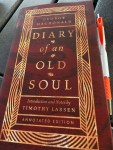
The edition of Diary of an Old Soul I am studying was expertly annotated by Dr. Timothy Larsen. I loved Larsen’s use of metaphor in the introduction, which was an incredible read in and of itself. Using metaphor, he said, “Your chosen path is the rocky bed of a stream that has temporarily gone dry. With each step you sweep past scores of stones – all of them ordinary, uninteresting, unworthy of your time.” Larsen then goes on to say, “Then a particular one catches your eye.” He was using this metaphor to cause us to think about poetry.
Larsen explained how every poem an author does, including MacDonald’s 365 in Diary of an Old Soul, will not necessarily jump out at us like the stone that catches our eye. Larsen explained this is not our fault nor the authors. Some poems will resonate with us and not others and visa versa. This reminded me also of how some musical artists songs really inspire us, but do not inspire others. This why there are so many songs on an album.

Then yesterday, when walking on the beach at Tybee Island, Georgia, I found myself walking in a bed of shells (see featured photo). They all looked unremarkable. All of the sudden, however, one jumped out at me. See the photo to the left. It caught my eye as beautiful and I took a photo of it.
There are so many lessons that can come from the stones and shells metaphors. First, it reminded us not to look at everything from a purely holistic viewpoint. We need to make sure we are looking for those individual pieces that inspire, motivate us, or cause us to pause and reflect deeply. Think about a book you are reading. Every chapter may not be exciting to you, but there may be those individual pebbles (pun intended) that jump out at you and inspire. A perfect example is how Larsen’s use of the bed of stone metaphor inspired this post.
Also, consider a conference you have recently participated in. Every session may not provide something for immediate use, but I’ll bet we can think of parts that we have copious notes from that we will immediately put to use. We need to be watching intently for those moments so we don’t miss the beautiful shell (again, pun intended).
It is all about how we show up. We must truly be present in every moment to find those gemstone moments that catch our eye and attention. As Larsen said, “The very act of attending to it deepens your admiration for it.” I am finding myself having to read MacDonald’s poems multiple times to fully understand the 1880 language they were written in. But I have been deeply moved to reflection by four of the six daily poems already. Are you staying alert for inspiration that may be right in front of you?
Art’s Eye for Evil

In the past several years I have reflected a lot on how I get more out of reading fiction books than non-fiction. I don’t say this just from an entertainment factor, but also from a deeper learning perspective. Interestingly, as I have in the last five years been intensively studying C. S. Lewis, GeorgeMacDonald, and Dorothy Sayers, and their appreciation for fiction, I have found fiction to be a major influencer of these author’s work and lives. Learning this has made me feel, not quite so “out there” in my thinking. In reading Dr. Richard Hughes Gibson’s just released and awesome book, The Way of Dante: Going Through Hell, Purgatory, and Heaven with C.S. Lewis, Dorothy L. Sayers, and Charles Williams (2025), the influence of fiction writing was even further affirmed.

Gibson noted, “…the fact that my archival labors revealed daily how thoroughly Dante had infiltrated my trio’s [C. S. Lewis, Dorothy L. Sayers, and Charles Williams] reading and writing lives” (p. xvii). Gibson’s new book interested me on several levels, but this idea of influence really interested me. Then at the beginning of Chapter 6, The Problem of Glory, Gibson asserted that, “EVIL MAY BE A PROBLEM for philosophers and theologians, but it is no problem for artists” (page 123). I loved this because it drove home what I have been saying about narrative artists and the power of fiction for years now – we get to see all the context and all the complexity of the characters. The artist reveals everything we need to know. This doesn’t happen, at least not all the time, with non-fiction.
Dr. Gibson referenced philosopher Agnes Callard saying, “Callard, let me be clear, thinks that art’s eye for evil is a good thing. Amid our busy lives, we look at the world with a purpose, and our purposes become blinders, obscuring our recognition of the ‘irrelevant, the unhelpful, and the downright wicked.’ Artists, by contrast, ‘take a long hard look at what the rest of us can’t bring ourselves to examine; they are our eyes and ears’” (p. 124). This illuminates the distinction between everyday perception and artistic perception. Callard suggested that people generally view the world through a purpose-driven lens, focusing on what matters to us—our goals, needs, and interests. This focus acts like blinders, preventing us from noticing things that don’t directly relate to our intentions, including aspects that might be irrelevant, unhelpful, or even morally troubling.
Gibson’s appreciation is for the artist’s role in providing a deeper, more honest perspective—especially regarding the presence of evil or wickedness—something that society generally tends to shy away from confronting directly. The emphasis, according to Gibson, is the importance of art as a means of truth-telling and of gaining a more comprehensive understanding of reality, beyond our convenient but limited viewpoints.
Our Deeper Realms Of Reality

It was curious to me that the last sentence in Lilith by George MacDonald was a quote by Novalis. The quote, “Our life is no dream, but it should and will perhaps become one” is attributed to Novalis, but some believe it is a paraphrased quote. Still, it was a pretty ingenious way of ending the book and concluding Lilith with a reflection on the transformative power of imagination, faith, and spiritual awakening. MacDonald was greatly influenced by the work of Novalis.

MacDonald was deeply interested in the idea that our earthly existence, while real and tangible, is also intertwined with the spiritual and the transcendent. By ending with a quote suggesting that life, though currently concrete, might become more like a dream—more fluid, wondrous, and spiritually aligned—he invites readers to consider the possibility of deeper realms of reality beyond the material world. It emphasizes hope and the potential for personal growth and enlightenment, encouraging us to see life not just as a series of fixed events but as something malleable, full of divine possibility.
I wonder if MacDonald may have wanted us to learn that even though our current experience is grounded in reality, there’s a divine or spiritual dimension that we can aspire to access—making life more like a meaningful, dream-like journey towards higher understanding and unity with the divine.
The Sport of Our Dreams

Yesterday’s post, Our Cosmic Holiday, was inspired by Mr. Vane in Lilith by George MacDonald. I just had to do another post inspired by the next sentence, “When a man dreams his own dream, he is the sport of his dream; when Another gives it him, that Other is able to fulfil it.” This suggested to me that when we envision our own desires or aspirations, we are at the mercy of our own subconscious or internal forces—essentially, we are “the sport” of our inner dreams. Think about the times we give ourselves encouragement or the times we get in our own way with self-doubt or overthinking something.
In contrast, when an external force or another person presents or influences our dreams, that external entity holds the power to shape and fulfill those dreams for us. As in all his works, MacDonald was masterful in Lilith with his allegorical approach by allowing the “Another” or “Other” be God or someone else in our worldly life like a mentor or friend. He very aptly reflected the tension between individual agency and external influences—perhaps highlighting how dreams and desires are not always entirely within our own control, especially when influenced by others or larger forces. Remember, that influence can be positive or negative. Also remember, what might seem negative today, turns out to be positive for us in the long run. As my mom used to say, “When God closes a door, he always opens a window – go find it!” Gosh I miss my mom!
This all underscores the interplay between personal longing and the shaping forces outside oneself, which is well explored by MacDonald in the Lilith through the interactions between characters and the broader metaphysical or societal currents. All this underscores the idea that while, we as humans, want control and understanding, much of our experience is shaped by influences beyond our grasp and understanding—whether divine, metaphysical, or societal. Macdonald taught that it was okay to be content with not knowing everything—there would come a day when it would all be revealed.
Our Cosmic Holiday

Today as I was finishing reading Lilith by George MacDonald, Mr. Vane, the protagonist, made a few profound comments. First, he said, “Life was a cosmic holiday.” My interpretation was that he was expressing a perspective that life should be enjoyed and experienced with a sense of wonder and freedom, much like a joyful celebration or vacation. The phrase suggests that life, in its vastness and mystery, can be seen as an extraordinary, almost otherworldly experience—an opportunity to explore, delight in existence, and find happiness amid the chaos and unpredictability of the universe. It reflects a philosophical outlook that emphasizes embracing life’s fleeting moments with joy and a sense of awe, rather than taking everything too seriously.
Another quote that MacDonald wrote for Mr. Vane was, “Man dreams and desires; God broods and wills and quickens.” For me this highlights a profound contrast between human and divine nature. It reminded me just how much we humans are characterized by our dreams, wishes, and aspirations—all things rooted in imagination, longing, and personal desire. In contrast, God’s role involves deep contemplation (“broods”), deliberate intention (“wills”), and the act of bringing life or reality into existence (“quickens”). This caused me to ponder how divine action is thoughtful and creative at a fundamental level, shaping the universe with intentionality and care. Contrast this with we humans sometimes fleeting or restless aspirations.
Gaining True Understanding


In a recent blog post, Our Internal State Shapes Our Future Experiences, inspired by George MacDonald‘s Lilith, I discussed how our beliefs, character, and moral strength serve to be the primary shapers of our future experiences. And how external events are secondary; what truly affects us is how we respond internally. In that post I quoted Mr. Vane, the protagonist in Lilith, as having said, “That which is within a man, not that which lies beyond his vision, is the main factor in what is about to befall him: the operation upon him is the event.” In that same paragraph, Mr. Vane went on to say, “Foreseeing is not understanding, else surely the prophecy latent in man would come oftener to the surface,” which relates to my earlier post highlighting internal influence and personal responsibility by emphasizing that merely predicting or foreseeing events doesn’t equate to true comprehension or mastery over them.
In other words, just knowing or anticipating what might happen isn’t enough; true understanding—an internal, moral, and intellectual clarity—is necessary for actual insight and meaningful action. If we truly understood ourselves and our inner capabilities, our innate prophetic potential—an intuition or deeper awareness—would manifest more frequently.
This aligns with the notion that inner growth and moral character are vital: by cultivating understanding within ourselves, we can better influence our experiences and perhaps even realize our own prophetic insights more often. It’s a call to go beyond superficial anticipation toward genuine understanding and inner development.
Our Internal State Shapes Our Future Experiences

In George MacDonald‘s Lilith, he emphasized the importance of inner qualities and personal development over external circumstances. In the book, the character Mr. Vane says, “That which is within a man, not that which lies beyond his vision, is the main factor in what is about to befall him: the operation upon him is the event.” At that moment in the book, MacDonald wants to highlight for us that our internal state—our beliefs, character, and moral strength—primarily shapes our future experiences. The phrase at the end of the sentence, “the operation upon him is the event,” suggested that external events are secondary; what truly affects us is how we respond internally.
Mr. Vane’s takeaway from this in the context of the story was the understanding that, regardless of external circumstances, our true power lies in how we manage our own internal state. Mr. Vane was recognizing that cultivating a positive mindset, virtues, and inner resilience can help us navigate challenges more effectively. Essentially, Mr Vane learned that by focusing on his internal operation—his thoughts and moral character—he could influence his experience of life’s events rather than being solely at the mercy of external factors. This realization models for us personal responsibility and the importance of inner growth as key to overcoming difficulties and achieving a sense of fulfillment.
Love And Understanding

Through my work at the Marion E. Wade Center I have become a huge fan of George MacDonald. His work had a big influence on C. S. Lewis. I am finding his work to influence me both professionally and spiritually. Right now I and reading and studying George MacDonald’s Lilith: A Romance.
MacDonald’s quote in the book, “to understand is not more wonderful than to love,” reflected a deep philosophical and spiritual insight. Essentially, MacDonald suggested that love has a higher, more profound value than mere understanding. At first I struggle with this, because I am such a believer in seeking to understand others, particularly from a leadership standpoint. Then, however, as I dug deeper into the context and really reflected I came to appreciate that while understanding involves intellect and knowledge—comprehending concepts, facts, or situations—love goes beyond the intellectual. It embodies compassion, connection, and a kind of wisdom that recognizes the intrinsic worth of others.
In the context of Lilith, this statement emphasized that true greatness or wonder lies not just in grasping ideas or truths, but in the capacity to love genuinely and unconditionally. Love can transform and elevate our experience of life, opening us up to deeper meaning and connection that understanding alone may not fully achieve. Therefore, MacDonald elevated love to a more divine or extraordinary realm, suggesting it holds a greater potential for fulfillment and wonder than simply understanding.
Needing To Know Versus Wanting To Know Something Else

Loved this line from George MacDonald in his great book, Lilith, a Romance: “We are often unable to tell people what they NEED to know, because they WANT to know something else, and would therefore only misunderstand what we said.” Right before saying that, the raven said, “…you and I use the same words with different meanings.” These statements really hit home because they are so true. I know I have been on both sides of this equation.
First, we are reminded how much our words we use matter. It is also important that we establish a common meaning for the words we use. Our words matter. They matter a lot. I always say that language matters. Another comment from the raven was, “…it involves a constant struggle to say what cannot be said with even an approach to precision…” Sometimes it is just hard to find the right words. When we can find common meanings for our words, we can begin to truly understand each other. To get the point here, think back to a meeting when someone was speaking in the lingo of an industry you were not familiar with. Super frustrating, isn’t it?
Now back to the comment of “…unable to tell people what they NEED to know, because they WANT to know something else…” This is one of those places where we need to be open-minded and malleable. So many times we aren’t hearing what we need to hear because we are listening for something else. Additionally, we get so focused on something that we do not hear what we need to know. One way I combat this is to ask the question, “What do I need to know?” If I am really listening to understand when I ask that question, I put myself in a much better place to learn what I need to know.
Casting A Shadow Despite The Sun Not Shining

In my studies of George MacDonald I have always been intrigued by his use of shadows as metaphors. Last year I wrote Our True Essence about MacDonald’s use of the metaphor of Anodos’ shadow to represent his inner and negative emotions in Phantastes. MacDonald may have been using this imagery to evoke a sense of the unseen forces at play, emphasizing themes of temptation, inner darkness, or the duality of human nature. The shadow serves as a visual cue to remind us that not everything is as straightforward as it appears, and that beneath beauty or allure, there may be complexity or peril.
In MacDonald’s Lilith, which I am reading right now, MacDonald says, “The sun was not shining, yet the bird seemed to cast a shadow, and the shadow seemed part of himself.” Quite the thought provoking metaphor, don’t you think? The image of a bird casting a shadow despite the sun not shining suggested to me that even in moments of darkness or absence of clarity, there are underlying influences or truths at play. The shadow being part of the bird itself can symbolize the idea that our inner darkness, subconscious thoughts, or hidden aspects of ourselves are inseparable from who we are, even when outward appearances seem unaffected.
MacDonald’s incredible metaphor emphasized the themes of duality within human nature—the coexistence of light and darkness—and hints that what is unseen or unacknowledged may still be an integral part of our identity. This reminded me that sometimes our unseen or unacknowledged qualities need to be seen by others. Or, possibly more important, we need to always be on the lookout for those shadows in others that will help us better understand those we serve.
 Byron's Babbles
leave a comment