Best Books Of 2019
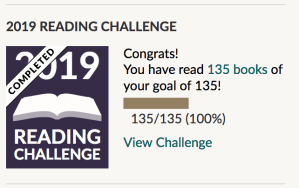 I was asked yesterday what the top five books I read in 2019 were. I had to really think about the question, because I do not read to rank them. In fact when I have a book recommended to me I always ask what am I going to learn from it. Reading for me is a way to open my mind to new ideas or hone skills. I hate it when someone reads a book and then wants to somehow miraculously put everything in place. It just doesn’t work that way. It’s why book reads, and there is research that backs this up, are not effective. As I reflected on the question, however, I decided to go back and see which books I read this year were referenced in my blog posts. This is a partial indication of learning from the books being used in the real-time pondering I am doing.
My Best Books Of 2019
So, here’s what I did first: I went back through my over 100 blog posts from this year and flagged every one which referenced a book I read in 2019. There were 22 posts referencing 20 of the books I read. I have those those posts organized in no particular order by four books at a time. Remember, these 20 books should be considered as part of the Best Books In 2019 that I read. If you read the posts you will find what lesson(s) I learned from the book, and there is a link to the book and the author in each post. Here are the posts:


Collaboration and Get Some Sleep and Self-Awareness


Do Others Like The Vibes You Give Off?
What We Know, And Don’t Quite Know We Know


Leading Without Kitschy Trinkets
Developing & Supporting Our Students: Future Identity Versus No Future Identity


Joyful and Leading With A Touch Of Quirkiness
Benevolent Leadership and The Tigress Of Forli


Do You Have The Inexhaustible Ability To Just Live?
MacGyver Intersectional Leadership
My Top 5 Books Of 2019
I know what you are thinking; I did not answer the original question of what my top five books of 2019 were. Even though I hate doing it, because I have gained so much value from all the books I read, but I won’t let myself of the hook. After a great deal of reflection here they are:


- The Tigress Of Forli: Renaissance Italy’s Most Courageous And Notorious Countess, Caterina Riario Sforza de Medici by Elizabeth Lev
- On Grand Strategy by John Lewis Gaddis
- The Medici Effect: What Elephants and Epidemics Can Tell Us About Innovation by Frans Johansson
- Talk Triggers: The Complete Guide To Creating Customers With Word Of Mouth by Jay Baer and Daniel Lemin
- The Pioneers: The Heroic Story Of The Settlers Who Brought The American Ideal West by David McCullough
As you can see, 2019 was quite the year of reading. I am still working on what my reading goal will be for 2020. Remember, leaders are readers! Happy New Year!
“Damage-Joy”
 My dad used to tell me when I was growing up to always remember that when someone asks you how your doing that “90% really don’t care how you’re doing, and the other 10% are happy if you’re not doing so well.” I used to laugh, but the older and wiser I get the more truth I find in my dad’s wisdom. You really don’t have to pay too close attention to politics and many so-called leaders to understand this. Most seem to focus on disagreement and taking someone down. Most don’t come to the table with solutions – just a desire to discredit others. I’ve recently experienced “leaders” wanting to memorialize disagreement. What? I thought this was a democracy. Clearly, we are missing the point that opposing views many times get us to the best solution – checks and balances. Memorialize means to preserve memories with a ceremony. So, I guess now we need to have disagreement ceremonies. That’s dumb!
In another episode of, you guessed it, Boston Legal, I learned about “schadenfreude.” It turns out that my dad was correct, as he always seemed to be. In Season Two, Episode 2, while defending a woman charged with murder who was very unlikeable, Alan Shore (James Spader) tells the jury:
“Schadenfreude. From the German words, Schaden and Freude, damage and joy. It means to take spiteful, malicious delight in the misfortune of others. We used to dismiss this as simply an ugly side of human nature, but it is much, much more than that...” “…But as for evidence to establish that she committed a murder beyond all reasonable doubt? It just isn’t there. The only possible route to a guilty verdict here is Schadenfreude.”
After a little studying I learned that schadenfreude is a real thing. Schadenfreude is a German word that broken down means schaden: damage or harm; and freude: joy. So, if there were an English word, which there is not, it would be “damage-joy.” It is a complex emotion that basically means we find joy in others’ troubles, failures, or misfortunes. If you don’t think it exists, think again and look around. It’s why you can’t resist looking at the tabloids or checking the latest tweets. It’s one of our worst traits in human nature, but we must own it. Research shows we get more pleasure when watching football when our rival team commits a penalty or throws an interception than when our team scores a touchdown. We can’t help ourselves.
Evan a cursory search of schadenfreude will bring up hundreds of studies from neuroscience, psychology, philosophy, and leadership. Part of this is our desire for empathy and compassion. With our growing commitment to empathy, the more our capacity to understand others’ points of view becomes more highly prized and the more obnoxious schadenfreude becomes. But, it is also this emotion that enables us to alleviate inferiority or envy. Research suggests it is part of the emotion that gives us our instinct for justice and fairness, quest for status, and desire to be social and belong to groups. So, all is not bad, and schadenfreude it is a testament to our ability to hold contradictory thoughts thoughts and feeling simultaneously.
Putting ourselves in another’s shoes impacts our abilities as leaders, parents, partners, and friends. While schadenfreude is probably a flaw, it is one we need to face head on and understand if we want to be more effective leaders using emotional intelligence. And, instead of tweeting the faults in others, how about we try to find consensus using the thought partnerships of all sides of the issue.
Assessing Mental Impact
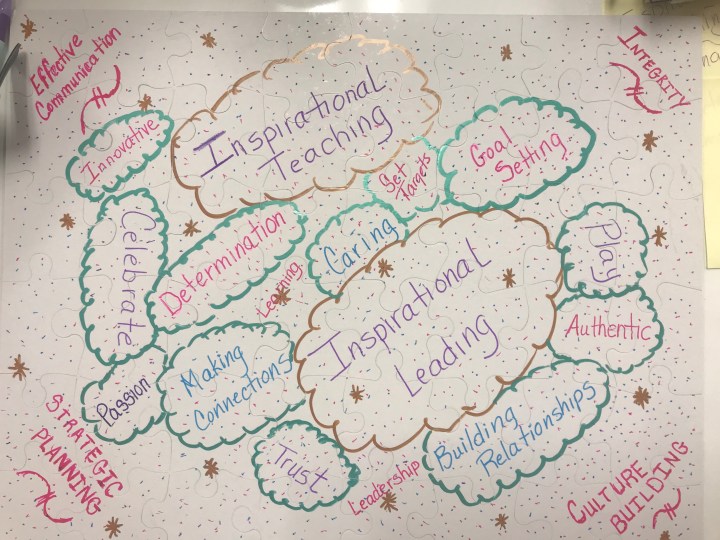 Today during a meeting I made a comment that we needed to assess the mental impact that a decision would make. This term made an impression on the group who said they had never thought about the mental impact a decision would have on others. We then proceeded to discuss the impacts.
I really wasn’t trying to come up with new terminology, but when I reflected on the great discussion I decided to look up mental impact. Guess what I found? Nothing. It seems I’m on to something. Again, it is not anything that is earth shattering; it is just doing the right thing. It is about considering how any decision made will affect those impacted by a decision.
Great leaders understand how to balance emotion with reason and make decisions that positively impact themselves, their employees, their customers and stakeholders, and their organizations. Making good decisions in difficult situations is no small feat because these decisions involve change. We must consider the mental impact these decisions have because change involves uncertainty, anxiety, stress, and sometimes unfavorable reactions of others. To get this right, I believe we must approach decisions as human beings and not humans doing.
Our core values come into play here. Never forget that our actions testify much more powerfully than words. Therefore, taking time to evaluate the mental impact of our decisions on people. Nearly every decision we make will affect different people in one way or another. We need to take time to understand and be fully aware of the influence our decisions will have, and understand what the mental impact will be on all individuals.
Constant connection with people enables us to recognize opportunities and threats, and figure out how to be adaptive to these threats or opportunities. Habitual outreach and taking stock of mental impact prevents insular thinking, opens doors to ideas and collaborative relationships, and expands our ability to problem- solve. By taking mental impact into account leaders can make better decisions.
Success In Aspirational Terms
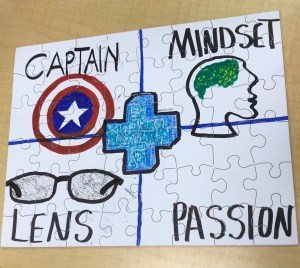 This past week I heard a person say that “success should be measured in aspirational terms.” The more I thought about it, the more I like it. In education I believe we need to think more aspirational in the way we prepare students. In other words looking beyond just credits and a diploma to the outcomes of what a student should be able to do now and be capable of learning to do later.
Let’s use an example that gets used a lot – welding. It is short-sided to think that having a student be in the single pathway of learning to fuse two pieces of metal together is enough. Don’t get me wrong, good careers await the student, but that’s not aspirational enough. This is why I believe in achieving multiple pathways. A student with aspirations for welding should also be studying computer science. Computers have become an indispensable part of welding processes. Computer, and even artificial intelligence, are required for the execution of many welding operations today. We can only imagine this need for knowledge of computer science will increase. Industry is telling us that welders will need knowledge of lasers, computer program, robotics, artificial intelligence, materials engineering, and systems integration to advance.
With the increased demand for highly skilled and technically sound workers, our students will need to shape their careers around multiple areas of expertise. This aspirational approach will enable their lifelong learning and ability to be agile to a ever-increasingly fast changing world.
We need to be deliberately aligning our student’s aspirations and abilities. The scene in the movie “The Martian” where it doesn’t look like it will end well for astronaut Mark Watney he sends this message to be relayed to his parents:
“Tell them I love what I do and I’m really good at it. And that I’m dying for something big and beautiful and greater than me. Tell them I said I can live with that.” ~ Mark Watney, played by Matt Damon, in The Martian (2015)
Try and tell me that’s not aspirational. We all need to find what we love and what we are good at. It’s not either or, and we need to help students find that balance as well. Some would say that aspiration is magical thinking. I don’t believe it is a magic trick to strategize about the future, help students invent themselves and us reinvent ourselves, push upscale, and keep a growth mindset. Without deep thought and planning about measuring success in aspirational terms, it just becomes a vacuous platitude, or “thing,” as I like to say. But taken in the context of enabling the future, career/skill agility, and student outcomes, measuring success in aspirational terms becomes about being prepared for what we don’t know we need to be prepared for.
Leading With Compassionate Solutions
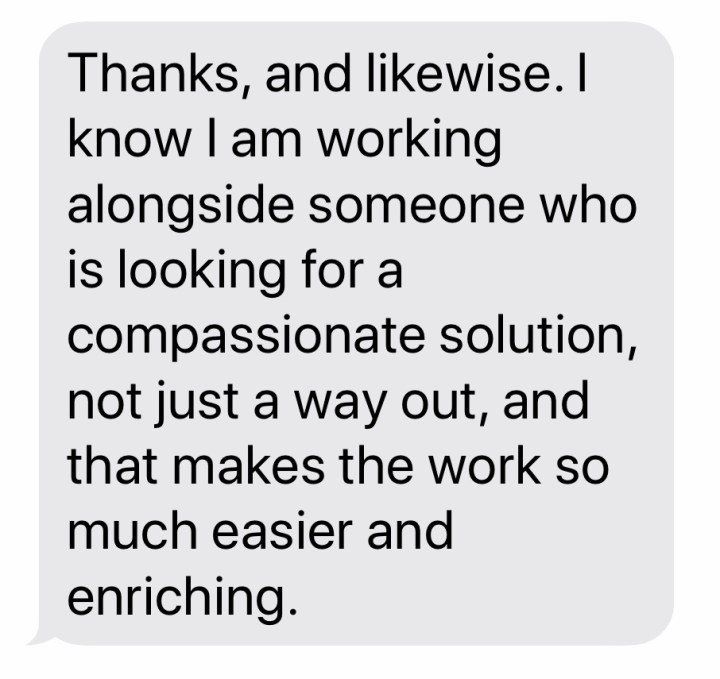 One of the driving forces of exceptional leadership is compassion. I am working through a situation right now that prompted the much appreciated text pictured above from a staff member and thought partner I am working on the situation with. Usually I pride myself on being very creative and innovative, but to be credited for finding a compassionate solution made me feel good and made me reflect on whether I was consistently a compassionate leader.
To be great, leaders must have the necessary empathy to inspire understanding and knowledge in team members. I teach about this in the leadership trainings I do. Empathy begins with taking an understanding from the experience and perception of another. Empathy, however, is just about understanding. Empathy is about opening doors and removing confusion. Compassion is the action step; compassion is about actually doing something.
The compassionate leader can then be creative in solving situations, problems, and opportunities. Looking for compassionate solutions allows the leader to look past “the easy way out” referenced in the text pictured above. This allows the team to look at challenges as opportunities to be dealt with as obstacles, not barriers. Barriers stop completely and obstacles can be removed, gone around, over, or under. I blogged about this in Obstacles Vs. Barriers. Actually, I said to the author of the above text, “Let’s make sure we look at any challenges as obstacles and not barriers. We are not allowing any barriers.” The compassionate leader seeks to understand people, families, and communities; knowing that understanding is the gateway to having the greatest influence as a leader.
Manatee Leadership Lessons

![image1[7322]](https://i0.wp.com/byronernest.blog/wp-content/uploads/2019/12/image17322.jpeg?w=236&h=236&crop=1&ssl=1 "image1[7322]")

Yesterday, I had the opportunity of a lifetime to learn leadership lessons from the West Indian Manatee. Our Central Florida/Tampa 3D Leadership Program participants decided that we would start our gathering at the Tampa Electric Company Manatee Viewing Center. The Big Bend Power Station in Apollo Beach delivers reliable electricity to the community. When the Tampa Bay water temperature reaches 68ºF or colder, the Manatees gather in large numbers in the power station’s discharge canal, where saltwater – taken from Tampa Bay to cool Unit 4 flows, clean and warm, back to the bay. The discharge canal is a state and federally designated Manatee sanctuary that provides critical protection from the cold for these unique, gentle animals. It has also been developed into an incredible education center dedicated to the Manatee, Sting Ray, birds, butterflies, and other wildlife and plant life indigenous to the area. I even got to smell the breath of a Manatee. For the farm kid from Indiana this was an incredible experience.


Prior to arriving for the experience I did a a little studying and learned how the Manatee handle thermoregulation by doing central-place grazing. In other words, they go out into the cold bay water to graze on plant life (they are herbivores) and then come back to the warm water near the power plant to get warmed up. I was also able to study the migratory maps of these amazing mammals.
The objective of participants was to come up with the leadership lessons learned from our Manatee experience. Here is what we came up:
- Must be caring
- Adaptive to change
- Lead by example
- Able to function alone
- Still move forward through the unknown
As you can see there are so many great leadership lessons to be learned from studying and observing these wonderful animals. I have done other blog posts with lessons from animals, such as Pelican Leadership Lessons, Living and Leading Like A Lobster, and Leading Like A Platypus. Using animals as metaphors for great leadership is a great way to learn and teach leadership. Do you have any examples? Share them by replying to my post.
Lessons Of Florida-Opoly
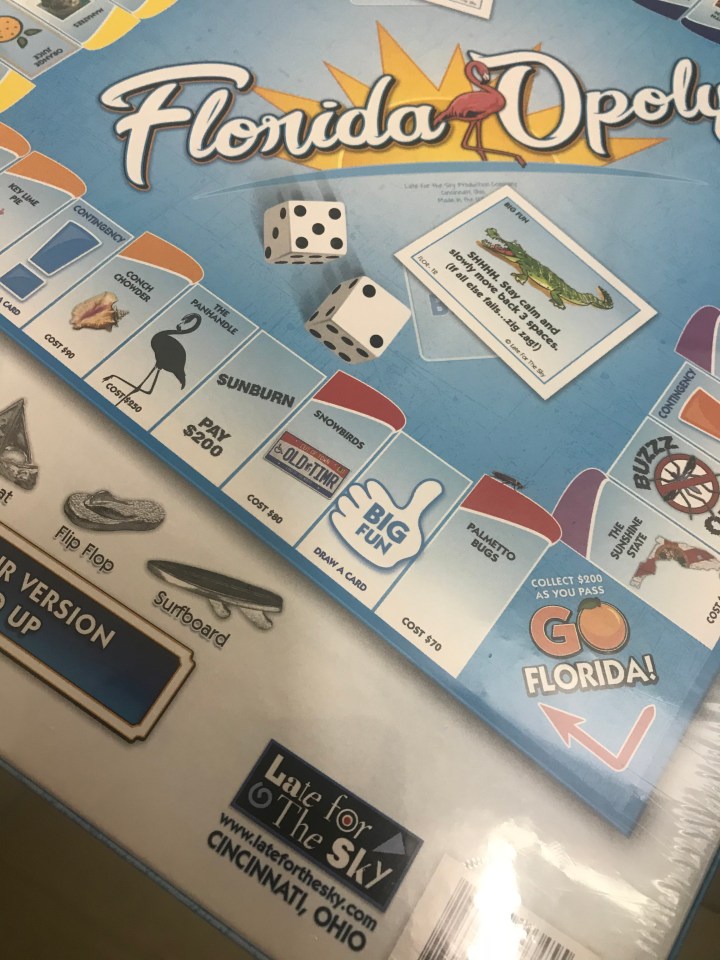 I was so honored to be presented with the newest wave of personalized Monopoly game, Florida-Opoly, last night by the Central Florida/Orlando cohort of 3D Leadership. For the guy that teaches leadership through the metaphors of toys, this was very appropriate and appreciated. When presented the game it was said they picked it as a gift of appreciation because I love to have fun, see the value of playing games, and have strived to learn all I can about Florida while spending time in the area. All true!
By personalizing the Monopoly game to local places, the creator, Late For The Sky, believes it brings more fun to the game through local authenticity. As a believer in local and state autonomy, this custom-opoly board game really struck a cord with me as I opened the box and began to explore all the parts, rules, and possibilities.
Here’s a brief rundown on what I found:
- Palm Trees
- Sunglasses
- Sea Turtles
- Sailboats
- Flip Flops
- Surfboards
- Key Lime Pie
- Alligators
- Orange Juice
- Disney World
- Snowbirds
- Manatees
- Dolphins
- Flamingos
- Hurricanes
- Sunscreen
- Atlantic Ocean
- Gulf of Mexico
- Conch Chowder
- Cuban Sandwiches
Now that’s a game. Players can buy their favorite Florida properties, like beach houses and resorts. But you have to watch out for hurricane warnings, alligators, and run ins with stingrays. Basically, it is a fun way to experience The Sunshine State. Also, it was a reminder of how different Florida is from my home state of Indiana. Now, I could make you a list of 20 cool things in Indiana, but the lesson here is the reminder of the different contexts in which we live.
This game is an important reminder of the complexity of the theory of autonomy. In 1982, President Ronald Reagan proposed returning significant responsibilities to the state and local governments. My other hero, Patrick Henry would have cheered. The challenge with this rhetoric, for as much as I believe in it and believe it should always be contemplated, is that it is not as simple as it sounds. The question that remains still today is what powers should be local and yet not compromise national concerns. I so wish I would have been around for the Federalism and Anti-Federalism discussions with the founders. It’s obvious I would have been an Anti-Federalist, but clearly a balance is where we landed (and needed to land). And, it continues to be a balancing act to this day.
As James Bryce posited in The American Commonwealth, “The wisest statesman is he who holds the balance between liberty and order” (Bryce, 1888, p. 749). Bryce spoke a lot about the balance of state’s rights and federalism in his critique of our democratic system of government. Bryce also warned of “Ill-considered legislation, facility and excess of law-making, and inconstancy and mutability in the laws, form the greatest blemish in the character and genius of our governments” (Bryce, 1888, p. 750). From a state’s rights standpoint, Bryce was concerned with states conducting rash experiments.
Alexis de Tocqueville did a much more sophisticated analysis of the underpinnings of a successful democracy. In Democracy In America (appearing in two volumes in 1835 and 1845), posited that there were two important tracks to our system, one of which were the broad freedoms assured by our national constitution. The other was a complimentary track of secondary liberties at the state and local levels. Tocqueville saw this as being product of human wisdom and choice, not historical necessity. Tocqueville saw the genius in a balance of both national and state/local control. Here we are at the end of 2019 still grappling the question of what the ideal balance is. Maybe that means our system works.
Only I could take the fun game of Florida-Opoly and turn in into such a deep political analysis. But, having spent Monday and Tuesday of this week up in Gary, Indiana to sort out best solutions for a school situation that I, as an Indiana State Board of Education member, have responsibility for, I can tell you the local, state, and federal contexts are at play. Full local autonomy failed our children, but some might argue that state and federal laws and requirements might have played a factor. Again, I believe it is a balancing act.
What I am for sure reminded of by Florida-Opoly is that we need to be aware of our local strengths, weaknesses, and needs. We then need to work within the autonomy we have to make our states and local communities great!
It’s All Superlatives
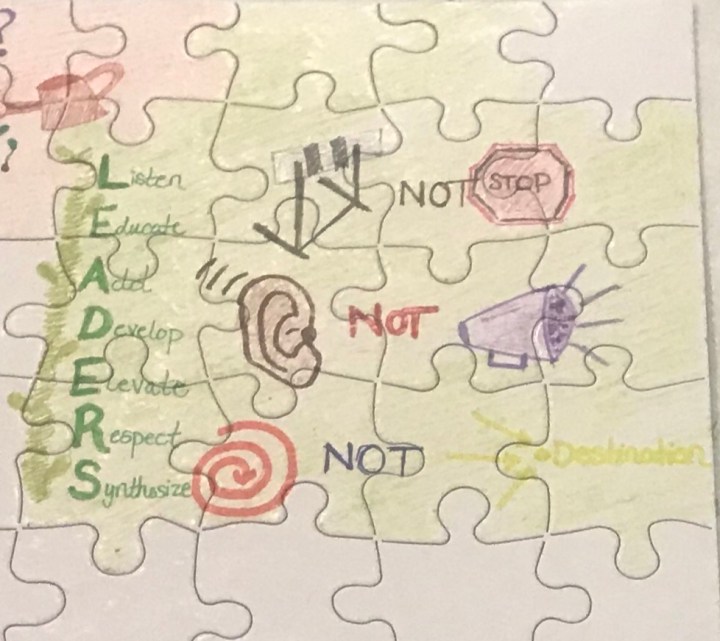 Have you noticed that we talk a lot in superlatives? Almost to the point that the superlatives don’t mean much. Or, we even use them incorrectly by saying something to one individual in a group we are in like, “You’re the best!” We have just told everyone else they are not the best. Using superlatives has become an important part of negotiating and making a case, but have we done this at the expense of good?
Are we beginning to see “good” as anything very good at all? Sometimes it seems that “premium” has become our new “basic.” It’s our starting point, so “good” becomes “less-than.” It is amazing what adding “est” to the end of a word can do. On the user side of superlatives, we can take advantage of the stronger meaning. But, as a leader we have to watch getting hoodwinked. In other words, have we, in many cases, made an objective comparison impossible?
As I understand it, there are web advertising platforms that won’t allow the use of superlatives unless there has been a third party evaluator confirm that something is the “world’s best” or “extremest.” These providers don’t want advertisers making claims that are demonstrably false. The Merriam-Webster Dictionary tells us that superlative means “surpassing all others – supreme.” Leaders need to care about and practice the quality, specificity, and power of our language.
If we use superlatives too much, we wash out the meaning. If we make every commonplace event out to be extraordinary, we actually make everything sound the same. So, we need to be careful that “awesome” continues to mean awe inspiring and “best” keeps its superlative meaning and doesn’t just become “good.”
Contrarian Thinker
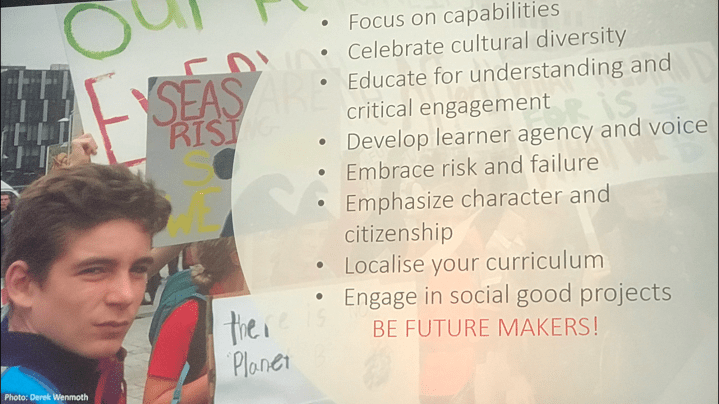 One day, this past week, I was introduced to a group I was speaking to as a “Contrarian Thinker.” Honestly, I wasn’t exactly sure what that was. After doing a little research, however, I found that this was probably a pretty accurate description. Contrarian thinkers are trailblazers. ✔️Check. They are polarizing visionaries who are just as likely to be called crazy before brilliant. ✔️Check. Contrarian thinkers have the foresight to see hidden opportunities and seize them when the right moment presents itself. I would like to think I do this, but I’m not so arrogant to say check on this one.
Never forget, the risks of going against the crowd are greater, but so are the rewards. The rewards of innovating, curiosity, and an imagination gone wild are always worth the effort. An important fact for a contrarian thinker to remember is that no one will be expecting you or your ideas to succeed, which is one of the reasons you will.
Then, last night as I was flipping through the channels (are they still called channels on the tv?) I stopped on Shark Tank long enough to hear Mark Cuban described by one of the other Sharks as a contrarian thinker. So, off I went to learn more about his storied history.
While reading 9 Critical Turning Points That Shaped Mark Cuban’s Extraordinary Career by Drake Baer, I found that Mark Cuban is a contrarian thinker. One of my favorite quotes from Mark Cuban in the article is, “The ‘sprint’ doesn’t have a finish line. There’s never a point where you can say, ‘We’ve made it.'”
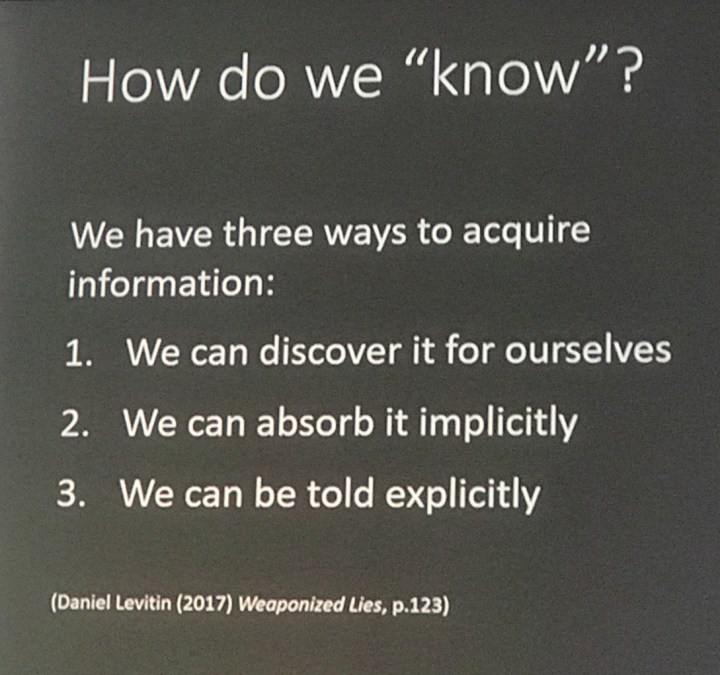 The more I studied this topic, however, I really found that many contrarian thinkers always find an opposing view. I don’t think that is me at all. Nor do I believe that would be very productive. A more productive view would be one of “independent thinker.” My takeaway to share with you is that rather than always being swayed by consensus view, or consistently being a contrarian, we should strive to be independent thinkers. I always strive, and would encourage you to as well, look at different perspectives, and sometimes find a unique angle.
Remember, if you think the same way as everyone else, it is very difficult to outperform them.
The Majestic Leader
 I had the opportunity to spend this week in Palm Springs, California for Aurora Institute’s annual symposium. The theme of this year’s symposium was Shining A Light On The Future Of Learning. Palm Springs is such a beautiful place located in the Coachella Valley. Palm Springs is completely surrounded by mountains; the San Bernardino Mountains to the north, the Santa Rosa Mountains to the south, by the San Jacinto Mountains to the west, and by the Little San Bernardino Mountains to the east.
These mountains are the cause for this post. I was visiting with a friend from the state of Washington about how the mountains were different than other mountains. She described them as being “majestic”. That seemed like an appropriate adjective, but I needed to think a little about just what majestic meant. It is an adjective meaning, having or showing impressive beauty or display great dignity. Also, majestic befits a great ruler and being simply far superior to everyday stuff. I was now fully on board with the mountains surrounding Palm Springs being described as majestic.
Then I got to thinking about majestic people I know. There are those with majestic beauty and those who are majestic leaders – those that display great dignity. I then reflected on what gave them that beauty. For me it is their referent power. Referent power is one of the most potent and majestic sources of power for a leader there is. It is a form of reverence gained from having tremendous interpersonal relationship skills. Referent power has become much more important as we move from command and control organizational environments to more collaborative and flattened hierarchical environments of influence.
Leaders with high referent power influence because of the follower’s admiration, respect, and identification with her or him. Think about this description when looking at the picture I took of the San Jacinto Mountains while I was in Palm Springs shown here: 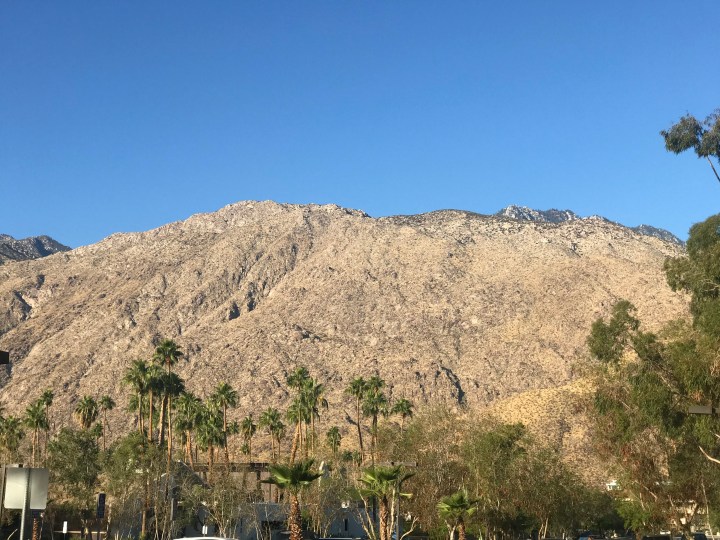 These majestic mountains are a pretty appropriate metaphor for a majestic leader, don’t you think? I couldn’t let the metaphor end there, however. I then got to thinking about how if we, as leaders, get this influence right, the view is beautiful. This made me think of the awesome picture I got from the top of Mount San Jacinto at 8,516 feet shown here:
 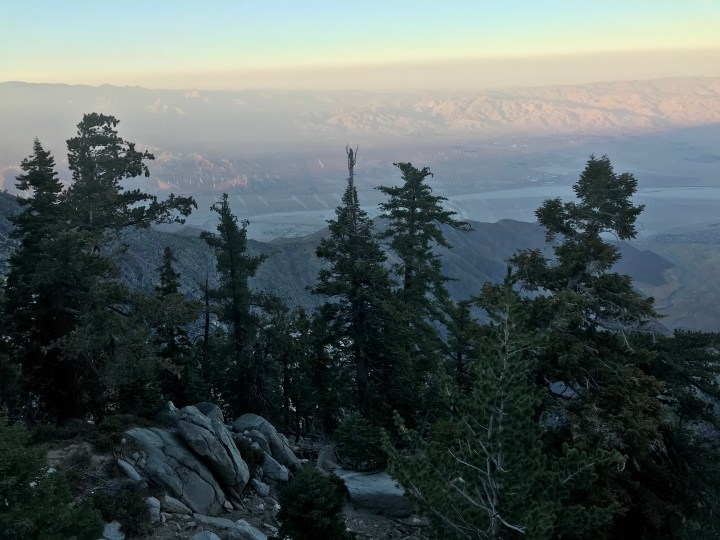 Getting leadership right is such a beautiful and majestic thing for both the influenced and influencer.
 Byron's Babbles
1 comment