Make Your Changes Out Loud

We know that a best practice for editing written work is listening out loud. Hearing our written work offers a new perspective to help us catch grammatical errors, poor sentence structure, plot holes, or pacing issues that your eyes skip over when you read. Because our minds will automatically make corrections when looking at something, listening provides another perspective for us to review our written work. In fact, there are apps for this. These apps allow you to edit documents while exercising, taking a run, or in my, case milking cows.
Last night when working with teacher leaders from Florida, Georgia, and Tennessee we were discussing how to adapt boldly and one of the participants said that we need to “make your changes out loud.” This was a ‘click the mic moment’ (the Zoom equivalent of ‘drop the mic’). This comment was genius. If we make our changes or intended changes out loud we can get feedback from others to make the proposed change better and give others a chance to understand the changes before they happen.
Let’s go back to using writing as the analogy here. Whether we are working on a blog, novel, or business document it’s critical that each paragraph is well written and tells the complete story necessary in that block of verse to get our point(s) across. Reading audibly as opposed to only in our head, changes our perspective on the text and provides deeper meaning. By employing making your changes out loud you will inspire others to greater engagement, ownership, and action to create positive change. So, I challenge you to listen to make your changes out loud, make sure others are listening and providing feedback, and listen to yourself as you speak or read your own words of change.
Leading From The Optimal Height

The Brown Pelican is one of my favorite birds. In fact I have blogged about them before in Pelican Leadership Lessons. The Brown Pelican will target and dive for food from heights of 60-65 feet. They have also learned that a steep dive angle, between 60 and 90 degrees, reduces aiming errors caused by water surface refraction. In doing some research I found that Brown Pelicans “learn” this behavior because adults are better marksmen than young birds.
This lesson and example from the Pelican reminded me that I must get myself to the optimal height to see the detail needed, but yet still get the big picture. This really becomes a question of strategic insight. An insight is the combination of two or more pieces of information or data in a unique way that leads to the creation of new value. Strategic thinking, then, is the ability to generate insights that lead to competitive advantage.
One of the leadership lessons I have learned over time is how we need to step into the balcony, as leaders, and watch the dance above all the chaos and noise. But, like the Brown Pelican, we must find the optimal height for seeing our targets and diving in to support our teams.
Build Great Things Anyway

I had a chance meeting of a professional sandcastle builder and teacher of sandcastle making this week. First of all, I did not know there was such a thing. Secondly, I didn’t do much sandcastle building in my childhood, so I was fascinated to discuss the art of sandcastle building. Really, I hadn’t thought much about the fact there are different kinds of sand. Bottom-line: lots of new things going through my mind.
There are three main rules for sandcastle building:
- Always use wet (sloppy) sand (no such thing as too much water)
- Always form shapes using a pyramid – larger at the base – thinner at the top
- When all the formed sand is completed work from the top to the bottom
Other pieces of advice were to build on a big mound. This enables sand to fall down and away from the sandcastle as you are carving. And, it makes it up higher and easier to work on. Besides buckets of sand and water, the tools are pretty basic. You use simple tools (like a straw, a pencil, and a metal cutting device) to chisel it starting from the top.
The rule that was stressed over and over was working from the top down. If you work from the bottom up, the pieces from the top will tumble down onto the bottom, thus flawing your previous work. This is a lot like leadership in an organization. If the leader is a tyrannical monster all the trash falls down on the people doing the work getting marred and ruined. Thus, the flatter the organization the better, or at least the leader needs to already be chiseled and refined so all the chaff and sand isn’t ruining those below. But remember, if there are no “those below” in an organization, no worries.
I love that there are people helping kids learn to build sandcastles. When children play and create in the outer world, simultaneously they also create and learn in the inner world. We adults know change is coming when we build sandcastles but we encourage kids to build something great anyway. In our schools and classrooms, this is a valuable lesson. It’s also an important lesson for leaders to remember. Change comes, colleagues come and go, new research is discovered with the ebb and flow of the waves ever coming and going, and the tide is ever shifting. Build great things anyway.
A Penguin Inspired Quest

Every Penguin in the World: A Quest to See Them All by Charles Bergman
My rating: 5 of 5 stars
Besides being in the non-fiction genre, this book could be categorized as a wildlife, leadership, global community building, travel, survivalist, and motivational literary work. This book encompasses all those things. Charles Bergman, traveled the world to see all 18 penguin species in their natural habitats. I did not even know there were 18 different species of penguins until I read this book. This book is an incredible visual and written chronicle of the 20-year-long journey it took the author to see all 18 species. He artfully used storytelling and photography to take the reader into the wilderness, from the Galapagos to South Africa and Antarctica, to teach us about these beautiful creatures. This book enables us to see and learn about an animal most might never see in the wild. It it important, however, for us to understand all these penguins, the environments in which we live, and our responsibility in the global community for their wellbeing.
View all my reviews
Becoming The First Me

Chapter 14 entitled “Trust Yourself” in Mindset Mondays with DTK, by David Taylor-Klaus (DTK) really resonated with me because he started out by talking about a coach he admired and then was encouraged to follow exactly. He went on to explain that this was toxic with his audience. Think about it; if you are trying to be someone else, there is no room for authenticity. I actually have a section of a leadership gathering that I discuss this. It starts with a slide that says, “Great leaders don’t copy!” I then ask the group to react. It’s always interesting to hear the responses. At first they usually want to push back and say that they try to do the things great leaders do. Then it shifts to, well they are learning from what the others are doing. Then they decide that copying probably is not the best way – they are adapting to fit in with their style.

DTK said, “I tried to become the next “fill-in-the-blank” instead of becoming the first me” (p. 121). We are all unique, have special talents and skills, and have our own style. This means we need to work toward being the best “me” we can be. As an educator I absolutely hate it when I hear someone say, “You need to be more like ___________.” Really? Why? This does not mean that we do not seek to grow professionally and personally. Growing is very different that stuffing yourself in a template.
Becoming the first me means we are not going to depend as much on outside validation. Do we need more likes and followers? I’m not sure. What do those likes and followers do? The great musical artists don’t try to write songs that are hits. They write songs from inspiration that then become huge hits. There is a difference. Otherwise, we just become a cheap imitation of someone else.
Becoming the first me also means that we trust in our own answers. Many times I say, “Make a decision, even if it’s wrong” or “Let’s do something, even if it is wrong.” We nee to trust our own decisions. DTK included a quote in Chapter 14 from Larry Winger that I love, “Don’t worry too much about making the right decision. Just make the decision, and then make the decision right” (p. 122). Or, as I always say, “The sun will come up tomorrow, and if it doesn’t that nothing else matters anyway.” So, let’s be the best first me we can be because we are the only me we can be.
Waves Of Change
“Sometimes in the waves of change, we find our true direction”
Unknown

As I read this quote I thought about how very relevant this is to us all in 2020. Changes from the global pandemic continue to hit us hard. Sometimes things are unexpected and we have to adjust on the fly to changing circumstances. As we ride the waves, the unrecognizable becomes clear, and finding new direction becomesJust as the tide changes, other things in our life can change too, and this can push us towards the path that we were destined to follow.
Change is something we cannot keep from experiencing, but the way we get over the hurdles is where the difference stands. We all have extra obstacles put in the way right now during the global pandemic. The question becomes what are you learning, what are you doing with that learning, and how are you sharing the learning? We must be a community. How are you breaking through and finding the right path?
The Ocean Awaits Us

“Even the upper end of the river believes in the ocean.” ~ William Stafford from his poem, Climbing Along The River.
Reading this line in this poem by William Stafford made me think back to standing at Point State Park in Pittsburgh which is situated in Pennsylvania where the Allegheny River and Monongahela River come together resulting in the formation of the Ohio River. The Ohio River is a tributary to the Mississippi River and drains into the Mississippi River at Cairo, Illinois. is I remember thinking how cool it was that the water I was looking at would be traveling 981 miles to the Mississippi River at Cairo and then another 954 miles until spilling into the Gulf of Mexico. No different than when I travel south from Indiana to the Gulf I expect it to be there.
Stafford was conveying the meaning that you should believe in something, even if you have no proof that it exists. As a human who has that “crazy gene” for coming up with wild and crazy ideas I’m good with this. Isn’t it, by the way, what the scientific process is all about: proving a hypothesis? Also, isn’t it great that we have a whole history of people who believed with no proof. Edison believed there could be an electric light bulb until he proved it could exist after more than 10,000 tries.
So, don’t be afraid to believe in your own ideas, or even crazy ideas, even if there is no proof they’ll work. There may just be an ocean of success on the other end. And, it might just be an idea to alter the world for the better forever.
Building A Community

As I reflected on the post I wrote yesterday, Imagining The Unimaginable, my mind went to just how powerful a community can be. In the case of an FFA Chapter, the students coming together to figure out how to hold events virtually during the pandemic; or in the case of agriculture teachers, coming together to discuss ideas for engaging students. It could also be a school community coming together to decide how to best educate children during a pandemic. It has been interesting to me to witness just how powerful a close knit community can be.
As I watch the classrooms that have continued to thrive during the fluid changes of going back and forth from virtual to in person to blended and then back to virtual, it has been the classrooms where the teacher had a clear community developed with her students. I have also witnessed a strong community of virtual students in a school come together to help each other learn how to become effective virtual teachers. Positive experiences with communities allow individuals to feel more connected to their environment and the people in it. Further, the connection that comes with being in a community can act as a support system for members when they require encouragement or help.
I have been fascinated with the power a community can bring for a long time. Check out what I wrote about community in Community: Aggregating for Innovation. Humans are made to live and work with others in a community where we can thrive. We are social beings that have evolved to exist within communities. In the great book Humanocracy, authors Gary Hamel and Michele Zanini told us that success depends on local improvisation. Try and tell me we are not seeing that during the pandemic. Hamel and Zanini said, “When interdependencies are varied, multidisciplinary, and difficult to specify in advance, you need a community” (p. 210). Is that a description of education, or what? A community gives us the opportunity for mining the wisdom of several people and helping each other out along the way.
“To solve unprecedented problems, individuals have to surmount unforeseen obstacles and extend the frontiers of human knowledge. That’s best accomplished by a community—a band of physically proximate compatriots who trust one another, are unmindful of rank and unencumbered by petty rules, and are mutually accountable and knit together by a common goal.”
Hamel & Zanini, 2020, Humanocracy, p. 210.
Organizations which emphasize community create a sense of belonging and foster transparency while reducing feelings of isolation. Having a strong community is so important right now as people and students alike are working and studying remotely. Hamel and Zanini also taught us that “At crunch times, silos and titles disappear” (p. 223). So, if we already have a strong community, void of bureaucracy, we are that much more prepared for a crisis. Overall, educational entities and workplaces who have a strong community have one major thing in common: they’re people centered. If the events of the last 255 days have shown us anything, it’s that the ever-changing work world and culture at large are ready for a more human-centered approach to the way we live, work, and relate to one another.
Imagining The Unimaginable

Last night I had the pleasure of recording a professional growth video focused on student engagement with five National FFA Teacher Ambassadors from Missouri, Nevada, Tennessee, and West Virginia. The goal of our recording was to provide teachers from around the country with ideas on how to keep students engaged right now whether it be in the classroom or in FFA activities. The recording turned out awesome and I really got to thinking about how the teachers were excited about the fixes their FFA chapters had developed for keeping students/members engaged during the global pandemic. We are on day 254, by the way. And, I loved the fact that several times it was the students who came up with the solution or idea for engagement. Make no mistake, though, they are still looking for ideas for upping their engagement game.
We also discussed things that we want to continue post-pandemic, like having members who can’t attend an event in person, for whatever reason, be able to join virtually. We weren’t thinking in that mindset 254 days ago. Things like pandemics, wars, and other social crises often create new attitudes, needs, and behaviors, which need nurturing. I believe in the power of imagination and creativity. Right now there are very few things that are absolute and for sure. We live in a very complex and ever changing environment right now – the future never releases hard data.
What we were really saying in the video was that we must keep imagining every possible scenario. In other words, letting our imaginations go wild. We must be imagining the unimaginable. Think about it; what is happening right now during the pandemic to our society has no precedent, or data behind it. No matter what industry we are in right now we need to continue to be creative and use our imaginations to open the path forward.
There is a silver lining, however. As I pointed out, these five teachers gave us numerous ideas and opportunities the pandemic have made imaginable. All kinds of new ways of staying engaged and connected have been implemented that will continue after this pandemic has passed. Because we will probably never return to our familiar pre-pandemic realities, we need to keep imagining an even better future.
Leapfrogging To New Paradigms In Education
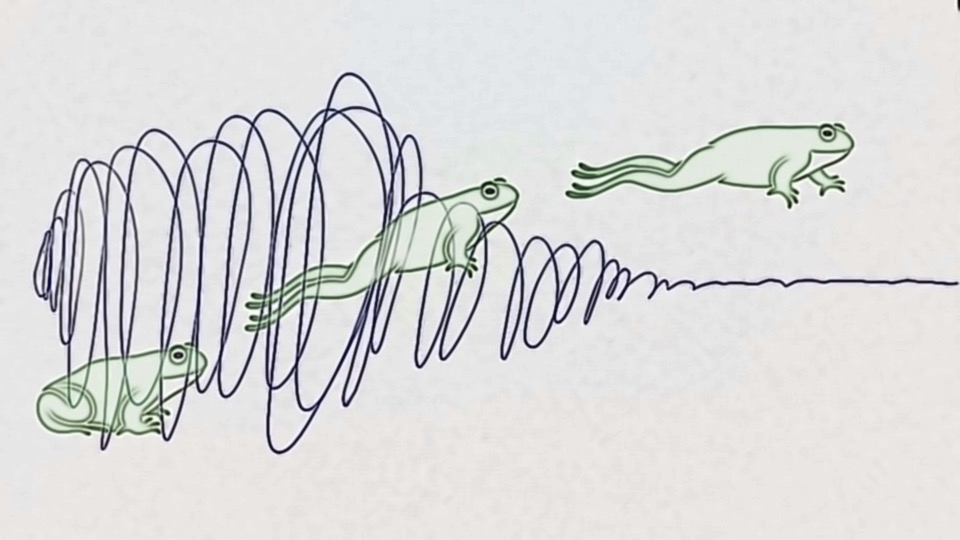
I am going guess most of us played the game of ‘leapfrog’ at some point in our childhood. You know, the game where a number of children bend down and another child jumps over them one at a time, moving the line forward. If you are still playing this game – no judgement here. I refuse to grow up, too. This is, however, a great metaphor for where we are right now as a country. You all know how I love a good metaphor and Susan Patrick, President and CEO of Aurora Institute, knocked it out of the park (note the baseball metaphor) during her opening remarks and call to action at Aurora’s 2020 National Policy Forum saying, “We are at a ‘leapfrog’ moment in education.” This is so true!
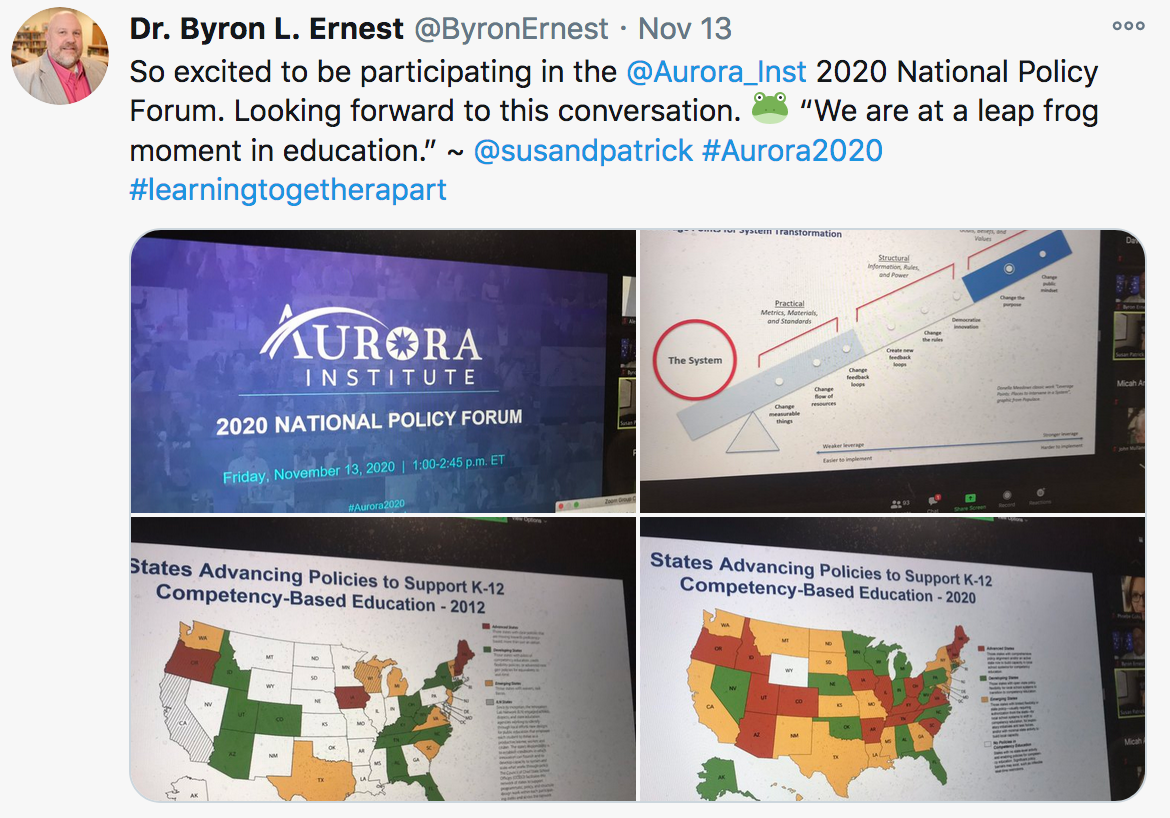
Besides the definition of ‘leapfrog’ as a child’s game I did not really like the other definitions because phrases like “moving past others quickly” or “missing stages” were used. I did kind of like Cambridge Dictionary’s definition of “to improve your position by moving quickly past or over something that blocks your way.” To Susan’s point, we have an obligation in education right now to do this for ALL students.
I had the opportunity to speak on a global platform to over 40 countries back in the spring and I presented the following list of what I believe to be our Global Education Policy Considerations:
- Connectivity and Technology Access
- Remote Learning – I followed the first bullet with this because remote learning is so much bigger than just devices and broadband access. We also need to be thinking about the support students need in coaching, mentoring, tutoring, social emotional learning, nutrition, and basic care/safety needs
- Personalized/Self Directed Learning/Mastery-Based Learning
- Equity In Learning
- Educating Students with Physical and Learning Disabilities
- Mental Health Counseling / Physical Health Support
- Flexibility
- Support for Teachers
A pretty daunting list, I know, but we must get our focus just right on these issues and now is the time to ‘leapfrog’ to that focus. And, maybe, just maybe, the bullet point of ‘flexibility’ is one way to get us there. If we put on our equity lens and take all the points into consideration can we create space, remove obstacles (I like thinking obstacles better than barriers because obstacles can be ‘leapfrogged’ and removed; barriers not so much) so we can address all these issues. The COVID-19 Global Pandemic has also highlighted how in need of attention areas of our education system truly are, with concerns of equity and quality leading the lists.
I would like to submit the following question for us all to consider as we contemplate the future of education for ALL: Can we have new paradigms for education? I certainly believe we can.
We truly are at a ‘leapfrog’ moment in education. I believe the Aurora Institute has the Strategic Pillars in place to be a catalyst for bringing about this ‘leapfrog moment’ and bringing about new paradigms in education. Here they are:
Policy & Advocacy
Removing barriers and creating space for education innovations by advancing enabling policies and providing technical assistance, expertise, briefings, and support to policymakers at all levels.
Field-Building & Knowledge Creation
Building the field across networks, creating new knowledge, analyzing field data and sharing the latest research to produce and communicate insights to move the field forward.
Convening & Connecting
Providing unparalleled networking and learning to professionals designing new learning models, our events connect the field’s leading experts and practitioners with the trends, promising practices, and research to shape the future of education.
I so appreciate Susan Patrick inspiring us to leapfrog forward. As Abraham Lincoln taught us, “You cannot escape the responsibility of tomorrow by evading it today.” Let’s not forget that excellence is our best equity proposition. By leading collectively we can create an educational ecosystem that is best for all students.
 Byron's Babbles
leave a comment