Polyphonic Leadership
In my University of Oxford class I’m in right now we have been using an orchestra metaphor through line to discuss orchestral leadership. While reviewing some literature I came across the musical term “polyphonic”, which means a musical texture comprised of two or more independent melodies or voices which combine to form one piece of music. The term “polyphonic” can also be used to describe a leadership style that encourages the inclusion and involvement of multiple perspectives, voices, and ideas.
A polyphonic leader values collaboration and diversity of thought, allowing different individuals and teams to contribute their unique insights and expertise. This approach recognizes that no one person has all the answers and that collective intelligence and the synergy created by multiple voices can lead to more innovative solutions and better decision-making. Polyphonic leadership fosters an inclusive and empowering environment where everyone’s contributions are valued and respected, leading to higher employee engagement and overall organizational success.
In contrast to the polyphonic style of leadership would be the monophonic leader. This is a very hierarchical style with an autocratic leader and relies solely on the perspective and opinions of one individual. This can lead to a lack of diverse ideas and a narrow focus on one person’s strengths and weaknesses. It may also create an environment where employees feel their contributions are not valued or heard. Monophonic leadership can hinder innovation, hinder collaboration, and ultimately hinder overall organizational success.
Polyphonic leadership is in sync with constructivist theory, which I subscribe to in education, because it promotes the idea that knowledge and meaning are constructed through collaborative and inclusive processes. Constructivist theory emphasizes the active participation of individuals in creating their own understanding of the world, and polyphonic leadership aligns with this by valuing diverse perspectives and encouraging open dialogue and collaboration among team members. We need to help all those we serve tap into the collective intelligence and creativity of their team members.
First Bubblings


As you know, I am at The Kilns in Oxford, England right now as a Scholar in Residence for the C. S. Lewis Foundation. It has been an amazing week and right now I am having my morning coffee sitting where Jack (C. S. Lewis) would have been sitting in the Common Room. I came out here intending to finish reading Out of the Silent Planet but instead looked over at the bookshelf beside me and pulled out Boxen: Childhood Chronicles before Narnia. Douglas Gresham wrote the Introduction and in it said, “So there was a sort of emotional and intellectual gap in Jack and Warnie’s literary experience” (p. 8 in Boxen). Gresham was referring to the books available in the house which were too old (advanced) for them. Their parents had no taste for faery (English spelling) tales. So, they bridged that gap. Imagine that C. S. Lewis was only eight years old when he described power and the rise and fall of nations in ‘History of Mouse-Land’ (p. 30 in Boxen).
Interestingly, Jack and Warnie did not write Boxen for anyone but themselves, but it could be a leadership book. Here’s what I mean (descriptors in parenthesis are from me):
- King Hacom used his power well and used counsel (collaborative/open minded).
- King Bublish I was conceited and full of pride (humble).
- King Benjamin was popular and knew everyone (Relationship builder).
- Governor Leppi I was a great scholar, but cruel, foolish, stubborn, and weak (pretty self explanatory).
As I reflect this morning, my mind is going in several different directions. Douglas Gresham called Boxen the “tangible and readable first bubblings forth of the springs of literature that were, years later to be the source of a great river from Jack and a healthy tributary from Warnie…” (p. 10). We talk a lot about making sure we are teaching creativity to our children and that we are making space for creativity in adults, but we need to make sure we give everyone the opportunity for “bubblings” no matter what state of life. I, in my sixth decade now am bubbling over from all the new thoughts in my head. Oh, to be sitting here having coffee with and talking to Jack!
The Frictionless Experience

I was reading an article, “What Smart Companies Know About Integrating AI: Talent and Data are Just As Important as Technology,”this week in Harvard Business Review last night related to artificial intelligence (AI). It was interesting to contemplate the idea of a “frictionless experience.” Having a frictionless experience means having a smooth and seamless interaction or process without any obstacles or difficulties. This is the customer experience (CX) at its best. We as consumers expect the same level of service, understanding of our needs, and prompt resolution of our issues across all channels. If we are to take a customer-centric approach we need to be able to personalize at every touch point. I really believe this is also true when working with our students and families in our schools. This relates to all the various aspects, such as customer/student services, user interface design, or even personal experiences. It means that everything flows effortlessly and efficiently, making it easy and enjoyable for every person involved.
AI can also analyze user data to personalize interactions and tailor recommendations, making the experience more relevant and personalized. Additionally, AI can automate repetitive tasks and streamline processes, saving time and reducing the chance of errors. One of the big points of the article was that AI does not replace people, but better informs the people who will be doing the inventing, creating, and innovating. It is about the talent using the data.
I also think about how AI-powered chatbots could be used to tutor and help students. Chatbots can provide personalized learning experiences by assessing the student’s needs and adapting the content accordingly. Not to mention the big support to students, this could be of huge help to teachers by providing both a time-savings and important data. The Chatbots could answer questions, provide explanations, and offer additional resources to support the student’s learning journey. Notice I am suggesting giving additional support – not replacing teachers or existing support. Those same Chatbots can also track the student’s progress, provide feedback, and suggest areas for improvement. With their availability 24/7, chatbots can provide continuous support and enhance the learning experience for students. Wouldn’t it then be amazing to get that report of what questions were being asked and what I, as the teacher, needed to go back and provide more learning on. This could be incredible for a frictionless student experience.
Brinkmanship

In a meeting this week, the posturing (as I call it) going on in Congress over the proposed education budget was being discussed. The House version has stripped some very important programs like Title I and Title II and comes in at around $67B. Whereas, the Senate version keeps those programs, increases funding for career and technical education and apprenticeships, and comes it at $79B. The correct terminology would be that there might be some brinkmanship going on. Brinkmanship refers to the tactic of pushing a situation to the brink of disaster in order to achieve a desired outcome. It can be seen as both good and bad, depending on the context and how it is used. In diplomacy and negotiations, brinkmanship refers to the tactic of pushing a situation to the brink of disaster in order to achieve a desired outcome.
If there is brinkmanship going on in relation to the education budget it is a risky strategy, as it may lead to increased tensions, conflict, or even harmful consequences. A careful assessment of the risks and benefits of engaging in brinkmanship is important. Understanding the potential costs and consequences of the actions need to be contemplated to make informed decisions and choose the most effective strategies. The other thing that bothers me is the question of how much money is being spent on lobbying for something that in reality, might not even need to be lobbied for. This seems like a huge waste of time and money that could be used in more productive ways.
I get it. Brinkmanship is a necessary tool. It concerns me that sometimes we overuse it. There are those things that might argue that brinkmanship is unethical because it involves intentionally pushing the limits and risking potential harm or conflict. Others, on the other hand will argue that it can be seen as a necessary tactic in certain situations to protect national interests or enforce boundaries. I just hope that we consider the unintended consequences of posturing and brinkmanship.
Unofficial Teachers

Alister E. McGrath spoke of one of C.S. Lewis’ friend and mentors as having been one of the best unofficial teachers Lewis ever had in, C.S. Lewis: A Life: Eccentric Genius, Reluctant Profit. I love the title given to this friend and mentor of “unofficial teacher.” We have all had them. We need the wisest and best of unofficial teachers because they offer unique perspectives and knowledge that can greatly benefit individuals and society as a whole. Unofficial teachers often possess specialized expertise in specific fields or areas of interest, and they may have a deep understanding of topics that may not be covered in traditional educational settings.

These unofficial teachers can provide alternative viewpoints, challenge conventional wisdom, and offer innovative solutions to problems. They may have practical experience or real-world insights that can supplement formal education and provide valuable lessons.
Additionally, unofficial teachers can play a vital role in mentorship and personal growth. They may offer guidance, support, and inspiration to help individuals navigate their careers, develop important skills, and overcome challenges. The insights of an unofficial teacher can foster intellectual curiosity, critical thinking, and creativity in learners.
Therefore, seeking guidance from the wisest and best unofficial teachers can expand our knowledge, broaden our perspectives, and help us become well-rounded individuals capable of making meaningful contributions to society.
Reigniting Our Passion

Last evening while facilitating a kickoff of our National FFA Teacher Ambassador trainings, we had teachers discussing needing to regain the “spark” and a desire for networking. I’m excited about this because building relationships are key to keeping our “spark.” By meeting new people and building genuine relationships, you can find support, inspiration, and new ideas that can reignite our passion for our work. Additionally, networking/relationship building can give us access to valuable resources and connections that can help us be successful and regain our spark.
Another great thing about developing new friends is that sometimes they can become mentors to us. Having friends who are also mentors can be incredibly valuable. They know us personally and can provide honest feedback, guidance, and support that is tailored to our individual needs and goals. Plus, they are invested in our success and will often go above and beyond to help us achieve our objectives.
Vulnerability
I have been discussion vulnerability a lot lately. In other words not faking it. I have written in these posts before just how much I hate the phrase, “Fake it till you make it.” Sorry to break it to those so called leaders who I hear saying this – it cannot be done. This is where vulnerability comes in. Great leaders are vulnerable and don’t mind modeling when they don’t know how to do something or don’t know the answer. I have added “being vulnerable” to my core values. Just what does it mean to be vulnerable? For me it is about letting others see the real me. It is being and showing who I am, what I know, and what I don’t know. Way back in the early days of my teaching career I had professors and others that would say, “Don’t ever let your students know you don’t know an answer.” Stupid advice! Once again, you can’t fake it…your students will know. And, let me tell you, some of the greatest lessons and days in class were when something happened in a lab and the students would ask why and I would have to say, “I have no clue.” Then we would proceed to discovering the answer together. It was incredible.
So, don’t underestimate vulnerability as an important leadership trait. Being vulnerable helps us develop trust and true connections with those we serve. We become more approachable when we are willing to share our own struggles and challenges. What steps are you taking to cultivate vulnerability within yourself and your organizations?
Being Reflective
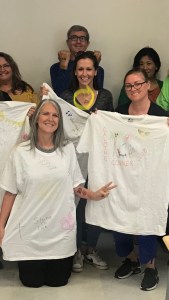
Self-awareness requires reflection. I am a very reflective person and believe in providing space for those I serve to do that reflection. Today I was doing professional development for Charlotte County Public Schools at the 2023 Summer Education Summit in Punta Gorda, Florida. In this morning’s session entitled “Self Care for Educators” I did an activity with temporary tattoos. One of the participants made a profound statement about where she placed her tattoo – at the base of her neck (see photo). She said, “I placed it there because the only way I can see it is in a reflection and this reminds me that to be self aware I need to be reflective.” Drop the microphone! 🎤 We then discussed that reflection involves taking a step back and examining one’s thoughts, feelings, and actions in order to gain a deeper understanding of oneself.
Furthermore, reflection can help us identify patterns and habits that may be holding us back or causing us problems. It can also help us recognize our strengths and values, which can guide us in making important decisions and pursuing our goals. Reflection is all about learning. We must curate the actions in our past to move into the future. Are you taking time to reflect?
Surface Level Career Versus Deep Level Career

You all know I am the farm kid that loves rock music. You also know I love studying rock musicians, their art, and their leadership. This past week I had the chance to hear the awesome Shannon Gunz, of Sirius XM Octane, interview Josh Katz from the band, Badflower. The interview took place at Welcome To Rockville held May 18-21, 2023 in Daytona, Florida at Daytona International Speedway. He made an interesting distinction about coming out of the pandemic and wanting to make sure he was still cultivating an environment where people thrive, innovation flourishes and progress is achieved. He talked about his message feeling different. Another profound statement he made was about the distinction between a surface level career versus something really deep. Josh wanted to make sure the art that the band was turning out and the message was impactful (deep). This caused me to spend time pondering this shallow versus deep career.
As a person who has spent my entire life in the education arena, I’ve been blessed to be in a deep career. I believe having a deep career means that we are passionate about our work and deeply invested in it. We have a sense of purpose and fulfillment in our job beyond just earning a paycheck. Really, the deepness takes it beyond a job. On the other hand, a surface-level career is one that may provide financial stability but lacks personal fulfillment or passion. It’s important to find a balance that allows us to feel both satisfied in your career and financially stable. I appreciated Josh discussing wanting to make sure that their work took them into the deep career realm. How about you? Are you doing something really deep?
Making Things Work

At my son’s graduation from Murray State University yesterday, President Dr. Robert Jackson made the comment, “Many things work to make things work.” Very true! He was referring to the graduation ceremony as well as the process of a student coming to Murray State as a freshman and graduating four years later ready to take on the world. There are often multiple factors or elements that contribute to making something successful or effective. This also suggests that there is not just one single solution, but rather a combination of different components that work together to achieve the desired outcome. Great leaders focus on the key inputs of organizations and make sure they are delivered at the right quality and at the right time.
Effective organizations rely on a combination of different processes/components rather than a single solution to achieve success. Those organizations, like Murray State University, understand that complex problems require a holistic approach and they are able to leverage the strengths of their team and resources to achieve their goals.
.
 Byron's Babbles
leave a comment