Dedication Attracts People
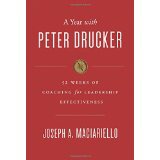 I must say that I looked forward to my dedicated study time this morning for reading the second week’s lesson in A Year With Peter Drucker: 52 Weeks of Coaching for Leadership Effectiveness. As you know from my first week’s post I dedicated myself to spending personal professional development time each week in doing a personal book study and then writing a post to this blog each week. Click here to read the first week’s post.
This week’s coaching lesson was very appropriate. The title of Week 2 is: “Questions to Ask Before Committing a Portion of Your Life to the Service of an Organization.” This was obviously important because I have had to do this in my life several times. But more importantly, it caused we to reflect on the importance of making sure the school corporation I lead can answer those questions correctly and is able to ensure everyone has a chance to achieve and make a meaningful contribution. These are two of the most important tasks an organization has to perform, according to Drucker (Maciariello, 2014). Interestingly, John C. Maxwell’s Minute With Maxwell word today was “Dedication.” Click here to watch the one minute video. Even though the teaching of Drucker this week was not on dedication, this spoke to me because I believe that our organizations must be dedicated to our team members’ achievement and ability to make meaningful contributions. The school system I lead right now needs to do a much better job of this and we are working very hard at this. I believe we need a leadership progression and training program. We should working side by side with those we lead to answer the questions: What should I contribute?; Where and how can I have results that make difference?; and, What should my contribution be? In Drucker’s view, these were questions that the person looking for a position should answer, but I believe we must help them answer these at all phases; from interviewing to job placement, to competency/leadership building.

The questions Drucker suggested a potential employee should ask of the organization are worth noting. I would also argue that these are questions that the organization, school, or business should be asking of itself as to whether they are providing (Maciariello, 2014). Here are the questions:
– Are you learning enough?
– Are you challenged enough?
– Does the organization make use of your strengths or what you can do?
– Does the organization make use of your strengths or what you can do?
– Does the organization constantly challenge and make you more ambitious in terms of contribution?
– Are you actually suffering from creative discontent?
Interestingly, Drucker talked about positive contentment and negative contentment. He argued that contentment was for six year olds. Thirty year olds should not be content because achieving great results should be hard to achieve and will be uncomfortable. At the same time, however, we must provide the environment where the results are meaningful. I love a quote in the book from Drucker because it is a school example where he says a team member should be saying: “We have that enormous job here in the new school… and we are recruiting faculty and so I spend all my weekends with prospective faculty people (Maciariello, 2014, p. 10).” This person is certainly challenged positively because they have responsibility to mobilize, challenge, and grow human resources. Let me tell you, from personal experience, taking over and turning around a school is anything but comfortable and is very hard work. But, it is extremely rewarding and, I believe, very fun work. It was very rewarding when a couple of people, one of them an Indiana State Board of Education member, said to me, “You should be very proud of providing the leadership for Emmerich Manual High School to be removed from the “F” list.” Let me tell you, I am, but I also always want to recognize the accomplishment took dedication from many more team members than me. There were many more who did much more heavy lifting than me and they were dedicated to the opportunity for achievement and making a meaningful contribution.
Another piece to this is very important. “Knowledge workers must take responsibility for managing themselves (Maciariello, 2014, p. 11).” Our team members, as well as ourselves, must take responsibility for developing ourselves. We need to seek feedback and feedback analysis. Concentration should be on areas of high skill and competence. It takes far more energy and farm more work to improve from mediocrity to first rate performance than it takes to improve from first rate performance to excellence.
Take a little time and reflect on where you are as an individual and where the organization you are a member of is in terms of dedication to every person having the opportunity to achieve and make a meaningful contribution. I know we have some work to do in this area. We have extremely talented individuals, but we need to make sure we are developing our bench strength, to use an athletic analogy, to have our future leaders ready to lead from within. REMEMBER: Opportunities do not come according to your schedule. Your job is to be prepared to recognize and seize opportunities as they come.
Reference
Maciariello, J. A. (2014). A year with Peter Drucker: 52 weeks of coaching for leadership effectiveness. New York, NY: HarperCollins Publishers.
Group Intelligence
 My first book read of 2015 has been a great one. I am reading Eleven Rings: The Soul of Success by Phil Jackson. During his storied career as head coach of the Chicago Bulls and Los Angeles Lakers, Phil Jackson won more championships than any coach in the history of professional sports. I have taken a great deal of notes during the reading of this book. One thing that has really jumped out at me though is the idea of what Jackson calls, “group intelligence.” Many also call this collective intelligence. When we form teams we commit to work together for a common goal.
“The strength of the team is each individual member. The strength of each member is the team.” –Phil Jackson
Jackson stated: “Basketball is a sport that involves the subtle interweaving of players at full speed to the point where they are thinking and moving as one… a powerful group intelligence emerges that is greater than the coach’s ideas or those of any individual on the team.” Really, coach and leader are interchangeable terms in this quote. One thing I’ve learned is that the only way to lead any school or organization with great success and scale is to build a great team. No matter how smart, talented, driven, or passionate you are, your success as a leader depends on your ability to build and inspire a team. A successful leader is one who can inspire his or her team members to work better together toward a common vision and goals.
“Talent wins games, but teamwork and intelligence wins championships.” –Michael Jordan
What we know as an individual is actually a dynamic collection of a lifetime interactions and knowledge sharing with all those we have collaborated with. Collective intelligence strongly contributes to the shift of knowledge and power from the individual to the collective. In education we have been modeling this with professional learning communities and the way educators are learning to participate in knowledge cultures outside formal learning settings. To be successful we must continue to embrace and find ways to make a a culture of group intelligence common place.
Idea Bee
We have all seen honey bees flitting from plant to plant spreading pollen and gaining much needed nectar for producing honey. As you read this post I also want you to imagine yourself as the leader going from person to person pollinating ideas – being an “Idea Bee.” One mouthful in three of the foods you eat directly or indirectly depends on pollination by honey bees. The value of honey bee pollination to U.S. agriculture is more than $14 billion annually, according to a Cornell University study. Crops from nuts to vegetables and as diverse as alfalfa, apple, cantaloupe, cranberry, pumpkin, and sunflower all require pollinating by honey bees. But the bees’ importance goes far beyond agriculture. They also pollinate more than 16 percent of the flowering plant species, ensuring that we’ll have blooms in our gardens. Of course, there is also the honey. More than $100 million worth of raw honey is produced each year in the United States.
The honey bees interdependence with plants makes them an excellent example of the type of symbiosis known as mutualism, an association between unlike organisms that is beneficial to both parties. We must develop this same type of symbiosis between our customers (in my case students), our different departments, our suppliers, or those we supply. The honey bee is very much like those of us in education; They are imbued with true creative intelligence because their purpose is to produce work that is noble and useful. No matter what organization we lead, should that not be our greater purpose?
Just as the value of the activity of honey bees is important to our agriculture industry and food supply there is also another important leadership lesson that can be taken from the bees. This is the thought that we, as leaders, should imitate the honey bees and go from team or team member to team or team member and pollinate ideas that will go toward the vision and mission of the organization. I call this being an “Idea Bee.” Then we must back away and just as the plant is then responsible for creating the seed, our teams must be responsible for taking the idea through to action. It is not enough just to plant the idea though. As the “Idea Bee” we must also make sure that all of the other team members understand their role in carrying out that part of the vision, mission, or strategy. We must also make sure that our team members have the resources necessary and the technical knowledge to carry out the ideas. Many leaders forget the very import capacity building act of making sure there is the technical knowledge necessary to do the job. It is a very important part of our leadership duties. Without competency there is chaos.
Experiments at Cornell University in the 1990s showed honey bee colonies had striking group-level adaptations that improved foraging efficiency of colonies, including special systems of communication, and feedback control. This research revealed that evolution of honey bees has produced adaptively organized entities at the group level. Think about it. This could could not have happened without there being “Idea Bees” in the hive to make this happen.
We must as leaders be the “Idea Bee” and make sure we are giving the support for the ideas to grow into flourishing organizational structure, processes, and products. We must also encourage all on our teams to become “Idea Bees” as well. Think about what your organization might look like if idea evolution were to produce adaptively organized entities at the group level.
Gummi Bear University
 Yesterday, on my way to northwest Indiana to deliver some Christmas gifts to some of our school families that had extra needs for the holidays I stopped at one of my favorite places to pick up some candy baskets to add to the gifts. Nothing says you care like a basket of chocolate and Gummi Bears from Albanese Candy Company in Merrillville, Indiana.


Of course I had to have a bag of Gummi Bears for me to munch on for the drive as well. As I was driving I got to thinking about how Gummi Bears are made. Actually, I got to thinking about how I did not how Gummi Bears are made. So, of course, my personal tutor, Google, helped out. Gummi Bears start as a liquidy solution of flavored gelatin and water. As you cool the solution and draw more water out of the Gummi Bears, they harden into the chewy texture you’re used to. Albanese Candy gets this mixture better than anyone because they have the best Gummi Bears in the world, no lie! Gelatin, is a chain-like molecule that can intertwine and form a solid-like matrix — that’s how Gummi Bears start as liquid, but solidify as water is removed. Can you tell I taught Food Science?

So, by now I’m a little disappointed that as a lifetime lover of Gummi Bears that I had never used them as a relevant connection to a chemistry lesson. Therefore, how about we take a look at how teachers might use the relevant context of Gummi Bears for a lab students can make a real world connection to?
One of the first labs you could do is to make two solutions: a gelatin solution and salt water. Both Gummi Bears and salt water are a mixture of things dissolved in water. When one material is dissolved in another, such as salt in water, the salt is known as the “solute” and the water is known as the “solvent”. With salt water, the solute is salt and the solvent is water. With Gummi Bears, the solute is gelatin, and the solvent is also water. Like Gummi Bears, salt water is a solution of water, but there is a lot less solute (by mass). Salt also cannot form interlocking chains like gelatin. That’s partially why salt water stays a liquid and the gelatin solution solidifies. However, because gelatin molecules are so much larger than salt ions, there may be many fewer (by number) gelatin molecules dissolved in the water. This size of molecules thus sets us up for some great lessons that students can see and experience in a real world context.
The reason numbers and size of molecules are important is because it turns out numbers of molecules play a big role in determining if your Gummi Bear will absorb water or not. This fact sets us up perfectly for a lab and a few great chemistry lessons. And, let’s face it, what student is not going to love doing labs where they get to work with Gummi Bears! So here is the scientific problem to start with: Why do Gummi Bears get bigger when placed in water, but not when placed in salt water?
If you put two solutions of water in contact with each other, water will tend to move from the solution with fewer molecules dissolved in it to the solution with more molecules in it. This is known as ‘osmosis.’ The force that pushes the water is called ‘osmotic pressure.’ With the Gummi Bear, if you put the Gummi Bear in a solution with very few molecules dissolved in it (like distilled water), the water will move into the Gummi Bear causing it to expand. If you put the Gummi Bear into a solution of water with many molecules of solute dissolved in it (more solute molecules than are in the Gummi Bear), then water will leave the Gummi Bear and move into the water. When water moves into the Gummi Bear, you can see the bear expand. However, since the Gummi Bear doesn’t shrink much when water leaves it, it appears the Gummi Bear stays the same.
Just to validate what I am telling you is true. I just did the lab. What is the old saying? “A picture is worth a thousand words.” Check out the picture of two of my blue raspberry Gummi Bears I experimented with (Note: No Gummi Bear was hurt during this experiment; but, many were eaten). Clearly, the Gummi Bear on the right is larger than the one on the left. This was after 30 minutes in distilled water.

So the last question to answer is if salt water has more solute molecules in it than the Gummi Bear (you know by your experiment that it does, but we can prove it with some math too). You can dissolve roughly 400g of salt (NaCl) in 1kg water at room temperature. That’s roughly 2/3 of a mole of salt molecules. Because a single molecule of gelatin weighs 10,000 times more than one of table salt, if you had the same mass of Gummi Bears as the salt solution (1 kg + 0.4 kg), or 1.4kg total, you would have only 1/25th of a mole. So the salt solution has around 10-20 times the number of molecules as the Gummi Bear. Because there are more solute molecules in the salt water, the water moves out of the Gummi Bear, and hence the Gummi Bear does not expand in salt water.
Isn’t science fun when we make it relevant and use a context we can relate to, like Gummi Bears? Think about this as you prepare lessons for second semester.
Hopefully, if you are a teacher you have found something here you can use, or it has helped you to think through how to make your lessons more real for your students. Finding ways to connect, extend, and challenge our students is the most exciting part of teaching in my opinion. The moe we can make the relevant contextual connections of school work to real life for our students, the greater the learning they will achieve.
Distress Patterns
 “Unfortunately, you don’t just have people on your staff; you also have distress patterns. The art of managing people includes the challenge of managing their distress patterns; people are very different from their distress patterns.” This statement by Dorothy Stoneman, President, YouthBuild USA is so true. Leading a school staff or any other group involves managing irrational distress patterns in other people, stress in yourself, and attacks on you. Being mindful of these distress patterns will enable you, as a leader, to navigate your organization.
I am a major believer in the power of context. With distress patterns, context certainly matters. Everyone experiences negative and positive feelings. The tendency to respond to a certain type of situation with a specific emotion, the intensity of our emotional responses, the ways in which we express our feelings, the balance between positive and negative feelings, and the duration of a particular emotion are all characteristic of each person as an individual. People differ, then, in regard to the inner experience (feeling) and in the outward experience (behavior) of emotions. I am learning how important understanding these distress patterns is. We all have behavior patterns and attitudes rooted in painful past experiences.
Sometimes these distress patterns undermine our ability to lead or function as a team. You can tell a distress pattern when you see one because it is behavior that is repetitive, that occurs whether or not it is appropriate for the situation, whether or not it achieves positive goals, whether or not it hurts other people or oneself. It is not flexible; it almost always occurs under certain circumstances. What we have to realize as leaders is that behind every distress pattern is a past experience that causes a repetitive or unproductive behavior develop. What I learned from Dorothy Stoneman is, “it is always useful to separate people from patterns, never blaming people for patterns they happen to have, always relating to the people rather than the patterns.” Remember, these patterns come from their past personal and professional experiences.
As turnaround school leader I have experienced these distress patterns related to the culture of the organizations. Lack of trust, self serving leadership patterns, divisiveness. personal attacks or other negative behavioral patterns can be major detriments to developing a positive environment. Sometimes leaders are criticized not based on the decisions made, but on the distress patterns experienced in the past. Fair and unfair criticism, including attacks, will come to anyone who takes the visible leadership in any situation. It’s part of the territory. We need to stand up for anyone willing to take, in good faith, for good purposes, the stress of being in charge.
Informational Vs. Transformational Learning
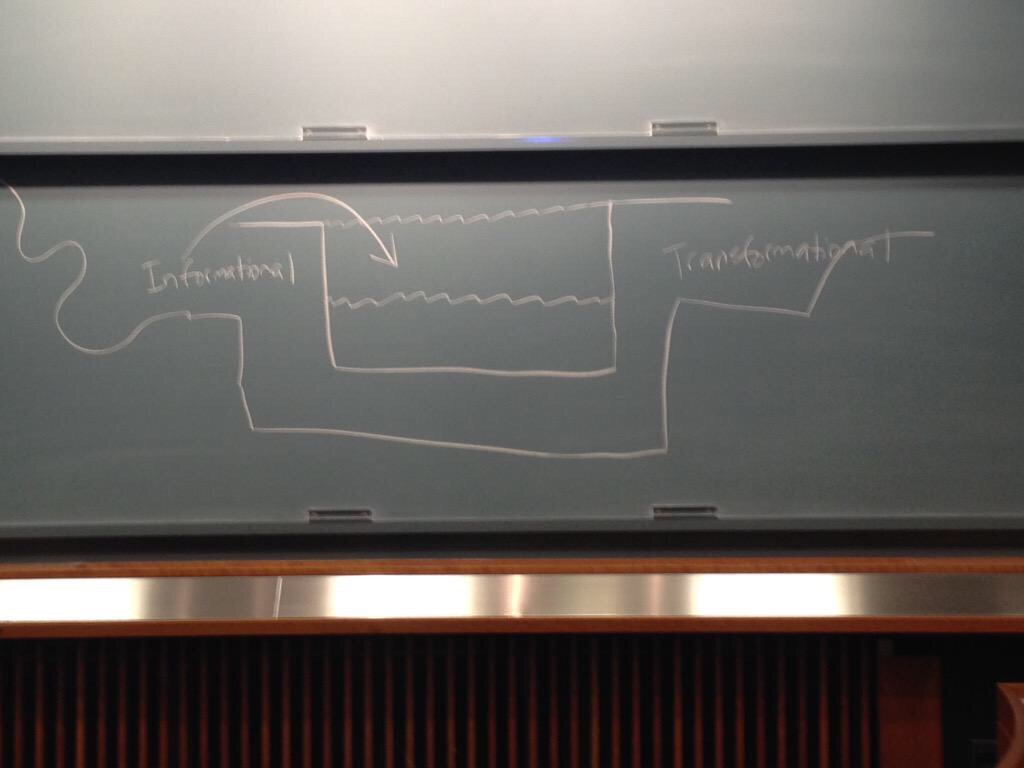 I was so impressed by the closing comments of Joseph Zolner today to conclude our learning at the Inner Strengths of Successful Leaders program at Harvard University. Joseph Zolner is Lecturer on Education and Senior Director of the Harvard Institutes for Higher Education at the Harvard Graduate School of Education. To conclude he drew a vessel on the board (see photo insert) and told us this was the vessel of the mind.
Joseph then proceeded to tell us there were two types of learning: informational and transformational. The first type is that which we use as a lower level form of learning. We are just gaining new information. In other words, informational learning will only fill our vessels so full. We need the second type of learning, transformational, in order to stretch our learning. The unique quality of human beings is our ability to think flexibly about new situations, comparing them intelligently to all past experiences, and then to do something that is uniquely appro- priate, bringing about desired objectives.
Transformational learning provides us with new ways of thinking. This can actually change the form of the vessel of the mind. In fact this new stretch, and extending of our thinking actually give us more room in the vessel of our mind for greater and more magnificent thinking. Think about the student who says to their teacher: ” I was confused before you started…Now I am confused at a higher level.” We need, as lifelong adult professional learner, to stay appropriately confused!
Don’t forget to add some transformational learning opportunities to your professional growth plan.
Values In Action: Viva VIA!
 Yesterday at Harvard University I had the opportunity to learn from and work with Jerry Murphy, former Dean of the Harvard Graduate School of Education. He is doing exciting work around the idea of ‘Dancing In The Rain.’ His idea is he wants us to flourish as a leader. The ‘Dancing In The Rain’ metaphor comes from wanting us, as leaders, to have an upbeat and realistic way of living in stressful times. I have actually played in the rain and I can tell you it is an upbeat experience. Jerry is currently writing a book on this and I cannot wait till it is published. Trust me, it will be a must read!
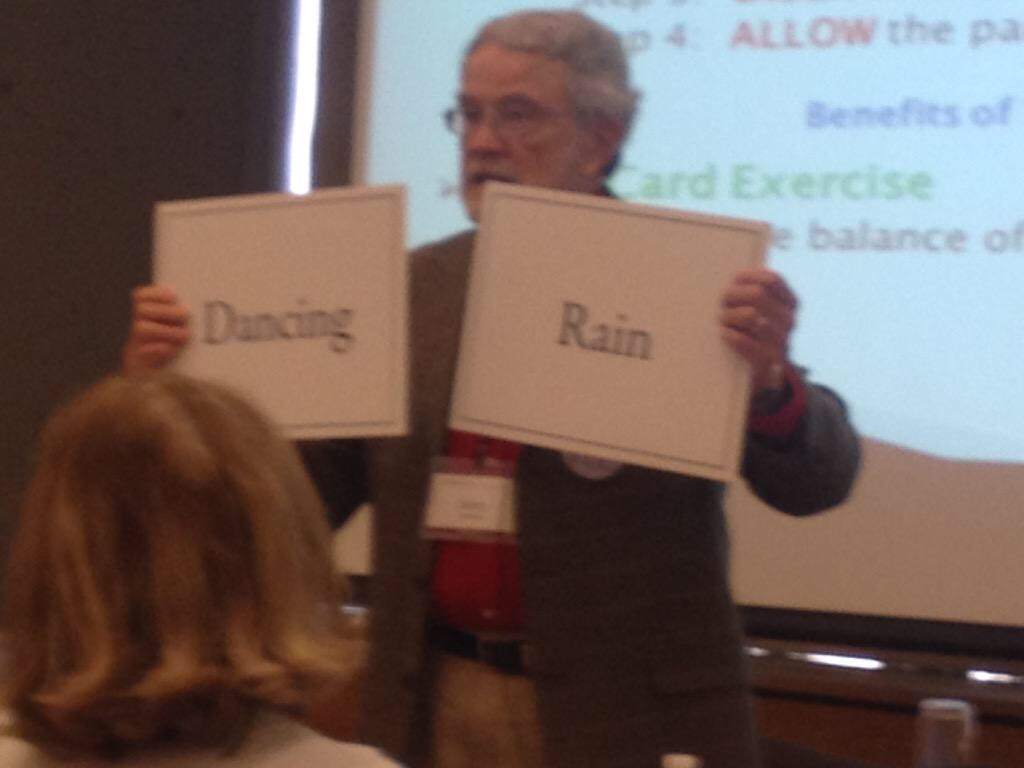 Jerry Murphy has developed a framework called ‘MY DANCE.’ Without going into much detail in this post, I would like to just share the framework.
MY DANCE FRAMEWORK:
Step 1: M – Do what MATTERS
Step 2: Y – Say YES to here and now
Step 3: D – DISENTANGLE from upsets
Step 4: A – ALLOW the pain life brings
Step 5: N – NOURISH myself
Step 6: C – Practice Self-COMPASSION
Step 7: E – EXPRESS feelings wisely
This post is really about Step 1: M – Do what MATTERS. It is the idea that what really matters are your core values. We cannot let our circumstances or discomforts that are thrown our way hijack us from what is important to us. During our time with Jerry Murphy he had us do an exercise called, ‘The Retirement Party.’ For this exercise you first imagine yourself retiring and you are attending your retirement party. Secondly, you spend a few minutes writing down four or five things that you like for people to say about your values as a trustworthy leader.
As you can imagine this exercise caused a great deal of reflection for me. I would like to share my points that I would want people to be able to say about me. Here are the four I cam up with:
1. Byron is just the kind of guy you are glad he is your friend and he has added value to your life because he has helped you grow.
2. Byron pulled me and enabled me to get to the places in my life I wanted to be. He has helped me be all I can be.
3. Byron certainly ‘Walked the Talk.’
4. Byron was able to bend in the breeze and navigate difficulties.
5. Byron was a lifelong learner.
This is not an easy exercise because sometimes you have to discover your values instead of just pulling them out of the air.
Then came the most powerful part of the exercise. He had us pick one of the statements that we wrote and think about if we were really doing and acting on that value. Then, we were to develop and action plan to truly carry out that value for everyone I serve as a leader and translate the value into action. Jerry call this Viva VIA! VIA – Values In Action. In fact he created buttons that he gave each of us. I have included a picture of the button here in this post.
My action step was for value number two: Make sure I do all I can for every staff member I serve according to their goals and professional growth plan. Sometimes it is easy to work with just a few, particularly those who are most aggressive with their own personal professional growth plans. I need to make sure and collaboratively identify those areas where the faculty I serve need to be pulled up to reach the goals they desire. This exercise really reminded me to lead my life shaped by what matters most to me. In other words what make me come alive and inspires me to lift those up which I serve.
We must remember that our values give meaning, purpose, and resolve to everything we do. As leaders, we must have a commitment to take action, even when it hurts. No matter how big the storm, the sky is big enough to handle it. Much like our storms as a leader, we must be big enough to handle them.
Bending In The Breeze: Being A Mindful Leader
 Today, while learning to be a more mindful leaders while at Harvard we did a meditation exercise looking out the window. This exercise was done in the Gutman Library at the Harvard Graduate School of Education during a session of Inner Strengths of Successful Leaders. I looked out and saw the tree that I have included a picture of in this post. It was a little windy out and the tree was gently bending in the breeze. It made me think about how as mindful leaders we must bend as the winds of difficulties blow in our everyday lives. I have seen wind break a tree that does not bend while leaving others that bend untouched.. After every windstorm there are broken branches scattered everywhere. I think, just like a tree we have a choice to either bend or break, or duck behind a windscreen.
While I agree with the observations regarding flexibility, resilence, and being adaptable. There is a fact that everyone must recognize. The tree that is highly flexible must also be rooted deeply or in a forest where the root systems intertwine and provide additional strength. A high rise building that moves up to 9 meters at the top requires a very strong foundation. A person who can bend with the circumstances must have core values and mindsets that are deeply rooted. Sometimes we need to take our mind for a walk, which was the whole purpose of the meditation at the window. We need to be aware of those things that are serving us well.
When we have difficult meetings, phone calls with difficult people, or are thrown difficult circumstances (which we will be) we need to take a mindful moment. In this mindful moment we are bending like the tree in the breeze. We need to be aware, take a moment to breathe, and show some compassion for ourselves. Also, in difficult situations we must recall what matters most to us as leaders. Another great leadership skill to remember is that when you feel the impulse to explain, LISTEN! Remember, act out of your values.
Furthermore, don’t try to get rid of difficulties, but build a bigger playing field so your values can be brought to the forefront. The leadership reality is that we will get overwhelmed. When thrown, we need to ratchet down the reaction just like the tree bends in the breeze. When thrown, our bend will be listening, looking inside to explore patterns and identify where we might be wrong, and take responsibility.
Finally, mindful leaders are poised. When we practice mindfulness we are able to bend with difficulties because of our presence and clarity to know what is happening. A great quote is, “What you resist persists.” Think about it; if the tree resists the wind and does not bend, it will break.
The Right Concepts
“It is virtually impossible to make things relevant for, or expect personal excellence from, a student you don’t know.” ~Carol Ann Tomlinson
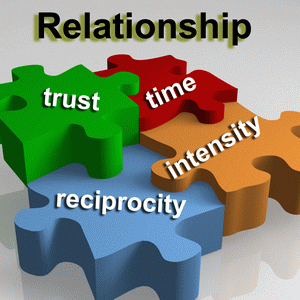 You have probably seen this quote from Carol Ann Tomlinson before, but it is so true it bears repeating frequently. I was reminded of this again this morning during my morning personal study time (yes, even on Thanksgiving day) when I was reading an article in one of my favorite periodicals, The Chronicle of Higher Education. An article entitled, “Colleges’ Prestige Doesn’t Guarantee a Top-Flight Learning Experience.” The article was about the National Survey of Student Engagement, which was released last week. This survey is known as Nessie, and was done to to identify educational quality at the institutional level. The data was collected last spring from 355,000 freshmen from 622 institutions. The research used two indicators for quality: student-faculty interaction and effective teaching practices. This research really caught my eye because of my belief in the three Rs of education: rigor, relevance, and relationships. The most important of which I believe is relationships. In fact I have blogged about this in the past. Click here to read my post entitled, “You Want Me To Do What? Teach.” Needless to say, my long and storied career in education would never have happened without the great relationship forged by Dr. Hobe Jones and myself. Obviously, this relationship has affected my feelings, attitude, and allegiance to Purdue University. I have been very blessed to have been very involved with Purdue in many ways since graduating with three different degrees.
Interestingly, this research involved asking students questions that included how often they talked with faculty members outside class about career plans, course topics, or other ideas. Wow, that is exactly what Dr. Jones did! We talked daily. Yes, you heard that right even on a campus on a university the size of Purdue with over 34,000 students. The College of Agriculture has mastered the art of making a big university small. It is really about understanding emotional intelligence. The days are gone when the preeminence of IQ as the standard of excellence in life was unquestioned; a debate raged over whether it was set in our genes or due to experience. But here, suddenly, was a new way of thinking about the ingredients of life success. Emotional intelligenc involves using emotions to promote thinking and cognitive activity. Emotions help prioritize what we pay attention and react to; we respond emotionally to things that garner our attention. Dr. Jones, through our relationship, was making sure I was paying attention to important decisions that would affect my life forever.
The other measure, which involved effective teaching practices, qualitatively analyzed the perceptions of how often their instructors clearly explained course goals and requirements, taught in an organized way, used examples to illustrate difficult points, and improve feedback. Amazingly, this list would be the same for what we would call highly effective teaching at the k-12 level. This is why the relevance part of the three Rs is so important. As we look at college and career readiness it is important we have our students ready for the teaching environment of post-secondary education. It was also no surprise that students perceived time spent improving teaching means less lecturing. Students participating in the study stated that instructors who were bettering their teaching used discussions, small group activities, student performances and presentations, and experiential-learning opportunities. It seems to me this research data allows for many partnerships between secondary and post-secondary education.
A Gallup-Purdue Index survey released earlier this year found that graduates were three times as likely to report thriving in their sense of well-being if they had connected with a professor during college. I am certainly proof of this. I believe this is true of k-12 students as well. Therefore, all of us in education have an obligation to be forming positive relationships and using effective teaching practice. After all, these are the right concepts!
Water The Bamboo
 I had the incredible privilege of meeting Greg Bell, author of Water The Bamboo this morning at the NWEA Fusion East conference. He was the keynote speaker and having read his book I was very pumped to hear him speak. I use the principles in his book and was excited to have him autograph it for me. He and I have also had great fun tweeting back and forth.
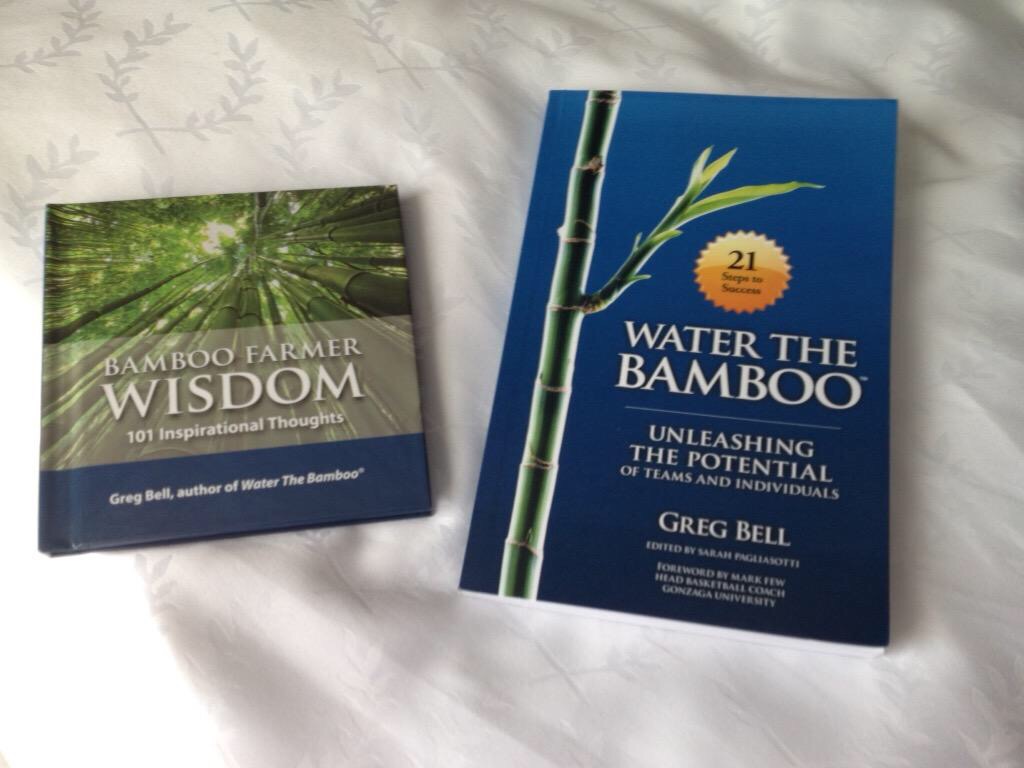
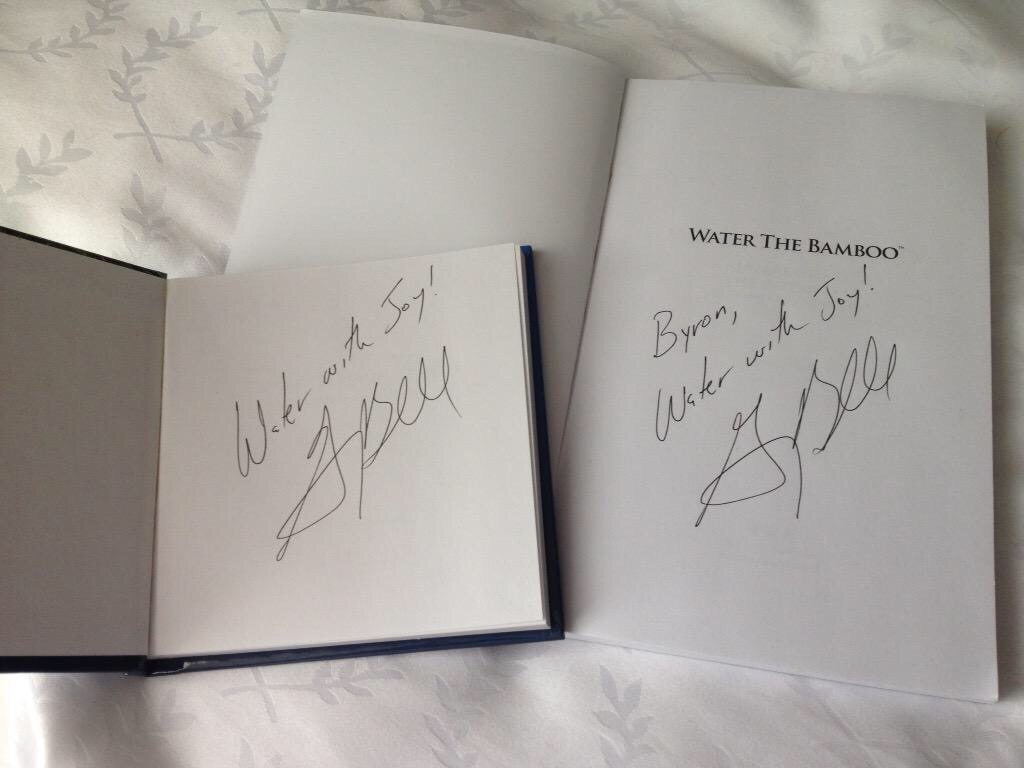 Let me tell you his keynote was just as inspiring as his book! He is awesome. During his keynote he had us all take the Water the Bamboo Oath. Needless to say, I and everyone else in attendance was inspired. I would like to share some of the thoughts with you from his speech.
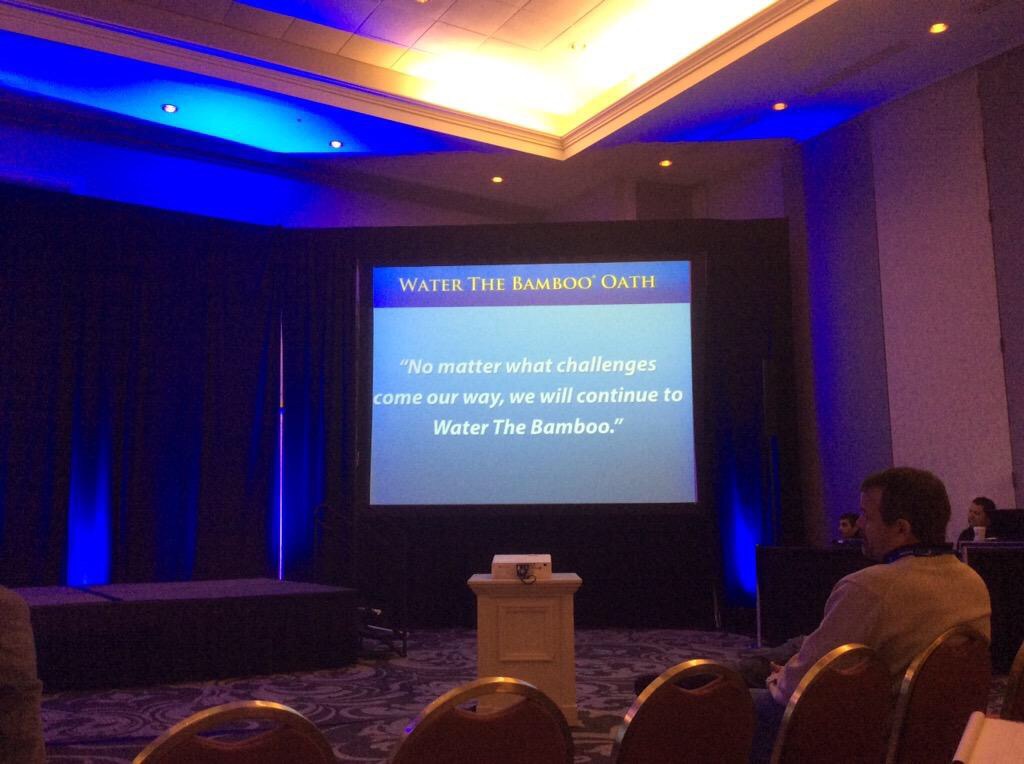 Here are the highlights:
– Sunrise or sunset…it’s all in your perspective
-Change your perspective; leave the either/or and reintroduce the “and”
-Instead of pushing, how can we stand side by side to address an issue?
-A person pushed against their will has the same opinion still
-Water the right intent
-How we talk to ourselves impacts our reality
-When you change the language you change everything
-Mindset of a Bamboo farmer: Patience, persistence, self-discipline, courage, and belief
-What are you holding on to? Bamboo sheds! Get rid of the things you no longer need. Focus on the right 20%
-Let go of your bad stories
-Don’t keep staring at the closed door. Turn around and look for the open one.
-Individuals and organizations who understand the relationship age will flourish
-Bamboo grows 90 feet in 60 days. Prior to that is shows no growth above ground for 220 days. Symbolic of many of our learners in our schools
-Start your day with this question: What’s going well?
-Don’t be a negaholic! Optimism always wins!
-We need to encourage our students to dream!
-Language matters in your organization’s culture
-Sweat the small stuff and the big stuff will take care of itself
-Catch reverse paranoia. Optimism always wins
-The word “student” in Latin means “eager to learn.” Are you cultivating this?
-Three things that will get you out of poverty: 1. education 2. education 3. education
-Are you a negaholic? Do you only see the negative? QUIT THAT! Instead, ask yourself what is going well.
 As you can tell, there was a lot of great information packed into our time with Greg Bell. Can you imagine how awesome all of our lives would be if we followed every bullet point above. Remember, we have an obligation to those we lead, particularly in our schools to be doing this. Also remember, every day with your students could be THE day!
 Byron's Babbles
leave a comment