Leadership Heroin

Empowered Teachers for Action with Speaker of the House Brian Bosma
Yesterday was one of those incredible days in the life of a school leader. In the morning I was able to spend time with several teachers from our own school as well as many others from around the state as part of a program developed by one of Hoosier Academies teacher leaders, Jill Landers, in conjunction with Tosha Salyers and the Institute for Quality Education called “Empowered Teachers for Action.” The program included five sessions, four of which were held the previous four Wednesday’s, with the goal of educating teachers on governance, policy, and how to become involved in the legislative process. The program was a total success and culminated yesterday at the Indiana Statehouse with a panel discussion with Indiana Senator Hershman and Indiana Representative Cook, a discussion about how legislation comes about, and finally a discussion with Speaker of the House Brian Bosma. It was AWESOME! I might add this was Jill’s Focused Leadership Project as part of her experience in our Focused Leader Academy (FLA).
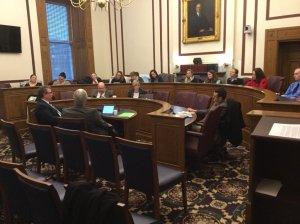
Discussion with Senator Hershman & Representative Tony Cook
As if that were not enough to make the day complete, we were then off to school for an afternoon session with our Focused Leader Academy where they were finishing up the development of our school’s new Vision, Mission, and Core Values. Last week, academy members led a school board retreat session getting board feedback and input. Now, the team was putting the finishing touches on everything. Earlier in the day there had been discussions about what a great experience and journey this has been for our teacher leaders. In fact, I would say our leaders have had an experience of truly building a vision, mission, and core values that very few top level CEOs have ever had. One of our FLA members, Alissa Davis, even said, “You know, I go through other organizations’ mission and vision statements and try to see if I can figure out what they do and stand for, and you know; many of them you can’t.” I have to give credit here to Mike Fleisch, who has been so much more than a graphic facilitator during our journey. He has been a partner, friend, and my jazz partner. We truly have become a jazz improvisation act. I’ll need to blog about this collaboration, but I’ll just say I would not be the leader I am today without the
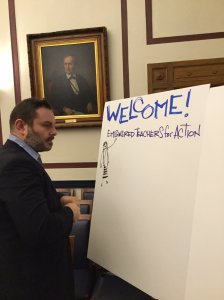
Mike Fleisch
collaborative friendship/partnership, and jazz act, we have developed.
Those that know me won’t be surprised when I say that during our Focused Leader Academy session I get a little, o.k. a lot, excited and animated. How can you not, with a room full of great teacher leaders? Anyway, I had just said earlier in the day that I lived for these days. I was concerned yesterday,however, because there was a snowstorm coming in and I did not want to cancel or quit early (we did not have to). You know how sometimes when weather comes in how great it is when you get part of your day back when something is cancelled or ended early? Let me tell you, I do not ever wish that on these sessions.
During the afternoon session I got all excited when the group finally put the final draft status on the vision and mission and had defined student success (you’ll have to wait for these to be revealed). Then Jill Landers looked over at me and said, “this is your heroin.” Wow, pretty profound, right! Yes, she was correct – leadership and working with our staff is my heroin. Working with our teacher leaders in the area of leadership and professional growth is a drug for me. I get all hopped up just preparing and putting the sessions together. And, at the end of the day, I go through a little withdrawal. We all laughed when Jill made the comment, but she was right. I then shared a story I had heard about why so many rock stars have drug problems – it is because of the rush and high they get being on stage with all the people cheering and then there is not that high when they are not performing and they need something to give them that high. Drugs and alcohol become the medium. Well, let me assure you I do not need the medium in between, but I think we can all understand the situation.
Last night I got to thinking about having a drug addiction-like passion for leadership. Our second President, John Adams, was concerned about this passion for leadership. He posited that leaders become so passionate and addicted to the power of leadership they have the tendency to become tyrannical. He believed that an important task of leaders was both to incite and to control human passion, both in ourselves and those we lead. Make no mistake here, however, it is the passionate leaders we need in the world. It’s the passionate people that take the biggest risks, step up to the plate, and help make the biggest leaps forward within teams, companies, and organizations. People want to follow a passionate leader. Someone who cares about not only the cause for which he or she is working, but also the other people who are involved in the effort. Passion for the projects, for the company and for the people involved are key to successful leadership.
Finally, I guess it comes down to my attitude and mindset that makes working with our future leaders one of my leadership drugs (to continue with the metaphor). I’m driven by curiosity and the motivation to learn about the world around us. As leaders, we need to find ways to connect with the world around us. Curiosity and interest are both key qualities of the best leaders I know. What is your leadership heroin?
Managing Strategies for Engagement
This post is an excerpt from the book Authentic Conversations by James Showkeir and Maren Shokeir. This book is included in BKpedia, a new digital subscription service from Berrett-Koehler Publishers. Please visit bkpedia.bkconnection.com for graphics, tweets, and other resources.
Managing Strategies for Engagement
Engagement means being able to make meaningful decisions and to have the resources to act on those decisions.
The marketplace demands results now. Your customers want attention in this moment. The necessity for flexibility and speed in the face of change is paramount. The question is how to create an organization that can:
• Quickly create and apply new knowledge
• Grant exceptions and deliver unique responses
• Foster passion and accountability throughout the entire enterprise
For these significant changes to occur, three areas in the organization must be affected: (1) culture and management/governance practices, (2) architecture, which includes the ways jobs are designed and how people are grouped, and (3) the ways in which employees are rewarded. For all these changes to be planted and take root, new conversations are required.
Individuals must accept personal accountability for the success of the whole business and be responsible for their own motivation and morale. The culture must generate passion for the work and action in service of customers and good results. This requires less focus on personal ambition and a sincere commitment to the success of others.
Organizations have to create and sustain universal business literacy and adult-to-adult conversations, one person at a time. Management practices, such as budgeting, meetings, training, objective setting, performance reviews, and so on, must be recreated to encourage partnership. Dissent must be viewed as healthy. Through different conversations, knowledge and collaboration are baked into the work process, replacing compliance and control as the operating values.
Where to start? If the longest journey begins with a single step, it won’t surprise you that our advice is to begin by changing the conversations. Better conversations will reap rich, diverse information. They will encourage an examination of who plays key roles in improving business results. They will allow you to address difficult issues in a constructive way.
New conversations will champion the kind of learning and resourcefulness that lead to innovation, cost efficiency, and personal accountability—essential elements in addressing the complex problems of organizational renovation.
*****
James Showkeir and Maren Showkeir are principals of Henning-Showkeir & Associates, Inc., whose clients include 3M, Ford Motor Company, Kaiser Permanente, British Airways, Coca-Cola, Hewlett-Packard, Levi Strauss, the Greenleaf Center for Servant-Leadership, and the Nature Conservancy. Together they authored Authentic Conversations and Yoga Wisdom at Work. James passed away in August of 2015.
Reading You Like A Book
 Lesson #21 in The Disciplined Leader (2015) by John M. Manning is about how as leaders it is important for us to understand what kind of nonverbal communication cues we are sending. In reading this lesson I was reminded of the incredible book by Dr. Nick Morgan, Power Cues (2014). Power Cues reports new brain and behavioral science about how humans communicate, and the importance of authentic face-to-face interactions. Dr. Morgan goes into detail on the visual cues, subtle gestures, sounds and signals that elicit emotion. As Manning (2015) taught us, leaders who are not in tune with putting on the right game face on are not effective with their teams. Manning (2015) said, ‘Leaders tend to pay way more attention to their verbal communication than their nonverbal communication. Many leaders often aren’t aware of what their nonverbal habits are and how they regularly affect others (Kindle Locations 1216-1217).” Leaders who understand how to become more persuasive and how to communicate more effectively will create more influence in all dealings, and as we know, leadership is about influence.
“No one gets led anywhere they don’t want to go. Machiavelli was wrong; leadership is not manipulation, not in the long run. It’s alignment, the leader with the group and the group with the leader. But you first have to maximize and focus your leadership strengths in order to be ready when your moment comes.” ~ Dr. Nick Morgan

“What this means is that body language doesn’t lie and can make or break what and how well you communicate to others.” ~ John M. Manning
The first three Power Cues deal with non verbal communication (Morgan, 2014):
- The first power cue is all about self-awareness. How do you show up when you walk into a room?
- The second power cue involves taking charge of your nonverbal communications in order to project the persona you want to project— through your emotions. What emotions do you convey through your body language for important moments, conversations, meetings, and presentations?
- The third power cue helps you learn to read unconscious messages. What unconscious messages are you receiving from others?
So, as you can see it is important for us to think about the nonverbal cues we are sending, but it is also important for effective leaders to read the nonverbal signals of others. Morgan (2014) told us that body language always trumps the spoken content. He also taught us in Power Cues that most of the emotional colors and tones of conversation are set through gestures (Morgan, 2014). For those involved in education reading this, Morgan (2014) pointed out that researchers have studied how children learn and have determined that they learn nonverbally first.
The bottom line is we need to be very aware of what message we are sending in our gestures, eye contact, hands, arms, stance, and attentiveness. As Morgan (2014) pointed out, the nonverbal communications, such as gesture, happen in the brain ahead of the verbal (spoken) communication. These nonverbal signals send messages that speak to the whole person and influence our ability to build effective relationships with our teams, influence those individuals, and lead our organizations.
If you want to dig deeper I would recommend getting a copy and reading Power Cues (2014) by Dr. Nick Morgan. Combine that with reading Manning’s The Disciplined Leader (2015) and you are taking major leaps toward your professional growth and becoming an even more influential leader.
References
Manning, John (2015-06-15). The disciplined leader: Keeping the focus on what really matters. Berrett-Koehler Publishers. Kindle Edition.
Morgan, Nick (2014). Power cues: The subtle science of leading groups, persuading others, and maximizing your personal impact. Cambridge, MA: Harvard Business Review Press. Kindle Edition.
Professional Growth Puzzle
 It never ceases to amaze me how when reading a book with 52 weekly lessons, how each week can somehow be related to something in my weekly leadership journey. This week is no exception. Lesson #18 in The Disciplined Leader (2015) by John M. Manning was titled “Write Your Professional Development Plan.” I am a firm believer that personal professional growth must be personal. In fact I blogged about this back in 2011 back in 2011 after being a part of reimagining 21st century education with the Pearson Foundation and the Smithsonian Institution. Click here to read Autonomy – Professional Growth Must Be Personal.
At the completion of our January Focused Leader Academy session yesterday I had a teacher ask me if at the end of the program in June if I would be doing an evaluation of each participant to see where they were as a leader and what they still needed to work on. Honestly, I had not given that a lot of thought yet, but my answer was: “I hadn’t thought about that yet, but yes that must happen.” Then I told her that part of that would have to be developing a personal professional growth plan. As I explained to her, leaders must own their own professional growth and she would need to continue to take responsibility for it. It is simply ludicrous to think that any organization can provide every piece of professional develop that every individual needs. As Manning (2015) pointed out, “having a professional development plan— a blueprint for where we want to go, what we want to be, and the steps we need to take to achieve it— can make the difference between professional fulfillment and failure (Kindle Location 1053-1055).” Now, it is part of mine and the organization’s responsibility to help mentor this teacher leader and help her to develop her plan. That is really an important part of the Focused Leader Academy. 
Our knowledge base is growing so quickly that individuals will no longer be able to think in terms of career education, but rather of a lifetime of multiple careers. It is the job of the organization to assist its employees in coping with this rapid change. The organization must be prepared to help its employees avoid the erosion of their skills and the onset of individual obsolescence. This is such an important concept as a believer that every person must lead from where they are. A professional development effort is most effective when it is integrated in the organization and internalized by the participant. It is why our Focused Leadership Projects are such an important part of our Focused Leader Academy.
“Even leaders with the best of intentions often do not realize the dramatic impact they can exert by being a role model or by providing guidance to employees seeking new paths to career satisfaction.” ~ Beverly L. Kaye
I appreciated this reminder of how important it will be for each of our teacher leaders to develop a professional growth plan. I will need to help mentor each participant and provide feedback. But… the plan will need to be owned by each individual. As Manning (2015) taught us, “Disciplined Leaders have been self-driven, lifelong learners who always put their goals down on paper and assigned a timeline with action steps for accomplishing those goals. They remained personally accountable to whatever they were pushing themselves to learn, do, or achieve (Kindle Locations 1065-1067).” In response to the original question of providing an evaluation – I prefer to call this feedback – I would posit that the feedback must be focused on behavior rather than on personality, that is based on observations rather than opinions, that is descriptive rather that judgmental. She will need for me to share ideas and information, that is specific about situations, and that is given at the appropriate time.
During the writing of this post I am reminded that in addition to taking responsibility for my own professional growth, I must also take personal responsibility for supporting the professional growth of all those I lead.
Reference
Manning, John (2015). The disciplined leader: Keeping the focus on what really matters. Berrett-Koehler Publishers. Kindle Edition.
Driven Crazy By Data

Yesterday I was involved in some pretty deep discussions on education. During one part of the discussion I made the comment that many times instead of being “driven by data” we are “driven crazy by data.” As usual, I got some weird looks, but it’s only because I was stating what many aren’t willing to discuss. I am calling this Part One because today I am going to use a personal example from our farm to make my point and will come back later in another post and prove an educational example. I believe those of you outside education in other industries and organizations will be able to use this example as well.
Today, my son and I needed to install a continuous 65′ run of matting for tie stalls in our dairy show barn. Pretty great Saturday Dad and Lad activity for a Saturday, I might add. Now here were the data points: Mat roll was 65′ long
Mat is 75″ wide
Mat weighs 2,000 pounds – 1 ton
Need to leave two inches on each end for the mat to expand
Needs to be 22″ from the wall at the top of the mat

The Mat as Shipped

Location of Mat Istallation

Success!
I am guessing that no matter what field you are in you can relate to this. Those in education could make a list of all the data points able to be tracked. But… we need to make sure we focus on data that really matters. Data that informs instruction and highly effective facilitation of learning is what matters most. If we are to be successfully driven by data, we must not let data that does not matter drive us crazy!
What data in your organization drives you crazy? What are the data points that will drive you to success?
Leadership is Responsibility
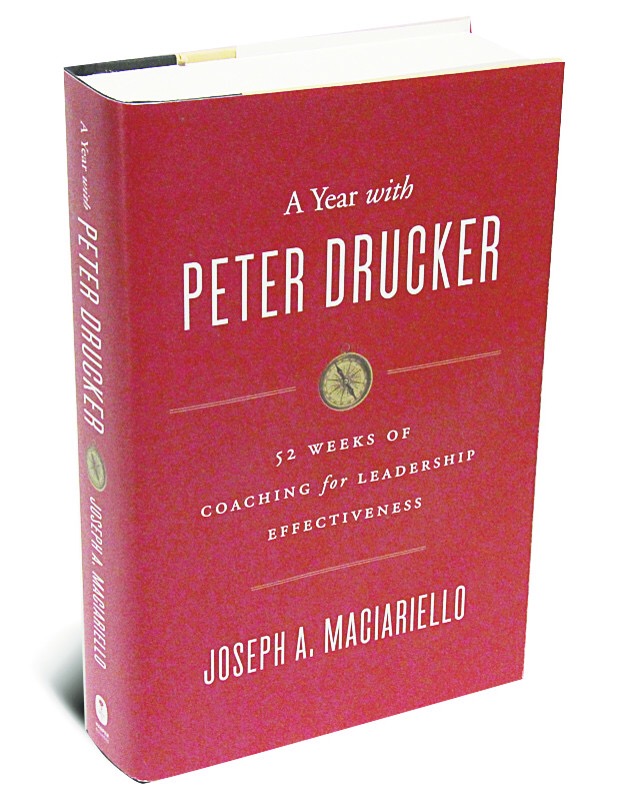
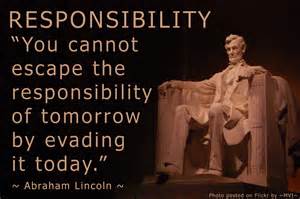 This week’s entry in A Year With Peter Drucker (Maciariello, 2014) deals with integrity in leadership. By posing the question “What do leaders stand for?” (p 369), Maciariello (2014) posits that leadership inspires trust and commits leaders to viewing the world as it is and not as they wish it to be. This is why core values are so important. I believe that the organization needs strong core value and then individual team members must be selected that have core values that match and compliment the organization’s. What a leader stands for is much more important than specific personality traits.
“By the way, the [great] CEOs I have known – and I have know quite a few – did not see themselves as supermen. They built a team. They were team leaders. ~ Peter Drucker
Effective leaders go to work on the priorities of the organization rather than those tasks they thought were going to dominate their tenure. In my world as a school leader it has been very important to have core values about what is best for students. I have had the opportunity to see the school’s and teachers’ core values develop organically in this this past year. Education is not unlike many industries in that it is so complex and ever changing. In fact, it is probably more complex and fluid. Leaders therefore must be continuous learners and surround themselves with experts in areas necessary to solve present and emerging problems. 
“Values, like nutrients that sustain an organism, also sustain an organization.” ~ Joseph A. Maciariello
Maciariello (2014) uses two of our great Presidents to drive home his points in this entry. Both Abraham Lincoln and Harry Truman are lauded for the strong individuals they surrounded themselves with. I would add that it was the set of strong, well developed core values that gave both of these great men the ability to do such a great job of selecting their cabinets and generals. By understanding their own core values and truly living them, Lincoln and Truman were both able to navigate the selection of individuals whose own core values were the same. When we study the history of the times of these great men we find that even in personnel struggles, those Lincoln and Truman struggled with had like core values. These men had to lead in extraordinary times and certainly were not doing the normal day to day tasks of most Presidents – at least at that time.
“It is also the business with these values, the business that believes it exists to contribute rather than just to take, that will weather adversity. In good times, values may look like an ornament. They may be treated – and frequently are – as something we can indulge in as a “nice little extra.” It is in times of adversity, in times that try a man’s soul, that values are a necessity. For if the right values are absent at such times there is no incentive for human beings to walk the extra mile, to make the extra commitment, to do the hard work of rethinking strategy, of trying new things, of rebuilding.” ~ Peter Drucker
This quote by Peter Drucker (Maciariello, 2014, p372) really sums up why I am so blessed to have been a leader of a high school and now a school corporation in turnaround mode. I have truly experienced why core values are so important. As Drucker said, core values become ornaments in good times, but a necessity in adversity. I have learned why it is important to not let core values only be words on a page. All decisions, in good times and bad, must match a leader’s personal core values and the core values of the organization.
At the end of the lesson Maciariello (2014) poses the question of “What are the espoused values in your organization?” (p 373) The word espoused means what do we say we intend to do. I like that Maciariello used this word because what we say and what we do are many times two different things. If the core values are just espoused then they are just ornaments, probably posted on a plaque somewhere – fair weather values. So, my question to you is; Are your and your organization’s core values just espoused, or are they real guides that are used everyday to make the important strategic decisions of your organization?
Reference
Maciariello, J. A. (2014). A year with Peter Drucker: 52 weeks of coaching for leadership effectiveness. New York, NY: HarperCollins Publishers.
Knowing Your Mission & Purpose
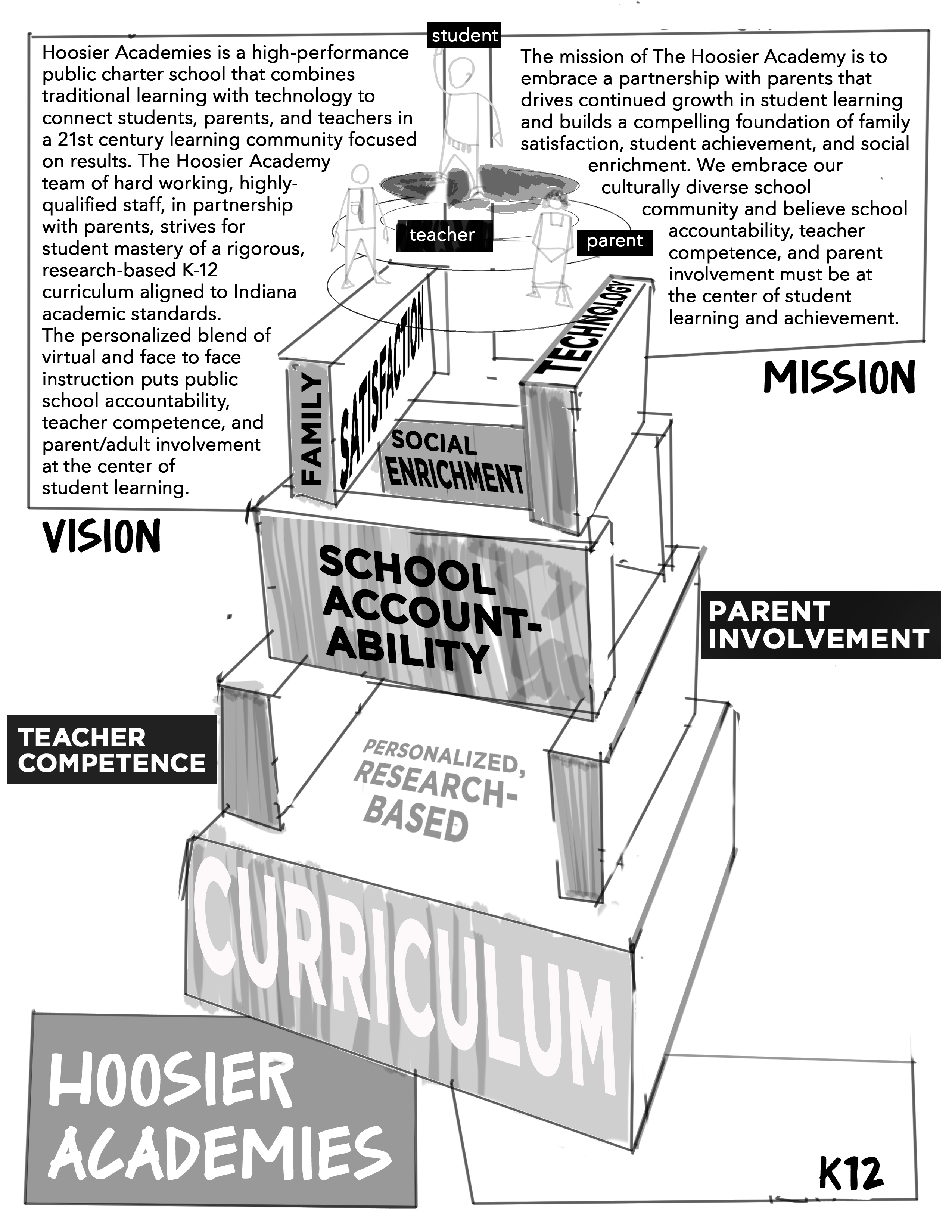
A Graphic Representation of Our Organization’s Study of our Mission & Vision. Thanks Mike Fleisch!
We are working on this very process right now in the schools I lead, Hoosier Academies. I have attached some visuals of our work in this area thus far. It is our desire that this process go so much further than just having words. We want our mission and vision to truly represent the shared purpose of all stakeholders in putting students first. By doing so, we can then budget on purpose, structure on purpose, staff on purpose, program on purpose, and strategic plan on purpose. We must know our mission because not everything is in life is worth doing. Without purpose it is hard to discern what is worth doing. In week 45’s lesson in A Year With Peter Drucker (Maciariello, 2014), five reasons for being purpose driven:
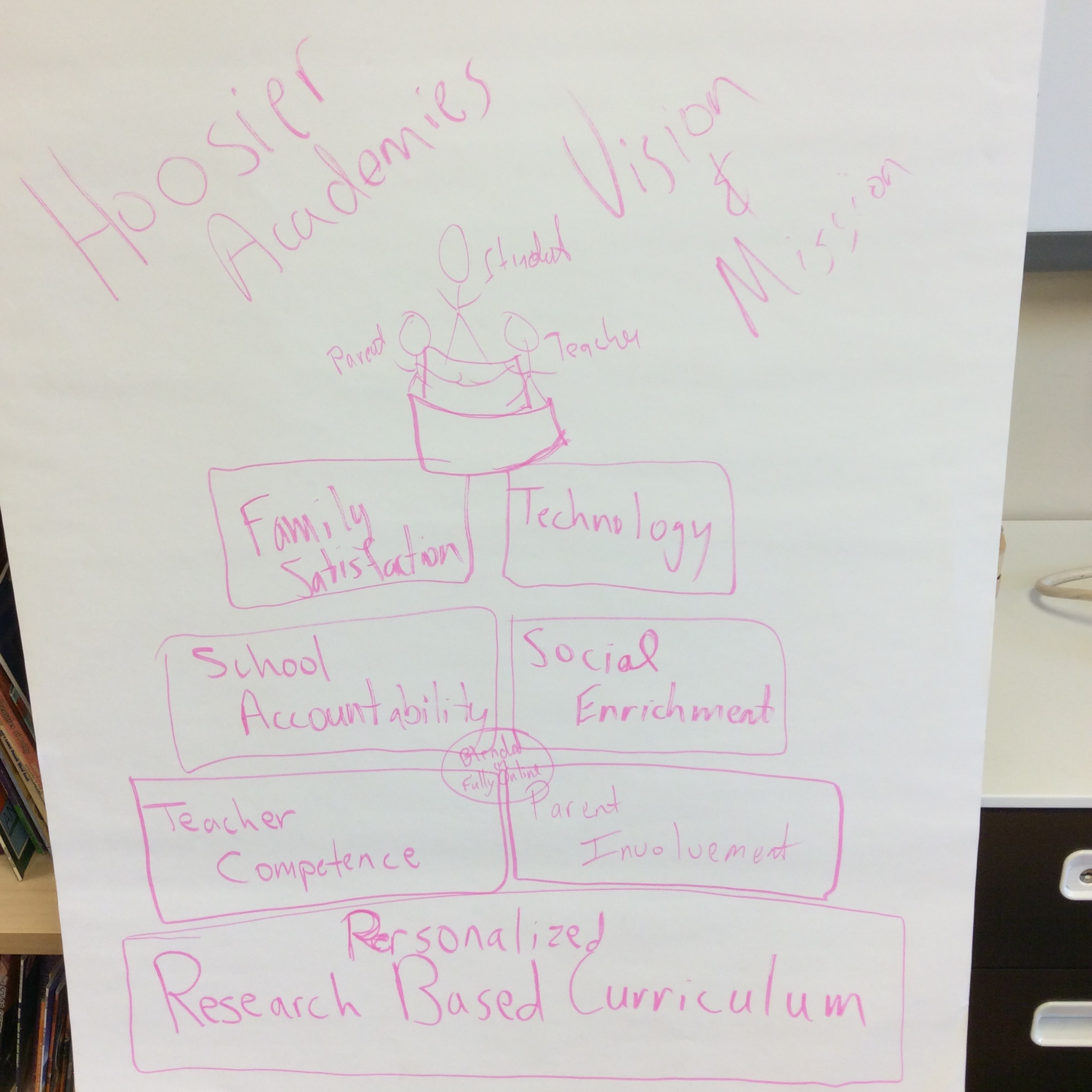
1st Draft of Our Graphic Study of Our Mission & Vision
- Purpose builds morale.
- Purpose reduces conflict in organizations.
- Purpose provides vision.
- Purpose allows concentrating.
- Purpose provides a system of evaluation.
Drucker (Maciariello, 2014) posited that a theory of business needed three parts to be successful. First, there needed to be defined assumptions about the environment of the organization. Second there must be a specific mission. Drucker put this so well, saying, “The assumptions about mission define what an organization considers to be meaningful results – they point to how it envisions itself making a difference in the economy and society at large.” (Maciariello, 2014, p.353) Finally, core competencies define where an organization must excel in order to maintain leadership.
 One of the main reasons we are going through this process right now was driven home by the fact that a mission must be tested against reality. Our schools had not taken a look and really studied it’s mission and vision since the start of the schools. No mission lasts forever. Also, we have to remember what Drucker (2014) taught, “Knowledge is a perishable commodity.” (p. 355) We must not procrastinate if our mission and vision are obsolete or no longer match our purpose. Additionally, we must rethink the assumptions and core competencies on which our mission and vision are based and update the premises on which our organizations are operating. I always have to remind myself and our team to stay focused on the things our organization must do extremely well in order to succeed in carrying out our mission. You will notice in the graphic representation of our mission and vision we chose to use a Jenga theme (I will be doing a post dedicated to the process we are using with our Graphic Facilitator, Mike Fleisch, later). We really think in the case of a school this is such a great way to look at our purpose, vision, and mission using because we have the student at the top, but if any other area fails it brings down the tower and does not allow us to carry out our core value you of putting students first. We must support those areas of required excellence by offering continuing professional development and education.
Reference
Maciariello, J. A. (2014). A year with Peter Drucker: 52 weeks of coaching for leadership effectiveness. New York, NY: HarperCollins Publishers.
Being Prepared For What You Don’t Know You Need To Be Prepared For

Later today I will be speaking at the Overcoming Obstacles Youth Expo. This expo is being put on by Uplift Indy. I love the title, “Overcoming Obstacles.” That’s really what it is all about. I will be closing out the day and will tie it all together by working with the youth on around the idea of “Being Prepared For What You Don’t Know You Need To Be Prepared For.” Isn’t that what obstacles are? Things we are not prepared for. But really, we have some tools already in our toolbox for being prepared and just need to think through how we get the rest. I can’t wait to spend time with these kids today!
I will post my comments and thoughts from the day when the expo ends today.
The Sheer Guts of Leadership!
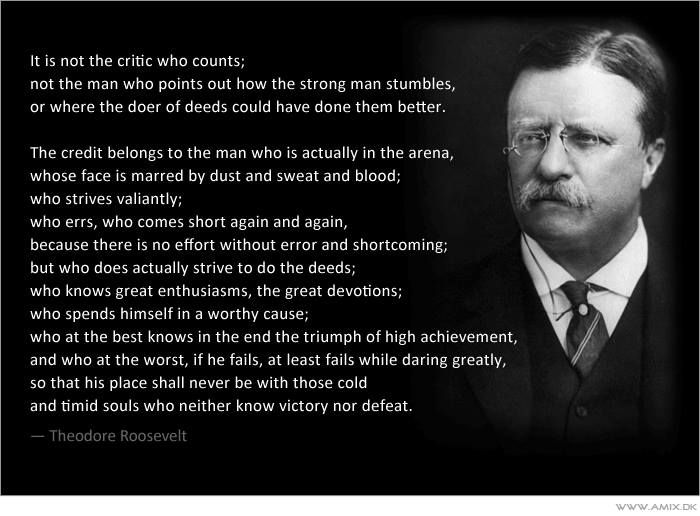
It’s hard to believe it is already time for Lesson #2 in our learning with John Manning in The Disciplined Leader. Without courage it is impossible to focus on what really matters (Manning, 2015). In my case of having now taken on the exciting and important work of leadership of two failing schools, I can tell you courage (or just sheer guts) is a necessary prerequisite skill. Courage is necessary just to get me through those days when I say, “What the heck am I doing here!” You ever had one of those days? If you haven’t I honesty feel sorry for you because you truly have not been in what Theodore Roosevelt called the “arena.” His entire thought is in the picture above. Doing significant work that matters puts us in that “arena” and makes us vulnerable and the focus of our critics. I love how Manning (2015) puts it: “…great leadership isn’t about facing fears but taking positive action in spite of your fears” (p. 17).
 Manning (2015) gives us three great ways to find our “sheer guts:”
- Look the Fear in It’s Face. In other words, recognizing your fear and then determining what you need to discipline in order to act against the fear. In my case I know I need to study to obtain current information, pertinent data, facts, figures prior to a media interview, panel discussion, presentation, or speech to overcome any fear of not knowing an answer to a question.
- Create a Plan of Attack. In my case I have trusted professionals I can go to, as advisers, to help me analyze what information I might need and help me to obtain the information I need for the example I used above. Then I study! But, as Manning (2015) points out: “to admit you do not always have the answer is more a show of strength than weakness” (p. 19).
- Acknowledge When You Succeed. I learned a long time ago that we need to learn to be nice to ourselves. In other words we need to show compassion for ourselves when we are not perfect, make mistakes, or when things go well, too. Scrutinize and self-reflect on what went well and how we made that happen and how to repeat the process.
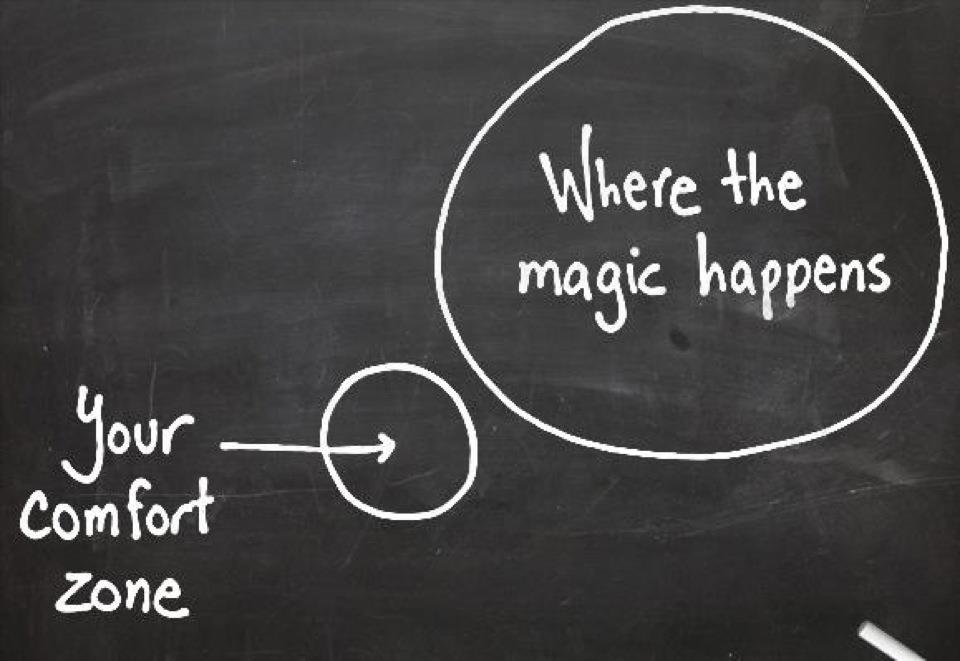 In the “Take Action” part of this week’s entry, Manning (2015) advises us to look to a role model for courage. That leader for me is Indiana Speaker of the House, Brian Bosma. He has taken many courageous stances during his career, but when it comes to education, he has an unwavering belief in School Choice and doing what’s right for Indiana’s children. These are things that I also believe very strongly in. When the Speaker appointed me to the Indiana State Board of Education I asked him what success in that role would look like to him. He had a simple, three word, but very powerful answer: “Consensus to Implementation.” Think about this answer. Really, doesn’t it take a great deal of courage to go through the process of reaching consensus and doing the hard work of implementation. This was a tremendous leadership lesson for me and I use it daily in evaluating myself and other leaders I come in contact with. The Speaker modeled this when he formed his Education Kitchen Cabinet this past year to act as a sounding board on education issues. It was exciting to experience him actively listening and processing all of the different views and opinions. Whether you agree with Speaker Bosma’s or my core beliefs or politics is really irrelevant here. The most important lesson here is that he models the three ways Manning (2015) has described having what I am calling, “The Sheer Guts of Leadership.”
Reference
Manning, J. (2015). The disciplined leader: 52 concise, powerful lessons. Oakland, CA: Barrett – Koehler Publishers, Inc.
Creating a Vision of Success
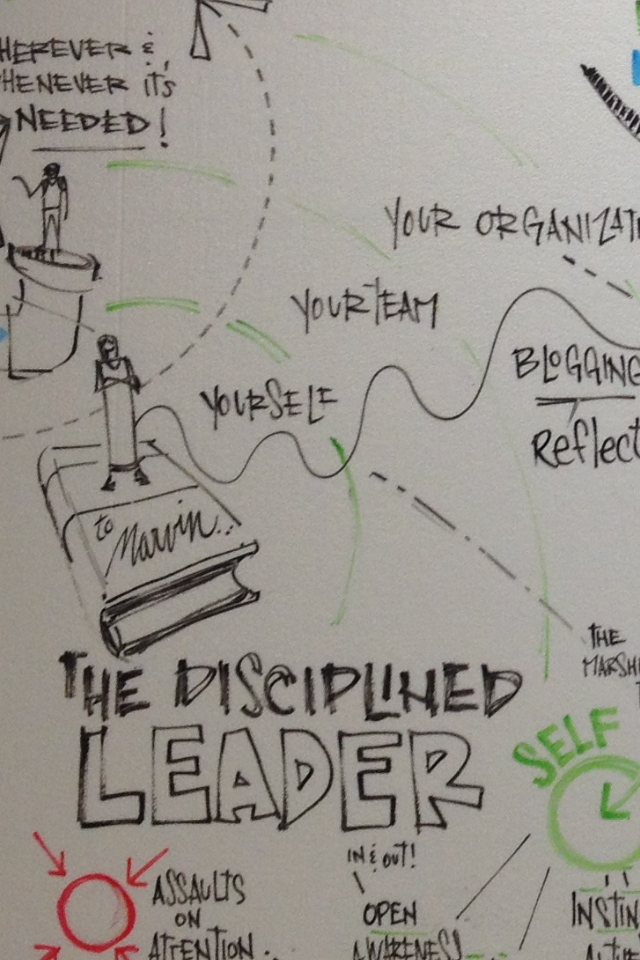
Graphic Facilitation by Mike Fleisch at our first Focused Leader Academy session
First of all, I am excited to report that I am embarking on another weekly book read and blogging journey. The book is The Disciplined Leader: 52 Concise, Powerful Lessons (2015) by John Manning. I had the opportunity to preview a copy of his book and participate in the book’s launch through Becky Robinson and Weaving Influence. I was fascinated by the book and have actually developed a friendship and professional camaraderie with John Manning. I am continued to be amazed by the power of Twitter for making professional connections. The start of our relationship is based solely on Twitter (@JohnMManning). I am sure I am right when I say it is the greatest professional tool available today. You can check out my Tweets at @ByronErnest.
I also decided the book would make the perfect reference material for our Focused Leader Academy that we have started at Hoosier Academies. All the participants will be blogging about a lesson in the book each week till we complete the 52 lessons. I am hoping for them to experience the joy and professional growth that can be experienced while “blogging the journey.” John was great enough to inscribe and autograph a copy of the book for each of our participants. How cool is that?
There are three core principles that the book is based on:
- Leading yourself
- Leading your team
- Leading your organization
Through John Manning’s research with Management Action Programs, Inc. (MAP), he has discovered that a disciplined leader focuses on these three core areas of leadership. But the point that John really drives home in the introduction of the book is what all great leaders do well: “they consistently disciplined themselves to focus on what really matters – people.” (Manning, 2015, p. 4) He also asks the question: “What percent of your budget do you allocate to develop your people?” This is why I believe our Focused Leader Academy is so important to Hoosier Academies. I am very proud we have started this program for the development of our teacher leaders. Not only is it the right thing to do for them, but it will also develop our future leadership bench. 
The first lesson in the book is “Make the Commitment.” The idea is that we must be fully engaged and emotionally, mentally, and physically into our learning. The changes that will result form this commitment to professional growth be amazing and lead to great things, but it will not be easy. The first step to this is becoming a focused leader and creating a vision for success. Manning (2015) suggests we must create an “it’s time to change” mindset. In other words, we must start with an inward focus.
Directing others’ attention is a primary task of leadership. But to do it well, leaders must be able to focus their own attention. And these days, that’s difficult. A constant onslaught of information leads to sloppy shortcuts – triaging e-mail by reading only the subject lines, skipping voice mails, skimming memos and reports. We think we’re reducing distractions, but these habits actually make us less focused. People commonly think of focus as directing your attention to one thing while filtering out other things. But research shows that we focus in many different ways for different purposes. The various types fall into three broad categories. The first two—focusing on self and focusing on others—help you develop emotional intelligence. The third, focusing on the wider world, can improve your ability to devise strategy, innovate, and manage organizations. Fortunately, you can become a more focused leader with the right kinds of exercise.
Focusing your attention on yourself involves self-awareness, or getting in touch with your inner voice. This is where emotional intelligence begins. It also involves self-control, or willpower—which allows you to put your attention where you want it and keep it there despite the temptation to wander. Manning (2015) also points out that we must learn to control our emotional reactions. Really, I call this learning to respond instead of reacting. We must also, according to Manning (2015), learn to take care of our health and well being to maintain the balance in our life that will allow us to become focused and disciplined.
Finally, Manning (2015) suggests that we journal about our progress. I am excited that we are doing just that as the Focused Leader Academy participants blog their journey in The Disciplined Leader. I can guarantee you they will be blogging about more than just the book portion of this journey learning to be focused leaders.
Reference
Manning, J. (2015). The disciplined leader: 52 concise, powerful lessons. Oakland, CA: Barrett – Koehler Publishers, Inc.


leave a comment