School Is For The Student
 I am reading an incredible book right now by Roger Daltrey, the frontman of The Who. As you know, I love rock music and am so intrigued by those who have artistic talent and took the risk to make it big. And, make it big The Who did…The Who is arguably one of the most influential formative influences during the development of rock and roll 🎸. I’m only half way through the book and now I want to meet Roger Daltrey. Oh…the places he has been and the things he has done!
“If anyone had ever once sat me down and explained that school was for me, not the teachers or the system, and there were reasons why I should stick at it, it would have been totally different. But no one ever did.” ~ Roger Daltrey, frontman for The Who in his book Thanks A Lot Mr. Kibblewhite: My Story/Roger Daltrey.
This post is about a statement in the book and the reason for the title. Mr. Kibblewhite was Roger Daltrey’s Principal who kicked him out of school. So…he’s thanking him? That really made me think. But then Daltrey wrote this statement: “If anyone had ever once sat me down and explained that school was for me, not the teachers or the system, and there were reasons why I should stick at it, it would have been totally different. But no one ever did” (Daltrey, 2018, p. 21). I haven’t been able to get this statement out of my mind ever sense.
 Did you catch what he said? That someone should have explained that school was for HIM, not the teachers or the system. Part of the reason no one ever sat him down and told him this, is because we forget it, or never believed it to start with. School exists for the students. Period. Not for the teachers or the system.
Schools are such complex and contested institutions in my country 🇺🇸 and globally. While every member of our society is promised a good education, there are ongoing inequalities that are fueled by race, class, and gender. Somehow, I believe education failed Roger Daltrey. Now I get that he did things that caused the expulsion – he divulged those in the book. But, again, I go back to the statement I can’t get out of my mind, “If anyone had ever once sat me down and explained that school was for me, not the teachers or the system, and there were reasons why I should stick at it, it would have been totally different. But no one ever did.” Daltrey needed to know the “why” and no one ever took the time to tell him.
Now you can argue that had he not been kicked out of school that any number of the 100 different paths that Daltrey would have taken wouldn’t have led to The Who. You are probably right, but how many other students are lost that don’t have the grit of a Roger Daltrey? For some, then, schools are seen as a means for learning and mobility; for others they are “sorting machines” that maintain social inequality. I believe we need to make sure that schools are student centered and not school system centered.
I have said it many times that many of the things we have done around holding schools accountable have forced us [schools] to make decisions in order to make the school look good without any regard to what the students need. We have it backward. If our students are successful and achieving the outcomes necessary for postsecondary success, then certainly, the school has done its job. It’s really about considering questions of relevant academic content, methods of teaching, ways of learning, and overall educational aims.
Another statement Daltrey made in the book was, “There was the maths teacher who hated me because I hated maths. I just couldn’t get it to go into my brain. I don’t know why they don’t work out which kids are good at maths and let them get on with it and which ones aren’t and give them a break. We still haven’t worked that one out today. It’s mad.” (Daltrey, 2018, p. 15). What he is really saying is why didn’t anyone ever make math real for him? Why was school work not made to be like real work. Daltrey went on to say, “Obviously it helps in life if you can add up a few numbers but I could do that. How else do you think I managed to work out how much we were being ripped off when The Who started making proper money in the 1970s?” (p. 15). Think about if math would have been taught in the context of managing a band. We must make education relevant for our students. Otherwise, we will lose them.
Our schools are effective only when we refocus on meeting the individual needs of students rather than the needs of the education system or the broader society. We must have our students ready to be a part of and function in a global economy and society. Remember, school is for the student.
Reference
Daltrey, R., 2018. Thanks a lot Mr. Kibblewhite: my story / Roger Daltrey. New York, NY. Henry Holt and Company.
Puzzling Leadership
 As you know, the first step in putting a puzzle together is to look at the picture on the box to see what the completed puzzle will look like. As a leader, we need to have a vision (picture) of the final product, and what it is you are trying to accomplish. But, what happens when the puzzle pieces are blank and there is no picture on a box?
It is extremely difficult, if not impossible, to put a puzzle together if you do not know what the picture looks like. It is also difficult to be a good leader if you do not know what you are trying to accomplish. But, if there is a vision and plan the leaders can create the picture and paint the picture one puzzle piece at a time.
 I witnessed this yesterday at our Carolinas gathering of our Noble Education Initiative 3D Leadership Program. Our theme for the day was “Setting The Leadership Table.” The main activity of the day involved telling the story. The only catch was that participants had to tell the story by planning and doing a luncheon telling the story of the North and South Carolina schools with the decorum, appetizers, salad, main course, and dessert. There was a budget provided and the participants had two hours to plan, go get supplies, prepare the food, decorate the room, and have their story ready for stakeholder guests to arrive for the luncheon. Here was the agenda for the day:
 I loved the planning discussion that ensued. Here are phrases and things that were said that jumped out at me during the discussion:


 Now, back to the puzzle metaphor. The participants decided to use a puzzle through line for the luncheon. Genius! Here’s the cool part; the same rules of making a puzzle applied to leadership and successful completion of the project. Here are the steps:
Step #1-Have a vision, know what you want to accomplish
Step #2-Get to know your group members. Interestingly, we talked about this in our “what did you learn” time afterward. It was discussed that the event would not have been near as successful back in January when the group came together for the first time.
Step #3-Identify leadership qualities you will need to be an effective leader
Step #4-Follow the guidelines
Step #5-Understand your importance, where you fit, and what you have to offer. This was a topic many reflected on following the luncheon.
 So, here’s the deal: everyone had responsibilities and had to complete a puzzle piece and write the story for their school’s part of “Team Carolina.” I also was asked to complete a piece of the puzzle representing Noble Education Initiative’s (NEI) role in the puzzle of support for the Carolinas.
 What we found was that creating the puzzle pieces for our puzzle used the same leadership principles needed for forming an effective team. When forming a group of individuals into a team, you must first figure out the following:
- Strengths, What are the individual strengths of each one? How can the strength of one, build up the weakness of another?
- Shape, What does each individual bring to the table as far as expertise and knowledge? Just like a puzzle piece each one will have something to share to the greater picture or vision your trying to create.
- Edges, Which individuals define the shape and scope of your vision? There will be some that will have definitive edges that will build the foundation of your team, therefore making the picture clearer to all who view it.
- Odd shapes, Which individuals appear, at first , not to fit into the picture? There will be those that don’t look like they are going to fit or add value to our vision or picture. Sometimes, these are the very pieces that end up truly fitting in and adding a lot of value to the team, making the overall picture clearer.
As I watched the participants put their pieces together and tell their school’s story, they did a great job of keeping the overall picture in view. So many times we lose focus on the overall picture and what do we do? We start to panic and cram pieces together. This is when we are no longer leading but are dictating and mission creep begins to take over. Or even worse, we begin to lose puzzle pieces, and we all know what’s it’s like to put a puzzle together with missing pieces.
The beautiful thing is, that when we do get all the pieces together we have created a beautiful picture, a real team (not just a bunch of individuals), and a true network of schools. How is your organization’s puzzle coming together?

“Big Boy” Leadership
 This week I went to Nashville, Tennessee with a group of great colleagues from Noble Education Initiative to put on a day of professional development for Trevecca Nazarene University. The day was amazing, and there was some great learning that went on. Really it comes down to being student centric – whether that student is a college pre-service teacher or a pk-k-12 student in our schools. We must deliver our best each and every day.
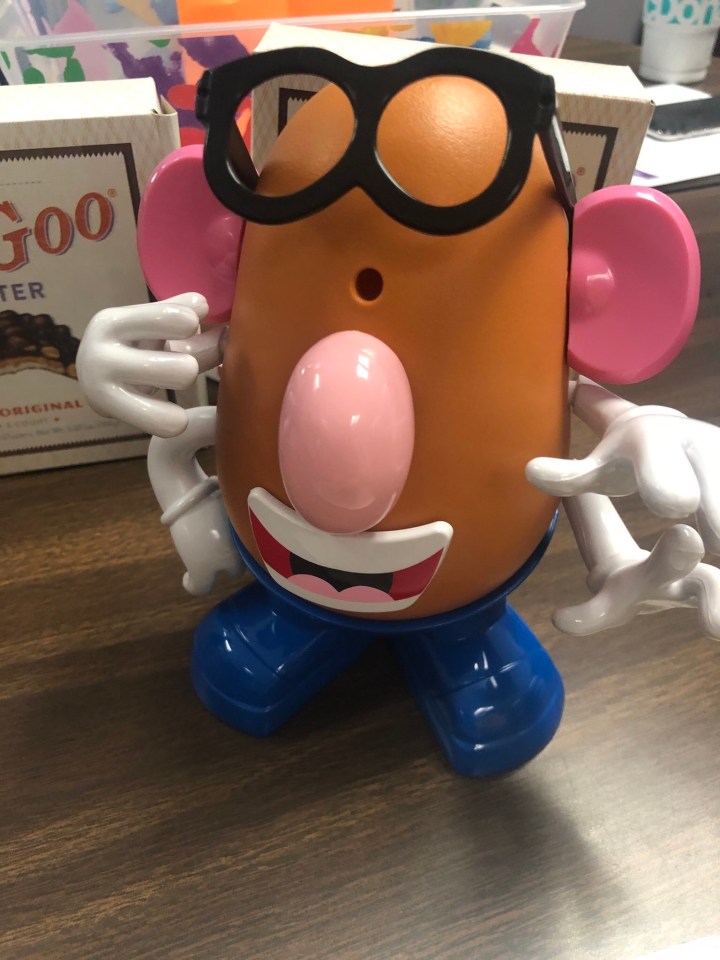
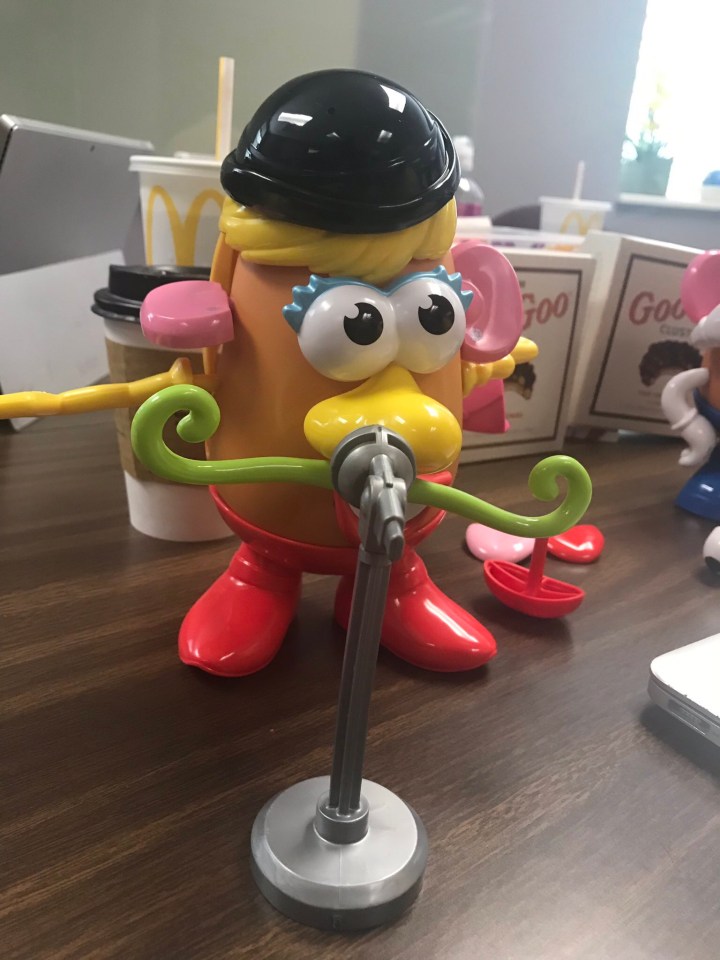 Our professional development covered the topics of “A Day In The Life Of Our Indy Schools,” Social Emotional Learning, Restorative Justice, and our Eight Step Process for Continuous Academic Improvement. Plus, we started the day with Mr.& Mrs. Potato Heads and participants making their Potato Heads answering the question: what does education look like on you? At the end of the day, participants had the opportunity to reflect and change their potato head answering the statement: now I look like this. Here is the agenda we used for the day:
 On the way down to Nashville we saw signs for Frisch’s Big Boy. Since all six of us seemed to have some affinity or fond memories of going to Frisch’s Big Boy, it was decided that is where we would eat on the way home. Needless to say, I was excited because there is just no better hamburger than the Super Big Boy.
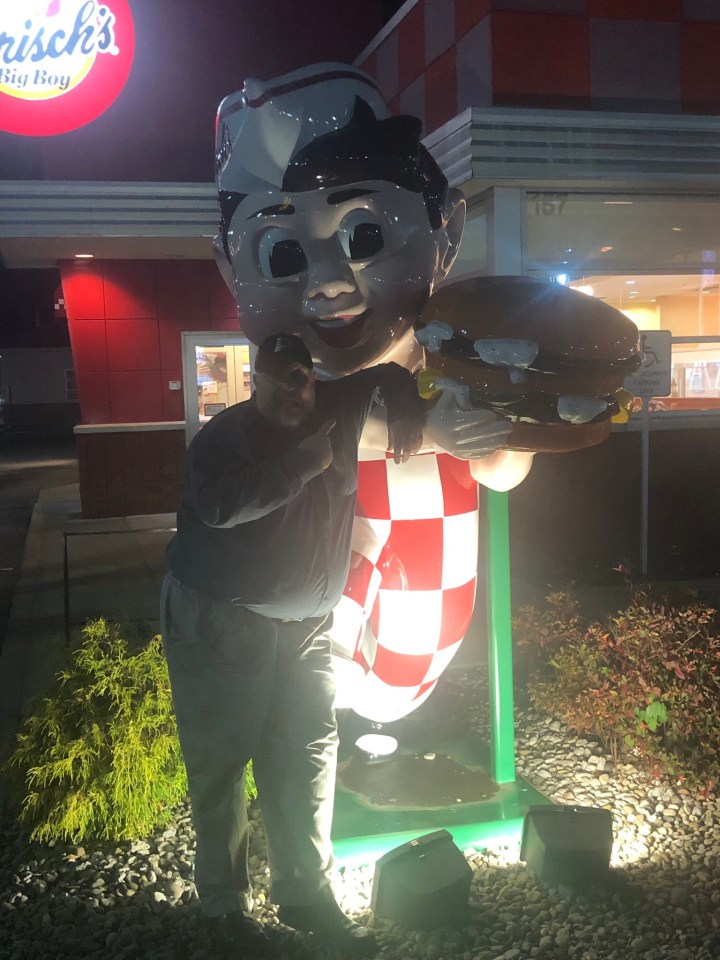
On the way home it became quite fun searching for our Big Boy location. Of course, I became “Big Boy” because I am a “Big Boy.” And…I couldn’t wait to get my picture taken with the iconic Frisch’s Big Boy. In fact, the group was so kind to buy me one of the “Big Boy” banks. It is now a treasured item on my desk.
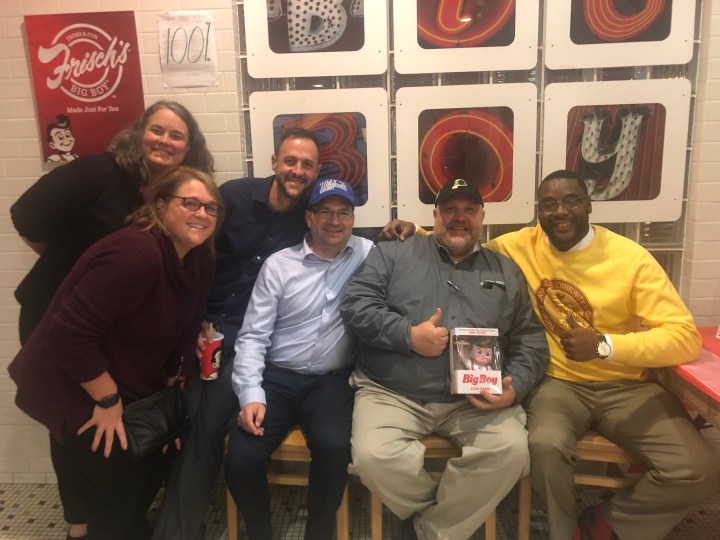 Then I got to thinking about the principles and core values that guided Dave Frisch, the founder of Frisch’s Big Boy restaurants. He founded on the idea of great food, a great work environment that was fun for employees, and a place of integrity. Who could argue with this?
As I did a little Big Boy studying. I found that Frisch’s Restaurants, Inc. use the value of being “Guest Centric.” Being in the field of education this was interesting to me because we use the term “Student Centered” a lot. I like the “guest centric” terminology better, however, because it refers to internal and external guests. The internal guests are employees. Frisch’s wants to provide its best service and support to its employees. I’ve always said in education we need put teachers first so we can put students first. I love that Frisch’s says, “We will be our best every time by delivering our best and being guest centric to our internal and external customers.” I believe this speaks to empowerment, engagement, and professional growth and development of staff, regardless of the industry we are in.
Frisch’s also has a core value of treating everyone as family (employees and customers), too. Their restaurants have a very diverse workforce and customer base. Frisch’s supports each team member through teamwork, coaching and development, fair treatment, and mutual respect.
Do you practice “Big Boy” leadership?
Teacher Leadership
 This week I had the chance to do a couple of sessions on Teacher Leadership at the Impact CSUSA 2020 Conference that Noble Education Initiative put on. In the session we discussed creating a shared leadership model and engagement pipeline. I even did a plate spinning show to represent how hard it is to spin all the plates we need to as leaders. If we empower teacher leaders, we can spread out the load and keep all the plates spinning. We must create a supportive community where everyone helps to spin the plates. By the way, I can only keep three going at once, but brought others up and we were able to have all six plates that I have going at once. Another one of my metaphors!
 First, let’s start by answering the question, “What is teacher leadership?”Here’s the definition I have always liked: “Teacher leadership is the process by which teachers, individually or collectively; influence their colleagues, principals, and other members of the school community to improve teaching and learning practices with the aim of increased student learning and achievement.” (York-Barr & Duke, 2004, p. 287) During the workshop, participants came up with a list of teacher leadership roles. Here is there list:
 I also laid out a seven step process for growing teacher leaders:
- Realize teacher leadership is essential
- Recognize teacher leadership as a teachable skill
- Recruit teachers to become teacher leaders
- Build leadership capabilities among teachers
- Nurture leadership qualities in teachers
- Empower teacher leaders
- Provide ongoing professional growth opportunities for teacher leaders
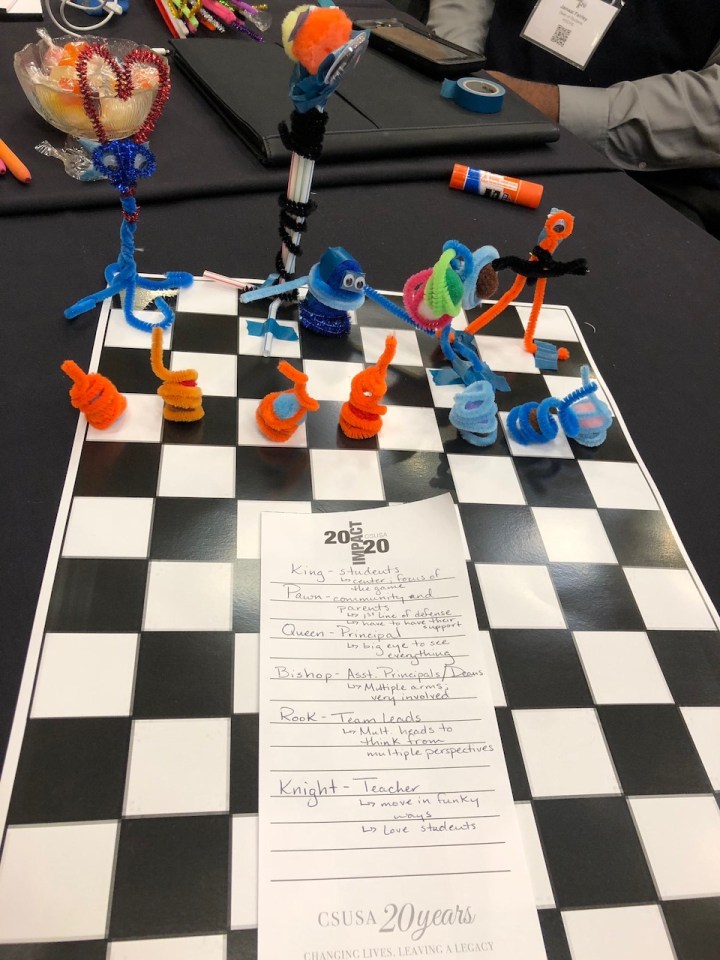
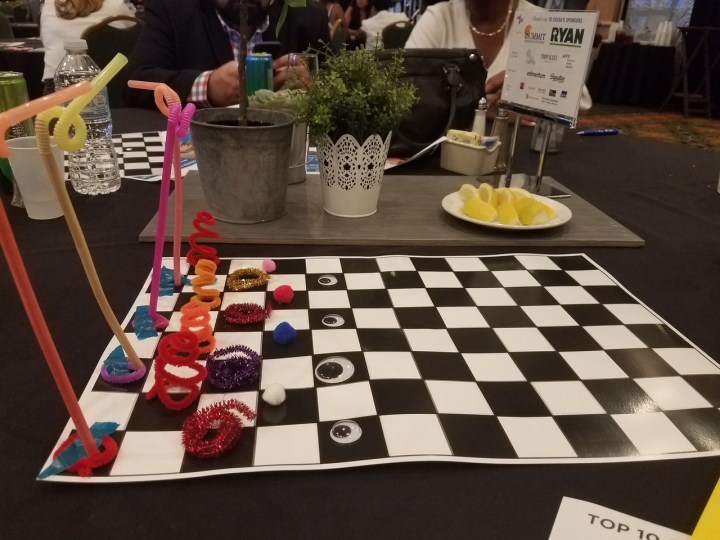
Of course it wouldn’t be a session by me without there being model making, innovation, creativity, and creations. First, I asked the question, “Why is building a great teacher leadership pipeline more like chess than checkers?” We had a great discussion in both sessions about this. We discussed how in checkers there are very limited moves and you can’t the checkers cannot be promoted until they reach the other side of the board – we believe everyone should lead from where they are. We discussed how chess is about strategy and a longer term overall play. I’m sure you get the idea.
I broke the participants into groups of four or five, gave them a chess board, pipe cleaners of all sizes, colors, and even with glitter, glue sticks, masking tape, little eyes, fuzzy balls of all sizes, and straws. I then told them that there objective was to replace the traditional chess pieces with ones that represented the ideal chess game for building an amazing pipeline of teacher leaders. I’ve got to tell you, it was amazing to watch them. Even more amazing were the descriptions of the chess pieces and and the discussion. Following are pictures of some of the games created:
Finally, we created a list of attributes for effectively developing teacher leaders. Here’s our list:
- Results-driven
- Standards-based
- Job-embedded
- Differentiated
- Linked to learning needs (student and teacher)
- Collaborative in nature
- Sustained over time
- Discipline-focused/Content rich
- Reflective
- Evaluated
How are you doing at developing your teacher leaders?
Using A Different Runway To Help Students Take Off To New Heights
 This morning as I was trying to fly home from Charlotte, North Carolina, the pilot came on and said there would be a slight delay. Because of the storm that was Hurricane Michael, we were going to have to use a runway that they usually do not use. He told us we would be using the runway going to the northeast, whereas typically the north/south runways are used. They would need 15 minutes to recalculate takeoff speeds, routes when in the air, et cetera. I was cool with it as long as we got in the air, headed north, and away from the storm.
As you know, I love metaphors, analogies, and similes; so here we go: I compared this to how, as teachers, we must constantly be making adjustments. We are constantly having to recalculate for our students and use new runways. We regroup students based on data, we spiral in new material based on mastery, we develop ways to maintain the proficiencies already mastered. Adjusting and recalculating instruction also means providing more opportunities for students to learn successfully based on information you gather such as their interests, work habits, motivation and learning styles and academic performance. Doing this on a consistent basis helps refine instruction so they can succeed.
Great teachers are those who know their students abilities, know the students proficiency of standards, and then use that information to determine how and what they will teach. They use educational standards and differentiation to guide instruction, while constantly focusing on 1) what the students know, and 2) what objectives (or steps) they need to take) to fulfill their goals. They focus on what the students can do today. How about you; Are you recalculating for a different runway for the success of your students?
Cultivating Your Team For Maximum Growth & Blooms
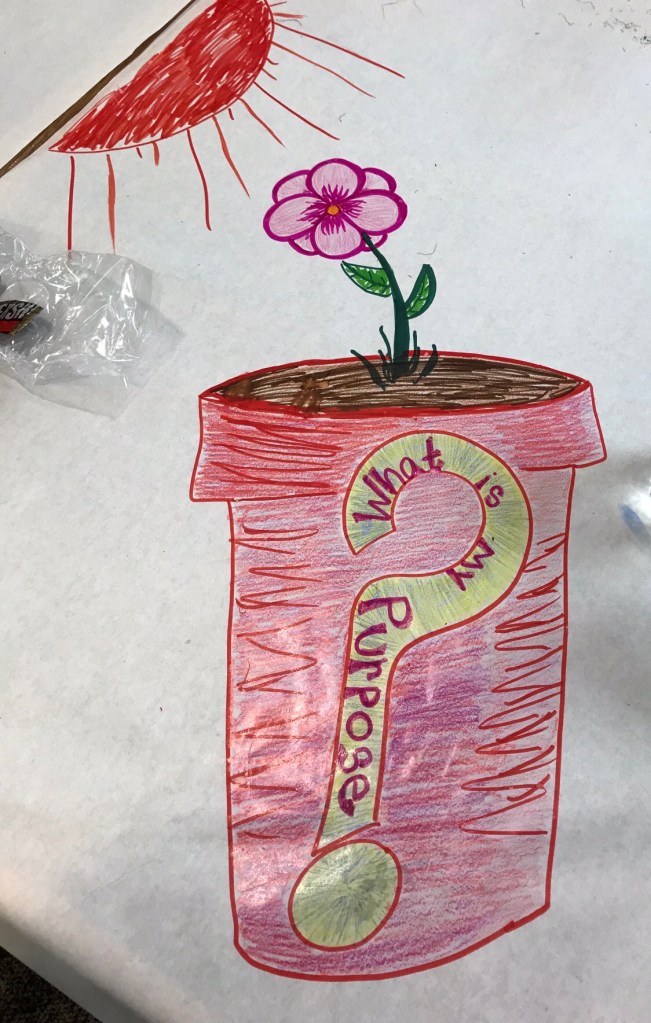 Consideration of the flower bed and the flower farmer is fertile ground that allows a leader to reflect upon her or his own performance. It gives insight into the needs of the flower bed (the people) and the outlook and perspectives needed by the person involved in floriculture (the leader). As leaders we need to develop ourselves as a leader and as a servant so that, together with our people, we can flourish and achieve our full potential in the purpose of our organization.
 I was reminded of this flower bed analogy this week when working with our South Carolina 3D Leadership cohort. I already blogged about our project of carving pumpkins to tell the story of “Truths We Are Frustrated With.” Click here to read my original post about this project from our Indiana cohort entitled, “The Messiness Of The Truths We Are Frustrated With.”
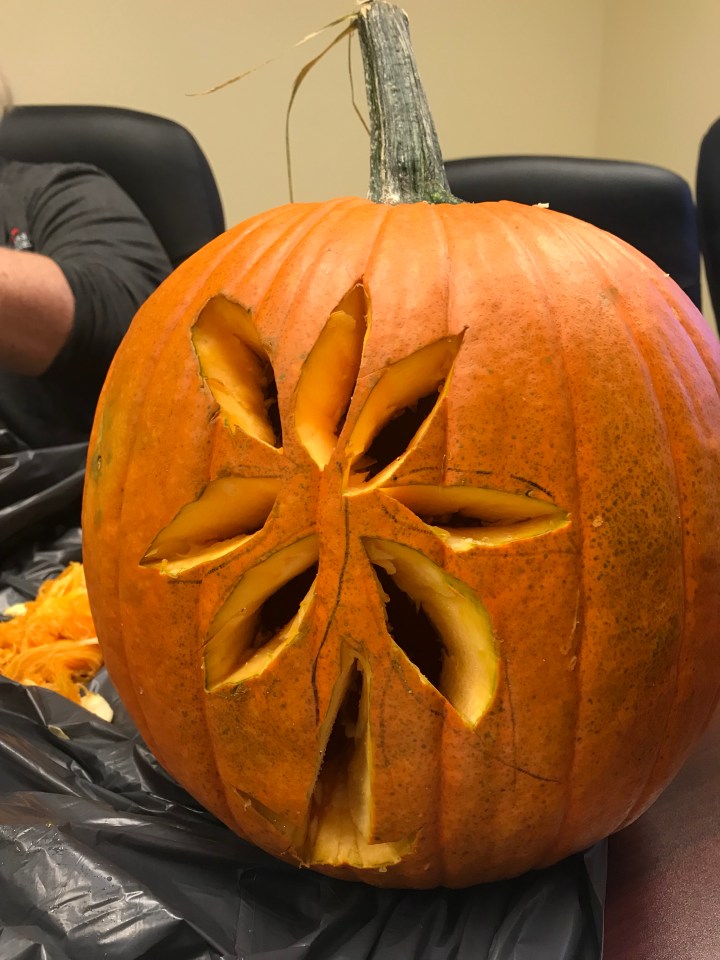
Ms. Russell’s Pumpkin 🎃 Carving
Ms. Linda Russell, Kindergarten teacher at Mevers School Of Excellence in Goose Creek, South Carolina, carved her pumpkin in the shape of an irregular flower with her as the stem. Her point was that everyone, just like the petals of a flower, develop at different rates, different sizes, in different ways, and has different needs. As Ms. Russell works as Kindergarten lead, this is a truth she has to remember. She has to work hard to not be frustrated by this, but embrace it. As I always say, we work really hard at differentiating for our students, but then don’t do a good job of differentiating for the different professional growth needs of our team members.We need to design professional growth opportunities that embrace the fact that we all develop like flowers. Too often, we fail to be good gardeners (leaders) in providing the choice, agency, and nurturing our team members deserve. How about about you? Are you doing everything you can to enhance the growth of your blooming team members?
I’ve Been BitMoji’d, Literally!
 So, I was asked to provide a BitMoji for my work to use on a key card. Sounded fun, but honestly, I had no idea what a BitMoji was. I knew what an emoji was, and have even blogged about them. In fact I just checked and I have blogged about emojis seven times. Click here to find my blogs on emojis. You are probably asking yourself, how did he figure out what a BitMoji was? Well, I did what any baby boomer would do, asked a much younger and tech savvy person. I happened to be working in a school at the time asked, so I asked a teacher. She was kind enough to help me find the app, download it, and show we how it worked. I love this reverse-mentoring stuff. What fun!
Well, do you BitMoji? If not, then you are missing out! I found it to be quite fun and even an exercise in reflection. I like the fact that you take a selfie and then your selfie is right there as you are creating the avatar. I found this to be a metaphor for how we reflect on how we are doing as leaders and in our jobs. Sometimes we need that selfie to help us reflect. Here’s my selfie and BitMoji (how did I do?):


What is funny is that at our 3D Leadership gathering this past weekend, the group was kidding me about using the word “literally” a lot. They created a “literally” hashtag: #literally. How cool was it that there literally is a “lit·er·al·ly” BitMoji. This caused me to reflect about the words and language I use, because we all know language matters.
Building a positive culture in our organizations takes commitment, consistency, and teamwork…and adding a little Bitmoji may just add that extra fun you are looking for. Don’t forget, it can also bring some reflection time into your own personal development and growth. Next time you are looking to represent your organization or school’s culture, just remember, there’s a Bitmoji for that! How will you use Bitmojis to add to your organization’s positive culture?
Relevant & Engaging Learning
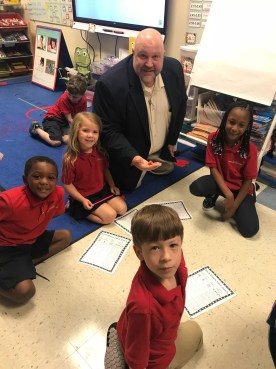
Doing An Engaging Lesson With Ms. Russell’s Kindergarten Class
This past week I had the opportunity to work closely with Mevers School of Excellence by focusing on student engagement and teaching using a relevant context. Most of you know this is a real purpose and passion area for me. I believe these are the two most critical components to student learning. It is just common sense that the more students are engaged, the more they will see the relevance of their experiences, feel connected to their school experiences and develop more positive attitudes and attributes, both inside and outside of the school walls. Student engagement must be part of a comprehensive strategy to have students fully develop their academic, social-emotional, civic and career knowledge and skills.
Learning in a relevant context is also a critical part to student engagement. True engagement happens when students discover that learning is a personal endeavor. Learning can only become personal when it is in a context that connects the learning to the students real life. In other words, as I always say, school work must be like real work. Mevers School of Excellence is a K-7 school and we discussed that school work can even be made relevant for kindergartners. I had the opportunity to work with Ms. Russell’s kindergarten class. Using pumpkins right now, at this time of year, for learning numbers, number sense, and counting is a real thing to these students. It doesn’t have to be elaborate; it just needs to be personal and real to the student.
When students make the connection from true engagement, they begin to understand that lessons and tasks are worthwhile because they help them meet personal goals they have begun to set for themselves, not just the teacher’s goals for them. Engagement and relevancy enable students to own their own learning. One of the activities that I had the Mevers School of Excellence teachers do during a professional development I conducted was to develop their own definition for student engagement and relevancy. To culminate their work, they developed a graphic recording of their definitions. Here’s the deal: If we want students engaged we must have students working in teams to experience and explore relevant, real-world problems, questions issues, and challenges; then have them create presentations and products to share what they have learned. Student motivation comes from lessons facilitated utilizing and encouraging student creativity, innovation, and problem solving. I have attached pictures here of their awesome work:


Schools need to have a systemic focus for all teachers to be facilitating learning in an engaging and relevant way. Student engagement needs to be intricately tied to how the school functions, supported in the context of a positive, safe, caring and equitable school climate.
Why Everyone Should Read Dopesick
 Dopesick: Dealers, Doctors, and the Drug Company that Addicted America by Beth Macy
My rating: 5 of 5 stars
As soon as I finished this book I tweeted, “Anyone who is a public policy maker, educator, or citizen (in other words everyone) needs to read Dopesick: Dealers, Doctors… by Beth Macy. This book tells the history of the #opioidcrisis back to the Civil War until today like none other!” I learned so much history that I did not know. By the time the Civil War ended, addiction had already touched middle-class housewives, immigrants, veterans and even physicians hoping to soothe their own aches and pains. This is when the opioid epidemic began. Between the 1870s and 1880s, America’s per capita consumption of opiates had tripled. On March 1, 1915 a law passed by Congress and signed by one of my favorite Presidents, Woodrow Wilson, would become the first law to criminalize drug use, the Harrison Narcotics Tax Act. I also learned that opioids such as morphine and codeine are naturally derived from opium poppy plants more commonly grown in Asia, Central America and South America. Heroin is an illegal drug synthesized from morphine.
Hydrocodone and oxycodone are semi-synthetic opioids, manufactured in labs with natural and synthetic ingredients.
I really like fact that Macy also spent a great deal of time discussing and educating her readers on the public policy component of the opioid crisis. Macy argues that a big obstacle to solving the crisis is that many local, state, and federal agencies and governments are more concerned about protecting turf and budgets than solving the problem and helping people. This book pushed and stretched me to understand this very complex issue.
North Carolina Leader Traits
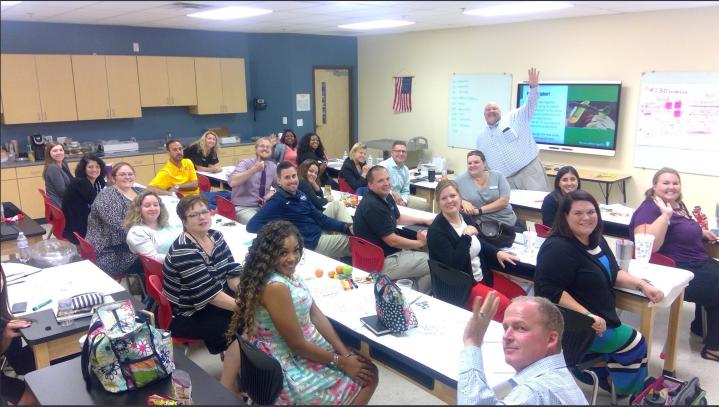
North Carolina 3D Leadership Cohort #1
Last night at our North Carolina cohort of 3D Leadership developed their top five list of good leadership traits and bad leadership traits. To do this we used one of my go to facilitation props (no pun intended), the toy prop gliders. Here is what participants did:


The groups then got back together and listed their top five list. Then the whole cohort voted on the top five good leadership traits and top five bad leadership traits. Here are the results:
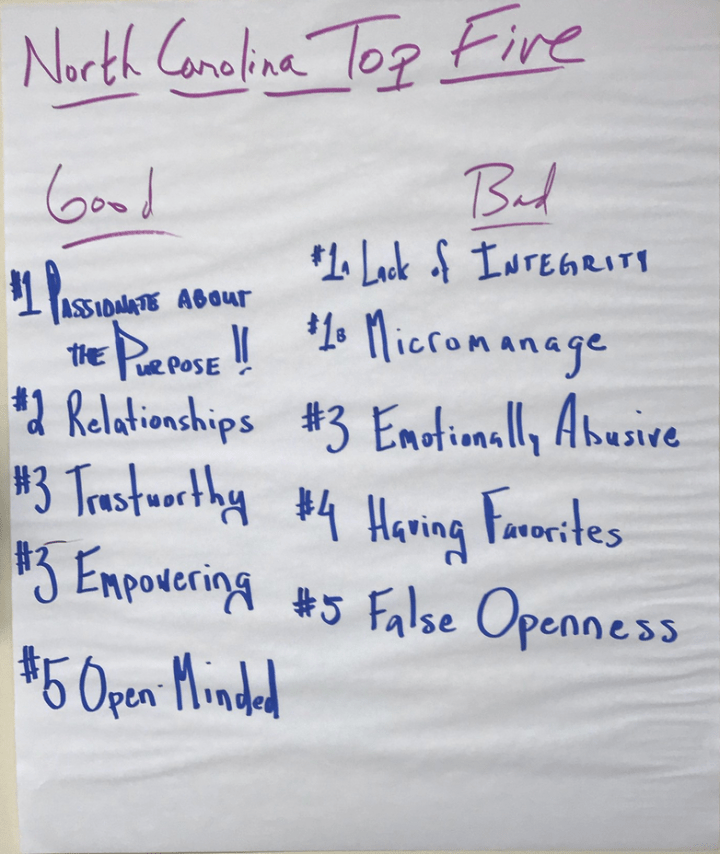
It is always interesting to me that as I do this in many different states and with individuals of different experiences, how different the lists can be. Successful organizations need leaders, someone (or as I believe everyone) who can inspire employees and lead them and the organization toward success. Leaders encourage others to work to their full potential, inspire creativity and aid motivation. During turbulent times, the need for good leaders intensifies. As I always say, “Leading is easy when things are going great, but really hard when it is chaos and earthquakes.” Someone who presents a clear vision for recovery, leads by example and instills confidence in those around them. A good leader has many traits, if you can recognize these within yourself and capitalize on them, then you can become a successful leader in your work environment and on your team.
By consciously making an effort to exhibit the traits highlighted by my North Carolina friends, people will be more likely to follow us. If we exhibit these traits on a regular basis, we will be able to grow our influence to its full potential as a leader. What’s on your top five list of good and bad leadership traits?


1 comment