Iron Triangle of Higher Education
 I had the opportunity to be a part of a group of agriculture industry leaders providing input to Purdue University’s Presidential Search Committee. I took this role very seriously as I saw myself representing both agriculture and education. The Trustee’s and Search Committee’s goal is to match the skill-sets of the top candidates to what Purdue University needs now and ten years in the future.
This is a tall order given the Iron Triangle of Higher Education: Quality, Cost, and Access. Purdue being in a position to appoint a new President is really a great opportunity at a great time. A time when students must thrive in a global market. This will require what Secretary of Education, Arne Duncan, just yesterday said will require “Reimagining how higher education does business.”
“My chief message today is a sobering one,” Secretary Duncan told officials from colleges and universities who were gathered this week at the annual Federal Student Aid conference in Las Vegas. “I want to ask you, and the entire higher education community, to look ahead and start thinking more creatively—and with much greater urgency—about how to contain the spiraling costs of college and reduce the burden of student debt on our nation’s students.” Click here to read his speech. Also, click here to learn more about the administration’s pay-as-you-earn proposal.
Given Secretary Duncan’s call for creative thinking and controlling the cost of higher education and amount of debt students incur I would like to provide a bullet list of the characteristics identified for the new President of Purdue University:
- high energy
- long-term
- familiar with the Land Grant University
- passion for Indiana
- appreciation of agriculture and extension programs
- research and acquisition savvy
- international presence
- able to bridge academia, research and applied science
- global stature – we have to do Indiana and the globe right
- its ok to have have someone with a shorter pedigree to have someone who can be longer term
- Midwestern values
- vision for advancing Purdue University
- balance strategic direction set by the board of trustees, but also foster an entrepreneurial approach
- does not change for the sake of change, but understands why
- able to make smart, quick decisions
- surrounds themselves with smart people
- visionary
- public person
- a person who will know how to staff themselves with the right people
- understands the role of delivery, branding, and recognition
- the person is more important than the resume
- understands public/private partnership
- engagement
- promotes Indiana value-added agriculture
- accessible
- transformational leader
- superb organizational leader
I am sure you can imagine the energy of this almost 3 hour discussion. Purdue Trustee John Hardin said at the end of the discussion, “On a bad day this person needs to be God.” Not an easy task to find a person who can do all of the above. Keep in mind the search committee has had 40+ discussions like the one I was involved in.
Personally, I want a transformational, unconventional leader who will think, as Secretary Arne Duncan has called for, creatively and reimagine higher education. Specifically I want Purdue University to be a leader in bridging the gap between p-12 education and higher education. I continue to stress that with all of the great education reforms in p-12 education in Indiana occurring that higher education, including Purdue University, must also make reforms accordingly.
Think about it, wouldn’t it be great if a students circumstance did not determine what type of education he or she received from pre-k all the way through college? Let’s all be unconventional leaders and solve the Iron Triangle of Higher Education – Quality, Cost, and Access.
Passion is Tough Work!
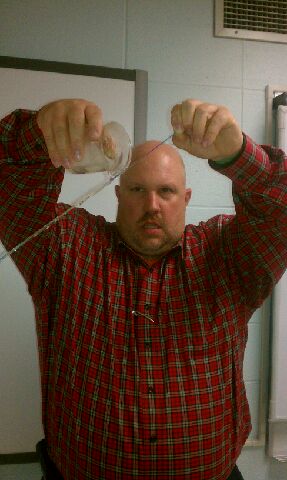
Me passionately teaching Adhesion & Cohesion
The word “Passion” comes from the Latin word “pati,” which means to endure, submit, or suffer. This past week I was really able to make the connection between what we usually think of passion being and the Latin word pati. We did a professional development that involved our entire student body providing a list of reasons why students were unengaged. One of the top reasons was some of our teachers having a lack of passion. Interesting that our students realize it, but some those very same teachers don’t see it in themselves. Gives validity to doing 360 degree evaluations.
It really saddened me to hear that said about teachers in our building because I consider myself very passionate. Then when I started thinking about it in light of how I view passion – powerful or compelling emotion and having a strong desire to accomplish something – I thought, wow, passion is really hard work. If we have passion it is really intense. It drives us and sometimes its painful. Sometimes it even eludes us.
Our professional development exercise reminds me, however, that it is important to our students to come to our learning environment prepared and with passion every day. This past week I finished reading the incredible book, Class Warfare: Inside the Fight to Fix America’s Schools by Steven Brill. In this book, Brill really drove home the fact that, “Truly effective teaching, could overcome student indifference, parental disengagement, and poverty – and, in fact, was the key to enabling children to rise above those circumstances” (2011, p.1). When I see that in print it really drives home the importance of what I do every day.
Brill (2011) went on to say, “successful teaching is grueling work. It required more talent, more preparation, more daily reevaluation and retooling, more hours in the class day, and just plain more perseverance than many teachers, and most teachers’ union contracts, were willing or able to provide” (p. 2). After seeing the thoughts of our students I would say Brill is spot-on right.
All of this reminded me that my continued passion is important, and all teachers need to self-evaluate and see if they have the passion it takes to do the work of educating our students. Guess what? If not, it’s probably time to find something else to do. It’s not an easy profession, but an important profession that deserves to be done by only the best and most passionate professionals.
Brill, S. (2011). Class warfare: Inside the fight to fix America’s schools. New York, NY: Simon & Schuster.
Action: Turning Dreams & Thoughts Into Reality
 I heard the words on a song this morning, “Why do we dream, when our thoughts mean nothing?” I really got to thinking about this and it is so true. Think about it, if there is no action our dreams and thoughts really do mean nothing. This really hit home with the two books I read this week – It’s Your Ship: Management Techniques from the Best Damn Ship in the Navy by Captain D. Michael Abrashoff and What to Ask the Person in the Mirror: Critical Questions for Becoming a More Effective Leader and Reaching Your Potential by Robert Steven Kaplan. I learned so much about what both authors call actionable leadership. Captain Abrashoff’s ship the USS Benfold is pictured above.
When coaching and leading those we serve have dreams and we must give them the actionable feedback necessary to enable them to carry out the actions of making the dreams happen. As Kaplan stated, “Is your feedback specific, timely, and actionable?” This question is very important to me as a teacher and department head. As I coach younger teachers on effectiveness I must always remember that the feedback must be constant, not just when I have time and it must be actionable. If someone I am coaching can’t act on the goals, then my coaching has no value.
Another point Kaplan made that was of particular interest was when he said, “Excellent companies view being a great coach as a criterion for promotion to higher managerial levels, as well as an important determiniant of compensation.” I believe that with the implementation of Senate Bill One in Indiana under the leadership of State Superintendent of Public Instruction, Tony Bennett and Governor Mitch Daniels dealing with teacher effectiveness we have also made this a criterion in education. We cannot look at teacher evaluations as a once a year punitive act, but a yearlong coaching opportunity to move all teachers into the category of highly effective.
When we think of using actions to turn dreams and thoughts into reality we must also do what Captain Abrashoff recommended, “Now more than ever, we must stop preparing for past battles and prepare for new ones.” So my final thought for this post is let’s keep dreaming ourselves and encouraging those we lead and c0ach to dream and let’s provide others and seek for ourselves the actionable feedback to make those dreams a reality.
Change Creation is Proactive

In doing some research this morning I came across the work of Lick and Kaufman (2000) and it was too good not to share. Lick and Kaufman (2000) asserted that,
Change creation is the process whereby an organization and its people:
- Invite, accept and welcome change as a vital component in defining and achieving future success.
- Define the future they want to design and deliver.
- Create the designed future and continuously make improvements while moving ever closer to the desired future. (Chapter 2)
When organizations enact change creation, they intentionally move from being victims of change to becoming masters of change. I don’t know about you, but I want myself and my school to be masters of change.
Reference
Lick, D., & Kaufman, R. (2000). Change creation: The rest of the planning story. In J. Boettcher, M. Doyle, & R. Jensen (Eds.), Technology-driven planning: Principals to practice. Ann Arbor, MI: Society for College and University Planning.
Impact of STEM and Academic Core Standards Integration in Career and Technical Education
 The achievement of U.S. students is becoming increasingly important for our nation’s ability to compete successfully in the world economy (Braun, Coley, Jia, & Trapani, 2009). As the Department Head of an Indiana Agriculture Science program who is successfully achieving academic integration I am continually investigating the problem of low student performance and achievement in Science, Technology, Engineering, and Math (STEM) and English and the impact of real-world and relevant application of Career and Technical Education courses on student achievement and performance in these core subjects.
Education has become competitive and my school is striving to meet this environment head on and with success. Simons (2010) wrote, “Today our economic well-being, not just military defense or advantage, is dependent on math and science. All of the world’s major countries are our competitors. So far we are not exactly winning” (p. G-1). The latest global rankings using high school test scores show China significantly beating us on science and math scores (USA Today, 2010). These rankings show the United States at number 15, and Shanghai at number one (USA Today, 2010). It is important for us to study those areas where the STEMs can be taught in a relevant context.
To that end it is very important that academics be fully integrated both vertically and horizontally into all course work. There is no research or evidence to support that non-core, non-academic elective courses, including Career and Technical Education courses, contribute to improve student achievement or performance. There is evidence (Reeves, 2008), however, that emphasis on the core academic subjects promotes student learning. Therefore integration of the STEMs and English is very important for Indiana students. Reeves (2008) said, “This does not make a brief for a curriculum based only on the ‘three R’s,’ but rather insists that every class, regardless of its label, owe a duty to the student and community to reinforce academic standards in math, language arts, social studies, and science” (p. 10-11). The consistent integration of the academic cores into Indiana’s Career and Technical Education disciplines is paramount to student learning. We cannot afford for these courses to be “soft” (Reeves, 2008, p. 11) in terms of including reinforcement of the academic cores.
References
Braun, H., Coley, R., Jia, Y., Trapani, C. (2009). Exploring what works in science
instruction: A look at the eighth-grade science classroom. Princeton, NJ:
Educational Testing Service.
Reeves, D. (2008). Making standards work: How to implement standards-based
assessments in the classroom, school, and district. Englewood, CO: Lead + Learn
Press.
USA Today (2010). “Our view on education: ‘We’re no. 15!’ doesn’t cut it in today’s
global economy. Retrieved on February, 26, 2011 from: http://usat.me?41746426.
Simons, J. (2010). “Education imbalance: U.S. needs top-notch math, science teachers
to compete in new economy. The Buffalo News (261) 35. Buffalo, NY: OBH, Inc.
 Byron's Babbles
1 comment