Better in 2013
 Those of you who know or follow me know I am a veracious reader. As we came to the end of 2013 I was trying to decide whether to do a top 10 reads in 2013 or what what to do to reflect on my reading. In considering my options I decided to write this final post of 2013 on what was clearly the best book I read this year. In fact it was so great I read it three times! It was not the first book I read from this author, but I was extremely moved and motivated by this book. What was the book? Better: A Surgeon’s Notes on Performance (2007) by Atul Gawande.
I am in education, but as I always say there is about 90% similarity between all industries and only 10% difference. There are amazing connections between the field of medicine and education. I have read all the books of Atul Gawande. He is widely known as an expert on reducing error, improving safety, and increasing efficiency in modern surgery. He wrote the books Complications: A Surgeons Notes on an Imperfect Science, A Checklist Manifesto: How to Get Things Right, and The Best American Science Writing 2006. All of his books are incredible, and I was particularly moved by Better.
There are always takeaways that are personal to the reader in any good insightful book, and this book was no different. One of his themes he discussed was the variation in doctors. Those doctors who are “the best” doctors with the best outcomes. Who are they? Why are they better? He calls these doctors “positive deviants.” The biggest question: How do you become one? As I read the book I also considered the variation in educators and educational leaders. Really, you could do this reflection on any profession, including your own.
A paragraph early in the book really touched me and set the stage for my intense study of the entire book. Gawande said: “Betterment is perpetual labor. The world is chaotic, disorganized, and vexing, and medicine (education) is nowhere spared that reality. To complicate matters, we in medicine (education) are also only humans ourselves. We are distractible, weak, and given to our own concerns. Yet still, to live as a doctor (teacher) is to live so that one’s life is bound up in others’ and in science and in the messy, complicated connection between the two. It is to live a life of responsibility. The question, then, is not whether one accepts the responsibility. Just by doing this work, one has. The question is, having accepted the responsibility, how one does work well.” (p. 9) You will notice I put ‘education’ in parentheses beside ‘medicine’ and ‘doctor.’ Do you see the connection between the two? You could put your profession in this paragraph too!
Now, I want to make sure you caught the responsibility part. People talk about accepting responsibility all the time and the question is asked if we accept responsibility. Think about what Gawande said here. Just by doing the work we have accepted the responsibility. Therefore we have accepted the responsibility to work to be better or best! This thought alone really brings urgency to what I do every day!
At the end of Better Gawande had five suggestions for anyone to get better:
1. Learn something about your patient. He says to ask “the unscripted question,” like where did you grow up? tell me about your family? He talks about making the human connection. Really it comes down to what I consider to be one of the most important components to education – Relationships. Without relationships and knowing your students (patients) there can be no learning.
2. Don’t complain. This is tough! It is easy to complain, but think about it… None of us like to hear others complain. Really, complaining becomes a poison to an organization. Be a solution to problems, not part of the problem!
3. Count something. We should be scientists and do action research. My doctoral degree journey really drove this home for me. By picking a problem to research that I was passionate about, I found a love for digging in and quantitatively and qualitatively analyzing. I have also learned to let the data speak for itself. It is also important to look at the data without judgement. We tend not to look deep enough into successes; it is easier to study failures.
4. Write something. Gawande said, “What you write need not achieve perfection. It need only add some small observation about your world.” I have always said that my posts to this blog serve more for my learning than for others. Even though it is really awesome to have others read what you write, writing is personal and causes us to reflect and learn.
5. Change. Gawande asserted we should, “Make yourself an early adopter. Look for the opportunity to change. I am not saying you should embrace every new trend that comes along. But be willing to recognize the inadequacies in what you do and to seek out solutions.”
Hopefully if you have not read this book yet, I have given you enough of an intellectual appetizer to convince you to read Better. If you have read it, I hope I have caused you to go back and look at your highlights and reflect on your reading. As we close out 2013 and begin 2014 I want to use Gawande’s five suggestions to help me achieve his three core requirements for success: (1) Diligence; (2) Do Right; (3) Ingenuity – Thinking Anew. My wish for everyone in 2014 is to truly be BETTER!
Keep Your Fork: Leadership Anticipation

As we have been taking part in different family and work traditions during this holiday season I am reminded how important the feeling of anticipation is. I tweeted a few moments ago that the greatest words ever said by a mother are, “Keep your forks.” We all know what that means – DESSERT IS ON THE WAY! Then we begin to anticipate what it will be; her famous Mince Meat Pie, Cheese Cake, Carrot Cake, or some other delicacy that only moms know how to make. Think about how important the feeling of anticipation really is.
Today, Christmas Eve, is probably the greatest example of anticipation there is. Children around the world are spending the day anticipating that Santa Claus will arrive during the night and leave toys. The anticipation is even greater for those kids who sat on Santa’s lap and told him what they wanted him to bring. Those kids are now in anticipation those gifts will arrive.
My son and I did our annual Christmas shopping excursion last night. We shop for mom and then go to Buffalo Wild Wings. While we were eating and watching the Indiana Pacers win, my son, Heath, made the comment, “Dad, I look forward to this every year!” I asked why and he said, “it’s fun to do this with you and we do the same thing every year.” In fact, I would add we get the same thing every year – a new Vera Bradley backpack purse! This story even has more to do with anticipation. The sales person at Merle Norman was the same one that has helped us buy mom’s purse for the last three years. In fact we always bring her an Aunt Millie’s pretzel and she wraps all our presents from other stores too. Are we true helpless guys, or what? When we walked in she said, “I knew you would be here!” She anticipated our arrival, and we did not let her down!
So how do we use anticipation in other areas such as education and leadership? When I was teaching I loved to use anticipation guides. I now recommend these to the teachers I serve. With an anticipation guide the students are introduced to the concept of previewing and guided in completing a prepared anticipation guide for a particular topic or reading. Students are then given an opportunity to complete a portion of the anticipation guide independently. In the days that follow, students work in both teacher-guided and student-facilitated groups to extend their use of the previewing strategy with other resources and texts. Finally, students discuss as a class how using anticipation guides helped them better understand the readings, resources, and ultimately the subject at hand.
As a leader, change represents an opportunity and it must be anticipated and prepared for. Foresight and change anticipation is a hallmark of effective leadership. Technology, radical innovations, new business models, globalization, demography, consumer demands, education reform, politics, and choices all contribute to making today’s society one of accelerating change. The drivers of change are numerous and complex, and their impact varies from one sector to another. The way change affects your company depends largely on the capacity of key actors to anticipate and prepare for such an eventuality. There is big difference between anticipating and guessing. Anticipation means expecting, being aware of something in advance, to regard it as possible. The ability to anticipate is one of the key ingredients of efficient speed in leadership.
As we celebrate Christmas today and tomorrow, allow me to bring Christ into my post leave you with a couple of other thoughts on anticipation and anticipating:
Some of you are too busy dreaming about where God is taking you next to appreciate how far He has taken you recently. Stop for a moment and celebrate.
Others of you are so busy celebrating what God has done in your life that you’ve yet to realize it’s just a taste of what He still has to do in you and through you. Stop for a moment and anticipate.
Merry Christmas! May all the great things you are anticipating come to pass!
Top 50 Strategy In Action Indicators

Strategy in Action
As I stated in my earlier post today, Strategy In Action, I spent this week in the classroom at Harvard University learning to be a more effective leader at being strategic in the Harvard Graduate School of Education program Strategy In Action. This was a program made up of an outstanding curriculum with the learning being facilitated by the incredible Harvard faculty, Elizabeth City and Rachel Curtis. Part of my homework this afternoon is to develop commitments that I will follow through on when I get back to my school tomorrow. To enable this process I did what I have done for other programs I have attended and created a Top 50 List. In this blog post I would like to share this list and my leadership commitment. Here are the Top 50 Strategy in Action Indicators:
Top 50 Strategy In Action Indicators
Created By: Byron L. Ernest
December 2-4, 2013
Harvard University
1. Use the data as grist for our mill
2. Beware of “analysis paralysis”
3. Most people think from the outside in [what, how, why]. The highly effective lead from the inside out [why, how, what].
4. People don’t buy what you do…they buy why you do it!
5. Being strategic asks three questions: 1. Why 2. What 3. How
6. Six habits of strategic thinkers:
Anticipate
Challenge
Interpret
Decide
Align
Learn
7. Use the “Week in Review” to strategize your life
8. We need to study all strategies and find out which we are really doing, and which we are just saying we are doing
9. Some things are necessary, but not sufficient
10. The most common place strategy falls down; it’s in the leader’s head, but nowhere else!
11. Much of what we do is in the hard/high impact quadrant
Good news: We’re focused on the stuff that makes an impact
Bad news: We don’t have the capacity to do it all
12. SWOT: Strengths, Weaknesses, Opportunities, and Threats
13. An effective team is the primary mechanism for driving work
14. An effective team results in engagement in and ownership of the teams work
15. An effective team sets the tone for culture
16. Building blocks of an effective team: Shared purpose (why), right people (what), processes, structures, agendas, and accountability (how)
17. People want to do challenging and consequential work
18. The same people in Number 17 do, however, want clarity
19. Lots of little steps take you to great places
20. A meeting’s purpose is not to have people go through all they are doing to make themselves look good. It is about what is being done to add value to the work of highly effective student learning.
21. Having stakeholders pre-load the agenda with important items is a best practice
22. Think about a “value added” approach. We need to think about how we measure “value added” to each position, strategy, and theory of action
23. It’s about the work, not about the people
24. We need to make sure all our team members understand how their daily work contributes to the strategic plan
25. Root Cause Analysis: It complicates our thinking, thus keeping us from chasing shiny objects
26. It’s easier to be unclear to keep from upsetting team members, but in the end the team becomes dysfunctional and everyone is unhappy
27. When doing a Root Cause Analysis don’t forget to include the actors (who)
28. Be specific and descriptive, not judgmental when obtaining and analyzing data
29. Three kinds of data available to us: 1. See 2. Count 3. Hear
30. Must be intentional with data use
31. If you don’t see it…it does not exist
32. Is the only reason we are looking at certain data because someone else is watching it? ie. State, authorizing agents, et cetera
33. The goal of data is to have a robust look at the whole picture
34. Data use ladder: Data, Interpretation, Conclusions, Actions
35. Describe data without judgment
36. Must have specificity of evidence
37. We tend not to look deep enough into successes; it is easier to study failures
38. We must look for patterns in the data
39. There is freedom and excitement thinking expansively; this in turn enables audacious thinking
40. Audacious thinking creates a North Star to move toward
41. A vision is bold, vivid, compelling, audacious and moves beyond incrementalism
42. Book recommendation: ThinkerToys
43. What if… – think about the conversations that can be started with this
44. Use the what if… structure to think outside the normal constraints of your own context
45. When you live in a box it is difficult to open it and think expansively
46. It is also really hard to step outside of the box if someone opens it
47. SWOT – Strengths, weaknesses, opportunities, and threats
48. The value of SWOT is more in the process, shared ownership, and the communication shared in doing the exercise as opposed to the product
49. Brutally Honest Truths: Theories of Use – If…Then…
50. Make sure to mine things for the resource they are!
I will present my commitment here in form of an If…Then… Brutally Honest Truth Theory of Use. If I improve my leadership to tie together the instructional/academic and operational processes of the school then our entire staff will function as one cohesive and high functioning team. But, right now I am bouncing between the two without balance. My commitment is to provide leadership in a way that all our team members understand how their daily work contributes to the strategic plan and the most important part of all our jobs – educating children!

Leading for Success
Strategy In Action

Strategy In Action
I spent this week in the classroom at Harvard University learning to use strategy and be more strategic in supporting powerful learning and teaching in the Harvard Graduate School of Education program, Strategy In Action. This was a program made up of an outstanding curriculum with the learning being facilitated by incredible the incredible Harvard faculty Rachel Curtis and Elizabeth City. Part of my pre-work homework for this course was to read Strategy in Action: How School Systems Can Support Powerful Learning and Teaching (Curtis & City, 2012). Let me just say this is a book that everyone in education should read. A habit that I developed doing literature reviews while completing my doctorate was to take bullet notes of everything I read. This book was so outstanding that I decided to include my summary as a post to this blog. Here it is:
Top 100 Play List From
Strategy in action: How school systems can support powerful learning and teaching
Rachel E. Curtis & Elizabeth City (2012)
Prepared by: Byron L. Ernest
1. It is simply not enough to have strategies in place; we must be able to consistently execute them
2. The education of children is our number one priority. Number one above power struggles, political whims, or practitioner and parental excuses
3. High performing schools are driven by four key strategic elements: unrelenting focus on quality instruction, robust community support, dedication to operational excellence, and strong leadership
4. Every stakeholder of the school must know the data
5. No matter what our role is as educators, we cannot go at it alone. We must involve the business, civic, parental and broader community in our strategic efforts
6. Evaluate all budget recommendations based on three criteria: their direct impact on student achievement, risk to the district if not implemented, and alignment with the district’s strategic objectives.
7. If principals don’t provide the instructional leadership, the school won’t perform
8. Systems making substantial progress answer three questions: What are we doing? Why are we doing it? How are we doing it?
9. What is strategy? “The set of actions an organization chooses to pursue in order to achieve its objectives. These deliberate actions are puzzle pieces that fit together to create a clear picture of how the people, activities, and resources of an organization can work effectively to accomplish a collective purpose.” ≈ Stacey Childress
10. The great challenge and opportunity: to educate all of our children to succeed in a rapidly changing world we can scarcely imagine
11. School systems exist to support learning for all students
12. Teaching matters most
13. Being strategic, coherent, and well aligned is everyone’s business
14. Our “product” in education is learning
15. American propensity is to favor breadth over depth, meaning that American fifth graders are taught twice as many math concepts as their Japanese counterparts
16. All three parts of the instructional core matter: teachers, content, and students. The core is the interaction of the three sides of the triangle
17. Systems, not just individuals, must steward the instructional core
18. Strategy is about filtering the noise
19. Deliberate actions are puzzle pieces that fit together to create a clear picture of how the people, activities, and resources of an organization can work effectively to accomplish a collective purpose
20. When strategies are not effectively implemented teachers will experience each initiative as a discrete thing to be done, not understanding the purpose behind each and the relationship between them
21. Strategy and all its components must address the instructional core by supporting high-quality teaching of rigorous curriculum, answering the question “How will this improve the quality of student learning and teaching?’
22. Every school system we know that is rapidly improving student learning places its bets on strategic objectives and initiatives with direct connections to the instructional core
23. Teachers’ focus must be shifted from what they taught to what the students learned
24. The purpose of a team must be clear, challenging, and consequential
25. A team is responsible for developing the improvement strategy for the system, ensuring coherence and aligning resources to strategy, creating the conditions required for implementation, and tracking results is more concrete
26. Being clear about purpose guides selection of team members, who are selected on the basis of their ability to help the team fulfill its purpose
27. Clarity of purpose also help team members understand what they are being asked to do
28. Norms are a set of agreements that define how team members will behave when they meet
29. A productive and satisfying meeting begins with a well-designed agenda
30. One simple way to build trust is to be deliberate about it
31. Expressing vulnerability is one of the most powerful ways to build trust and one of the strongest indicators of the level of trust that exists in a team
32. A strong leadership team is composed of people with different expertise, experience, and perspectives
33. In the face of problems, one questions helps focus complex systems and teams: “What is best for children”
34. We can’t talk in generalities
35. Generalizations are tidy and can make conversations more comfortable, but they don’t help us to understand what is most needed in the system and to learn from the variations and exceptions
36. When tempted to oversimplify and generalize, remember to dig deeper to understand the nuances of why a project works in some settings better than it does in others
37. Use data to guide the analysis
38. Look closely at the data
39. Ask questions about the data
40. Wonder about the data
41. Many time instead of being data-driven, we are driven to distraction
42. If you want to improve outcomes, numbers alone will probably not provide all the information you need, particularly in the very human endeavor of teaching and learning
43. Three types of data: Counting, hearing, and seeing
44. Using data often leads to more questions than answers
45. Problems have causes and symptoms. We often mix these two things up.
46. “We see things as we are, not as they are” ≈ the Talmud
47. When the vision is clear, everyone in the system give the same responses to the important questions
48. In cultivating strategy for a school, it is encouraged to assess the present, imagine the future, and learn from the past
49. Personal/not personal paradox è Not about us…is about us
50. A theory of action describes the beliefs that undergird an organization’s strategy and links the strategy to the organization’s vision
51. A theory of action can be thought of as the storyline that makes a vision and strategy concrete
52. A theory of action is a hypothesis using an if-then statement to articulate what will be achieve and how, in the broadest sense, it will be achieved
53. Context matters
54. A strategy consists of a small number of strategic objectives (three to five) that frame big areas upon which the system will focus
55. The segments are: identify major strategic objectives; map strategic objectives with theory of action; and identify strategic initiatives, weighing ease and impact, synergy, and pacing and sequencing
56. Tool: Ease Versus Impact Graph
57. Strategy is not enough on its own
58. Clear and established methods of executing the strategy, problem solving, learning from the work, and refining the work as you go along are essential to helping the strategy become something that actually helps children move toward the system’s vision
59. Often, the way work gets done is defined by who is doing it rather than by principles of effective management
60. When individuals and departments work independently, their approaches to the work are variably effective and create inefficiencies in the system
61. Systems struggle in four areas: aligning resources to the strategy, implementing systems and structures to facilitate the work, supporting employees through work that demands they change their behaviors, and embracing the dynamic nature of the work
62. Strategy comes to life when its execution drives the budgeting process and the allocation of resources, be they time, staff, or money
63. The concept of cross-functional teams, the lifeblood of high-performing organizations, is unfamiliar and directly challenges the prevailing culture of autonomy and “turf.”
64. Teams need to engage in the productive conflict that generates the best ideas and work
65. Strategy execution is dynamic
66. The strategy written on the page must evolve as it grows into life, responding to the environment, changing conditions, and the learning that occurs along the way
67. Reality bumps up against the tendency of many school systems to function as if their work is static, linear, and predictable
68. The system that is able to stop “doing” long enough to respond to the environment will be better able to keep purpose at the center
69. Two-way learning is required for successful implementation of strategies
70. Logic Model: Activities, Resources, Outputs, Outcomes, Assumptions
71. A work plan is the bridge between the logic model and action
72. After-Action Reviews: The building into implementation process the mechanisms to learn from the work
73. For building stakeholder support communication in all directions is essential
74. The trick to in communicating strategy is to simultaneously communicate a sense of urgency combined with sense of agency to improve, answering the questions “why change?” and “how to change?”
75. Engaging a broad range of actors in the work is critical
76. Successful strategy execution requires a balance of support and accountability
77. Support for strategy is provided through resource allocation, technical assistance, and collaborative problem-solving
78. Accountability is ensured through regular tracking of work, timelines and benchmarks, and assessing organizational learning
79. Coordination across initiatives leads to better results
80. The work of all initiatives must be aggregated to the system level
81. Execution of strategy requires a high level of collaboration and interdependence
82. Strong execution is marked by careful planning, ongoing learning, and nimble adjustments along the way
83. Driving improvement requires us to dive in and develop ideas about what we most need to do to improve student learning and to constantly be looking beyond ourselves for better ideas
84. The success of strategy depends on your making smart bets, learning from the work, and then shaping and refining it accordingly
85. Three simple questions: How does what I’m doing support children and their learning? Is this working for children? How do I know?
86. Designing strategy requires taking the time to be thoughtful and thorough
87. For strategy to be effective, it cannot be immutable
88. Strategy must evolve in response to needs and changes in the environment
89. Measuring results is simultaneously simple and complex
90. When we ferociously commit to acting and learn from that action, both become easier because they feed on and reinforce one another
91. In execution, strategy comes to life
92. Through the process of execution strategy evolves
93. A system that uses strategy that focuses on autonomy and accountability will surely evolve as it learns from the innovations some schools initiate and the struggles other schools face
94. Two tensions of strategy design and execution: How loosely or tightly the system will manage the school and the strategies focus on all children and, at the same time, on each child
95. All children and each child
96. A system needs to balance all with each by differentiating support in response to the specific needs of struggling students, teachers, and schools
97. At the same time you are executing strategy you need to be intentionally learning from it so that you stay conscious, keep learning, and make good decisions
98. Remember to keep the focus of the system’s work on students, teachers, and the content: the instructional core
99. We must bring our best selves to the endeavor while maintaining a boundary between the work and ourselves
100. It is about the work, not the people. Ultimately, it is about the education of children.
Again, this was an outstanding book that I believe anyone who is serious about delivering wowful educational leadership, or leadership for any organization should read and study!
The Success Story Is Not Mine

My wife, Hope and son, Heath enjoying Purdue’s 2013 Homecoming!
I had the tremendous honor to be asked back to Purdue University this past Friday to be recognized by the Purdue University Animal Science Department. As many of you know my first Bachelor of Science Degree is in Animal Science. I have blogged about how I ended up in education before and the story is told again in this blog; as the reason is because of a Professor of Animal Science, Dr. Hobe Jones.
Anyway, I received the 2013 Purdue University Animal Sciences Distinguished Alumni Mid-Career Award on Friday. It is interesting that Purdue recognizes an individual each year for demonstrating excellence the animal science industry in academia, governmental service, leadership, community service, and professional accomplishment. This is a big deal to the Animal Science Department because they had never awarded this to someone not directly employed in the Animal Science field. It is so humbling and such an honor because these people have been following and supporting my career since I got to Purdue University till now. As you know I have two B.S. degrees – one in Animal Science and the other in Agricultural Education. The degree that gets the most credit for me being in education is Animal Science. I truly believe my success story has very little to do with me, and more about how and what I was taught while at Purdue University. I would like to share my reflections that I presented at the awards ceremony which I dubbed “The Success Story Is Not Mine!”

My son, Heath, enjoying Purdue’s Homecoming from the Buchanan Club Compliments of the Purdue University Animal Science Department
Reflections On My Journey In The Purdue University Animal Science Department
Byron L. Ernest
Friday, September 27, 2013
It is such a privilege to be before you today to give reflections of my experience as a proud alumnus of the Purdue University Animal Science Department. When I consider all the outstanding individuals that have walked these halls it is very humbling to be before you. Really, today is very little about me, and a whole lot about an incredibly well designed, highly functioning department that teaches students to have a growth mindset and develop into all they can be. The success story is not mine, but that of the Purdue University Animal Science Department.
Lately there has been a great deal of discussion about the importance of measuring a college’s “return on investment.” Is the point of a college education quantifiable results or personal and intellectual growth? Should colleges be preparing students for the work force, or be preparing them for lifelong learning? Quite frankly the answer is simply “Yes.” I believe universities are responsible for facilitating personal and intellectual growth. I also believe that being prepared for lifelong learning is crucial.
Right now, data suggest that graduates will have three different professions during their lives. My life would support that data. Therefore, it is important that students are taught how to learn, how to find information, and how to work collaboratively across disciplines and cultures. Great universities, like Purdue, find a balance where students are free to form their long view of the world while at the same time acquiring the knowledge and skills to pursue a rewarding profession.
College is for finding a calling, or many callings, including the calls of friendship and love. I would like to introduce one of the loves that I found while here, my wife Hope, who is also a proud Purdue graduate. In addition we have my son, Heath, who is everyday an inspiration and my niece, Autumn Brown. Let’s talk about this calling. I came to Purdue as an Animal Science major with no intention of being in education. My teaching career did not begin with the same story that many teachers share. As a third generation teacher, I did not have an epiphany where I said to myself, “I want to be a teacher.” My journey as an educator began during my sophomore year when my Animal Science Professor and Academic Advisor Dr. Hobart Jones pulled me into his office and asked if I had ever considered teaching. When I said, “no,” Dr. Jones explained that he saw a talent in me for educating and wanted me to double major in Animal Science and Agricultural Education. His inspiration and personal interest helped me to deal with the challenges of a double major, making my 29-year career in education possible. Without Dr. Jones’ personal interest in my abilities, I probably would have missed this opportunity. It is his example of true caring that I strive to emulate every day of my career in education.
It is said, “We teach like we were taught.” I believe this. I taught like my Animal Science professors – with rigor, relevance, and always building relationships. Just a couple of examples would be Tip Cline giving us a quiz every Friday and returning it on Monday with instant feedback for growth. Also, Hobe Jones always encouraging us to stop him if we had a question or needed further understanding. I can still here him saying, “Sing out now, if you have a question!” I could go on and on, but let’s suffice it to say that Purdue Animal Sciences gave me the life lessons for the career I now hold. As I said at the beginning, the success story is not mine, but that of the Purdue University Animal Science Department. Thank you for all you have done for me and those I serve, and for this tremendous honor.
As you can can see the success story is not mine. Let’s strive every day to make someone else’s success story come true. Thank you Purdue University Animal Sciences!!!

The Oldest Band Formation in History. The Purdue Block “P.”
Mount Everest Leadership (Part 2)

Thomas Carlyle had it right: All history is a biography – as so all great companies and organizations, including schools, are indeed the direct reflection of their leaders. The leader sets the tone, the mood, the style, and the character of the whole enterprise.
Restrained Leadership
In part one of this post I spoke of the tragedy of Hall and Fisher, but to me the greatest story on leadership is from accomplished climber David Breashears, the leader of the IMAX film crew in 1996. While everyone else was headed for the summit, he sought the advice his team. The conditions did not feel right to him. His team concurred and they turned their team around and headed back to base camp. They all recalled questioning their decision when meeting the other teams on their way up while they were retreating.
Breashears argued that experience, formal authority, or expertise in one’s field do not make someone a great leader. Sometimes it is just as important to practice restraint when making decisions. I can really relate to this as a leader of a turnaround academy. There are so many resources and “the next great program,” coming at me that sometimes I have to say, “No, we are sticking to what we know works best for learning.” Additionally, we must also be able to accept others’ ideas without being threatened.
“If you assemble a great team, don’t you want to hear their ideas?” ~ David Breashears
Wow, what a statement by a great leader! While speaking at Harvard University, Breashears stated: “Some people have tremendous charisma, and they can dominate a room full of people, but all of that does not equal competence. Sure, leaders need to have a vision. But by restraint I mean the ability to accept others’ ideas without feeling threatened. Those are the people I found to be my role models – not the person who ordered me to go up the mountain, but the person who talked to the team, asking for a dialogue, not feeling threatened by the dialogue, because they still had the ability to make the final decision. Some people can tolerate no dissent. But, if you assemble a great team, don’t you want to hear their ideas” (Roberts, 2011, p. 24). Breashears is a Mount Everest size leader!
I practice this with all decisions. Pulling in all the team members that are appropriate to the decision has become standard operating procedure for me. Some have criticized, saying I can’t make a decision. Ultimately, however, I do make the decision and accept responsibility for the outcome. We have assembled a great team at our school, and guess what? I want their dialogue, dissent, and ideas!
Reference
Roberts, M.A. (2011). Leading with restraint. FTPress Delivers: Upper Saddle River, NJ.
Fireside Chats
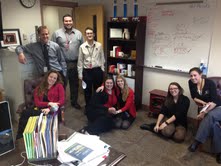
Fireside Chat In My Office
I realize that all the credit for the idea of fireside chats goes to Franklin Delano Roosevelt but I want to share with you something that started spontaneously at our school and has turned into an important part of our culture. Just as FDR used the chats to bring awareness to the American public. We use these to bring awareness about our world as a turnaround academy. These fireside chats started as a group of teachers mingling in my office after school, particularly on nights when there was an hour or two gap between school letting out and an athletic event. Most principals use this time for catching up on paperwork or the likes – not me!
We use the time for our staff to get together in my office to vent, share ideas, make me aware of issues, laugh, and even cry. Honestly, many great ideas, procedures, and programs we now have in place came from these fireside chats. Interestingly enough we called them fireside chats without a fire. Then word got out about our fireside chats and some students bought me a small electric fireplace for my office. This has become one of my most valued possessions in my office. You can see it in the picture – look close under the white board or you might miss it.
In the great book, TouchPoints: Creating Powerful Leadership Connections in the Smallest of Moments, Douglas Conant discusses the interruptions that leaders face interacting with their staff are actually moments that give the opportunity for awareness and leading in the largest of proportions. Amazingly I had a lengthy fireside chat with some teachers today and also amazingly I got an email from an assistant principal of a school in our network of schools that had started “campfires” after hearing a presentation I made on our fireside chats. I really believe the email exchange between us does the best job of describing the thoughts I would like to present in this post.
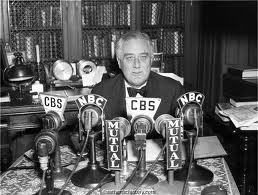
FDR Fireside Chat
So, here it is:
I wanted to share how much I appreciated “Camp Fire”. The advice/counsel that I was given will definitely help me grow in my position. I left those moments with a sense that not only am I valued as an employee but as an individual. I guess that’s what happens when we take the time to validate a student’s concerns/feelings. Thanks again and I look forward to an amazing year!
Hope you had a great first few weeks of school! Thanks again for sharing your ideas that support and value our people!
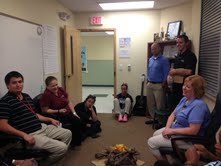
Campfire
Byron
Seriously, how cool is this! So next time you think you are wasting time talking with the people you lead, remember these could be the moments where the greatest leadership opportunities lie!
Mount Everest Leadership (Part 1)
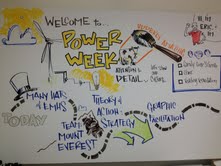
Graphic Facilitation From Power Week Session 1
This past week during our Power Week Staff Training I modeled using a case study for facilitating learning for our staff. It was on e of the first sessions and I was amazed at how we then looked back to the case study I chose, Mount Everest – 1996, the rest of the week. I understand why Harvard University uses the case study method to teach their classes and am glad I had the opportunity to learn this method from Harvard first hand. Today, I begin Part 1 of a three part post to my blog using Mount Everest – 1996 as the focal point.
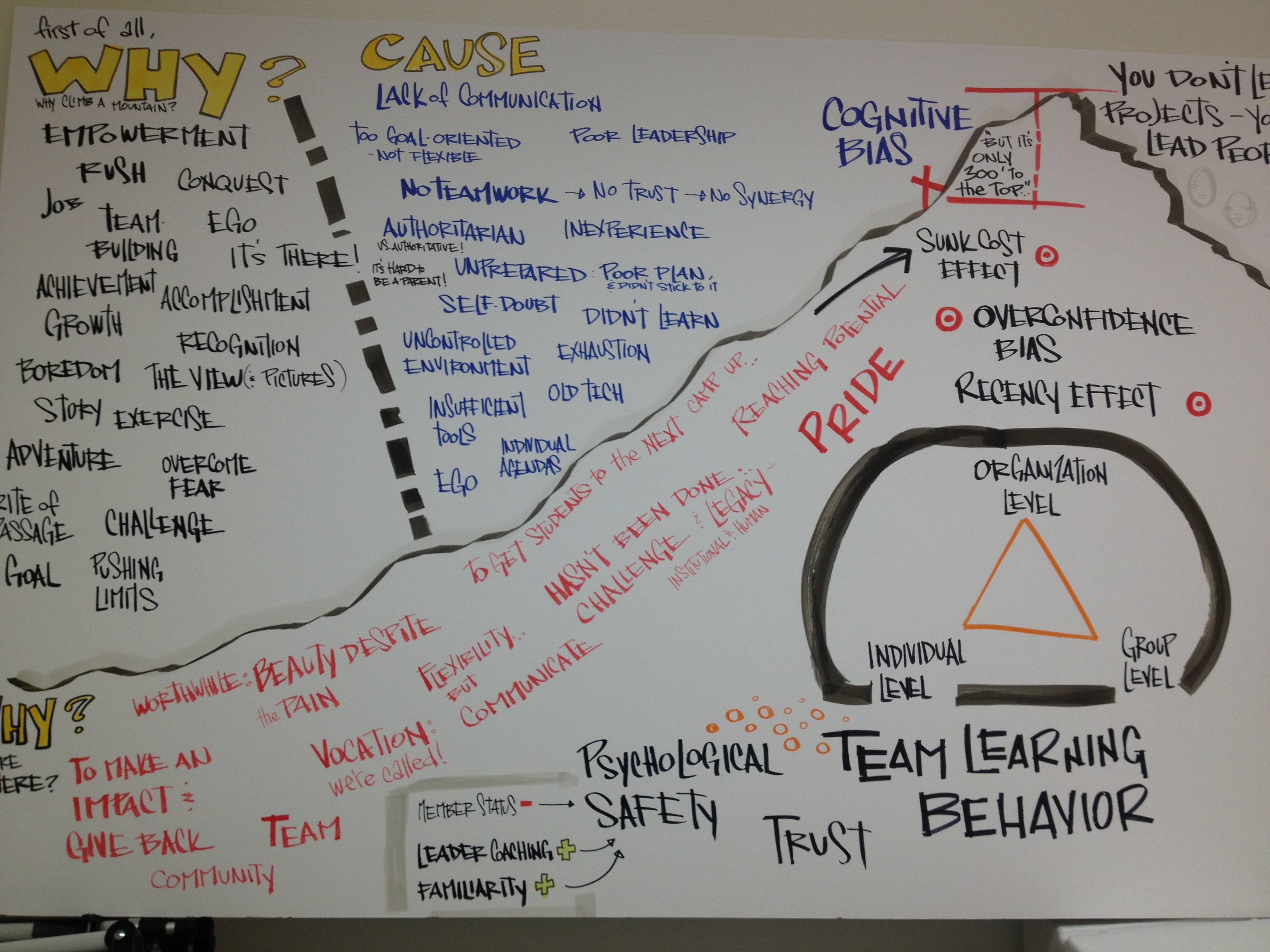
Graphic Facilitation From Mount Everest – 1996 Case Study Session
The case study of Mount Everest – 1996 also gave powerful imagery for the graphic facilitation we were also using for our week long of learning (see insert picture). If you are not familiar with the events on Mount Everest in 1996 I suggest you put Into Thin Air: A Personal Account of the Mount Everest Disaster (1997) by Jon Krakauer on your 2013 must read list.
There was both incredible achievement and great tragedy on Mount Everest in the spring of 1996. Ninety-eight men and women made it safely to the summit, but 15 did not return. Even some of the world’s most renowned high-altitude climbers, including Rob Hall and Scott Fischer reached the summit, but died during the descent because of a storm. Others barely escaped with their lives, and since then many have sought to understand what happened that day.
The first question that I asked the staff during the case study facilitation was: “Why do people climb mountains?” Here is the list that was developed:
- Push oneself to the limit
- Set goal to make it
- See things and do things that haven’t been done
- Rush
- Ego
- Recognition
- Elite Club
- Help others make it
- Competition
- The ultimate challenge
- The love of doing it
- The ultimate proving ground
As a leader, I get why some individuals want to make the climb. It is the idea of being a Trailblazer. Trailblazers go before others go. They don’t send someone where they are unwilling to go themselves. Trailblazers have been up the mountainous leadership challenges so others can come after. This is contrary to a travel agent who sends people places they have never been.
Today is the first day of school for the 2013-2014 year for our students. In my role as a Turnaround School Leader I am certainly a Trailblazer. From the list above I strive each day to be an effective Trailblazer leader from the love of doing this. My prayer is to help others involved in this important education reform work be successful and see and do things that haven’t been done before.
As we start school today I want us to help blaze the trail for our students in their world of education and learning. Our goal is for all our students to become lifelong learners. John Wooden said: “It’s what you learn after you know it all that counts.” When you are out of school, you are not out of the classroom. Life is the big classroom.
I love to learn and I want to share that love with others in the hope it will rub off. John Maxwell puts education in these three steps: 1. Learn; 2. Earn; and, 3. Return. Let’s not stop our learning with the formal education. Be an every day learner to be an every day grower!
The Achievement Gap Elephant
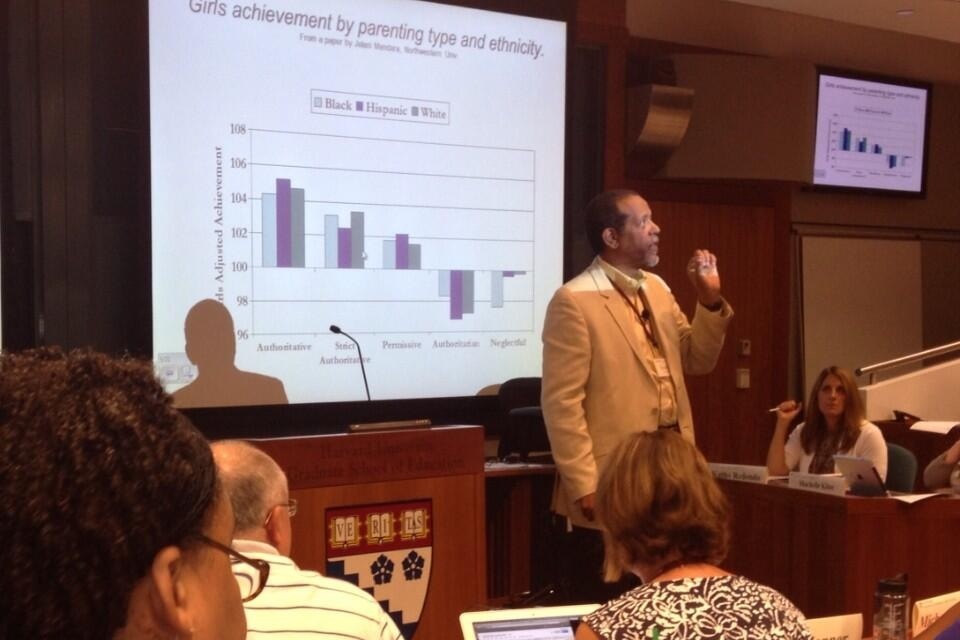
I spent this week in the classroom at Harvard University learning to be a more effective at closing the achievement gap in the Harvard Graduate School of Education program for Closing The Achievement Gap. This was a program made up of an outstanding curriculum with the learning being facilitated by incredible Harvard faculty and other expert facilitators. Part of my homework for this evening is to do a Learning Synthesis of the week. I was here at the beginning of this month for the Turnaround School Leaders program and used my blog for the Learning Synthesis. I have chosen to do this again.
We learned this week about “learned helplessness.” Dr. Ron Ferguson told the story of how an elephant is trained to stay in one place at a young age by having a painful collar and change placed on their leg. By the time they are older and big enough that the chain would not hold them it doesn’t need to even be attached to an anchor because the elephant doesn’t know he can get loose. In some ways I worry that this is the way we approach the achievement gap. Do we spend a lot of time discussing it, but then not just diving in and doing the hard work?
For this post I would like to share with you my list of 100 points that I want to use as spring boards to continuing the important work of closing the achievement gap. Here we go:
1. Shift school and district level foci to external benchmarks as points of comparison, instead of inter-group comparisons in the home community.
2. People feel overwhelmed by the complexity of the challenge.
3. School administrators try to change too many things at once.
4. We start things but do not monitor the progress.
5. There are prescriptive disagreements – people do not agree on what needs to be done.
6. Plans and strategies seem incoherent to people who are asked to participate
7. Everyone (all stakeholders) must be involved in the process.
8. Everyone must believe that students are able.
9. Everyone must have the right attitudes.
10. Students make fun of peers who try to do well.
11. Leaders must combine passion with competence.
12. We need instigators, people who work behind the scene, to plant the seeds of change and help do the hard work.
13. Dedicated teams are needed to do the hard work.
14. We need clear central themes.
15. We need a streamlined and coherent “curriculum” for the change process.
16. Have an organizational structure and capacity to teach and motivate the adults.
17. We need patient, but tough accountability in closing the achievement gap.
18. There must be institutional gathering and management of the data.
19. Data driven decision making and transparency are keys to success.
20. Community involvement is paramount for resources.
21. Theories of action for closing the achievement gap must be simple, teachable, and very specific.
22. Warm, firm control
23. Family engagement plans must be simple, teachable, and very specific.
24. Identify the evidence to guide the strategic plan.
25. Strategize/plan for specific target groups
26. The moms and dads say, “Sit your ass down!” We say, “Will you please sit down.” Students don’t understand this change in leadership style.
27. Warm, firm control
28. Parenting style is more important than anything else.
29. Most of the parenting things that work for kids, work no matter what race. The only difference is when we talk to our kids about race – “the talk.”
30. Achievement gaps occur in life experiences.
31. Life experience differences accumulate.
32. Encourage “mastery” not “performance.”
33. We must be career-long learners to be the best educators.
34. Focus on high-expertise teaching.
35. Students need ownership in the classroom.
36. When a kid asks a question, don’t berate them over it. It should be safe to say you don’t understand something.
37. Class starts the second you walk through the door.
38. Teachers need to make a connection with the student.
39. Teachers greet the students as they come through the door.
40. In great classrooms, the students know each other’s names.
41. Focus on learning, not compliance.
42. Teaching is anything a person does that affects student learning – ANYTHING!
43. The school as a workplace is the most important place for teacher training/learning/and induction.
44. The highest gain teachers go ahead and do mastery grading.
45. Learning is messy!
46. High performing teachers will let students struggle, but will scaffold the struggle.
47. Ability is malleable – Smart is something you can get!
48. High performance teachers tolerate a students’ struggle in learning.
49. Generally students know how effective their teachers are.
50. You can take what the students think to be correct about education.
51. Only putting the objectives on the board doesn’t cut it; the students won’t get it. We must put it in kid friendly language and check for understanding.
52. There is no such right as: “Students have the right to fail!” We must take that perceived right away!
53. Create an environment where no staff member can overlook something that is a non-negotiable.
54. We must create more consciousness of both positive goals and negative behaviors; we want balance in the degree to which each of these is a motivator.
55. Many students have positive self images; but they make decisions that can have long term negative consequences.
56. Difficulty can be taken as a sign that the goal is inappropriate for one’s self; the intervention helped change.
57. Incorrect assumptions about what other people think causes individuals to alter their behaviors to fit what they think other people value – “Pluralistic Ignorance.”
58. In many cases the kids already have the correct values – they just don’t know it because of pluralistic ignorance.
59. The cost of resisting what appears to be the norm can be isolation or worse.
60. When discussing issues we must create opportunities to reach consensus in the room.
61. Dominant social capital: behaviors, language, and signals that earn access and privilege in mainstream society.
62. Non-Dominant cultural capital: behaviors, language, and signals that earn access and privilege in the less dominant society.
63. Non-dominant cultural capital has value for members of non-dominant groups.
64. Tracking students increases achievement gaps!
65. Tracking helps high achievers and hurts low achievers, and exacerbates achievement gaps because people of color are disproportionately represented among low achievers.
66. The real problem is low quality instruction for classes of lower skilled students.
67. Differentiated teaching is very difficult and presents a challenge to mixed ability groupings.
68. Ultimately, the quality of instruction is what matters most.
69. There is no evidence that minority students are less likely to be assigned to high tracks if they have the same skills as white students.
70. Disproportionality of suspension and expulsions for students of color – differences in how discipline is administered. This results in depressing achievement.
71. We should use suspension and expulsion as a last result.
72. Kids decide how much you care, by how you discipline when they mess up.
73. Bias is the absence of neutrality.
74. Stereotype anxiety – “white men can’t jump.”
75. Implicit bias – unconscious behaviors that you do that you are not aware of.
76. Signaling – when someone is trying to send a signal that they are in a higher status group than they appear. As leaders, we need to find ways for them to signal.
77. Code switching and navigating – what behaviors will maximize your success in that particular setting?
78. “Sagging your pants is ok outside of school on your block, but here we are getting you ready for the adult world – the executive board room!”
79. The narratives around all the issues affecting the achievement gap are what need to be worked out.
80. Marginality: you don’t get the resources you deserve.
81. The third grade is when kids figure out the achievement hierarchy.
82. Survivors guilt – Students feel like they don’t deserve the success they have achieved.
83. If you really care about your family and community you must maximize your success so you can maximize your giving back.
84. Selling out – many times the low achievers will just say, “I don’t want to be like that anyway!”
85. Acting “white”
86. High achieving black girls tend to group.
87. High achieving black boys do not group.
88. If you take care of business from ages 12-18 you are set!
89. Training Fleas and training elephants – Learned Helplessness.
90. How do we leverage hip-hop to our students?
91. Flocabulary -www.flocabulary.com
92. Every course in school must be doing multiple high level and rigorous writing assignments.
93. The best people in the organization that can put structures in place for success are not necessarily the ones with the titles to do so – Lead from where you are!
94. If you are going to say there is bias; you must define neutrality!
95. We teach like we were taught.
96. We parent like we were parented.
97. Parenting Styles: Authoritarian, Strict Authoritative, Neglectful, and Permissive.
98. The neglectful parents do not set out to be this way. These families are overpowered by life.
99. No family chooses to be neglectful.
100. White parents get it wrong by being too permissive, but not on purpose.
Well, there are my 100 takeaways from the week. If you ever want a way to unpack what you have learned after a long week of learning you can try this exercise. I hope they have provoked some thought on education reform and closing the achievement gap for you. If so, feel free to leave a comment and we will begin a dialogue.
I really believe we need to put aside differences and join side by side in the important work of school improvement. In doing so we will begin to collaborate, build relationships, and gain the trust necessary to be successful in this hard, rewarding, and fun work! Remember, we are not tied down like the elephant thinks he is!
View From 30,000 Feet

As I write this post I am on a flight from Boston to Philadelphia heading home from Harvard University. It always amazes me how the view changes at 30,000 feet. The weather was terrible in Boston and there was flooding because of the storms coming in the aftermath of hurricane Andrea. But when you you get up to 30,000 feet you are above all that and the view below changes.
I was so proud to be a part of the School Turnaround Leadership Program this past week. One of the leadership lessons of the week was how we need to step into the balcony as school leaders, and watch the dance above all the chaos and noise. This analogy was driven home to me this morning as I looked out the plane window and saw the sunshine with the storms going on below.
As transformational turnaround school leaders it is important for us to get above the clouds and take stock of where we are. This clear “awareness,” as Marzano calls it gives us the opportunity to sort through the clutter and stay focused on the important work at had of putting students first.
So, next time you find yourself getting caught up in all the noise of being a leader sit back and let your mind travel to 30,000 feet where you can watch the dance in the positive cognitive glow of sunshine!
 Byron's Babbles
leave a comment