Matching School Work To Real Work

Andy’s Baling Equipment
Last week I had the annual pleasure of being at the county fair showing dairy cows with my son. The other great part of the week is being able to visit with friends and former students. One visit I look forward to every year is from former student, Andy Clark and his family. I had him in Fundamentals of Agriculture Science and Business and Welding Technology the first year I was at Lebanon starting the Agriculture Science program. Andy is a 2005 graduate of Lebanon High School. I love catching up with him each year and hearing about all of his successes, family, and latest learning.
I have to give a little background on Andy for context. He is, and was as a student, extremely intelligent. The challenge for Andy was that he did not find most of school relevant. He grew up on a farm and is now a partner in that family farm. Andy is one of the reasons I have done so much research on teaching science in the relevant context of agriculture. Andy’s mother and I had many a conversation about her concern for Andy graduating. That concern had nothing to do with ability, and all to with him not finding relevancy in school. He did not want to be there! He wanted to be home getting on with his life as an agribusinessman.
In contrast, Andy excelled in the classes I had him for. In fact, on a final presentation about welding, Andy said he and his partner could go into such detail he could take the whole 90 minute block class to do the demonstration. I told him if he could, and the content was great, I would give him an automatic “A.” Well, you guessed it, he got the “A!” He and his partner even bought Reese Cups to give out to classmates for correctly answered questions – now that’s student engagement. Interestingly, teachers would ask how I could get him involved and so engaged in class. It really didn’t have much to do with me, but more to do with the fact that school work in my classes matched real work in Andy’s world – Agriculture. Again, as I said earlier, Andy just wanted school to be over so he could get on with his life of farming.
Andy was not alone. Most students need the relevant connection of their real world, their school world, and their virtual world. Education exists in the larger context of society. When society changes – so too must education, if it is to remain viable. The latest movement to college and career readiness attempts to do just this. Although the phrase “college and career readiness” has become increasingly popular among federal, state, and local education agencies as well as a number of foundations and professional organizations, it can be challenging to define precisely. In today’s economy, a “career” is not just a job. A career provides a family sustaining wage and pathways to advancement and requires postsecondary training or education. A job may be obtained with only a high school diploma but offers no guarantee of advancement or mobility. Being ready for a career means that a high school graduate has the English and mathematics knowledge and skills needed to qualify for and succeed in the postsecondary job training and/or education necessary for their chosen career (i.e., technical/vocational program, community college, apprenticeship, or significant on-the-job training).
The point of this post is that Andy has gone on to become a successful businessman. Of course, readiness for college and careers depends on more than English and mathematics knowledge; to be successful after high school, all graduates must possess the knowledge, habits, and skills that can only come from a rigorous, rich, and well-rounded high school curriculum. I would also add work ethic and a commitment to lifelong learning to the list. I know that Andy works very hard every day. I also know Andy is committed to learning and professional growth. I was so proud last week to hear him say, “Knowledge is power.” Andy went on to say he was shocked at how much time he spent studying on his smartphone. He said, “I’ll sit down at night and start reading about something I want to study and the next thing I know it is 4:00 in the morning.” I just wish we would have done a better job tapping that learning behavior while Andy was in school. Once again proof that we must continue to connect school work to real work for optimal student engagement and career readiness.
Really, I wish we would just talk “student success” as opposed to just college and career readiness or any other terms that people want to add. Student success is a better way to look at it because the ultimate goal is to have our students learning to learn. We must recognize that youth will choose their own paths in life, with some young people charging forward on a traditional four- year college pathway and others moving equally quickly to pathways that are more technically or occupationally oriented. For a student to be successful, they must be able to learn, apply, and adapt in all subject areas. In order to engage the Andy Clark’s of our classrooms we must integrate higher-order thinking skills and real world problem solving into core subjects making learning more rigorous, relevant, and engaging. Both core subject knowledge and skills are necessary for readiness in college, work, and life. Preparing all students with content knowledge and essential skills will empower them to meet new global demands. Thus, setting our students up for SUCCESS.
Ideation SPAN™EX Style!

What A Great Group Of Education Transformers!
This past week I spent time with the great innovators and transformational leaders at Nureva, Inc. as part of an advisory board made up of education professionals to provide feedback and discuss new product designs, functionality, and desired solutions to educational needs. This was very astutely arranged by Kimberleigh Doyle at Nureva Education. During this advisory time we were introduced to Nureva’s newest product, SPAN™. Let me tell you, I was blown away. As you know I am a digital adoptee and believe in the power of what technology tools can do to enhance learning. Click here to learn more about my journey and click here to learn more about SPAN™.
I do need to explain the title of this blog post. With Smart Technologies we had SMART Exchange; a community of SMART Technology users where we could upload lessons, share lessons, and collaborate. Of course, I argued that we would need this for SPAN™. And…of course, I thought it should be called SPANDEX! You know, for SPAN™ Exchange! Can’t you just imagine the website? Anyway, I settled for SPAN™EX, but I am not sure I convinced everyone else.


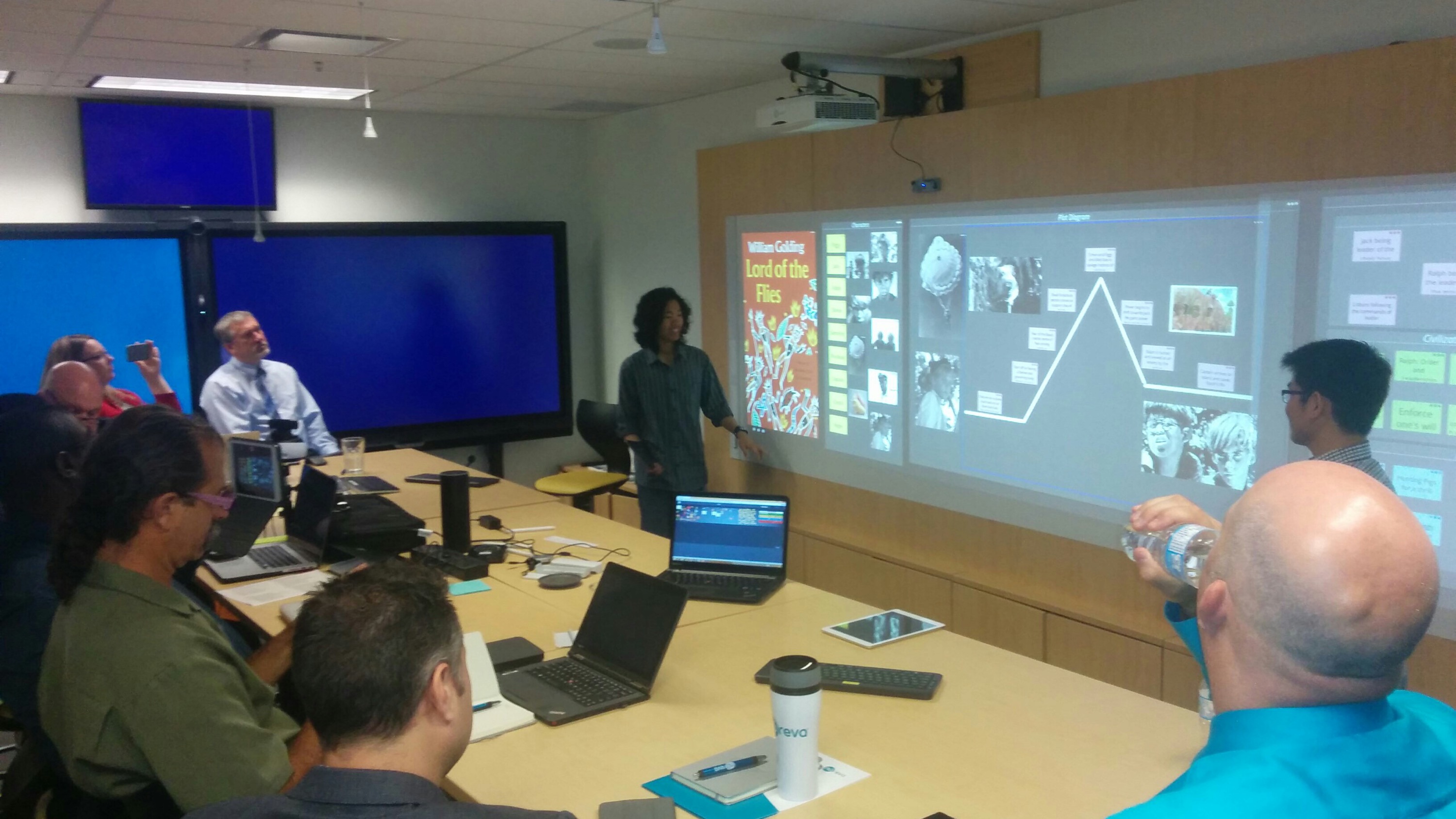
Nureva, Inc. was founded by technology veterans David Martin and Nancy Knowlton in 2014. They are friends of mine and were also the founders of SMART™ Technologies. As a SMART™ Exemplary Educator I fully understand the functionality and power of interactive white board technology. The designers and innovators at Nureva have transformed the way we can use interactive technology with SPAN™. Basically, there are two interactive projectors and 20 feet of interactive space. The projectors employ solid-state illumination, SSI, and the projectors provides a useful life of 25,000 hours. As the user, you are provided with different backgrounds, called a canvas, then an entire collaborative group can be adding and manipulating content at the same time.
The technology makes “ideation” possible. “Ideation” is a disciplined process of generating ideas and then working those ideas in a team or group environment over a sustained period of time. You have more than likely participated in ideation activities even though you may not have labeled them as such.This group does not even need to be at the same location – as the leader of a virtual school with students in all 92 counties can you see where my thoughts went immediately. Click here for an FAQ about SPAN™.
Check out these videos to see SPAN™ in action:


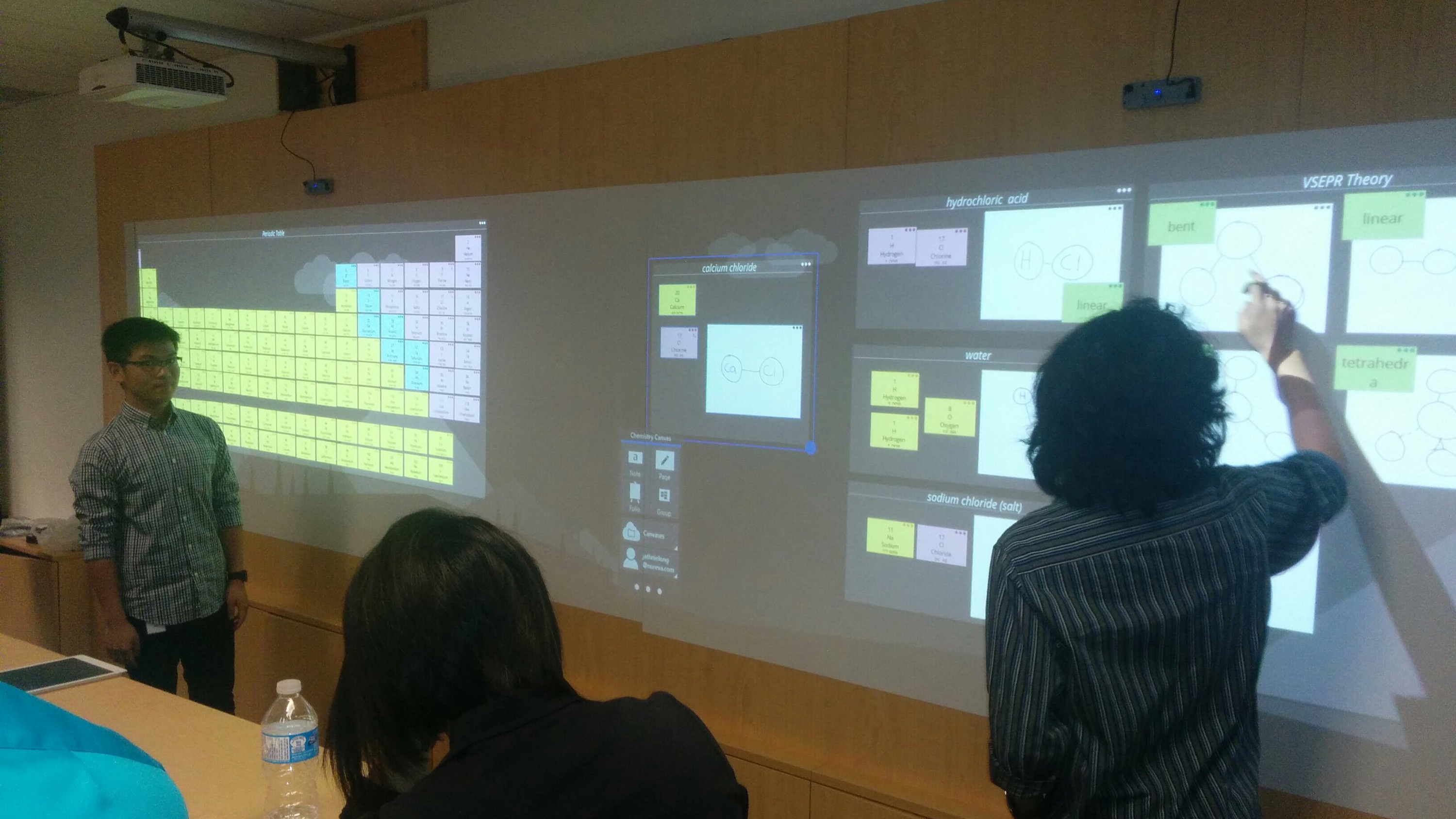 More importantly, however, Nureva made a very smart move and hired two high school interns to work on the project. In fact, they were the ones who taught us how to use SPAN™. They had learned it in a week’s time just by using it with no training. We had the chance to work with Mathieu Chin and Jathaniel Ong during the time we in Calgary and gain insight from them. Let me tell you; I learned a lot from them. I asked them to name the top five important uses of SPAN™ they would advise teachers to use in effective facilitation of learning. Here is their list:
- Collaboration – they believe they learn more when collaborating with other students. I hope this sounds familiar to all reading as we move to college and career readiness standards. Business and industry stakeholders continue to tell us we need to facilitate learning in a way our students learn to collaborate.
- Creation – these two very astute interns recognized the importance of being able to create and produce during the learning process. We were able to witness collaborative creations they had made during learning of chemistry, World War II history, literature, and food science.
- Student Centered – these interns wanted to be involved in the lesson, not just watching a teacher present.
- Transportable – our interns valued that they could collaborate and work in their groups from anywhere. They really saw value in being able to take the learning anywhere and have 24/7 learning. This product is cloud based and changes and collaboration are done in real time.
- Full class involvement – with SPAN™, unlike traditional interactive products, all students can be working in the collaborative space on their computers at once and 10 can actually be manipulating on the projected image at once. Talk about engagement!

I Learned So Much From Mathieu Chin & Jathniel Ong!
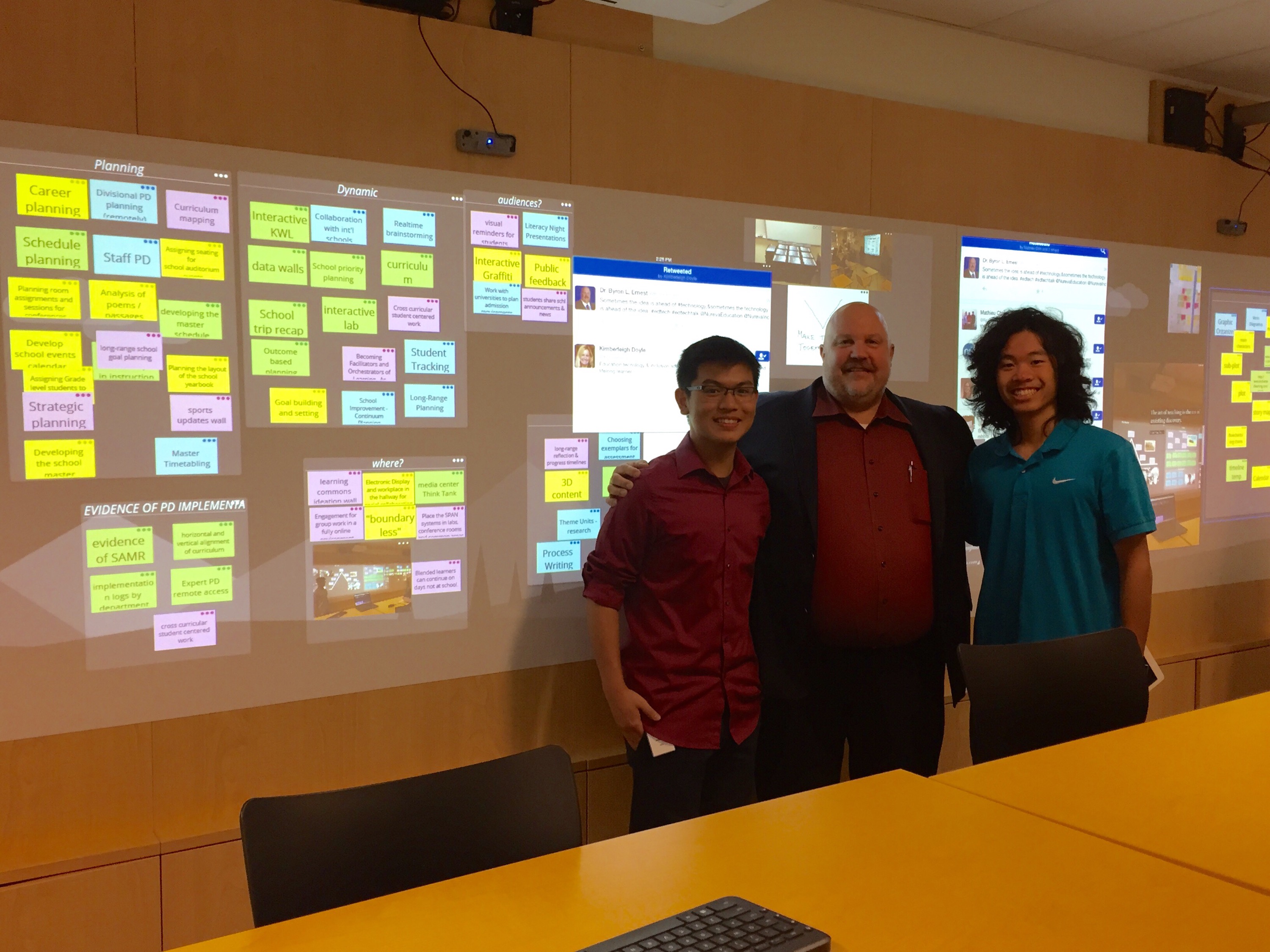
As you can see, I am very excited about SPAN™ and its possibilities for facilitating highly effective learning for students. It was so great to be a part of testing the product and providing feedback, but the most important point I want to make here is the power of the insight of students. This experience reminded me how important it is for us to seek the input of our most knowledgeable stakeholder – our student. Kudos to Nureva, Inc. for modeling this for us as they transform the way we use technology in education.
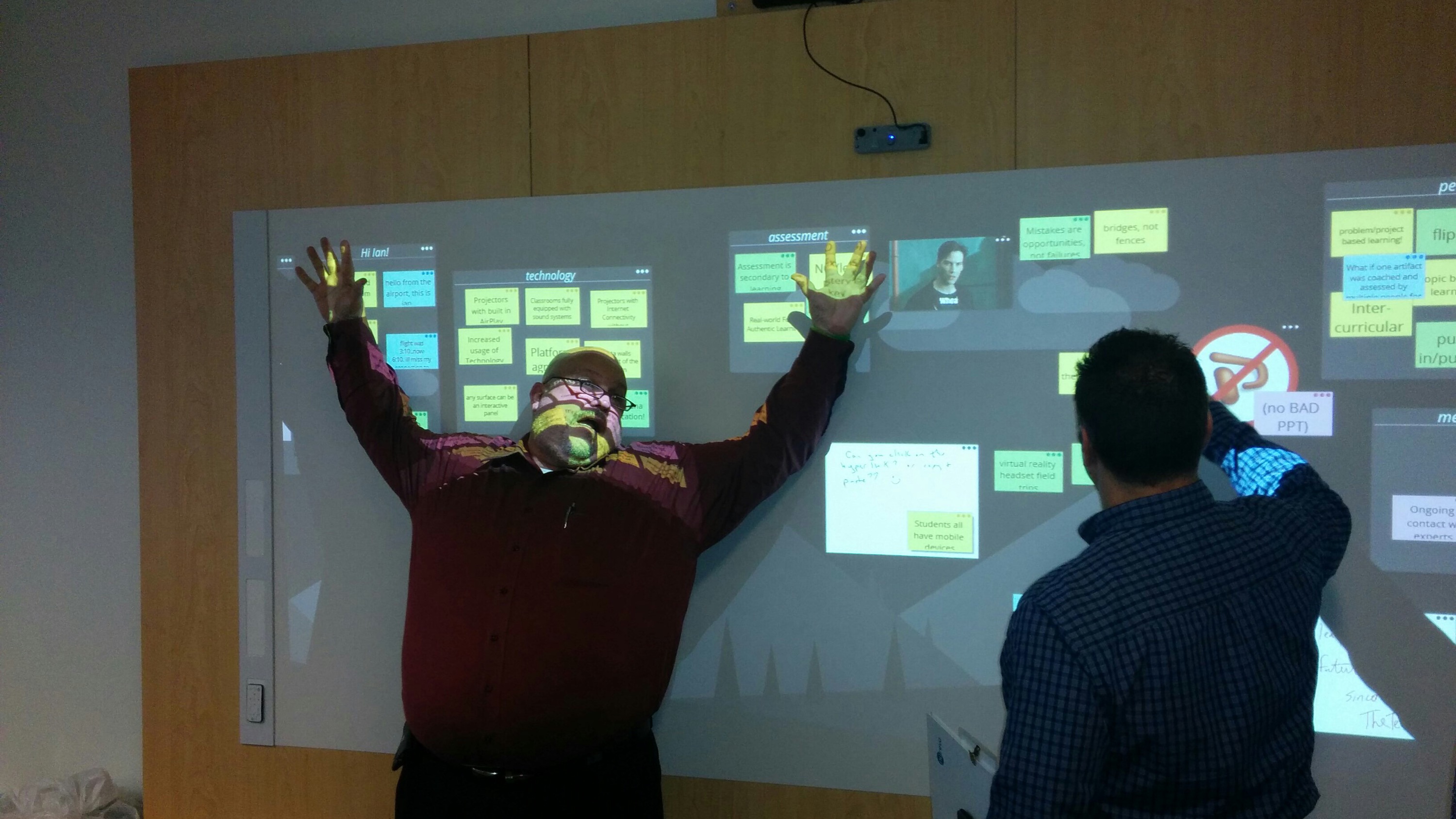
Having A Little Fun With SPAN™
Connecting The Dots
 I had the opportunity to spend time this week in Calgary, Alberta Canada as a guest of Nureva, Inc. as part of a group of education professionals for a discussion about education technology. As a newly appointed Indiana State Board of Education member it was great to be meeting on the top floor of the Calgary Board of Education building. It was humbling to be learning from a group of outstanding educators from all over the United States and Canada.
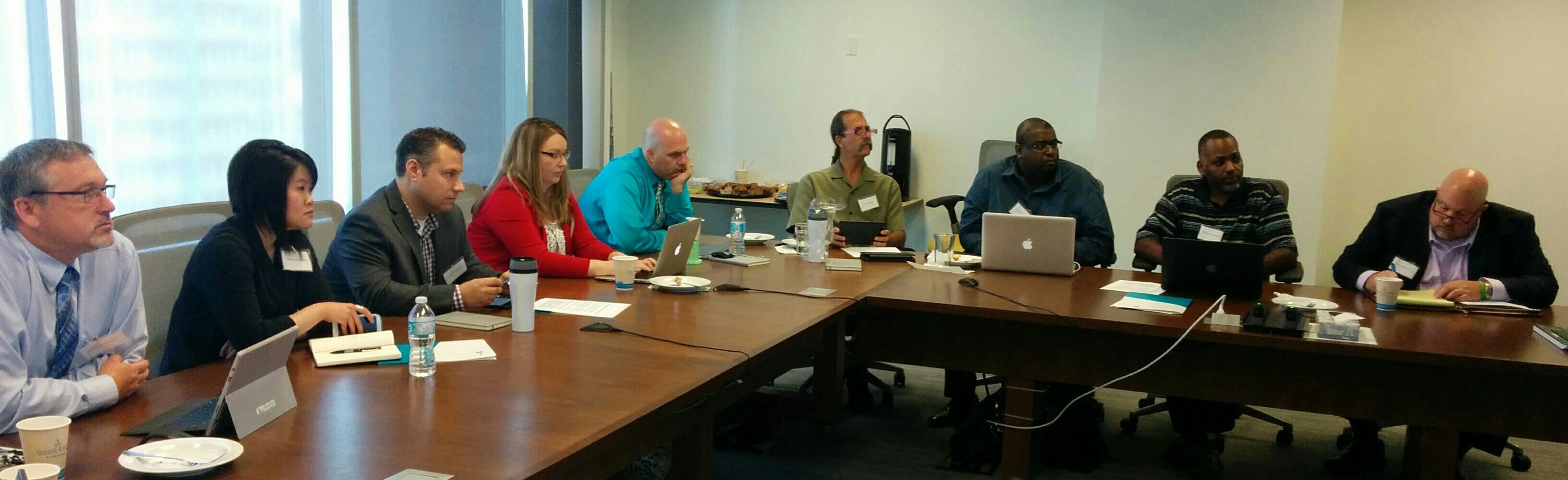 It was so exciting to be working with a group of individuals and education technology company that believes in and practices “holistic adoption” of projects and initiatives; whether those projects and initiatives are related to business technology, educational technology or other academic processes.
 This “holistic adoption” must include professional development. This adoption must also include strong involvement of community and stakeholders, both in the decision-making and adoption/professional development phases. Of course, the most important piece of holistic adoption is the impact on the children we serve.
 We must be able to measure the impact. We also know, the most important person affecting our students is the teacher. Therefore, I would submit the most important essential question, from a school perspective, when holistically adopting new strategies is: What does that mean to a teacher who has never done this before?
 As I reflected on my essential question, I thought about the “connect the dots” sheets we used to get in school. You remember – those numbered sheets that if you follow the numbers with your pencil, it creates a picture. Anytime we bring on a new project or initiative, we must connect the dots to previous initiatives; or, it will look like we, as leaders are abandoning the ongoing initiatives or initiatives from before. We must connect all of the dots for those we lead.Those dots may be past to present, connecting initiatives to student learning, connecting what the intitiative means to teachers and students, or connecting the initiative to the mission, vision, strategies, and action plans of the school/organization. In other words, making sure we connect the dots for those we lead to what his or her role is in accomplishing the mission.
Are you connecting the dots for those you lead?
Network Society
 This week’s lesson from Peter Drucker (Maciariello, 2014) dealt with how many organizations in our society are becoming network organizations. A networked organization is one that operates within a system of interdependent organizations for the purpose of achieving objectives that are agreeable to partner organizations. Many schools, including my own, have a number of partner organizations, whether outsourced services or community partners. This lesson really gave me an opportunity to think about the behaviors necessary to make a network successful:
- Trust
- Shared Values
- Integrity
- Commitment
- Goal Alignment
- Continuous Communication
- Conflict Resolution Processes
In the partnership of a network there can be no command and control (Maciariello, 2014). The questions must be, “What are the objectives?; “What are our values?”; and, “What are our ways of doing things?” Networked organizations are demanding to lead, and rely on developing and maintaining strong personal relationships among the partnering organizations. A network is somewhat like a team, except the network builds the team out of a wide variety of organizations.
Reference
Maciariello, J. A. (2014). A year with Peter Drucker: 52 weeks of coaching for leadership effectiveness. New York, NY: HarperCollins Publishers.
Investments in Managerial Ego
 “Nothing so powerfully concentrates a man’s mind on innovation as the knowledge that the present product or service will be abandoned within the foreseeable future.” ~ Peter Drucker
This quote from Peter Drucker is so true. The first key to innovation is the willingness to abandon the old so that you free yourself for the new. Thus, the idea of “investments in managerial ego.” The three sectors of government, social, and business all have difficulty abandoning obsolete products, services, policies, and procedures. The inability to abandon existing programs reduces resources available to both fund and carry out new initiatives necessary to stay competitive and meet the mission and vision of our organizations (Maciariello, 2014). You are probably already thinking of programs, both in the government and social sector, that no longer serve their originally intended purposes.
Robert Anthony, a former Harvard Business School professor and under Secretary of Defense for Robert McNamara during the Kennedy administration, believed all agencies need to “examine its [program] reason for being, its methods of operations, and its costs.” (Maciariello, 2014, p. 171) I would also add the question of whether the team has the capacity to carry out the program. I really experienced this early in my career as an agriculture science teacher and FFA advisor. Both the state FFA and national FFA organizations would add new contests and programs each year, but there was never anything taken away. Well, as you can imagine this put strains on budgets and the ability to get things done well. The positive of this was, however, it taught many of us how to really ask the question of, “What are the things we are going to do well?” I always believed, and I believe they are doing a better job of this today, the FFA organizations should have been asking, “If we add this [program or contest], what are we going to get rid of or take off the teachers’ plates.” I really do try to practice this now as a school leader, but as any of you know who are on the front lines as the “Deer in the Headlights,” this is easier said that done.
Peter Drucker (2014) said we must ask the questions, “If we did not do this already, would we go into it now?” If the answer is no , ‘What do we do now?'” The question has to be asked – and asked seriously. In other words, “If we did not do this already, would we, knowing what we know, go into it now?” If the answer is no, the reaction must be “What do we do now?” I get it though; it is so difficult for any business or organization to abandon a program because the program may represent an investment by the people who introduced it and who nursed it along. Beware of commitment to ego as an excuse for maintaining status quo (Maciariello, 2014). Developing a process of systematic abandonment (Maciariello, 2014), and making it a regular part of the culture of an organization, is one of the most effective ways to eliminate the old and make room for the new.
We must remember that when given the challenge of choosing between two or more competent programs, we must keep the one that makes the more significant contribution to the mission and vision of our organization and to society.
Reference
Maciariello, J. A. (2014). A year with Peter Drucker: 52 weeks of coaching for leadership effectiveness. New York, NY: HarperCollins Publishers.
Nothing Works Forever: Perpetuating the Mission & Values of the Organization!

“Nothing works forever. Our purposes never change – but our methods and tactics must constantly change. It is amazing how quickly a successful organization can deteriorate into mediocrity.” ~ Rick Warren, Pastor and Founder of Saddleback Church in Lake Forest, California.
This week’s lesson in Maciariello’s (2014) A Year With Peter Drucker was based on an interview with one of my hero’s – Rick Warren. Dr. Warren founded Saddleback Church in Lake Forest, Calif., in 1980 with one family. Today, it is an evangelical congregation averaging 30,000 weekly attendees. Peter Drucker and Dr. Warren were friends and this week’s lesson was based on a 2003 interview. They discussed that organization must innovate and change. Organizations also tend to become bureaucratic and need to have conscience activities for maintaining and transmitting its core values (Maciariello, 2014). These principles should be implemented in a way that will perpetuate the mission and values of an organization and provide continuity, while also facilitating change.
The key here is facilitating needed innovative change, but at the same time having continuity. Tough order, huh? Drucker posited that we all need people committed to our vision our our teams, but we also sometimes need radical change (Maciariello, 2014). Drucker also argued that change and continuity are not opposites, but a continuum (Maciariello, 2014). If an organization does not change, it will die of being status-quot. In order to achieve continuity, therefore, an organization must be designed to change. Change and continuity are thus poles rather than opposites. Interestingly, I just spoke on this last week at the American Federation for Children National Education Policy Summit. In our panel I stated that in education and “school choice” that we were in danger of the new beginning to look like the old. In other words as a believer in “school choice,” we must make sure that the choices are not just some of the same old thing in a new wrapper. We must create schools that have the core value of all students can learn, but are differentiators in the way we do that. We need schools that educate better than anyone else and that have an “edge” or “niche” in doing so. In other words, a constant stream of incremental improvements will lead to substantial change and great schools over time. Schools, and all organizations, should therefore seek and reward continuous improvement activities. Continuous improvement must be one of our “BIG” initiatives to be working on in education, and all organizations for that matter.
According to Maciariello (2014) change can occur in two forms: 1.) creating new wealth through innovation; 2.) creating wealth by moving resources from low to high productivity. Competition speeds this process up. This is why I am such a believer in school choice. We cannot predict the future, so it is our job, as leaders, to have the core values in place to allow for changes in products, processes, and services that will continue to meet the needs of our customers in the future.
As an “Energetic Change Agent,” I know that change is risky and creating the future is a lofty goal, but it is much more risky to leave the future to chance. Are your organization’s core values strong enough and believed by all to make it possible plan for change? Are your own core values and change agent abilities such that you will be able to maintain organizational cohesiveness during necessary changes? Isn’t it excited to be creating the new future?
Reference
Maciariello, J. A. (2014). A year with Peter Drucker: 52 weeks of coaching for leadership effectiveness. New York, NY: HarperCollins Publishers.
Improving STEM Education: Connecting School Work to Real Life
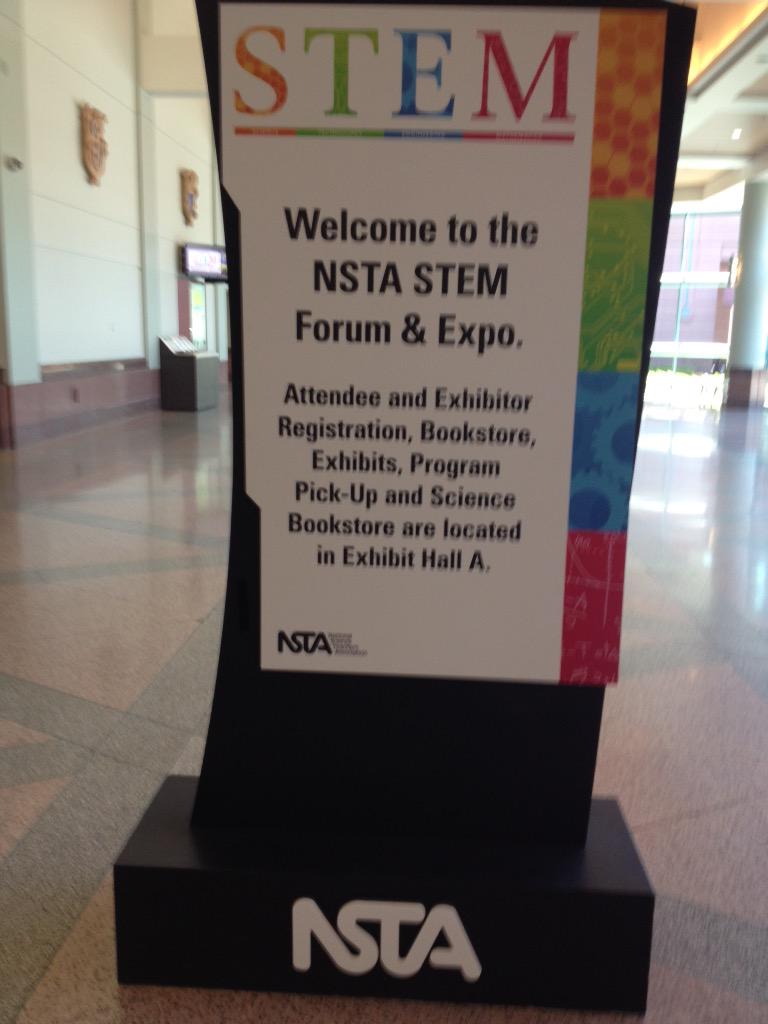 I had the tremendous honor of presenting at the International STEM Forum & Expo yesterday put on by the National Science Teachers Association (NSTA). What an incredible event. It was well-planned, and the sessions were, well, incredible. It was a great reminder to me, now that I am not in the classroom as a teacher, just how important STEM education is to our children. It was also a reminder of how tough a job it is to keep our children motivated in STEM courses and then, ultimately, through higher education if that is what the student chooses. The attendees of the National STEM Forum were reminded of this when Dr. Freeman Hrabowski, President of The University of Maryland, Baltimore County, spoke. He told us that high SAT scores correlated with students who had taken AP & Honors courses, but then ended up being the same students who dropped out or changed majors from STEM related degrees in college. Why? Because of a “fixed mindset” instead of a “growth mindset.” Dr. Hrabowski sited the work of Carol Dweck, author of Mindset: The New Psychology of Success (everyone needs to read this and all of her books). These students are so driven for success and making the top scores that when they get to college they are often disappointed by not being “#1.” Many are still top students, but can’t handle not being the top. Then, as Dr. Hrabowski pointed out, they switch to the humanities. Why? Because the humanities gets the iterative nature of the “growth mindset.” The idea that nothing needs to be perfect on the first try. In STEM courses, we tend to want to give a grade on the first, and only try. As a big believer in mastery grading, I wanted to go up and hug Dr. Hrabowski. He was talking my language!
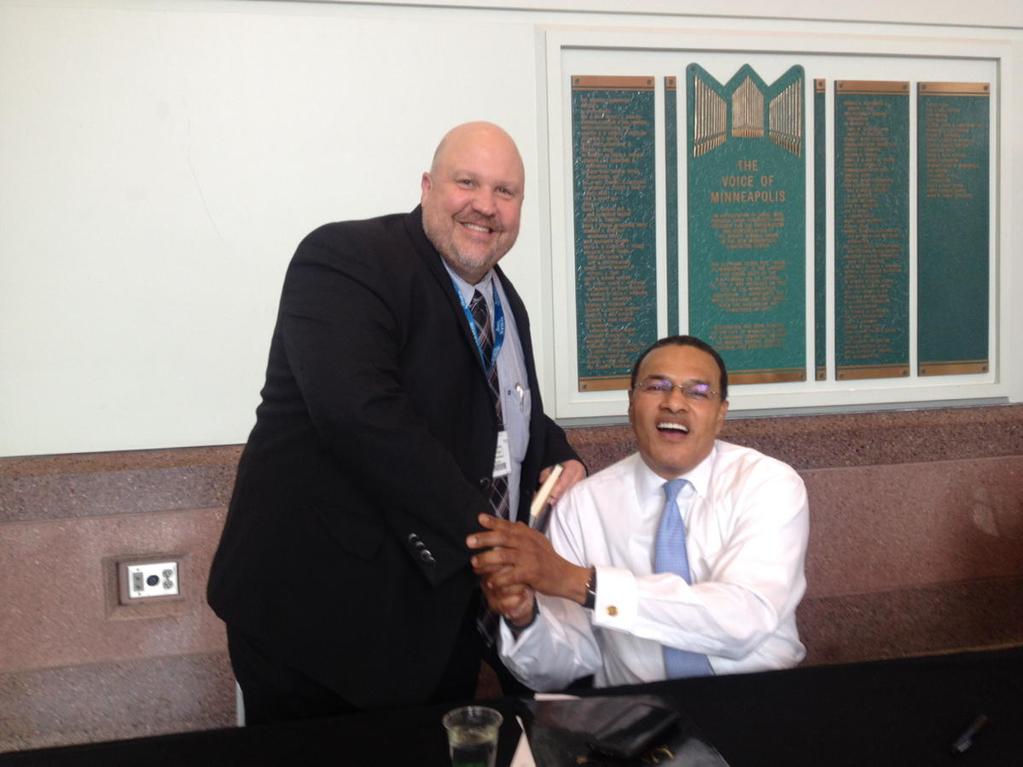
Me Hanging With My Friend, Dr. Freeman Hrabowski
It is curious to me that we have this “fixed mindset” in STEM education, because careers in STEM are not that way at all. Think about all the trial and error, experimentation, and “ah ha!” moments there are. Thus, why what Dr. Hrabowski was saying really reinforced what I had just spoke about prior to his keynote. My presentation title was: “Improving Science Education: Connecting School Work to Real Life.” The presentation was all about teaching in a real world context. I stressed that we must connect the three worlds that a student lives in: school world, real world, virtual world. The presentation was based on research I did based on student academic performance and achievement in Biology based on being taught in the real world relevancy of Agriculture. If students do not make the connection between the school work they are doing and real life, they will fall into the “fixed mindset” trap.”
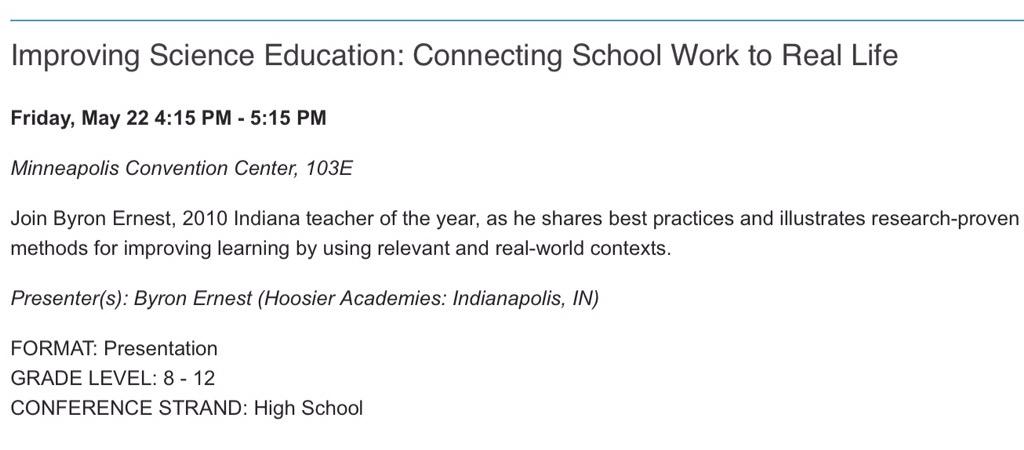
I discussed with attendees how we had partnered with AgReliant Genetics when I was teaching at Lebanon High School to provide opportunities for our students to do real world/real time research. The students were able to do this working with real researchers. This working with adults component is so very important in my opinion. To create the ideal learning environment we must have Students working in teams to experience and explore relevant, real-world problems, questions, issues, and challenges; then creating presentations and products to share what they have learned. Here is a link to my presentation:
Ernest_NSTA_RealAgSTEM_Final_2015
So, as we continue to facilitate learning for our STEM students, and all students, let’s not forget to practice a “growth mindset” and make the connection between school work and real life.
Our Origins, Legends, & Heroes
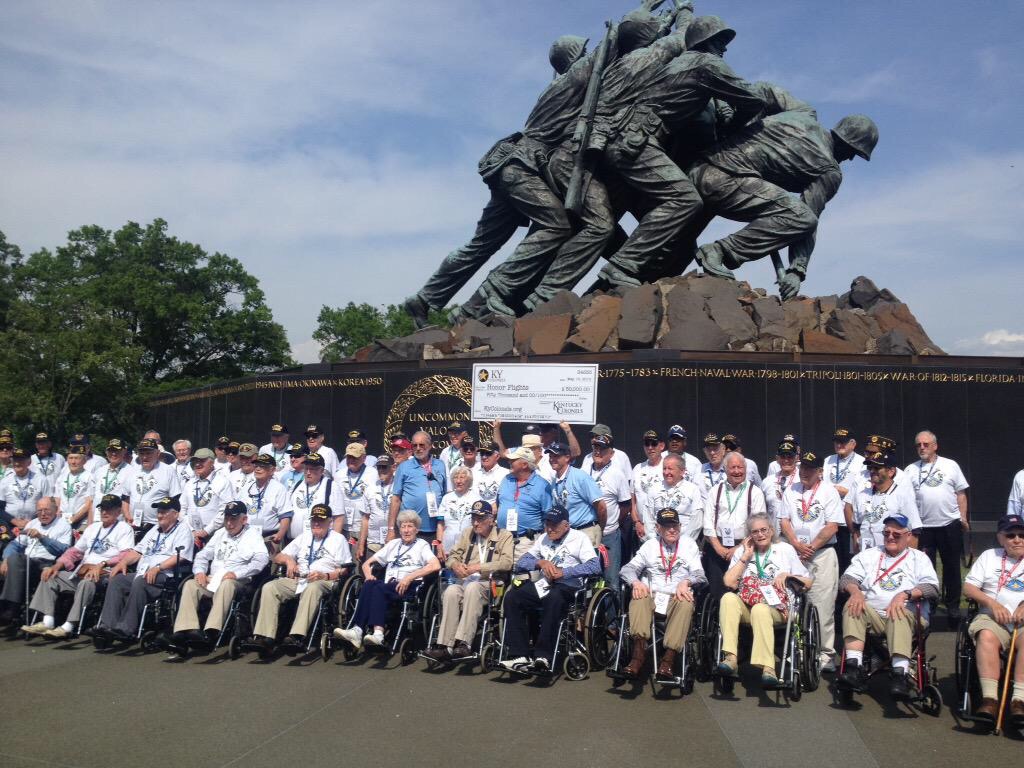
2015 Kentucky Colonel Honor Flight
“Not to know what happened before we were born is to remain perpetually a child. For what is the worth of a human life unless it is woven into the life of our ancestors by the records of history.” ~ Cicero
People living in democratic republics should know not only of its origins but also of the imperfect democratic struggle it spawned. Such appreciation might alleviate the taking of one’s way of life for granted. Americans understand the embodiment of heroic virtue in everyday life, for legends runs deep in American history.
Yesterday I had the privilege of serving our Veterans as a Guardian for our Honorable Order of Kentucky Colonels Honor Flight to Washington DC. This was a very emotional experience and I still, 24 hours later, hardly have the words to describe or reflect on the day. As a Kentucky Colonel, this was something I really wanted to do, but did not know what to expect. Well, let me tell you, it exceeded my expectations. This opportunity to serve provided the best lessons in selflessness and servant leadership one could receive anywhere. The Veterans taking part in the Honor Flight, all of whom were Kentucky Colonels, were transformers in life; they thought not of themselves but of a higher cause – America and global freedom.
“Kentucky Colonels are unwavering in devotion to faith, family, fellowman and country. Passionate about being compassionate. Proud, yet humble. Leaders who are not ashamed to follow. Gentle but strong in will and commitment. The Honorable Order of Kentucky Colonels, as a Brotherhood, reaches out to care for our children, support those in need and preserve our rich heritage.” ~ The Honorable Order of Kentucky Colonels Credo

Water Cannon Salute
Everywhere we went the Veterans were met with mobs of crowds cheering and thanking them for their service. There was even a “Water Cannon” salute at Reagan International Airport for our plane as we landed in Washington D.C. As I watched in amazement, these heroes practiced our Kentucky Colonels Credo of being, “Proud, yet humble.” These Veterans were truly touched by the outpouring of support and cries of, “Thank you for your service!” For me it was the first time of truly being in a role of 100% servant leader. Because I am not a Veteran, I did not matter to anyone yesterday, and should not have. This was incredibly satisfying and humbling. The entire day was about serving the Veterans as a group and the Veteran I was responsible for as a Guardian, Jerry McCandless (more about him later). I have always prided myself in walking the talk as a servant leader, but this provided the opportunity to be 100% servant. I have to tell you, I am a changed man.
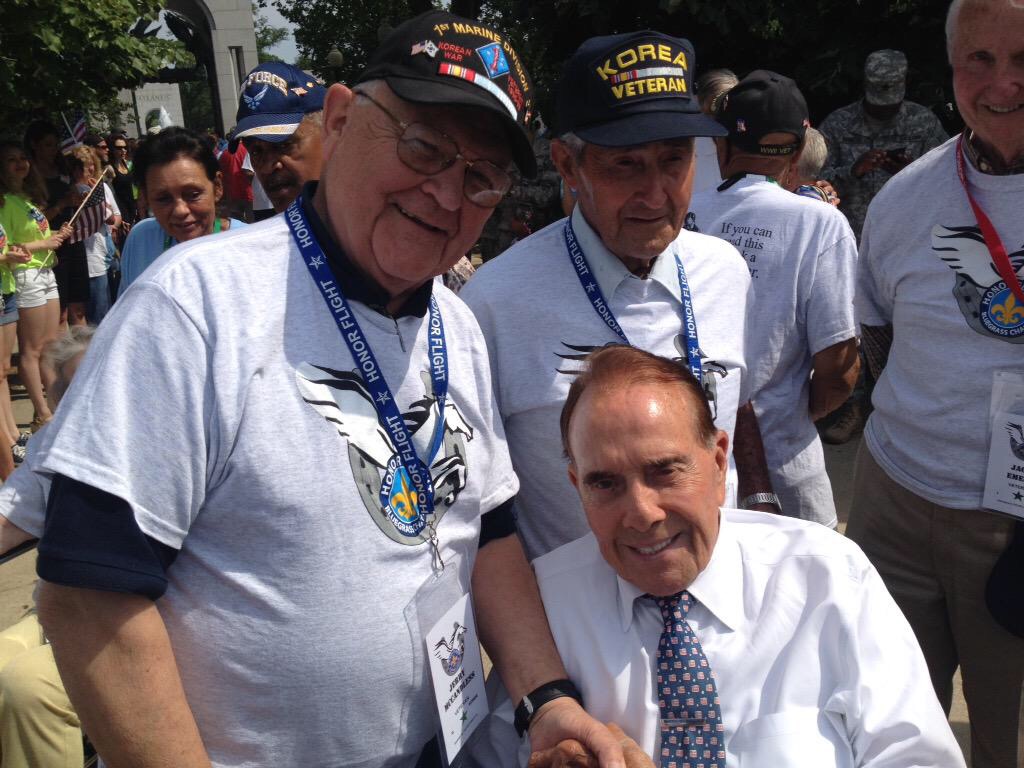
Jerry McCandless With Former US Senator Bob Dole
Amazingly, after returning to the bus someone asked me if I had my picture taken with former U.S. Senator Bob Dole. He comes out and personally greets Veterans from the Honor Flights at the World War II Memorial. Honestly, I had not even thought of getting a picture of me with him. In fact, I don’t even care to have a picture of me with him. I am, however, very proud of the picture I took of Jerry with Bob Dole. Remember, as a servant, I was to have no wants or needs on this trip – and I’m still amazed I had none, except for our Veterans to have the greatest day of their lives. As I said before, this experience really changes you and gives you the chance to fully understand what it means to be a servant leader.
These Honor Flight participants are heroes and legends. Legends serve two purposes: they provide a shared cultural experience for a people, and they symbolize the aims and ideals of that people’s common history, religion, culture, or institutional authority. As a legend, Lucius Quinctius Cincinnatus is a great example. Having stirred the passions of Republican Rome, later citizens of the Roman Empire and eighteenth century America, and men and women of contemporary times, he has been revered throughout history. His life is one of legendary accomplishment and character. Not merely legendary, Cincinnatus is also heroic. While fellow ancient warrior Alexander the Great or fellow Roman leader Julius Caesar are legendary, they do not impart the timeless moral lessons of a hero.
The hero sacrifices himself for something—that’s the morality of it. He gives his life to something larger than himself. In further contrast, the hero symbolizes our ability to control the irrational savage within us, whereas the leader may exploit the savage to gain his ends. One of the many distinctions between the celebrity and the hero…is that one lives only for self while the other acts to redeem society.” ~ Joseph Campbell
George Washington, one of our American heroes, like Cincinnatus, was a man of great accomplishment, but character, not achievement or genius, is also his most honored legacy. Character sets them apart from others. Children in schools all over Italy still recite the Cincinnatus story in the same way children of the United States learn of George Washington and the “cherry tree.” Another great American hero, Patrick Henry asked repeatedly of the role of the citizen in a Republic. He sought much more than a far removed vote in regularly scheduled elections.
Having met the living legend, a British soldier penned the following observations of Washington’s quest to live as Cincinnatus:
“Altogether he made a most noble, respectable appearance, and I really think him the first man in the world. After having had the management and care of the whole Continental army, he has now retired without receiving any pay for his trouble. he knows how to prefer solid happiness in his retirement. I admire him as superior to even the Roman heroes themselves. I am told during the war he was never seen to smile. he had only the good of his country at heart. his greatest pride now is, to be thought the first farmer in America. He is quite a Cincinnatus, and often works with his men himself—— strips off his coat and labors like a common man .”
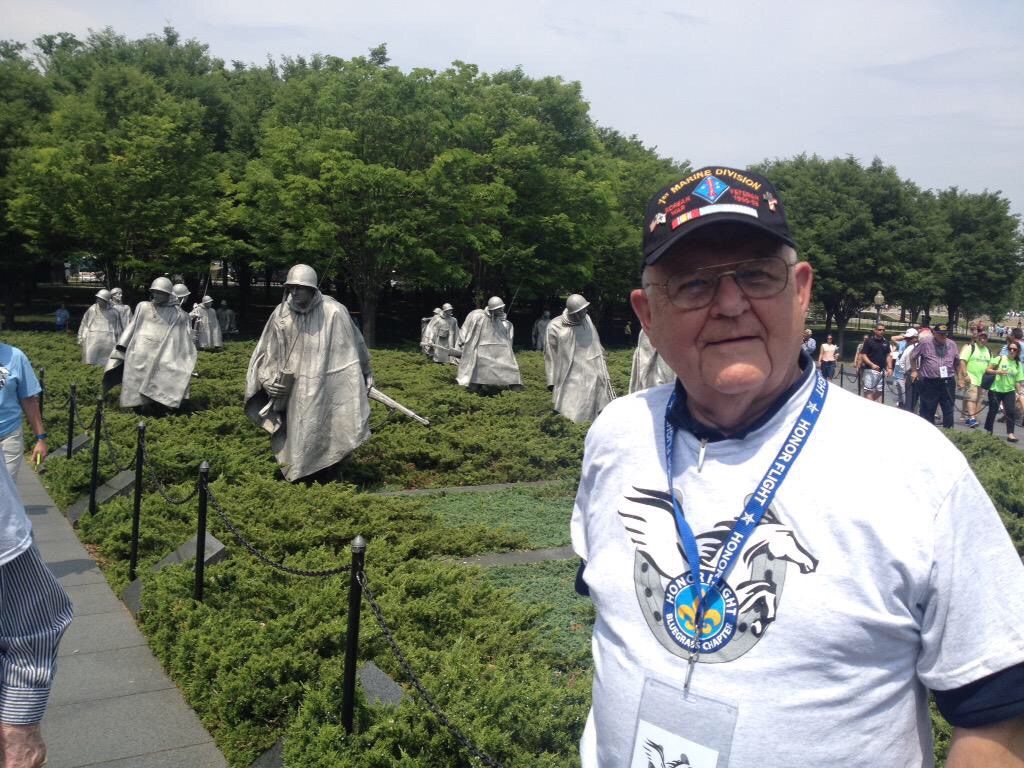
Jerry McCandless At The Korean War Memorial
This was exactly the kind of person I found in the Veterans we served for our Honor Flight. I promised I would tell you about Jerry McCandless. Jerry and I both, as Christians, believe God hand picked us to be together on this flight – God does do that you know! Jerry is a Korean War Veteran and lives on a farm. That agrarian connection got us started on the right foot. I learned so much from Jerry during our whirlwind tour of Washington D.C. I particularly loved watching him interact with young people. He brought history and a sense of patriotism alive and real for all those around him. Jerry truly is a hero who embodies the selflessness and character of George Washington and Cincinnatus. I also still get chills thinking of him telling the story of how, while on active duty in the Marine Corps, he donated $2.00 to the Marine Corps War (Iwo Jima) Memorial. He is very proud to have played a part in our country having that memorial and I believe he should be. There really are heroes who live up to the legends of countries founding heroes and we had the opportunity and honor to serve them yesterday. I would encourage you to seek out opportunities to serve our nation’s heroes!
Reference
Hilliard, M.J. (2001). Cincinnatus and the citizen-servant ideal. Xlibris Corporation.
Turmoil In Education: No One Right Way To Learn

Korean War Veteran Jerry McCandless Teaching Students From Michigan
Yesterday I had one of the most incredible experiences of my life. On Armed Services Day (May 16) I had the opportunity to serve our Veterans as a Guardian for our Honor Flight sponsored by The Honorable Order of Kentucky Colonels. Once I get sorted through all of my emotions from that experience I will write a post, but for today I am going to use the Veterans as the heroes of a post on education reform. The quote above was actually said by one of the students in the picture. The Veteran, my new friend and hero, Jerry (in the picture), did an incredible job of bringing history alive for these students from Michigan. I have to say he brought it alive for me, too! As a believer and researcher of real world context in education this really drove home the fact that students need to be able to make the connection of what they are learning to their real world context. In fact, it has really got my wheels turning as to how we might, more intentionally, on our Honor Flights connect students with our Veterans. What an untapped wealth of wisdom and knowledge for the students we serve.
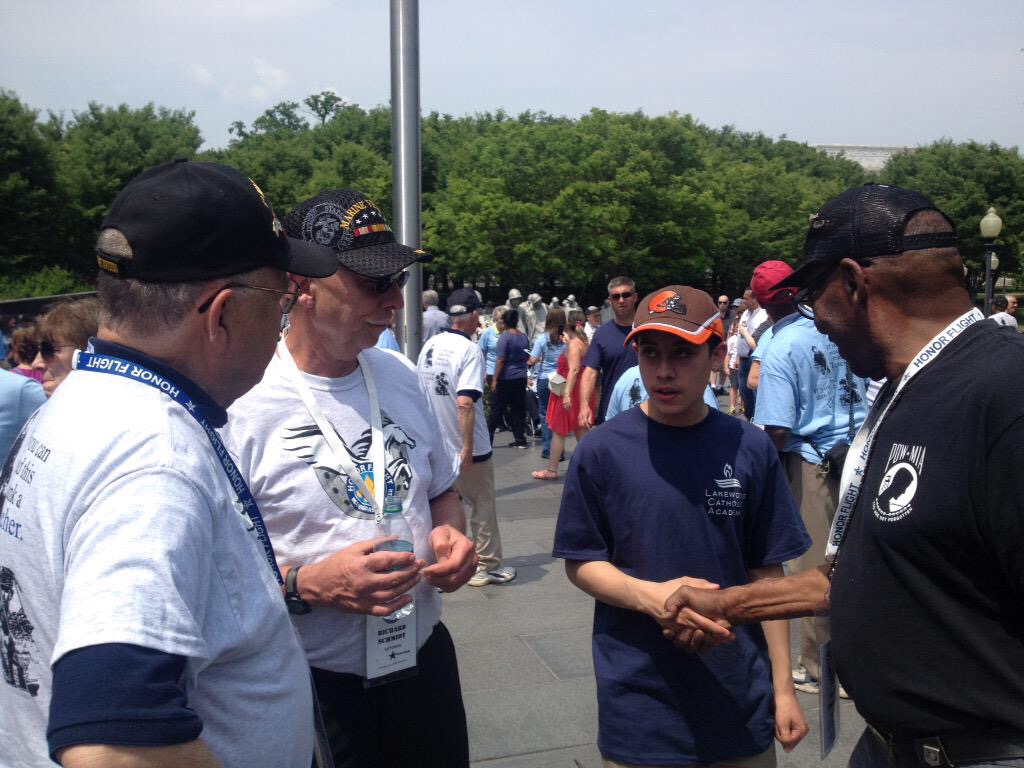
Veterans Jerry McCandless & Richard Schmidt Bringing History Alive For A Student
It was so ironic that this week’s lesson in Marciariello’s (2014) A Year With Peter Drucker was on education. Also, it is ironic that as I type this this post I am sitting in the airport waiting to board a plane for New Orleans for the American Federation for Children’s National Education Policy Summit where I am speaking on a panel on school choice and education reform. Drucker called for a systematic innovation in our schools (Maciariello, 2014). Drucker believed the heart of remediation was a “focus on strength.” He also believed we must stop “treating by patching.”
“Perhaps the time has come for an entrepreneur to start schools based on what we know about learning, rather than the old wives tales about it that have been handed down through the the ages.” ~ Peter Drucker
In September 2012 the Intelligence Unit of “The Economist“ had the United States ranked 17th out 39 countries plus Hong Kong, who was ranked third in Education Attainment, in Cognitive Skills (reading , math, and science) and Education Attainment (literacy and graduation). Bottom line: we have some work to do. “Literacy” traditionally means subject knowledge. In a knowledge society, however, people have to learn how to learn (Maciariello, 2014). The knowledge society also requires lifelong learning. For this we need a discipline of learning. We must also remember that reading is the basic skill needed for lifelong learning.
 Make sure we are aware that learning, to be most effective, should be individualized – otherwise it can be torture!
We must start with the question, “How does each of our students learn most effectively?” Then, and only then, can an individualized plan for lifelong learning be developed. The goal of teaching should be to find the student’s strengths and then focus them on achievement. Students have different patterns of learning – teachers must unlock these patterns. We need to lead our students to great achievement. We need to create a real world connection, excitement, and motivation just as our Veterans did for students yesterday in Washington D.C. This relevancy of context will go a long way in creating intrinsic motivation for the rigorous, disciplined, persistent work, and practice that learning requires. Education is a mentoring process.
Most schools and colleges are organized on the assumption that there is only one right way to learn. If we are going to be successful in truly reforming education we must differentiate the choices students have for schools. I believe in school choice, but we must actually have choices for our families, and then help them make those choices. If all schools are using exactly the same cookie cutter approach, is it really school choice? Another question to ponder in closing, “How do we create more opportunities for our students to glean from the incredible wisdom of our Veterans like Jerry McCandless and Richard Schmidt?
Reference
Maciariello, J. A. (2014). A year with Peter Drucker: 52 weeks of coaching for leadership effectiveness. New York, NY: HarperCollins Publishers.
Creating A New Future: Practice Before Theory
 “The important thing is to identify the ‘future that has already happened.'” ~ Peter Drucker
As an “Energetic Change Agent,” I was really into the week 19 lesson in Maciariello’s (2014) A Year with Peter Drucker: 52 Weeks of Coaching for Leadership and Effectiveness. If you have not begun the journey of reading this book, let me recommend it again. This week’s lesson dealt with identifying emerging trends and how that is different from trying to forecast the future. Identifying trends concentrates on directions and patterns. We must, as leaders, discern patterns from emerging trends, and separate fads from real changes (Maciariello, 2014). I have blogged about change before in other posts, but really dug into this topic in a post entitled: Change Creation is Proactive. You can read that post by clicking here.
Leaders who are effective at facilitating change capitalize on emerging trends and use them to create a new future for their organizations, thus providing a competitive advantage in times of rapid change, This is proactive, not reactive! Again, as was stated in the Drucker quote, this is an exercise in “seeing the future that has already happened.” To create the future any other way is reacting rather than acting, which is what one does if one grows quickly. We need to make sure to study the trends and look for the ‘certainties’ of the future. One place to look for this is in the demographics. One important part of change that I believe was left out of this lesson, and may be discussed in future weeks, is how some organizations ability to create the new future will be impaired by legislation and other government misunderstanding or slowness to adjust. An example is my own: education. As I look back to this year’s legislative session here in Indiana there was a lot of work around education. It is interesting to me that our House of Representatives is very pro “school choice” and innovative practices such as online education, but our Senate is not. Some of our legislation passed is helpful toward the ‘new future,’ but part of it still does not necessarily hinder practices for facilitating futuristic change, but certainly does not serve as a catalyst either.
Therefore, it will be important for us, as leaders of these affected organizations, to help all involved in decision/policy-making to understand the methodology that Drucker outlines to identify “the future that has already happened.” As I describe what Drucker calls the “seven windows of opportunity,” (Maciariello, 2014) think about online education as an example. Online education is already here and I believe everyone would agree it is not going away – nor should it go away. Amazingly, however, there are those that continue to try to block any legislation or policies that help to improve or make online education more effective. So we (and leaders of other such change) will need to help all of those involved understand the seven sources that Drucker outlines as: (1) unexpected success or failure, (2) incongruities, (3) process need, (4) a change in industry or market structure, (5) demographics, (6) changes in perception, (7) new knowledge (Maciariello, 2014). I believe you can extrapolate the implications of the seven windows to your organization. I believe in my own case we have done a pretty good job beginning to work on windows 5, 6, and 7, but we need to continue to put the whole package together to continue to move our cause for the students we serve forward.
“Theory organizes the new realities, it rarely creates them.” ~ Peter Drucker
As a rule, theory does not precede practice (Maciariello, 2014). Decision and policy-makers in government and organizations need to remember this. They need to understand, and few do, that events that have already occurred do not fit their present-day assumptions, and thereby create new realities. We must make sure our policies and structures support “the future that has already happened.”
What steps are you taking to turn future trends and needs into your advantage?
Look for “the future that has already happened” and turn it into an opportunity for innovation. If you do this, you can become an effective change leader. If you are a policy or decision-maker, please make sure you are thinking about how you can support “the future that has already happened.”
Reference
Maciariello, J. A. (2014). A year with Peter Drucker: 52 weeks of coaching for leadership effectiveness. New York, NY: HarperCollins Publishers.
 Byron's Babbles
1 comment