Leadership is Responsibility
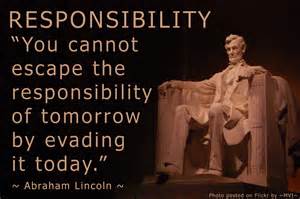 This week’s entry in A Year With Peter Drucker (Maciariello, 2014) deals with integrity in leadership. By posing the question “What do leaders stand for?” (p 369), Maciariello (2014) posits that leadership inspires trust and commits leaders to viewing the world as it is and not as they wish it to be. This is why core values are so important. I believe that the organization needs strong core value and then individual team members must be selected that have core values that match and compliment the organization’s. What a leader stands for is much more important than specific personality traits.
“By the way, the [great] CEOs I have known – and I have know quite a few – did not see themselves as supermen. They built a team. They were team leaders. ~ Peter Drucker
Effective leaders go to work on the priorities of the organization rather than those tasks they thought were going to dominate their tenure. In my world as a school leader it has been very important to have core values about what is best for students. I have had the opportunity to see the school’s and teachers’ core values develop organically in this this past year. Education is not unlike many industries in that it is so complex and ever changing. In fact, it is probably more complex and fluid. Leaders therefore must be continuous learners and surround themselves with experts in areas necessary to solve present and emerging problems. 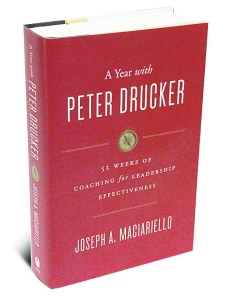
“Values, like nutrients that sustain an organism, also sustain an organization.” ~ Joseph A. Maciariello
Maciariello (2014) uses two of our great Presidents to drive home his points in this entry. Both Abraham Lincoln and Harry Truman are lauded for the strong individuals they surrounded themselves with. I would add that it was the set of strong, well developed core values that gave both of these great men the ability to do such a great job of selecting their cabinets and generals. By understanding their own core values and truly living them, Lincoln and Truman were both able to navigate the selection of individuals whose own core values were the same. When we study the history of the times of these great men we find that even in personnel struggles, those Lincoln and Truman struggled with had like core values. These men had to lead in extraordinary times and certainly were not doing the normal day to day tasks of most Presidents – at least at that time.
“It is also the business with these values, the business that believes it exists to contribute rather than just to take, that will weather adversity. In good times, values may look like an ornament. They may be treated – and frequently are – as something we can indulge in as a “nice little extra.” It is in times of adversity, in times that try a man’s soul, that values are a necessity. For if the right values are absent at such times there is no incentive for human beings to walk the extra mile, to make the extra commitment, to do the hard work of rethinking strategy, of trying new things, of rebuilding.” ~ Peter Drucker
This quote by Peter Drucker (Maciariello, 2014, p372) really sums up why I am so blessed to have been a leader of a high school and now a school corporation in turnaround mode. I have truly experienced why core values are so important. As Drucker said, core values become ornaments in good times, but a necessity in adversity. I have learned why it is important to not let core values only be words on a page. All decisions, in good times and bad, must match a leader’s personal core values and the core values of the organization.
At the end of the lesson Maciariello (2014) poses the question of “What are the espoused values in your organization?” (p 373) The word espoused means what do we say we intend to do. I like that Maciariello used this word because what we say and what we do are many times two different things. If the core values are just espoused then they are just ornaments, probably posted on a plaque somewhere – fair weather values. So, my question to you is; Are your and your organization’s core values just espoused, or are they real guides that are used everyday to make the important strategic decisions of your organization?
Reference
Maciariello, J. A. (2014). A year with Peter Drucker: 52 weeks of coaching for leadership effectiveness. New York, NY: HarperCollins Publishers.
Values Define Your Unique Leadership Identity
 Leaders know what they value. They also recognize the importance of ethical behavior. The best leaders exhibit both their core values and their ethics in their leadership style and actions. Your leadership ethics and values should be visible because you live them in your actions every single day. People know what to expect if leaders have identified and shared their core values, living the values daily – visibly will create trust. To say one sentiment and to do another will damage trust – possibly forever. As Manning (2015) pointed out in The Disciplined Leader it is not only important for leaders of lead according to their values, but the leaders core values must also align with the values of the organization they work for. Our unique leadership identity is made up of our core values. As a leader, choose the values and the ethics that are most important to you, the values and ethics you believe in and that define your character. Then live them visibly every day at work. Living your values is one of the most powerful tools available to you to help you lead and influence others. Don’t waste your best opportunity.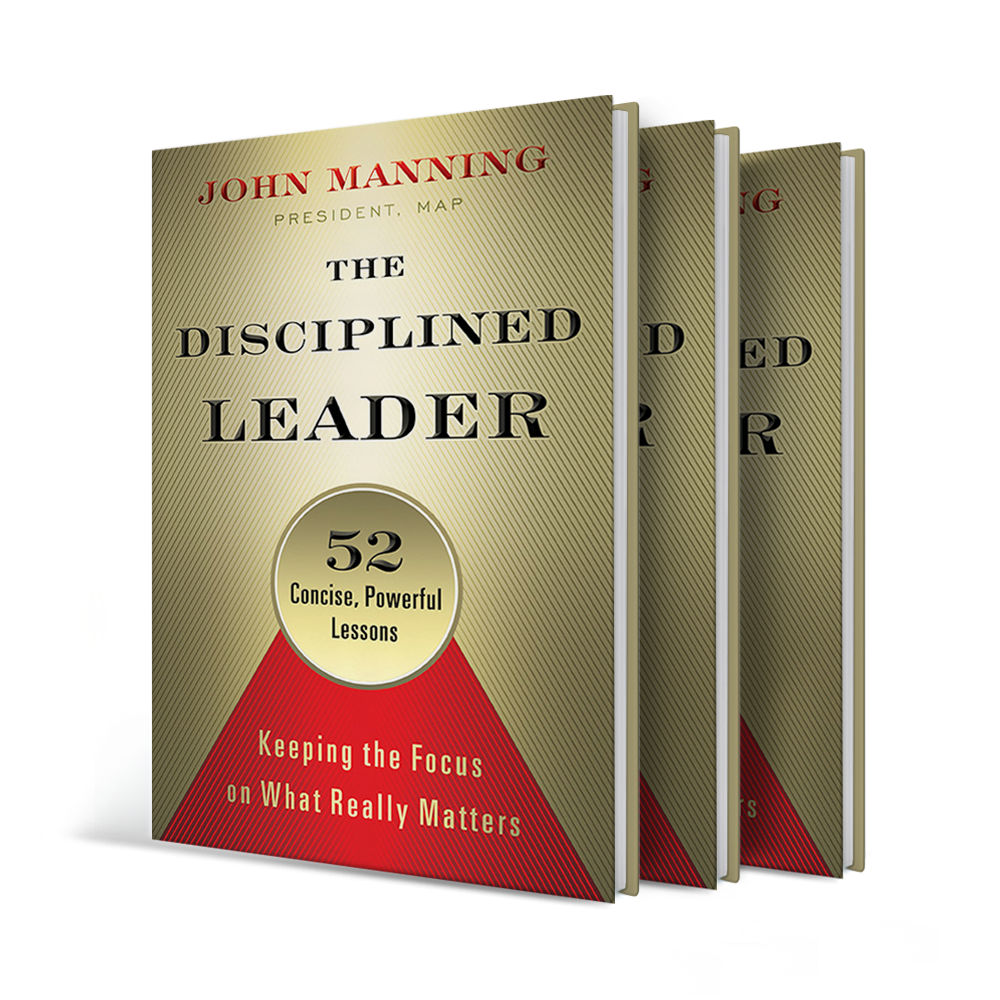
Bottom line, the role of leadership is to add value to other people and the true measure of leadership is influence, thus a great leader must have the ability to change the attitude or behavior of others. Therefore values must be aligned to key decision making. Organizations must also determined what the core values of that organization will be. We have really been working on this becoming a part of the DNA and culture of the schools I lead. This has to be so much more than just words on a paper. I was so proud this past week when I was meeting with some members of our team to make some decisions and one of them referenced our core value of putting students first. In fact, she said, “You know, this is a pretty easy decision if we truly want to put students first ahead of the adults this decision will affect.” She even pointed to our graphic we are using to represent our vision, mission, and core values. I thought, “Wow, it does not get any better than this! We are truly changing the culture and really using our core values, not just printing them on a page.” We all need to use this example to guide us to use our core values to proactively and consistently guide our personal and organizational decisions.
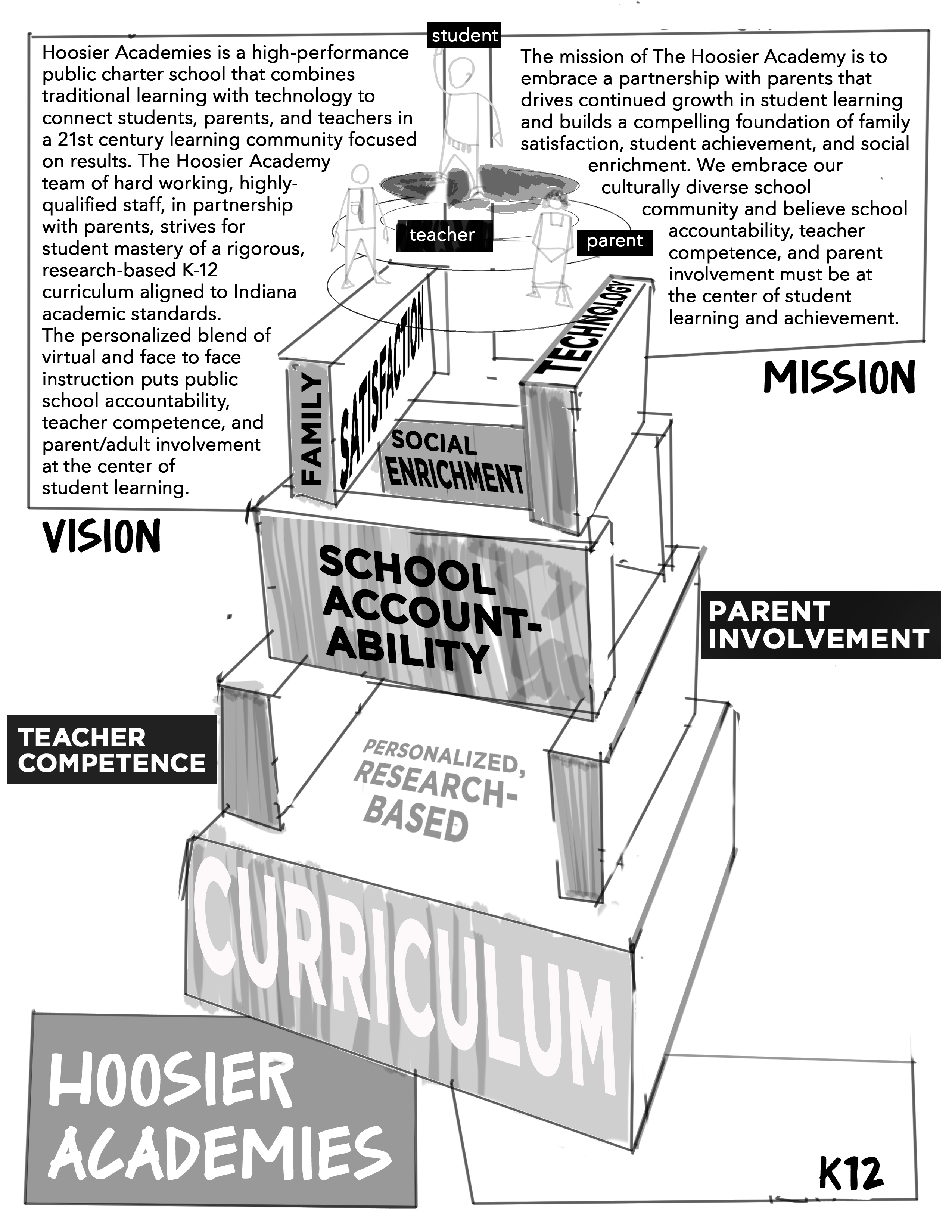
Students Are At The Top of Our Core Value Structure!
- Living the values
- Teaching the values
- Recognizing the values
- Hiring new people based on the values
- Reviewing people based on the values
- Letting people go based on values
In this week’s entry, Manning (2015) also reinforced points 5 & 6. Many CEOs don’t make it because their core values don’t match those of the organization they lead. My goal for the organization I lead is to clearly communicate and integrate our school’s core values with all the processes and operations of our school. This should result in higher employee engagement and making sound decisions based on our #1 core value of putting students first. This also plays into another important leadership point of making sure that all team members understand his or her role in carrying out the vision, mission, or strategic plan of the organization. Understanding, living, and making decisions based on the core values of the organization goes a long way to making this possible.
“Disciplined Leaders regularly reference their values in critical decision making and rely on them when they are stuck between “a rock and a hard place.” They use them to establish specific direction and get confirmation about those choices they’ve made.” ~ John M. Manning
For me, as a leader I must continue to developed my leadership style around my personality and values, and in the end, actions are consistent with what I truly believe. As Goethe said: “Things that matter most must never be at the mercy of things that matter least.”
References
Hyatt, M. (2012). Platform: Get noticed in a noisy world. Nashville, TN: Thomas Nelson.
Manning, J. (2015). The disciplined leader: 52 concise, powerful lessons. Oakland, CA: Barrett – Koehler Publishers, Inc.
Knowing Your Mission & Purpose
A Graphic Representation of Our Organization’s Study of our Mission & Vision. Thanks Mike Fleisch!
We are working on this very process right now in the schools I lead, Hoosier Academies. I have attached some visuals of our work in this area thus far. It is our desire that this process go so much further than just having words. We want our mission and vision to truly represent the shared purpose of all stakeholders in putting students first. By doing so, we can then budget on purpose, structure on purpose, staff on purpose, program on purpose, and strategic plan on purpose. We must know our mission because not everything is in life is worth doing. Without purpose it is hard to discern what is worth doing. In week 45’s lesson in A Year With Peter Drucker (Maciariello, 2014), five reasons for being purpose driven:
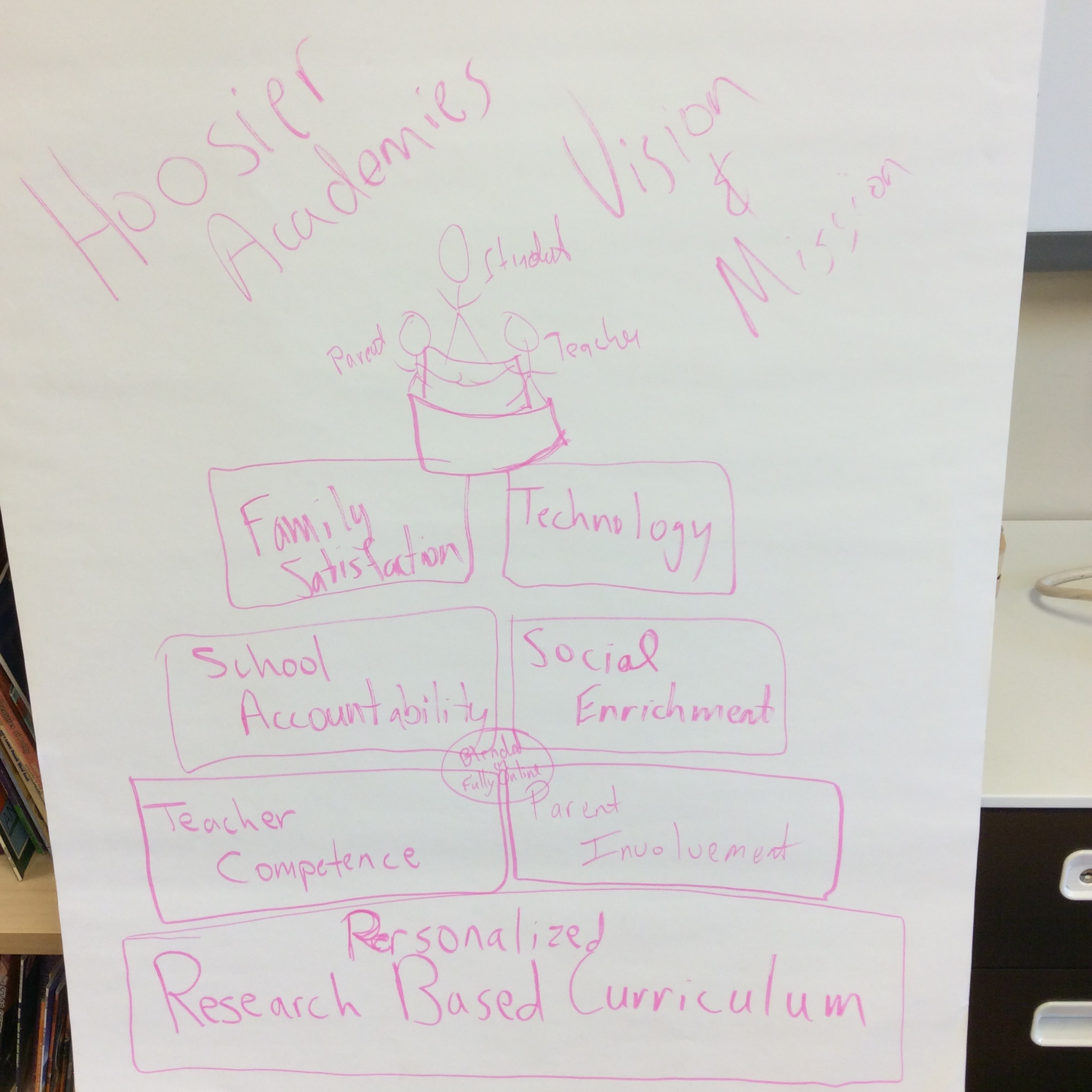
1st Draft of Our Graphic Study of Our Mission & Vision
- Purpose builds morale.
- Purpose reduces conflict in organizations.
- Purpose provides vision.
- Purpose allows concentrating.
- Purpose provides a system of evaluation.
Drucker (Maciariello, 2014) posited that a theory of business needed three parts to be successful. First, there needed to be defined assumptions about the environment of the organization. Second there must be a specific mission. Drucker put this so well, saying, “The assumptions about mission define what an organization considers to be meaningful results – they point to how it envisions itself making a difference in the economy and society at large.” (Maciariello, 2014, p.353) Finally, core competencies define where an organization must excel in order to maintain leadership.
 One of the main reasons we are going through this process right now was driven home by the fact that a mission must be tested against reality. Our schools had not taken a look and really studied it’s mission and vision since the start of the schools. No mission lasts forever. Also, we have to remember what Drucker (2014) taught, “Knowledge is a perishable commodity.” (p. 355) We must not procrastinate if our mission and vision are obsolete or no longer match our purpose. Additionally, we must rethink the assumptions and core competencies on which our mission and vision are based and update the premises on which our organizations are operating. I always have to remind myself and our team to stay focused on the things our organization must do extremely well in order to succeed in carrying out our mission. You will notice in the graphic representation of our mission and vision we chose to use a Jenga theme (I will be doing a post dedicated to the process we are using with our Graphic Facilitator, Mike Fleisch, later). We really think in the case of a school this is such a great way to look at our purpose, vision, and mission using because we have the student at the top, but if any other area fails it brings down the tower and does not allow us to carry out our core value you of putting students first. We must support those areas of required excellence by offering continuing professional development and education.
Reference
Maciariello, J. A. (2014). A year with Peter Drucker: 52 weeks of coaching for leadership effectiveness. New York, NY: HarperCollins Publishers.
The Sheer Guts of Leadership!
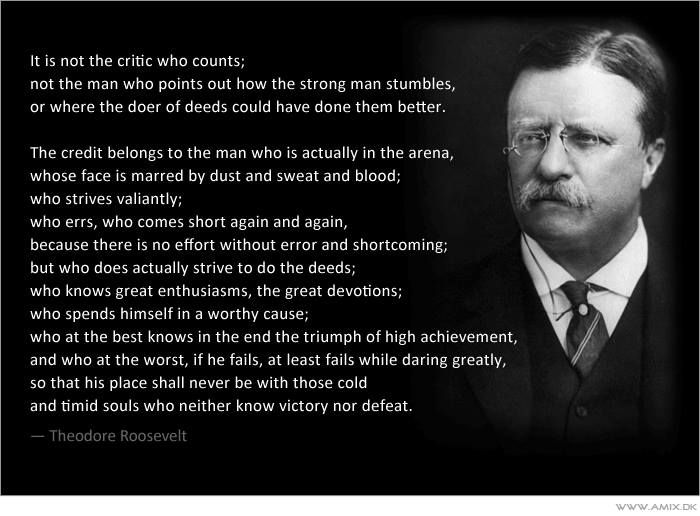
It’s hard to believe it is already time for Lesson #2 in our learning with John Manning in The Disciplined Leader. Without courage it is impossible to focus on what really matters (Manning, 2015). In my case of having now taken on the exciting and important work of leadership of two failing schools, I can tell you courage (or just sheer guts) is a necessary prerequisite skill. Courage is necessary just to get me through those days when I say, “What the heck am I doing here!” You ever had one of those days? If you haven’t I honesty feel sorry for you because you truly have not been in what Theodore Roosevelt called the “arena.” His entire thought is in the picture above. Doing significant work that matters puts us in that “arena” and makes us vulnerable and the focus of our critics. I love how Manning (2015) puts it: “…great leadership isn’t about facing fears but taking positive action in spite of your fears” (p. 17).
Manning (2015) gives us three great ways to find our “sheer guts:”
- Look the Fear in It’s Face. In other words, recognizing your fear and then determining what you need to discipline in order to act against the fear. In my case I know I need to study to obtain current information, pertinent data, facts, figures prior to a media interview, panel discussion, presentation, or speech to overcome any fear of not knowing an answer to a question.
- Create a Plan of Attack. In my case I have trusted professionals I can go to, as advisers, to help me analyze what information I might need and help me to obtain the information I need for the example I used above. Then I study! But, as Manning (2015) points out: “to admit you do not always have the answer is more a show of strength than weakness” (p. 19).
- Acknowledge When You Succeed. I learned a long time ago that we need to learn to be nice to ourselves. In other words we need to show compassion for ourselves when we are not perfect, make mistakes, or when things go well, too. Scrutinize and self-reflect on what went well and how we made that happen and how to repeat the process.
 In the “Take Action” part of this week’s entry, Manning (2015) advises us to look to a role model for courage. That leader for me is Indiana Speaker of the House, Brian Bosma. He has taken many courageous stances during his career, but when it comes to education, he has an unwavering belief in School Choice and doing what’s right for Indiana’s children. These are things that I also believe very strongly in. When the Speaker appointed me to the Indiana State Board of Education I asked him what success in that role would look like to him. He had a simple, three word, but very powerful answer: “Consensus to Implementation.” Think about this answer. Really, doesn’t it take a great deal of courage to go through the process of reaching consensus and doing the hard work of implementation. This was a tremendous leadership lesson for me and I use it daily in evaluating myself and other leaders I come in contact with. The Speaker modeled this when he formed his Education Kitchen Cabinet this past year to act as a sounding board on education issues. It was exciting to experience him actively listening and processing all of the different views and opinions. Whether you agree with Speaker Bosma’s or my core beliefs or politics is really irrelevant here. The most important lesson here is that he models the three ways Manning (2015) has described having what I am calling, “The Sheer Guts of Leadership.”
Reference
Manning, J. (2015). The disciplined leader: 52 concise, powerful lessons. Oakland, CA: Barrett – Koehler Publishers, Inc.
Lazy Leaders
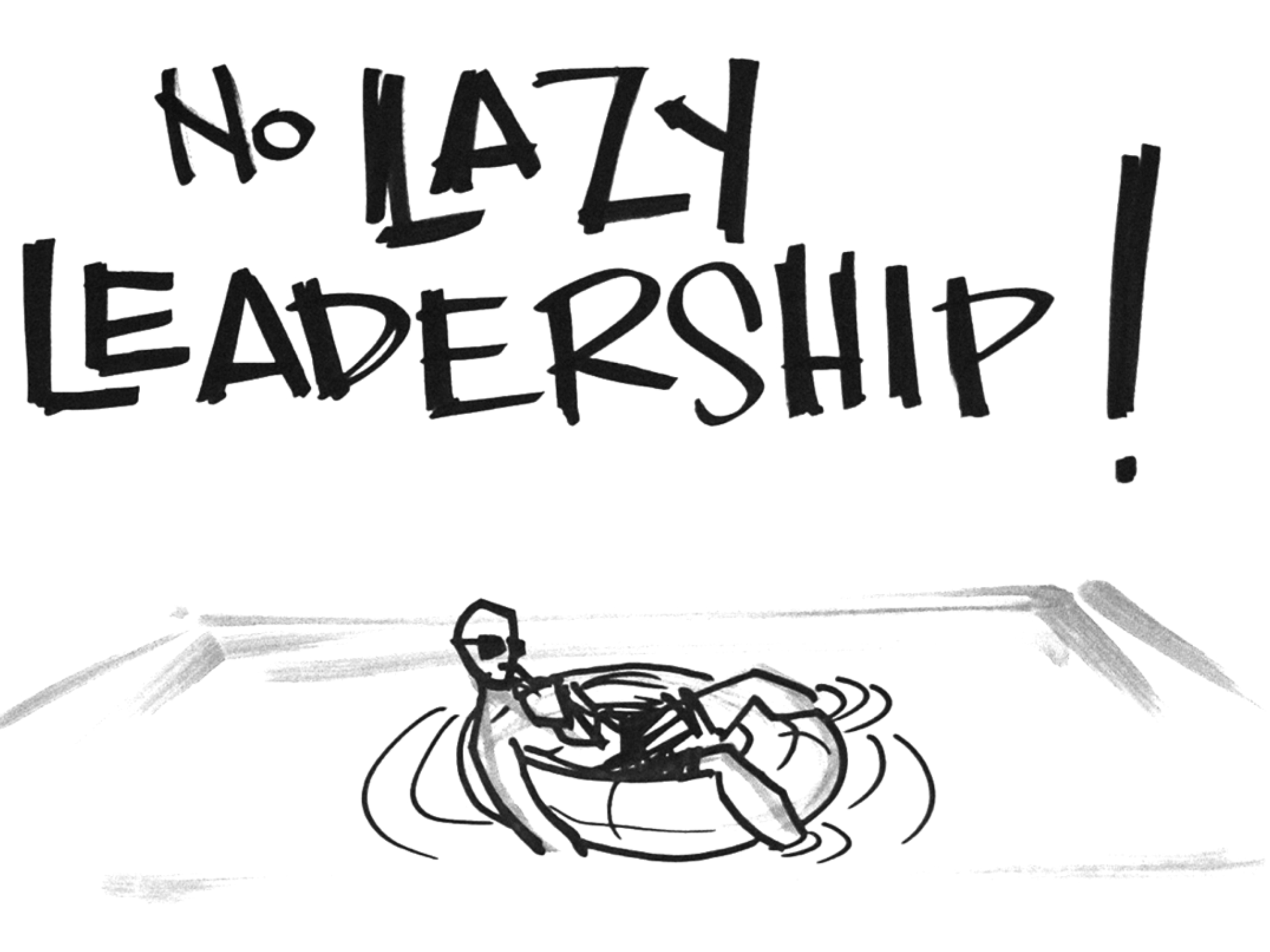
Hoosier Academies Focused Leader Academy Graphic by Mike Fleisch
I have seen this so many times in many organizations and in my own industry as a school leader. As a person who has come in to help school teams turn schools around, I have heard so many teacher leaders say, “we were always told this idea does not fit the model.” Then when I ask the question of who said that, we find that no one did except the lazy leader who did not want to go to the trouble of making the change or explaining (selling) the change throughout the organization.
Lazy leadership really goes beyond the example of the widget itself. Probably the worst effect of lazy leaders and lazy leadership is on the organization’s culture. Imagine a culture where you are always told, “no, we can’t do this or change that because…” At some point you would just decide that your knowledge was irrelevant. We know that this would then translate to the most important component of employee satisfaction – engagement. Research tells us that the happiest employees and the ones that stay with organizations the longest are the ones that truly believe they are valued and making a difference. These same employees have been empowered and have a clearly defined role in carrying out the vision and mission of the organization. Research tells us that this level of enagagement is much more important than even salaries.
 Lazy leaders may just be one of the biggest crushers of culture there is. So, how do we keep ourselves from falling into the lazy leadership trap? You are caught in the quick sand of lazy leadership if you catch yourself telling one of your team members that your superior will never agree to a change suggested by someone on your team without trying to lobby for the change. Furthermore, let’s do a Jeff Foxworthy parody.
“You might be a lazy leader if…
- You move on with a decision without finding out the real answers.
- You don’t delegate because you don’t want to have to help others hone and develop their skills.
- You delegate by “dumping and running.” What I call “relegating.” You have to help people know the vision, understand a win, and stay close enough in case they need you again. New leaders are developed, loyalty is gained, and teams are made more effective through delegation.
- You give up after the first try. No one likes to fail. Sometimes it’s easier to scrap a dream and start over rather than fight through the messiness and even embarrassment of picking up the pieces of a broken dream, but if the dream was valid the first time, it probably has some validity today.
- You don’t invest in the young and up-and-coming leaders. There’s the whole generational gap — differences in values, communication styles, expectations, etc. It would be easier to surround ourselves with all like-minded people, but who wins with that approach — especially long-term?
- You settle for mediocre performance. It’s more difficult to push for excellence. Average results come with average efforts. It’s the hard work and the final efforts that produce the best results.
- You don’t explain “why. “Just do what I say” leadership saves a lot of the leader’s time. If you don’t explain what’s in your head — just tell people what to do — You maybe get to do more of what you want to do. The problem is, however, you will have a bunch of pawns on the team and one disrespected, ineffective and unprotected king (lazy leader). (And, being “king” is not a good leadership style by the way.) Continually casting the vision and connecting the dots is often the harder work, but necessary for the best results in leadership.
- You avoid any kind of discourse. If there was only answer, solution, or innovation who needs a leader?
So, let’s get out there and excercise our leadership muscles and not be lazy!
Social Ecology: Creating Voracious Learners

“The starting point for management can no longer be its own product or service, and not even its own market and its known end-users for its products and services. The starting point has to be what customers consider value. The starting point has to be the assumption – an assumption amply proven by all our experience.” ~ Peter Drucker
Peter Drucker fancied himself a social ecologist. This was a person who attempts to spot major future trends in society that are discernible but not widely understood (Maciariello, 2014). I would posit that these persons are also pioneers, but that pioneers many times don’t do the social ecologist part. Drucker had a methodology the social ecologist should follow for the creation of emerging institutions that included four parts:
- Understanding their function
- Understanding the disruptions they create for existing institutions
- Thinking through how they could be made to function effectively
- Thinking how the new institution will have a constructive impact on society
As a pioneer who tries to practice artful leadership this really hit home for me. We need to make sure that in education we take the time as begin new, innovative, and disruptive innovations to really think through and strategically think about Drucker’s methodology. We must also diffuse innovation throughout the entire education system to those affected by emerging trends and help them to capitalize on those trends. We must become a “teaching education system,” one devoted to the diffusion of innovation.
This week’s lesson in A Year With Peter Drucker prompted me to put Everett Roger’s seminal book, Diffusion of Innovations (2003) on my book reading list. Roger’s book is the standard reference on how innovations spread throughout a social system. I cannot wait to read this book! In order for our innovations which will create disequilibrium to become viable and do all the good possible we must become “voracious learners” (Jim Mellado in Maciariello, 2014, p. 301). This is key to spreading new ideas and innovations to the majority that need them the most.
“The adoption of an innovation usually follows a normal, bell-shaped curve when plotted over time on a frequency basis.” ~ Everett Rogers in Diffusion of Innovations, p. 272

We must consider abandoning unjustifiable products and activities; set goals to improve productivity, manage growth, and developing our people. This will create resources to explore and undertake new innovations. We must not forget, however, to employ Drucker’s methodology as social ecologists and become voracious learners.
Maciariello (2014) had three great practicum prompts for this: “What are the risks of being an early adopter of innovations?” What are the risks of being a laggard?” “Where is the optimal place for you and your organization to be on the innovation diffusion curve?” Make plans to get there. 
Reference
Maciariello, J. A. (2014). A year with Peter Drucker: 52 weeks of coaching for leadership effectiveness. New York, NY: HarperCollins Publishers.
Everett, Roger, M. (2003). Diffusion of innovations (5th Edition). New York, NY: Free Press.
Finding & Implementing Best Practices
“So I began this concept of Just For Kids, an effort that, to me, raises the essence of the {education} problem: too often no one is focused on the needs of the education establishment, whether it is the teachers union, or administrators, or this group or that group; or it’s this group that wants school prayer, or this group that wants something else. Very seldom are things really looked at from the viewpoint of the child.” ~ Tom Luce, Founder of Just For Kids, speaking to Peter Drucker
One of the problems with public education is that sometimes people do not approach the issue from a systems-wide approach. Additionally there must be an easier, more efficient way of diffusing knowledge and innovation. In the entry this week in A Year With Peter Drucker it is discussed how educators and educational leaders do not learn everything they need to know in the schools of education (Maciariello, 2014). I don’t believe this is new to any of us in education, but I’m not sure we’ve done everything we can about it.
It is also worth noting again, as I did in my post Multidimensional Missions: Don’t Create A Flea Circus, it is necessary to meet the needs of a number of separate stakeholder groups, and meeting these needs very often requires leaders to make trade-offs. You have to affect the delivery system but you also have to affect the political environment, you have to also deal with public opinion. Sometimes, if we are honest, we also become smug and self-satisfied inward looking school systems (Maciariello, 2014). This is why having an accountability system that is appropriate and student-centered is so very important.
Education in the knowledge society is much too important to be left for schools to do alone. All institutions of society should be involved in continuous learning and teaching. Technology should be used as a tool to increase the effectiveness of education. The technology will be significant, but primarily because it should force us to do new things rather than do the same old things better (Maciariello, 2014). Technological advances in education should allow more time for our teachers to individualize instruction for our students by identifying strengths and weaknesses. We should also use technology to make professional growth opportunities more available and find better ways to share innovation.
Innovations in the form of best practice dos and don’ts must be diffused through the educational system.
Reference
Maciariello, J. A. (2014). A year with Peter Drucker: 52 weeks of coaching for leadership effectiveness. New York, NY: HarperCollins Publishers
Teacher of the Year Learning Continues in 2015!
 Today was one of my favorite days of the year. As an Indiana Teacher of the Year, I was part of the selection committee for the 2015 Indiana Teacher of the Year. Today we held the interviews for the top 10 finalists. As always, I was inspired! Click here to see the listing of this year’s top 10. I am so inspired each year by how great these teachers are and come away refreshed and rejuvenated as a school leader. During the interview I take copious notes to inform our decision making at the end of the day, but also take personal notes that I use for my own professional growth. Last year I wrote a post entitled Teacher of the Year Learning and this year I thought I would do the same. For this year’s post I am going to provide you a bullet point list of all the comments, phrases, and learning that I jotted down today.
Here is the list:
- We must match teacher goals to individualized professional development
- What steps should be taken to reach the goals?
- Implementation plan
- Feedback needs to be provided regarding progress toward goals
- Purposefully select books for libraries that give a window to the world
- “One of the things that makes me, me is…”
- “I’m either going to fail forward, or being totally successful!”
- “I’m just as much a learner as they [students] are.”
- “I [teacher] lead sometimes, and they [students] lead sometimes.”
- We should be blogging our thoughts instead of just journal-ling
- Use formative assessments before even approaching summative assessments – this needs to be balanced
- Diversity is not always visible
- Teacher effectiveness starts at the local school – the school must have a process that supports growing highly effective teachers and teacher leaders
- The community drives instruction
- Share the gifts that you have
- Read the book: 7 Habits of Happy Kids
- Read the book: Mindsets in the Classroom
- “Clustering” – bringing in students who aren’t quite ready for the High Ability program, but are close and need extra attention to get them there
- We need to make students feel welcome and loved
- We need to be writing from different points of view and exposing students to writing from different points of view
- Twice Exceptional Students – high ability students who also have learning disabilities
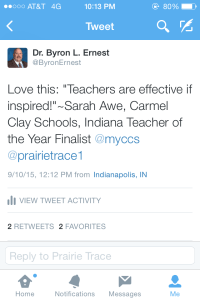
- “Teachers are effective if inspired” (my favorite quote of the day – I tweeted it)
- “Let me make a theme out of all of this”
- Blogging our journey
- If you cannot adapt to changes you will not be successful
- “Subject matter is important, but one to one contact and relationships are most important. Remember, what you are teaching today may not be the most important thing happening in a particular student’s life today”
- Ask your students: “What am I doing that is irrelevant?”
- You can’t put everyone in a box, you must individualize the instruction
- Find the students’ strengths and weaknesses
- “I evaluate myself every day”
- “Shine On”
- “Make kids first and everything else second”
- “Immediate feedback should be innate in everything we do”
- We need to love all the different experiences students bring to our classrooms
- Teacher effectiveness measures – ask the kids
- We need our students to do “authentic reading”
- We must be immersed in what matters
- We must create an environment where we have an investment in each other – this will build a true TEAM
- As a coach/mentor – the goal should be to work yourself out of a job
- We should have less required collaboration and more spontaneous/unstructured collaboration
- Poverty is the biggest issue facing education today
- Choice based classrooms –
Give students the opportunity to explore what they are interested in. Help them ask powerful questions. Give them time to explore. Students should be able to share what they have learned in a compelling way.” ~ George Couros
- We need to bookend creative lessons
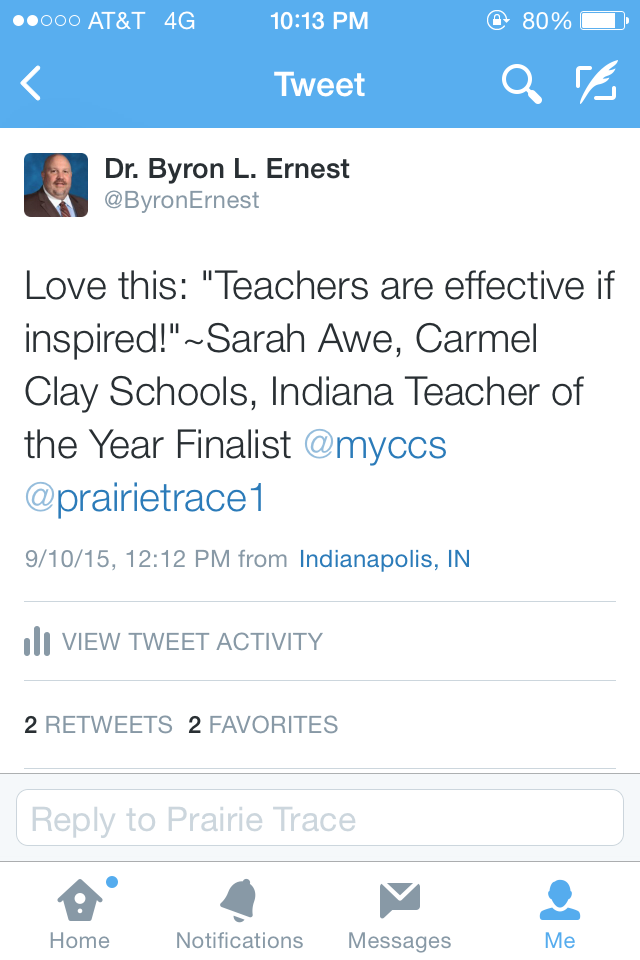
Need I say more? Again, congratulations to this year’s Indiana Teacher of the Year finalists and thanks for inspiring me today!
I think my tweet at the end of the interviews says it all:
Converting Missions To Results
 If effectively managed, social sector organizations are powerful vehicles for meeting human needs and for alleviating human suffering. They could also fulfill the needs of their volunteers for individual achievement and citizenship within a community. Sometimes we forget about the individual needs of the volunteers. This is why it is so important to have a clear mission and vision of the organization. Because these volunteers are desiring to achieve and bring good to the organization it is very important that nonprofits define performance measures congruent with the results and with their mission.
This week’s entry in A Year With Peter Drucker (Maciariello, 2014) deals with the fact that Peter Drucker believed the Salvation Army to be the most effective organization for meeting human needs and for developing its volunteers.
“The Salvation Army is by far the most effective organization in the U.S. No one even comes close to it in respect to clarity of mission, ability to innovate, measurable results, dedication and putting money to maximum use…. They know how to work with the poorest of the poor and the meanest of the mean.” ~ Peter Drucker
The management process for The Salvation Army has strong alignment. The mission is converted to results for each program. Results are in turn supported by appropriate performance measures. Programs are evaluated periodically and resources are allocated to those most deserving, on the basis of performance and need. Programs that no longer serve their original intent are abandoned (Maciariello, 2014). We could all improve the organizations we lead by taking these pages out of the The Salvation Army’s play book. For me the big takeaway was the need to convert my organization’s mission statement and the mission of the stakeholders to a definition of results for our organization and for each programmatic activity we are undertaking. Then develop appropriate performance measures for each of our direct result areas. Then the essential question becomes: How close are these new measures to existing result areas and performance measures? What changes, if any, should be made?
Reference
Maciariello, J. A. (2014). A year with Peter Drucker: 52 weeks of coaching for leadership effectiveness. New York, NY: HarperCollins Publishers.
Multidimensional Missions: Don’t Create a Flea Circus!
“If you focus on short-term results, they will all jump in different directions. You will have a flea circus – as I discovered during my own dismal failure some forty years ago as an executive in an academic institution… What I learned was that unless you integrate the vision of all the constituencies into the long-range goal, you will soon lose support, lose credibility, and lose respect… I began to look at non-profit executives who did successfully what I unsuccessfully tried to do. I soon learned that they start out by defining the fundamental change that the non-profit institution wants to make in society and in human beings; then they project that goal onto the concerns of each of the institutions constituencies.” ~ Peter F. Drucker

As a school leader, the entry entitled “Accommodating Various Constituencies in a Mission” in A Year With Drucker (Maciariello, 2014) really hit home with me. We know that single-purpose institutions tend to be the most effective. Yet as a school leader, and for the leaders of many organizations, it is necessary to meet the needs of a number of separate groups, and meeting these needs very often requires leaders to make trade-offs. I have always compared it to a train station roundabout where the engine sits on a rotating swivel and there are many tracks leading out. As a school leader I have all of those tracks to serve as stakeholders. Some of those stakeholders include: students, parents, charter authorizer, state, state department of education, education management company, school board, teachers, taxpayers, and the list goes on and on. As a school leader this list of at least nine constituencies sees the school a little differently. Make no mistake, each of these stakeholders is crucial to the success of the school. In my case, it even gets tougher when turning a school around. There are short-term gains that must be met, but sometimes it seems those gains are at the expense of long-term gains. How then can the leader reconcile the demand for short-term performance with the demand to care for tomorrow? 
First of all, it is important for leaders to consider both the present and the future; both the short run and the long run (Maciariello, 2014). A decision is irresponsible if it risks disaster this year for the sake of a grandiose future. Likewise, if the future is risked for short-term gains; that decision is irresponsible as well. Leaders must meet the critical needs of the future (Maciariello, 2014). Leaders of all organizations must try hard to reconcile the interests of each of their constituents as they manage the short-term and long-term interests of the organization. It is very difficult to reconcile these conflicting interests of constituents around short-term goals, but much easier for leaders to integrate them around the long-term vision of the organization. A clear vision is essential, but when you deal with so many constituencies it is very difficult to stay balanced in the present and future.
For success, there must be a unified, clear vision and mission for the organization. In the past this vision and mission were much easier for schools. The mission was to learn to read and do multiplication tables. Now, the vision is much broader and includes such things as development of character, personality, social tasks, citizenship, et cetera (Maciariello, 2014). Nothing wrong with any of these things, but it has sparked the argument of what learning means. Our unifying focal point has been lost (Maciariello, 2014). With so many goals to accomplish, it is hard for the organization to function according to a unified mission.
I really like how Maciariello (2014, p. 277) ties all of this together with essential questions and would like to close with these:
“List the constituents whose needs you must satisfy in your position and in your organization. How are you meeting the needs of each constituent person or group? Which demands of these various groups conflict in the short term? Can these demands be reconciled in the longer-term goals of your organization? List the constituents again. Try to reconcile the interests of each one in your long-term goals. Which, if any, cannot be reconciled with these goals? Can you release yourself and the organization from the responsibility of meeting the irreconcilable interests of these constituents?
Reference
Maciariello, J. A. (2014). A year with Peter Drucker: 52 weeks of coaching for leadership effectiveness. New York, NY: HarperCollins Publishers.
 Byron's Babbles
leave a comment