Leading The Broader Organizational Ecosystem

In some reading I was doing this morning I came across a quote often attributed to Robert H. Schuller: “The solutions to yesterday’s problems often create tomorrow’s obstacles.”
This statement emphasizes the idea that while we may find solutions to current issues, those solutions can lead to unforeseen complications in the future. It serves as a reminder that decision-making requires careful consideration of long-term consequences, not just immediate fixes. Often, what seems like a solution might introduce new challenges that weren’t initially apparent.
I often think about this like dominos. I’ve even been known to carry dominos in my pocket to meetings so I can make the metaphor even more real. You can’t knock one down without it impacting the others. Check out Leadership Dominoes for more of my thoughts and experience on this topic.
Reflecting on this also reminded me the importance of foresight in leadership. Effective leaders must look beyond immediate solutions and consider the long-term implications of our decisions. Here are some thoughts on how to do this:
- Strategic Thinking: As leaders, we should adopt a strategic mindset, anticipating potential future challenges and opportunities. This involves assessing how current decisions might affect the organization, and even society in general, down the line.
- Holistic Approach: It’s crucial for us to consider the broader organizational ecosystem and how various elements interact. This is that domino effect I mentioned earlier. A short-term fix in one area might create problems in another, leading to unforeseen complications.
- Change Management: We must be prepared to manage change effectively. Implementing new initiatives or policies often requires careful planning and consideration of how they will impact employees, stakeholders, and overall organizational culture.
- Risk Assessment: Decision-making should involve a thorough analysis of risks and benefits. As leaders we need to evaluate possible outcomes and prepare for contingencies that might arise from their choices.
- Continuous Learning: Leadership involves learning from our past experiences. Understanding how previous decisions led to unforeseen complications can help us make better choices in the future.
Overall, this concept underscores the need for us to be proactive, thoughtful, and mindful of both immediate needs and long-term consequences in our decision-making processes.
Leading Like Yahtzee
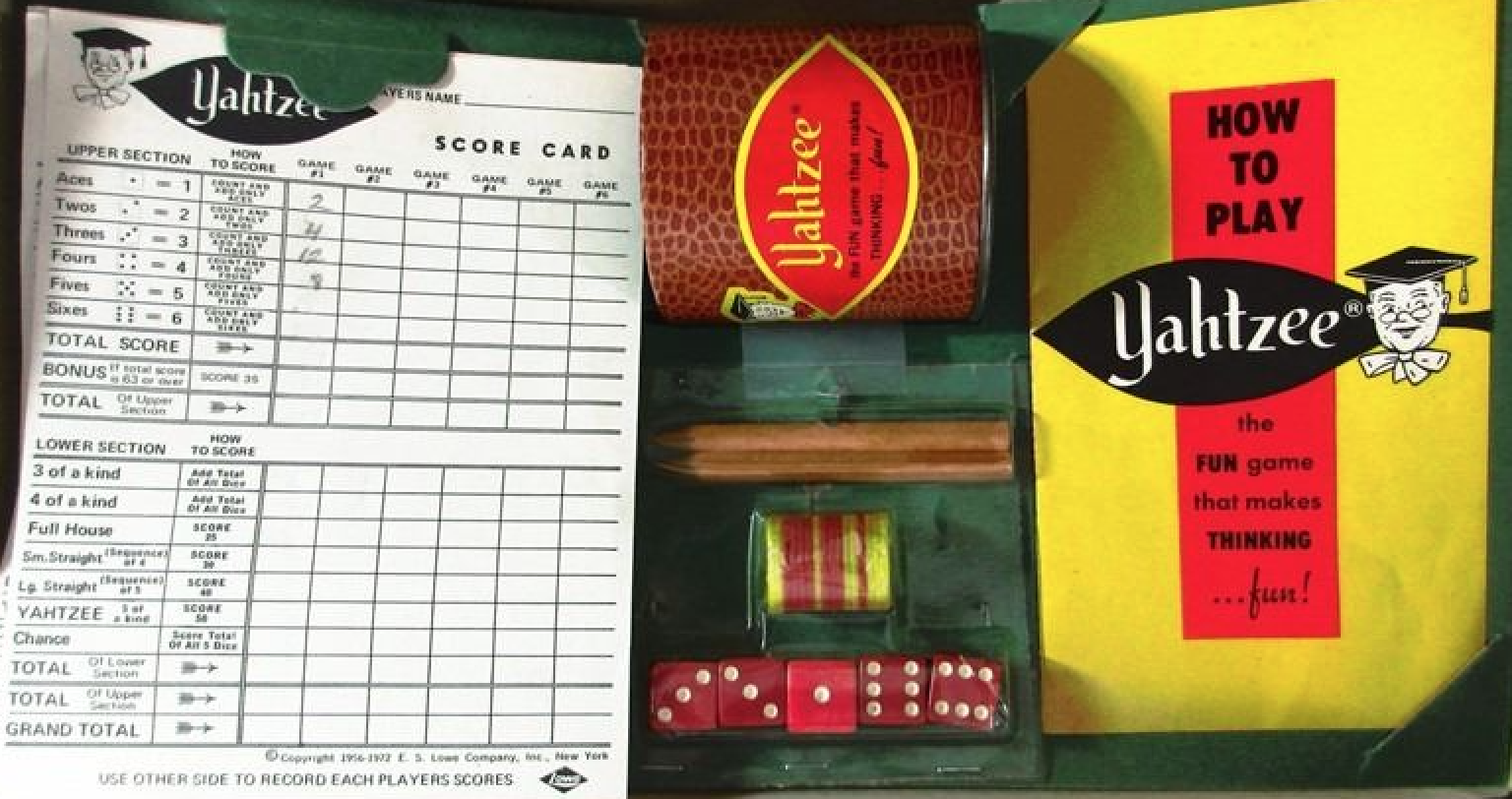
Last week in our first gathering of our newest cohort of Florida 3D Leadership Program participants, we were discussing leadership being like chess or checkers. The participants even played chess and checkers while having the discussion. We had some great discussion related to this considering things like you must know your opponent, players have limited movements, checkers is at a smaller level, checkers and chess have different missions, playing chess is more like be a principal, playing checkers is more like being a teacher leader, and strategic movement/placement. Then, one group discussed that they thought leadership was more like playing Yahtzee. The game of Yahtzee then came up again in another discussion. I finally had to come clean with the group and admit I had never played Yahtzee or even knew how the game was played. Of course after the gathering was over I had to look up the game of Yahtzee and found that the group was right, there are leadership characteristics contained in the game of Yahtzee.
Actually, on the surface Yahtzee appears to be a simple game. Each player gets thirteen turns to complete their score card. The top section of the score card consists of numbers 1 thru 6. You need to roll three ones, three twos, three threes, etc. to get your “minimums.” You could also roll four fives (or four of anything), which comes in handy if you were only able to roll two threes on a previous turn. The idea on the top section is to score at least 63 total points, so you can get the 35-point bonus. If you get a “Yahtzee!” you score 50 points. That’s when you get all five dice to be the same during your turn. Some players focus solely on getting Yahtzee at the expense of everything else. Some people really work hard count on getting the Yahtzee. From my studying, however, a balanced scorecard is more beneficial to winning the game. Balance is important in leadership as well. In education for example there must be balanced effectiveness in governance, financial health, student performance and achievement, or teacher effectiveness. Concentrating on any one of these and forgetting the rest would be disastrous to the school.
Yahtzee seems like a game of chance. It’s much more. It’s a game of decisions and imperfect trade-offs. Wow, doesn’t that sound a little like leadership. So, there is actually some genius in comparing leadership to the game of Yahtzee. We must at some point fully form our approach to decision making. Success, failure, decisions, and sacrifices are in play with every turn while playing Yahtzee. Excellent practice for leading in real time. The game of Yahtzee is completely random. But, as leaders we know that sometimes completely random things happen. Therefore, something completely random and driven by chance can be, as we can learn from playing Yahtzee, be managed within a solid set of priorities and strategies. Do you have other ways you would compare playing Yahtzee to leading effectively?
Leadership Dominoes
“Everything affects everything else in one way or another. Whether you are aware of that or not does not change the fact that this is what is happening. That’s why I say a business is a system. This systems perspective reminds us that this is what is going on. And when you see it this way, you can manage your business better. You appreciate, for example, that any action will reverberate throughout the entire company. This causes you to pay more attention to what you do, and learn the right lessons from your experience.” – John Woods
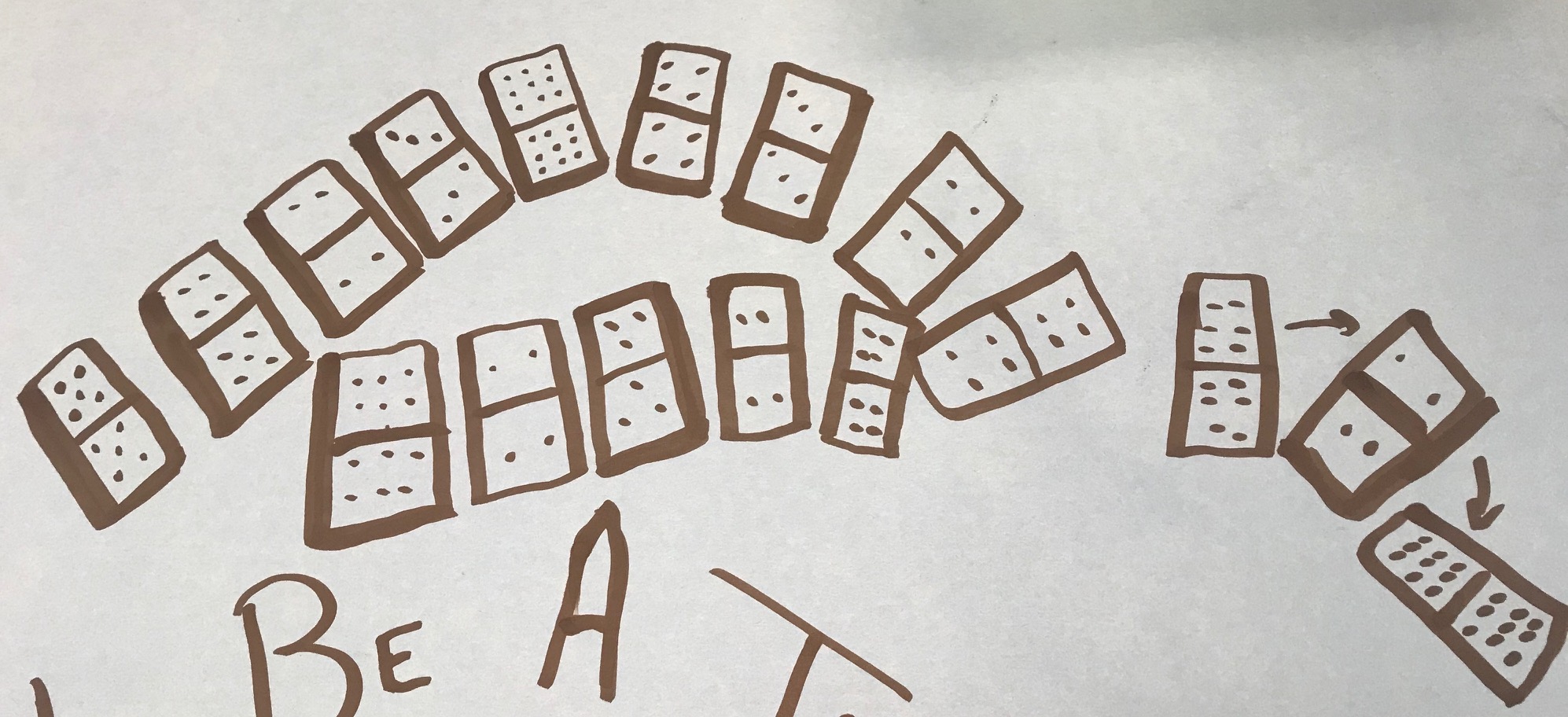
I use the metaphor of dominoes falling all the time and was reminded that everything affects everything last night at our Tampa, Florida area gathering of 3D Leadership. We did an activity carving pumpkins in the theme of “truths that frustrate me”. As a story was being told about how a Curriculum Resource Teacher (CRT) was covering classes that didn’t have a teacher, because of the teacher shortage, she stated that she loved covering the class and teaching. The problem, however, was that she was very frustrated she was not able to support the teachers that she was responsible for coaching. This really made me think about how this was really two rows of dominoes put in play. I did my best to graphically represent it (shown here in the post). The first row of dominoes was put in play when there was a teacher not available for a class. The second row of dominoes was put in play when the CRT covered the class, even though she loved doing that, and she couldn’t work with the teachers on her coaching load.
 Dominoes are actually a learning lesson when it comes to leadership. Up until the time I heard this story originating with a pumpkin carving I had thought of the domino effect in a very linear view. this caused me to think about all the other rows of dominoes that get put into play with just one decision, event, action, or mistake. Regardless of the catalyst that sets the dominoes in motion, it is some type of change. Leaders and organizations need to navigate these changes carefully and be sure the changes, or the people making the changes, aren’t like a bull in a china shop. Sorry for the use of another metaphor. We need to lead with a systemic focus. We need to take into consideration all the interconnected parts of our organizations that could set the domino effect into motion, impacting the success of the change, productivity, effectiveness and lives of those we serve.
Even though all the people and parts of your organization are not dominoes, we would be well served to treat them as such. Our organizations are interconnected systems. Changes in on area have a direct impact on changes in other areas. We need to remember that once dominoes start to topple over, it will take time to get them put back up.
 Byron's Babbles
leave a comment