What Can We Create Together?
 Every year, the Ernest family takes the first week of July as an opportunity to get away and spend time together. We have found this to be a great week because it is moratorium week for Indiana High School athletics; in other words, Heath (my son) does not have football 🏈 practice all week. Another thing I love is that when we travel we get to celebrate the Fourth of July in different places around the country. And…with the holiday, many others are off work too, and it seems the draw to do work related things is less.

This year, we are spending our week working out of York, Maine. This trip is giving us the opportunity to pick up visiting in four states (Maine, New Hampshire, Connecticut, and Vermont) that he had not been to yet in his quest to get all 50 before he graduates from high school. He will just have Alaska, Utah, Idaho, and New Mexico left after this trip. Not bad for a 17 year old. Yesterday, as we were setting up our camper, my son and I noticed a neighboring camper flying the American flag 🇺🇸 and The Gadsden (“Don’t Tread On Me Flag”). Heath and I had a discussion about the flag, Christopher Gadsden (who designed the flag), what it meant during the American Revolution, and what it means to us now. Please don’t go down the route of thinking I am on some anti-government weird movement. I’m just reflecting on our past,studying history, and what it means to our future.
“There is nothing new in the world except the history you do not know.” ~ President Harry S. Truman
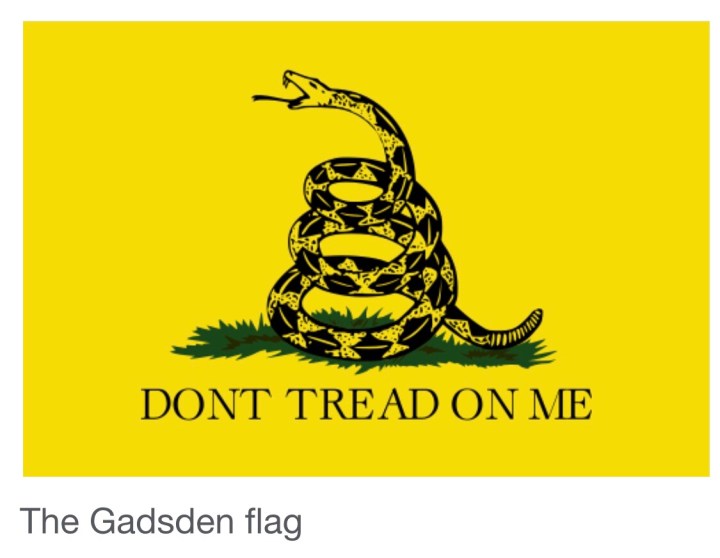 The Gadsden Flag
Many people during revolutionary war times thought the rattlesnake was a good example of America’s virtues. They argued that it is unique to America; individually its rattles produce no sound, but united they can be heard by all; and while it does not attack unless provoked, it is deadly to step upon one. I have to think 🤔 this was how our forefathers were thinking. Even though we later had some expansionist behaviors as we put the whole United States project together, there continued to be to mentality we would not go beyond our geographic boarders.
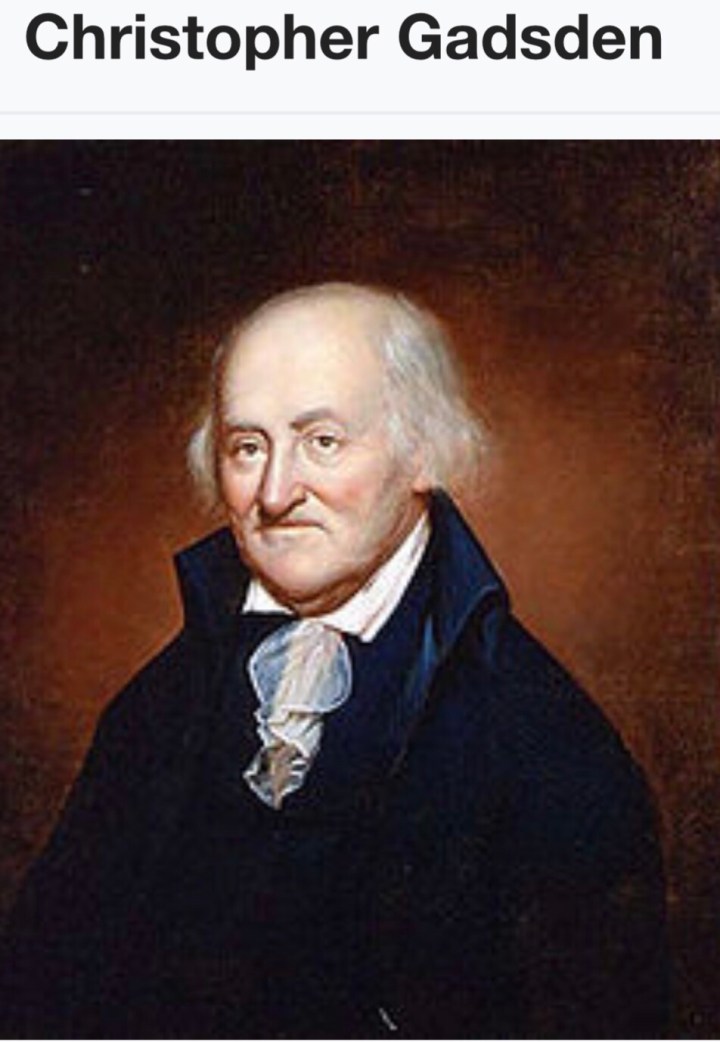 Colonel Christopher Gadsden
He was from South Carolina and really liked a yellow banner he had seen with a coiled rattle snake drawn on it, and the rest is history, so to speak. Gadsden made a copy of this flag and submitted the design to the Provincial Congress in South Carolina.
During The American Revolution
At the time of the American Revolutionary we were in a time period where intense, but controlled individualism was the dominating disposition of most people. Remember, most of the colonists had come here to escape some type of oppression. An important fact, by the way, I believe we need to remember today! This was a time when self-directing responsible individuals again and again decided for themselves what they should do, and did it without needing anyone else to give them an assignment or supervise them in carrying it out.
Does The Gadsden Flag Have Meaning Today?
YES! I want to just stop there, because I believe we must make that meaning for ourselves, using our founding fathers as the guides. It reminds me, we need to be mindful of the idea of government overreach. For me this means on a local and state level, as well as at the federal level.
And…as we know, this is not an easy thing to balance. What I see as support, you may see as overreach, and visa versus. Or, I’m reminded of pre Civil War times when decisions were made pointing to states rights, which I believe very deeply in, but states rights were being used as a political shield to not doing the right thing – abolishing slavery once and for all for the whole country. I believe this conundrum itself is part of the genius our democratic design. It allows us to debate and have discourse about how to proceed. My only wish on this week of celebrating the independence of our great country is that we take more of a stance of civilized discourse and come together as a nation of communities to develop great solutions to our challenges. What can we create together?
A KISS of Stardom!
 This week I had the opportunity to do something that I had never done before. I became Gene Simmons as a part of a team in a Battle Of The Bands Lip Sync Contest. This was part of our Carolina Schools Big Potential Leadership Conference put on by Noble Education Initiative, Inc. What an experience. Although each of the group’s members is iconic, perhaps the most memorable of them all is front man Gene Simmons, who is famous for his demonic character that breathes fire, spits blood, and engages in all sorts of outrageous behavior on stage. Here’s the deal: when we hit the stage, after an hour and a half of getting in costume and having makeup put on, I became Gene Simmons. I even spit blood. And, I didn’t lip sync. I sang every word of “Rock And Roll All Night.” Then, I spit blood (we got the fake blood capsules at a party supply place and I put the all in my mouth – what a mess) and did “God Of Thunder.” The crowd was going wild – literally. I’ve got to tell you, I did not want it to end. It was addictive.
So, what did I learn?
 Shared Vision and Enthusiasm – Everyone, regardless of her or his age, knows KISS, the band. They are the band that would wear 6-inch heels, has blue/black hair, paints their faces, and one member, Gene Simmons, who would spit blood and blow fire. Amazingly, it’s hard to find anyone who doesn’t know that. Furthermore, when my colleagues and I started our rendition of “Rock and Roll All Night” it amazed me that everyone knew the words and sang along. It wasn’t just singing, though, it was singing with enthusiasm. We could tell, the song meant something to this group. Everyone was connecting in some way to it. As leaders, that is our job to make connections. Whether that means partnerships, or connecting everyone in the organization to a shared vision.
Engagement – I did a session yesterday morning on student engagement. While I was facilitating that session I was thinking about my rock band front man experience. My job both as a facilitator and front-man was to move, affect and engage an audience. This is also true in a classroom. We must move our students toward proficiency of skill, standards, and competencies, as well as affect change in their lives, while engaging them.
 The Band Is A Team – While I acted out the part of the demonic and crazed front man part of our our band, I realized it was the other three members of our band that made it all possible. Others in the band literally got my costume ready and did my makeup. They were supporting my antics on stage and supporting me acting crazy. The lesson here is that we can never be as good by ourselves as we can be as part of a team.
We All Need A Brand or To Be A Part of A Brand – The 2016 Gallup survey information tells us that we all want to be part of a successful brand or part of an organization that is doing good in the world. KISS holds all the records for record sales for any rock band ever – including Elvis and the Beatles. Their empire is worth over 1 billion dollars and there are over 3000 branded KISS products on the market today. KISS is a rock BRAND not a rock Band. What is your brand?
Have A No Limits Attitude and Approach To Life – There truly are no limits to what you can achieve. Success is a mind set. We all need to have a growth mindset. Either you think you can achieve it, or you don’t. Never let someone else tell you what you can and cannot achieve. Control those thoughts yourself.
 Upon reflection, I got chills thinking about a few things:
- Without KISS, I wouldn’t be who I am today.
- What would the world and I be like if there were no KISS?
- What band would have been my mentor to have a no-holds-barred attitude toward going after all my dreams?
- Who would have taught me it doesn’t matter what the critics are saying because you cannot please everyone; I learned, from KISS, to go after what I believe will create change in the world?
- Without Gene Simmons I don’t have the example of a humanitarian. Simmons received the MEND Humanitarian award, for his support of Mending Kids International, which provides surgical care to children in developing countries. During his acceptance speech he said, “I don’t have the right NOT to give back and neither do you. Some mother somewhere is crying her heart out because her child can’t have what we have in this country and we can change that.” Did you catch that? “I don’t have the right NOT to give back…” I heard you loud and clear, Gene!

 As you can see, Gene Simmons and KISS has had quite an affect on me since the band began when I was 10 years old. I am so glad they have been a part of my life. I am also glad I had the opportunity this week to experience a very, very, very, very small part of what it feels like to be Gene Simmons on stage.
Leadership To Tear Down Walls
 Today, I had the opportunity to stand in Berlin, Germany where President Ronald Reagan stood in 1987 behind two panes of bulletproof glass 100 yards from the Berlin Wall at the Brandenberg Gate and called on the Soviet leader Mikhail S. Gorbachev to dismantle it. I can remember that speech like it was yesterday and to then be standing there, was awe inspiring.
Think about it, at that time it was a very powerful stage: a United States president in front of the Brandenburg Gate at the height of the Cold War, with an East Berlin security post visible behind him. President Reagan firmly said, “General Secretary Gorbachev, if you seek peace, if you seek prosperity for the Soviet Union and Eastern Europe, if you seek liberalization: Come here to this gate! Mr. Gorbachev, open this gate! Mr. Gorbachev, tear down this wall!” That is audacious leadership, and why President Reagan is at the top of my most admired Presidents list.
The effects of the speech have been debated by historians, but I will always believe it was an important part to the wall coming down and the freedom and unification of Germany. President Reagan’s speech emphasized freedom and reunification, and then ingeniously and deliberately asked for more than Gorbachev would stretch to. President Reagan saw an opportunity to undercut Europe’s perception of the Russian leader as a leader of peace. A little more than two years later, on Nov. 9, 1989, East and West Germans converged on the wall and began dismantling it after East Germany lifted travel restrictions. The country was reunified less than a year later in 1990. The wall had been in place from 1961-1989.
As a leader, President Reagan was showing us his resilience to continue working with the Soviet Union to end the Cold War. Most who listened at the time viewed Reagan’s speech as a dramatic appeal to Gorbachev to renew negotiations on nuclear arms reductions. eight months before, a summit between Reagan and Gorbachev had ended unsatisfactorily, with both sides charging the other with bad faith in talks aimed at reducing nuclear arsenals. Reagan, who had formed a personal closeness to Gorbachev during their previous meetings, obviously wanted to move those negotiations forward. In December 1987, the two met once again and signed the Intermediate-Range Nuclear Forces (INF) Treaty, which eliminated an entire class of nuclear missiles from Europe.
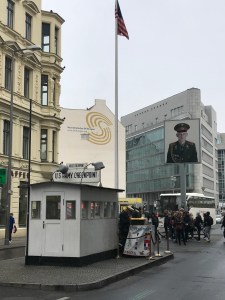 President Reagan was a great leader because of his vision. He said, “America is too great for small dreams.” I believe this is true of every organization we lead. We need to dream big. My favorite President certainly did. Great leaders are not satisfied with small dreams. Rather than trying to just gain an edge over the Soviet Union, Reagan totally dismantled the “Evil Empire”, where he succeeded. The dismantling of the Berlin Wall was just one part of that vision.
Here is what former President George Bush had to say about President Reagan, “Our friend was strong and gentle. Once he called America hopeful, big hearted, idealistic, daring, decent and fair. That was America and, yes, our friend. And next, Ronald Reagan was beloved because of what he believed. He believed in America so he made it his shining city on a hill. He believed in freedom so he acted on behalf of its values and ideals. He believed in tomorrow so the great communicator became the great liberator.” President Reagan had a huge vision and had the audacity to go after it. Because of that the world is a better place and more nations are free because of him. Do you have an an uplifting and positive vision for your organization and our country and their future. Let’s get out there and tear down the walls.
Leading Without Surprises
 In Gem #18 entitled, “No One Likes Surprises” in 52 Leadership Gems: Practical and Quick Insights For Leading Others by John Parker Stewart I was reminded that there are three types of news:
- Good news
- Bad news
- No news
Stewart told us that people love good news the most and hate no news. With this I was reminded that no one likes to be surprised unless it is a party, an award, or a call/visit from someone special we haven’t seen for a while.
We need to be reminded of this every so often (probably often). I just had a situation where I did this. It wasn’t really good or bad news (it was a good thing that I was going to be doing) but it was something I needed to discuss with those above me. I had just got busy and had not had the conversation. I was in the wrong here, make no mistake. Let me tell you, I took responsibility and apologized. By the way, it worked out ok because I work with great leaders who understand when you take responsibility for your own actions. It is best to report news at at the first point at which we know it.
“Diplomacy and timing are important; but whenever possible, avoid delaying the sharing of news (however bad) with your boss, your team, or your customers.” ~ John Parker Stewart
Now I know some of you are saying, “yes but sometimes news needs to be timed right.” I get that, but not providing news gives others the opportunity to write the narrative. My experience has been, when we allow someone else to tell and set the narrative of our news it usually is not reported correctly. Can you remember a time when this happened to you?
 So, let’s all remember, we really don’t like surprises and report information and news we have whether it’s good or bad.
A Better Boss Stays Engaged
 Guest post by Mark Miller
In the Talent Magnet, we established how important it is for leaders to Demonstrate Care. The well-worn axiom is true: People don’t care how much you know until they know how much you care. According to Top Talent, this is a highly valued trait of the women and men they want to work for.
What other attributes or best practices are often associated with a Better Boss? Well, there are some things leaders can delegate, and there are others we cannot. The second expectation of a Better Boss underscores this truth. Top Talent expects their leaders to Stay Engaged.
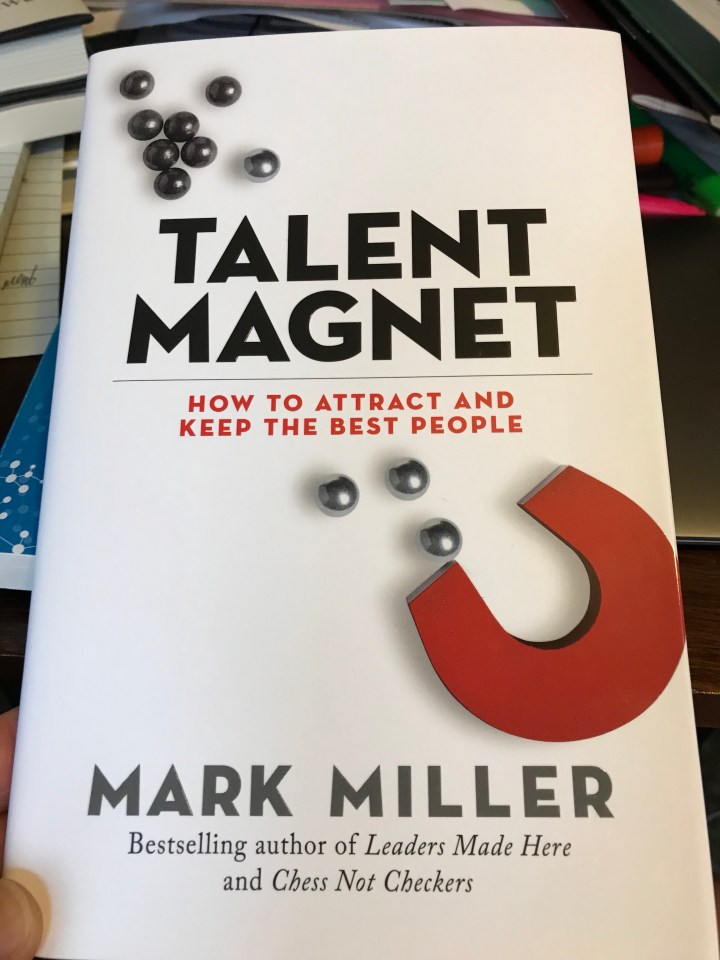 The following is an excerpt from the Talent Magnet Field Guide co-authored with Randy Gravitt.
Why do some organizations prosper while others plateau? The answer is usually found in how well they are led and in how much talent they have. As the leader, you have the ability to impact both. But in the eyes of your people, your ability to lead well is contingent on your level of engagement. A Better Boss must Stay Engaged.
Whenever we hear the word engagement it often brings to mind a wedding proposal. But great marriages are not built on a one-time engagement day. No, both the bride and the groom must remain engaged if a relationship is to flourish over time. The same is true for leaders. If they really hope to attract Top Talent and keep them energized over time, the leaders themselves have to show up – ready to contribute.
To be a Better Boss, your presence is required – not every minute of every day, but your presence must be felt. You must remain involved and stay grounded in reality. Leaders demonstrate involvement in many ways. Staying focused in meetings, listening to the opinions of others, being willing to do real work, and taking ownership when things go wrong communicates a strong message to your team.
Your responsibility is to fully lean in and Stay Engaged. When you do, you meet one of Top Talent’s most often stated expectations of their leaders: Showing up in reality – never just going through the motions.
************************************
About Mark Miller
Mark Miller began his Chick-fil-A career working as an hourly team member in 1977. In 1978, he joined the corporate staff working in the warehouse and mailroom. Since that time, Mark has steadily increased his value at Chick-fil-A and has provided leadership for Corporate Communications, Field Operations, and Quality and Customer Satisfaction.
Today, he serves as the Vice President of High-Performance Leadership. During his time with Chick-fil-A, annual sales have grown to over $9 billion. The company now has more than 2,300 restaurants in 47 states and the District of Columbia.
When not working to sell more chicken, Mark is actively encouraging and equipping leaders around the world. He has taught at numerous international organizations over the years on topics including leadership, creativity, team building, and more.
Mark began writing about a decade ago. He teamed up with Ken Blanchard, co-author of The One Minute Manager, to write The Secret: What Great Leaders Know and Do (2007). More recently, he released Chess Not Checkers (2015), and Leaders Made Here (2017). His latest is Talent Magnet: How to Attract and Keep the Best People (February 2018). Today, over 1 million copies of Mark’s books are in print in more than two dozen languages
How Do We Change This World?
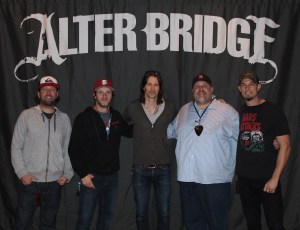
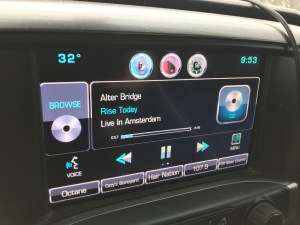 This morning as I was driving to visit with my mom I was listening to my favorite band, Alter Bridge. I would argue that no group has a line up of more inspiring songs. If you disagree, let’s have that discussion because I would love it, but that is not the point of this post. One of my top five songs from Alter Bridge is “Rise Today.” The main lyric of the song says, “I Wanna Rise Today And Change This World!” How can you not be inspired by that? But then as I sat with my mom, I got to thinking about what it, or what does it, mean to “rise today and change this world?” Particularly, when we all have different ideas of what it means to change the world.
 Then I remembered what Leo Tolstoy, the Russian novelist, so famously wrote: “Everyone thinks of changing the world, but no one thinks of changing himself.” This got me thinking that if we really want to change the world we need to think and act on changes that we need to make to ourselves. Tolstoy’s dictum is a useful starting point for any leader engaged in organizational change that will change the world. I’m convinced that organizational change and changing the world is inseparable from individual change. Most change falters because individuals overlook the need to make fundamental changes in themselves.
There are a few pieces of the lyrics of “Rise Today” that really hit home as I was reflecting on the question of what it means to change the world. Here they are:
- Have we lost our way tonight?
- Have we lost our hope to sorrow?
-
Feels like we’re all alone, running further from what’s right
And there are no more heroes to follow - Hope we find a better way before we find we’re left with nothing
-
Seems to me that we’ve got each other wrong. Was the enemy just your brother all along?
Research shows that half of all change efforts for transformational change fail either because leaders don’t act as role models for change or because people defend the status quo. Let me tell you, I have experienced this a lot lately. So as I think deeply about the five phrases I pulled from the song, it really comes down to something I learned from my studies at the Harvard Graduate School of Education: Technical vs. Adaptive Leadership. The problem is we view most things as technical challenges and they really aren’t. Technical leadership is just about applying the solution we already know to apply. An example I can think of right now to illustrate the difference is with budgets. Most think doing a budget is just a math problem – tweak here, tweak there, presto… done. That would be a technical challenge. But, with all budgeting, difficult discussions, trade-offs, staffing changes and re-deployments, and disappointments happen—this is the adaptive leadership work.
“Adaptive leaders learn to live with unpredictability. They spend less time fretting about the inability to establish a routine or control the future and focus more on exploiting opportunities.” ~ Dr. Leonard Wong
- Be able to consider diverse and conflicting views in all situations.
-
Be able to operate with autonomy under a general framework (and not just look for the easy way to be compliant).
- Model great behaviors as being both technically and and tactically proficient.
- Be mentally flexible and agile.
- Recognize and be able to navigate the gap between the way things are and the desired state.
- Understand there are multiple perspectives on the issue.
- Remembering that new learning will absolutely need to happen.
- Knowing that resistance will be triggered in stakeholders.
So, if we are going to change the world we know that behaviors and attitudes will need to change. The tough part is people with the problems are key to solving the problems. And, those groups will have varying opinions on solutions. Thus, why I believe the lyric, “Seems to me that we’ve got each other wrong. Was the enemy just your brother all along?” is so appropriate. We must also remember that with adaptive leadership, old ways need to change, and that will create a sense of loss for some (or a lot).
As I reflect on rising today to change this world, I believe we must, as leaders, not miss thinking, “What’s good, right, and just for everyone?”
Leaders Never Fully Ripen
 Gem #11 entitled, “When You’re Green You Grow. When You’re Ripe You Rot” in 52 Leadership Gems: Practical and Quick Insights For Leading Others by John Parker Stewart reminded us that when we quit learning and growing we become like an over-ripe apple and rot. This is an interesting topic because we do not want to just continue to be a green apple that has not ripened in certain areas and is not good for anything, but we do not want to ever take the attitude we have arrived – or ripened, so to speak – and we have nothing else to learn. I believe we need to look at this in terms of having “green apple” traits and “ripe apple” traits. We will always have those things, “green apple traits,” that we need to work on, grow and mature in, and develop. In other words we need to be participating in our own personal and professional growth to ripen. What we do not want to do is just be content to fully ripen where we are. Personally, I do not ever want to quit learning, or arrive.
“Look for ways to improve any aspect of your capabilities and skills. Stay fresh and green. Like good fresh apples, you will be in high demand.” ~ John Parker Stewart
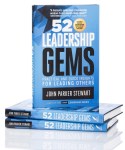 How sad is it that I have literally heard people say, “I have many years experience and am old enough that I don’t need to participate in professional development activities”? I guess these people think time is standing still, but really they are becoming over-ripe rotten apples. Being a leader means being willing to continually grow and develop. If we don’t want to become over-ripe we must develop our insights about ourselves and our areas for growth.
Leading Like Billy Graham
 With the passing of the great leader, Billy Graham, this week I feel compelled to reflect on what made him a great leader. It just so happened I was in Charlotte, North Carolina working with school leaders and teachers this week and had the opportunity to go to the Billy Graham Library, pay my respects, and reminisce about growing up with Billy Graham on our television set.
 I grew up watching Billy Graham while sitting beside my dad on the couch in our living room. Growing up in a rural Christian home, we could relate to the teachings of this North Carolina man who, as his daughter has described him, was always a farmer at heart. Little did I know at the time I was witnessing one of the greatest leaders that would ever walk the earth (besides Jesus, of course) for 99 years. Also, little did I know he was teaching me to lead like Jesus.
It has been said that there are three very important questions that leaders must answer:
- Who am I?
- Who do I want to be?
- How do I make a difference in the greater world and bring influence to others?
Certainly, Billy Graham modeled answering these three leadership questions for us. There was never any doubt who Billy Graham was. He believed in Jesus, told the stories of Jesus, and that was who he was. He led with integrity because who he was on the outside was who he was on the inside, period. That was who he was and who he wanted to be. Bottom line: he wanted everyone to know Jesus, and that was that. As we would say today, “drop the mic!”
 Furthermore, as a believer in the idea that leadership is influence, I am not sure you could name me anyone else who has influenced more people in a life span, other than Jesus of course. This morning as I was studying the day’s tweets, I came across one from Billy Graham’s daughter, Anne Graham Lotz. She had written a tribute to her dad, “Daddy Is Home.” Needless to say, I was inspired. Click here to read it, because you’ll be inspired too.
A sentence Anne wrote in the statement really stood out to me. She said, “While he may be physically absent and his voice silent, I am confident that his message will continue to reverberate throughout the generations to come.” Wow! If leadership is influence, then this says it all. Even after passing, Billy Graham’s influence of changing the world and influencing others lives on. Powerful!
“While he may be physically absent and his voice silent, I am confident that his message will continue to reverberate throughout the generations to come. My prayer on this day of his move to Our Father’s House is that his death will be a rallying cry. That tens of thousands of pastors, teachers, evangelists, and ordinary men and women will rise up to take his place. That they will take up his message like a baton being passed in a relay race and faithfully pass it on to those with whom they come in contact. Because Daddy’s message is God’s message. And it’s a message of genuine hope for the future, of love for the present, of forgiveness for the past.” ~ Anne Graham Lotz
We all look for leaders who can appreciate our vulnerability and inspire us, understand us, support us, and guide us through looming chaos. We are inspired and influenced when this happens. As leaders, we need to understand who we are, why we are doing something, and be clear about about our own core values and goals when applying our skills of influence. That way, influence comes from a place of authenticity and has the greatest impact. Remember, to be truly influential, we need to be the same person on the outside that we are on the inside.
What Do You Think?
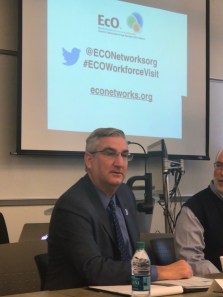
Governor Eric Holcomb
I had the opportunity to meet with an impressive group of community leaders this past Friday. As we continue to work through the guidance and implementation of our new Indiana Graduation Pathways, of which I chaired the panel that created this policy, we are working very hard to learn from the groups in the state that have been doing this work already and successfully. The Community Education Coalition and Economic Opportunities through Education (EcO) Network in southeast Indiana is one such group that brings educators, manufacturing leaders, workforce, and community-based organizations together to coordinate and align educational program offerings for students to successfully connect with well-paying manufacturing occupations.
Last year, the Indiana State Board of Education was charged with establishing graduation pathways per HEA 1003. The goal was to create an educated and talented workforce able not just to meet the needs of business and higher education, but also have students able to succeed in all post-secondary endeavors. To account for the rapidly changing, global economy, every K-12 student needs to be given the tools to succeed in some form of quality post-secondary education and training, including an industry recognized certificate program, an associate’s degree program, or a bachelor’s degree program. Every student should graduate from high school with 1) a broad awareness of and engagement with individual career interests and associated career options, 2) a strong foundation of academic and technical skills, and 3) demonstrable employability skills that lead directly to meaningful opportunities for post-secondary education, training, and gainful employment. During the process of our panel convenings we did a lot of asking, “What do you think?” Now, thanks to the Community Education Coalition we are able to continue to ask “what do you think?” as we work through making sure schools are able to put the pathways in place for students. We are so grateful that they put the event together last week that included Governor Eric Holcomb, State Legislators and Policy Makers, business and industry leaders, higher education leaders, K-12 school leaders, and most importantly students. There was a lot of question asking and learning going on.
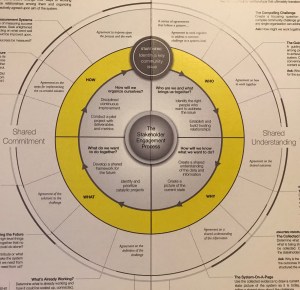 The partners and facilitators of the Community Education Coalition and EcO initiatives have learned to make inquiry a habit of mind, thereby initiating a long-term commitment to continual improvement and growth. This coalition has developed an outstanding process that uses the questions of “who?, why?, what?, and how?” in order to identify key community issues. You can bet the four words of, “What do you think? are asked in this process. Essential to the success of this process was collaboration with colleagues across different disciplines for clarifying their questions and for understanding and analyzing the data they collected. For example, data like: high school graduation rate, education attainment growth, STEM enrollment growth rate, GDP per capita, employment growth, and average annual wages are used as outcomes to measure success.
 This data is then able to be used by stakeholders to answer the questions of “who?, why?, what?, and how?” and the question of: What do you think? We are reminded of how important these four words are in Gem #7 entitled “Four Magic Words: ‘What do you think’” in 52 Leadership Gems: Practical and Quick Insights For Leading Others by John Parker Stewart. In this lesson Stewart reminds us that leaders often fall into the trap of assuming they have the right answer. I am also reminded of the teaching of one of my heroes in community work, Peter Block, who believes that effective leaders are not problem solvers, but conveners of communities of people to solve issues.
“Using these four inclusive words [What do you think?] is evidence of an effective and healthy leader who actively listens to the input of the members of the team.” ~ John Parker Stewart
All research is messy and recursive; and it has been my experience that collaborative inquiry is more so because no one knows the end. You are not starting with answers, but with questions. Throughout the process, partners reflect on what is being observed and found out. The stakeholders may change direction, ask new questions, challenge the inconsistencies they discover, seek new perspectives, and fill gaps in their information. During our gathering on Friday we were reminded over and over that the process of connecting the stakeholders is more important than looking at programs. It would be very hard to replicate programs in all parts of the state, but it would not be hard to replicate the process of deciding what programs are needed and developing programs specific to each area. It is all about bringing collaboration to scale.
To do this we must remember to ask the pertinent questions, listen, and ask “what do you think?”
The Servant Leadership: Self-Esteem Connection
 The Servant Leadership: Self-Esteem Connection
By Ken Blanchard
Originally Appeared on the Ken Blanchard Companies Blog
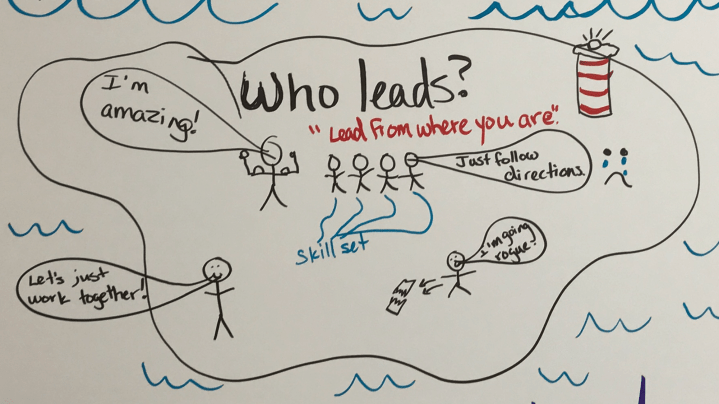
Servant leadership is best described as an others-focused form of leadership. It’s not an easy model to follow for leaders who believe in commanding and controlling their people—but it is easy for leaders with high self-esteem. Such people have no problem giving credit to others. They have no problem listening to other people for ideas. They have no problem building other people up. They don’t see praising others as a threat to themselves in any way. People with high self-esteem buy into the ancient Chinese philosophy of Lao Tzu:
“A leader is best when people barely know he exists; when his work is done, his aim fulfilled, they will say, ‘We did it ourselves.’”
Leaders who place themselves in the center of the universe and think everything must rotate around them are really covering up not-okay feelings about themselves. This is an ego problem that manifests as either fear or false pride. When you don’t feel good about yourself, you have two choices. You can either hide and hope nobody notices you, or you can overcompensate and go out and try to control your environment. I think people who feel the need to control their environment are just scared little kids inside.
I learned from the late Norman Vincent Peale that the best leaders combine a healthy self-acceptance with humility. Norman liked to say, “Leaders with humility don’t think less of themselves—they just think about themselves less.” To me, this approach sounds like a great way to begin for an aspiring servant leader.
Coaching and Self-Esteem
To me, servant leadership is a good way to describe the role that managers are expected to play today to help their people win. Judging and evaluating people erodes their self-esteem, but servant leadership builds self-esteem and encourages individual growth while attaining the organization’s objectives.
Servant leadership is something people need. Leaders need to support and help individuals in the organization to win. The days of the manager being judge, jury, and critic are over. Today, a manager needs to be a cheerleader, facilitator, and listener. Managers who are servant leaders are the ones most likely to achieve both lasting relationships and great results.
**************************************************************************************
 More about Ken Blanchard
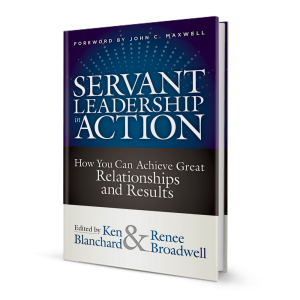
Ken Blanchard is a best-selling business author with over 21 million books sold. His newest book, Servant Leadership in Action, is being released on March 6. Ken is also hosting a free Servant Leadership in Action Livecast on February 28 featuring more than 20 authors, CEOs, and thought leaders speaking on the topic. Learn more here!
 Byron's Babbles
1 comment