Horse Power – What is the Equivalent for Companies? HumanPower
 This guest post originally appeared on the Alex Vorobieff Blog
Horse Power – What is the Equivalent for Companies? HumanPower
By Alex Vorobieff
Today, there is a lot of talk about Artificial Intelligence, AI, and computers taking over more jobs but as I write this, human beings still provide the essential power to build thriving companies. What is this power we provide? The term “Human Resources” is inadequate. The term “Human Capital” is static. A company’s power comes from its people’s ability to coordinate their efforts. HumanPower is what propels companies. We quantify car engine horse power but what is the equivalent for companies? HumanPower.
What determines whether a company thrives or slowly dies? How well its people use their experience and expertise to coordinate their decisions and actions.
Recent scientific insight has shed light on how our species of humans, homo sapiens, evolved and thrived while other species died out even though we were not the fastest or strongest. We survived because of our unique competitive advantage; our ability to coordinate our efforts.
Coordinating efforts generates the HumanPower that propels the few companies past the many that struggle, but misaligned HumanPower can also tear companies apart. For example in an Olympic rowing competition, team members rowing at slightly different paces are working against each other and diminishing their HumanPower. Understanding how to harness HumanPower is critical for growing a business successfully.
Okay Vorobieff, how do we coordinate the efforts of our people? By answering key questions that provide guidance for people within the company to make big and small decisions such as:
Why does the company exist?
• What are we really selling? (What problem are we solving for our customer?)
• Who is our core customer?
• What is essential for the company to survive and thrive?
• What are the core values essential for keeping our unique culture?
• Who is responsible for what?
• When things don’t go according to plan, how do we get back on track?
• What is the number one priority for the company?
These questions do not answer themselves. If answered, the answers are easily forgotten, or often not communicated to new team members. Most companies do not have clear answers to these questions. Over time, differing and conflicting answers evolve generating conflicting decisions and efforts or worse DeadPayroll.
How can you measure HumanPower? There is no Dynamometer to hook people up to measure a company’s horsepower. It’s easier to measure the drag than the force. Start with measuring your DeadPayroll.
You can also measure HumanPower by using the most powerful tool humans’ possess, questions. Start asking the key questions listed above to your leadership team. Let them answer separately and see if your people are headed in the same direction or are pulling the company in different directions.
Coordinating decisions and actions was the competitive advantage our ancestors used to survive and thrive in a harsh environment where survival was not guaranteed, and the same coordination will determine whether your company thrives in a competitive environment where long-term survival is not guaranteed.
 ******************************
About Alex Vorobieff
Founder and CEO of The Vorobieff Company, Alex Vorobieff is a business turnaround specialist, working to implement Business Alignment Tools for their specific needs. Alex has served as clean-up CFO and president of companies in telecommunications, aviation, aerospace, and real estate development, leading successful turnarounds in as little as three months. He shares his how-tos and techniques through Confident ROi magazine and his latest book, Transform Your Company: Escape Frustration, Align Your Business, and Get Your Life Back.
Shaking Our American Demons
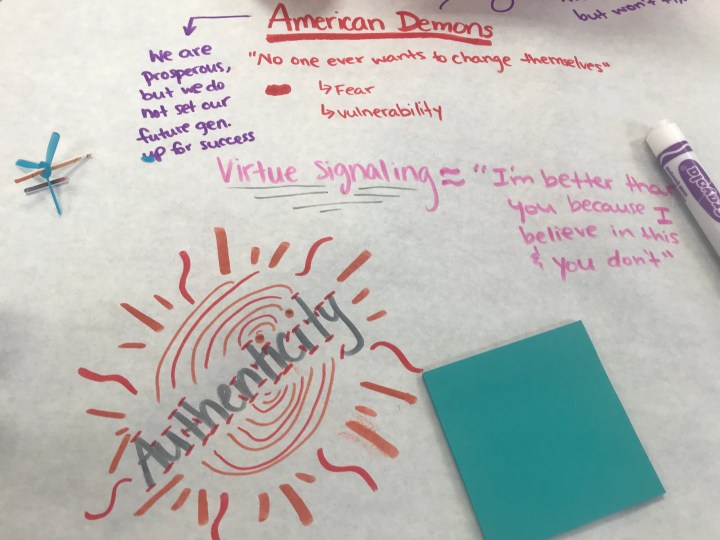 This past week I started a session of our Noble Education Initiative 3D Leadership Program by playing the song “Do You Really Want It?” by Nothing More. The participants were to listen and graphically reflect on what the song meant to them as leaders. Click here to read another post, “What Do You Really Want?”, I wrote about this song and see a music video of the song. One of the things we discussed during this pat Thursday’s session was a phrase in the song (Do You Really Want It?) that says, “We say ‘give me a sign that proves what I believe in’ So I can shake these American demons.”
 This was actually a phrase I discussed with Johnny Hawkins when on the tour bus hanging out with Nothing More a week ago. Our 3D Leadership participants discussed it in much the same way as Johnny did. They talked about how, as Americans, we are so prosperous, but we do not set our future generations up for success.
As I reflect on this great discussion I think about how we, United States Of America, are so different from other countries of the world. For one thing, we were an experiment. Plus, American independence, of course, involved more than humility. It was an act of defiance rooted in an arm-long list of grievances. While pondering all this I went back and studied the Declaration Of Independence. The Declaration was the genius of our founders. I believe it was Abraham Lincoln that posited that the founders did not need much of what is in the Declaration just to declare our independence from Great Britain.
 Our Founders, however, had the forethought, according to Lincoln, to add in these words to our Declaration Of Independence: “We hold these truths to be self-evident, that all men are created equal, that they are endowed by their Creator with certain unalienable Rights, that among these are Life, Liberty and the pursuit of Happiness. — That to secure these rights, Governments are instituted among Men, deriving their just powers from the consent of the governed, — That whenever any Form of Government becomes destructive of these ends, it is the Right of the People to alter or to abolish it, and to institute new Government, laying its foundation on such principles and organizing its powers in such form, as to them shall seem most likely to effect their Safety and Happiness.” As I continue to read these words I believe this is our battle cry to shake our “American Demons.”
I believe it was incredibly visionary that our Founders included these concepts, knowing it would not be until later, when we actually got our government and society created that we would actually be able to begin to govern accordingly, and by these core values and beliefs. I also believe we have gotten away from walking the walk of our values we declared our independence with. What if we checked all our decisions against the fact we should secure our rights of life, liberty, and the pursuit of happiness?
To me, the Declaration of Independence proclaims we are all created equal. This means that all human beings, regardless of religion, sex, or skin color, possess the same natural rights. The Founders had to know that different people are unequal in physical and mental capacities. I believe we can shake our “American Demons” by always remembering that however noticeable the differences between people may be, they are never so great as to deprive them of their rights.
Who We Are
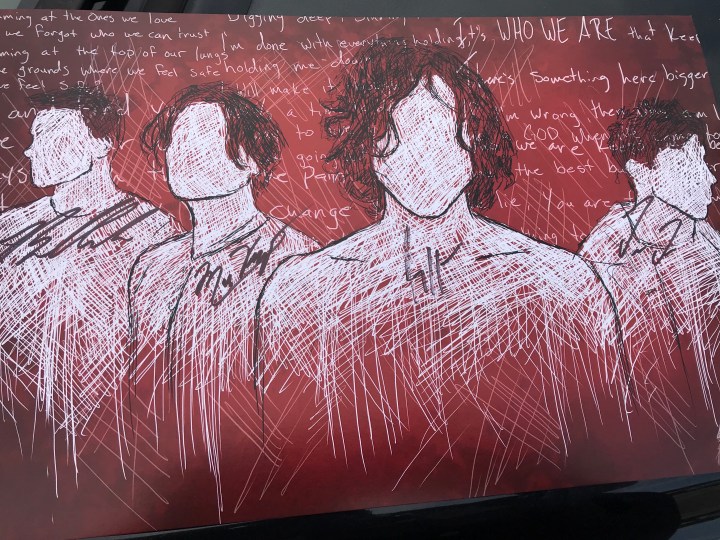 After my post yesterday, I really got to thinking about this question of being bigger than something other than ourselves. You can click here to check out All The World’s A Stage. It’s actually pretty simple, however, we are all part of something bigger than ourselves, namely the universe. We often forget this, however, and we stop looking beyond our own body, opinion, experience, well-being, and other self interests. I constantly need to be reminded that, though I am tiny and only temporarily on this earth, I can take action toward outcomes that go beyond my own life, needs, comforts, desires, gains and losses — often through shared work with others, influencing decisions, or helping, coaching, or mentoring others.
 Because it was my conversation with Johnny Hawkins, Mark Vollelunga, Daniel Oliver, and Ben Anderson, the band members of Nothing More, that really got me thinking about all this, I am going to point to one of their songs for inspiration. Honestly, I not paid very close attention to the words of their song, Who We Are, until they autographed the poster pictured here in this post, and gave it to me. It has the words to the song in the background. There’s a pretty powerful message in this song that who we are should keep us believing. Click here to watch the video of Who We Are by Nothing More.
“It’s who we are that keeps me believing
There’s something here bigger than ourselves
If I’m wrong then why am I still feeling?
Who we are, keeps me believing
Keeps me believing”
~ Chorus From Who We Are by Nothing More
This is actually very profound. Who we are is much more important than what we do. We need to focus on being bigger on the inside, our character, than we are on the outside, our influence. Think about it, if our character waivers, our influence becomes discounted. We must line our lives up with our values or we will live a life that is out of balance and devoid of the creative energy we need to achieve our true potential.
“For what will it profit a man if he gains the whole world, and loses his own soul? ” ~ Jesus in Mark 8:36
We also need to think about the chorus phrase, “It’s who we are that keeps me believing.” Think about that; it doesn’t say, “who I am” it says, “who we are.” This is profound when we think about leading or being part of our businesses and organizations, our communities, our schools, our country, or the larger aggregate of the world 🌎. Who we are and what we believe in aggregate matters. We need to create organizations, communities, countries, and a world 🌍 where we all matter.
“What we know matters but who we are matters more.” ~ Brené Brown
As it says in Who We Are, I want the “you, that’s in me, [to be] in everything.” Let’s work to create a world where we can “stand together” because of Who We Are!
All The World’s A Stage
Nothing More
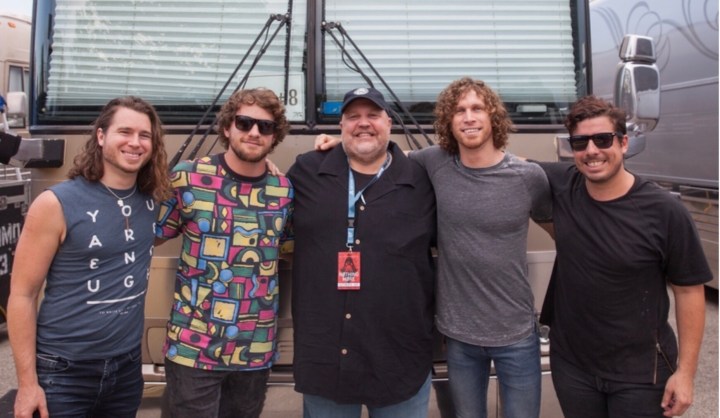
My blog post yesterday was inspired by the incredible experience I had of having the honor to spend some time visiting with the members of Nothing More on their tour bus prior to the show at Ruoff Music Center this past Friday. Click here to read Leading Without “Virtue Signaling.” As I stated in that post, Johnny Hawkins, Mark Vollelunga, Daniel Oliver, and Ben Anderson, the band members of Nothing More, are four of the greatest guys you will ever meet. Today’s post was inspired by a chance conversation as we were getting off the tour bus. Standing in the doorway of the bus, I had a side conversation with Johnny Hawkins and Mark Vollelunga about how much their music made me reflect and think. I thanked them for using their talents and taking the risk to be who they are in the music business. They knew I was using their songs to introduce leadership concepts and spur thought and discussions in the leadership development work I do. I wanted them to know, however, how much the words they were creatively arranging into music were more that just that – words or music. For example, if you want to be moved, take a moment and click here and watch Fade In / Fade Out. This song really moves me because of losing my dad early in my adult life and now having a son.
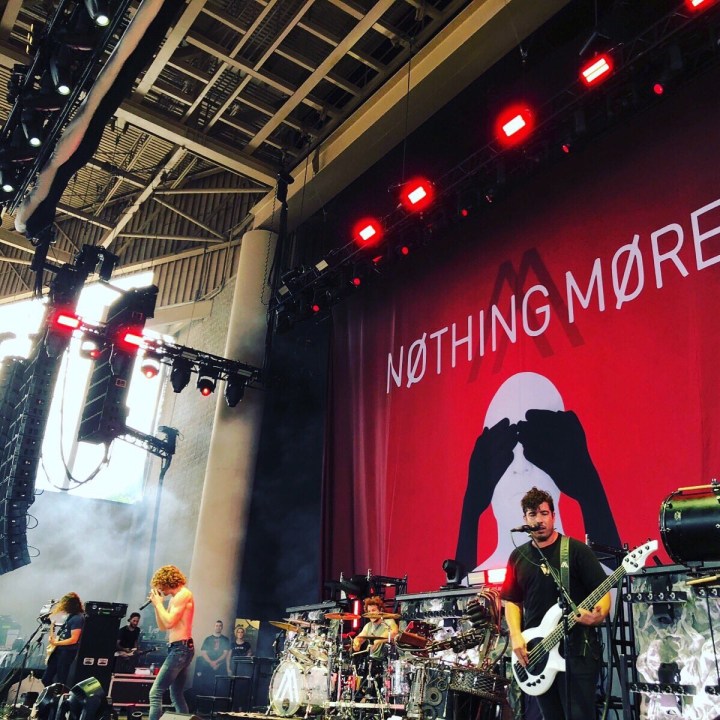
Ruoff Music Center
I believe my comments caused them to reflect for a moment. Both Johnny and Mark became very reflective and appreciative of being reminded what they do is much bigger than them. They commented on sometimes forgetting and needing to be reminded that the music they make and the shows they put on make a difference in people’s lives. Mark said, “we need to remember that and take that seriously.” Johnny said, “we get caught up in doing the next show, looking for inspiration for the next song, writing the next song, or putting the next album together, but everything we do touches others.” Think about what they both were saying – they are doing something bigger than themselves. It isn’t about them, it is about connecting with their fans and influence. And…since leadership is influence, my friends in Nothing More are leaders. They just have a different, and I would argue, more exciting platform to lead from. Always remember, we all have a platform, everyone! It is our responsibility to use it to the fullest. I also believe it is our responsibility to help those whose stage might not reach the masses of Nothing More, reach his or her potential as well.
We’ve almost made the thought of being part of something bigger than ourselves cliche’. But, we all need to think about what stage we have chosen, or what stage we have available. What platform do we have to lead and influence, because we all have one. As William Shakespeare so wisely put it: “All the world’s a stage, And all the men and women merely players; They have their exits and their entrances, And one man in his time plays many parts.” That really says it all. Think about all the lives we enter and exit. Think about all the parts we play in one day. Everyone is a leader from where she or he is, so we need to get up on stage and perform. Are you taking advantage of the platform you have right now to lead and make a difference from where you are?
Leading Without “Virtue Signaling”
Getting Ready To Get On Nothing More’s Tour Bus
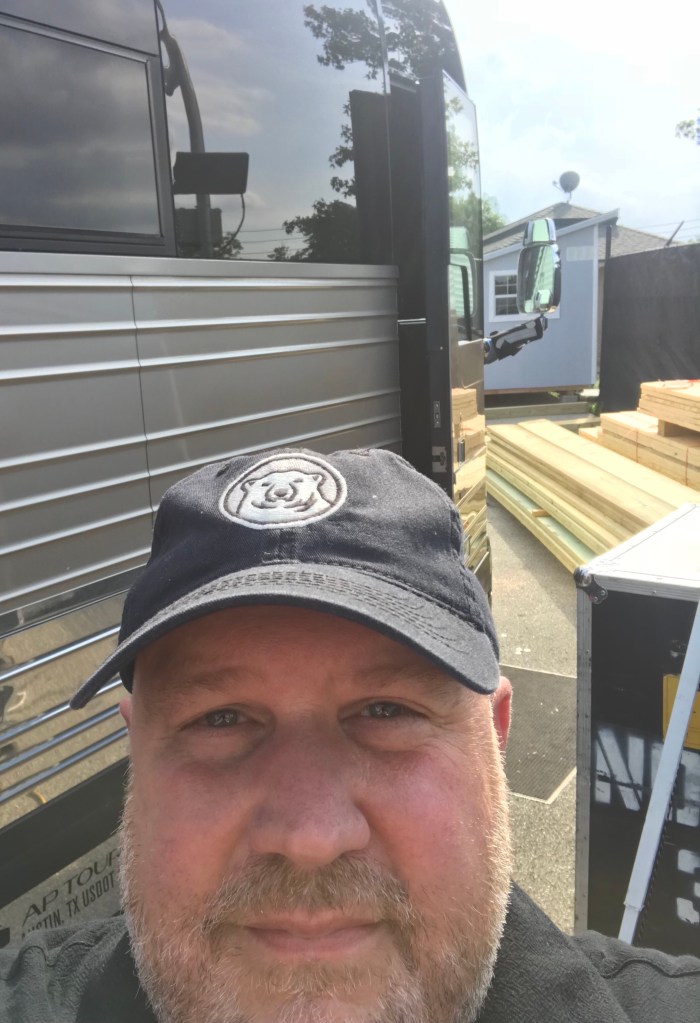
Yesterday, I had the rare opportunity to spend time on the tour bus of one of my favorite rock bands before their concert at Ruoff Home Mortgage Music Center. The band was Nothing More. Those that know me know I love rock music and still dream of being a rock star. Hey, if my idol, Gene Simmons can still be rockin’ it at age 69, no reason why I don’t still have time, right? Anyway, back to the subject of this post. I believe we all imagine what goes on in a rock band tour bus, but I’ve got to tell you I was amazed by the deep conversation we had. I gotta tell you the conversation yesterday is going to span several blog posts.
First of all, Johnny Hawkins, Mark Vollelunga, Daniel Oliver, and Ben Anderson, the band members of Nothing More, are four of the greatest guys you will ever meet. They are super friendly and very deep and philosophical thinkers. Need I say more for you to understand my gravitation toward them. So, I asked them if they would tell me a little more about one of their songs, DO YOU REALLY WANT IT?,” that I use to introduce a leadership training session I do. Little did I know the great conversation that was about to begin. As I said earlier, the conversation is going to turn into several blog posts, but this morning’s is going to be about something that Johnny Hawkins talked about that really made me pause and think; think about my own actions, as well as others.
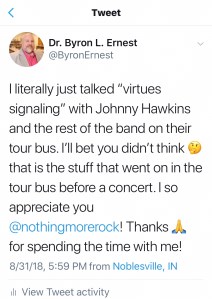 Johnny started talking about “virtue signaling.” If you would have told me we were going to talk “virtue signaling” on Nothing More’s tour bus before yesterday, I would have told you you were nuts. But, I gotta tell you, I really wanted to get back on the bus and ride to the next venue, and have one of those all night philosophical discussions. I loved Johnny’s visual description of “virtue signaling” when he took his fingers and made a circle ⭕️ symbolizing a button and held it to his chest. He talked about how this signaling is a camouflage. It’s noticeable how often virtue signalling consists of saying we hate things. Or, many times by saying we are for something, we are saying how much better we are than others. The emphasis on hate distracts from the fact we are really saying how good we are.
“Virtue signaling” is a habit we now have of indicating that one has virtue merely by expressing disgust or favor for certain political ideas, cultural happenings, or philosophical or religious beliefs. The phrase was coined by the British author, James Bartholomew. When we seize moments to throw a fit about what or who we hate, we many times are not really talking about the real issues or our philosophical differences with another person, we are just showing our vanity and try to signal to others how virtuous we are. As James Bartholomew said, “If you were frank and said, ‘I care about the environment more than most people do’ or ‘I care about the poor more than others’, your vanity and self-aggrandizement would be obvious. . . . Anger and outrage disguise your boastfulness.” In other words we are not talking anything of fact or substance. Johnny pointed out that we really need to take a step back and think about what we can do. This is much tougher than just saying we are going to solve world hunger, eliminate all racism, or make all schools great. Think about it. It is easy to say those things, but a much tougher conversation when we begin to think about what we are personally going to do.
We discussed how we talk about changing the world, but we really need to think about changing the things within the scope of what we can control or affect change. A big part of that is just changing and growing ourselves. That’s why I am so moved by the chorus in the lyrics of the song, DO YOU REALLY WANT IT? where it says, “Everybody wants to change the world, But one thing’s clear, No one ever wants to change themselves.” This is the chorus that I use for a major discussion among up and coming leaders. As you can see, this prompted an inspiring discussion that helped me grow as a person and leader that I have not even begun to scratch the surface on in this post. How about you? Do you really want it? What can you change? Are you willing to change yourself? Or will you “virtue signal” and blame others? Let’s take our “virtue buttons” of our chests and talk about substance and the issues not about the people and personalities.
Refreshingly Organic Leadership
 Humble Leadership: The Power of Relationships, Openness, and Trust by Edgar H Schein
My rating: 5 of 5 stars
This is a refreshing change to other leadership books and theories that have multiple steps that really only work in an ideal culture or environment, or when everything is going perfect. Humble Leadership is not about doing this and then that; it is about building authentic relationships and trust, and then letting the group growth and development happen organically. This book starts out by posing the question as to whether the leader makes the culture, or the culture makes the leader. The authors also posit that leadership exists at all levels and everywhere in the organization. This helps the reader view leadership as multidimensional as opposed to a two-dimensional, top-down hierarchy. Humble Leadership is about relationship building and trust. Humble Leadership teaches the reader how to be adaptive and practice adaptive leadership while letting the individual team members and organization grow in an organic way. There were great examples of how Humble Leadership works with the Air Force Thunderbirds and David Marquet’s turning around of the Navy submarine, USS Sante Fe. This book is a must read for all leaders who want a culture where every person is empowered to be a leader and is working to make the organization great.
The Implications of What We Call “Level 2” Relationships at Work
 The following is an excerpt from Humble Leadership
The Implications of What We Call “Level 2” Relationships at Work
By Ed and Peter Schein
Organizations today are doing all kinds of experiments in how work is defined and are showing great flexibility in how roles and authority are allocated. What we see in these experiments is that they encourage relationships that are more personal. Bosses, direct reports, team members, and resources from other teams are making it a point to get to know each other at a more personal level, fostering more openness and, in time, more trust and the psychological safety to speak up and be heard.
In a Level 2 relationship, I convey that “I see you.” This is not necessarily “I like you” or “I want to be your friend,” or “Let’s get our families together,” but I let you know through my words, demeanor, and body language that I am aware of your total presence, that in this relationship we are working together and are dependent on each other, are trying to trust each other, and should each try to see the other as more than a fellow employee, or associate, or team member, but as a whole person. By conveying that “I see you”, we are also conveying that we will not allow “professional distance” to separate us; we are forming a personal-working bond that will not tolerate obfuscation or deception. Seeing each other as whole persons is primarily a choice that we can make. We already know how to be personal in our social and private lives. Humble Leadership involves making that conscious choice in our work lives.

Six Principles of Humble Leadership
- Humble Leadership builds on Level 2 personal relationships that depend on and foster openness and trust.
- If Level 2 relationships do not already exist in the workgroup, the emergent humble leader’s first job is to develop trust and openness in the workgroup.
- In a Level 2 workgroup Humble Leadership emerges by enabling whoever has pertinent information or expertise to speak up and improve whatever the group is seeking to accomplish.
- The process of creating and maintaining Level 2 relationships requires a learning mindset, cooperative attitudes, and skills in interpersonal and group dynamics.
- An effective group dealing with complex tasks in a volatile environment will need to evolve such mindsets, attitudes, and skills in all of its members.
- Therefore, Humble Leadership is as much a group phenomenon as an individual behavior.
***********************************************
About Authors
Edgar H. Schein is Professor Emeritus from the M.I.T. Sloan School of Management. He’s a pioneer in organizational studies, organizational culture and leadership, process consulting, career development. Ed’s contributions to the practice of O.D. date back to the early 1960s and continue with the recent publication of Organizational Culture and Leadership 5th edition and now Humble Leadership, co-authored with Peter A. Schein, co-founder of OCLI.org who brings 30 years of hands-on experience in large and small companies leading growth initiatives in Silicon Valley.
A New Approach to Leadership
 The following is an excerpt from Humble Leadership
A New Approach to Leadership
By Ed and Peter Schein
This book introduces a new approach to leadership based more on personal relationships than transactional role relationships.
The good news: employee engagement, empowerment, organizational agility, ambidexterity, innovation . . . all of this can flourish in the rapidly changing world when the fundamental relationship between leaders and followers, helpers and clients, and providers and customers becomes more personalized and cooperative.
The bad news: continued deception, scandals, high turnover of disengaged talent, safety and quality problems in industry and health care, all the way to corruption and abuse of power at the highest levels of industry and politics, driven by financial expediency and the obsession with retaining power as primary success criteria . . . all of this will continue to happen as long as leader-follower relationships remain impersonal, transactional, and based on the roles and rules that have evolved in the current culture of management that still predominates in our hierarchical bureaucratic organizations.
The Leader-Follower Relationship
“Leadership” is wanting to do something new and better, and getting others to go along. This definition applies as much to senior executives developing new strategies, new purposes, and new values as it does to a group member down in the organization suggesting a new way of running a meeting or improving a process to drive better results. Both the word new and the word better remind us that leadership always refers to some task that can be improved and to some group whose values and culture will ultimately determine what is better.
What is new and what is better will always depend on context, the nature of the task, and the cultural values that are operating in the group or organization that is doing the work. What we later may label as “good or effective leadership” thus always begins with someone perceiving a new and better way to do something, an emergent leader. Our focus will be not on the individual and the desired characteristics of that emergent leader, but on the relationships that develop between that person and the potential followers who will have influenced what is finally considered to be new and better and who will implement the new way if they agree to try it. Those potential followers will always be some kind of workgroup or team, so our focus will also be on the relationships between them. They may be co-located or widely spread in a network, and their membership may change, but there will always be some kind of grouping involved, hence group dynamics and group processes will always be intimately involved with leadership.
*************************************
 About Authors
Edgar H. Schein is Professor Emeritus from the M.I.T. Sloan School of Management. He’s a pioneer in organizational studies, organizational culture and leadership, process consulting, career development. Ed’s contributions to the practice of O.D. date back to the early 1960s and continue with the recent publication of Organizational Culture and Leadership 5th edition and now Humble Leadership, co-authored with Peter A. Schein, co-founder of OCLI.org who brings 30 years of hands-on experience in large and small companies leading growth initiatives in Silicon Valley.
Community: Aggregating For Innovation
 Last week I had the opportunity to be part of a webinar with Peter Block, author of Community: The Structure of Belonging, 2nd Edition. I already blogged once about this webinar hosted by Becky Robinson at Weaving Influence in honor of the release of the second edition of this book last week. Click here to read, Why Does Community Matter?
During the webinar I had the opportunity to ask a question of Peter Block. My question was, as a public policy maker, how can we scale the use of community and convening of people to really solve the issues at hand; in my case in education? You can listen to Peter’s response to my question here:
This was such a deep and thoughtful answer from Peter, don’t you agree? I had to do some follow-up study to really get my mind wrapped around all of the thoughts he presented here. First of all, this idea of aggregation. There are so many ways you can use and think about the idea of an aggregate. Many times the aggregate is thought of as the whole, like a country, and then the community as part of that whole. Peter challenged me to think about aggregating as opposed to bringing something to scale. He said, “When I aggregate I bring big things and people together that do not need to be alike.” This was powerful and made me think about aggregates like components of a composite material that resist compressive stress. In other words, we need to aggregate people who are co-creating what education, in my case, needs to look like.
Peter was also very clear that legislation follows the innovation phases; you can’t legislate innovation. You innovate through experience. As I was putting this thought process together I realized the aggregation theory was so powerful because by aggregating we are developing by the merging of the differences of the people we are bringing together. Therefore, when we aggregate people together, we get a great deal of experiences to draw from. Peter also pointed out we need to make visible the people who are doing great and important things with the idea of replication. I believe an aggregate can also be made up of many different communities with diverse experiences. Across the country, we find a wide array of communities. However, when you put all of them together, we get an aggregate or the whole.
 Then we need to begin aggregating for co-creating for education (in my case), and we then get people talking to each other. I love the question that Peter suggested we should be posing when convening, “Who wants to participate with us by making it real for you?” Two other things I have learned from Peter Block are to always ask, “What can we create together?” and elected officials and policy makers need to be conveners and not problem solvers. I have always tried to take this very seriously and convene communities with no preconceived solution. This idea of aggregating really drove home the value in convening groups with a wide array of experiences and then valuing those differences – not being afraid of them.
As you can see, this was a very thought provoking webinar that caused a lot of reflection. Here is the entire webinar for you to watch:
Why Does Community Matter?
 This past week I had the honor to be involved in a webinar put on by my friend Becky Robinson at Weaving Influence. The webinar featured a hero of mine, Peter Block. I consider him to be the father of Community. In fact, he literally wrote the book on it – Community: The Structure of Belonging, 2nd Edition. The webinar was held to launch the 2nd Edition of the book that was released last week. Peter Block was introduced to me by my good friend Mike Fleisch. Mike has literally shown me all the great community work that Peter Block has done in Cincinnati. I have read Peter’s books and was excited to be on the webinar with him. Peter is truly helping to change the world.
“The best way to connect is with groups of three people with their knees 9 inches apart.” ~ Peter Block
Let me tell you, there was a great deal of content in a one hour webinar. Peter is very philosophical, but is also able to bring his philosophies and core values to a practical level as well. I want to provide you a bulleted list of some of the more salient points that I believe Peter made during the interview. I will provide you with the link to the webinar and you can make your own list later in this post. Here is my list:
- We’ve reached a limit as to what professionals can do.
- Schools cannot raise our children.
- PowerPoint pretends our conversations are predictable.
- How can you have learning, if all you have is content?
- We need to ask the question, “why did you show up?”
- All cultures value depth of relationship!
- We are afraid of the stranger.
- Working of deficiencies just makes the deficiencies stronger.
- Using community strategies creates real and concrete outcomes.
- You can’t innovate through legislation.
Wow, I just realized I created a top ten list from the webinar. I am not going to go back and number them because there is no real order to this list, but all important points that Peter covered in the webinar. I need to go back and blog about each one (we’ll see if I get that accomplished or not). So, I promised you the opportunity to make your own list. I want to provide you with the link to the YouTube video of the entire webinar, including the chance I had to visit with and ask a question of Peter Block. My next post after this one to my blog will specifically deal with my question and the conversation that followed. But for now, click here to watch the whole webinar (again my thanks to Becky Robinson and Weaving Influence for making this possible):
https://www.youtube.com/watch?v=cUPAFSbcEHY&feature=youtu.be
As you can see, this was a very powerful webinar. I would love for you to reply to this post with your top ten (or however many) takeaways you have from the webinar. By replying you will be creating the strong aggregate Peter talked about. Notice I am trying to practice the teachings of Peter by not offering my own thoughts on each of the bulleted points, but asking you to give your thoughts. I really do want to hear from you. Peter Block really is the father of using Community to change the world.
 Byron's Babbles
leave a comment