Discovering New Horizons

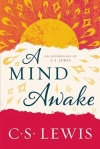
C. S. Lewis made a statement in Mere Christianity, bk 3, ch. 6, where he was referring to the idea that it’s often more enjoyable and fulfilling to learn and grow in new experiences rather than continuously chasing after the nostalgia and longing for past experiences. I was reminded of this comment when it was restated in A Mind Awake: An Anthology of C. S. Lewis. Here is what he said: “It is because so few people understand this that you find many middle-aged men and women maundering about their lost youth, at the very age when new horizons ought to be appearing and new doors opening all round them. It is much better fun to learn to swim than to go on endlessly (and hopelessly) trying to get back the feeling you had when you first went paddling as a small boy.” He was suggesting that instead of trying to recreate the same feelings and emotions we had in our initial experiences, we should embrace the process of learning and adapting to new situations, which can bring new and different joys in life.
We need to work at keeping new horizons appearing and diligently watch for new doors opening throughout our entire life:
- Embrace change: Change is inevitable, and embracing it can open up new opportunities and experiences. Be open-minded and willing to step out of our comfort zones.
- Continuously learn and grow: Always seek new knowledge and skills. This could be through reading, attending courses or workshops, or even pursuing new hobbies or interests. One of those opportunities for me most recently has been the opportunity to be a Scholar in Residence at The Kilns for the C.S. Lewis Foundation and take classes at the University of Oxford.
- Cultivate a growth mindset: I believe in our ability to learn and adapt. See challenges as opportunities for growth and see failures as learning experiences.
- Network and connect with others: When we surround ourselves with diverse individuals who can offer different perspectives new doors to exciting and new opportunities are opened.
- Set goals and challenges: Having clear goals and regularly setting new challenges for ourself can help keep us motivated and open to new possibilities.
- Practice gratitude and mindfulness: Appreciate the present moment and what we already have. This can help us stay grounded and open to new experiences without constantly longing for the past.
Remember, life is a journey, and there’s always something new to discover and learn. Embrace the unknown and enjoy the process of exploration and growth.
Being Influenced By What You Said

C. S. Lewis said, “The very man who has argued you down will sometimes be found, years later, to have been influenced by what you said” in A Mind Awake: An Anthology of C. S. Lewis (p. 150). I have found this to be so true. In fact, I’ve been on both sides of this, as the arguer and the argued. It just really reminds us how everything we do has a role in our evolution. We evolve with every conversation and action we take. I can actually think of some things that I have successfully argued for in my policymaking life that I have now come to disagree with myself on and argue against using the arguments and reason of those who argued against me in the first place.
Lewis believed in the power of persuasive arguments and the potential to change people’s minds over time. He suggested that even if someone initially disagrees with our viewpoint, they may still be influenced by our argument and come to see things differently in the future. His thoughts emphasize the importance of presenting compelling and thought-provoking arguments, as they can have a lasting impact on others.
Showing Before Explaining

Yesterday, while reading further in God In The Dock by C. S. Lewis, he said, “You must show that a man is wrong before you can explain why a man is wrong.” This really seems so basic, but as Lewis points out, we are very quick to jump to an explanation of why something is wrong, or why someone’s view is wrong without considering the most basic question of whether the person’s claim is right or wrong. This really takes me back to thinking about judging the idea, claim, or hypothesis and not the person.
Lewis argued that it is important to first establish that someone’s belief or argument is flawed or incorrect before attempting to provide an explanation or evidence as to why it is wrong. This could be seen as a way to approach discussions or debates in a logical and persuasive manner. It seems counterintuitive, but think of how many times we’ve done just that. So next time you find yourself ready to explain why someone is wrong, first consider if we can really show the claim to be wrong. There really is, as Lewis pointed out, a difference.
Stepping Outside One Experience And Into Another

This morning I continued my reading in God In The Dock by C. S. Lewis. There are so many things Lewis says that I have to think deeply about to get a handle on what he is saying. I love learning that way. This morning’s reading revealed him saying, “In other words, you can step outside one experience only by stepping inside another” (p. 214). On the surface, this comment seems pretty basic, but when reflecting it becomes much deeper. Lewis, in my opinion was emphasizing the importance of gaining new perspectives. He believed that in order to truly understand and appreciate different experiences, we must immerse ourselves in them. We can gain a new perspective or escape from our current experience by immersing ourselves in a different one. By delving into another experience, we can broaden our understanding and potentially overcome the limitations of our own perspective.

According to Lewis, exploring different viewpoints and immersing ourselves in different cultures or ideas, can break us free from our own limited perspectives and gain a broader understanding of the world around us. This can be achieved through reading, learning about different cultures, or even engaging in meaningful conversations with others who hold different views. Lewis encouraged us to be open-minded, curious, and willing to learn from others.
Follow The Argument Wherever It Leads

In God In The Dock, C. S. Lewis reminded us that “Socrates had exhorted men to ‘follow the argument wherever it led them’” (p. 126). Actually, Socrates said, “We must follow the argument wherever, like a wind, it may lead us” (Republic 394d). Socrates argued (pun intended) that one should not be afraid of questioning or challenging ideas and beliefs, even if they seem uncomfortable or go against commonly accepted views. By urging us to follow the argument, Socrates was urging us to explore and engage in intellectual discussions without preconceived biases or limitations. There is power in critical thinking and the pursuit of truth through logical reasoning.

Lewis’ statement is so true: “Each group hears not the best, but the worst, that the other group can say” (p. 127). There is a tendency for groups or individuals to only hear and focus on the negative aspects or criticisms coming from others. He wanted us to recognize this bias and strive to approach discussions and disagreements with an open mind, actively seeking out the best arguments and perspectives from all sides. By doing so, we can foster a more constructive and empathetic dialogue, leading to a better understanding of different viewpoints and ultimately a more inclusive and tolerant society.
The Inner Ring Phenomenon

C.S. Lewis wrote about inner circles in “The Inner Ring.” I would encourage you to read it. In the “The Inner Ring” was the Memorial Lecture he gave at King’s College London, in 1944. In this lecture Lewis explored the desire to belong and be accepted by an exclusive group (inner circle) and how it can affect individuals. Lewis warned, “The circle cannot have from within the charm it had from outside. By the very act of admitting you it has lost its magic. Once the first novelty is worn off the members of this circle will be no more interesting than your old friends. Why should they be? You were not looking for virtue or kindness or loyalty or humor or learning or wit or any of the things that can be really enjoyed. You merely wanted to be “in.” And that is a pleasure that cannot last. As soon as your new associates have been staled to you by
custom, you will be looking for another Ring.” Here, Lewis was suggesting that being part of an exclusive inner circle will lose its allure once we are actually inside it. The charm and allure come from the perception and longing to be a part of that particular group, but once we are on the inside, we may realize that it is not as special as it seemed. In other words, the exclusivity itself may not provide the satisfaction or fulfillment that one might expect.
Lewis used the metaphor of the onion in “The Inner Ring.” He posited that the inner ring is like peeling an onion – once you have succeeded, there is nothing left. I am going to guess you are all like me and have been parts of inner circles. Additionally, I would guess we have all worked in environments with a distinct inner circle we were not a part of. I have worked for two organizations that had/still have distinct inner rings that I was not invited into. Nor, were most of the others really doing the work. It’s toxic to a great collaborative work community. Especially when the top, hierarchically speaking, person is the ring leader (pun intended). This also, as you well know, in our government and law-making circles (again, pun intended).
“Sweet is a legacy, and passing sweet
Lord Byron quoted by C. S. Lewis in “The Inner Ring”
The unexpected death of some old lady.” ~ Lord Byron
While Lewis acknowledges that being part of an inner circle is not inherently bad, there can be negative aspects associated with it. Wanting to get into an inner circle can can lead to being seen as exclusionary. The negative in some situations is that the inner ring can lead to the formation of cliques, or other exclusionary, behavior which can and create feelings of create isolation an and rejection unhealthy sense for those who of are not included. Additionally, seeking validation among the group or self-worth members. solely from Inner rings can also perpetuate an exclusive inequality and favoritism group that is unhealthy and limiting personal growth for those both in and outside the ring. An inner circle can shut out others who may have valuable perspectives and contributions to offer. It’s important to foster inclusivity and recognize that meaningful connections should be formed outside an inner ring.
I close with the recognition that it is in our very nature to desire being in the inner ring. Lewis told us, “…at all periods between infancy and
extreme old age, one of the most dominant elements is the desire to be inside the local Ring and the terror of being left outside.” We just need to remember it is never as satisfying on the inside as it looked from the outside and is terrifying when we realize we are no longer on the inside.
A Might Be

In the book Perelandra by C.S. Lewis, the phrase “A might be” really intrigued me. The protagonist in the book, Elwin Ransom, represented the human perspective and was referring to the concept of potentiality or what could possibly be. It reflected the idea that everything in existence has the potential to become something else or to undergo change. It suggests that there are endless possibilities and potential outcomes in the universe.

I do believe we have endless possibilities and potential. As humans, it is our role and responsibility to explore and discover those possibilities and potential outcomes. We have the ability to think, reason, and make choices, which gives us the power to help shape all that goes on around us. It is up to us to use our potential wisely and make decisions that not only benefit ourselves but also contribute to the greater good of humanity and the universe as a whole. What might be?
Wonder Woman Leadership

I got back into the U.S. today and had the chance to turn the television on. I watched no television while I was in England. It was time to sneak some screen time! When I turned on the television an old episode of Wonder Woman was on. I just kept watching the 1977 Season 1 Episode 14 because Diana said to Wonder Women (Lynda Carter), “I don’t think he is much of a war hero.” Diana thought one of the stars of a movie being made using actual military heroes was a scared lier. Wonder Woman replied saying, “sometimes that has to do with something called ego.” The war hero starring in the film had only become heroes through circumstances that had occurred allowing him to look like a hero. This really hit home after spending the past weeks intensely studying the work of C. S. Lewis.
Lewis told us this in Mere Christianity of pride: “There is no fault which makes a man more unpopular, and no fault which we are more unconscious of in ourselves. And the more we have it ourselves, the more we dislike it in others” (p. 121). Lewis taught us that if we want to acquire humility, we need to realize we are proud. Pride is one of the great vices according to Lewis. I wrote about humility in Becoming Humble. Lewis also told us we could and should feel pride when someone we respect is proud of us. As he said, “Pleasure in being praised is not Pride.” It becomes pride with conceit; when we start believing we are better than everyone else.
Interestingly, the proud person is the one that tells us that he is humble. We certainly don’t need the high and mighty, egotistical leader. We need authentic and humble leaders.
Meditation at The Kilns
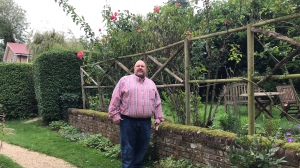
I have had the opportunity for a great deal of “meditation” this week regarding so many aspects of both my personal and professional life while serving as a Scholar in Residence at The Kilns. I use the word “meditation” here and put it in quotes purposely because it is in the title of an essay titled “Meditation in a Toolshed,” by C. S. Lewis. For this post I am using the definition of meditation from Oxford Languages of “a written or spoken discourse expressing considered thoughts on a subject” for “meditation.” I make that distinction because my own definition of meditation here has been based on the opening two paragraphs of “Meditation in a Toolshed”:
“I was standing today in the dark toolshed. The sun was shining outside and through the crack at the top of the door there came a sunbeam. From where I stood that beam of light, with the specks of dust floating in it, was the most striking thing in the place. Everything else was almost pitch-black. I was seeing the beam, not seeing things by it.
Then I moved, so that the beam fell on my eyes. Instantly the whole previous picture vanished. I saw no toolshed, and (above all) no beam. Instead I saw, framed in the irregular cranny at the top of the door, green leaves moving on the branches of a tree outside and beyond that, 90 odd million miles away, the sun. Looking along the beam, and looking at the beam are very different experiences.”
C.S. Lewis, “Meditation in a Toolshed” in God in the Dock (Grand Rapids: Eerdmans, 1998, pp. 212-215.)
And that’s just the beginning of the essay! The point Lewis was making is that instead of merely looking at the sunbeam and looking through it, out into the world beyond the dark of the toolshed, he sees a completely different picture. As he said, “Instead I saw, framed in the irregular cranny at the top of the door, green leaves moving on the branches of a tree outside and beyond that, 90 odd million miles away, the sun” (Lewis, p. 212). There is a difference between simply looking at something or experiencing it. We must use our experiences, just as Lewis used his toolshed experience to see something greater. Without this deeper meditation the experience would be lost on us. I call this being the “Deer In The Headlights.”
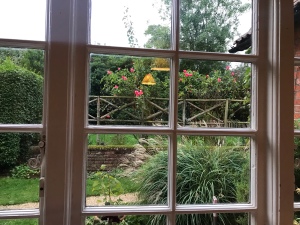
This is why it was so important for me to be at The Kilns as a Scholar in Residence. I felt the need to live through (along) this incredible place that C. S. Lewis lived, meditated, and wrote as opposed to just looking at it. I didn’t want to just see the property – that’s a tour. I wanted to see through the property – living through The Kilns. I wake each morning to see the roses outside the windows and then can go smell them. I hear the stairs creak and crack as I walk up to Lewis’ study. I will never forget the feel of the southerly breeze and warmth of the sun through the window in Lewis’ study. You get the idea.
My entire study experience has been deepened because of the full immersion into C. S. Lewis’ life. Even my walks to the local pubs and other sites gave me the opportunity live through Lewis, who was described as a habitual walker. I wanted to walk where he walked. Lewis used the simple example of the neurologist who can describe pain scientifically, but really understands it because he has looked along pain (experienced) and not just looked at pain.
Lewis explained that we can’t look at or along, but use both. He said, “…we must start with no prejudice for or against either kind of looking” (p.215). We need the entire picture from looking at and along.
The Kilns And World War II

Another bit of history from The Kilns. The house in Oxford, England and home of C. S. Lewis, served as living quarters for teenage girls during Operation Pied Piper. During World War II Operation Pied Piper was a major evacuation program that took place in the United Kingdom. The operation aimed to protect children, particularly those living in urban areas, from the dangers of bombing raids by evacuating them to rural locations.
Some important things to remember about Operation Pied Piper include:
1. The evacuation: Starting on September 1, 1939, over 3 million people, mostly children, were evacuated from cities and towns to safer areas in the countryside. The initiative ended in 1946.
2. The reasons behind it: The main objective of the operation was to safeguard children from the devastating effects of aerial bombings by the Nazis. By relocating them to areas less likely to be targeted, it was hoped that their lives would be protected.
3. The process: Children were often separated from their families and housed with host families or in designated reception areas. Some experienced homesickness and difficulties adapting to new environments, while others formed lasting bonds with their hosts.
4. Post-evacuation challenges: After the initial wave of evacuation, many children returned to their families in cities due to the lack of immediate bombing threats. However, when intense bombing resumed later in the war, further evacuations occurred.
5. Long-term impact: Operation Pied Piper had a significant impact on the affected children and society as a whole. It highlighted the vulnerability of civilian populations during wartime and raised awareness about the need for child protection services and support systems.
It’s important to note that while Operation Pied Piper was a crucial part of history, it may also contain personal stories and experiences that contribute to the broader narrative of the human experience during times of conflict. I became interested in learning more about Operation Pied Piper while reading The Secret Book of Flora Lea by Patti Callahan Henry.

While at The Kilns this week I had the opportunity to spend some time in the room where the children stayed (see photo). I tried, but couldn’t, to imagine what it must have been like to have a luggage tag put around your neck and shipped off to be picked out of a line and then spend long periods of time with people you did not know. I did love the story told while I was here at The Kilns that Jack (what everyone called C. S. Lewis) would sneak the girls out through the window to take them for fish and chips. That really raises him on the coolness scale for me even further. Don’t you agree?

The other notable area on the site is the bomb shelter (see photo). It is hard to imagine living less than an hour from London where bombs were falling and wondering if and when it might happen in Oxford. It is believed that Oxford was safe because it was being saved by Hitler to be his capital of Europe.
This was some very interesting history and certainly shaped many lives.
 Byron's Babbles
leave a comment