What Does Industry 4.0 Mean?
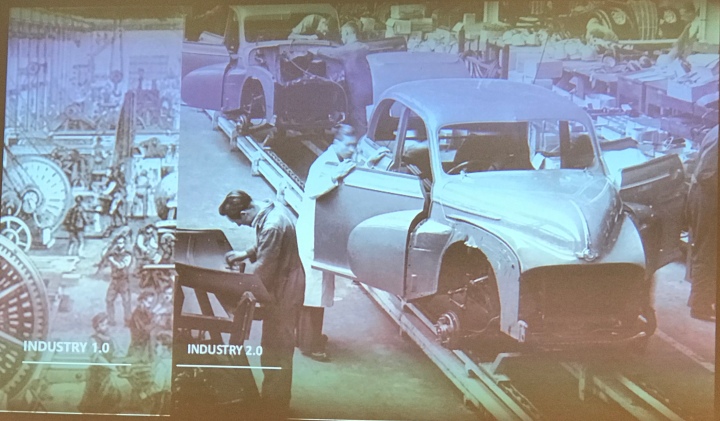 Today, I had the honor of being in attendance at the 2nd Annual Global Smart Manufacturing Summit in Berlin, Germany. One of the topics we grappled with was of what does Industry 4.0 mean? Ron Zahavi, Chief Strategist for IoT Standards and Consortia, Microsoft Corporation did a great job of walking us through some history.
Industry 1.0
This is the first industrial revolution:
- Technology such as wheels and engines replaced artisans
- Child labor laws had to be introduced to prevent abuse
Industry 2.0
- Assembly lines allowed workers to be turned into consumers
Industry 3.0
- Lean Processes improved the quality of products
- Advent of computer use
- Robots reduced mistakes and improved productivity and safety, but began replacing people
Industry 4.0
- Big data and analytics
- Autonomous robots
- Simulation
- Horizontal and vertical system integration
- The industrial Internet of Things (IoT)
- Cybersecurity
- Additive Manufacturing/Advanced Manufacturing
- Augmented Reality
Interestingly, in all these cases technology and mechanization are involved, but in the revolutions of Industry 1.0, 2.0, and 3.0, I wonder if we forgot how important people are. We must remember as we navigate Industry 4.0 that people are more important that the devices and technology.
In my world of educating young scholars and creating education policy, we have a responsibility to make sure as we move to Industry 4.0 to put people at the forefront. We do not want to make the same human mistakes with 4.0 that we made with the first three revolutions.
I really believe more than ever that we must make sure that we create space for industry to do as much of the training of our students as possible. Industry is in a good position to do this. What we have to do, though, is identify the transferable skills students need and institutionalize those skills in the framework of the internship learning being done in partnership with industry. This is crucial because of the mobility of our students.
We must be educating our students on the new things being done with Industry 4.0, but must also be educating them on the benefits. In other words, answering the question: How does this make life easier? Not just always pointing to financial improvement and the bottom line. We must begin to develop a workforce made up of the right quantity and right quality of workers. The skills we are preparing students with must match the needs of the workplace.
Industry 4.0 will require new skill sets, and manufacturers will need to attract the right talent. This may involve partnering with k-12 schools to train students. Existing training programs may need to be expanded to include new technologies that are introduced to the marketplace. Manufacturers also need to recruit for Industry 4.0, which may differ from how they have done it in the past. Both business and industry and education will need to stop all focus being on qualifications determined by degrees and certificates, companies should recruit for capabilities to succeed. These capabilities will include specialized skills.
For us to compete during Industry 4.0, it will require us to conduct constant iteration and be flexible. It’s not about buying software or purchasing a curriculum and then watching it all play out. To compete in Industry 4.0, the education sector and manufacturers must be flexible and agile in the face of change, and, most importantly, partner together.
Learning to Do, Doing to Learn!
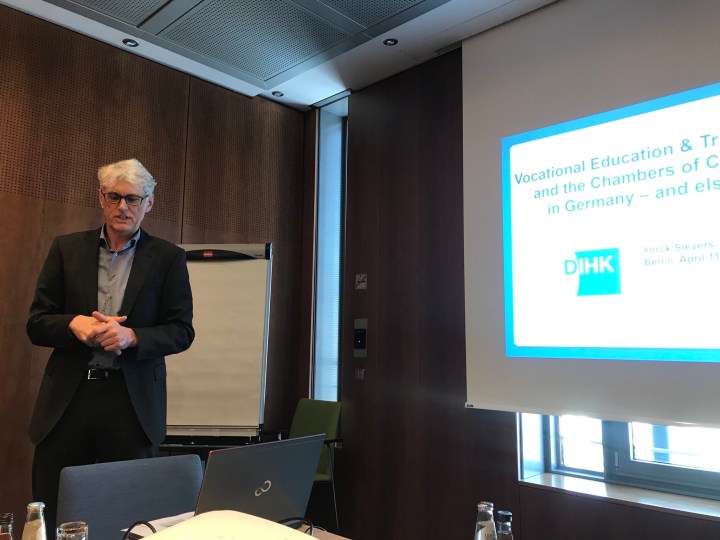 Today, while in Berlin, Germany, I was reminded that what I always say, “Once an Agriculture Science teacher and Career and Technical Education (CTE) Director, always a CTE guy. As I visited with Yorck Sievers of The Association of German Chambers of Commerce and Industry, I was reminded just how engrained the FFA motto of, “Learning to Do, Doing to Learn, Earning to Live, Living to Serve” is to making a positive difference in the lives of students by developing their potential for premier leadership, personal growth and career success through agricultural education. This is also engrained in my core values of how to educate young scholars. The Association of German Chambers of Commerce and Industry (Deutscher Industrie- und Handelskammertag, DIHK) is the central organisation for 79 Chambers of Commerce and Industry, CCI (Industrie- und Handelskammern, IHKs) in Germany. All German companies registered in Germany, with the exception of handicraft businesses, the free professions and farms, are required by law to join a chamber.
The FFA motto gives members 12 short words to live by as they experience the opportunities in the organization. Learning to Do, Doing to Learn, Earning to Live, Living to Serve. Learning by doing is also a cornerstone of the German education system. Whether someone wants to become a carpenter or a hotel concierge, she has probably gone though what is known as the dual education system. This system combines time spent in the classroom with work at a company. During our education research trip with Horizon Education Alliance, we learned about how Germany’s vocational education system pairs hands-on learning with classroom learning to give young people a leg up in the workforce. Most students graduate not only with a degree, but also with job experience and a deep knowledge of their trade. This vocational training offers a high degree of job security. The professional certifications issued to students at the end of their programs are well respected within their fields, and more than half of apprentices stay on as full-time employees at the businesses where they trained. They even get paid during their studies.
Check out a few slides from our meeting with Sievers:
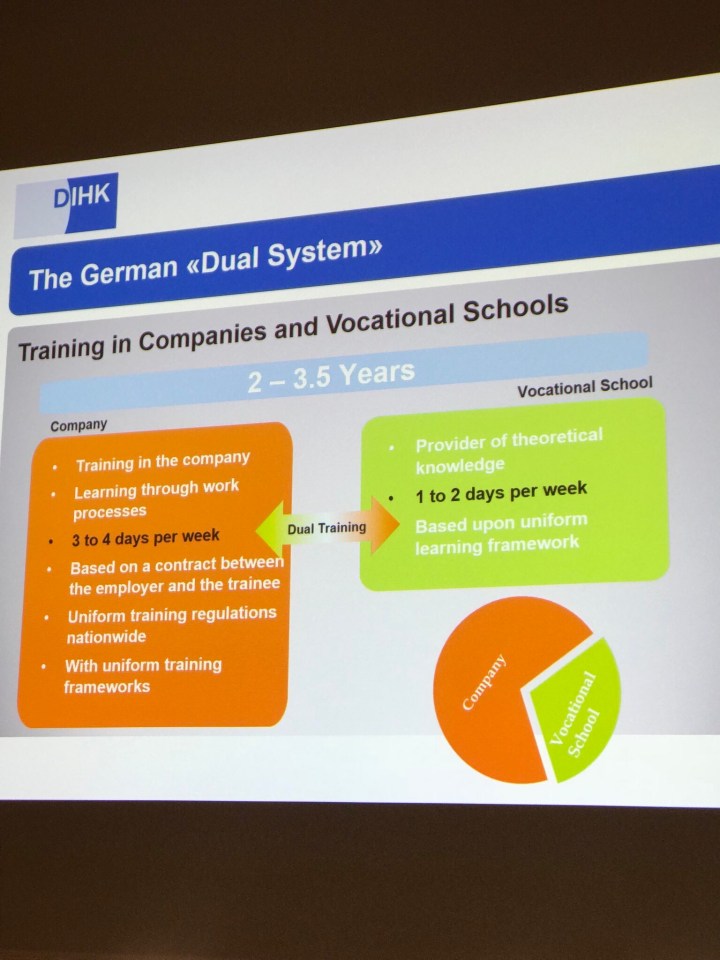
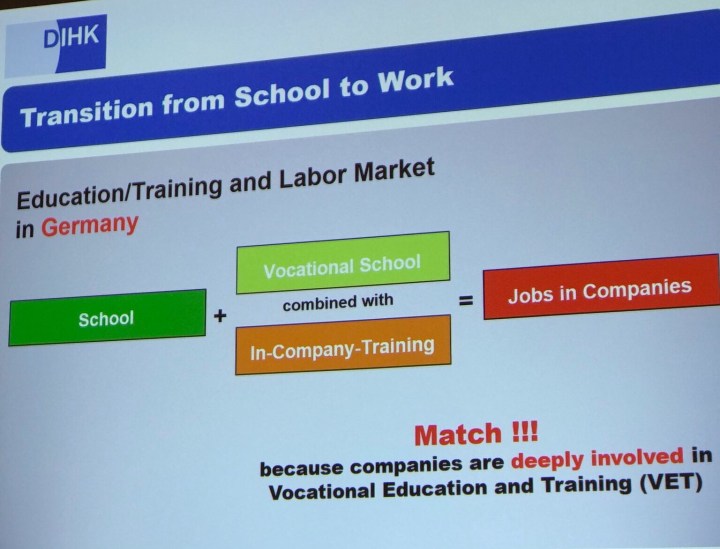
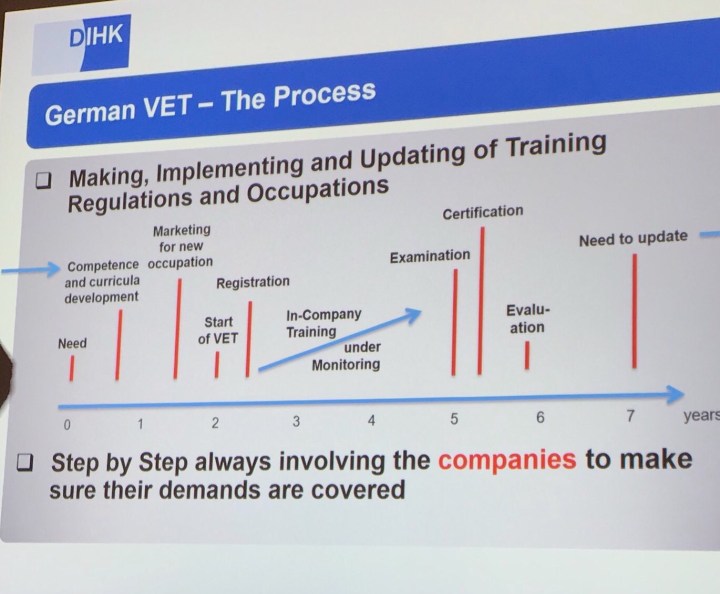
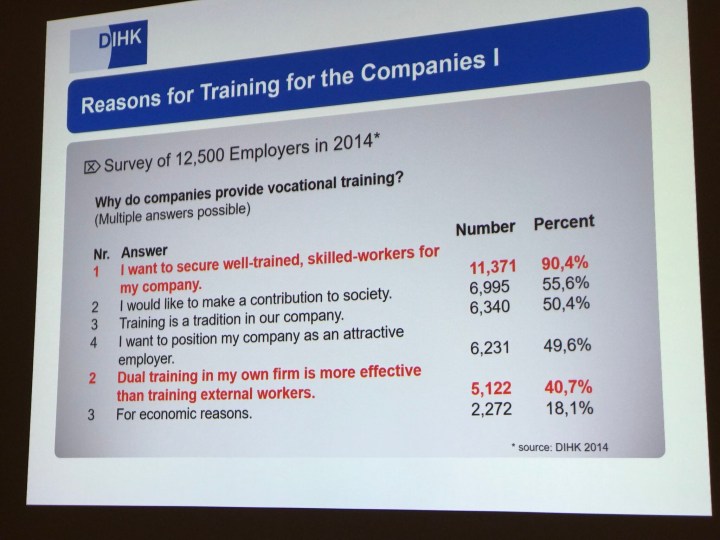 During this time with Sievers we also learned that schools follow the companies and not the other way around. This training model is all about the future of the company, but the companies are not left alone. The companies need support. This is competency based education. The Chambers in Germany provide:
- Organization
- Registration
- Examination
- Certifications on a national level
In this German model there are courses that cover more than 350 different occupations that are approved by the businesses and federal bodies overseeing the program. In Germany, they are truly walking the talk by facilitating students for “Learning to Do, Doing to Learn, Earning to Live, Living to Serve.”
Focus On The Wider World
 Last week I did a 3D Leadership Program™ session on focusing as a leader. It was about focusing on three things:
- Self
- Others
- Wider World
Clearly if we want to be effective leaders we must focus on ourselves. This focus does not mean being self-centered, but self-caring. We must take care of ourselves physically, emotionally, and spiritually. Additionally, we must take ownership of our own professional growth. If we are taking care of ourselves then we can begin to focus on others using our empathy, caring, and relationships.
Another important focus area and focus of this post is to focus on the wider world. To do this I believe it is important for us to not only take a worldview look at our own part of the world, but also look literally at the rest of the world. I will be doing this for the next 12 days in Germany and Switzerland. I am on the plane flying to Berlin, Germany as I write this post. I am very honored to have been asked to go on this trip that was organized by Horizon Education Alliance. There are representatives from schools and business/industry in Elkhart County, Indiana as well as State Representatives, Governor’s Office officials, colleges and universities, and me as a member of the Indiana State Board of Education taking part in this experience and serving as ambassadors of our state and country. Again, what an honor!
 I am hoping to add a post to my blog each day as our journey progresses. So, stay tuned to Byron’s Babbles each day to see where we have been and what we have learned. It is going to be fast and action packed learning. Tomorrow we will be attending the 2nd Annual Global SMART Summit in Berlin, Germany. This will be a chance to learn more about Manufacturing 4.0 and I am excited to learn how we can better prepare Indiana’s students to work in this environment upon completion of high school. I am super pumped about all the businesses and industries that will be represented. See the photo here to see who the players are who will be in Berlin:
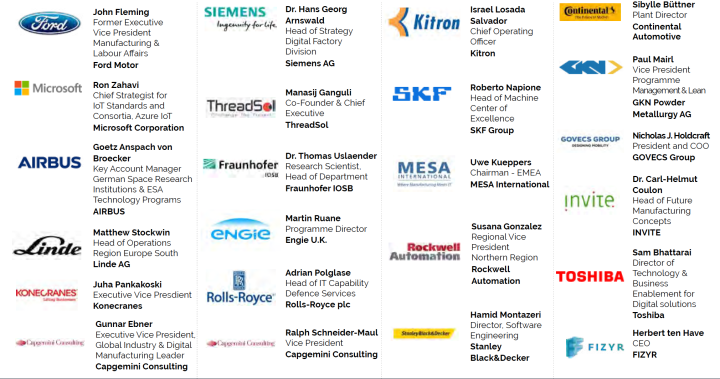
Surely you recognize a few on the list. This will be the who’s who of business and industry. SMART, or 4.0 Advanced Manufacturing applies information and manufacturing intelligence to integrate the voice, demands and intelligence of the ‘customer’ throughout the entire manufacturing supply chain. It marries information, technology and human ingenuity to bring about a rapid revolution in the development and application of manufacturing intelligence to every aspect of business. It changes how products are invented, manufactured, shipped and sold. We will be gaining insights on what it takes to thrive in this new paradigm shift in manufacturing through the use of advanced technology. Our Indiana delegation will be part of the 200+ delegates from the top leading companies from around the world sharing their management strategies on the opportunities and challenges that lie ahead in the Digital Economy.
Back to the point of this post – focusing on the wider world. This is so important because we must practice exploratory strategic thinking and creative thinking. Leaders with a strong outward focus are able to exercise these two skills. These leaders tend to be visionaries who sense the far-flung consequences of local decisions and imagine how the choices they make today will play out in the future.Take Bill Gates: On 60 Minutes, Melinda Gates remarked that Bill was the type of person who would read an entire book on fertilizer. “Why fertilizer?” Charlie Rose wanted to know. The connection was obvious to Bill Gates, who is constantly looking for technological advances that can save lives on a massive scale: “A few billion people would have to die if we hadn’t come up with fertilizer.”
Any business school course on strategy will give you the two main elements: exploiting your current advantage and exploring for new ones. It’s not surprising to find that exploitation requires concentration on the job at hand, whereas exploration demands open awareness to recognize new possibilities. But exploitation is connected to the brain’s reward circuitry—in other words, it feels good to coast along in a familiar routine. So when you switch to exploration to roam widely and pursue fresh paths, you have to make a deliberate cognitive effort to disengage from that routine and maintain open awareness. We must always be looking to spot new opportunities.
Thinking creatively involves three forms of focus:
- Vigilance—remaining alert for relevant information while immersing yourself in all kinds of input
- Selective attention—focusing on one thing while filtering out everything else
- Open awareness, which we’ve discussed earlier
The classic model of creative thinking shows how you use each of these:
• First you use vigilance to gather a wide variety of pertinent information.
• Then you alternate between intense concentration on the problem at hand (selective attention) and letting your mind wander freely, as you might in the shower or going out for a run (open awareness).
Being a focused leader doesn’t merely mean concentrating on the biggest priorities of the year or being in tune with corporate culture. It means commanding the full range of your own attention. With diligence, you can cultivate focus on yourself, on others, and on the wider world. As a result, you’ll be able to direct your attention—and others’ attention—where you need it.
For the next few days I am going to focus on a wider world view. I want to know how the best of the best are leading our industries. I want to learn how the best of the best in Germany and Switzerland are educating young scholars to be ready for post-secondary success. Let me be clear; I do not want the United States to become Germany or Switzerland. What I want is for us to learn the best of what others are doing find ways for us to get better at educating our students. In saying that it does not mean that I do not think we are doing a good job. It means that if better is possible than good is not enough. We need to be pursuing fresh paths by spotting new opportunities with open awareness. I hope you will tune into my blog over the next several days and check out the wider world global learning taking place with a group of us from Indiana, USA.
How Radical Innovation Happens
 The following is a book excerpt from The New Science of Radical Innovation
How Radical Innovation Happens
By Dr. Sunnie Giles
Radical innovation germinates for a long time, surfacing at the critical inflection point when momentum has become large enough (as some would call self-organized criticality). Radical innovation happens when many self-organizing employees experiment profusely and learn—to see how to adapt to the environment best and adjust their behavior iteratively using simple rules. The iterative adaptation based on the results of these experimentation builds the momentum, often well below the radar screen. The employees take cues from the environment in an open-feedback system. Radical innovation is a result of these employees coevolving with the environment in an open system where information for feedback and adaptation flows without friction. Radical innovation is created by an adequate level of random perturbations from the environment and the complex system’s adaptations to them. It often results from accidental, spontaneous recombination of existing ideas and tools.
In the process of this constant adaptation to signals from the environment, employees use simple rules to speed the reaction time, rather than executing with perfect accuracy, because second order change happens as a result of growth of variances or errors from imperfect execution. As such, speed to generate meaningful variances from iterations of trials is more important for radical innovation than perfection.
Radical innovation cannot be planned or choreographed; it can only be fostered and nurtured. Putting someone in charge of an “innovation” department, allocating some budget, and tasking that person with managing the innovation pipeline can only yield incremental innovation, such as packaging innovation or line extension. To maximize chances of radical innovation, the kind that produces 10x improvements, individuals with differentiated, unique expertise, skill sets, and perspectives must be forged in solid connection as a coherent team.
Radical innovation involves a cultural shift and the accompanying changes in HR and leadership practices. Once manifested, radical innovation sustains for a relatively long period, until the next radical innovation redefines industry dynamics. To summarize, I define radical innovation as a serendipitous result of many self-organizing, interdependent employees learning from profuse experiments using simple rules to produce a minimum of 10x improvements. Radical innovation is a specific manifestation of complexity.
 *******************************
About Dr. Sunnie Giles
Dr. Sunnie Giles is a new generation expert who catalyzes organizations to produce radical innovation by harnessing volatility, uncertainty, complexity, and ambiguity (VUCA). Her research reveals that applying concepts from neuroscience, complex systems approach, and quantum mechanics can produce radical innovation consistently. Her expertise is based on years as an executive with Accenture, IBM and Samsung. Her profound, science-backed insight is encapsulated in her leadership development program, Quantum Leadership. An advisor to the Stanford University Graduate School of Business, she also is a sought-after speaker and expert source, having been quoted in Harvard Business Review, Entrepreneur, Fast Company, Forbes, and Inc.
Dr. Giles’ latest book, The New Science of Radical Innovation, provides a clear process for radical innovation that produces 10x improvements and has been endorsed prominent industry leaders such as Jonathan Rosenberg, Daniel Pink, Marshall Goldsmith and Sean Covey.
Leading Without Surprises
 In Gem #18 entitled, “No One Likes Surprises” in 52 Leadership Gems: Practical and Quick Insights For Leading Others by John Parker Stewart I was reminded that there are three types of news:
- Good news
- Bad news
- No news
Stewart told us that people love good news the most and hate no news. With this I was reminded that no one likes to be surprised unless it is a party, an award, or a call/visit from someone special we haven’t seen for a while.
We need to be reminded of this every so often (probably often). I just had a situation where I did this. It wasn’t really good or bad news (it was a good thing that I was going to be doing) but it was something I needed to discuss with those above me. I had just got busy and had not had the conversation. I was in the wrong here, make no mistake. Let me tell you, I took responsibility and apologized. By the way, it worked out ok because I work with great leaders who understand when you take responsibility for your own actions. It is best to report news at at the first point at which we know it.
“Diplomacy and timing are important; but whenever possible, avoid delaying the sharing of news (however bad) with your boss, your team, or your customers.” ~ John Parker Stewart
Now I know some of you are saying, “yes but sometimes news needs to be timed right.” I get that, but not providing news gives others the opportunity to write the narrative. My experience has been, when we allow someone else to tell and set the narrative of our news it usually is not reported correctly. Can you remember a time when this happened to you?
 So, let’s all remember, we really don’t like surprises and report information and news we have whether it’s good or bad.
Improving To Great
 In Gem #17 entitled, “Good IsThe Enemy Of Great” in 52 Leadership Gems: Practical and Quick Insights For Leading Others by John Parker Stewart we are reminded that we need to adopt a culture where every aspect of the organization can be improved. “Good is the enemy of great” are the opening words of “Good to Great,” the best-selling iconic book by preeminent leadership and management thought leader Jim Collins.
 In order to do this we must surround ourselves with the right people. Collins taught us to have the right people in the right seats on the bus.
Additionally, we need to remember that the journey to great is just that, a journey. This journey should not end. Once you think you are great, you have nowhere to go but down. Very few organizations ever achieve greatness, even though at times leaders and those who they lead may use that term to describe their organizations.
Many times we are blinded by the facts. We get lulled into thinking everything is going great. We must be open to looking at all the brutal facts about our organizations. Let’s take a moment and think about our leadership style and the culture of our organizations. Should any changes be made?
We Try Harder!
 In 1963 Avis came out with an add that rocked the advertising world. The CEO at the time, Robert Townsend, was running a struggling brand. Hertz was number one in the rental car space and Avis was way behind in number two. To help, Townsend brought in the hottest advertising agency of the time – DDB. The agency took the job on one condition: Townsend agreed to run whatever campaign they suggested no questions asked. With this creative freedom, copywriter Paula Green created the new tagline, the brand ran it and it helped turn the brand around – “We’re #2, and we try harder.”
 There are several lessons in this story from Avis I was reminded of in Gem #16 entitled, “Beware The #1 Syndrome” in 52 Leadership Gems: Practical and Quick Insights For Leading Others by John Parker Stewart . Stewart reminded us it is hard to stay on top as number one in both business and athletics. It’s not only hard to become number one, but even tougher to stay there. Everyone is gunning for you, and the tendency to get complacent is overwhelming. Therefore, Stewart contends we need to take the Avis approach and consider ourselves or organizations number two and always keep trying harder. If we always work like we are number two, we will probably remain number one. Do you try harder?
Owning It
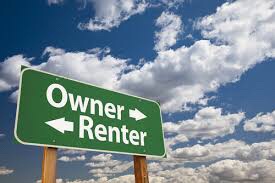 One of the most important responsibilities of great leaders is to continually grow team members into “owners”, and at the same time convert “renters” to “owners” by engaging and developing them to realize their potential and purpose. Gallup (2017) research tells us one of the most important things employees want is to have the opportunity to make a difference and grow professionally where they work. Taking ownership is an important part of this engagement.
 By ownership I don’t necessarily mean monetarily owning. The owner mentality is one of commitment, individually and collectively, to a shared purpose. The metaphor of “renter” vs. “owner” was used in Gem #15 entitled, “Ownership Or Rentership” in 52 Leadership Gems: Practical and Quick Insights For Leading Others by John Parker Stewart . Stewart talked about the difference in the way we care for a rented house versus one we own. I think of the metaphor of a rental car versus the one I own. What’s the saying? “Nothing parties like a rental!”
We will know we have developed owners if they are always looking for ways to make the workplace increase in value. Owners are also always looking for others who can help increase the value of the workplace. Are you developing owners or renters?
Setting Your Leadership Style
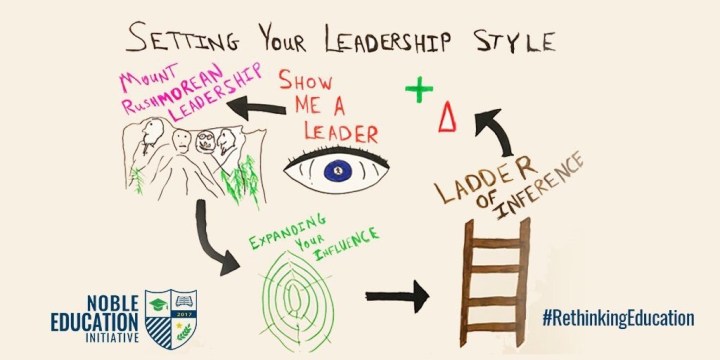 Last evening we did a really cool project during our 3D Leadership Development Program. First of all, the participants were tasked with bringing 10 pictures of leaders that had influenced the participants in a positive way. I must say that all participants put a great deal of thought and reflection into this and all brought their 10 pictures to our gathering. To begin with I had the participants quickly pick four of the leaders and make/draw/create their own person Mount Rushmore with the four most influential leader examples in their lives. These turned out really cool and I have included some pictures of the personal Mount Rushmores that were created, here:
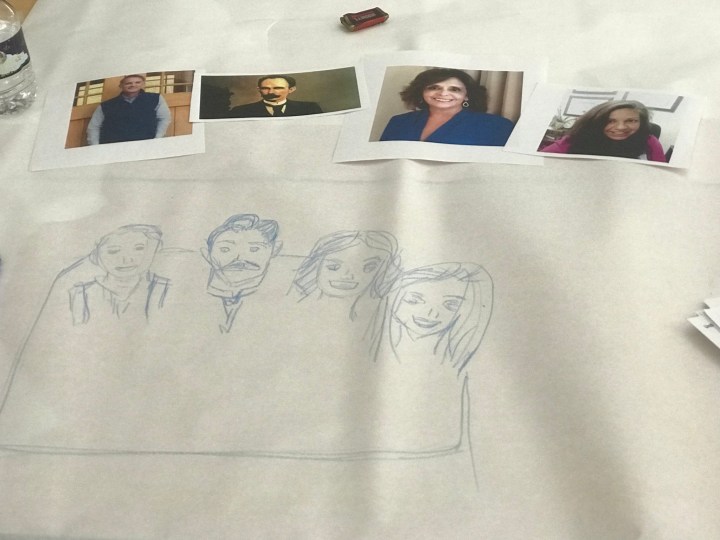
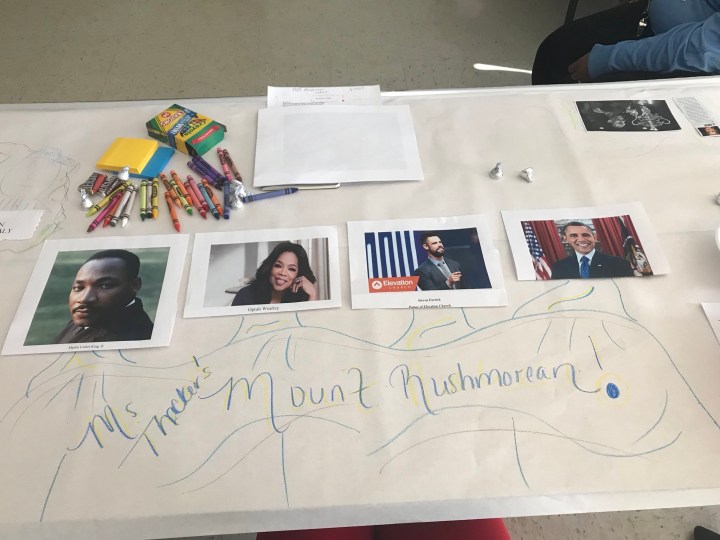 In the discussion afterward, the participants explained how tough it was for them to just pick the four influencers for the original Mount Rushmore. Creating that frustration of only picking four was by design. It is very tough to only pick four for a Mount Rushmore. At the same time we need to realize that our influencers come and go. Also, our influencers have different levels of influence at different times. In other words, as we take our journey of leadership, our role model can, or maybe need to, change. This is why I love reading about a diverse group of leaders. For example, right now I am reading about President James K. Polk. I don’t think he would make my current Mount Rushmore, but I am certainly learning things from his leadership style I can use. Some of them are things I have learned to not do, or stop doing. This is certainly important to our development. The bottom-line is that our personal Mount Rushmore should be continually changing. More importantly, we should constantly be studying and looking for new candidates for our own version of Mount Rushmore.
 I have to admit, the idea for for this activity came from my own desire to have a drawing made of what would be my personal Mount Rushmore. Originally, I thought I would have the Wright Brothers, Gene Simmons (KISS), Patrick Henry, and Thomas Edison. But, then I started wanting President Ronald Reagan, Walt Disney, President Harry Truman, et cetera. Honestly, I couldn’t decide so it never got done. In fact the person I wanted to do the drawing told me that it can’t be fixed, it needs to be fluid. In fact he suggested it should be a Mount Rushmore frame with no pictures and then I should have a bunch of magnet pictures to move in and out. Additionally, as new influencers come on, they can be added.
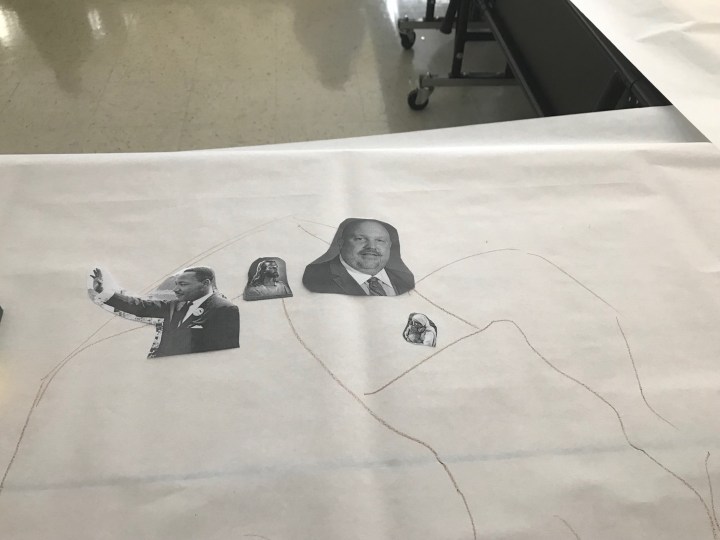
I’ve got to tell you, it really impacted me to see my picture on one of our participant’s Mount Rushmore. Others in the cohort were also on others’ Mount Rushmore’s or leadership mosaics (described next). This really caused me to think about and ask the question of “Am I worthy of this?” Particularly, when I was right next to Jesus on Mount Rushmore. See picture here:
 After that activity and share out, I had participants go back and create a leadership mosaic using all 10 pictures/leaders. Here is what I asked them to do:
•Place a tear sheet on the wall
•Now create a collage with all 10 pictures
•Be creative so that the 10 individuals you selected are incorporated in a way that tells a story.
•Now gallery walk
•Place at least one comment on each
•Popcorn out things that jumped out at you
I have to tell you, this was impactful. There were individuals who teared up while looking at the 37+ mosaics that were created. It was amazing. Here are a few examples:
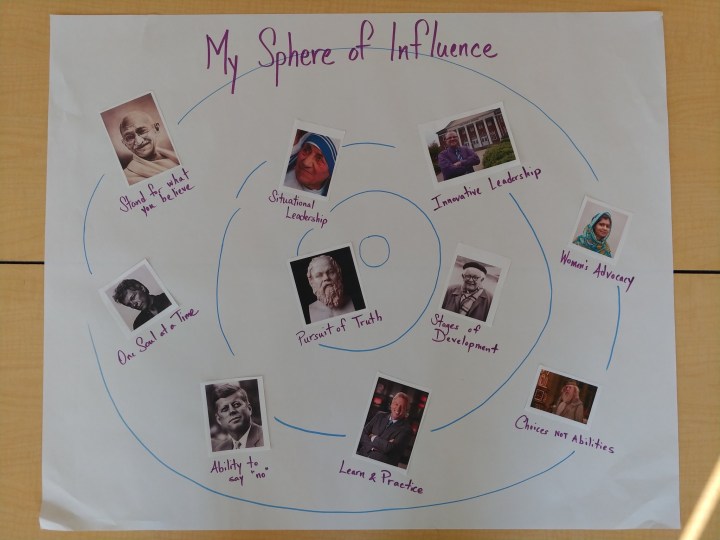
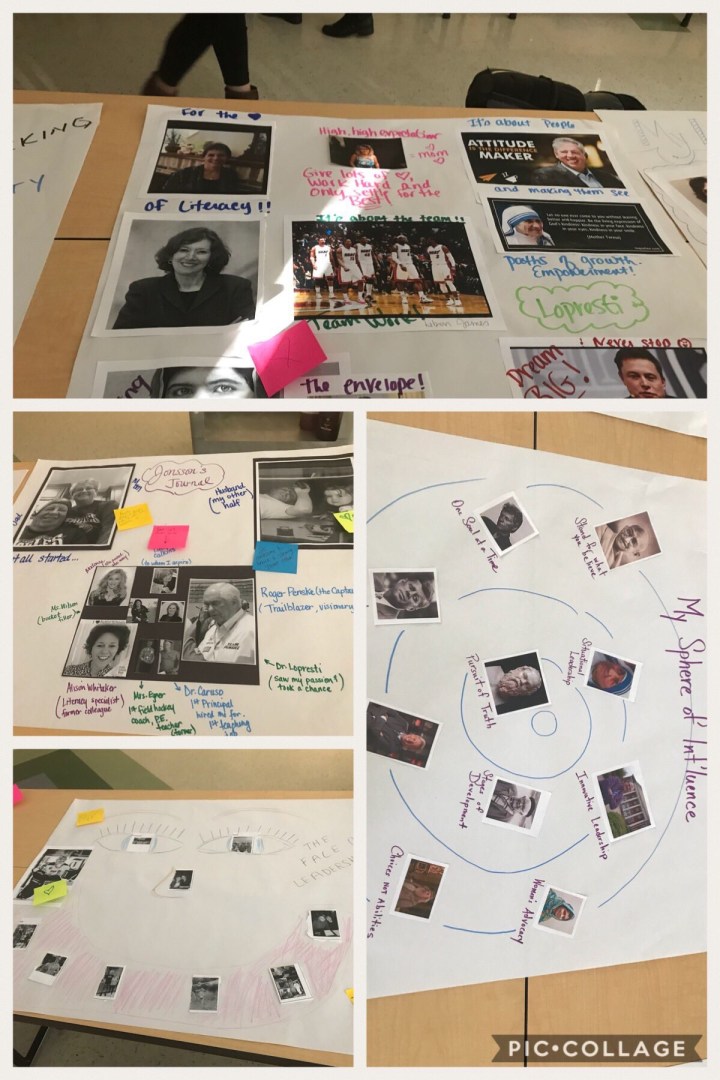 We then had a very impactful discussion about leadership style and influence. Then one of our always thoughtful and very engaged participants, Christopher Scholl, from Langtree Charter Academy Upper school spoke up and said, “What really struck me was how different everyone’s mosaics are, but everyone completed the assignment correctly, did everything we were supposed to, and all were very impactful.” We then had a discussion about this. Chris went on to say, “As leaders we need to lead more like the way you set up this activity. We need to lay out the vision, but how our teams and those we lead get there or what the final product looks like really does not matter and needs to be theirs to own.” Wow, this was an awesome discussion that came out of this. It really is intent-based leadership being described at its best. David Marquet would sure be proud. Get all the team developed in the technical skills necessary (otherwise it is chaos) and then let them do their jobs and tell you, the leader, what they intend to do. This will truly drive innovation and creativity. And…HELLO…it means the decisions will be made right where the data is being created.
It was also discussed how we must also create space like this for our students to be able to have the autonomy to create and not have to always turn in assignments where every child’s work looks exactly the same. This is why I am such a big believer that we should be looking at student outcomes and transferable skills. In fact, we should be changing our whole school accountability models to look at outcomes instead of outputs or the inputs.
The whole point of the personal Mount Rushmore and leadership mosaic activities was for participants to take a deep personal and reflective look at their personal leadership style. Keep in mind that leadership style is different than leadership skills, theory, and tactics. To me, leadership style focuses specifically on the traits, behaviors, and personalities of leaders. In my opinion, no one should ever let anyone determine their leadership style for them. Leadership styles can be broken down in several different ways depending on what information is being looked at. There are many ways to define styles, such as: being charismatic, participative, situational, transactional, transformational, adaptive, disruptive, loud/boisterous (like me), quiet or servant-like. One more way to differentiate leadership styles is according to whether leaders are task-oriented or people-oriented. Task-oriented leaders are said to have a considerate style and people-oriented leaders an initiating-structure style.
So why was it important for us to take a deep look at our own personal leadership style and recognize those we learned those skills from. Since organizations are always striving to find great leaders that can lead them to success, much effort has been put forth into finding out how they operate. More specifically, organizations are trying to identify the characteristics and behaviors associated with the best leaders. As a result, many leadership theories have been developed over the years that attempt to explain what makes a leader great. Organizations figure if they can identify the traits that make a successful leader, they cannot only identify potential leaders more readily, but also can hone in on those specific skills for improvement. While I agree with all of what I am saying here, I also want to make sure we do not lose sight of the fact that leadership style should be an individual thing. I certainly would not want a world where all the leaders looked and acted exactly the same. I do have some leaders, however, I would love to know who the world is on their Mount Rushmore and who they are using as a role model. Ill bet you have some you are wondering about too.
I challenge those reading this post to reflect on who is on your Mount Rushmore or your leadership mosaic. Most importantly, I encourage you to reflect on whether you are worthy of being on someone else’s Mount Rushmore or leadership mosaic. Thinking about being on someone else’s Mount Rushmore is not egotistical or vain; It is, again, about reflecting on our worthiness of being a role-model of leadership influence. I would love to have some replies of who you would put on your personal Mount Rushmore and why.
The Anatomy Of An Idea
 Leaders speak last. I really believe in this and try to practice it. When you’re the last to speak, you empower those you lead to voice their opinions and ideas without you butting in. You also become smarter as a leader, since you get to hear all your employees’ thoughts and suggestions. I was reminded of how much I believe in this while reading Gem #14 entitled, “In The Decision Making Process, Voice Your Opinion Last” in 52 Leadership Gems: Practical and Quick Insights For Leading Others by John Parker Stewart . If we are always giving the answer first, sooner or later, your discouraged team members will stop sharing any ideas, and that kills communication in your organization.
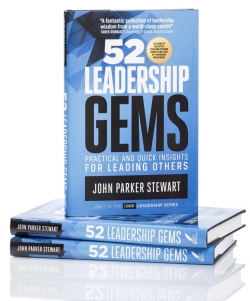 Also, watch how you ask questions and make comments. Again, speak last. Watch comments like the following:
• “Here’s the problem, here’s what I think… What do you think?”
• “Before you go into that, let me just say one thing first…”
• “I understand where you’re coming from, but I think…”
Furthermore, pay attention to your nonverbal clues. Avoid giving away any verbal or non-verbal cues, like shaking or nodding your head, or gesturing with your hands. Make no mistake, I am not saying I’m good this, but I work really hard at speaking last.
So, next time you have decisions to make, speak last. I guarantee you will see how the quality and creativity of the discussion will improve exponentially.
 Byron's Babbles
3 comments