Leading The Enormity & Simplicity Of Change

Of change, Machiavelli told us, “It must be be considered that there is nothing more difficult to carry out, not more doubtful of success, nor more dangerous to handle, than to initiate a new order of things.” Change is ever present, and is a source of value and risk. Recognizing that change is not easy allows us to prepare and strategize for the obstacles we may face.

We were introduced to another thought on change by Astrid. Astrid is a character in Rob Hart’s great book Assassin Anonymous and at the end of the book she said: “And the enormity of what it means to decide you want to change. Both the impossibility and the simplicity of it.” This thought captures the dual nature of change—how it can feel overwhelming and straightforward at the same time. On one hand, the enormity of deciding to change implies recognizing the challenges, fears, and uncertainties that come with stepping out of one’s comfort zone. It suggests that change often feels monumental, as it can require significant effort, sacrifice, and a willingness to confront difficult truths about oneself or one’s situation.
It’s important to view change as both a daunting journey and a straightforward choice. Balancing these two perspectives can help us navigate the process with greater resilience. Understanding that change begins with a decision can empower us. We don’t need a perfect plan; just taking that first step can be enough.
Do Not Let Eventually Turn Into Too Late

Yesterday when I was finishing reading Rob Hart’s great book, Assassins Anonymous, the protagonist, Mark, had a thought that gave me pause. Mark, who was the world’s best assassin and trying to get out of the business through Assassins Anonymous, was reflecting on the death of his sponsor, Kenji. Kenji was Mark’s rock and Mark was reflecting that he had not fully expressed his appreciation to Kenji. He pondered that, “Eventually turned into too late.” His regret of not telling Kenji all he wanted to highlights a sense of urgency and the consequences of inaction—what could have been addressed in time ended up being too late for effective resolution.

We need to remember that situations will progress to points where it becomes impossible to take the necessary actions or make the needed changes. This scene in the book reminded me that there are opportunities or windows of time that are available the important things we need to do, but as time goes on without action, those opportunities slip away. I want to make sure I don’t push things to eventually and then realize it’s too late.
What Is The Team You Are Supposed To Be?

Last night I watched the Indiana Pacers beat the Milwaukee Bucks 115-114. During the American Express Halftime Report on TNT, Shaquille O’Neal made a great comment directed at the Bucks: “Be the team you are supposed to be.” Shaquille’s message that he said he would give to the Bucks was to focus on their strengths, trust in their abilities, and work cohesively as a unit to achieve success. It’s about living up to the expectations that come with their individual player’s skills, talent, and hard work. The importance of each player playing to their potential and capabilities and then working cohesively as a team to achieve success.
Today, I am working with a team of educators at a Focused Leader Academy. I could not help but start the gathering with the prompt: “Last night, Shaquille O’Neal made a great comment directed at the Milwaukee Bucks: ‘Be the team you are supposed to be.’ In context of your team here at school, what would that comment mean to you?” Here are some of their responses:
- Play my role
- Pull my weight and support others
- Student, teacher, administrator support team
- Lead by example
- Serve our stakeholders
- Communicate and collaborate
- Do my job the way it is supposed to be done
- Gifts and talents are identified
- Public perception and reputation based on what the best data suggests
- Collaboration inside / competition outside
- Expect what we inspect
As you can imagine this prompted a great discussion, but it came down to that O’Neal was encouraging every member of the team to do what they were put on the team to do. This emphasized my strong belief in well defined roles and responsibilities. And when those roles and responsibilities are well defined we are better equipped to move out of our own lane occasionally to help others.
Leading With Our Ears

Last night in a leadership development gathering for administrators in my Focused Leader Academy one of our great leaders, Jerry Smith, Technology Director/CETL for Silver Creek School Corporation, reminded us of a great leadership lesson from the Bible in the book of James. Specifically, he was referencing James 1:19. He has a sign on his desk with this verse reminding him to always lead in this way. I am one of those people who then needs to go read the verse in different versions and study a little further. Here are my two favorites:
Good News Translation
James 1:19 Remember this, my dear friends! Everyone must be quick to listen, but slow to speak and slow to become angry.
The Message Bible
James 1:19 Post this at all the intersections, dear friends: Lead with your ears, follow up with your tongue, and let anger straggle along in the rear
As a Christian I was disappointed in myself for having forgotten about that verse. I really like the book of James. I’m so glad that Jerry pointed out and reminded us of this tremendous leadership lesson. James was writing this book to encourage Christians to encourage living consistently and letting our actions speak louder than our words and intellectual acumen. That is what leadership is all about isn’t it?
I really like the idea of us “leading with our ears.“ Probably, I really like it because it is a metaphor. I can’t resist a good metaphor. It reminds us to prioritize listening and understanding over speaking or asserting one’s own views.
The phraseology in the other version of “everyone must be quick to listen” also resonates with me. This allows us as leaders to gather insights and perspectives from others before making judgments or conclusions. Listening always allows us to foster deeper connections, enhance communication, and promote empathy, as it encourages us to truly hear and acknowledge the experiences and thoughts of those around us.
Regardless of your faith, this verse has so much to unpack. I would love to hear your thoughts. Please leave a comment.
The Vision In A Dream

Yesterday, in Scarcity, I discussed my rereading of The Great Divorce by C. S. Lewis. The Great Divorce is an allegory that is an incredible example of Lewis’s imagination and deep thoughts about Heaven and Hell. Interestingly, Lewis puts himself in the book as narrator of the bus trip from Hell to Heaven. For this post I want to hone in on who Lewis picked to be his spiritual guide, or “Solid People”, as they are called in the book – George MacDonald.

MacDonald had a huge effect on Lewis from age 16 when he read Phantastes so was a fitting character for Lewis to pick. Lewis later said, “Picking up a copy of Phantastes one day at a train-station bookstall, I began to read. A few hours later, I knew that I had crossed a great frontier.” Lewis also said that, MacDonald’s Phantastes “baptized his imagination.” Having read Phantastes myself, I get it – amazing!
Lewis was born toward the end of MacDonald’s life, but the two’s path’s never crossed. Yet, here is a man, George MacDonald, who had a profound impact on Lewis’s faith as well as influencing him as a writer. In The Great Divorce, the narrator says, “…I tried, trembling to tell this man all that his writings had done for me” (p. 66). This is quite the reminder that we never know who we might be influencing. Lewis, who died the year I was born, has had a profound influence on me. If I could pick a spiritual guide in heaven, it would be C. S. Lewis.

As you can imagine, in The Great Divorce the narrator is asking MacDonald many questions. I believe through his answers Lewis is trying to help us understand there will be things we don’t know the answers to and we need to be okay with that. I loved it when MacDonald said, “Ye saw the choices a bit more clearly than ye could see them on Earth: the lens was clearer. But it was still seen through the lens. Do not ask of a vision in a dream more than a vision in a dream can give” (p. 144). That last sentence is powerful and emphasizes the limitations of our understanding and perceptions, especially in spiritual contexts, but also in our hopes and dreams for the here and now. We must remember that our dreams can provide insights or reflections on deeper truths, but they are not reality itself.
Scarcity

As part of my Continuing Scholars Program at the Marion E. Wade Center, I am rereading for the third or fourth time The Great Divorce by C. S. Lewis. The Great Divorce was inspired by Lewis’s reflections on the nature of heaven and hell, as well as his Christian beliefs regarding life after death. These reflections according to the preface came from Lewis having read William Blake’s The Marriage of Heaven and Hell. This book is so C. S. Lewis! He didn’t write the book to go against Blake, but to make sense of Blake’s views. At the beginning of the Preface Lewis wrote, “If I have written of their [heaven and hell] Divorce, this is not because I think myself a fit antagonist for so great a genius, nor even because I feel at all sure that I know what he meant” (p. VII). I love this because even as self-assured Lewis was he is being vulnerable with us. He is making sense of heaven hell with his readers. I like this vulnerability because it makes it okay for me at times to be able to say to myself, “I’m not sure I have a clue what he meant here.” But then I dig in and try to figure it out.

The philosophical allegory follows a bus ride from a dreary, grey town (representing hell) to a vibrant, beautiful landscape (representing heaven). As various characters disembark from the bus, they encounter people who have already made their choice to embrace or reject the divine. Through these encounters, Lewis explores themes such as free will, the nature of sin, redemption, and the human struggle with accepting divine grace.
One character in the book, Mr. Intelligent, said, “It’s scarcity that enables a society to exist.” This really intrigued me and caused me to ponder Lewis’s exploration of the themes of choice, desire, and the nature of reality in this book and others he wrote. Through Mr. Intelligent’s assertion, he seems to be highlighting the consequences of a materialistic worldview—emphasizing that an overemphasis on scarcity can lead to a disconnection from deeper spiritual truths and moral responsibilities.
Through Mr. Intelligent, Lewis introduces us to the idea that society relies on certain limitations or sacrifices to function. The notion of scarcity, in this context, suggests that when resources are limited, people must make choices and prioritize values, which can lead to the establishment of social structures, relationships, and communities.
We are invited, as readers, to reflect on our own choices and the consequences of those choices. Ultimately, Lewis was emphasizing that the path to spiritual fulfillment and joy lies in the acceptance of God’s love and truth.
Greatest Question Ever Asked
During my study time this morning I finished the great book by Diana Pavlac Glyer, The Company They Keep: C. S. Lewis and J. R. R. Tolkien As Writers In Community. One of the important things Dr. Glyer speaks of is that for a community, such as the Inklings, to be effective the author has to assume an attitude of their manuscript being open to edits. This might seem pretty obvious, but how many times have you asked for edits really hoping the other person would just say, “Great job!” Instead you received a whole lot of good suggestions that needed to be contemplated. In the end, I am guessing at least some of those suggested edits made your end product better.
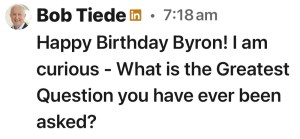
This morning, my friend, great leader, and awesome author, Bob Tiede, sent me this message: “Happy Birthday Byron! I am curious – What is the greatest question you have ever been asked?” Every year he sends me a cool birthday wish with a thought provoking question. Last year it was, “What is the best advice you have ever received?” Back to this year’s question. I took the liberty of changing the question a little to “What is the greatest question I have ever asked?” I hope you don’t mind, Bob. In fact, I asked it in a meeting I was in just yesterday. The question I love to ask is, “Tell me why this is a stupid idea?”
I ask that question because I really do want to know if the idea is stupid. And experience has taught me that the ensuing discussion always makes the idea better. The question also fosters an environment of open dialogue and critical thinking. I always say I can come up with 100 crazy ideas a day and wrote about it in The Devil’s Advocate. Here’s why the asking our community to tell us why our idea is stupid works:
- Encouraging Honest Feedback: By framing the question this way, we invite team members to express their concerns or doubts without fear of judgment. This can lead to a more thorough evaluation of the idea.
- Identifying Flaws Early: Understanding potential pitfalls or weaknesses in an idea can help refine it or even lead to new, better ideas. If you’re like me, you want to ensure that all angles are explored before moving forward.
- Promoting Creative Thinking: Asking for criticism encourages team members to think creatively about solutions and improvements, rather than just accepting the initial proposal.
- Building Trust: This kind of questioning shows that we value input from our teams (communities). It helps create a culture where everyone’s voice is heard, promoting collaboration and trust.
- Clarifying Thought Processes: It can also help the idea’s originator clarify their own thinking and solidify their rationale, making the concept stronger overall. This was one of the most powerful parts of the Inklings.
My powerful question leaves the door open for edits and ultimately helps in honing innovative ideas while ensuring that any potential issues are addressed early on. Thanks, Bob, for the question!
 Byron's Babbles
leave a comment