Greatest Question Ever Asked
During my study time this morning I finished the great book by Diana Pavlac Glyer, The Company They Keep: C. S. Lewis and J. R. R. Tolkien As Writers In Community. One of the important things Dr. Glyer speaks of is that for a community, such as the Inklings, to be effective the author has to assume an attitude of their manuscript being open to edits. This might seem pretty obvious, but how many times have you asked for edits really hoping the other person would just say, “Great job!” Instead you received a whole lot of good suggestions that needed to be contemplated. In the end, I am guessing at least some of those suggested edits made your end product better.
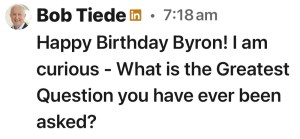
This morning, my friend, great leader, and awesome author, Bob Tiede, sent me this message: “Happy Birthday Byron! I am curious – What is the greatest question you have ever been asked?” Every year he sends me a cool birthday wish with a thought provoking question. Last year it was, “What is the best advice you have ever received?” Back to this year’s question. I took the liberty of changing the question a little to “What is the greatest question I have ever asked?” I hope you don’t mind, Bob. In fact, I asked it in a meeting I was in just yesterday. The question I love to ask is, “Tell me why this is a stupid idea?”
I ask that question because I really do want to know if the idea is stupid. And experience has taught me that the ensuing discussion always makes the idea better. The question also fosters an environment of open dialogue and critical thinking. I always say I can come up with 100 crazy ideas a day and wrote about it in The Devil’s Advocate. Here’s why the asking our community to tell us why our idea is stupid works:
- Encouraging Honest Feedback: By framing the question this way, we invite team members to express their concerns or doubts without fear of judgment. This can lead to a more thorough evaluation of the idea.
- Identifying Flaws Early: Understanding potential pitfalls or weaknesses in an idea can help refine it or even lead to new, better ideas. If you’re like me, you want to ensure that all angles are explored before moving forward.
- Promoting Creative Thinking: Asking for criticism encourages team members to think creatively about solutions and improvements, rather than just accepting the initial proposal.
- Building Trust: This kind of questioning shows that we value input from our teams (communities). It helps create a culture where everyone’s voice is heard, promoting collaboration and trust.
- Clarifying Thought Processes: It can also help the idea’s originator clarify their own thinking and solidify their rationale, making the concept stronger overall. This was one of the most powerful parts of the Inklings.
My powerful question leaves the door open for edits and ultimately helps in honing innovative ideas while ensuring that any potential issues are addressed early on. Thanks, Bob, for the question!


leave a comment