Imagining The Unimaginable

Last night I had the pleasure of recording a professional growth video focused on student engagement with five National FFA Teacher Ambassadors from Missouri, Nevada, Tennessee, and West Virginia. The goal of our recording was to provide teachers from around the country with ideas on how to keep students engaged right now whether it be in the classroom or in FFA activities. The recording turned out awesome and I really got to thinking about how the teachers were excited about the fixes their FFA chapters had developed for keeping students/members engaged during the global pandemic. We are on day 254, by the way. And, I loved the fact that several times it was the students who came up with the solution or idea for engagement. Make no mistake, though, they are still looking for ideas for upping their engagement game.
We also discussed things that we want to continue post-pandemic, like having members who can’t attend an event in person, for whatever reason, be able to join virtually. We weren’t thinking in that mindset 254 days ago. Things like pandemics, wars, and other social crises often create new attitudes, needs, and behaviors, which need nurturing. I believe in the power of imagination and creativity. Right now there are very few things that are absolute and for sure. We live in a very complex and ever changing environment right now – the future never releases hard data.
What we were really saying in the video was that we must keep imagining every possible scenario. In other words, letting our imaginations go wild. We must be imagining the unimaginable. Think about it; what is happening right now during the pandemic to our society has no precedent, or data behind it. No matter what industry we are in right now we need to continue to be creative and use our imaginations to open the path forward.
There is a silver lining, however. As I pointed out, these five teachers gave us numerous ideas and opportunities the pandemic have made imaginable. All kinds of new ways of staying engaged and connected have been implemented that will continue after this pandemic has passed. Because we will probably never return to our familiar pre-pandemic realities, we need to keep imagining an even better future.
Beyond COVID-19
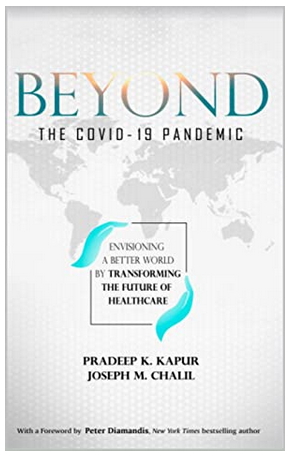
Beyond the COVID-19 Pandemic: Envisioning a Better World by Transforming the Future of Healthcare by Amb. Pradeep K. Kapur
My rating: 5 of 5 stars
This book could not have come at a better time. I finished reading it on Day 250 of the COVID-19 Global Pandemic. No part of our lives has been untouched by the pandemic. As an education policymaker I am always amazed at the parallels between the medical/healthcare field and education. Figuring out how to move forward as the pandemic rages on and in, hopefully soon, a post-pandemic world will be critical. While this book serves as a guide for us to improve healthcare and create a new paradigm, educational leaders need to read this book because so many of the ideas and recommendations are applicable. It reminds us how important it is to take time and learn from what we have experienced and contemplate, very thoughtfully, the path forward.
View all my reviews
Leapfrogging To New Paradigms In Education
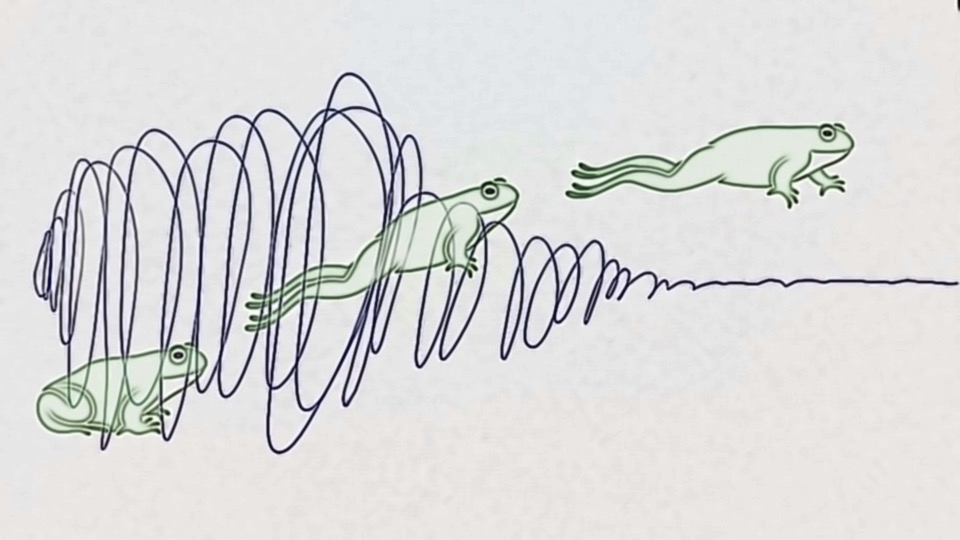
I am going guess most of us played the game of ‘leapfrog’ at some point in our childhood. You know, the game where a number of children bend down and another child jumps over them one at a time, moving the line forward. If you are still playing this game – no judgement here. I refuse to grow up, too. This is, however, a great metaphor for where we are right now as a country. You all know how I love a good metaphor and Susan Patrick, President and CEO of Aurora Institute, knocked it out of the park (note the baseball metaphor) during her opening remarks and call to action at Aurora’s 2020 National Policy Forum saying, “We are at a ‘leapfrog’ moment in education.” This is so true!
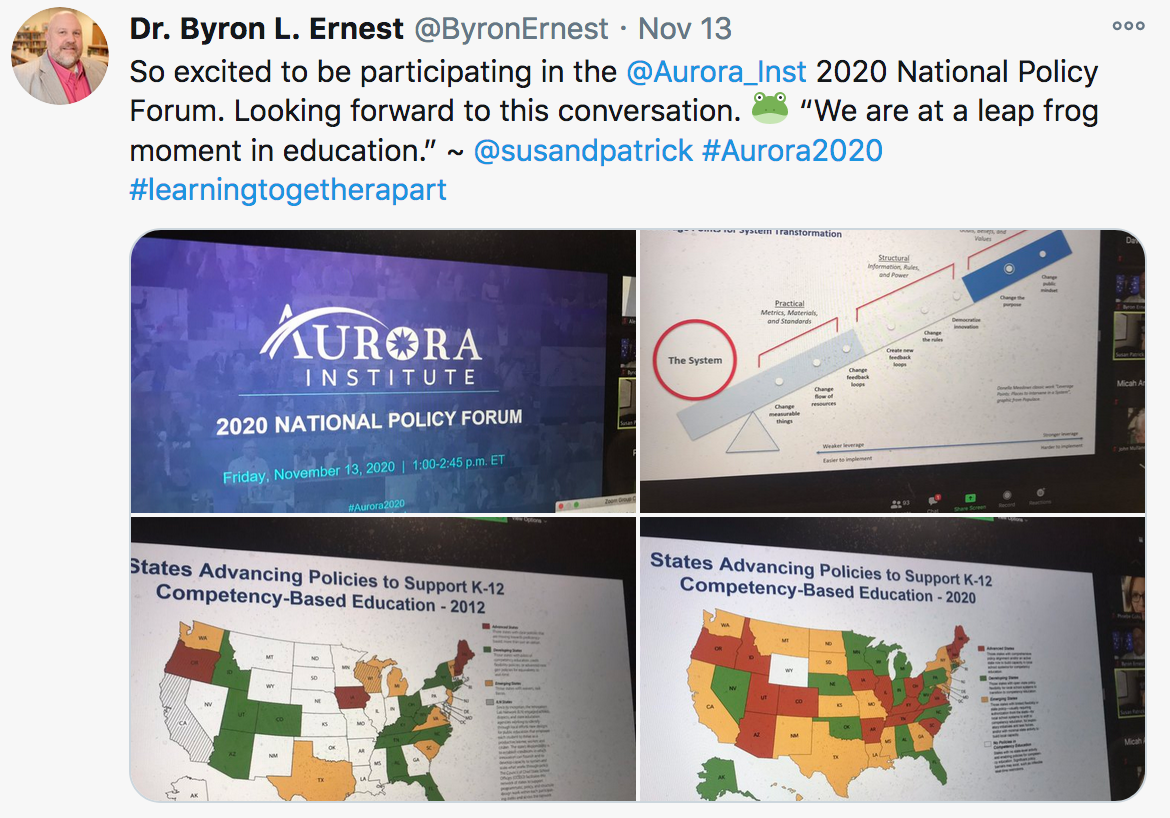
Besides the definition of ‘leapfrog’ as a child’s game I did not really like the other definitions because phrases like “moving past others quickly” or “missing stages” were used. I did kind of like Cambridge Dictionary’s definition of “to improve your position by moving quickly past or over something that blocks your way.” To Susan’s point, we have an obligation in education right now to do this for ALL students.
I had the opportunity to speak on a global platform to over 40 countries back in the spring and I presented the following list of what I believe to be our Global Education Policy Considerations:
- Connectivity and Technology Access
- Remote Learning – I followed the first bullet with this because remote learning is so much bigger than just devices and broadband access. We also need to be thinking about the support students need in coaching, mentoring, tutoring, social emotional learning, nutrition, and basic care/safety needs
- Personalized/Self Directed Learning/Mastery-Based Learning
- Equity In Learning
- Educating Students with Physical and Learning Disabilities
- Mental Health Counseling / Physical Health Support
- Flexibility
- Support for Teachers
A pretty daunting list, I know, but we must get our focus just right on these issues and now is the time to ‘leapfrog’ to that focus. And, maybe, just maybe, the bullet point of ‘flexibility’ is one way to get us there. If we put on our equity lens and take all the points into consideration can we create space, remove obstacles (I like thinking obstacles better than barriers because obstacles can be ‘leapfrogged’ and removed; barriers not so much) so we can address all these issues. The COVID-19 Global Pandemic has also highlighted how in need of attention areas of our education system truly are, with concerns of equity and quality leading the lists.
I would like to submit the following question for us all to consider as we contemplate the future of education for ALL: Can we have new paradigms for education? I certainly believe we can.
We truly are at a ‘leapfrog’ moment in education. I believe the Aurora Institute has the Strategic Pillars in place to be a catalyst for bringing about this ‘leapfrog moment’ and bringing about new paradigms in education. Here they are:
Policy & Advocacy
Removing barriers and creating space for education innovations by advancing enabling policies and providing technical assistance, expertise, briefings, and support to policymakers at all levels.
Field-Building & Knowledge Creation
Building the field across networks, creating new knowledge, analyzing field data and sharing the latest research to produce and communicate insights to move the field forward.
Convening & Connecting
Providing unparalleled networking and learning to professionals designing new learning models, our events connect the field’s leading experts and practitioners with the trends, promising practices, and research to shape the future of education.
I so appreciate Susan Patrick inspiring us to leapfrog forward. As Abraham Lincoln taught us, “You cannot escape the responsibility of tomorrow by evading it today.” Let’s not forget that excellence is our best equity proposition. By leading collectively we can create an educational ecosystem that is best for all students.
What Are Your Filters?


I promised another post inspired by the Carolina 3D Leadership participants from the activity where I showed the group the picture of a spider web that I had taken in the barn the morning of their gathering to prompt a discussion. The first post was entitled Out of Kilter. This post is about a comment made that the picture has a filter that blocks everything except the spider web, which if you do not like spiders is a bad thing. The picture used for this activity is shown above on the left. The original picture without any filtering is on the right. This was described as a negative filter. Then it was said that we need to remove the negative filter to see the good. Therefore, we need to change the filter we look through at times. This was such an awesome metaphor the group had created.

This also made me think about all the augmented reality filters there are out there right now to use with our images of ourselves to make our Zooms and other interactions more interesting. Honestly, they just annoy me! But, we really do need to think about what our personal filters are. This is particularly true when we are experiencing what David Taylor-Klaus (DTK) describes as “feeling less” (p.109) in Chapter 12 (Choose a New Perspective) of Mindset Mondays With DTK. This would be like the filter only showing the spider web, or an amygdalla hijack, where our brain is seeing the event as a bad thing – real or perceived. The way to shift out of this hijack, as DTK taught us, is to remove the filter as the event is happening so we can see it for what it really is. That spider web doesn’t look near as threatening in the picture on the right. I love DTK’s questions he proposes we ask ourselves for removing filters:
- What am I making up as true?
- Is that actually true? If so, when did it become true?
- What do you know is true?
Now: choose a new perspective, one that serves you and you can honestly believe is true.
DTK’s last thoughts in the chapter on this are very meaningful. He said, “Once you can get beyond your made up beliefs of who you think you are not,creativity emerges. In that more open, receptive space, that’s where ideas are born and connections grow” (p.112). My final thoughts are if you look for things that are wrong with whatever you are looking at you can usually find plenty. After all you are looking through your filter that defines what wrong and right look like. It is easy to find confirmation for any viewpoint, whether negative, positive or neutral. The unfortunate thing for most of us, much of the time, we are unaware that we are looking through our own filter. Therefore, we need to be aware of what filter we are looking through.
Consider using a positive first filter starting today. Life would look much better if we were able to use our very own positive filter to remove the negative and focus on the positive. What are your filters?
Do Ideas Cause Change Or Does Change Cause Ideas?

In the great book, The Upswing: How America Came Together A Century Ago and How We Can Do It Again, Robert D. Putnam and Shaylyn Romney Garrett posed the question of, “Do ideas cause change or does change cause ideas?” I am loving reading the research and work of Putnam and Garrett. I am only about 80% through the book and I love how he always points out when there cannot be any correlation, causality, or answers gained from leading or lagging indicators. I see this a lot in education; people want to jump immediately to causation. Putnam is a brilliant political scientist and Shaylyn has had a brilliant career as a change-maker and social entrepreneur. The two of them together have put together this award winning literary analysis of economic, education, civil rights, political, and other social trends for over a century. The book posits we have gone from an “I” to “We” and back to “I” society and gives us hope and ways to get back to we.
Change is defined as to simply make something or someone different, unlike the way it was before. Change can also be defined as moving from one thing to another. Synonyms for the word change consist of transform, alter, and modify. A lot of people have ideas about changing the world and making it a better place for people to live. This desire to change the world sounds very noble and heroic.

Now, back to the question prompting this post: do ideas cause change or does change cause ideas? I believe it is both. For example the idea of us carrying a source for listening to music in our pocket caused an entire chain of events (changes) leading ultimately to the SMART phone. Conversely, Coronavirus has hit the world in 2020. This has drastically changed our world from open and social to closed and locked down. This change has affected people’s lives, finances, relationships, and even their children. New ideas because of this change are being thought of every day.
Therefore, we need to keep being creative and having ideas about how to change the world. Additionally, we need to be paying attention to changes happening around us and let them prompt ideas for positive change.
Out of Kilter
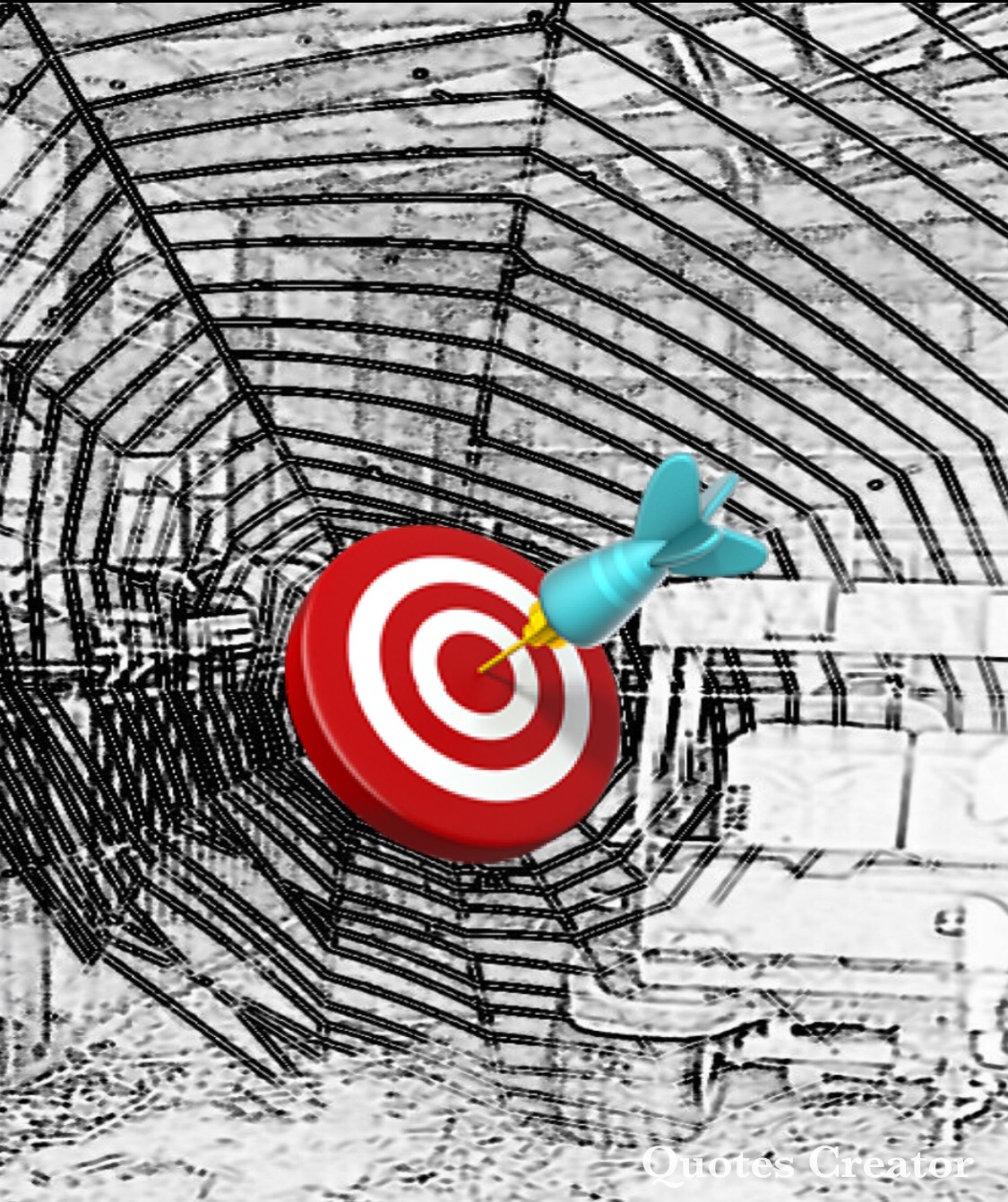
We had a gathering of our Carolina’s 3D Leadership Program today and, as is always the case, I was inspired and learned a lot from the group. Last week I blogged about the activity where I showed the group the picture of a spider web that I had taken in the barn that morning to the group to prompt a discussion. You can read about Leaders Weaving The Web here. Today I switched up the prompt just a little. Here it is: On Day 247 of the Global Pandemic, relate the journey you are on to the picture. The picture was the photo featured in this post minus the target and dart. After having some time to discuss in small breakout groups, they came back with some very insightful points for discussion. This post includes all of their points except one: the picture looks as though we are looking through a filter. I will address that point in a separate post.
Looks Like a Target
It was commented that the web looks like a target. I loved a comment that was made that even though the world has been thrown “out of kilter” (this, from one of our participants, is so much better than saying unprecedented times), we still have much to accomplish for our students. We must still be meeting our educational targets for our students and developing them as a whole person. In other words we need to be very careful about what things we have paused that turn into permanent pauses. Some pauses need to be made permanent, but we really need to match what decisions we make to the targets that need to be achieved for our students.
Looks Like Broken Glass
One group of participants said the web looked like broken glass. This was a reminder that we must keep going. This reminded us that there has been a great deal of positive innovation brought by the pandemic. Also, we discussed that the pandemic cannot be used as an excuse to lower expectations. Our kids deserve effective instruction and like was said earlier we must continue to lead them to their learning targets.
Looks Fragile
The group pointed out that everyone is very fragile right now, but there is strength in the web. We need to make sure we are serving like the silk of the spider web connecting all the small, important pieces together for our students, families, and those we serve. We need to continue connecting ideas, which in-turn creates the beautiful masterpiece. Even though the web looks fragile, we need to remember that much of the strength of the spider web comes from its elasticity.
It turns out that a key property of the silk in the spider web that helps make it so robust is something previously considered a weakness: the way it can stretch and soften at first when pulled, and then stiffen again as the force of the pulling increases. Now that is a great metaphor for during this time of being out of kilter. We are being pulled and we need to soften and allow for being stretched, which will then allow us to stiffen and become strong for those we serve. Markus Buehler, an associate professor of civil and environmental engineering (CEE) at MIT, has done extensive research on spider webs says this about the web: “It’s a very flaw-tolerant system.” We need to also assume this “flaw-tolerant” position when dealing with students or those be serve.
Hopefully this being out of kilter is preparing us for a new phase of greatness in education, business, and our lives. With each day of the pandemic my hope is that we are assuming an attitude of preparation. I know I am very different today that I was 247 days ago. I’d like to think that most of those differences land in the positive column. Let’s keep moving forward – onward and upward!
The Education Catapult
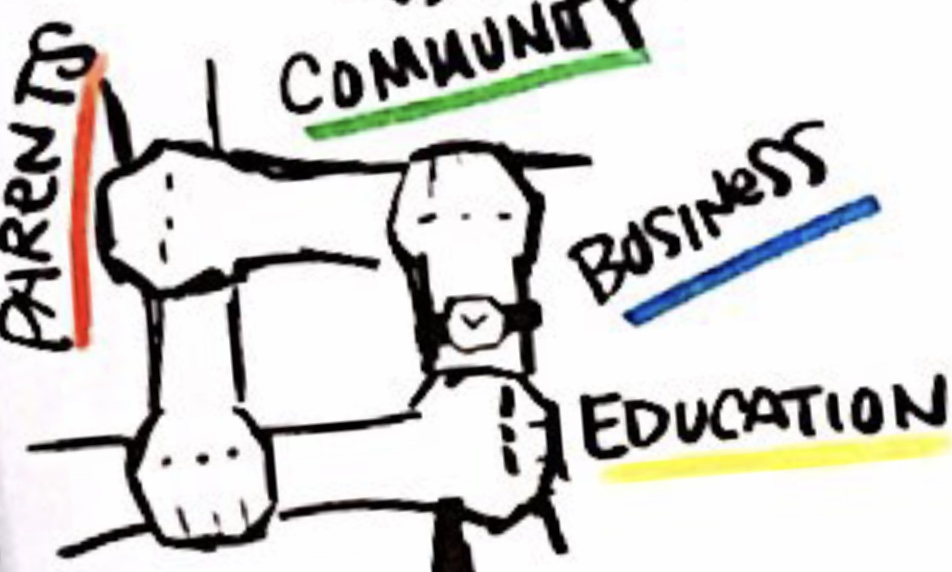
Last evening I had the opportunity to do some of what I call #LearningTogetherApart. Yesterday was Day 245 of the Global Pandemic and the webinar was entitled “Post-Election 2020: Charting a Path Forward in Education.” The webinar was put on by The Hunt Institute and the National Association of State Boards of Education (NASBE), which I am chair of the board for, was one of the partner organizations involved in making this conversation possible. Other partners were The School Superintendents Association, National Association of Elementary School Principals, National Association of Secondary School Principals, and National School Boards Association. And, what a great conversation it was. The panel included The Honorable Margaret Spellings, Former U.S. Secretary of Education (2005-2009), President & CEO Texas 2036; The Honorable Arne Duncan, Former U.S. Secretary of Education (2009-2015), Managing Partner, The Emerson Collection; Chancellor Richard A. Carranza, New York City Department of Education (2018-Present); and Superintendent Alberto Carvalho, Miami-Dade County Public Schools (2008-Present). As you can see this was quite the lineup of experience and expertise in the room.

Another highlight yesterday was receiving the new book Beyond The COVID – 19 Pandemic from authors Pradeep K. Kapur and Joseph M. Chalil. I am so glad that I started reading it in the space between the end of the work day and the webinar. In the preface of the book there are six questions posed for the global community to contemplate (p. xxi-xxii):
- What sort of changes are required at the policy level to cope with such pandemics in the future?
- How do we better equip global organizations to evolve for dealing with the challenges ahead?
- Do we need to think of setting up new organizations to replace the WHO and the UN?
- Can we have new paradigms for healthcare?
- How do we create reserves and stockpiles of essential healthcare supplies? Where will the money come from when the budgets are already under great stress?
- How do we get the global economy back on its feet?
As you can see, these are pretty good guiding questions and even though these are not education specific questions they could be great guiding questions for any conversation. Really, the answers to these questions need to involve education in every answer. The authors point out that the pandemic is the biggest disruption to our county in 100 years. In having studied the 1918-1920 pandemic, I am amazed that we are experiencing and struggling with many of the same issues we had then. I can’t wait to immerse myself into the book as these authors dream big and have offered solutions that are possible if we just reach political consensus and carry through to implementation (a core value of how I try to serve as a policymaker on the Indiana State Board of Education).
The panelists last night were also using their experience to dream big. I want to touch on a few thoughts they had by referring back to tweets I made during the conversation. Allow me to pick a highlight or two (or three) from each of the participants using tweets. You can check out all the tweets at @byronernest or by going to #ElectionEd2020. Here we go!
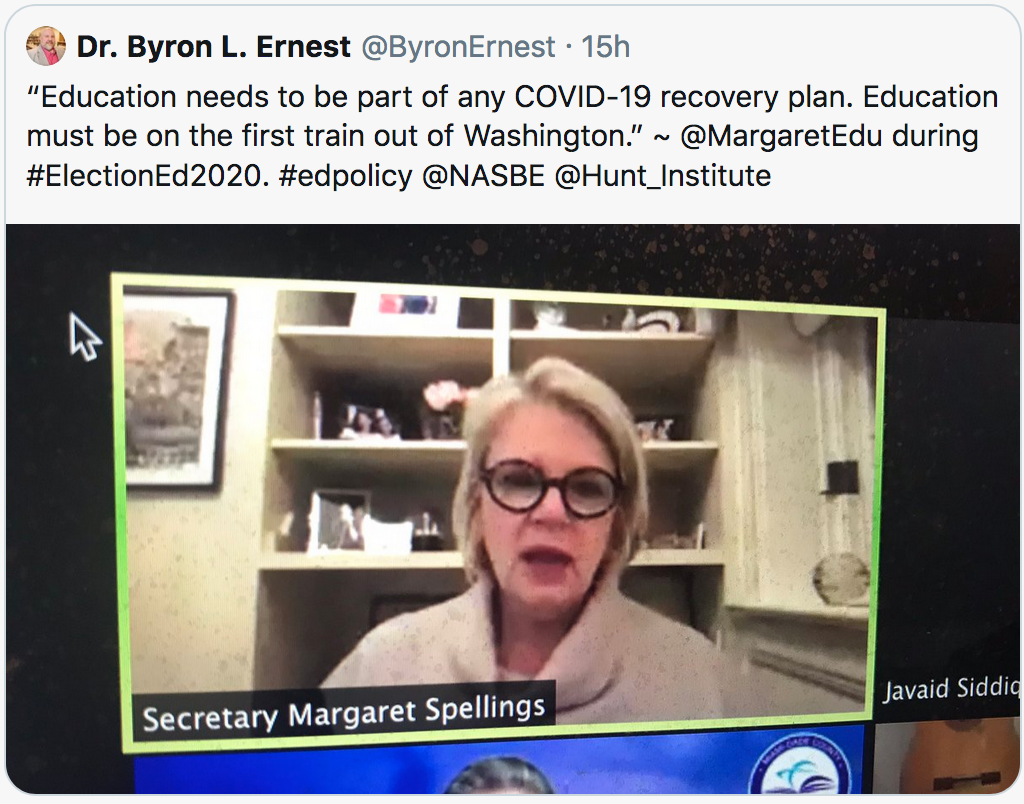
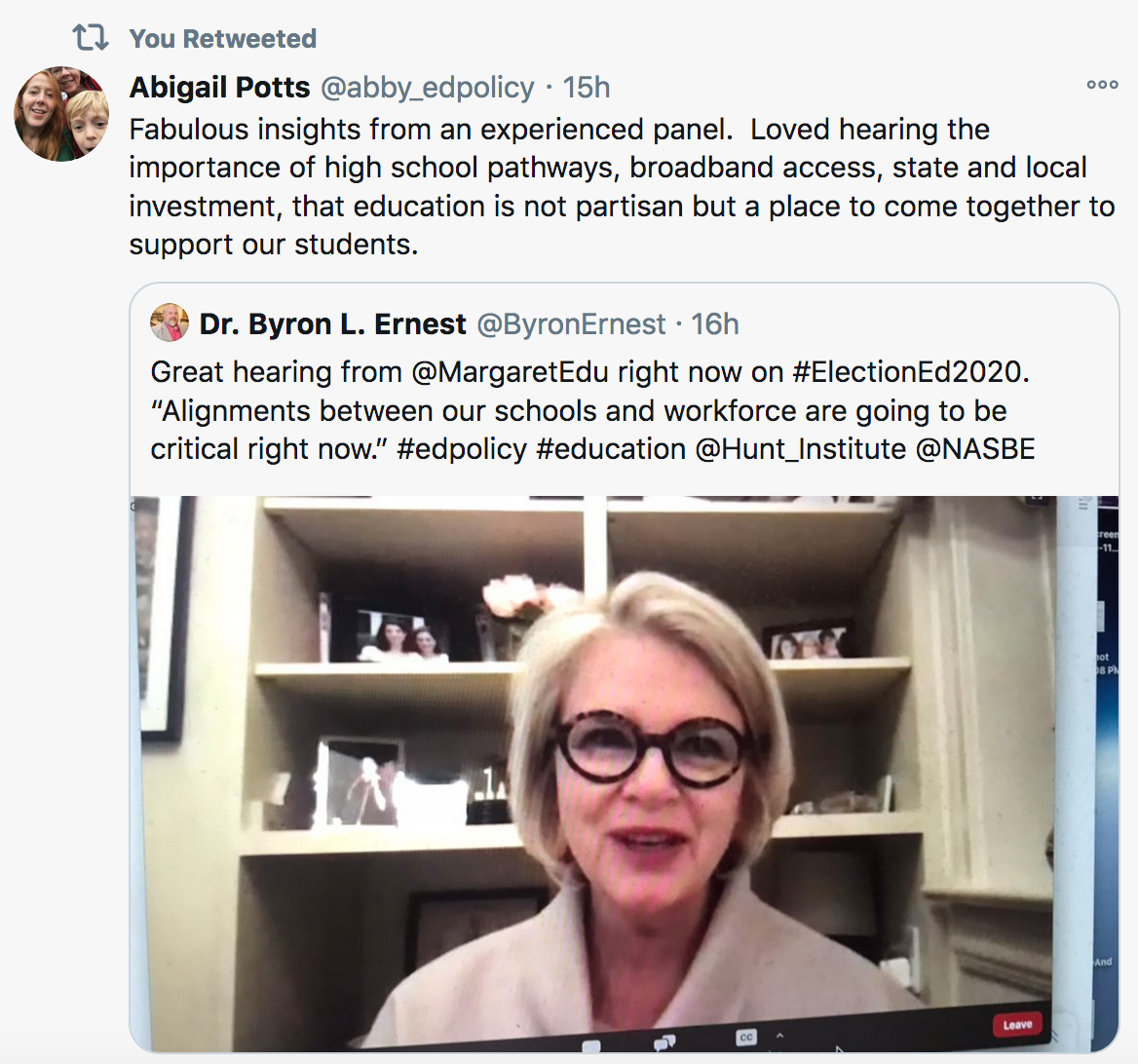
Secretary Margaret Spellings reminded us that education must be a major component of any pandemic recovery plan. As she said, “Education must be on the first train out of Washington.” And, she also reminded us that in order for there to be economic recovery, education must be involved. As a person who believes so much in the involvement of business/industry in education it gave me hope when she suggested that “Alignments between our schools and workforce are going to be critical right now.” This also includes continued alignments with higher education for all of dual credit, dual enrollment, Advanced Placement, internships, and work-based learning opportunities. We cannot let the pandemic take these away from our students. These opportunities provide for some of the greatest outcomes being afforded our students. I loved that Abigail Potts, NASBE’s Director of College, Career, and Civic Readiness, retweeted my tweet on this with comments that added the importance of our high school pathways, broadband access, and state and local investment. And, Abby pointed out in that tweet that education is not partisan but a place to come together to support our students. Thanks for the tweetversation (yes, I just made up a word), Abby!
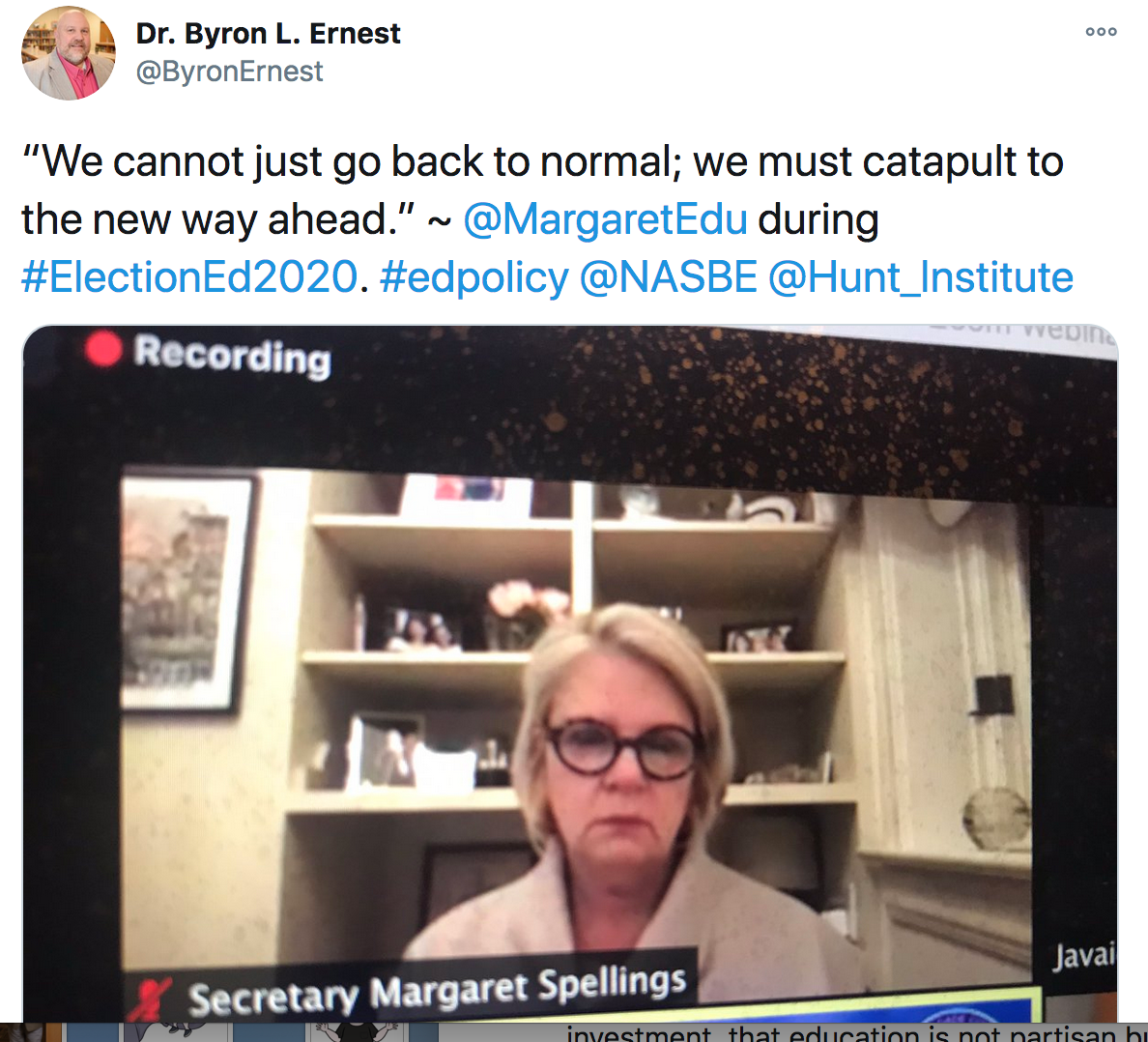
Additionally, I have to add in one more insight from Secretary Spellings. She reminded us that “We cannot just go back to normal; we must catapult to the new way ahead.” I love the way she put that. I have continued to say over and over we have to take what we have learned and apply it and never look back. “Catapult” was the best term that could have been used for this. Go back to the questions posed in Beyond The COVID – 19 Pandemic and put them into the context of education and that is exactly where Secretary Spellings is suggesting we need to go.
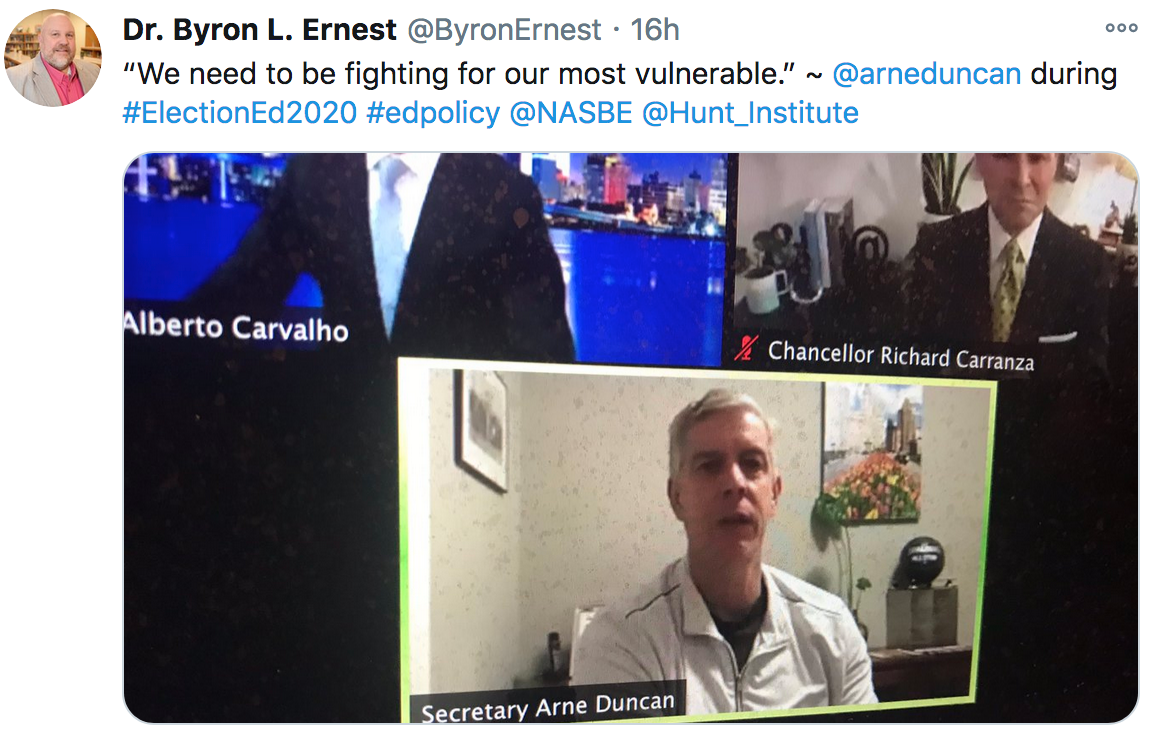
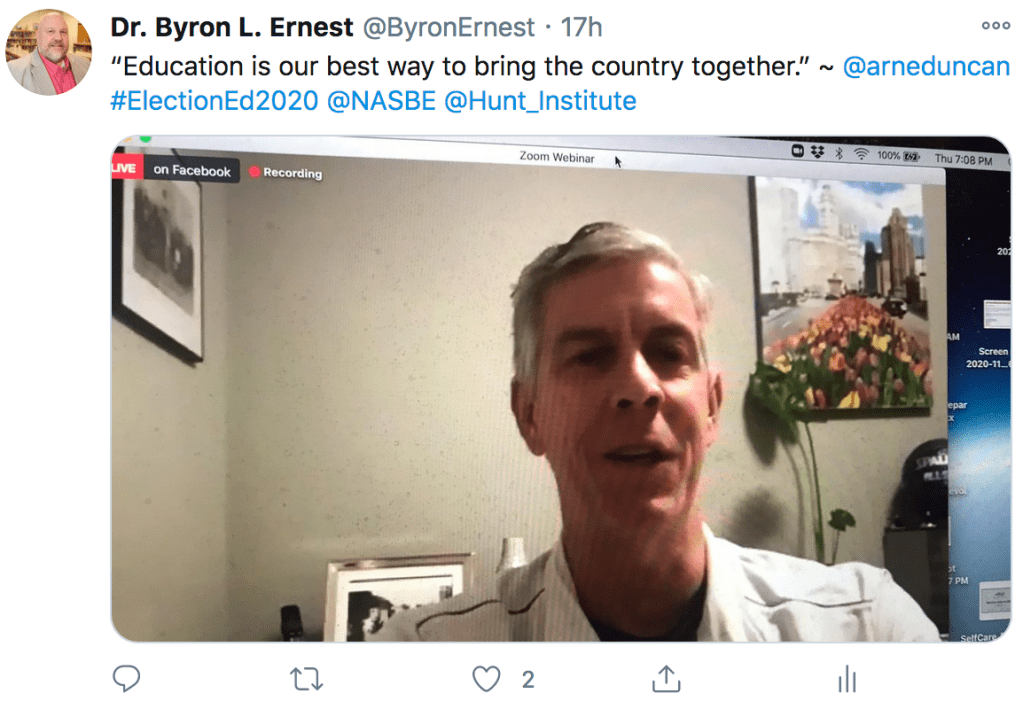
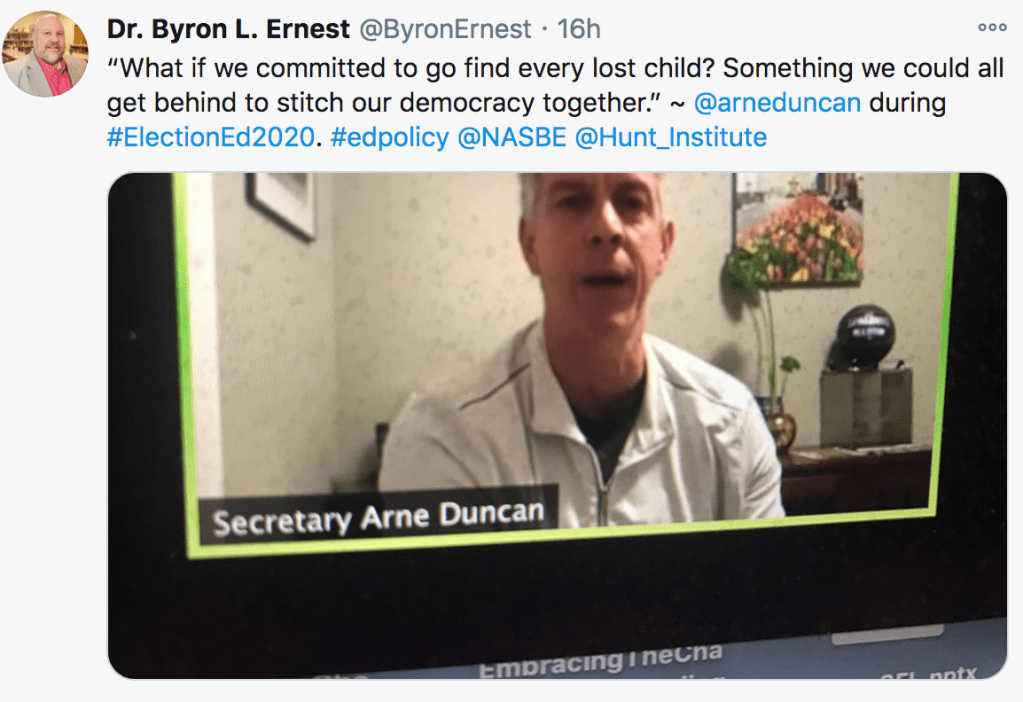
I got to know Secretary Arne Duncan during my service as 2010 Indiana Teacher of the Year. He is so passionate about doing what is right for ALL children. In fact he made this clear when he said, “We need to be fighting for our most vulnerable.” I’ve also been impressed with the non-partisan way in which he views education. He also reminded us that “Education is our best way to bring the country together.” He firmly gave us a call to action for stitching our democracy back together. He posed the question, “What if we committed to go find every lost child?” Wouldn’t it be great if we could reach some consensus on a vital few things we could all work on and begin our evolution dealing with educational challenges? Secretary Duncan finally reminded us that, “We need need a healthy debate/conversation, putting aside political ideologies, based on data. We need the courage to do some things differently.” Well said!
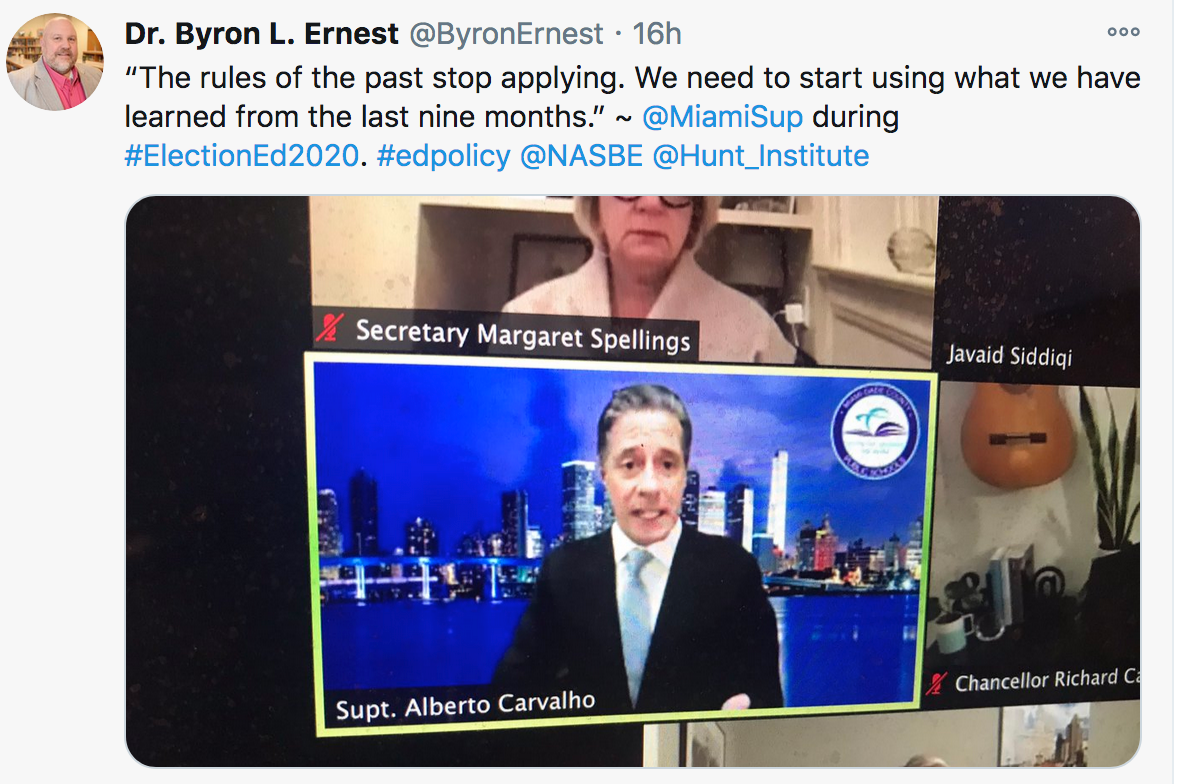
Superindent Carvalho and Chancellor Carranza brought great perspective to the conversation from street level at the school. Superintendent Carvalho taught us that “The rules of the past stop applying. We need to start using what we have learned from the last nine months.” Providing education to ALL children has been a continuing challenge for families, schools, local, state, and federal governments, and leaders around the world. To answer the challenge we have tried and need to continue to try different paradigms to equity in learning for all. In my opinion we must develop a system by which we are developing the whole child in every child. Also, we must develop an ethos that sees the potential in every student. As a policymaker I use the test question of “Will this policy reduce inequity, maintain inequity, or increase inequity?” to inform my decisions. As I listened to these two school leaders I thought about how, after 245 days, we really need to assess what to de-prioritize and what needs to be prioritized.
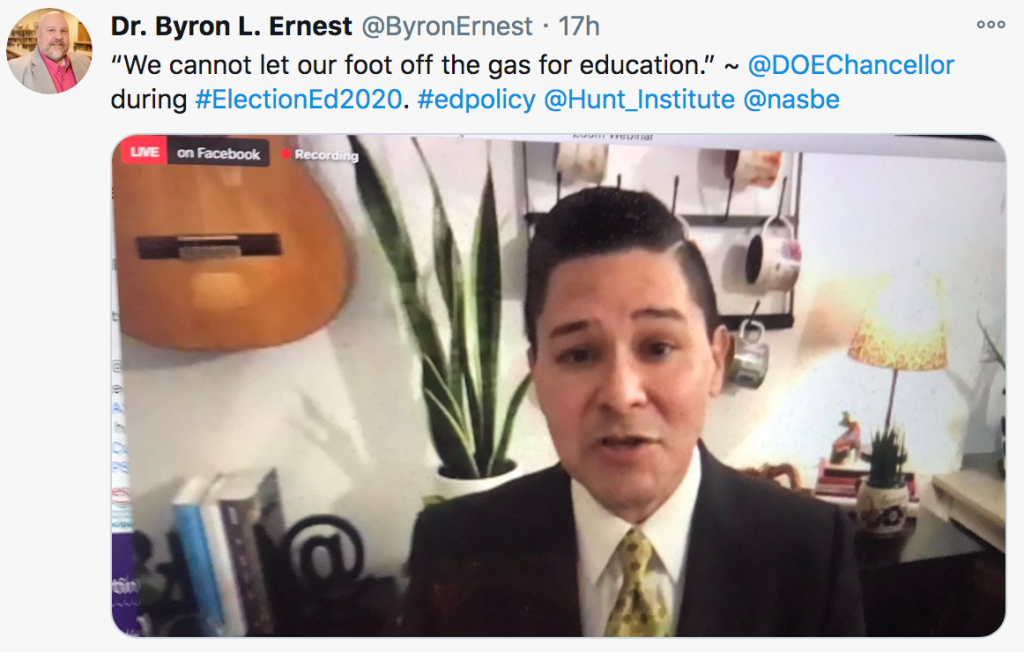
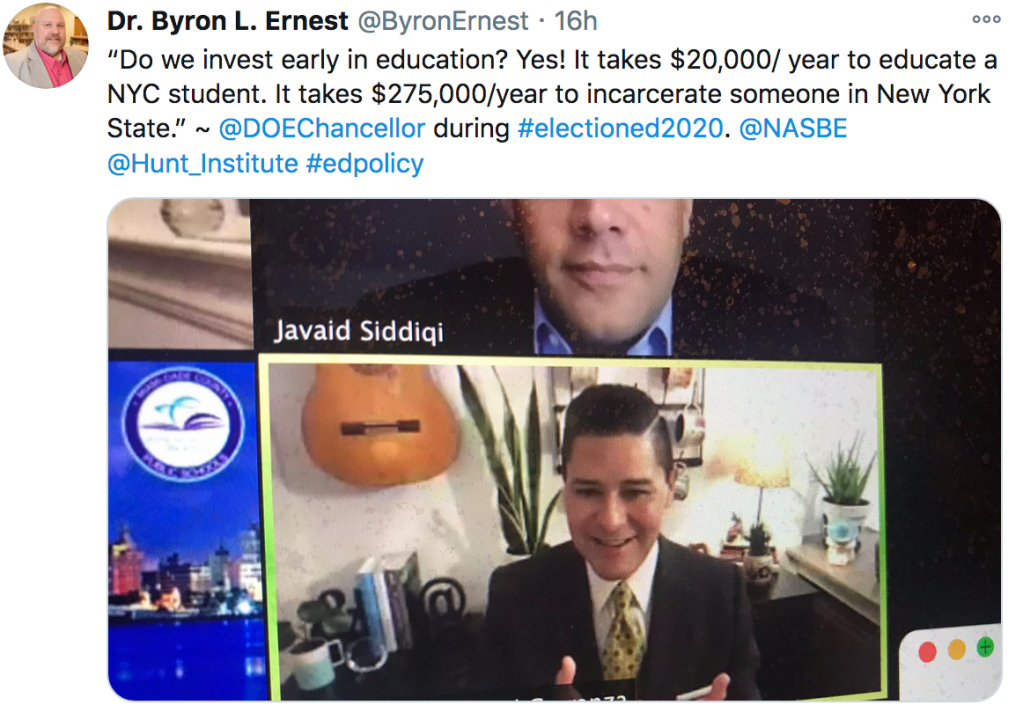
Chancellor Carranza warned us to not “let our foot off the gas.” Some might argue that in some areas we need to put our foot on the gas, but those are the areas that Secretary Duncan told us we need to all get around and start working together on. When speaking of early childhood education and education funding in general, Chancellor Carranza gave a very real example by asking and answering his own question: “Do we invest early in education? Yes! It takes $20,000/year to educate a NYC student. It takes $275,000/year to incarcerate someone in New York State.” This was a reminder to us all how important an investment education is. And, let’s not forget the economic impact of having students prepared for our ever changing workplaces. Additionally, I think a lot about how we need to identify all the reasons for our students’ learning struggles. This goes beyond having devices and internet access. It takes us into the support structures in place or not in place for the student. We must have the whole portrait of student if we are create the ideal environment for learning.
As you can see, this was quite the discussion and I’ve only scratched the surface. This truly was a conversation, not an interrogation around defining the challenges and how to best disrupt education with the exponential learning we have done during the pandemic.
Putting More Carpe In Your Diem

Today, someone said they “needed to put more carpe in their diem.” You all know me; this got me thinking about how one would do this. “Carpe diem” is a Latin aphorism, usually translated “seize the day” or “pluck the day [as it is ripe]”. It is a philosophy that I think we should take more seriously. I like the “pluck the day” interpretation the best. Plucking is an action, like picking a ripe apple from a tree. If not picked when ripe it will fall from the tree and rot. Sometimes I believe we should focus less on what should happen in the future and more on what is happening now.
“A good plan violently executed now is better than a perfect plan executed next week.”
~ General George Patton
If the apple is ripe today, we better pick it. Wind could blow it off the tree over night, or insects, or birds could begin to eat the apple before we have the chance. What does this metaphor teach us? We have more control over the present than we ever do over the future. Here are the questions we need to be answering:
- What can I do right now to move what I am trying to do in the direction I would like to see things go?
- What are the possibilities?
- What are the opportunities available right now?
- How do I move what I’m trying to accomplish in the direction I would like to see things go?
We can make sure we are prepared for the future, but not at the expense of living for the present day. Pluck the day.
Work From The Heart

I am amazed at how one football game is now prompting a third blog post from me. The game was the amazing 38-3 win of the New Orleans Saints over the Tampa Bay Buccaneers on Sunday night. Posts are already out there from me entitled Spreading The Wealth and Catch Me and Prop Me Up inspired by this game. This post is inspired by Terron Armstead, who was really the inspiration for the latter mentioned post as well, and his posting of Colossians 3:23 on his twitter landing. When someone posts a Bible verse, if I don’t remember it, I always look it up and reflect on it. Here is the verse from The Message Bible:
“Work from the heart for your real Master, for God,” ~ Paul to the Colossians
Colossians 3:23 The Message Bible
So this immediately meant working from passion and purpose. I also went ahead and read the whole chapter (3), and verse 17 (Colossians 3:17 The Message Bible) jumped out. Here it is:
“Let every detail in your lives – words, actions, whatever – be done in the name of the Master, Jesus, thanking God the Father every step of the way.” ~ Paul to the Collosians
Colossians 3:17 The Message Bible
Does this speak to character, or what? This is all about walking the talk! Our conduct should extend to all aspects of our life, not just a small set of rules. Then for me I need to put verses 22-25 all together. Here is how it reads in The Message Bible:
“22Servants, do what you’re told by your earthly masters. And don’t just do the minimum that will get you by. Do your best. 23 Work from the heart for your real Master, for God, 24 confident that you’ll get paid in full when you come into your inheritance. Keep in mind always that the ultimate Master you’re serving is Christ. 25 The sullen servant who does shoddy work will be held responsible. Being a follower of Jesus doesn’t cover up bad work.” ~ Paul to the Colossians
Colossians 3:22-25 The Message Bible
In other words we are to work heartily, giving it our best every day. I believe this why Terron picked this as the Bible verse to put on his landing page. In his case he must give of his all whether it be working out, studying film, practicing in order for him to be able to show up as a positive role model on one of the world’s largest stages NFL game day. This is all about enthusiasm and passion. We may not be on as big a stage as Terron, but we do have influence on others. Demonstrating a good work ethic and attitude makes a tremendous difference on our personal life and on the influence we have on others. Thanks Terron Armstead for posting Colossians 3:23 on your Twitter landing so we could be inspired in the influence we have on others.
Catch Me and Prop Me Up!

In Chapter 11 of Mindset Mondays with DTK, David Taylor-Klaus used the analogy of a fitness class and wearing a weighted vest to discuss “Reclaim Your Brain.” This got me to thinking that athletes are the perfect examples of reclaiming your brain. Let’s use football as the example. When a quarterback throws an interception, they must immediately get their mind back on track and tell themselves the next pass will be caught. Otherwise the mindset of throwing another interception will take over. For the quarterback it becomes about taking a deep breath and the reminder of all the work in practice that has gone into being on the same page that ensures success on the next pass.

Then, during a post-game interview following the New Orleans Saints huge 38-3 win over the Tampa Bay Buccaneers, Drew Brees (Pride of Purdue University and greatest quarterback of all time) reminded us that we also need to be propped up by others to help us see the things that will keep our mindset focused in the the right direction. Here’s an excerpt from Brees’ inspiring comments:
“It was funny, I got hit and I was going down and Terron Armstead caught me and propped me up and said, ‘I just wanted you to see this touchdown.’ So, it’s funny how often the offensive linemen catch that stuff; You know, their blocking, their blocking {and} the minute their guy sees the balls been thrown, the lineman is able to look down the field…So, it’s funny, he caught me, propped me up and said, ‘I just wanted you to see this touchdown.’
Drew Brees is post-game interview
Is that the coolest story or what? It really got me thinking about how many times others have propped me up, even at times when I probably didn’t deserve it. In listening to the interview, this propping up of Drew Brees had a profound impact on him. He was also very complimentary Terron Armstead’s awareness of what was going happening on the whole field. This big picture vision and propping up I’m sure plays a huge role in the team community of the Saints. Armstead saw a need for leadership and seized the moment. I touched on this in Spreading The Wealth. Everyone is a leader and everyone has the responsibility to lead from wherever they are whenever necessary. Period.
Leadership is crucial to setting others up to become successful. By really understanding and paying attention to the needs of those on our teams we can help provide for other to become the “best self” they can be. In our example here, Armstead became a servant leader by being there for Brees. Sometimes we need a cheerleader, other times a champion, and other times a blocker. Through our own curiosity and vision we can help others reflect on their own work and mindset, which helps them be successful the next time around. Don’t think for a minute that Drew Brees won’t be thinking about being propped up and watching that touchdown for some time to come. And, that seeing that touchdown first hand while being propped up hasn’t added to a positive mindset. Success breeds success and the more we learn from what others do right, the more we all grow.
What have great leaders in your life done lately to prop you up and help you reclaim your brain with the right mindset?
 Byron's Babbles
1 comment