The Synchronized Team

“The camp worked together like a synchronized team.” This was the wagon master speaking of the group he was leading westward in Book 2 of Threads West An American Saga: Maps of Fate by the award winning historical fiction author Reid Lance Rosenthal. As I read that line I imagined the pioneers as synchronous swimmers, floating around their wagons, oxen, horses, and cooking fires, practicing marksmanship for those new to firearms, and getting all the important things done. Like, cooking food, greasing and tightening wagon wheel axles, making jerky from a freshly harvested deer, or the myriad of other duties necessary for a very long and arduous journey to be successful. I imagined every person having some role they were particularly good at and then learning new skills as they chipped in and helped each other. A synchronized team, just like in synchronized swimming, consists of differing roles or dimensions that are balanced to ensure success.
In synchronized swimming the choice of music and choreography enhance the team’s performance and highlighting of the best attributes of team members. The wagon master had displayed this leadership skill by building relationships with those he was leading, allowing him to understand strengths, weaknesses, and skills. This allowed him to choreograph each stop to be perfectly synchronized. Everyone had to move together and everyone had to be able function together as a team. Sound familiar? This is what all our teams need to do. So what are the keys? Here’s what the wagon master taught us:
- Build relationships
- Have a shared vision/goal
- Build trust
- Create transparency and accountability
- Understand each others’ strengths
- Communication
Are you serving as a good leadership wagon master?
Delete The Screenshot

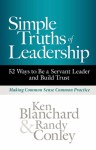
This will be my 51st post about the book Simple Truths of Leadership: 52 Ways To Be A Servant Leader and Build Trust, Making Common Sense Common Practice, by Ken Blanchard and Randy Conley. I committed to reading one simple truth each week during 2022 and writing a reflective post. With this one I’ve got 51 down and one to go. This week’s Simple Truth #51 is “Choosing Not To Forgive Someone Is Like Taking Poison And Waiting For The Other Person To Die.” Everyone knows how I love metaphors. My metaphor for refusing to forgive others is like taking a screenshot of the time of the offense and then making it your lock screen wallpaper, so every time your phone or computer screen lights up, you see it.
Why does that screenshot matter? You end up playing that offense over and over and over. Conley told us that, “Leaders need to have tough skin and soft hearts” (p. 131). This is so true! This simple truth also taught us we are limited in our ability to lead authentically when we choose not to forgive. We need to choose to forgive completely, delete the screenshot, and move on to what we are called to do.
Ringing True

It is interesting when reading about something in history how different people have different takes on the same event. The way we remember things is not necessarily the way they were. Reality and imagination get mixed together. If you think about it, endings have a disproportionate influence on any narrative. How what happened ended can have an impact on how the story is told. We need to remember that the context of the person telling the story matters. Sometimes the context gets dropped or there is nuance to the history. As leaders or authors, when we tell the stories they need to be true.
Knitting Relationships

Relationships have always mattered. This past week I was complimenting a school team I work with and the superintendent said, “Well, it always comes back to the relationships we’ve built and are building.” Those are such true words and a reminder that building relationships is a top of the list item for us to always be working on. I am reading Book 2 of Threads West An American Saga: Maps of Fate by the award winning historical fiction author Reid Lance Rosenthal. In this book the wagon master told the group he was leading west that, “groups where everyone gets to know each other are more likely to cover each other’s back.” That covering of each other’s backs was pretty important during the 1850’s migration westward. But, it is just as important today as we navigate through the 21st century.

Great relationships bring with them an implicit trust that increases the opportunity for collaboration and cooperation. These relationships many times turn into intelligence communities that could potentially solve the world’s most complex problems. What I really believe the superintendent above was saying was that the people around us help us make better decisions. We in turn, can also help them make better decisions. Now, back to the wagon train. I can’t imagine taking that several month journey westward. But, I really can’t imagine taking it without the building of relationships. Really, that is one of the great things that Rosenthal brings out. People of uncommon origins form bonds and relationships that weave together to explore and innovate in an unknown land. It really is, as Rosenthal told me when I visited with him last month, “Our story.” Actually, getting to know Rosenthal has made reading the books even more meaningful. I got to know him and about his motivation for writing the books. Again, relationships matter!
I’ve heard it said that we are “human beings” not “human resources.” So true! As I read about the knitting (🧶 pun intended) of relationships, I am reminded of how every relationship, good or bad, matters. As I read about some of the relationships I kept yelling, “Get away from them!” And for others I would say, “Get closer.” Reid was right; this is our story. We need to lean into those strong relationships and get away from those that are bringing us down. Happy knitting!
The Apology Bridge

Apologies are about accountability. Because relationships are the key to everything it is important to, “Choose the relationship over being right” (p. 129). Randy Conley told us it is about playing the long game. He said, “All relationships have conflict. Use wisdom to discern when it’s better to apologize, even if your in the right, for the sake of preserving the long-term health of the relationship” (p. 129). All these thoughts were in Simple Truth #50, “Apologizing Is Not Necessarily An Admission Of Guilt, But It Is An Admission Of Responsibility” in the great book Simple Truths of Leadership: 52 Ways To Be A Servant Leader and Build Trust, Making Common Sense Common Practice, Ken Blanchardand Randy Conley.
As I stated at the beginning, apologies are all about being accountable, apologies meet the moment, and apologies can transform our relationships. Apologies are an opportunity for us to take clear and direct responsibility for our wrongdoing without evading, blaming, making excuses, or dredging up offenses from the past. Psychologist Harriet Lerner advised that most apologies completely miss the mark. Lerner said, “When the apology is absent or it’s a bad apology, it puts a crack in the very foundation of a relationship and can even end it.” Let’s let apologies be a bridge of communication and accountability for our relationships.
Who Are You?

Our purpose goes much deeper than our job. Sometimes we need little reminders of this. Last night I was watching a new episode of The Neighborhood. In this great sitcom Cedric the Entertainer stars as Calvin Butler, who owns Calvin’s Pit Stop – an auto repair shop. In this episode he is offered a huge sum of money to buy his business. He continues to say he will not sell his business stating he would be nobody without his business. His wife, Tina, played by Tichina Arnold, explained, “Baby [Calvin], that shop does not define you; you define that shop.” So many times we get caught up associating self-worth in conjunction with a job. Tina was reminding Calvin that his identity should be defined by what he loved, what he dreamed of, what he valued, and who he cherished. We should heed this reminder as well.
We are doing ourselves, and others, an injustice if we only define ourselves by our jobs. Our mission here are on this earth is so much more. We have lives of others to touch and impact. Our relationships will serve as our identity more than our careers. When other people reflect or remember us, the thought of our careers might come up, but our personality, character, and how we inspired or impacted them will resonate more. Our identity should be, and is really defined by what we love, what we dream of, our core values, and who we cherish. Who are you?
An Apology Is Ownership

An apology is ownership. When reflecting on the people I respect most, they are the ones that have no trouble saying “I was wrong,” or “I’m sorry I…” When we apologize, we are putting honesty and honor above personal comfort or self-protection. It requires a great deal of courage. Since everyone makes mistakes, it gives us legitimacy to admit to and own our mistakes. Great leaders model the behavior of admitting mistakes. It can, and does, build a community of trust.
Apologizing when trust has been broken is particularly important. This was the topic in Simple Truth #49, “A Successful Apology Is Essential In Rebuilding Trust” in the great book Simple Truths of Leadership: 52 Ways To Be A Servant Leader and Build Trust, Making Common Sense Common Practice, Ken Blanchardand Randy Conley. We were told by Conley that, “Delivering a successful apology is essential to rebuilding trust that’s been eroded” (p. 127). Additionally, I appreciated Randy Conley’s reminder that we must make a commitment to not repeating the behavior. He said, “An apology is only as effective as your attempt not to repeat the actions that eroded the trust in the first place” (p. 127). This is about follow through. If we don’t attempt to change the behavior people question not only our courage, but also our trustworthiness.
Leading Like The DC League of Super-Pets

This past week I worked in Las Vegas, Nevada and on my flight out there I watched the animated adventure centered around the pets of DC superheroes, DC League of Super-Pets. I loved it! The movie is chocked full of leadership lessons, lessons about friendship, and learning to rely on others. Every one of the pets has a story. Also, the relationship of the pet to the superhero has a story. This alone is important to note. As leaders we must understand our own story and well as the stories of those we serve. Additionally, it always comes down to relationships.
No leader works alone. They have teams, friends, and those in the organizations they serve. During my work this week I was reminded that everyone I have ever worked with has played a significant role in my success. In the movie, I was reminded of this by Batman (Keanu Reeves) refusing the to adopt Ace (Kevin Hart) from the shelter. His reasoning was that Batman works alone. Ace was the only shelter pet to work with Krypto (Superman’s dog played by Dwayne Johnson) that had not found a match with a Justice League member. In the end, Batman realized he had never really worked alone. Nothing really great has ever happened by someone working alone. We all have teams, friends, and supporters. We must nurture those relationships.
Batman also made another astute observation in the movie. He told Lex Luthor (Marc Maron), who was hoping to gain superpowers, that superpowers were overrated. How many times have you looked at the skills or talents of others with envy, or even as if they have superpowers. We don’t need what others have. We need what we have. We need to keep becoming the best “me” we can become! We don’t need to look outside for superpowers, we already have those powers within.
Leading With Impact

In his great book, This Is Day One: A Practical Guide To Leadership That Matters, Drew Dudley told us to create a pledge to create experiences that make others feel good about engaging with you. To do this he explained we need to pick a value. An example would be “impact.” You can define impact as “a commitment to creating experiences that make others feel better after interacting with me.” I love this value you and try really hard to practice it daily by asking myself a question like, “What have I done today to recognize someone else’s leadership?” Sometimes our light shines better by reflecting the light of others.
Last night I experienced this first hand by someone else’s living being impactful. Jason Ferreira sat down beside me last night at a dinner we were having for National FFA Teacher Ambassadors and said, “I have something I want to tell you. Not a day goes by that I do not use what I have learned about facilitating in my own classroom, facilitating for teachers, or helping others improve their facilitation.” He went on to say that he keeps many of the objects I use for facilitating on hand, like toys and Big Feelings Pineapples. Then, Jason said, “I wanted to tell you that I’m person because it makes me better to reflect on this and tell you thank you and how much you impact me every day.” I’ve got to tell you that this recognition of my leadership felt really good.
This wasn’t an ego thing. Quite the opposite. It was an affirmation that the teaching I am doing for National FFA Teacher Ambassadors is having a impact. It motivated and inspired me to want to work even harder serving the Ambassadors I love so much. Jason showed me a living example of having a daily “impact” – he made me a better person by his interaction with me and he recognized my leadership. I am grateful for Jason being an example and what he does to impact students lives and the lives of others every day.
Trust Is Not A Place

Here we are in week 48 of 2022 and I am reading Simple Truth #48, “Building Trust Is A Journey, Not A Destination” in the great book Simple Truths of Leadership: 52 Ways To Be A Servant Leader and Build Trust, Making Common Sense Common Practice, Ken Blanchard and Randy Conley this morning. Trust being viewed as a journey and not a destination is in line with what I wrote in Trust Is A Verb. In that post I quoted Michael Fullan, who argued that “trust is a verb before it becomes a state.” In that post I discussed that trust becomes part of the community culture in real time. Furthermore, trust is an action. When a leader is an active participant and becomes part of the group, accountability becomes a shared norm instead of something imposed from above. Randy Conley told us, “The truth is that building and keeping trust is a journey, an ongoing process of demonstrating trustworthiness.” Again, trust happens in real time.
Just like with any journey, wrong turns can be taken and trust lost. If we have done something to lose others’ trust, Conley advises to acknowledge, apologize, and act. We are reminded that “…it may take some time to fully restore trust in a relationship – but it can be done.” He went on, “Remember, building trust is a lifelong journey. There is no final destination.” In any team or organization trust is critical. In this ever more transparent world we need to be embracing the journey using our ability, integrity and benevolence to build trust.
 Byron's Babbles
leave a comment