I Used To Think…But Now I Think…
During my time at the Harvard University Graduate School of Education this week I was provoked, stretched, and made uncomfortable while exploring the principles of effective pedagogy and school design for the future. I was part of the Learning Environments for Tomorrow program. At the end of our week Daniel Wilson, of the Harvard Graduate School of Education, posed the following sentence/reflection question for us to spend 15 minutes writing about: I used to think…But now I think… I thought this was a splendid way to end a conference with some self reflection! Not to mention the fact it would make a great post to my blog. So, here is my reflective free writing:
I used to think in the same paradigm of the past that we would modernize, remodel, or build a new building that in 60 years (which is how old the average school is today) from now others would say: “This is such an old school that needs to be redesigned for the 22nd Century Learner (bet you haven’t heard anyone talking about them yet, but remember we are already 13 years into the 21st Century).”
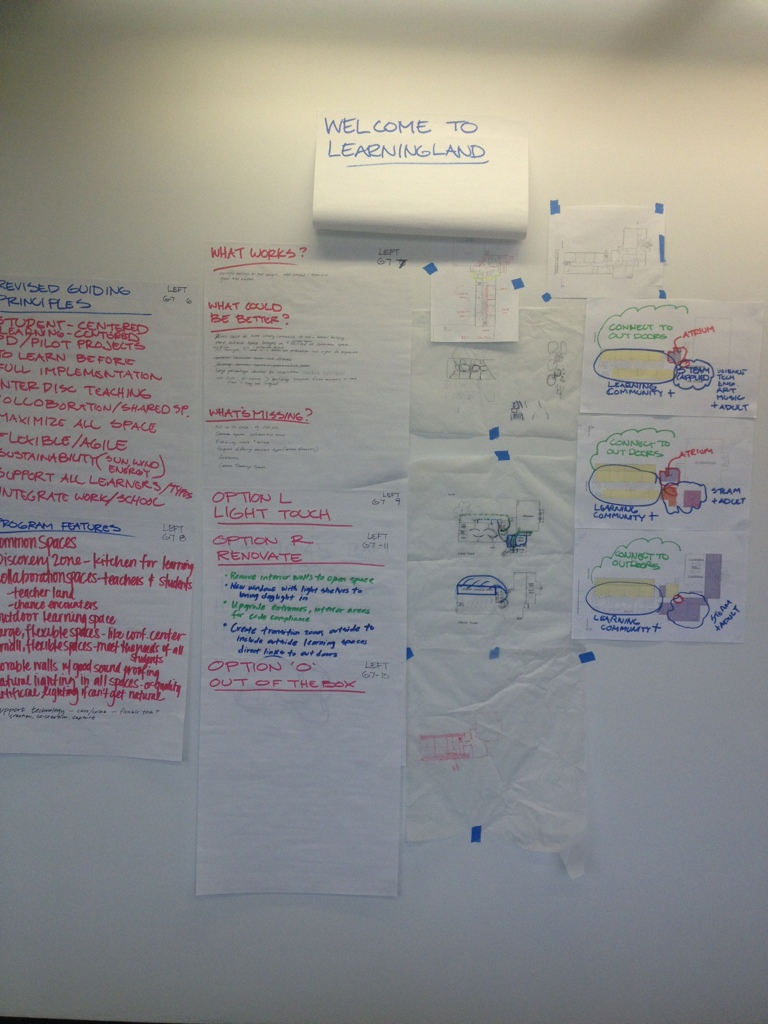
But, I now think (actually, I know) that we need to design spaces that take into account the principles of student centered learning, learning centered, professional development and pilot projects, interdisciplinary teaching, collaboration, shared space, maximizing all space, flexibility, agility, sustainability (sun, wind, & energy), supports all learning styles and types, and integrated the community and school.
And now, I also think (actually I know) we need to use architectural and learning theory, emerging technologies, environmental sustainability, child and adult collaboration, and community engagement to create “AGILE” learning facilities that can be flexed into the 22nd Century without taking millions, or even billions of dollars to sustain or modernize in another 60 years.
The photo in this post is of the visual work process of the Design Team Project my classmates and I created. We called it LEARNING LAND! Sounds like a fun place to be, huh?
Leadership To Open The Era Of Aviation
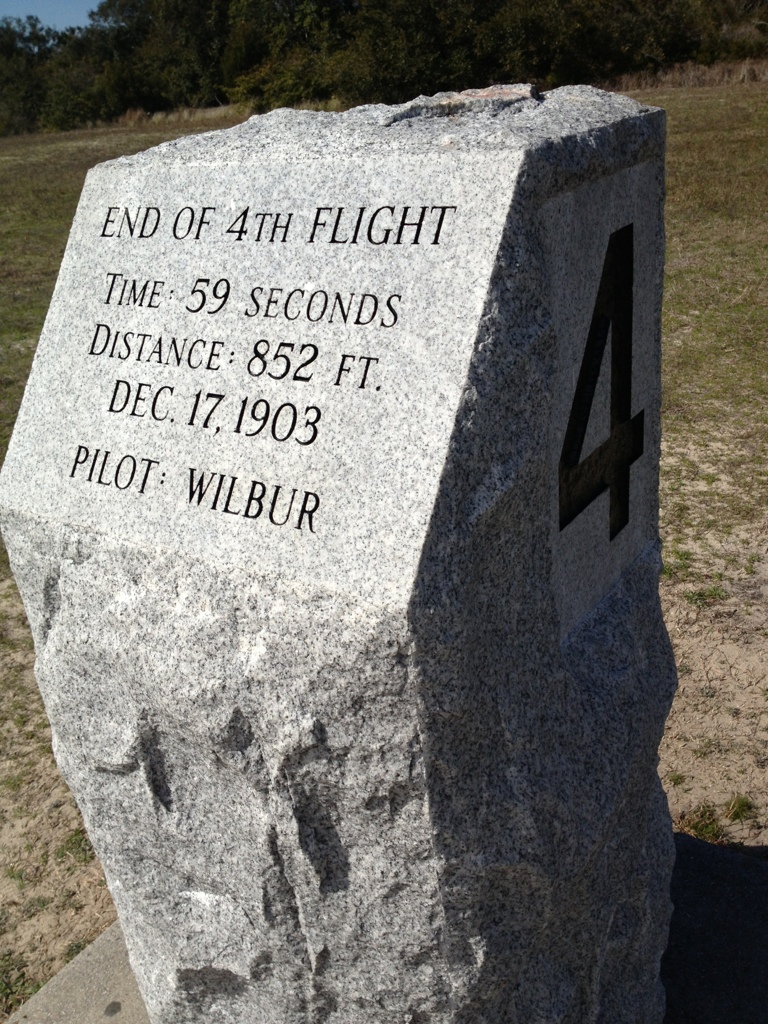
As I stood at the monument (pictured in this post) marking the fourth fiight on that blustery December 17th day I reflected on the first time I stood beside the Wright Flyer at the Smithsonian Institution. The plaque at the exhibit reads: “THE ORIGINAL WRIGHT BROTHERS AEROPLANE: The world’s first power-driven, heavier-than-air machine in which man made free, controlled and sustained flight, invented and built by Wilbur and Orville Wright flown by them at Kitty Hawk, North Carolina December 17, 1903. By original scientific research the Wright Brothers discovered the principles of human flight as inventors, builders, and flyers they further developed the aeroplane, taught man to fly, and opened the era of aviation.” Think about what this says, they “…opened the era of aviation.” What a leadership legacy!
In 1901 Wilbur and Orville had tested their latest glider design. The performance was improved and the control bugs were worked out, but the Wrights were perplexed about why their calculations were still off. Their response to this was unique and would he reason enough to regard the Wrights as the first to fly. They constructed a wind tunnel in the rear of their bicycle shop and conducted precise tests of different wing sections. The tunnel was only six feet long by sixteen inches square, with a glass window in the top panel to allow observation. A steady fan driven by a small gas engine blew air through the box at a steady twenty-seven miles per hour ), and inside, balance and spring scales measured lift and pressure on a variety of airfoils. In these experiments, the Wrights raised aviation experimentation to the level of serious engineering.
The Wrights discovered that much of the published data on wing design was incorrect or had ignored important elements of flight. After testing two hundred different wing surfaces, the brothers used their newly gained information to design Glider Number 3. As leaders we must do our own research and not take for granted the opinions of others.
The Wright Brothers put the necessary time and research into finding the best design. They did this all in the name of bringing about social change! This is what great leaders do!
Wright brothers the Extreme Leaders vs. Samuel Langley
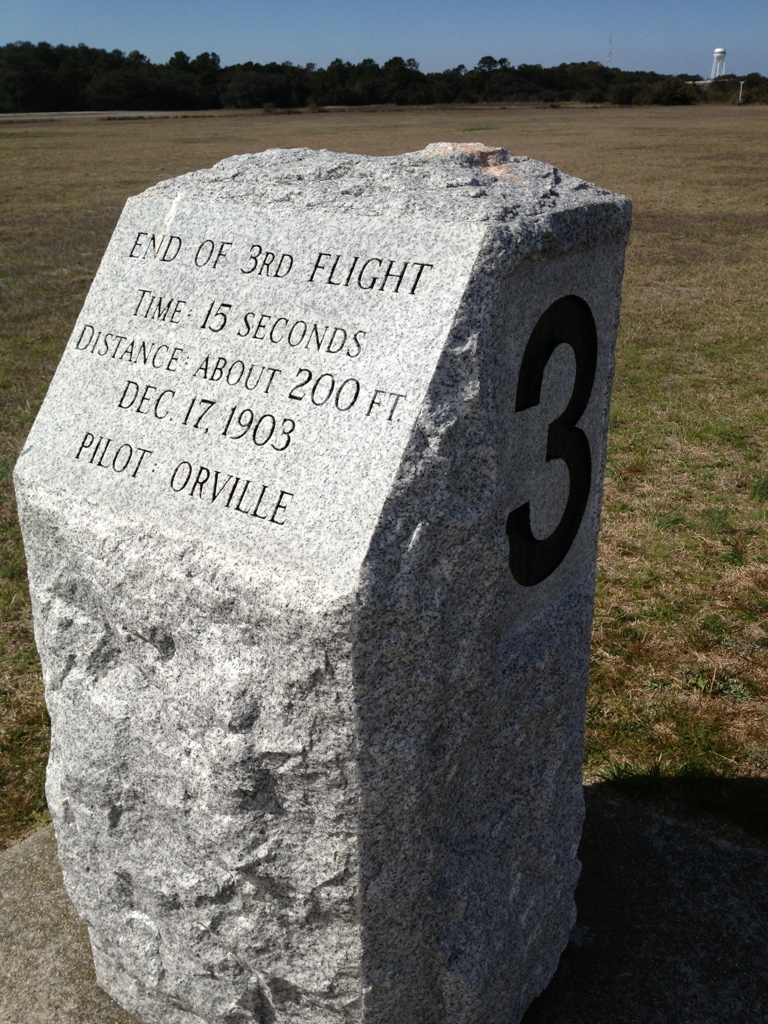
December 17, 1903
How did the Wright brothers succeed where a better equipped, better funded and better-educated team could not?
They started with why! They developed a technology that would change the world. Only the Wright brothers started with why!
Ironically, while I stood at this third flight marker a pair of fighter jets went over. I’m so glad the Wright brothers imagined a world in which we’d all take to the skies as easily as we catch the bus. And it happened.
Remember, if you’re not trying to change the world, you haven’t entered the realm of the EXTREME LEADER!
Wright Brothers Determination
The Wright brothers invented the flying machine in a little more than four years, and spent less than one thousand dollars on the entire project. The brothers went about their discovery in a methodical, deliberate manor, and for the most part, they were confident that success was only a matter of time and effort.
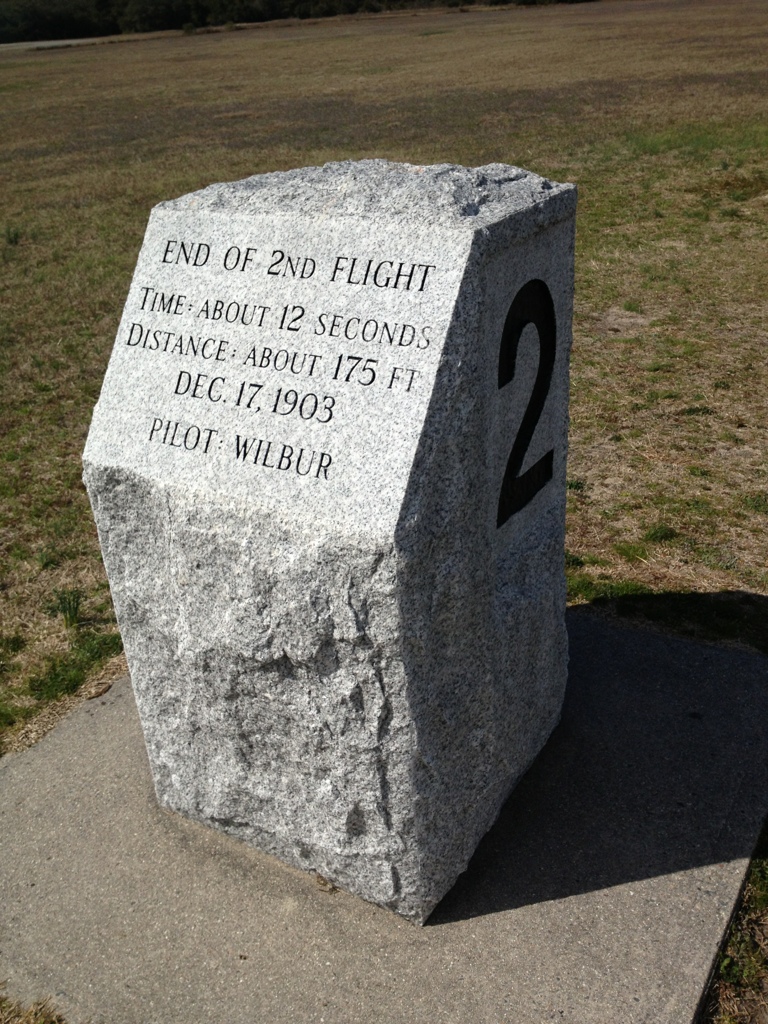
As I stood at the marker for the second flight I thought about the others, such as Samual Langley, who was far more educated and well financed for the task of being first in flight. What the Wright Brothers lacked in education and financing, however, they made up for in determination, and a single-minded devotion to the task at hand.
Many people begin a new endeavor and don’t really give it the the determination needed for success. As Malcolm Gladwell said it takes 10,000 hours of practice to become great. Imagine if the Wright brothers “tried” flying for a couple of months and then gave up saying “we are just no good at flying.” It sounds humorous but many people do this when starting a new project. At the second marker pictured in this post I thought about the thousands of glider flights testing designs and the tenacity it took to drag the plane back on December 17th, 1903 for two more flights trying to go farther still and stay in the air longer.
The next time you are in the middle of that monster project think about the journey the Wright Brothers took to give us the gift of flight!
12 Seconds of Extreme Leadership
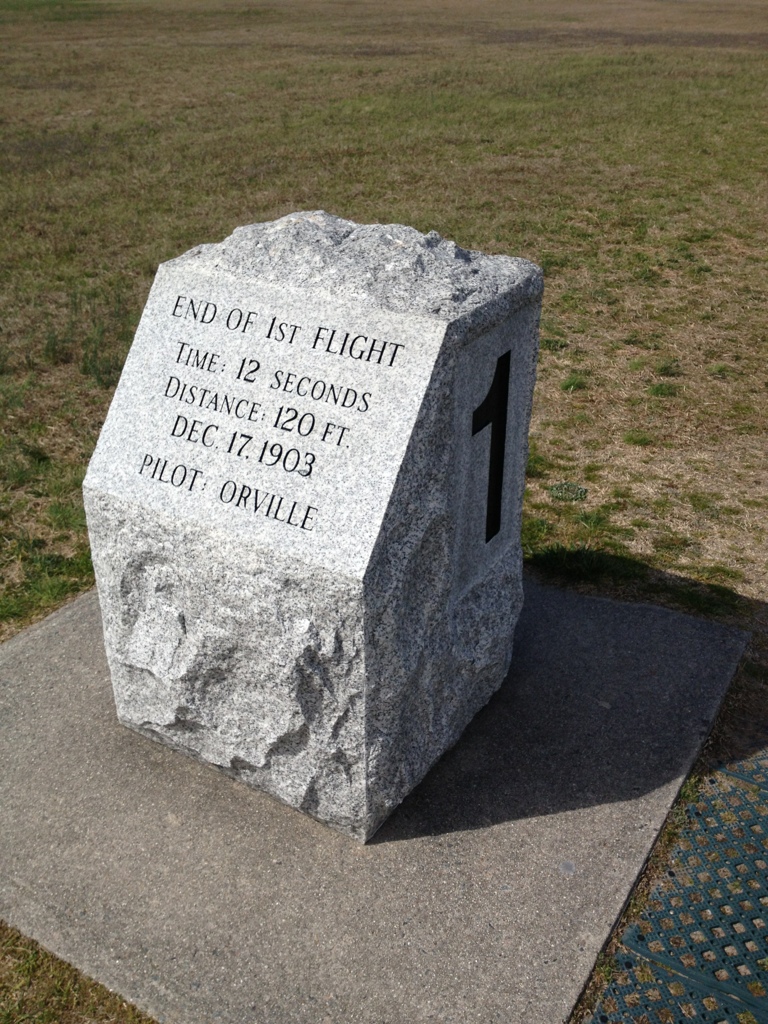
Today I walked the sandy ground where all of the Wright Brother’s extreme leadership, genius, and tenacity culminated in the first flight. To stand by the rail that the Wright Flyers slid down as a runway was breathtaking to say the least. I have been a student of their journey for many years and finally got to walk the testing grounds.
What really made me go “WOW” today was seeing and walking the length of the first flight. 12 seconds and 120 feet! I had to think, “Would I have called this success or written it off as – not enough?” Well, the Wright Brothers did both. They called it success and then said that’s not enough. In fact, they carried the plane back and made three more flights – I am going to do three more posts over the next three days using those flights. So, stay tuned!
Back to the first flight – 12 seconds and 120 feet. Why – why go again? Because of their LOVE for what they were doing. It wasn’t about them, it was about giving humans the ability to fly. It wasn’t about just going 12 seconds and 120 feet. It was about the fact it was now possible and they loved it. I can just imagine the brothers looking at each other and saying, “lets do it again, only farther.”
Wilbur Wright said, “…it is not really necessary to look too far into the future; we see enough already to be certain it will be magnificent. Only let us hurry and open the roads.” I for one am glad and inspired by the fact the the Wright brothers had the fortitude to come back to Kill Devil Hill year after year till they got it right.
In an age of instant gratification, I hope we all continue to look to these two great Americans and the many great leaders before and after them, who have achieved the unthinkable, and their achievements changed our lives.Think about it, with their game-changing feat, the Wright brothers became our exemplary innovators who helped bring about America’s rise as an economic superpower! It is their example that inspired the kind of businesses and industries that built and grew our nation, continue to solve the issues of today, and change the way we live our lives. As I stood on this hallowed ground today my prayer was and continues to be that I can carry their legacy forward by taking on new challenges with tenacity and meeting the hardships of my leadership roles with courage and confidence. If all leaders do this, our shared future is bright and our best days are still ahead.
I pray this will have have the same inspiration for you!
Oh Shit! Outer Banks Leadership Moments

Every year I write a post (or two or three) from reflections and study time while on spring break. This year will be no different. The context from where I am doing my reflecting and studying is different, however. Even though we absolutely love camping on the beach, as we had done for the last ten years, in Destin, Florida; we decided to retrace the journey of the Wright Brothers and go to the Outer Banks and camp on the beach near where the first flight took place.
To make this experience a major geography lesson we started near Richmond, Indiana where Wilbur Wright was born and went to high school. Then we were off to Dayton, Ohio to view the bicycle shop where the dream of flying began to develop in the brothers. Now, we did not stop the learning here!
As a lover of Audible.com I researched the best book on the Wright Brothers for us to listen to on the 15 hour trip in our RV to North Carolina. We chose To Conquer The Air: The Wright Brothers And The Great Race For Flight by James Tobin. Let me say this is an outstanding book that takes the reader from birth to death of the brothers. We even learned why Wilber chose Kill Devil Hill near Kitty Hawk, NC to make all the test flights leading up to success in 1903.
While learning about the brothers quest for flight we learned that it had nothing to do with the desire for money or fame, but all to do with their love of studying and invention. Also, their “Why” was in the right place. They imagined what life would be like if we were able to fly. Hearing this I immediately thought of one of the greatest leadership books ever written: The Radical Leap Re-energized: Doing What You Love In The Service of People Who Love What You Do by Steve Farber. So, I decided to read the book again on the beach close to the site of the Wright Brothers first flight for the third time. This is a must read leadership book for a person like me called to be a leader of a turnaround school!
There are three main parts of the book I want to touch on in this post. The first is the concept of the word LEAP. Farber explains this as “Love. Energy. Audacity. Proof.” Enough said! Wilbur and Orville Wright certainly possessed these qualities. As do all great leaders.
Secondly, I love Farber’s concept of OS!Ms – Oh Shit! Moments. Now I cannot imagine any leaders having more Oh Shit! moments than Wilbur and Orville Wright. Just imagine the glider coming off the ground for the first time and coming down Kill Devil Hill for the first time. Anyone, including me, would have said, “Oh Shit!”
Which brings me to the third point, and probably the most important – great leaders are not afraid to fail! They are not only not afraid to fail, but not afraid to fail openly, publicly, and often. In Tobin’s book we learned the Wright Brothers failed often, but always found ways to learn from the failures and improve the first flying machine. They would even go to the beach and study the birds to get new ideas and solve issues with the gliders. All this because of their LEAP of faith – LOVE, ENERGY, AUDACITY, AND PROOF!
A quote from Farber’s book will serve best as a summary of this blog post: “If I love who we are, and if I love what we can be, then I’ll love the process of how we get there. And in order to make it all happen, I will act boldly and courageously and I will, at times, fail magnificently. But my love demands that I try. Demands it.” Does your love of your leadership demand that you keep leading with audacity and no fear of failure?
I want to be the audacious madman leader that Farber described in contrast with just being a pro when he said, “A pro does as well as he can within what he has set out to do, and a madman does exceptionally well at what he can’t help doing!” I want to be considered a madman, just like the people of the late 1800’s and early 1900’s thought the Wright Brothers were.
My Easter wish for you is that you take a LEAP and become a Madman or Madwoman with lot’s of “Oh Shit!” Moments!
The Power of Delay
 I love it when an event happens that gives me a great inspiration for blogging! Yesterday my flight home from Fort Lauderdale, Florida was delayed because of a sensor problem. Really, it turned in to more than a delay. Let me start with this, however, ATA handled the situation perfectly and were great! We were deplaned because it was going to take 45 minutes to do the repair and they had to shut everything off on the plane and they were afraid we would get to hot (it was 85 degrees out and today I am back home to ice and closed my school today!).
Then they had us get back on the plane, only to find out we were to get our luggage and get off the plane because they did not have the needed part to make the repair. Now, let me make this perfectly clear – I am happy to have my day interrupted for a delay of this nature! I am not ready to die yet, so I want everything possible done to avert a plane crash!
Let me tell you this caused quite a stir. The old man across the aisle from me yelled, and I quote, “This is f#@%in’ bulls#$t, ATA can’t get their act together!” I’m not sure what he was talking about because, again, I want to be safe. Also, I thought it was genius to put us back on the plane to get our carry-on baggage in an organized fashion. Now, I fly ATA to Florida twice a month and think they have their act together.
Anyway, as a guy who views every challenge as an opportunity I had fun with this whole ordeal by saying things like, “I’m cool with this because I think this plane crashing would cause a greater inconvenience to my evening than the delay.” Even though I am positive there are probably some out there who would have been cool with me going down with the plane.
Of course the guy on the aisle next to me said, “Obviously you have nothing going on, but I need to get home for a dinner with friends tonight.” I thought, “REALLY!” I have to change two interviews I had scheduled for the evening, I won’t get to go to our basketball team’s last game, or pick my son up from school!” NOPE, I’ve got nothing going on. BUT, I didn’t say anything!
In these situations I am reminded what an awesome God I serve. He could change or keep anything from happening, but he chooses to let life happen. This truly shows the extent of his power. Anyone else would want to take control, then there would be no need for faith.
Anyway, in continuing to make the best of the situation when we finally got to board our new plane that would take us all home, I began to visit with the flight attendant. She shared how bad everyone was treating her. I said, “It’s out of your control, but let’s have some fun!” Because I always pick the next to last row to sit, I said, “I’ll help you get the back rows in a good mood.”
People got on the plane, some complaining, and I told our back rows, “I have arranged for you all to get free drinks.” Of course I really did not need to arrange for that because the flight attendant can do this if there is a mechanical delay, but they did not know that – AND, of course the flight attendant took care of this! Needless to say, my new friends had a stress free flight home!
Here’s the best part of the story, though. I made a comment that I really didn’t even think about whether anybody even heard, or least of which paid attention to. Here’s what I said: “You know folks, here’s the deal: there will be a reason for each one of us as to why this plane was delayed for two and a half hours. It will be different for each one of us and we may never know the reason, there will be a reason!”
So, here’s the reason why it was delayed form me (I think): As I was leaving the airport the woman sitting in the row behind me approached me and told me she needed to tell me something. I thought, “Great, this woman’s going to tell me how annoying I was.” Because, really I was. No, not the case, however! She said, “I just want you to know that ‘YOU’ were the reason the plane was delayed for me.” She went on to say, “I always get very upset in these situations and you taught and modeled for me how to find the opportunity in the challenge and not worry about the things I cannot control.” She also saw that I had given the flight attendant an “I’m REMARKABLE” bracelet and told her how well she had handled the situation. I thanked her and also gave her an “I’m REMARKABLE” bracelet and explained that the bracelets are from my good friend Kevin Eikenberry of The Kevin Eikenberry Group. I told her that both he and I believe every person is REMARKABLE and must remember this every day and find ways to improve our own lives, and more importantly, the lives of those around us. This is my mission as a servant leader.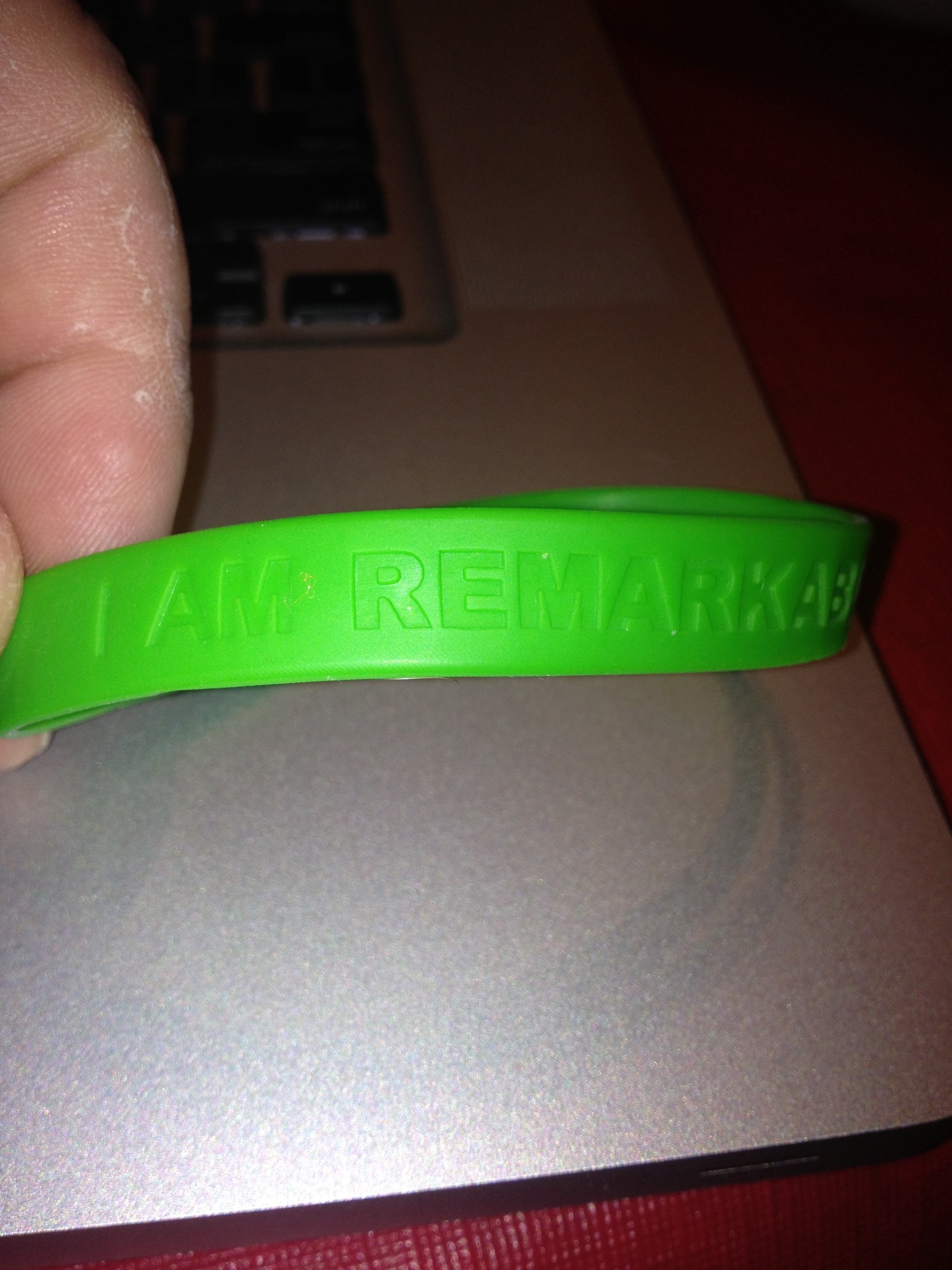
I bid the woman goodbye by telling her it was obvious that “SHE” was the reason the plane was delayed for me!
I wrote last year about traveling like Flat Stanley (click here to read the post). We must remember to travel like Flat Stanley and enjoy every moment, whatever happens!
Don’t forget- View every challenge, obstacle, or delay as an opportunity! And, always remember the words of my friend Kevin Eikenberry: “YOU ARE REMARKABLE”
President’s Day Rushmorean Leadership

All of us have either seen or at least seen pictures of the famous sculpture done between October 4, 1927, and October 31, 1941 by Gutzon Borglum and 400 workers. They sculpted the colossal 60 foot (18 m) high carvings of U.S. presidents George Washington, Thomas Jefferson, Theodore Roosevelt, and Abraham Lincoln to represent the first 150 years of American history. These presidents were selected by Borglum because of their role in preserving the Republic and expanding its territory.
Although faced with different challenges and employing different styles, they all had certain values that they never compromised or lost sight of-such as integrity, trust and respect for followers. They exemplify values-based leadership.
Here’s why I believe they were great choices:
George Washington
Washington was a skillful visionary leader. This type of leader is an expert in designing and creating an organizational culture which will make possible the attainment of the leader’s vision and ideas.
As a visionary leader Washington had a vision into the far future, could develop an effective organization and attracted others to strive for the attainment of his vision so that it became a shared vision and they all worked together in an organization that sustained the vision, its beliefs and its values.
Thomas Jefferson
I believe Jefferson was chosen for his role in authoring the Declaration of Independence, which today some might call an “action statement:” In that declaration Jefferson set out the long-term aspirations of a new nation, and in asserting a natural right to happiness Jefferson meant that all individuals are entitled to make all they can of their lives.
Additionally, with his vision for public education, he understood that all individuals need to learn about democracy. As the father of public education, he set up the avenue by which all young people can become all they can be! As an educational leader I believe it is crucial to be a steward of what Jefferson started!
Theodore Roosevelt
Theodore Roosevelt is recognized as a transformational leader. He defined numerous aspects of leadership that we now take for granted in the presidency as well as in private life. His inspirational vision about the economy, industry, environmental protection, and the National Parks system is still influencing our great country to this day. He had a remarkable ability to communicate his vision, not only through his well-crafted words, but even more through his indelible example. Roosevelt’s well-publicized, courageous exploits in Cuba in the brief but deadly Spanish-American War of 1898—the fateful days he viewed as the linchpin of his life—are perhaps the most apt symbol of his leadership. Roosevelt, mounted on horseback in front of his troops, showed the way—asking others to “come” rather than saying “go” in the words of his friend Henry Cabot Lodge—putting himself at risk, making himself accountable, giving more of himself than he would ask of others. I have always said that we must walk arm in arm with others, even pulling them along at times, instead of pushing!
Abraham Lincoln
Lincoln created a true learning organization where those in his administration were free to disagree without fear of retaliation. At the same time, he knew when to stop the discussion and after listening to the various opinions, make a final decision.
When there was success, Lincoln shared the credit with all of those involved. Conversely, when there was failure, Lincoln took all the blame. Lincoln did not fear failure and created an environment where those around could take risks and make decisions without risk or worry of failure.
Finally, the most important thing we can learn from these Presidents is: you don’t have to become someone else or become like someone else to be a leader, you have to just become yourself. Go be the leader you are!
Exodus 14 Leadership
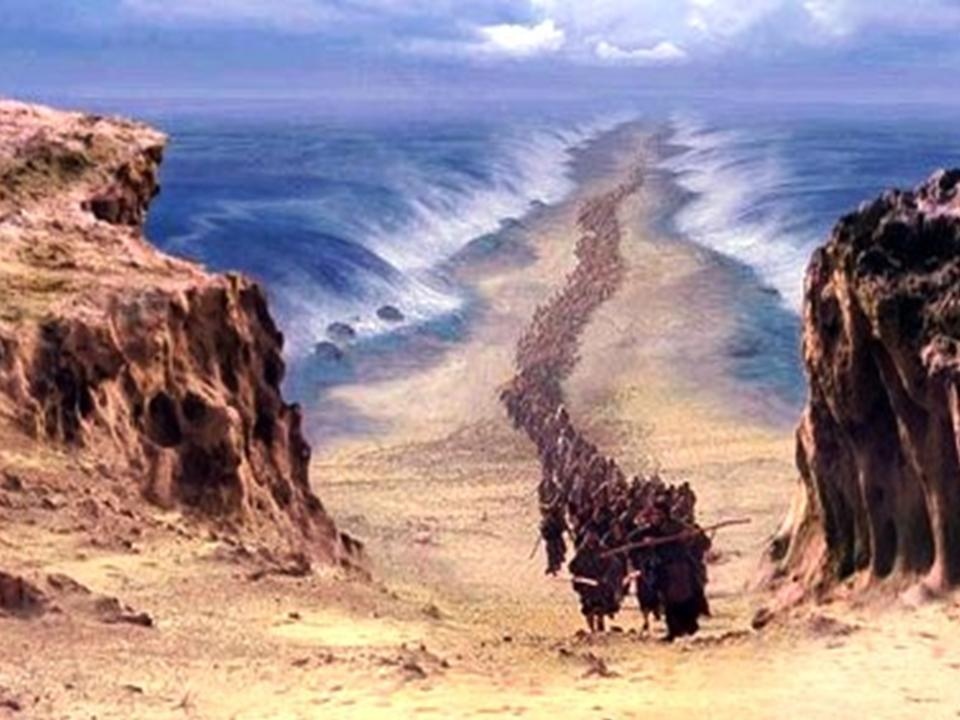
You all have probably read the story of Exodus 14 where God directs the Israelites to Pihahiroth where they camp beside the Red Sea and Pharaoh pursues after them (Exodus 14: 1-9) Then the Israelites look back and their faith in moving forward wavered and Moses comforts them (Exodus 14: 10-14). God then instructs Moses to look forward and instruct the people that he will fight the fight for them. Also, the cloud between the Israelites and the Egyptians (Exodus 14: 15-20) The Israelites pass through the Red Sea, which drowns the Egyptians. God reminds the Israelites there is no enemy that can defeat them as long as He is on their side (Exodus 14: 21-31).
This is such an incredible story on leadership. You may remember that Moses’ leadership got the people out of Egypt. But when the hardships of leading the people through a desert got tough the people began complaining and looking back to and yearning for the life they came from, even though it was a life of slavery. This challenged Moses to his limit. Moses, you remember, was familiar with life in the desert; he had been a shepherd in the Sinai wilderness for 40 years when he served his father-in-law, Jethro. But the people of Israel were used to an agrarian life in the well-watered Nile delta. The desert was new and terrifying to them.
Does this sound familiar, that we as leaders, must lead through events and processes that they are not comfortable with. Even with the Red Sea blocking them from safety, Moses kept looking forward and sought God’s help. If you read the passage you will notice what Moses did. He seeks the Lord, literally, he “cried out” to the Lord. As a leader we most times see ourselves as problem-solvers rather than pray-ers. We need to learn from Moses who called on God and God gave him the solution. Wow, makes sense doesn’t it.
Moses, as a leader, was dealing with complaining, quarreling, and fractious people who began to question Moses’ leadership abilities. While leading the Israelites Moses met many challenges, but perhaps the greater leadership crisis is the kind of rebellion that surfaces when people are afraid or frustrated. Does this sound familiar in your organization?
We must remember to lead like Moses and continuing to move forward and not look back and second guess our decisions. While the Israelites were looking back at Pharaoh’s chariots coming at them, Moses was working out a solution with God’s help! We can learn from this, that as leaders we must stay focused on the task at hand.
Probably the most powerful part of the story in Exodus 14 is in verse 14 when Moses said “God will fight the battle for you” (Exodus 14: 14). Remember, to be a great lead-er we need to be pray-ers as well!
Matthew 20:26 on Being A Servant Leader
 During today’s personal devotion time I came across the Bible verse of Matthew 20:26. It reads, “Whoever wishes to become great among you shall be your servant.” Pretty good Bible leadership advice to a guy who believes in and strives to Walk the Talk on servant leadership. In fact I have written many posts on this blog on that very subject. It is mind boggling for me to think about all of the people who have been a servant to me during my life, sharing unselfishly of their time, treasures, talent, and wisdom (advice) to get me where I am today. This Bible verse reminded me of how important it is for me to be a true servant leader to those around me, and most importantly, to those I lead.
If you think about all the skills you have that have enabled you to be successful, you can probably point to someone who enabled you to hone those skills. Even though I am far from being a great father, I had a great father that modeled what great parenting was. From the kisses on the forehead to the long talks about never giving up or just being average; these are all things that are on my mind when I interact with my own son. My own experience of becoming a teacher and my commitment to students can all be traced back to a servant leader at Purdue University named Dr. Hobe Jones. You can read more by clicking here to read my post entitled “You Want Me To Do What? Teach? There is not enough internet space in the cloud to hold all the anecdotes of all those who have blessed me with their servant leadership but I must include one other.
My abilities as a teacher leader and now administrator were enabled by a man named Ralph Walker. He was my supervising teacher when I student taught, then became my principal, and ultimately became my Superintendent at the school he recruited me to start an agricultural science program. The rest is history, so to speak, but none of that history, nor the present would be possible without his having been a true servant to my leadership development needs. There are so many others that I could go on and on about here in this post like Kevin Eikenberry, who has always been there as a mentor, friend, and coach and has included me in many events of his leadership business that have helped me to grow as a leader. Or, Dr. Tony Bennett, and my Mom who taught me at a very young age that “God never shuts a door without opening a window somewhere!”
Think of all the skills needed in life to succeed. All of us are in need of leadership in our roles as spouses, teachers, administrators, business people, salesmen, CEO’s, and as friends and family members. In each of these fields, someone who is knowledgeable, whether a professional or a wise friend, is of great value to you as a servant leader. The exchange of wisdom between people is an incredible event. Good advice, the fruit of experience, is a sweet deal to those of us who hunger for wisdom.
We cannot forget, however, our obligation to become a servant to others to provide that same wisdom those we lead hunger for. Always remember the leadership lesson of Matthew: “Whoever wishes to become great among you shall be your servant.” That’s pretty good advice from the ultimate leadership manual – The Bible!
 Byron's Babbles
1 comment