Improving STEM Education: Connecting School Work to Real Life
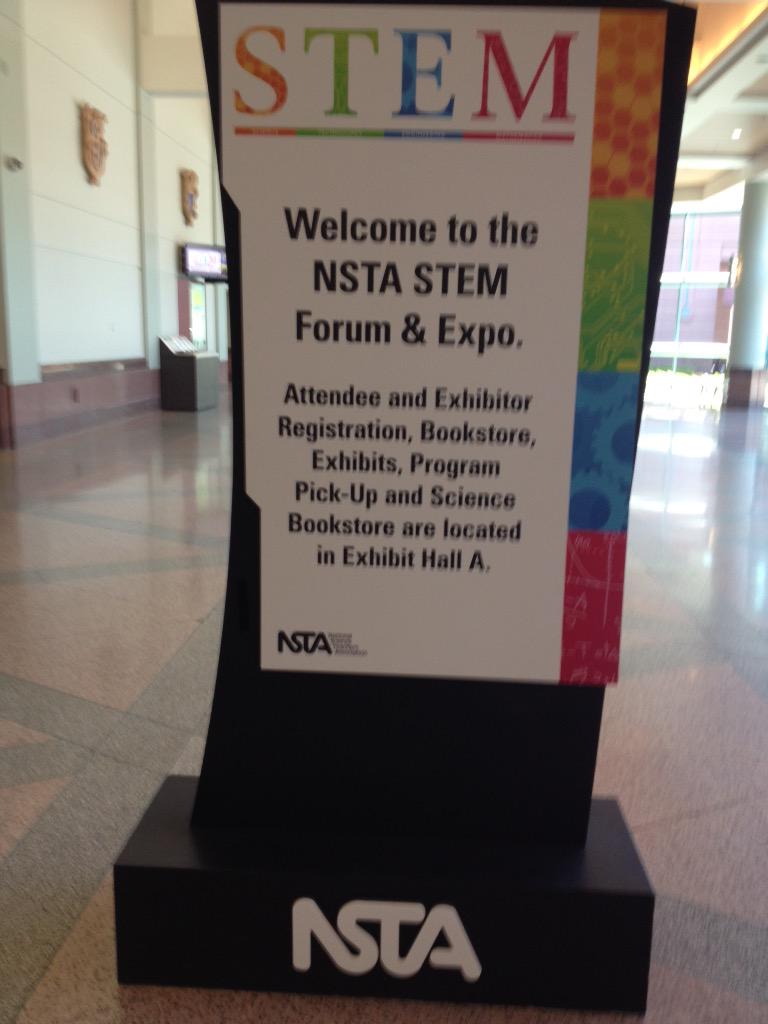 I had the tremendous honor of presenting at the International STEM Forum & Expo yesterday put on by the National Science Teachers Association (NSTA). What an incredible event. It was well-planned, and the sessions were, well, incredible. It was a great reminder to me, now that I am not in the classroom as a teacher, just how important STEM education is to our children. It was also a reminder of how tough a job it is to keep our children motivated in STEM courses and then, ultimately, through higher education if that is what the student chooses. The attendees of the National STEM Forum were reminded of this when Dr. Freeman Hrabowski, President of The University of Maryland, Baltimore County, spoke. He told us that high SAT scores correlated with students who had taken AP & Honors courses, but then ended up being the same students who dropped out or changed majors from STEM related degrees in college. Why? Because of a “fixed mindset” instead of a “growth mindset.” Dr. Hrabowski sited the work of Carol Dweck, author of Mindset: The New Psychology of Success (everyone needs to read this and all of her books). These students are so driven for success and making the top scores that when they get to college they are often disappointed by not being “#1.” Many are still top students, but can’t handle not being the top. Then, as Dr. Hrabowski pointed out, they switch to the humanities. Why? Because the humanities gets the iterative nature of the “growth mindset.” The idea that nothing needs to be perfect on the first try. In STEM courses, we tend to want to give a grade on the first, and only try. As a big believer in mastery grading, I wanted to go up and hug Dr. Hrabowski. He was talking my language!
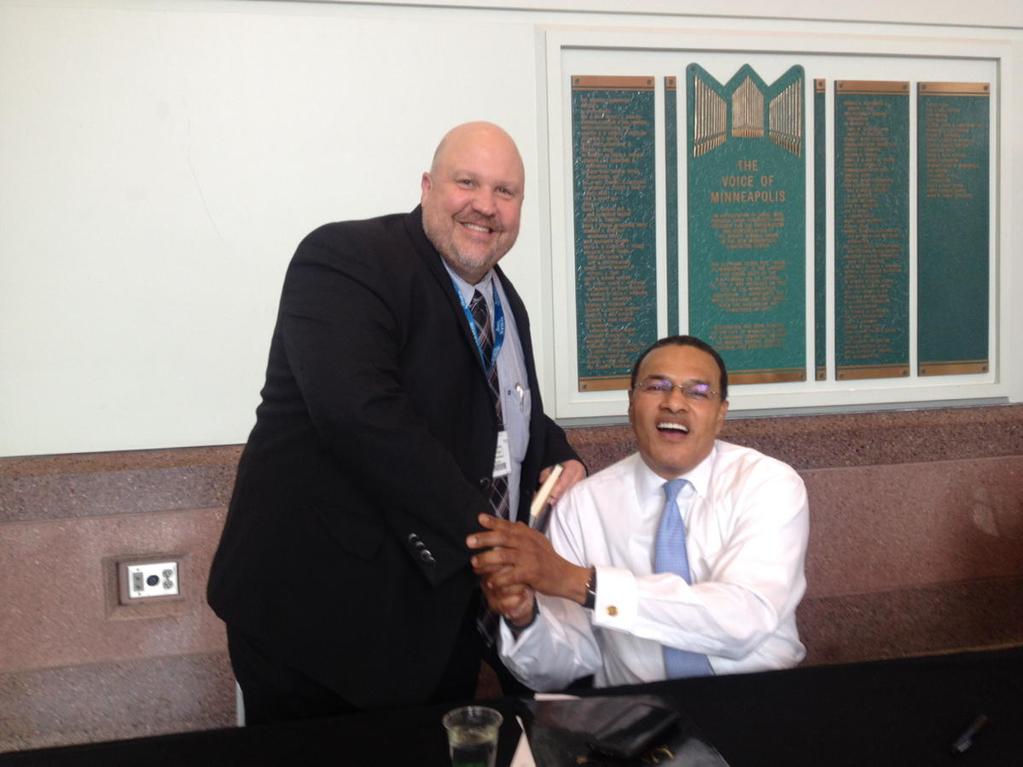
Me Hanging With My Friend, Dr. Freeman Hrabowski
It is curious to me that we have this “fixed mindset” in STEM education, because careers in STEM are not that way at all. Think about all the trial and error, experimentation, and “ah ha!” moments there are. Thus, why what Dr. Hrabowski was saying really reinforced what I had just spoke about prior to his keynote. My presentation title was: “Improving Science Education: Connecting School Work to Real Life.” The presentation was all about teaching in a real world context. I stressed that we must connect the three worlds that a student lives in: school world, real world, virtual world. The presentation was based on research I did based on student academic performance and achievement in Biology based on being taught in the real world relevancy of Agriculture. If students do not make the connection between the school work they are doing and real life, they will fall into the “fixed mindset” trap.”
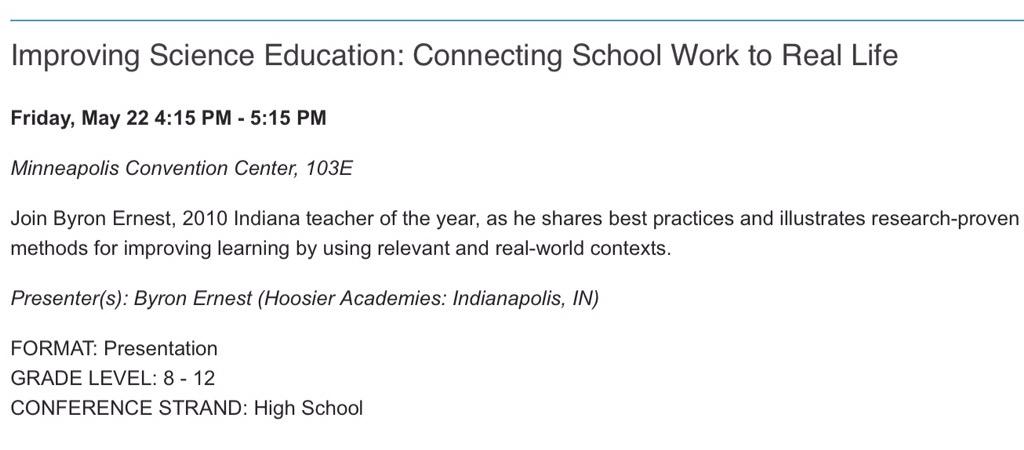
I discussed with attendees how we had partnered with AgReliant Genetics when I was teaching at Lebanon High School to provide opportunities for our students to do real world/real time research. The students were able to do this working with real researchers. This working with adults component is so very important in my opinion. To create the ideal learning environment we must have Students working in teams to experience and explore relevant, real-world problems, questions, issues, and challenges; then creating presentations and products to share what they have learned. Here is a link to my presentation:
Ernest_NSTA_RealAgSTEM_Final_2015
So, as we continue to facilitate learning for our STEM students, and all students, let’s not forget to practice a “growth mindset” and make the connection between school work and real life.
Earned Empowerment is Dangerous
 On Tuesday of this week, at the breakfast session of the American Federation for Children National Education Policy Summit, my new friend Jean-Claude Brizard made a comment during our discussion that really hit me like a ton of bricks. We were talking about building leadership capacity in our teachers and building our leadership benches/pipelines. Jean-Claude said, “Earned empowerment is very dangerous.” I have to say I more than a little taken aback by this statement. As a believer in distributive and shared leadership, I was a believer in the the idea of “earned empowerment.” In fact I have even blogged about it. Click here to read “Walk the Talk” and click here to read “Be Consistent, Not Clever!” Jean-Claude went on to explain what he meant. He believes that if you subscribe to “earned empowerment” that you will only be empowering the top 10% of your team. In other words, those top-performers who “earn” it.
Jean-Claude contends that we need to empower everyone in some way or another. In his words, “we need to empower them whether they want to be or not.” His belief is this empowerment will then develop them as leaders. I must say, after reflecting, this really makes a lot of sense. As a leader who has created a “make it so” environment, why would I not want everyone to be empowered. I guess I really have been practicing empowering everyone, because I want everyone to come to me with well thought through plans and tell me what they intend to do. My goal is to always say, “Make It So!”
This idea of empowering everyone really is interesting. Think about it; if we are able to empower all of our people with projects, responsibilities, and aren’t we really expanding the capacity of our organization. So really, mass empowerment equals capacity building. This in turn means leadership development of our teams. Wow!
There is one catch to this, however, in Turn The Ship Around!: A True Story of Turning Followers Into Leaders by L. David Marquet, he talks about empowerment really being a delegation of authority. Marquet described, however, that delegation alone is not the answer. We must also be committed to increasing the technical knowledge of those on the team. As Marquet said, “When authority is delegated, technical knowledge takes on greater importance at all levels” (Marquet, 2013). He went on to say, “Control without competency is chaos” (Marquet, 2013). I love this quote because it drives home the point that leaders must consistently provide an environment of professional growth that builds the competency of all in our organizations. Therefore, if we are going to empower all of the members of our organization we need to make sure we have trained them and provided them the necessary professional growth opportunities to prepare them for their responsibilities. Pretty exciting stuff!
Another important thing to keep in mind is that there will be differences in abilities of those on our teams. Also, there will be those who do not want to be empowered. There always seem to be a few who just want to be told what to do. This means that we, as leaders, will need to differentiate and individualize how we empower our team members.
This whole idea of the danger of earned empowerment has really got me thinking about those on the team I lead that I have not empowered or need to empower more. Do you have members of your team you need to empower?
Reference
Marquet, L. D. (2013). Turn the ship around!: A true story of turning followers into leaders. New York, NY: Penguin Group.
Our Origins, Legends, & Heroes
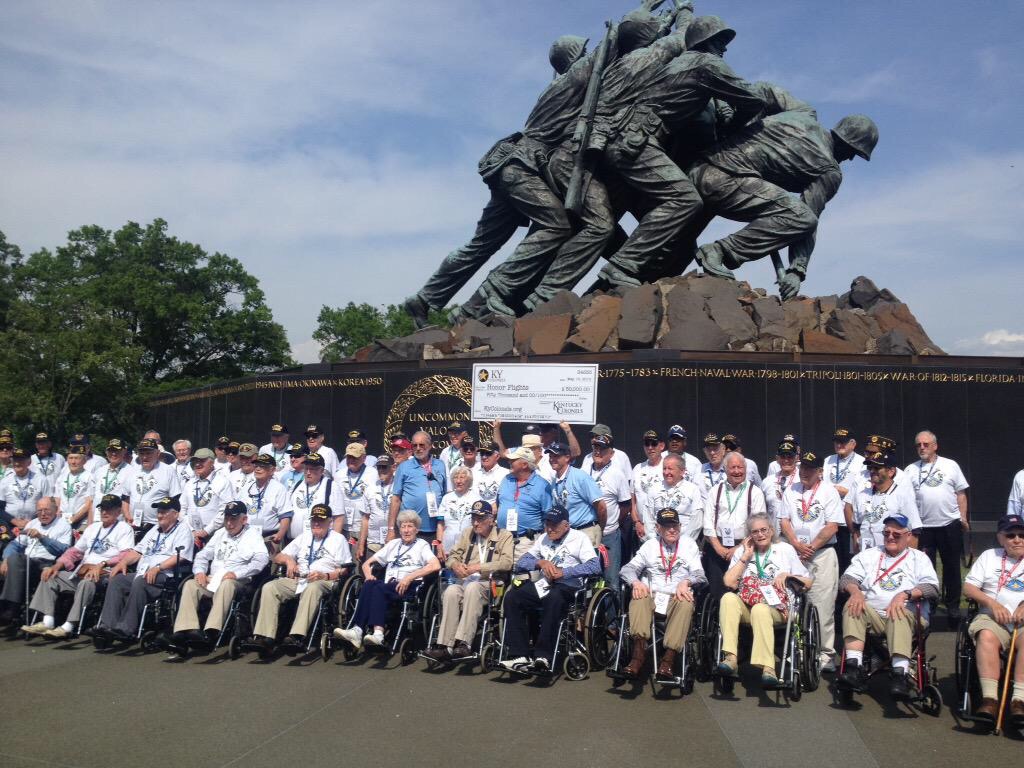
2015 Kentucky Colonel Honor Flight
“Not to know what happened before we were born is to remain perpetually a child. For what is the worth of a human life unless it is woven into the life of our ancestors by the records of history.” ~ Cicero
People living in democratic republics should know not only of its origins but also of the imperfect democratic struggle it spawned. Such appreciation might alleviate the taking of one’s way of life for granted. Americans understand the embodiment of heroic virtue in everyday life, for legends runs deep in American history.
Yesterday I had the privilege of serving our Veterans as a Guardian for our Honorable Order of Kentucky Colonels Honor Flight to Washington DC. This was a very emotional experience and I still, 24 hours later, hardly have the words to describe or reflect on the day. As a Kentucky Colonel, this was something I really wanted to do, but did not know what to expect. Well, let me tell you, it exceeded my expectations. This opportunity to serve provided the best lessons in selflessness and servant leadership one could receive anywhere. The Veterans taking part in the Honor Flight, all of whom were Kentucky Colonels, were transformers in life; they thought not of themselves but of a higher cause – America and global freedom.
“Kentucky Colonels are unwavering in devotion to faith, family, fellowman and country. Passionate about being compassionate. Proud, yet humble. Leaders who are not ashamed to follow. Gentle but strong in will and commitment. The Honorable Order of Kentucky Colonels, as a Brotherhood, reaches out to care for our children, support those in need and preserve our rich heritage.” ~ The Honorable Order of Kentucky Colonels Credo

Water Cannon Salute
Everywhere we went the Veterans were met with mobs of crowds cheering and thanking them for their service. There was even a “Water Cannon” salute at Reagan International Airport for our plane as we landed in Washington D.C. As I watched in amazement, these heroes practiced our Kentucky Colonels Credo of being, “Proud, yet humble.” These Veterans were truly touched by the outpouring of support and cries of, “Thank you for your service!” For me it was the first time of truly being in a role of 100% servant leader. Because I am not a Veteran, I did not matter to anyone yesterday, and should not have. This was incredibly satisfying and humbling. The entire day was about serving the Veterans as a group and the Veteran I was responsible for as a Guardian, Jerry McCandless (more about him later). I have always prided myself in walking the talk as a servant leader, but this provided the opportunity to be 100% servant. I have to tell you, I am a changed man.
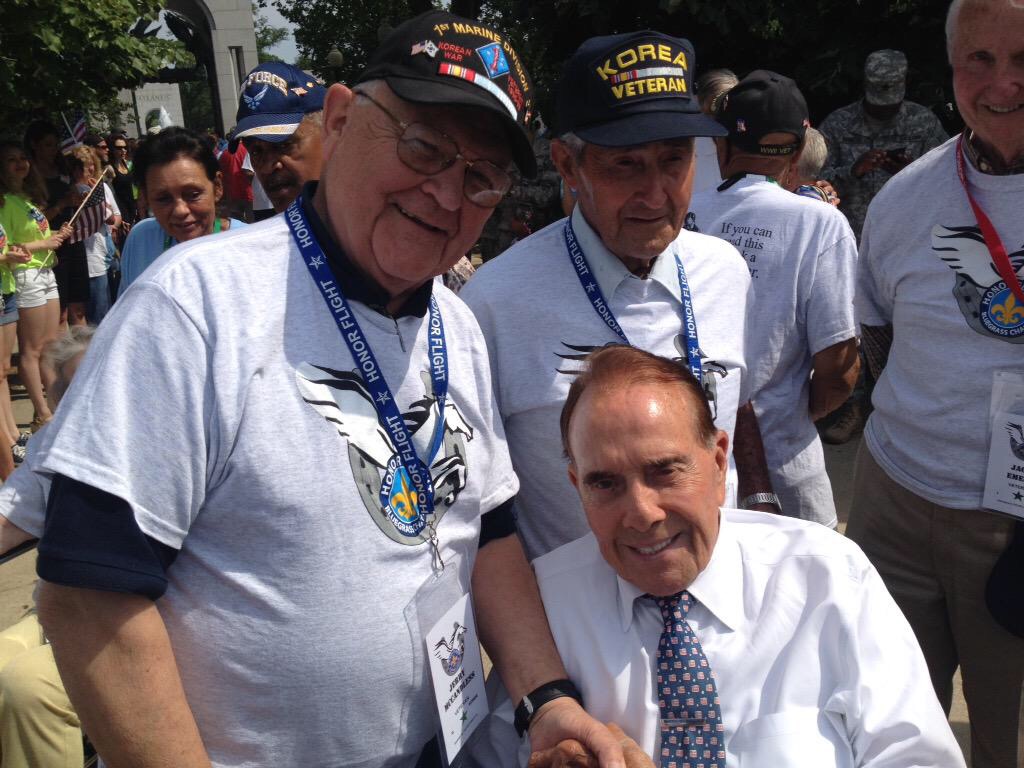
Jerry McCandless With Former US Senator Bob Dole
Amazingly, after returning to the bus someone asked me if I had my picture taken with former U.S. Senator Bob Dole. He comes out and personally greets Veterans from the Honor Flights at the World War II Memorial. Honestly, I had not even thought of getting a picture of me with him. In fact, I don’t even care to have a picture of me with him. I am, however, very proud of the picture I took of Jerry with Bob Dole. Remember, as a servant, I was to have no wants or needs on this trip – and I’m still amazed I had none, except for our Veterans to have the greatest day of their lives. As I said before, this experience really changes you and gives you the chance to fully understand what it means to be a servant leader.
These Honor Flight participants are heroes and legends. Legends serve two purposes: they provide a shared cultural experience for a people, and they symbolize the aims and ideals of that people’s common history, religion, culture, or institutional authority. As a legend, Lucius Quinctius Cincinnatus is a great example. Having stirred the passions of Republican Rome, later citizens of the Roman Empire and eighteenth century America, and men and women of contemporary times, he has been revered throughout history. His life is one of legendary accomplishment and character. Not merely legendary, Cincinnatus is also heroic. While fellow ancient warrior Alexander the Great or fellow Roman leader Julius Caesar are legendary, they do not impart the timeless moral lessons of a hero.
The hero sacrifices himself for something—that’s the morality of it. He gives his life to something larger than himself. In further contrast, the hero symbolizes our ability to control the irrational savage within us, whereas the leader may exploit the savage to gain his ends. One of the many distinctions between the celebrity and the hero…is that one lives only for self while the other acts to redeem society.” ~ Joseph Campbell
George Washington, one of our American heroes, like Cincinnatus, was a man of great accomplishment, but character, not achievement or genius, is also his most honored legacy. Character sets them apart from others. Children in schools all over Italy still recite the Cincinnatus story in the same way children of the United States learn of George Washington and the “cherry tree.” Another great American hero, Patrick Henry asked repeatedly of the role of the citizen in a Republic. He sought much more than a far removed vote in regularly scheduled elections.
Having met the living legend, a British soldier penned the following observations of Washington’s quest to live as Cincinnatus:
“Altogether he made a most noble, respectable appearance, and I really think him the first man in the world. After having had the management and care of the whole Continental army, he has now retired without receiving any pay for his trouble. he knows how to prefer solid happiness in his retirement. I admire him as superior to even the Roman heroes themselves. I am told during the war he was never seen to smile. he had only the good of his country at heart. his greatest pride now is, to be thought the first farmer in America. He is quite a Cincinnatus, and often works with his men himself—— strips off his coat and labors like a common man .”
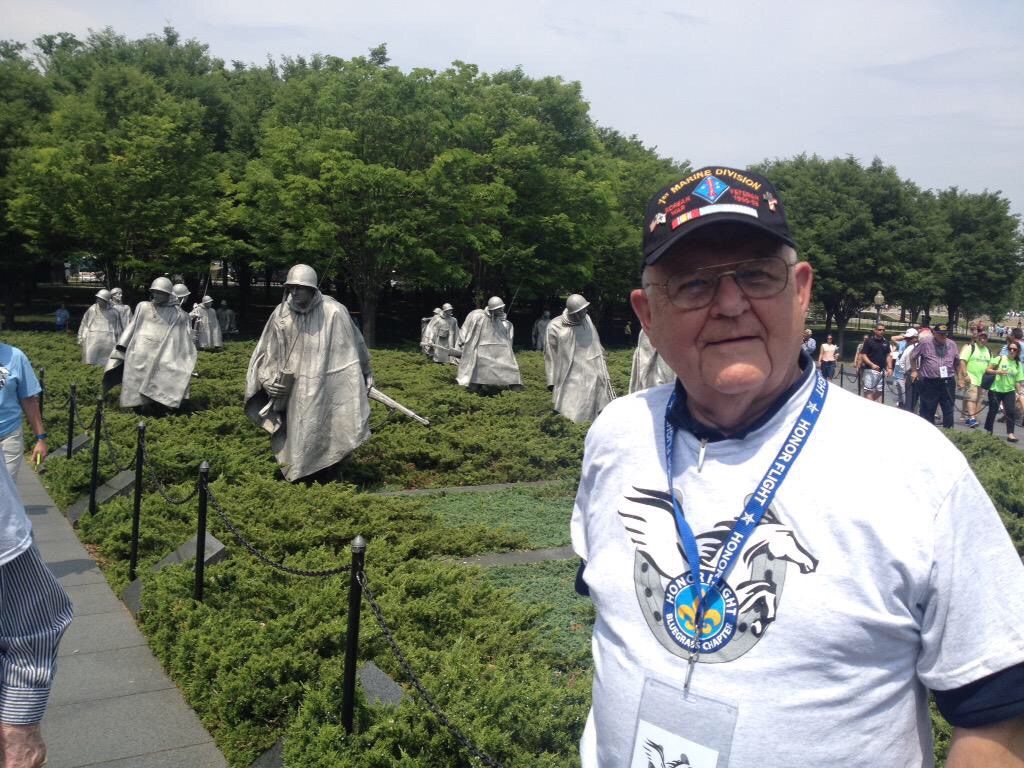
Jerry McCandless At The Korean War Memorial
This was exactly the kind of person I found in the Veterans we served for our Honor Flight. I promised I would tell you about Jerry McCandless. Jerry and I both, as Christians, believe God hand picked us to be together on this flight – God does do that you know! Jerry is a Korean War Veteran and lives on a farm. That agrarian connection got us started on the right foot. I learned so much from Jerry during our whirlwind tour of Washington D.C. I particularly loved watching him interact with young people. He brought history and a sense of patriotism alive and real for all those around him. Jerry truly is a hero who embodies the selflessness and character of George Washington and Cincinnatus. I also still get chills thinking of him telling the story of how, while on active duty in the Marine Corps, he donated $2.00 to the Marine Corps War (Iwo Jima) Memorial. He is very proud to have played a part in our country having that memorial and I believe he should be. There really are heroes who live up to the legends of countries founding heroes and we had the opportunity and honor to serve them yesterday. I would encourage you to seek out opportunities to serve our nation’s heroes!
Reference
Hilliard, M.J. (2001). Cincinnatus and the citizen-servant ideal. Xlibris Corporation.
Turmoil In Education: No One Right Way To Learn

Korean War Veteran Jerry McCandless Teaching Students From Michigan
Yesterday I had one of the most incredible experiences of my life. On Armed Services Day (May 16) I had the opportunity to serve our Veterans as a Guardian for our Honor Flight sponsored by The Honorable Order of Kentucky Colonels. Once I get sorted through all of my emotions from that experience I will write a post, but for today I am going to use the Veterans as the heroes of a post on education reform. The quote above was actually said by one of the students in the picture. The Veteran, my new friend and hero, Jerry (in the picture), did an incredible job of bringing history alive for these students from Michigan. I have to say he brought it alive for me, too! As a believer and researcher of real world context in education this really drove home the fact that students need to be able to make the connection of what they are learning to their real world context. In fact, it has really got my wheels turning as to how we might, more intentionally, on our Honor Flights connect students with our Veterans. What an untapped wealth of wisdom and knowledge for the students we serve.
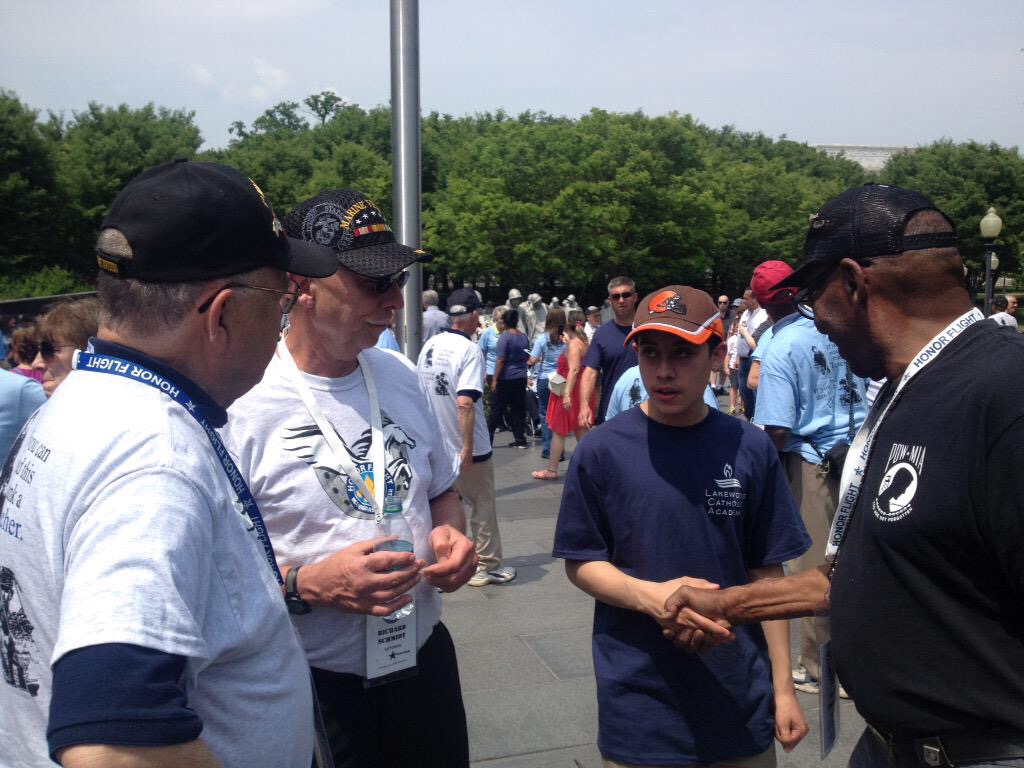
Veterans Jerry McCandless & Richard Schmidt Bringing History Alive For A Student
It was so ironic that this week’s lesson in Marciariello’s (2014) A Year With Peter Drucker was on education. Also, it is ironic that as I type this this post I am sitting in the airport waiting to board a plane for New Orleans for the American Federation for Children’s National Education Policy Summit where I am speaking on a panel on school choice and education reform. Drucker called for a systematic innovation in our schools (Maciariello, 2014). Drucker believed the heart of remediation was a “focus on strength.” He also believed we must stop “treating by patching.”
“Perhaps the time has come for an entrepreneur to start schools based on what we know about learning, rather than the old wives tales about it that have been handed down through the the ages.” ~ Peter Drucker
In September 2012 the Intelligence Unit of “The Economist“ had the United States ranked 17th out 39 countries plus Hong Kong, who was ranked third in Education Attainment, in Cognitive Skills (reading , math, and science) and Education Attainment (literacy and graduation). Bottom line: we have some work to do. “Literacy” traditionally means subject knowledge. In a knowledge society, however, people have to learn how to learn (Maciariello, 2014). The knowledge society also requires lifelong learning. For this we need a discipline of learning. We must also remember that reading is the basic skill needed for lifelong learning.
 Make sure we are aware that learning, to be most effective, should be individualized – otherwise it can be torture!
We must start with the question, “How does each of our students learn most effectively?” Then, and only then, can an individualized plan for lifelong learning be developed. The goal of teaching should be to find the student’s strengths and then focus them on achievement. Students have different patterns of learning – teachers must unlock these patterns. We need to lead our students to great achievement. We need to create a real world connection, excitement, and motivation just as our Veterans did for students yesterday in Washington D.C. This relevancy of context will go a long way in creating intrinsic motivation for the rigorous, disciplined, persistent work, and practice that learning requires. Education is a mentoring process.
Most schools and colleges are organized on the assumption that there is only one right way to learn. If we are going to be successful in truly reforming education we must differentiate the choices students have for schools. I believe in school choice, but we must actually have choices for our families, and then help them make those choices. If all schools are using exactly the same cookie cutter approach, is it really school choice? Another question to ponder in closing, “How do we create more opportunities for our students to glean from the incredible wisdom of our Veterans like Jerry McCandless and Richard Schmidt?
Reference
Maciariello, J. A. (2014). A year with Peter Drucker: 52 weeks of coaching for leadership effectiveness. New York, NY: HarperCollins Publishers.
Creating A New Future: Practice Before Theory
 “The important thing is to identify the ‘future that has already happened.'” ~ Peter Drucker
As an “Energetic Change Agent,” I was really into the week 19 lesson in Maciariello’s (2014) A Year with Peter Drucker: 52 Weeks of Coaching for Leadership and Effectiveness. If you have not begun the journey of reading this book, let me recommend it again. This week’s lesson dealt with identifying emerging trends and how that is different from trying to forecast the future. Identifying trends concentrates on directions and patterns. We must, as leaders, discern patterns from emerging trends, and separate fads from real changes (Maciariello, 2014). I have blogged about change before in other posts, but really dug into this topic in a post entitled: Change Creation is Proactive. You can read that post by clicking here.
Leaders who are effective at facilitating change capitalize on emerging trends and use them to create a new future for their organizations, thus providing a competitive advantage in times of rapid change, This is proactive, not reactive! Again, as was stated in the Drucker quote, this is an exercise in “seeing the future that has already happened.” To create the future any other way is reacting rather than acting, which is what one does if one grows quickly. We need to make sure to study the trends and look for the ‘certainties’ of the future. One place to look for this is in the demographics. One important part of change that I believe was left out of this lesson, and may be discussed in future weeks, is how some organizations ability to create the new future will be impaired by legislation and other government misunderstanding or slowness to adjust. An example is my own: education. As I look back to this year’s legislative session here in Indiana there was a lot of work around education. It is interesting to me that our House of Representatives is very pro “school choice” and innovative practices such as online education, but our Senate is not. Some of our legislation passed is helpful toward the ‘new future,’ but part of it still does not necessarily hinder practices for facilitating futuristic change, but certainly does not serve as a catalyst either.
Therefore, it will be important for us, as leaders of these affected organizations, to help all involved in decision/policy-making to understand the methodology that Drucker outlines to identify “the future that has already happened.” As I describe what Drucker calls the “seven windows of opportunity,” (Maciariello, 2014) think about online education as an example. Online education is already here and I believe everyone would agree it is not going away – nor should it go away. Amazingly, however, there are those that continue to try to block any legislation or policies that help to improve or make online education more effective. So we (and leaders of other such change) will need to help all of those involved understand the seven sources that Drucker outlines as: (1) unexpected success or failure, (2) incongruities, (3) process need, (4) a change in industry or market structure, (5) demographics, (6) changes in perception, (7) new knowledge (Maciariello, 2014). I believe you can extrapolate the implications of the seven windows to your organization. I believe in my own case we have done a pretty good job beginning to work on windows 5, 6, and 7, but we need to continue to put the whole package together to continue to move our cause for the students we serve forward.
“Theory organizes the new realities, it rarely creates them.” ~ Peter Drucker
As a rule, theory does not precede practice (Maciariello, 2014). Decision and policy-makers in government and organizations need to remember this. They need to understand, and few do, that events that have already occurred do not fit their present-day assumptions, and thereby create new realities. We must make sure our policies and structures support “the future that has already happened.”
What steps are you taking to turn future trends and needs into your advantage?
Look for “the future that has already happened” and turn it into an opportunity for innovation. If you do this, you can become an effective change leader. If you are a policy or decision-maker, please make sure you are thinking about how you can support “the future that has already happened.”
Reference
Maciariello, J. A. (2014). A year with Peter Drucker: 52 weeks of coaching for leadership effectiveness. New York, NY: HarperCollins Publishers.
Talkin’ Turkey About Sunk Cost Bias
 I am always amazed at how much I learn on my son and I’s annual turkey hunt. First let me answer the big question on everyone’s mind. Did you get one? I am happy to report that my son did! I did not. For the second year in a row Heath got a turkey and I didn’t. This was his fifth turkey in the seven years we have been hunting together. Not bad for a fourteen year old. In my defense, I did not even take a shot. I saw a bunch of turkeys and witnessed some great wildlife shows, but never a gobbler close enough to harvest.
When turkey hunting there is a great deal of time in solitude for thinking. My favorite time is the first thing in the morning. We get to the woods at 5:00 a.m. and then watch and listen as the woods comes alive. First there are the birds, then the occasional deer, and then the gobble of a roosted turkey. Our two days of turkey hunting each year remind us of all the wonderful creations that God has made. Though my seat attached to my turkey vest is not as comfortable as a yoga mat, I am not any less mindful when in this state of thought and meditation. There are so many things that run through your mind when sitting in total silence and not being able to move. It is exhilerating and I am already looking forward to next year.
On our first morning of the hunt, Saturday, we went to the river bottom along the levee. My son, Heath, set up along the field’s edge that separated the levee from a woods (the turkeys typically come off the levee and graze the field while heading to the woods for the day). I set up about a mile south of him. We both had a great show of turkeys that first morning. I even had a hen come right past me close enough that I could of reached out and touched her. Those that know me are probably amazed that I am able to sit that still in my full camo glory! Anyway, neither of us got a long beard (tom turkey) close enough for harvesting.
Later that afternoon, my wife took Heath to a baseball game (he pitched a save, by the way), and I went back near where we had hunted in the morning. There was a tremendous showing of birds. There was a group of 11 that appeared – four long beards, three jakes (young male), and four hens. They worked the field in front of us for two hours, but we could never call them in close enough for a shot. Then there was a single Tom who strutted around the field like he owned it, but again, not close enough. It was a tremendous show that Walt Disney would have been proud to have filmed for his nature films. But, still, they stayed along the levee side.
The next morning, you guessed it, I went back to the levee. Heath, on the other hand, went to another location. You guessed it, at 8:30 he harvested a bird. I was texted a picture (seen at the top of this post) and was thrilled – the goal is always for Heath to get a bird – I am secondary. Once again, however, I had the greatest show ever. Turkeys were coming off the levee right and left – lots of them. You guessed it, though, they were not interested in coming to me. The Toms were with hens and not interested in what I had to offer. Anyway, it was another great morning of solitude and thought. At least I kept telling myself that!
Toward the end of the morning, as the turkeys were moving out of site I got to thinking about “sunk cost bias.” Was I falling into the trap that leaders fall into. As I thought about this I realized that turkey hunting might be one of the greatest case studies to teach this because I kept getting drawn back to this same area. I knew there were lots of turkeys here. In fact three of Heath’s turkeys he harvested in past years had been taken very near where I was sitting. Also, I had already spent a lot of time there this year. This year, however, the turkeys were just not moving across the fields in the same way – this is what really makes turkey hunting so exciting and facinating. The turkeys never act the same from year to year. Does this sound like any of the organizations you lead? Yet, for some reason I was drawn to this place. Part of it was the fact that it is one of the most beautiful places in the world. Hemlocks were blooming, Blue Jays were playing in the trees above me, a squirrel was hopping from tree to tree, and a Bald Eagle was soaring above. It is just a glorious place to be.
Still, there were all these turkeys. When we regrouped for the afternoon and Heath’s turkey had been processed it was decided to go to another location for the afternoon. “Sunk Cost Bias” had been resisted; at least for now. At 4:30 p.m., after not seeing or hearing any turkeys, it was decided, you guessed it, to go back to the levee. I know what you are thinking: this guy is an idiot because he knows the turkeys won’t come close enough. You are right, I was giving into sunk cost bias. I knew we would see birds, but I would never get a shot. Yet, I was drawn by the fact I had invested so much time there and knew there were turkeys. I had become the poster child of what sunk cost bias is: The sunk cost bias is manifested when we have a greater tendency to continue an endeavour once an investment in money, effort or time has been made.
I was first introduced to this thinking at Harvard University by Dr. Monica Higgins when studying a case study of the 1996 Mount Everest tragedies. Reasoning that further investment is warranted on the fact that the resources already invested will be lost otherwise, not taking into consideration the overall losses involved in the further investment. During the Mount Everest tragedy the sunk cost bias was carried out on two fronts: 1. At the time of starting for the summit, some thought the conditions were not right, but they had come all this way and were not going to wait; and, 2. Many that died did not summit by the 2:00 p.m. cutoff time (the time set to turn around if a summit had not been made yet) but went ahead and summited as much as two hours late. Again, the thought of “I’ve invested all this time, money, effort, et cetera and by golly I am going to summit Mount Everest” was at play there.
Obviously, my life was not on the line, but by going back to the levee for one last ditch effort at the end of our last day of hunting was giving into sunk cost bias. You guessed it, too, we saw a lot of turkeys but none came close enough. What I was failing to realize is that moving back to the levee would most likely result in the loss of much more time and not getting a turkey. I was thinking short-term, not long-term, and simply trying to avoid not getting a turkey, which was fallacious thinking. It was really thinking from a defensive posture and not an offensive one. This experience has really caused me to think about the strategic and academic plans we are carrying out in the schools I lead. Do we have areas of sunk cost bias? It begs taking an introspective look.
When we make a hopeless inventment of time, treasures, or talents we sometimes reason: We can’t stop now, otherwise what we have invested so far will be lost. This is true, of course, but irrelevant to whether we should continue on with the plan. If the plan will not work that everything invested will be lost regardless. Therefore, it really is irrational to continue, but yet we (at least me) continue on anyway. The rational thing for me to do on our turkey hunt would have been to try a new spot. Why didn’t I make the rationale choice: Our decisions are tainted by the emotional investments we accumulate, and the more we invest in something the harder it becomes to abandon it. As an emotional human, my aversion to loss often leads me right into the sunk cost bias. We need to instead look at the loss from a growth mindset and consider it learning and knowledge gained.
Luckily, we all have the ability to reflect, study, and regret past actions. So, in my case, I need to remember what I did on this turkey hunt and apply it to my professional life as a leader. Do you have areas in your personal or professional life where sunk cost bias is hurting your ability to move forward? If you’re not sure, might I suggest an early morning meditation time in a woods as it comes to life at the start of the day?
Meaningful Measurement
 This week’s lesson from Peter Drucker started with a story from when Ronald Reagan gave a campaign appearance at Claremont College. He was telling about how different it was at the time in 1980, than when he went to college. When discussing all the entertainment and laborsaving devices and space exploration, he said: “My generation didn’t have these; we invented them. (Maciariello, 2014, p. 139).” Even today there will be fundamentally new concepts, new ways of seeing the world, new ways of relating as individuals, as organizations, and as countries that will need to be developed. This is why Peter Drucker believed that, even in 1992, we were in a “very dangerous, a very upsetting, and a very exciting period (Maciariello, 2014, p. 141).”
These upsetting, dangerous, and exciting times that Drucker refers to, and I still believe we are in, also leads to a great deal of uncertainty. Drucker talked about realizing that the things being measured for success are not meaningful anymore (Maciariello, 2014). This is where all industry and education are alike; we must have meaningful measurement of metrics that matter. This is exacerbated by the fact that we live in a “mixed mindset” society as opposed to a “growth mindset” society. We have such a fear of failure because have become so fixated on winners and losers as opposed to getting smarter. We need to use all our knowledge and insight from all sources, including the humanities, life sciences, physical sciences, economics, history, and social sciences to bring about effectiveness and results. According to Drucker (Maciariello, 2014), the knowledge society has contributed to income inequality and uncertainty (this whole idea of winners and losers).
 Education certainly is a prerequisite to competing and succeeding in our global economy today. This, in turn, creates exciting times for education. This is why I believe we must shift to a much more student-centered accountability that is framed on a growth mindset. In other words, we should weight student growth more heavily than proficiency. We should be measuring credits earned (as many students transfer from school to school already credit deficient), courses failed, attendance, and classroom engagement. We should also develop alternative accountability definitions that include mobility, date of enrollment, prior achievment, persistence and course failure. We should also include a growth measurement for high school students, which may require a pre-test in courses that have end-of-course assessements; although this is an additional assessment, a pre-test will provide actionable data that will lead to individualized instruction. I think you get the idea from this that I believe we must find out where the students are and then develop an action plan to get them there. This is very much a growth mindset approach to facilitating highly effective instruction and learning for the students we serve.
In closing, I would challenge you to take an introspective look at your organization, business, school, or governmental entity you lead and ask yourself, and your colleagues “Are we measuring the right things, do we have a growth versus fixed mindset, and how should we be measuring success?” Let me know your thoughts.
Reference
Maciariello, J. A. (2014). A year with Peter Drucker: 52 weeks of coaching for leadership effectiveness. New York, NY: HarperCollins Publishers.
New World Global Leadership
 “We know this much. The world is not going to be dominated by any one great power. For Americans that’s going to be a very difficult thing to accept. Most of us still see a world – the world of 1960 – in which America was the only great power, and the only functioning economy.” (Peter Drucker in Maciariello, 2014, p. 134) These were the words of Peter Drucker in 2004 and I think he was spot on. In fact, I believe we still don’t fully understand the new world we live in. Drucker also said, “So we Americans will have to learn that it is going to be a very different world in which different values must coexist (Maciariello, 2014, p. 134).” I really believe that sometimes we proceed as if the United States is the world, when in reality we are part of the world.
We are going to have to learn to be effective change agents of a global future. We will need to create our own future, rather than trying to predict the outcome of all these global forces (Maciariello, 2014). Whether the global demands become threats or opportunities will depend on our competence. The forces of a global society cannot be left to market forces or any one sovereign nation. Today’s lesson from Peter Drucker furthers my belief that leaders in education must make a commitment to moving global education forward. Engagement is the key to having teachers lead this movement in global education.
 Global education is not just about economics, it has to be about citizenship and global awareness. Therefore, kids need skills to navigate globally. Furthermore, kids need skills to navigate a shrinking world. The world is getting smaller and kids need the skills to navigate globally. Hanging world flags and doing multi-cultural days with different ethnic foods does NOT make students globally competent. We must begin to use the ABCs of global immersion: Academic Achievement, Bilingualism/Biliteracy, and Cultural Competance. We must create intentional/strategic curricula for global education and competancies, not just a few activities.
The skills and insights students can gain from interacting with people of different nations and cultures is critical as America engages more intensely with an increasingly global marketplace and interdependent world. As an educational leader, I must lead the charge to help the students I serve to have a high quality global education program. A great global education program is multi-faceted, fully job imbedded professional development for the teachers, and has transdisciplinary themes. Finally, I believe all students have the right to deep global competency! How will you help to develop a sense of urgency around global education?
Reference
Maciariello, J. A. (2014). A year with Peter Drucker: 52 weeks of coaching for leadership effectiveness. New York, NY: HarperCollins Publishers.
Love Thy Neighbor!

Choose Your Friends By Their Character & Your Socks By Their Color
I want to begin this post by posing an essential question for you to reflect on: How can you make yourself useful and effective in helping to solve a social problem of our society?
In this week’s study of Peter Drucker in Maciariello’s (2014) A Year with Peter Drucker: 52 Weeks of Coaching for Leadership Effectiveness, I learned that Drucker believed that social issues and problems were of greater danger to the United States than economic issues. During the 1992 presidential campaign, former President Bill Clinton’s strategist, James Carville, coined the slogan: “Its the economy, stupid!” Obviously, the public seemed to believe this because Clinton won the election. Drucker disagreed, however, and thought our growing social problems were more significant than our economic problems (Maciariello, 2014). Drucker pointed to the fact that none of the U.S. government’s programs of the last 40 years really produced any significant results. We can however point to programs put in place by religious organizations, churches, and other independent non-profit agencies that have had impressive results and done a great deal of good for Americans, as well as individuals in other countries. In my opinion one of the best legacies that President George W. Bush will be remembered for were his faith-based initiatives to have private organizations taking on the overwhelming societal needs.
Social needs, according to Drucker, grow in two areas. First, in charity: helping the poor, disabled, helpless, and victims. Secondly, and probably a faster growing need is in respect to the services that aim at changing the community and at changing people (Maciariello, 2014). Every developed country needs an autonomous, self governing social sector of community organizations to provide the requisite community services, but above all to restore the bonds of community and a sense of active citizenship. Historically, community just happened by fate. We must now make a commitment to the development of the community. In 1939, Winston Churchill even commented prior to becoming Prime Minister of England in 1940 about Drucker’s forward thinking on the needs of society. Churchill said, “…he [Drucker] not only has a mind of his own, but has the gift of starting other minds along the stimulating line of thought.” Drucker knew that taking care of the social needs of our country was going to be important.
Right now there is a great deal of animus in America dealing with race, religion, gender, sexual orientation, socioeconomic differences, education, and even partisan politics. Some of these differences are constrained by social norms, but certainly not to the extent necessary. In education, as school curriculum continues to be aligned with standards and goals, pressure will grow for these goals to be aligned with the students’ strengths and societal needs. We must teach our students how to make changes in society peacefully and democratically. Thinking, reasoning, problem-solving, entrepreneurship, and creativity and the arts must align with the revolutionary changes in all cultures around the world. We live in a country and world of multiple cultures, made even smaller by instant communication and rapid transportation. If we manage our diversity well, it will enrich us. If we don’t, it will divide us. Meeting that challenge is up to each and all of us.
We must listen to the students we serve and give them a voice. Getting them engaged. Students will expect their voices to be her in decisions. As stated earlier, thinking, reasoning, problem solving, creativity, and communication skills coupled with ethical  behavior, will be essential if we hope to have a future. We must take extra care to provide our young people with experiences that enable them to develop core values of ethical behavior and civic duty. I have witnessed and been involved with non-governmental organizations that do this quite well. One is the National Honor Society. My son is a member right now and certainly besides the promotion of high academic performance and achievement, he is also getting a taste of the importance of community service and why it is important to be involved in finding solutions for the needs of the community. I am also proud to have been a part of bringing the National Honor Society to Hoosier Academies. As a school leader, I understand the importance of these civic-minded experiences to our students. Drucker
  called this developing “creaturehood” for the ordinary individual. Another incredible organization that gives students real world, in context, leadership experience in a societal setting is the Kiwanis Key Club. From their many enrichment and civic projects, Key Club members dedicate their energy to serving their communities in order to ensure the world will be a better place for future generations.
As adults and leaders we also have a responsibility to society and modeling our social service to our young people. We all have time, talents, treasures, and connections we can bring to the table in order to do our civic duty for society. I realize time is a precious commodity, but we must make  time to do those things in our communities, state and nation that are necessary to make the radical changes necessary to not be left behind. I have made a conscience effort to model this or “walk the talk,” so to speak. I have been involved at the local, state, and national levels for civic service whether in service organizations or politically. In 2010 I had the honor of being commissioned as a Kentucky Colonel because of my contributions in the realm of education in Kentucky. The commission of Kentucky colonel is the highest title of honor bestowed by the Commonwealth of Kentucky. Commissions for Kentucky Colonels are given by the Governor and the Secretary of State to individuals in recognition of noteworthy accomplishments and outstanding service to a community, state or the nation. Because I really believe in the mission of the Honorable Order of Kentucky Colonels I have made a real commitment to provide time, talent, treasures, and connections. In fact, on May 16, 2015 I am going to be on an Honor Flight, sponsored by the Honorable Order of Kentucky Colonels, serving as a Guardian while taking Veterans from Indiana and Kentucky to honor them. We will be flying out of Louisville, Kentucky to Washington, D.C. for them to be honored as Veterans and tour the Monuments of our foreign wars.
  Check out this inspirational video promotion of our Honor Flight. Click here to watch the video. I am very excited to have been selected to serve as a Guardian for this very important service to our Veterans. This is just one of the social services that the Honorable Order of Kentucky Colonels provides through our Good Works Program. If you are so moved and want to donate feel free to click here.
Our second president, John Adams, stated: “We have no government armed with power capable of contending with human passions unbridled by morality and religion. Avarice, ambition, revenge, or gallantry, would break the strongest cords of our Constitution as a whale goes through a net. Our Constitution was made only for a moral and religious people. It is wholly inadequate to the government of any other.” I am a believer in the rights given to us of freedom of religion and the freedom of speech (in other words the right to hit “publish” when I complete this blog post). I also completely believe in our moral responsibility to give in service to the civic and social needs of our communities, state, and nation. The title of this post is “Love Thy Neighbor!” The inspiration comes from the the Bible in the book of Mark. It first comes up in the 31st verse, but then the most important lesson is given in the 41st through 44th verses: “Sitting across from the offering box, he [Jesus] was observing how the crowd tossed money in for the collection. Many of the rich were making large contributions. One poor widow came up and put in two small coins – a measly two cents. Jesus called his disciples over and said, ‘The truth is that this poor widow gave more to the collection than all the others put together. All the other gave what they’ll never miss; she gave extravagantly what she couldn’t afford – she gave her all’ (The Message Bible).” Are you giving your all to make the world we live a better place now and for future generations?
I hope you have reflected on the essential question I started with: How can you make yourself useful and effective in helping to solve a social problem of our society? Now, I leave you with this question for a post-reflection: How can you leverage your social and religious involvements to increase your involvement in civic life?
Reference
Maciariello, J. A. (2014). A year with Peter Drucker: 52 weeks of coaching for leadership effectiveness. New York, NY: HarperCollins Publishers.
Educating Outside The Walls
 I spent Monday and Tuesday of this week at the Indiana State House with a group of our teachers. Our mission was to demonstrate to our state legislators how virtual education really works. We set up in the House Committee rooms and had our teachers facilitate learning for our students from there. Many legislators came down and spent time with our teachers and we really appreciated the opportunity to share. At stake, right now, is a bill (HB 1001) that came out of the house calling for 100% funding for all schools. When the bill went to the Senate the amount was reduced back to the present level of funding of 90% for us, as a virtual charter school. I absolutely believe that our school, Hoosier Academies, should be funded at 100%. I believe all schools serving Indiana’s students should be funded equally at the 100% level.
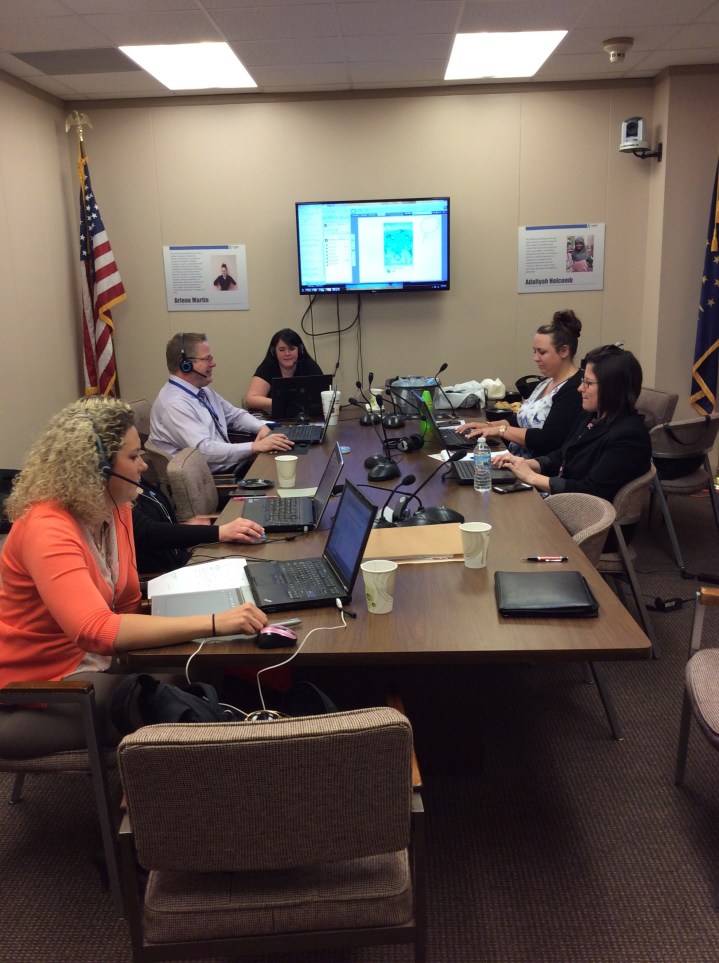
Hoosier Academies Teachers Teaching In Room 156A Of The State House
 Representative Dave Ober, from Albion, said it best this week in a tweet: “The education philosophy in Indiana is that money follows the child. We need to make that commitment clear.” I have blogged about leading with certainty and clarity before (click here to read), and I consider this leading with both certainty and clarity. I had the opportunity to visit with Representative Ober this week and he certainly understands what is at stake. He is displaying his commitment to ALL Indiana students. In my personal growth time this morning I was reading David McCullough’s Truman. McCullough stated that former President Harry S. Truman hated the words “progressive,” “liberal,” and “reform.” Truman wanted everything to be “Forward Moving.” To have our schools and education to be “forward moving” there needs to be 100% funding for all schools, regardless of type.
One of the issues about funding right now relates to virtual schools. Let’s dive into the virtual thing. Really, virtual education is very “forward moving,” as Truman would have said. I hope we can all agree that all students can learn and that all students learn differently. If that is the case, then why would we think that all students learn best in a building with walls and a roof? We need to think “outside the walls.” Having just spent time with my Smithsonian Institution friends in Washington D.C. this past week, I can tell you they embrace the fact that not all students will be visiting, or even have the means to be able to visit within the walls of their museums. In fact, the Smithsonian Institution wants you to take advantage of visiting virtually. Truly, the Smithsonian Institution is equal access to everyone. EVERYONE!
I’ll give you an example: The Wright Flyer, on display in the Smithsonian National Air and Space Museum, was scanned using a 3D laser, which produces a highly detailed and accurate image of the object. The 3D Wright Flyer exhibit is part of the Smithsonian Institution X 3D Collection, which provides a very detailed look at objects. The 3D Explorer allows visitors to rotate the objects on the screen and includes guided tours. The X 3D Collection provides access to many of the Smithsonian Institution’s 137 million objects of which only one percent is on display at any one time in the 19 museums, nine research centers, and the Smithsonian National Zoo. This is very “forward moving” and is in line with the Smithsonian Institution’s core mission – “The increase and diffusion of knowledge.” The Smithsonian Institution is certainly thinking “outside the walls” to provide extensive public outreach and educational programs.
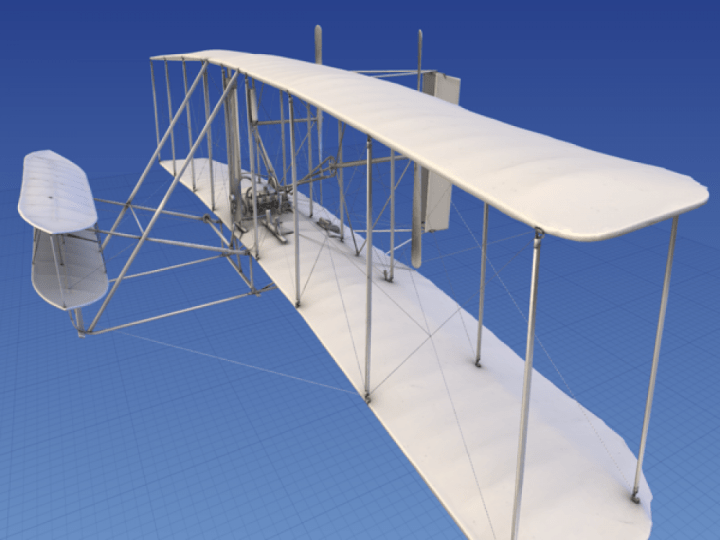
Image Of The Wright Flyer From The X 3D Collection
Just like the Smithsonian Institution, we in the virtual education world, are serving as pioneers and trailblazers in online and blended education. We continue to learn how best to navigate innovative ways to deliver content and facilitate engaging lessons for students. Our “forward moving” and “outside the walls” approach includes a data-driven academic plan, increased professional development for our teachers, individualized learning plans for all students, strengthened family and stakeholder engagement, and a targeted credit recovery program.
A key to the success of any organization is understanding what makes it distinct. At Hoosier Academies we are distinct because we are carrying out, as called for in the state constitution, education equally open to all and by all suitable means. We know in our case what makes us unique is the fact that students served by Hoosier Academies are able to be fully online (statewide in all 92 counties) or have the option to go to our hybrid schools (face to face two days a week and online the other three) in Indianapolis. What also makes us distinct is that we have a 67% mobility rate. We must embrace the fact that in many cases we are a short term solution to many of our students. This mobility may be because of health issues, bullying, differentiated learning needs, or students who have special circumstances such as being an Olympic gymnast. For many students we are the only available choice in a state that embraces school choice. I believe we are beginning to make progress because we have begun to answer the question of what what makes us different and really owning it. This realization has only come about because of really asking and listening to the students and parents of the students we serve about what they believe we should be trying to accomplish for them. We have a long way to go, but are making progress.
This discovery has come about from stories, for example, of the family whose daughter has been with us through 6th, 7th, and 8th grade, because of being bullied at her local school, but, is going to try going back to her local high school next year. Another family, who I visited with recently in Gary, has their children enrolled in Hoosier Academies because they are scared to have the students walk to school. We also have students with medical conditions that do not allow them to be enrolled in a traditional setting and who are flourishing in our modality. Another story comes from our starting a National Honor Society this year and how the parents of a student with Down’s Syndrome who was inducted stated that there was no way their daughter could have ever been as successful, academically or socially, in a traditional setting. These stories are anecdotal and qualitative proof that Hoosier Academies is an interim solution for many families. We are a place for students to go for whatever length of time the parent believes is necessary. Furthermore, more than one-half of parents of high school students and one-third of elementary students will choose this option to catch their child up academically.
The internet has changed the way people accomplish so many things, including the education of their children. Thanks to technological advances, students aren’t limited to learning in a traditional classroom environment. Many parents are choosing virtual schooling as a viable educational choice that provides a range of benefits. Virtual schooling provides the same opportunities for children and teens, allowing them to use technology to learn and grow in the familiarity and comfort of their home environments. Online school programs may also provide students with more of the personal attention they need. Teachers are often better able to focus on each student’s unique needs and provide a more customized approach to learning. In a perfect world, no child would ever face bullying or other social struggles in school. In reality, however, many children deal regularly with bullies and troubling social interactions that make learning nearly impossible. Many students we serve also face classroom-learning challenges because of their own behavioral or emotional needs. Online learning modalities allow students to learn in a safe and secure environment that is free from the social and behavioral concerns typical of traditional classrooms.
Again, if we truly believe all students learn differently we need to embrace the fact that students will need individualized learning environments as well. Let us be “forward moving” in our continued improvement of all learning environments for tomorrow!
 Byron's Babbles
leave a comment