Being Perfectly Imperfect
 I am always amazed at the twists and turns our 3D Leadership gathering discussions take. It is amazing because there is always so much learning that takes place. Last week’s gathering which was virtual with individuals from Florida, Georgia, Tennessee, South Carolina, and North Carolina was no exception. I already blogged about one twist in learning we took in Leading Like Yoda. We also spent a great deal of time discussing how leaders are built by learning from their imperfections.
“Leaders are built by learning from their imperfections.” ~ 3D Leadership Participants on April 2, 2020
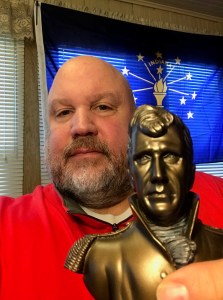
My Andrew Jackson Bronze
The question that prompted the discussion was about whether those leaders that most influenced us were perfect or did they have imperfections? The group immediately started responding with the fact that the leaders were imperfect and that recognizing those imperfections was the ultimate in transparency and authenticity. I even held up my bronze of Andrew Jackson and talked about all the great things he was and did as a leader, but there were so many things he did that were very wrong. He serves as a reminder of how we need to be humble and remember that all humans are imperfect and flawed creatures. I was moved that our discussion led us to talk about how it was those imperfections that attracted us to leaders. Particularly if those Rushmorean leaders were working hard to improve their imperfections.
“The long road to character begins with understanding that all humans are flawed creatures.” ~ David Brooks in The Road to Character
 Today we are even faced with the bigger issue that David Brooks argued in his great book The Road to Character: society has made a shift, from a focus on humility and reservedness to a focus on individual desire. I call this desire “ambition.” Many times ambition begins to rule our purpose. This becomes very dangerous and takes us from a moralistic world view to one of being self-centered. We must check our moral compass, according to Brooks, and strive to become/stay virtuous. The core of what makes a human “human” are displaying the traits of kindness, bravery, honesty, and devotion. Brooks argued that people, and I would argue our children/students, are beginning to obsess over themselves and live only for their own desires.
 One thing that we discussed in our 3D Leadership gathering that Brooks also discussed in The Road to Character was how many of us have shifted our lives to revolve around how we achieve, and no longer why. The effect is profound. Again, we can see well documented cases of this ambition taking over our purpose. I have blogged about a couple of such cases in When Purpose & Passion Turn Into Ambition and Passion At Ambition’s Command. But how do we change this? By embracing the flaws inherent in all of us. One of our participants called us “Perfectly Imperfect.” I loved that, and if we work off of that to learn from and correct or mistakes and failures every day, it would be a great start.
Doing things like being honest about our flaws can help us overcome self-centeredness and embrace deeper social values, like love and connection to others. As Yoda said, “Much to learn you still have.” If we are going to thrive and maybe be that next person on someone else’s personal Mount Rushmore then we must free ourselves from pride. We must embrace the assistance of others admit our own flaws. Through that we will become more authentic and transparent, thus being a better inspiration and role model for others; while being happier, more fulfilled, and worthy.
Leading Like Yoda
 Last night we created personal Mount Rushmores in our 3D Leadership gathering. I was surprised to have a new leader added to the list – Yoda. Of all the years I’ve been doing this, this is the first time a participant has put Yoda on their personal Mount Rushmore. Moreover, last night there were two people out of the group of 48 that picked Yoda to be on their personal Mount Rushmore.
So of course I had to dig into Yoda as a leader. In the Star Wars universe, Yoda might be the single most important hero. Yoda is wise and insightful and brings many leadership lessons to the forefront to help us all become better at serving those we lead. Of course, several Yoda quotes were thrown out in the course of the gathering, like:
- “Do or do not. There is no try.”
- “[Luke]: I can’t believe it. [Yoda]: That is why you fail.”
- “You must unlearn what you’ve learned.”
- “Much to learn you still have.”
- “Fear leads to anger. Anger leads to hate. Hate leads to suffering.”
One of the things I took away from some really great discussions was that we need to remember that thinking about the future is really important for finding direction, but don’t do it at the expense of what we are currently doing. We need to focus on the task at hand. Spend time in the moment. Be present. It will make us more efficient, and we’ll notice more.
Yoda often taught his pupils through action. We decided last night that leaders are built by learning from their imperfections. Yoda gives us an example of what one participant said she would like to be: “Fair, compassionate, and motivational.” Challenges will push and motivate us. In this time of uncertainty we must focus on continuing to learn so we can help the world triumph. As the group taught me last night, the only thing to do is the next right thing.
Play Time For Leaders


I so enjoyed my extra day that we all had today because of this being a Leap Year. I spent the day with aspiring teacher leaders at Knowledge Academies in Nashville, Tennessee facilitating a 3D Leadership gathering. Because I am always so inspired at each of these gatherings I tend to have something to blog about after most of them. Today was no exception, and because I so wanted to have a February 29th (Leap Year) entry – here it is. Today’s through line of the program titled The Focused Leader was “Your Leadership Toy Box.”
“To infinity and beyond!” —Buzz Lightyear
The first activity involved the participants picking a toy, playing with the toy, and then answering the following questions. If this toy was in your Leadership Toy Box:
- How does this toy represent great leadership traits?
- How could you use this toy to be a great leader?
We then shared these out after some quality play time. I was so blown away by the responses that I asked for volunteer guest posts to put into this blog post. Here are three of those responses:
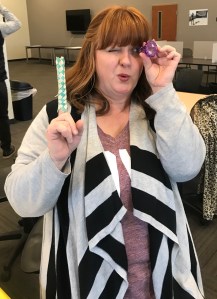
Lori Tharp
Toys and Leadership?
Today in the NEI 3D Leadership Cohort session, we were asked to select a toy and explain ways it could be a leadership tool. I selected two – a kaleidoscope and a Chinese finger trap. I was excited to answer this question since I have always been a kid at heart! After all, toys have always been a part of my life: My kids played with toys. I used to work in Children’s Ministry, then I worked as a preschool teacher. My husband sells vintage and current toys and one of my favorite movies is Toy Story! – so, this was “right up my alley!”
When I looked into the kaleidoscope at an object, I could see that the one image turned into many objects – showing a whole new perspective of the image with many facets. When I turned the kaleidoscope around and looked through it at the opposite end, I could only see one image. As I apply this to leadership I realized, as leaders, we should learn to see the things from a wider perspective – or different angles. We can all have the same goal or the same focus, but we need to be able to view ideas, opinions and suggestions from the perspectives of others, and ultimately, work together as a team…which leads me to the other toy I selected – the Chinese finger trap.
Looking at the Chinese finger trap – a simple little toy that traps the victim’s fingers in both ends of a small cylinder woven from bamboo. If you place your fingers in each end and pull outward, this only tightens the grip of the trap. Push your fingers together, it loosens up. The pieces of bamboo seem to be very fragile, and if it was only one piece, it would probably break. This little device is actually many pieces of bamboo woven together, which makes it very strong as one small unit. This reminds me of leadership. Working together as a team, makes us a stronger, tighter unit. We can accomplish more together than we can alone. Good leaders are aware of this, and they value the input of the other team members. Sometimes, though, we need to tighten up as a team, and sometimes we are so rigid we need to loosen up! Either way, leaders work as a team!
The possibilities are endless if I were to use these items in the classroom as a leadership tool. I could just imagine the kids in the class exploring these toys and finding fun and creative ways to use them. I could learn just as much from them!
“I realized, as leaders, we should learn to see the things from a wider perspective – or different angles.” ~ Lori Tharp
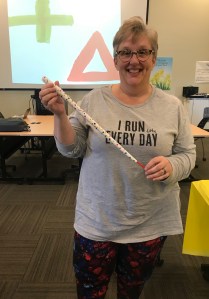
Jane Rogers
Chinese Yo Yo….. A leadership tool???
I was asked today to explain how a Chinese Yo-Yo as a leadership tool. At first, I thought “Why did I pick this toy?” Then after studying it, I thought as you throw the paper out it could be really fun to just bug people with it and see how long it would take to get them to ask me to stop. As I studied it I saw that there were different colored dots and different sizes. The larger one made me think that a leader needs to be “big” and strong and take charge. The medium dot represented that a leader needs to know when to step back and mix in and work collaboratively with everyone. The smaller dot reminded me that a leader must allow the team to be forefront and allow them to grow and shine. A good leader should know when to take charge and when to step back. As I played with the toy, throwing it out and in, it showed me that a leader needs to be flexible, adjustable, fun and maybe slightly annoying. I can see myself using it in my classroom, as a pointer to get my kids to stay engaged and would want me to call on them by slinging the toy towards them. So yes, a Chinese Yo-Yo can be leadership if you allow your self to look at it in a way you might never have thought of.
“A good leader should know when to take charge and when to step back.” ~ Jane Rogers
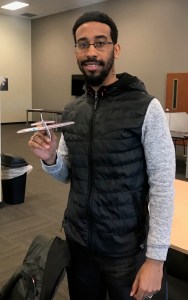
Quintarius Grigsby
Up Up & Away
Hello my name is Mr. Quintarius Grigsby. I am a Science Instructor at Knowledge Academies, basketball coach, and Christian minister. I teach Biology, Physical Science, Chemistry and I have a a background in Agricultural Sciences. At the 3D Leadership meeting the toy I chose was the World War ll Hell Cat Fighter Jet replica. Its symbolic warlike features resonated with me in such a way that I had to choose it as an identifiable leadership tool. Due to its frame and features it helps me to to remember how disciplined I am, and that I am free enough to believe that the sky is the limit. Bombs and missiles represent potential power that is destructive upon release. I believe just like the Hell Cat Fighter Jet, I have the power and influence to destroy the negatives which represent the enemy that limits us from being successful. The wings on the jet also represent freedom. This toy replica can be utilized to inspire others who desire to ascend beyond where they are now. (Leadership is a process, not a position.)
“Due to its frame and features it helps me to to remember how disciplined I am, and that I am free enough to believe that the sky is the limit.” ~ Mr. Quintarius Grigsby
We really can, as you just read, learn a lot from playing with toys. Toys can inspire new ways of thinking about leadership, teamwork and accomplishing our goals. Whether it’s motivation, wisdom or practical advice, there are some great lessons we can all take away.
❤️ Kids Having Ownership!
 This past week I had the honor of doing a day long professional development for teachers from all schools corporations in Elkhart County, Indiana. I am representing Noble Education Initiative carrying out this customized professional development. This was part of an ongoing Project Based Learning partnership created by Horizon Education Alliance to bring business/industry and education together to best educate students. I love doing professional development workshops, particularly when they are on topics that I am passionate about. Project Based Learning (PBL) is one of those topics. It is also energizing to be with a group of educators who are very engaged. Groups like this always remind me and validate what Gallup® finds teachers value in question 12 of the Gallup Q12 Index©: “In the last year, have you had opportunities to learn and grow?” These teachers have been given this opportunity and very much value the opportunity, and are taking advantage of the opportunity to learn and grow.
The group last week was both passionate and engaged. We started the day with what I called “Level Setting.” I had them work in pairs to talk about their PBL experience now that we were half way through the school year. I wanted them to talk about what they had learned, “wow” moments, what they still had questions about, and what they still needed help with. They were to represent this on a tear sheet and put it up on the wall. Here are a few of the tear sheets that were put up:


Did you see the comment “❤️Kids Having Ownership”? That’s what this is all about. The next few paragraphs will dig into that a little deeper.

Aubri Mosness with her students
We then had everyone individually do a gallery walk and pick one thing that stood out to them. This was an awesome discussion when the group came back together. There were questions like, “who wrote… I would like to know more,” or “I had that same experience because…,” or “I am so glad you wrote that because that same thing happened to us, and we are still trying to figure out…” You get the idea. One comment really stood out to me during this discussion; It was by Goshen High School Teacher, Aubri Mosness. She said, “I have felt the transition from me doing most of the work to the students doing most of the work. At first I was a little uncomfortable because I felt like I was doing much, but then I realized how much the students were getting out of it.” I was so excited by this. This is such a revelation in teaching. Great teaching should have the students doing most of the work. She was truly facilitating with a student managed classroom and the students have student agency and choice.
Then, at lunch Ms. Mosness’ students presented to the whole group and business/industry representatives that had joined us, on their project and I led a little Q&A. The students were incredible. During the presentation Ms. Mosness commented, “When I give my students too much, too much information, too much guidance, I am taking away opportunities for learning.” This was a drop the mic opportunity as far as I was concerned. The students all concurred. I then asked the students to give a thumbs up or thumbs down on the following question: “School work should look more like real work?” All six students gave me a thumbs up. Our students deserve to learn in an environment that is facilitated in a real world and relevant context.
 These students were giving first hand testimony affirming the research I did for my book, The Hand In The Back Of The Room: Connecting School Work To Real Life.” In the book I talk about that the hand in the back of the room was mine, and probably yours too, that was raised wanting to know why I needed to learn what I was being taught. In other words school work must be connected to real life. This is why PBL is so great. Using PBL teaching principles will make school work look and feel like real work. In other words, the question from “the hand in the back of the room is answered as to why she needs to learn what she is being taught. When teachers are allowed to make student learning the ultimate test of facilitation of learning, then instruction improves to produce better learning. The results of my research showed improved achievement/performance in science when students are taught in a relevant context. For me that context was agriculture, but there many other real world contexts to be used. This is why the partnerships with business/industry is so important for our students. The challenge to all of us in education is to find ways to make learning visible by connecting school work and real life for the students we serve.
Let’s Have Lunch Together!
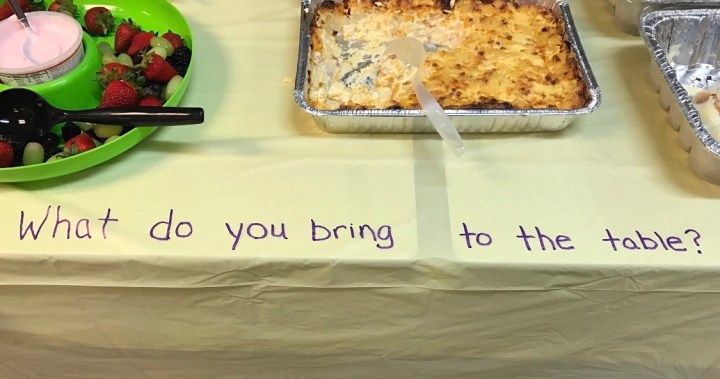 Last night we started our third cohort of 3D Leadership in Indiana. Hard to believe we have started our third year. Just seems like yesterday that I began putting the curriculum together for this program. Last night as we were discussing relationship building as a function of leadership, one of our participants, Sarah Medve, shared a story that really touched me and the rest of the group.
Sarah said she realized that she needed to do a better job of building relationships. Sarah also realized that she was missing out on building work friendships and collaboration because instead of taking time to eat lunch with coworkers she was making copies, grading papers, or any of the many other tasks of the day. This great teacher leader explained she has begun making sure all her tasks are done at other times so she can stop and eat lunch with others. Then Sarah told us she had fun eating lunch with others and did not want to miss it. Wow! This is a big deal!
We all do it, though. Work through lunch or sit alone and check emails. Sharing meals together, however, builds relationships. Eating together provides time to get to know each other and encourage cooperation through informal communication. Eating lunch together also increases productivity because it widens our perspectives. Eating together is a powerful act.
Researchers at Cornell University argued that eating lunch together has a much more positive effect on organizational community than the artificial activities that many organizations use like rope courses and things we call team building activities. These things are sometimes offsite and require a lot of energy. The Cornell study showed that employees (in the case of this study – firefighters) make fun of and do not see any value in them (Kniffin, et al., 2015).
This insightful story from our teacher leader reminded us all of the benefits of commensality. Coworkers that eat lunch together feel more like family and build friendships. So, we need to learn from our teacher leader, Sarah Medve, and make time to eat together with fellow teachers and staff. Why? Because, as Sarah so insightfully told us, it is fun and she feels closer to her coworkers. The rest of us leaders need to think more about providing opportunities for employees to eat together and do away with the manufactured and trite team-building exercises.
 You might be interested to know that after our gathering we all went to Jockamo’s and had dinner together. It was so much fun and we learned a lot about each other. It was nice to put into practice what we were learning in 3D Leadership. I know I left feeling much closer to the group.
REFERENCE
, J. (2015). Eating Together at the Firehouse: How Workplace Commensality Relates to the Performance of Firefighters, Human Performance, 28:4, 281-306,DOI: 10.1080/08959285.2015.1021049
Infectious Leadership


In the past week I have been with four groups of school and teacher leaders from three different states doing leadership development facilitation as part of our 3D Leadership Program. As part of this months focus we did a good leader/bad leader activity where each group developed a top 5 good leader trait and top 5 bad leader trait list. Two things that did not hit the lists were charisma and celebrity. It is clear that all want present and technically competent leaders who have a growth mindset and are contagious. This then trickles down to the team.
So what does having a growth mindset mean? To me it means having a transformative and innovative approach with the team. It means letting the team be curious and creative; finding ways to get better. Great leaders let go of certainty and open the door to other points of view. Great leaders also trust their team members and give them more latitude. These same leaders provide appreciation for all new ideas and achievements of employees. They are comfortable trying new things knowing that all will not work. It’s about being curious themselves.
To set the stage and paint the picture for modeling this growth mindset the leader needs to talk in ideals; ideal work, ideal team, ideal outcome. The question I always like to answer as an innovative and curious leader with a growth mindset is: “what does success look like?” One thing is clear from listening to all these leaders: we need to be present, communicate (including effective listening), and have a mindset for growth. Are you infectious?
Preaching From The Office
 Last night we had a great 3D Leadership gatherings in Indianapolis. One of the cool things we did was have a good leader/bad leader discussion. With this we discussed good leadership traits and bad leadership traits. Then by writing good leader traits on the right wing of gliders and bad leader traits on the left wing and throwing them to each other, we developed a top 5 good leader traits and top 5 bad leader traits.
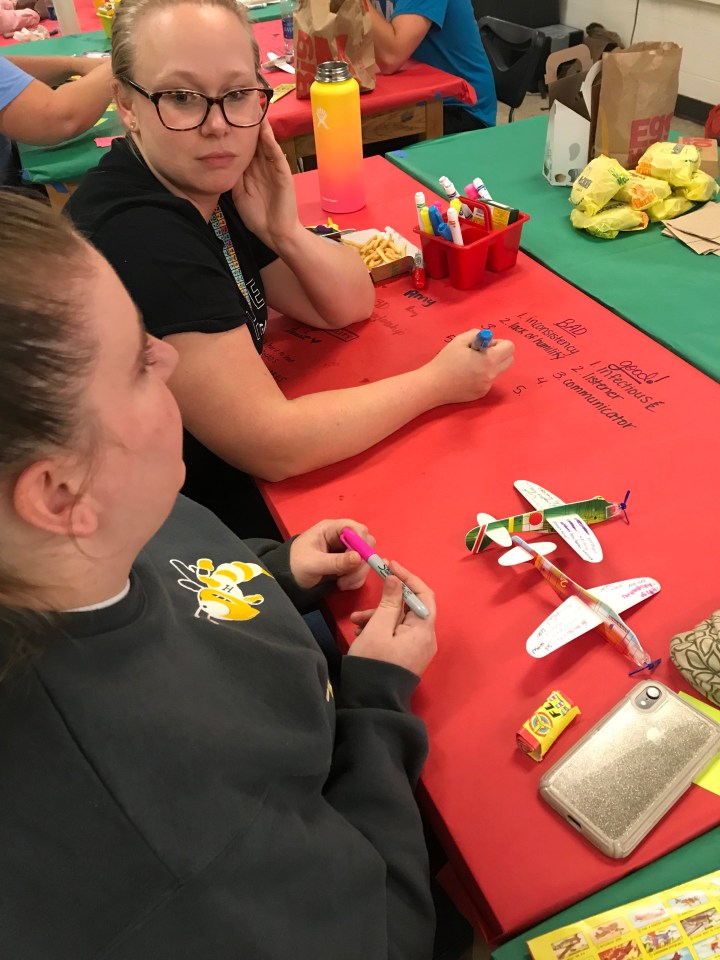 One of the top 5 bad leader traits was “Preaching From The Office”. Bottom-line: the pull to stay in the office can be great. It takes a love of the people and the work to throw oneself into the work, for leaders to leave their offices. The best leaders, according to the teacher leaders I was working with last night, get out of their offices. Here’s why:
- When we get out of our offices we give encouragement to those we serve.
- When we get out of our offices we discover the amazing people in our organizations. This enables us to get to know those we serve.
- When we get out of our offices we collaborate. This allows us to see the organization from all vantage points. Thus we would avoid making decisions in isolation.
- When we get out of our offices we see where the vision has leaked, excellence has slipped, and communication has faltered.
- When we get out of our offices we are able to tweak and make changes with knowledge, clarity, and credibility.
As you can see this bad leader trait has serious implications. The good news is, it is easily fixed. Get out of your office. You will gain insight and those you serve will love having you in the trenches.
Known Knowns, Known Unknowns, & Unknown Unknowns
 Today during the last day of our Teacher Academy I realized that our first year teachers and those teachers who were with us for the first time still had a few gaps of things they needed and wanted to know for the first day of school. It is very tough to give beginning teachers everything they need to know, and many times in doing so it is like making them drink from the proverbial water hose. So, I pulled an audible and planned a “lunch and learn” and framed it as giving them a chance to learn about what they knew they didn’t know. It was awesome and a huge success. We had pizza and salad and had four of our great teacher leaders and school leaders sit and have a conversation just answering their questions (they did a great job, by the way). This group of new teachers had great questions and were much more at ease going into the weekend before the start of school. They were so appreciative of having the opportunity to have a discussion in a non-threatening environment and be able to ask anything. I was quickly reminded of how many times we awesome people know things that in reality they would have no way of knowing.
Many times we don’t know what we don’t know; we know more than we quite know we know; or know what we don’t know. Sometimes we need to pose the question: “What don’t you know and how will you learn it?” What I learned today was that we need to take time to listen to those we serve and find out what they know they don’t know. This seems like such a novel idea, but I’m not sure we do a very good job of this at times.
“As we know, there are known knowns. There are things we know we know. We also know there are known unknowns. That is to say we know there are some things we do not know. But there are also unknown unknowns, the ones we don’t know we don’t know.” ~ Donald Rumsfeld – February 12, 2002, Department Of Defense news briefing
Maybe another great question we should ask as leaders is, “What do you feel unknowledgeable about?” You can’t know what you don’t know. You can’t know about things you have yet to discover. You can’t know what the future holds, though you might conjecture on it. But, many times we do know what we don’t know. This is simple ignorance: just not knowing and knowing you don’t know.
Contrast simple ignorance with compound ignorance: thinking you know but knowing so little you can’t recognize your own ignorance. Today really made me think about the fact that we need to embrace simple ignorance and allow those we serve to express what they know they don’t know. Simple ignorance is the most honest and least harmful. It can be beneficial in avoiding stupid mistakes as well as prompting one to learn more.
Are you encouraging others to explore the things they know they don’t know? Are you helping them learn the things they know they don’t know?
Teacher Leader Shape-Shifter


This morning I did a session for our Teacher Academy where I had the teachers pick a toy from a bag of lots of different cool toys. I gave them two minutes to play with the toy and then they had to report out how the toy related to their classroom, serving students, and them personally. This is a great reflective activity that really makes participants think. Then, of course, these reflections really get me thinking and I end up writing blog posts like this one.
One of the teachers chose a Slinky® and while reporting out she described herself as a shape-shifter. She stated that she needed to adjust and adapt according to student needs. This was genius. I have always tried to inspire team members to be continually comfortable shape-shifters. I am such a big fan of fluid change; whether that is organizationally, personally, or in the classroom. We need to be comfortable with the one thing that is constant – change.
Here’s the deal: as leaders, teacher leaders, and organizations, we must be comfortable with an ever-changing skin; no matter what we call it. Whether we call it change, changeover, conversion, metamorphosis, mutation, shift, transfiguration, transformation, translation, transmutation, transubstantiation we must have the resilience that shape-shifting brings to be successful. I would suggest that leaders and teachers must become adept at negotiating multiple, sometimes divergent, identities. We must be adaptive because everything we do during the day as teachers is situational – it shifts from context to context.
In other words we all need to use our portfolio of attributes, skills, and experiences to arrange, re-arrange, and adapt to meet the needs of our current situation. The concept of shape-shifting implies a sense of individuality and free agency in making choices, removed from constraints. By creating her own meanings for curriculum and leading of learning, the teacher who inspired this post, will be able to apply it within the context she is teaching. We then need to be able to demonstrate the resourcefulness and ability to change as contexts change.
Shape-shifters can be seen as innovators, rebels, or even a compromiser, but I see this as an important adaptive leadership trait. I do believe that shape-shifting also allows us to push away from the status-quo way of doing things and adapt to changing needs.
Joyful
 Joyful: The Surprising Power of Ordinary Things to Create Extraordinary Happiness by Ingrid Fetell Lee
My rating: 5 of 5 stars
In this book you will learn how to find joy and bring joyfulness into the lives of others. We learn to not feel bound by convention; break the mold & bring joy to the world through quirkiness. Even a touch of quirkiness can help everyone relax, be less anxious, and feel joyful. We also learn in this great book that playful design increases joy. The second benefit to playful design: it makes designers more innovative. This book will certainly help you to be more joyful.
~ Dr. Byron Ernest
 Byron's Babbles
1 comment